REVIEW 4 major objections 5 minor 46 references
Thoughts without Thinking: Reconsidering the Explanatory Value of Chain-of-Thought Reasoning in LLMs through Agentic Pipelines
T0 review · 4 major / 5 minor · reviewed 2026-08-16 · deepseek-v4-flash
Pith's one-line read Fails: Chain-of-thought reasoning can't explain or improve LLM outputs
desk verdict A well-intentioned workshop paper whose evidence is too confounded to support its claim that CoT doesn't help in agentic pipelines—but the qualitative examples and the system itself are worth a look. read the letter →
The pith
A machine-rendered reading of the paper's core claim, the machinery that carries it, and where it could break.
The reading
What carries the argument
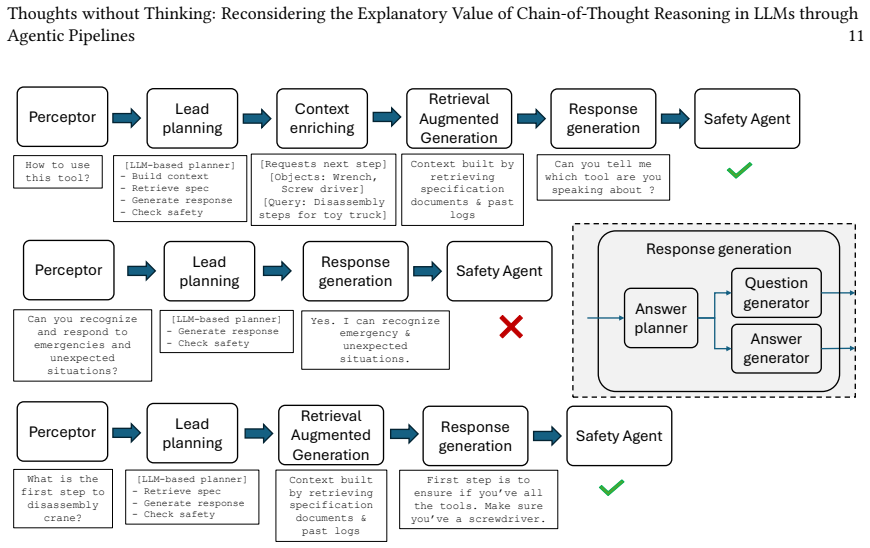
The central object is the agentic pipeline, a fixed-and-dynamic flow of LLM-based agents (perceptors, planners such as lead/query/answer planners, and actors including the RAG module, question answerer, reformulator, and safety agent) with the same LLM deployed in each agent. Within this pipeline, chain-of-thought is treated as the vehicle of explainability under test: the DeepSeek-distilled reasoning models produce a CoT scratchpad before each response, while the Llama and Qwen models do not. The comparison between these two groups, together with human and LLM-as-a-judge scoring of answers and thoughts, is what carries the argument; the qualitative content analysis of CoT tuples supplies the mechanism by which CoT misleads.
What would settle it
Run a within-model ablation on the same agentic pipeline: take one model family (e.g., Qwen) and compare its responses with chain-of-thought prompting enabled versus disabled on the same benchmark questions. If the CoT-enabled version achieves equal or higher human and judge scores, the paper's claim that CoT alone does not improve outputs would be contradicted.
Extended reading notes
Core claim
The paper's central claim is that in an agentic pipeline, chain-of-thought reasoning text does not deliver the two things it is often credited with: better answer quality and explainability. Quantitatively, the DeepSeek-distilled reasoning models, which generate CoT, scored significantly lower than their non-reasoning counterparts on both task-specific and organizational/social questions, as rated by human reviewers and an LLM judge (Wilcoxon rank-sum tests). The reviewer scores of the CoT thoughts were only weakly correlated with the reviewer scores of the answers, suggesting the thoughts do not steer the model to correct responses. Qualitatively, the CoT text exhibited reasoning that fixated on familiar machine-related vocabulary rather than the task context (Einstellung paradigm), made hasty generalizations from incomplete context, and produced excessive text that raised the burden on any user seeking an explanation. The authors argue that such CoT output amounts to explanations without explainability: it does not improve end users' ability to understand the system or achieve their goals.
Load-bearing premise
The paper assumes that the performance gap between the DeepSeek distilled models and the Llama/Qwen models is caused by chain-of-thought, even though the models differ in family, size, and training method and no model was tested both with and without CoT.
Editorial extensions
If this is right
- Showing users the raw chain-of-thought text of an agentic system will not, by itself, produce actionable transparency; systems need explanations designed for the user's task.
- Agentic pipelines that rely on CoT for explainability should be re-examined; the paper's results suggest the traceability of agent calls does not guarantee trustworthy explanations.
- Benchmarking reasoning models on real participatory task questions can yield different conclusions than standard reasoning benchmarks, so deployment-oriented evaluation should include human-centered scoring.
- If CoT text can actively mislead, safety and accountability mechanisms should not treat CoT as a faithful record of why an answer was produced.
- LLM-as-a-judge scores, though weakly correlated with human scores in this study, may still serve as a scalable reference-free indicator for triaging response quality.
Reading between the lines
- A natural extension beyond this paper is a within-model ablation that toggles chain-of-thought on and off for the same model, which would separate the effect of CoT from differences in model family and distillation.
- The 'explanations without explainability' framing likely extends beyond agentic pipelines: any system that emits fluent rationalizations ungrounded in retrieved evidence may mislead users just as much as it informs them.
- A testable follow-up would measure end users' actual task performance (time to completion, error rate) with and without CoT text displayed, rather than relying only on expert and judge ratings of answer quality.
- The weak correlation between thought scores and answer scores could be exploited as an early-warning signal for unreliable answers, though the paper does not draw this conclusion.
Signed reviews
Editorial analysis
A structured set of objections, weighed in public.
Referee Report
Summary. This paper reports early findings from an agentic task-guidance pipeline evaluated offline on a participatory dataset of task-based and organizational/social questions. Six LLMs (Llama-3-8B, Qwen-7B/14B, and their DeepSeek-R1-distilled counterparts) are deployed as the LLM in each agent of the pipeline. Answers are scored by human reviewers and GPT-4o as a judge on a -1/0/0.5/1 scale. The paper's headline claims are that chain-of-thought reasoning alone does not lead to better outputs and does not offer explainability. The reported results show higher judged scores for the non-reasoning models, weak correlation between thought scores and answer scores for reasoning models, and a qualitative analysis of three prompt-CoT-output tuples suggesting that CoT can be unhelpful or misleading. The authors acknowledge the preliminary nature of the work and defer ablations to future work.
Significance. If the causal claim were established, the paper would be a useful cautionary contribution to HCXAI, challenging the assumption that surfacing chain-of-thought text in agentic systems provides transparency. The participatory dataset built with manufacturing technicians is a genuine strength, as is the use of both human and LLM-based judges and the authors' explicit acknowledgment of limitations. However, as it stands the central causal claim is not identified by the experimental design, and the explainability claim lacks user evidence. The paper is therefore better read as a preliminary observational study than as a demonstration that CoT has no explanatory value.
major comments (4)
- [§5-6, Fig. 2] The comparison of 'non-reasoning' Llama/Qwen models against DeepSeek-R1-distilled models is confounded by model family, size, distillation procedure, and decoding behavior; there is no within-model ablation that toggles chain-of-thought on and off, and no condition suppresses the reasoning tokens in the DeepSeek models. The paper's own Limitations section states that ablations of each agent are left to future work. Therefore the abstract's claim that 'CoT reasoning alone does not lead to better outputs' is not identified by the reported experiment. What is supported is the weaker claim that the DeepSeek-distilled model family received lower judged answer scores in this agentic pipeline.
- [Abstract and §7 Discussion] The claim that CoT 'does not improve the ability of end users to better understand systems or achieve their goals' is an empirical claim about users, but no user study is reported. The conclusion rests on the authors' qualitative reading of three tuples (Table 1) and on the weak correlation between thought and answer scores, neither of which measures user comprehension or task success. A user study with a condition that shows or hides CoT text is needed to support the explainability half of the headline claim.
- [Table 1, tuple C] The chain-of-thought text shown for the input 'Can you communicate with humans in multiple languages?' is identical to the chain-of-thought shown for tuple B ('How do you ensure data privacy and security?'), yet §7's qualitative analysis of tuple C relies on details (e.g., 'Since the context only lists English') that are not present in the displayed CoT. This suggests either a copy-paste error in the table or an unacknowledged model perseveration; either way, the qualitative evidence for the tuple C discussion as presented is not trustworthy and must be corrected or re-analyzed.
- [§6 Results] The paper reports weak human-LLM judge agreement (Cohen's kappa = 0.48 for org-soc, 0.28 for task) but Figure 2 plots LLM-as-judge scores alongside human scores and uses them in significance tests. Given the weak agreement, the paper should state whether the main effect (reasoning vs. non-reasoning) holds when using only human scores, and should caution against pooling or relying on LLM judge scores for the central comparison.
minor comments (5)
- [§7 Discussion] There is a typo in the word 'susceptiblity' that should be corrected to 'susceptibility'.
- [§3 Data] The data counts given as 'N=750/300 (Task), 300 (Org-Soc), 150 (Thoughts)' are unclear; please clarify the exact number of question-answer tuples and thought annotations per condition.
- [Fig. 2 caption] The caption refers to the 'middle column in the heatmap Figure 2', but the figure appears to be a bar chart; please clarify what the heatmap is and how it relates to the reported bar values.
- [§5 Experiments] The sentence 'the experts assign scores to every answers generated by the agentic flow using 6 different LLMs' is ambiguous; the six LLMs are the systems being evaluated, while scoring is performed by human reviewers and GPT-4o. Please reword to avoid confusion.
- [Table 1] The acronym 'MARIE' appears in the example tuples without prior definition; please define the system name when it is first introduced.
Circularity Check
No circularity: the study is an empirical comparison with external judges; the between-model confound is a validity threat, not a circular reduction.
full rationale
The paper does not derive its conclusions from definitions or fitted parameters. The central quantitative claim is that DeepSeek-distilled reasoning models receive lower reviewer scores than non-reasoning models; this is an empirical observation scored by human reviewers and an LLM judge, not a quantity constructed from the claim itself. The weaknesses in the paper are experimental confounds: the reasoning and non-reasoning models differ by family, size, and distillation procedure, with no within-model CoT toggle, so the comparison may not isolate CoT. Similarly, the explainability claim is supported by qualitative analysis of example tuples rather than by direct end-user measurement. These are threats to internal and construct validity, not circularity. No equation in the paper reduces to its inputs, no fitted parameter is renamed as a prediction, and no load-bearing premise is justified solely by a self-citation. The only self-citations (QA-TOOLBOX and the HCXAI position paper) supply dataset provenance and framing, not the paper's conclusion. Accordingly, the circularity score is 0.
Assumptions & free parameters
assumptions (4)
- domain assumption The toy assembly/disassembly task is a valid proxy for factory technician task execution.
- domain assumption The human and LLM-as-a-judge scoring protocol yields valid measures of accuracy, comprehensiveness, and helpfulness.
- domain assumption Performance differences between reasoning and non-reasoning model families are attributable to chain-of-thought generation rather than other model differences.
- domain assumption Qualitative analysis of three selected CoT tuples is sufficient to support claims about explainability for end users.
Cite this review
Pith. "Pith review of Thoughts without Thinking: Reconsidering the Explanatory Value of Chain-of-Thought Reasoning in LLMs through Agentic Pipelines." pith.science (2026). https://pith.science/paper/J5YHNJ2N
@misc{pith2026250500875,
  author       = {Pith},
  title        = {Pith review of: Thoughts without Thinking: Reconsidering the Explanatory Value of Chain-of-Thought Reasoning in LLMs through Agentic Pipelines},
  year         = {2026},
  howpublished = {\url{https://pith.science/paper/J5YHNJ2N}},
  note         = {Machine review of arXiv:2505.00875}
}
read the original abstract
Agentic pipelines present novel challenges and opportunities for human-centered explainability. The HCXAI community is still grappling with how best to make the inner workings of LLMs transparent in actionable ways. Agentic pipelines consist of multiple LLMs working in cooperation with minimal human control. In this research paper, we present early findings from an agentic pipeline implementation of a perceptive task guidance system. Through quantitative and qualitative analysis, we analyze how Chain-of-Thought (CoT) reasoning, a common vehicle for explainability in LLMs, operates within agentic pipelines. We demonstrate that CoT reasoning alone does not lead to better outputs, nor does it offer explainability, as it tends to produce explanations without explainability, in that they do not improve the ability of end users to better understand systems or achieve their goals.
Figures


Figures from the paper (1 more)
Reference graph
Works this paper leans on
-
[1]
Alireza Amiri, Xinting Huang, Mark Rofin, and Michael Hahn. 2025. Lower Bounds for Chain-of-Thought Reasoning in Hard-Attention Transformers. arXiv preprint arXiv:2502.02393 (2025)
arXiv 2025
-
[2]
Anthropic. 2023. Long Context Prompting for Claude 2.1. https://www.anthropic.com/news/claude-2-1-prompting Accessed: 2025-02-26
work page 2023
-
[3]
Alejandro Barredo Arrieta, Natalia Díaz-Rodríguez, Javier Del Ser, Adrien Bennetot, Siham Tabik, Alberto Barbado, Salvador García, Sergio Gil-López, Daniel Molina, Richard Benjamins, Raja Chatila, and Francisco Herrera. 2019. Explainable Artificial Intelligence (XAI): Concepts, Taxonomies, Opportunities and Challenges toward Responsible AI. doi:10.48550/a...
-
[4]
Jinze Bai, Shuai Bai, Yunfei Chu, Zeyu Cui, Kai Dang, Xiaodong Deng, Yang Fan, Wenbin Ge, Yu Han, Fei Huang, Binyuan Hui, Luo Ji, Mei Li, Junyang Lin, Runji Lin, Dayiheng Liu, Gao Liu, Chengqiang Lu, Keming Lu, Jianxin Ma, Rui Men, Xingzhang Ren, Xuancheng Ren, Chuanqi Tan, Sinan Tan, Jianhong Tu, Peng Wang, Shijie Wang, Wei Wang, Shengguang Wu, Benfeng X...
arXiv 2023
-
[5]
Agathe Balayn, Lorenzo Corti, Fanny Rancourt, Fabio Casati, and Ujwal Gadiraju. 2024. Understanding Stakeholders’ Perceptions and Needs Across the LLM Supply Chain. arXiv:2405.16311 [cs.HC] https://arxiv.org/abs/2405.16311
arXiv 2024
-
[6]
Alan Chan, Rebecca Salganik, Alva Markelius, Chris Pang, Nitarshan Rajkumar, Dmitrii Krasheninnikov, Lauro Langosco, Zhonghao He, Yawen Duan, Micah Carroll, et al. 2023. Harms from increasingly agentic algorithmic systems. In Proceedings of the 2023 ACM Conference on Fairness, Accountability, and Transparency. 651–666
work page 2023
-
[7]
DeepSeek-AI, Daya Guo, Dejian Yang, Haowei Zhang, Junxiao Song, Ruoyu Zhang, Runxin Xu, Qihao Zhu, Shirong Ma, Peiyi Wang, Xiao Bi, Xiaokang Zhang, Xingkai Yu, Yu Wu, Z. F. Wu, Zhibin Gou, Zhihong Shao, Zhuoshu Li, Ziyi Gao, Aixin Liu, Bing Xue, Bingxuan Wang, Bochao Wu, Bei Feng, Chengda Lu, Chenggang Zhao, Chengqi Deng, Chenyu Zhang, Chong Ruan, Damai D...
arXiv 2025
-
[8]
Abhimanyu Dubey, Abhinav Jauhri, Abhinav Pandey, Abhishek Kadian, Ahmad Al-Dahle, Aiesha Letman, Akhil Mathur, Alan Schelten, Amy Yang, Angela Fan, et al. 2024. The llama 3 herd of models. arXiv preprint arXiv:2407.21783 (2024)
arXiv 2024
Show all 46 references
-
[9]
Upol Ehsan, Pradyumna Tambwekar, Larry Chan, Brent Harrison, and Mark O Riedl. 2019. Automated rationale generation: a technique for explainable AI and its effects on human perceptions. In Proceedings of the 24th international conference on intelligent user interfaces . 263–274
2019
-
[10]
Vera Liao, Elizabeth Anne Watkins, Carina Manger, Hal Daumé III, Andreas Riener, and Mark O Riedl
Upol Ehsan, Philipp Wintersberger, Q. Vera Liao, Elizabeth Anne Watkins, Carina Manger, Hal Daumé III, Andreas Riener, and Mark O Riedl
-
[11]
Andrea Ferrario, Alberto Termine, and Alessandro Facchini. 2024. Addressing Social Misattributions of Large Language Models: An HCXAI-based Approach. arXiv:2403.17873 [cs.AI] https://arxiv.org/abs/2403.17873
2024 arXiv
-
[12]
Jiawei Gu, Xuhui Jiang, Zhichao Shi, Hexiang Tan, Xuehao Zhai, Chengjin Xu, Wei Li, Yinghan Shen, Shengjie Ma, Honghao Liu, et al. 2024. A Survey on LLM-as-a-Judge. arXiv preprint arXiv:2411.15594 (2024)
2024 arXiv
- [13]
-
[14]
Alexey Ignatiev, Nina Narodytska, and Joao Marques-Silva. 2019. Abduction-Based Explanations for Machine Learning Models. Proceedings of the AAAI Conference on Artificial Intelligence 33, 01 (July 2019), 1511–1519. doi:10.1609/aaai.v33i01.33011511
2019 doi
-
[15]
Help Me Help the AI
Sunnie SY Kim, Elizabeth Anne Watkins, Olga Russakovsky, Ruth Fong, and Andrés Monroy-Hernández. 2023. " Help Me Help the AI": Understanding How Explainability Can Support Human-AI Interaction. In Proceedings of the 2023 CHI Conference on Human Factors in Computing Systems . 1–17
2023
-
[16]
Siegfried Kracauer. 2025. The Challenge of Qualitative Content Analysis. (2025)
2025
-
[17]
Yuri Kuratov, Aydar Bulatov, Petr Anokhin, Ivan Rodkin, Dmitry Igorevich Sorokin, Artyom Sorokin, and Mikhail Burtsev. [n. d.]. Babilong: Testing the limits of llms with long context reasoning-in-a-haystack. In The Thirty-eight Conference on Neural Information Processing Syste...
-
[18]
Jiachun Li, Pengfei Cao, Yubo Chen, Kang Liu, and Jun Zhao. 2024. Towards faithful chain-of-thought: Large language models are bridging reasoners. arXiv preprint arXiv:2405.18915 (2024)
2024 arXiv
-
[19]
Ramesh Manuvinakurike, Elizabeth Watkins, Celal Savur, Anthony Rhodes, Sovan Biswas, Gesem Gudino Mejia, Richard Beckwith, Saurav Sahay, Giuseppe Raffa, and Lama Nachman. 2024. QA-TOOLBOX: Conversational Question-Answering for process task guidance in manufacturing. arXiv prep...
2024 arXiv
-
[20]
Margaret Mitchell, Avijit Ghosh, Alexandra Sasha Luccioni, and Giada Pistilli. 2025. Fully Autonomous AI Agents Should Not be Developed. arXiv preprint arXiv:2502.02649 (2025)
2025
-
[21]
Raymond J. Mooney. 2000. Integrating Abduction and Induction in Machine Learning. In Abduction and Induction, Dov M. Gabbay, John Barwise, Peter A. Flach, and Antonis C. Kakas (Eds.). Vol. 18. Springer Netherlands, Dordrecht, 181–191. doi:10.1007/978-94-017-0606-3_12 Series Ti...
2000 doi
-
[22]
Franco Moretti. 2000. Conjectures on World Literature. New Left Review 2, 1 (2000), 54–68
2000
-
[23]
Saeid Alavi Naeini, Raeid Saqur, Mozhgan Saeidi, John Giorgi, and Babak Taati. 2023. Large language models are fixated by red herrings: exploring creative problem solving and einstellung effect using the only connect wall dataset. , Article 246 (2023), 22 pages. doi:10.5555/36...
2023
-
[24]
Farhad Nooralahzadeh, Yi Zhang, Jonathan Furst, and Kurt Stockinger. 2024. Explainable Multi-Modal Data Exploration in Natural Language via LLM Agent. doi:10.48550/arXiv.2412.18428 arXiv:2412.18428 [cs]
2024 doi
- [25]
-
[26]
OpenAI. 2022. Introducing ChatGPT. https://openai.com/index/chatgpt/
2022
-
[27]
OpenAI. 2024. GPT-4o Model. https://openai.com. Accessed: 2025-02-26
2024
- [28]
-
[29]
Advait Sarkar. 2024. Large Language Models Cannot Explain Themselves. arXiv:2405.04382 [cs.HC] https://arxiv.org/abs/2405.04382 8 Manuvinakurike et al
2024 arXiv
-
[30]
Fadime Sener, Dibyadip Chatterjee, Daniel Shelepov, Kun He, Dipika Singhania, Robert Wang, and Angela Yao. 2022. Assembly101: A large-scale multi-view video dataset for understanding procedural activities. In Proceedings of the IEEE/CVF Conference on Computer Vision and Patter...
2022
-
[31]
Close Reading
Barbara Herrnstein Smith. 2016. What Was “Close Reading”? the minnesota review 2016, 87 (Nov. 2016), 57–75. doi:10.1215/00265667-3630844
2016 doi
-
[32]
Weld, and Leah Findlater
Alison Smith-Renner, Ron Fan, Melissa Birchfield, Tongshuang Wu, Jordan Boyd-Graber, Daniel S. Weld, and Leah Findlater. 2020. No Explainability without Accountability: An Empirical Study of Explanations and Feedback in Interactive ML. In Proceedings of the 2020 CHI Conference...
2020
-
[33]
Le, Ed H
Mirac Suzgun, Nathan Scales, Nathanael Schärli, Sebastian Gehrmann, Yi Tay, Hyung Won Chung, Aakanksha Chowdhery, Quoc V. Le, Ed H. Chi, Denny Zhou, and Jason Wei. 2022. Challenging BIG-Bench Tasks and Whether Chain-of-Thought Can Solve Them. doi:10.48550/arXiv.2210.09261 arXi...
-
[34]
Sijun Tan, Siyuan Zhuang, Kyle Montgomery, William Y Tang, Alejandro Cuadron, Chenguang Wang, Raluca Ada Popa, and Ion Stoica. 2024. Judgebench: A benchmark for evaluating llm-based judges. arXiv preprint arXiv:2410.12784 (2024)
2024 arXiv
-
[35]
Sree Harsha Tanneru, Dan Ley, Chirag Agarwal, and Himabindu Lakkaraju. 2024. On the difficulty of faithful chain-of-thought reasoning in large language models. In Trustworthy Multi-modal Foundation Models and AI Agents (TiFA)
2024
-
[36]
Miles Turpin, Julian Michael, Ethan Perez, and Samuel R Bowman. 2023. Language Models Don’t Always Say What They Think: Unfaithful Explanations in Chain-of-Thought Prompting. (2023)
2023
-
[37]
Douglas Walton. 1999. Rethinking the Fallacy of Hasty Generalization. Argumentation 13, May (1999), 161–182. doi:10.1023/A:1026497207240
1999 doi
-
[38]
Lei Wang, Chen Ma, Xueyang Feng, Zeyu Zhang, Hao Yang, Jingsen Zhang, Zhiyuan Chen, Jiakai Tang, Xu Chen, Yankai Lin, Wayne Xin Zhao, Zhewei Wei, and Jirong Wen. 2024. A survey on large language model based autonomous agents. Frontiers of Computer Science 18, 6 (Dec. 2024), 18...
2024 doi
- [39]
-
[40]
Xuansheng Wu, Haiyan Zhao, Yaochen Zhu, Yucheng Shi, Fan Yang, Tianming Liu, Xiaoming Zhai, Wenlin Yao, Jundong Li, Mengnan Du, et al
-
[41]
Eric Zelikman, Yuhuai Wu, Jesse Mu, and Noah D Goodman. [n. d.]. STaR: Self-Taught Reasoner. ([n. d.])
-
[42]
Lianmin Zheng, Wei-Lin Chiang, Ying Sheng, Siyuan Zhuang, Zhanghao Wu, Yonghao Zhuang, Zi Lin, Zhuohan Li, Dacheng Li, Eric Xing, et al
-
[43]
Alexandra Zytek, Sara Pidò, and Kalyan Veeramachaneni. 2024. LLMs for XAI: Future Directions for Explaining Explanations. arXiv:2405.06064 [cs.AI] https://arxiv.org/abs/2405.06064 A Agentic implementation details Received 28 February 2025 Thoughts without Thinking: Reconsideri...
2024 arXiv
-
[2022]
In CHI Conference on Human Factors in Computing Systems Extended Abstracts
Human-Centered Explainable AI (HCXAI): Beyond Opening the Black-Box of AI. In CHI Conference on Human Factors in Computing Systems Extended Abstracts. ACM, New Orleans LA USA, 1–7. doi:10.1145/3491101.3503727
-
[2023]
Advances in Neural Information Processing Systems 36 (2023), 46595–46623
Judging llm-as-a-judge with mt-bench and chatbot arena. Advances in Neural Information Processing Systems 36 (2023), 46595–46623
2023
-
[2024]
arXiv preprint arXiv:2403.08946 (2024)
Usable XAI: 10 strategies towards exploiting explainability in the LLM era. arXiv preprint arXiv:2403.08946 (2024)
2024 arXiv
Reviewed August 16, 2026 · model on record in the stance chip above.
Discussion (0). Continue with ORCID to comment.