REVIEW 4 major objections 5 minor 107 references
HD 35843: A Sun-like star hosting a long period sub-Neptune and inner super-Earth
T0 review · 4 major / 5 minor · reviewed 2026-08-16 · deepseek-v4-flash
Pith's one-line read HD 35843 hosts two planets: a transiting 46.96-day sub-Neptune and a non-transiting 9.90-day super-Earth.
desk verdict HD 35843 c is a solid, well-characterized long-period sub-Neptune; HD 35843 b is plausible but the paper's exclusion of PFS RVs leaves the inner planet less certain than advertised. read the letter →
The pith
A machine-rendered reading of the paper's core claim, the machinery that carries it, and where it could break.
The reading
What carries the argument
The central object is a two-planet Keplerian model constrained by the transits of planet c and the Doppler wobble of both planets. The load-bearing technique is a joint nested-sampling fit of the TESS light curve with the ESPRESSO radial velocities, supported by a Lomb-Scargle periodogram and a stacked periodogram that show the 9.9-day signal grows stronger as more data are added and does not correlate with stellar activity indicators. False-positive scenarios for the transiting planet are excluded with ground-based photometry, high-resolution imaging, and a statistical validator that returns a false-positive probability of about $0.05\%$.
What would settle it
A decisive test is to add more ESPRESSO radial velocities over a longer baseline and include the independent radial-velocity data in a single joint fit: if the 9.9-day signal does not stay phase-coherent with one well-determined period near 9.90 days, or if its amplitude tracks the bisector or line-width activity indicators, then planet b is not established.
Extended reading notes
Core claim
The paper reports the discovery and confirmation of two planets around HD 35843 (TOI 4189), a metal-poor G dwarf. The outer planet, HD 35843 c, transits with period $P=46.9622$ d, radius $R=2.54\,R_\oplus$, mass $M=11.32\,M_\oplus$, and eccentricity $e=0.153$; the inner planet, HD 35843 b, is detected only in radial velocities with period $P=9.8991$ d and minimum mass $M\sin i=5.84\,M_\oplus$. The outer planet's bulk density of $3.80$ g/cm$^3$ places it in the degenerate region between a rocky planet with a substantial hydrogen envelope and a water world, and its equilibrium temperature of about $480$ K makes it one of the coolest sub-Neptunes found by TESS.
Load-bearing premise
The load-bearing premise is that the 9.9-day radial-velocity wobble assigned to HD 35843 b comes from an orbiting planet rather than from stellar activity or an alias of the observing window; the paper's own analysis leaves a residual ~27-day peak with false-alarm probability 0.02, and adding independent radial-velocity data makes the period of planet b bimodal, so this is the premise that would collapse the two-planet claim.
Editorial extensions
If this is right
- HD 35843 c joins the small set of long-period ($P>40$ d) transiting sub-Neptunes with a well-measured mass orbiting a bright host star, making it a high-value target for atmospheric characterization.
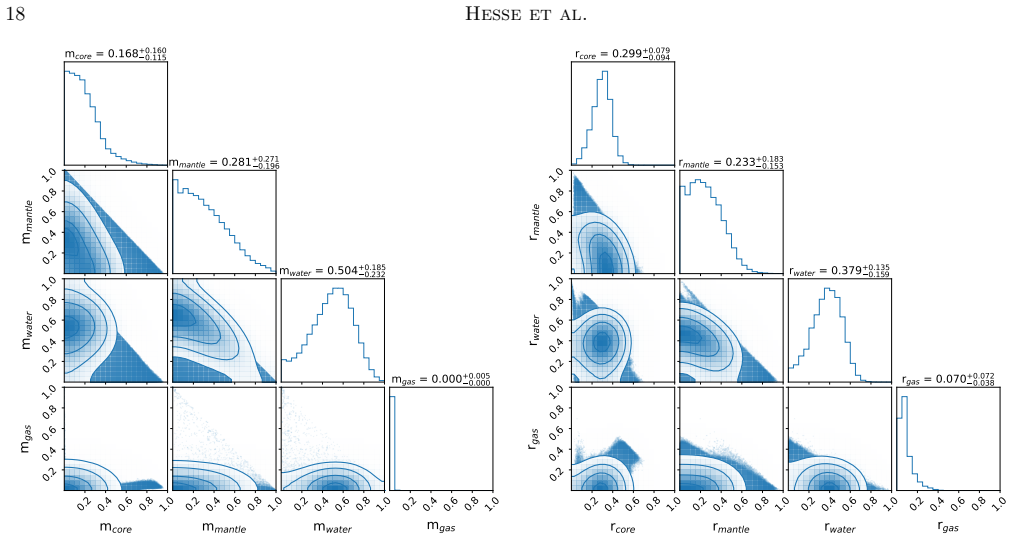
- The measured density of $3.80$ g/cm$^3$ means the planet's composition is ambiguous between a rocky world with a hydrogen envelope and a water world; only atmospheric spectra can break that degeneracy.
- If planet b truly does not transit, HD 35843 becomes one of only six known systems with a non-transiting inner planet and a transiting outer sub-Neptune, an architecture that may preserve a record of past dynamical instability.
- Upcoming TESS re-observations in Sectors 87 and 95 can test whether b transits and can check the apparent transit-timing variations of c.
Reading between the lines
- The bimodal period for planet b that appears when the independent radial-velocity data are included is a warning sign; if future data do not sharpen the 9.9-day period into a single coherent solution, the inner planet could turn out to be activity or an alias, leaving HD 35843 as a one-planet system.
- If the apparent transit-timing variations in the ground-based partial transits are real, they imply a third body in the system; full transits from Sectors 87 and 95 could confirm this and constrain the perturber's mass.
- A rocky, non-transiting b with $M\sin i\approx5.8\,M_\oplus$ would put the system on both sides of the radius valley, offering a single-star test bed for how super-Earths and sub-Neptunes form in the same disk.
- The host's low metallicity suggests that temperate sub-Neptunes can form around metal-poor stars; a targeted search for such planets around other metal-poor FGK stars would test how common this population is.
Signed reviews
Editorial analysis
A structured set of objections, weighed in public.
Referee Report
Summary. The paper reports the discovery and characterization of two planets around the metal-poor Sun-like star HD 35843 (TOI 4189). The outer planet, HD 35843 c, is a transiting sub-Neptune with P = 46.9622 d, R = 2.54 R⊕, M = 11.32 M⊕, and e = 0.15, validated through TESS photometry, ground-based follow-up, speckle imaging, and ESPRESSO radial velocities, with a triceratops false-positive probability of 0.05%. The inner planet, HD 35843 b, is inferred from ESPRESSO RVs with P = 9.90 d and a minimum mass of 5.84 M⊕, and is not observed to transit. The authors combine TESS and ESPRESSO data in a joint allesfitter fit, explore model scenarios with BIC/AIC, check activity indicators, and discuss composition and atmospheric prospects.
Significance. If both planets are real, the system is valuable: HD 35843 c is a bright (V = 9.4), temperate sub-Neptune with a precise mass and radius, adding to the sparse population of long-period transiting sub-Neptunes with well-measured masses. The validation of planet c is thorough and community-oriented, and the TSM and equilibrium temperature make it a plausible JWST target. Planet b, if confirmed, would make the system one of only a few with a non-transiting inner planet interior to a transiting sub-Neptune, with implications for system architecture and formation. The analysis is generally careful, with explicit activity checks, injection-recovery tests, and an appendix with the alternative fit including PFS. The main weakness is the security of planet b, whose detection rests on a single instrument and the post-hoc exclusion of an independent dataset.
major comments (4)
- [Section 3.4, Appendix D] The exclusion of the PFS radial velocities from the final joint fit is a load-bearing step for the 9.9-day planet b claim. The text states that PFS data are excluded because they 'result in a bimodal posterior for the period of planet b'; Appendix D shows that the joint fit with PFS still yields a bimodal Pb posterior (printed median 9.935 d over a 9.75-10.05 d prior, with two modes). Since PFS is an independent 18-epoch dataset with ~1 m/s precision, the bimodality indicates that the 9.9-day period is not uniquely determined when a second, independent dataset is included. Please provide a periodogram and a joint model of the ESPRESSO and PFS RVs (with and without an activity component), and discuss whether the 9.9-day signal is an alias or is genuinely present in both datasets. The current treatment amounts to removing the dataset that challenges the claimed period, and that is not sufficient support for the discovery claim.
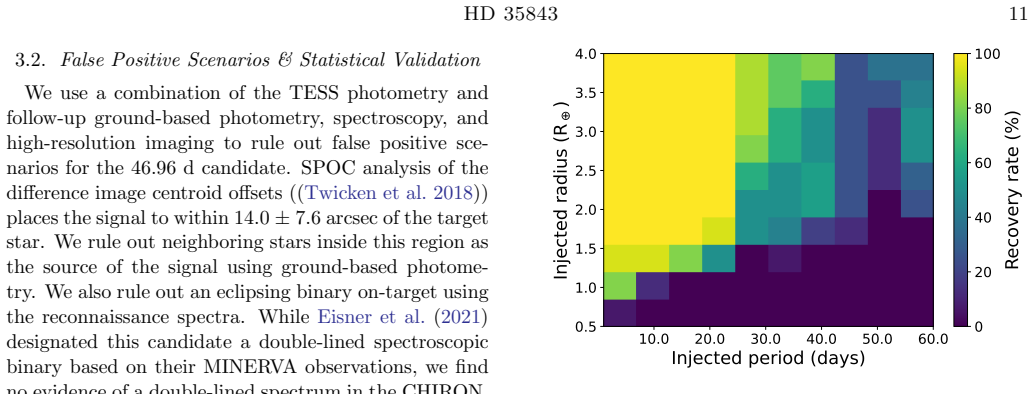
- [Section 3.1.1, Section 3.3.1, Section 3.4] A ~25-27 d stellar activity signal is detected in the bisector span (25.49 d, FAP 1e-8) and remains in the RV residuals at 26.95 d with FAP 0.02 after subtracting both planets, yet the RV fits model only white noise (jitter) plus the two Keplerian signals. The 9.9-day signal has K = 1.81 ± 0.25 m/s, only a few times the expected activity-induced RV amplitude for a slowly rotating G star. To secure the planetary interpretation of the 9.9-day signal, the authors should perform a joint fit that includes a quasi-periodic Gaussian-process activity model (or at least a sinusoid at the adopted rotation period) and show that the 9.9-day Keplerian remains stable in period, amplitude, and significance. The checks against activity indicators are useful but do not rule out a non-sinusoidal or harmonic activity signal that could project onto the 9.9-day period.
- [Section 3.3.1, Table 2] The model comparison in Table 2 prefers the two-planet flat model over the two-planet linear-trend model by ΔBIC = 2.55 but by only ΔAIC = 0.94, which is marginal evidence against a linear trend; the text states the preference is 'nearly indistinguishable' between the flat and linear two-planet models. This is not itself a problem, but the derived parameter tables and discussion should note that the trend is not strongly constrained and that omitting a trend could slightly bias Kb or Kc. A sentence in Section 3.3.1 or Section 3.4 would suffice.
- [Section 4] The discussion states a minimum mass for HD 35843 b of 5.47 ± 0.82 M⊕, which is inconsistent with the abstract, Table 4, and Section 5 (5.84 ± 0.84 M⊕). Because this is the only reported parameter for planet b that appears in multiple places, the inconsistency should be corrected before publication.
minor comments (5)
- [Figure 3 caption] The caption says 'Ground-based photometry of HD 35843 b', but the transits shown belong to HD 35843 c; the figure and text refer to the 46.96-day transiting planet. Please correct the caption.
- [Abstract] The phrase 'among the coolest ~5% of planets discovered by TESS' lacks a quantitative definition or citation; please specify the comparison sample (e.g., TESS confirmed planets with measured radii) and provide the percentile calculation.
- [Section 3.4, Table 3] The inner planet's eccentricity is fixed to zero in the global fit (√eb cosωb = √eb sinωb = 0), but a test with a free eccentricity for planet b is not reported. Given the low Kb, an eccentric solution could affect the period and mass; please report such a test or justify why circularity is a safe assumption.
- [Section 3.2] The triceratops FPP is quoted as 0.05 ± 0.01 %, but the sentence immediately before states an NFPP of (2.7 ± 0.7) × 10−8 and then says 'We calculate an FPP of 0.05 ± 0.01 %'. It would be clearer to define FPP and NFPP in the text, since the former is the more standard validation metric.
- [Table A1] The PFS RVs are listed as relative velocities with an arbitrary zero point; because the final fit excludes them, the table would benefit from a note stating the zero-point convention and whether the absolute velocities were adjusted to a common barycentric frame.
Circularity Check
No significant circularity; planet parameters are measured from independent TESS photometry and ESPRESSO RVs, and self-citations are contextual corrections, not load-bearing.
full rationale
This is an observational discovery paper, and its central claims are fits to independent data rather than conclusions forced by the model inputs. HD 35843 c is validated with triceratops (FPP 0.05±0.01%) using TESS, ground-based photometry, speckle imaging, and reconnaissance spectra; its orbital period and radius come from TESS transits, while its mass comes from ESPRESSO RVs fitted jointly with the transits. HD 35843 b is detected as a ~9.9 d GLS peak in the ESPRESSO RVs after subtracting the 46.96 d signal; the two-planet model is preferred over one-planet models by ΔBIC≈30, activity-indicator periodograms show no 9.9 d peak, and residual RVs are not correlated with activity indices. These are standard, falsifiable data-analysis steps. The only self-citations are to Eisner et al. (2021), the Planet Hunters identification and the earlier SB2 misclassification; the paper expressly corrects the SB2 claim with CHIRON, NRES, CORALIE, PFS, and ESPRESSO spectra, so that citation is contextual rather than load-bearing. Disclosed limitations — exclusion of PFS RVs because they produce a bimodal Pb posterior (Section 3.4, Appendix D), a residual 26.95 d activity peak with FAP 0.02 (Section 3.1.1), and possibly unreal TTVs (Section 3.5) — are correctness/robustness concerns, not circularity. The ExoMDN composition inference is explicitly acknowledged to be degenerate and to require atmospheric observations. No equation or derived quantity is equivalent to an input by construction.
Assumptions & free parameters
free parameters (9)
- Orbital period of planet b (Pb) =
9.8991 +0.0557/-0.0574 d
- Orbital period of planet c (Pc) =
46.9622 ± 0.0002 d
- RV semi-amplitude of planet b (Kb) =
1.81 ± 0.25 m/s
- RV semi-amplitude of planet c (Kc) =
2.13 ± 0.24 m/s
- Eccentricity of planet c (ec) =
0.153 +0.070/-0.064
- Radius ratio Rc/R* =
0.02603 ± 0.00061
- cos i_c =
0.0074 +0.0016/-0.0030
- RV jitter of ESPRESSO datasets =
ln σ = -6.60 +0.10/-0.09 (km/s)
- TESS white noise scaling (ln σ_TESS) =
-7.535 ± 0.015
assumptions (5)
- standard math Keplerian orbital motion: the RV signal of each planet is described by a Keplerian orbit, and the two planets do not interact significantly.
- domain assumption The 9.9-day RV signal is generated by a planet, not by stellar activity or an instrumental window-function alias.
- ad hoc to paper Planet b is non-transiting and its orbit is circular.
- domain assumption The star is a single, slowly rotating G dwarf with the spectroscopically measured parameters (T_eff=5666 K, [Fe/H]=-0.27).
- ad hoc to paper PFS radial velocities are excluded from the final joint fit.
Cite this review
Pith. "Pith review of HD 35843: A Sun-like star hosting a long period sub-Neptune and inner super-Earth." pith.science (2026). https://pith.science/paper/2WVRGP7G
@misc{pith2026250500898,
  author       = {Pith},
  title        = {Pith review of: HD 35843: A Sun-like star hosting a long period sub-Neptune and inner super-Earth},
  year         = {2026},
  howpublished = {\url{https://pith.science/paper/2WVRGP7G}},
  note         = {Machine review of arXiv:2505.00898}
}
abstract
We report the discovery and confirmation of two planets orbiting the metal-poor Sun-like star, HD 35843 (TOI 4189). HD 35843 c is a temperate sub-Neptune transiting planet with an orbital period of 46.96 days that was first identified by Planet Hunters TESS. We combine data from TESS and follow-up observations to rule out false-positive scenarios and validate the planet. We then use ESPRESSO radial velocities to confirm the planetary nature and characterize the planet's mass and orbit. Further analysis of these RVs reveals the presence of an additional planet, HD 35843 b, with a period of 9.90 days and a minimum mass of $5.84\pm0.84$ $M_{\oplus}$. For HD 35843 c, a joint photometric and spectroscopic analysis yields a radius of $2.54 \pm 0.08 R_{\oplus}$, a mass of $11.32 \pm 1.60 M_{\oplus}$, and an orbital eccentricity of $e = 0.15\pm0.07$. With a bulk density of $3.80 \pm 0.70$ g/cm$^3$, the planet might be rocky with a substantial H$_2$ atmosphere or it might be a ``water world". With an equilibrium temperature of $\sim$480 K, HD 35843 c is among the coolest $\sim 5\%$ of planets discovered by TESS. Combined with the host star's relative brightness (V= 9.4), HD 35843 c is a promising target for atmospheric characterization that will probe this sparse population of temperate sub-Neptunes.
Figures


Figures from the paper (14 more)





Reference graph
Works this paper leans on
-
[1]
Addison , B., Wright , D. J., Wittenmyer , R. A., et al. 2019, , 131, 115003, 10.1088/1538-3873/ab03aa
-
[2]
Albrecht, S. H., Marcussen, M. L., Winn, J. N., Dawson, R. I., & Knudstrup, E. 2021, The Astrophysical Journal Letters, 916, L1, 10.3847/2041-8213/ac0f03
-
[3]
Aller , A., Lillo-Box , J., Jones , D., Miranda , L. F., & Barcel \'o Forteza , S. 2020, , 635, A128, 10.1051/0004-6361/201937118
-
[4]
Astropy Collaboration , Robitaille , T. P., Tollerud , E. J., et al. 2013, , 558, A33, 10.1051/0004-6361/201322068
-
[5]
Astropy Collaboration , Price-Whelan , A. M., Sip o cz , B. M., et al. 2018, , 156, 123, 10.3847/1538-3881/aabc4f
-
[6]
Astropy Collaboration , Price-Whelan , A. M., Lim , P. L., et al. 2022, , 935, 167, 10.3847/1538-4357/ac7c74
-
[7]
1996, , 119, 373
Baranne , A., Queloz , D., Mayor , M., et al. 1996, , 119, 373
1996
-
[8]
I., Gibson , S., Nield , K., & Cochrane , D
Barnes , S. I., Gibson , S., Nield , K., & Cochrane , D. 2012, in Society of Photo-Optical Instrumentation Engineers (SPIE) Conference Series, Vol. 8446, , 844688, 10.1117/12.926527
Show all 107 references
-
[9]
2023, Astronomy & Astrophysics, 676, A106, 10.1051/0004-6361/202346216
Baumeister, P., & Tosi, N. 2023, Astronomy & Astrophysics, 676, A106, 10.1051/0004-6361/202346216
2023 doi
-
[10]
2024, JWST Reveals CH _4 , CO _2 , and H _2 O in a Metal-rich Miscible Atmosphere on a Two-Earth-Radius Exoplanet
Benneke, B., Roy, P.-A., Coulombe, L.-P., et al. 2024, JWST Reveals CH _4 , CO _2 , and H _2 O in a Metal-rich Miscible Atmosphere on a Two-Earth-Radius Exoplanet. 2403.03325
2024 arXiv
-
[11]
K., Irwin , J., Charbonneau , D., Burke , C
Berta , Z. K., Irwin , J., Charbonneau , D., Burke , C. J., & Falco , E. E. 2012, , 144, 145, 10.1088/0004-6256/144/5/145
2012 doi
-
[12]
J., Koch , D., Basri , G., et al
Borucki , W. J., Koch , D., Basri , G., et al. 2010, Science, 327, 977, 10.1126/science.1185402
2010 doi
-
[13]
Bou \'e , G., & Fabrycky , D. C. 2014, , 789, 111, 10.1088/0004-637X/789/2/111
2014 doi
-
[14]
2021, , 654, A152, 10.1051/0004-6361/202141527
Bourrier , V., Lovis , C., Cretignier , M., et al. 2021, , 654, A152, 10.1051/0004-6361/202141527
2021 doi
-
[15]
Brande, J., Crossfield, I. J. M., Kreidberg, L., et al. 2024, The Astrophysical Journal Letters, 961, L23, 10.3847/2041-8213/ad1b5c
2024 doi
-
[16]
M., Baliber , N., Bianco , F
Brown , T. M., Baliber , N., Bianco , F. B., et al. 2013, , 125, 1031, 10.1086/673168
2013 doi
-
[17]
M., Bayliss , D., McCormac , J., et al
Bryant , E. M., Bayliss , D., McCormac , J., et al. 2020, , 494, 5872, 10.1093/mnras/staa1075
2020 doi
- [18]
- [19]
-
[20]
L., Vanderburg , A., Burt , J., et al
Christiansen , J. L., Vanderburg , A., Burt , J., et al. 2017, , 154, 122, 10.3847/1538-3881/aa832d
2017 doi
-
[21]
R., Beichman , C
Ciardi , D. R., Beichman , C. A., Horch , E. P., & Howell , S. B. 2015, , 805, 16, 10.1088/0004-637X/805/1/16
2015 doi
-
[22]
2017, , 600, A30, 10.1051/0004-6361/201629705
Claret , A. 2017, , 600, A30, 10.1051/0004-6361/201629705
2017 doi
-
[23]
2019, in American Astronomical Society Meeting Abstracts, Vol
Collins , K. 2019, in American Astronomical Society Meeting Abstracts, Vol. 233, American Astronomical Society Meeting Abstracts \#233, 140.05
2019
-
[24]
A., Kielkopf , J
Collins , K. A., Kielkopf , J. F., Stassun , K. G., & Hessman , F. V. 2017, , 153, 77, 10.3847/1538-3881/153/2/77
2017 doi
-
[25]
D., Shectman , S
Crane , J. D., Shectman , S. A., & Butler , R. P. 2006, in Society of Photo-Optical Instrumentation Engineers (SPIE) Conference Series, Vol. 6269, Society of Photo-Optical Instrumentation Engineers (SPIE) Conference Series, ed. I. S. McLean & M. Iye , 626931, 10.1117/12.672339
2006 doi
-
[26]
D., Shectman , S
Crane , J. D., Shectman , S. A., Butler , R. P., et al. 2010, in Society of Photo-Optical Instrumentation Engineers (SPIE) Conference Series, Vol. 7735, Ground-based and Airborne Instrumentation for Astronomy III, ed. I. S. McLean , S. K. Ramsay , & H. Takami , 773553, 10.1117...
2010 doi
-
[27]
D., Shectman , S
Crane , J. D., Shectman , S. A., Butler , R. P., Thompson , I. B., & Burley , G. S. 2008, in Society of Photo-Optical Instrumentation Engineers (SPIE) Conference Series, Vol. 7014, Ground-based and Airborne Instrumentation for Astronomy II, ed. I. S. McLean & M. M. Casali , 70...
2008 doi
-
[28]
M., Skrutskie , M
Cutri , R. M., Skrutskie , M. F., van Dyk , S., et al. 2003, VizieR Online Data Catalog, II/246
2003
-
[29]
2019, , 631, A28, 10.1051/0004-6361/201935944
Dalal , S., H \'e brard , G., Lecavelier des \'E tangs , A., et al. 2019, , 631, A28, 10.1051/0004-6361/201935944
2019 doi
-
[30]
D \'e vora-Pajares , M., & Pozuelos , F. J. 2022, in Zenodo Software package, Vol. 65, 65770831, 10.5281/zenodo.6570831
2022 doi
-
[31]
D., Rees , D
Donati , J.-F., Semel , M., Carter , B. D., Rees , D. E., & Collier Cameron , A. 1997, , 291, 658, 10.1093/mnras/291.4.658
1997 doi
-
[32]
2020, The Journal of Open Source Software, 5, 2101, 10.21105/joss.02101
Eisner , N., Lintott , C., & Aigrain , S. 2020, The Journal of Open Source Software, 5, 2101, 10.21105/joss.02101
2020 doi
-
[33]
L., Barrag \'a n , O., Lintott , C., et al
Eisner , N. L., Barrag \'a n , O., Lintott , C., et al. 2021, , 501, 4669, 10.1093/mnras/staa3739
2021 doi
-
[34]
J., Petigura , E
Fulton , B. J., Petigura , E. A., Blunt , S., & Sinukoff , E. 2018, , 130, 044504, 10.1088/1538-3873/aaaaa8
2018 doi
-
[35]
Gaia Collaboration , Brown , A. G. A., Vallenari , A., et al. 2018, , 616, A1, 10.1051/0004-6361/201833051
2018 doi
-
[36]
Gaia Collaboration , Vallenari , A., Brown , A. G. A., et al. 2023, , 674, A1, 10.1051/0004-6361/202243940
2023 doi
-
[37]
P., Gandolfi, D., et al
Garai, Z., Osborn, H. P., Gandolfi, D., et al. 2023, Astronomy & Astrophysics, 674, A44, 10.1051/0004-6361/202345943
2023 doi
-
[38]
Giacalone , S., & Dressing , C. D. 2020, triceratops: Candidate exoplanet rating tool , Astrophysics Source Code Library, record ascl:2002.004. 2002.004
2020
-
[39]
N., & Daylan , T
G \"u nther , M. N., & Daylan , T. 2021, , 254, 13, 10.3847/1538-4365/abe70e
2021 doi
-
[40]
A., Templeton , M., Terrell , D., et al
Henden , A. A., Templeton , M., Terrell , D., et al. 2016, VizieR Online Data Catalog, II/336
2016
-
[41]
2019, , 623, A39, 10.1051/0004-6361/201834672
Hippke , M., & Heller , R. 2019, , 623, A39, 10.1051/0004-6361/201834672
2019 doi
-
[42]
B., Everett , M
Howell , S. B., Everett , M. E., Sherry , W., Horch , E., & Ciardi , D. R. 2011, , 142, 19, 10.1088/0004-6256/142/1/19
2011 doi
-
[43]
B., & Furlan , E
Howell , S. B., & Furlan , E. 2022, Frontiers in Astronomy and Space Sciences, 9, 871163, 10.3389/fspas.2022.871163
2022
-
[44]
B., Scott , N
Howell , S. B., Scott , N. J., Matson , R. A., et al. 2021, Frontiers in Astronomy and Space Sciences, 8, 10, 10.3389/fspas.2021.635864
2021
-
[45]
2007, , 375, 1449, 10.1111/j.1365-2966.2006.11408.x
Irwin , J., Irwin , M., Aigrain , S., et al. 2007, , 375, 1449, 10.1111/j.1365-2966.2006.11408.x
2007
- [46]
-
[47]
N., et al
Izidoro , A., Ogihara , M., Raymond , S. N., et al. 2017, , 470, 1750, 10.1093/mnras/stx1232
2017 doi
-
[48]
M., Twicken , J
Jenkins , J. M., Twicken , J. D., McCauliff , S., et al. 2016, in Society of Photo-Optical Instrumentation Engineers (SPIE) Conference Series, Vol. 9913, Software and Cyberinfrastructure for Astronomy IV, ed. G. Chiozzi & J. C. Guzman , 99133E, 10.1117/12.2233418
2016 doi
-
[49]
2013, Tapir: A web interface for transit/eclipse observability , Astrophysics Source Code Library
Jensen , E. 2013, Tapir: A web interface for transit/eclipse observability , Astrophysics Source Code Library. 1306.007
2013
-
[50]
Kempton , E. M. R., Bean , J. L., Louie , D. R., et al. 2018, , 130, 114401, 10.1088/1538-3873/aadf6f
2018 doi
-
[51]
R., & Vanderspek, R
Kunimoto, M., Winn, J., Ricker, G. R., & Vanderspek, R. K. 2022, The Astronomical Journal, 163, 290, 10.3847/1538-3881/ac68e3
2022 doi
-
[52]
Kurucz , R. L. 1993, SYNTHE spectrum synthesis programs and line data
1993
-
[53]
V., Matson , R
Lester , K. V., Matson , R. A., Howell , S. B., et al. 2021, , 162, 75, 10.3847/1538-3881/ac0d06
2021 doi
-
[54]
D., et al
Li , J., Tenenbaum , P., Twicken , J. D., et al. 2019, , 131, 024506, 10.1088/1538-3873/aaf44d
2019 doi
-
[55]
2022, Science, 377, 1211, 10.1126/science.abl7164
Luque, R., & Pall \' e , E. 2022, Science, 377, 1211, 10.1126/science.abl7164
2022 doi
-
[56]
2023, Carbon-bearing Molecules in a Possible Hycean Atmosphere
Madhusudhan, N., Sarkar, S., Constantinou, S., et al. 2023, Carbon-bearing Molecules in a Possible Hycean Atmosphere. 2309.05566
2023 arXiv
-
[57]
E., & Hillenbrand , L
Mamajek , E. E., & Hillenbrand , L. A. 2008, , 687, 1264, 10.1086/591785
2008 doi
- [58]
-
[59]
2021 a , STScI/MAST, 10.17909/t9-nmc8-f686
MAST Team . 2021 a , STScI/MAST, 10.17909/t9-nmc8-f686
2021 doi
- [60]
-
[61]
A., Howell , S
Matson , R. A., Howell , S. B., Horch , E. P., & Everett , M. E. 2018, , 156, 31, 10.3847/1538-3881/aac778
2018 doi
-
[62]
Maxted , P. F. L., Anderson , D. R., Collier Cameron , A., et al. 2011, , 123, 547, 10.1086/660007
2011 doi
-
[63]
M., et al
McCully , C., Daily , M., Brandt , G. M., et al. 2022, in Society of Photo-Optical Instrumentation Engineers (SPIE) Conference Series, Vol. 12189, Software and Cyberinfrastructure for Astronomy VII, 1218914, 10.1117/12.2630667
2022 doi
-
[64]
H., Harbeck , D.-R., et al
McCully , C., Volgenau , N. H., Harbeck , D.-R., et al. 2018, in Society of Photo-Optical Instrumentation Engineers (SPIE) Conference Series, Vol. 10707, , 107070K, 10.1117/12.2314340
2018 doi
-
[65]
L., Twicken , J
Morris , R. L., Twicken , J. D., Smith , J. C., et al. 2020, Kepler Data Processing Handbook: Photometric Analysis , Kepler Science Document KSCI-19081-003, id. 6. Edited by Jon M. Jenkins
2020
-
[66]
2017, Astronomy & Astrophysics, 601, A110, 10.1051/0004-6361/201630201
Mortier, A., & Collier Cameron, A. 2017, Astronomy & Astrophysics, 601, A110, 10.1051/0004-6361/201630201
2017 doi
-
[67]
P., Correia , C
Mortier , A., Faria , J. P., Correia , C. M., Santerne , A., & Santos , N. C. 2015, , 573, A101, 10.1051/0004-6361/201424908
2015 doi
-
[68]
2023, Exoplanet Follow-up Observing Program Web Service, IPAC, 10.26134/ExoFOP5
NExScI. 2023, Exoplanet Follow-up Observing Program Web Service, IPAC, 10.26134/ExoFOP5
2023 doi
-
[69]
J., Cale, B., et al
Osborn, A., Armstrong, D. J., Cale, B., et al. 2021, Monthly Notices of the Royal Astronomical Society, 507, 2782–2803, 10.1093/mnras/stab2313
2021 doi
-
[70]
A., Henry , T
Paredes , L. A., Henry , T. J., Quinn , S. N., et al. 2021, , 162, 176, 10.3847/1538-3881/ac082a
2021 doi
-
[71]
2002, , 388, 632, 10.1051/0004-6361:20020433
Pepe , F., Mayor , M., Galland , F., et al. 2002, , 388, 632, 10.1051/0004-6361:20020433
2002 doi
-
[72]
2021, , 645, A96, 10.1051/0004-6361/202038306
Pepe , F., Cristiani , S., Rebolo , R., et al. 2021, , 645, A96, 10.1051/0004-6361/202038306
2021 doi
-
[73]
L., Skillen , I., Collier Cameron , A., et al
Pollacco , D. L., Skillen , I., Collier Cameron , A., et al. 2006, , 118, 1407, 10.1086/508556
2006 doi
-
[74]
, Henry, G
Queloz, D. , Henry, G. W. , Sivan, J. P. , et al. 2001, Astronomy & Astrophysics, 379, 279, 10.1051/0004-6361:20011308
2001 doi
-
[75]
G., Schlichting, H
Rogers, J. G., Schlichting, H. E., & Owen, J. E. 2023, The Astrophysical Journal Letters, 947, L19, 10.3847/2041-8213/acc86f
2023 doi
-
[76]
Rogers, L. A. 2015, The Astrophysical Journal, 801, 41, 10.1088/0004-637X/801/1/41
2015 doi
-
[77]
C., Sousa , S
Santos , N. C., Sousa , S. G., Mortier , A., et al. 2013, , 556, A150, 10.1051/0004-6361/201321286
2013 doi
-
[78]
J., Howell , S
Scott , N. J., Howell , S. B., Gnilka , C. L., et al. 2021, Frontiers in Astronomy and Space Sciences, 8, 138, 10.3389/fspas.2021.716560
2021
-
[79]
2010, , 511, A45, 10.1051/0004-6361/200912136
S \'e gransan , D., Udry , S., Mayor , M., et al. 2010, , 511, A45, 10.1051/0004-6361/200912136
2010 doi
-
[80]
J., Brown , T
Siverd , R. J., Brown , T. M., Barnes , S., et al. 2018, in Society of Photo-Optical Instrumentation Engineers (SPIE) Conference Series, Vol. 10702, Ground-based and Airborne Instrumentation for Astronomy VII, ed. C. J. Evans , L. Simard , & H. Takami , 107026C, 10.1117/12.2312800
2018 doi
-
[81]
C., Stumpe , M
Smith , J. C., Stumpe , M. C., Van Cleve , J. E., et al. 2012, , 124, 1000, 10.1086/667697
2012 doi
-
[82]
Sneden , C. A. 1973, PhD thesis, THE UNIVERSITY OF TEXAS AT AUSTIN
1973
-
[83]
Sousa , S. G. 2014, [arXiv:1407.5817]. 1407.5817
2014 arXiv
-
[84]
G., Santos , N
Sousa , S. G., Santos , N. C., Adibekyan , V., Delgado-Mena , E., & Israelian , G. 2015, , 577, A67, 10.1051/0004-6361/201425463
2015 doi
-
[85]
G., Santos , N
Sousa , S. G., Santos , N. C., Israelian , G., Mayor , M., & Monteiro , M. J. P. F. G. 2007, A&A, 469, 783, 10.1051/0004-6361:20077288
2007 doi
-
[86]
G., Santos , N
Sousa , S. G., Santos , N. C., Mayor , M., et al. 2008, , 487, 373, 10.1051/0004-6361:200809698
2008 doi
-
[87]
G., Adibekyan , V., Delgado-Mena , E., et al
Sousa , S. G., Adibekyan , V., Delgado-Mena , E., et al. 2021, arXiv e-prints, arXiv:2109.04781. 2109.04781
2021
-
[88]
S., et al
Sozzetti, A., Damasso, M., Bonomo, A. S., et al. 2021, Astronomy & Astrophysics, 648, A75, 10.1051/0004-6361/202040034
2021 doi
-
[89]
G., Collins , K
Stassun , K. G., Collins , K. A., & Gaudi , B. S. 2017, , 153, 136, 10.3847/1538-3881/aa5df3
2017 doi
-
[90]
G., Corsaro , E., Pepper , J
Stassun , K. G., Corsaro , E., Pepper , J. A., & Gaudi , B. S. 2018 a , , 155, 22, 10.3847/1538-3881/aa998a
2018 doi
-
[91]
G., & Torres , G
Stassun , K. G., & Torres , G. 2016, , 152, 180, 10.3847/0004-6256/152/6/180
2016 doi
- [92]
-
[93]
G., Oelkers , R
Stassun , K. G., Oelkers , R. J., Pepper , J., et al. 2018 b , , 156, 102, 10.3847/1538-3881/aad050
2018 doi
-
[94]
C., Smith , J
Stumpe , M. C., Smith , J. C., Catanzarite , J. H., et al. 2014, , 126, 100, 10.1086/674989
2014 doi
-
[95]
C., Smith , J
Stumpe , M. C., Smith , J. C., Van Cleve , J. E., et al. 2012, , 124, 985, 10.1086/667698
2012 doi
-
[96]
2018, , 130, 035002, 10.1088/1538-3873/aaa7d9
Tokovinin , A. 2018, , 130, 035002, 10.1088/1538-3873/aaa7d9
2018 doi
-
[97]
A., Bonati , M., et al
Tokovinin , A., Fischer , D. A., Bonati , M., et al. 2013, , 125, 1336, 10.1086/674012
2013 doi
-
[98]
2010, , 18, 67, 10.1007/s00159-009-0025-1
Torres , G., Andersen , J., & Gim \'e nez , A. 2010, , 18, 67, 10.1007/s00159-009-0025-1
2010 doi
-
[99]
D., Clarke , B
Twicken , J. D., Clarke , B. D., Bryson , S. T., et al. 2010, in Society of Photo-Optical Instrumentation Engineers (SPIE) Conference Series, Vol. 7740, Software and Cyberinfrastructure for Astronomy, ed. N. M. Radziwill & A. Bridger , 774023, 10.1117/12.856790
2010 doi
-
[100]
D., Catanzarite , J
Twicken , J. D., Catanzarite , J. H., Clarke , B. D., et al. 2018, , 130, 064502, 10.1088/1538-3873/aab694
2018 doi
-
[101]
J., West , R
Wheatley , P. J., West , R. G., Goad , M. R., et al. 2018, , 475, 4476, 10.1093/mnras/stx2836
2018 doi
-
[102]
N., & Fabrycky, D
Winn, J. N., & Fabrycky, D. C. 2015, Annual Review of Astronomy and Astrophysics, 53, 409, 10.1146/annurev-astro-082214-122246
2015 doi
-
[103]
F., Batalha, N
Wogan, N. F., Batalha, N. E., Zahnle, K., et al. 2024, JWST observations of K2-18b can be explained by a gas-rich mini-Neptune with no habitable surface. 2401.11082
2024 arXiv
-
[104]
2009, , 496, 577, 10.1051/0004-6361:200811296
Zechmeister , M., & K \"u rster , M. 2009, , 496, 577, 10.1051/0004-6361:200811296
2009 doi
-
[105]
B., Sasselov , D
Zeng , L., Jacobsen , S. B., Sasselov , D. D., et al. 2019, Proceedings of the National Academy of Science, 116, 9723, 10.1073/pnas.1812905116
2019 doi
-
[106]
E., Vanderburg , A., et al
Zhou , G., Rodriguez , J. E., Vanderburg , A., et al. 2018, , 156, 93, 10.3847/1538-3881/aad085
2018 doi
-
[107]
2020, , 159, 19, 10.3847/1538-3881/ab55e9
Ziegler , C., Tokovinin , A., Brice \ n o , C., et al. 2020, , 159, 19, 10.3847/1538-3881/ab55e9
2020 doi
Reviewed August 16, 2026 · model on record in the stance chip above.
Discussion (0). Continue with ORCID to comment.