REVIEW 3 major objections 6 minor 43 references
Enhancing User Sequence Modeling through Barlow Twins-based Self-Supervised Learning
T0 review · 3 major / 6 minor · reviewed 2026-08-16 · deepseek-v4-flash
Pith's one-line read The paper claims that adapting the Barlow Twins self-supervised objective to user action sequences yields sequence-level representations that outperform dual-encoder baselines by 8–20% across downstream tasks without needing negative…
desk verdict First Barlow Twins application to user sequences is a sensible idea with clean reporting, but best-of-many validation selection and missing SSL baselines mean the 8-20% headline is an upper bound, not an established result. read the letter →
The pith
A machine-rendered reading of the paper's core claim, the machinery that carries it, and where it could break.
The reading
What carries the argument
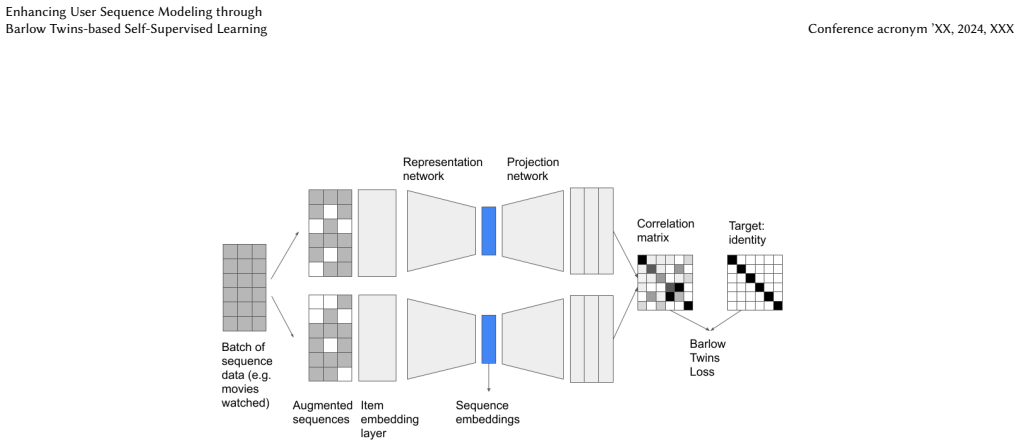
The load-bearing object is the Barlow Twins loss, $\mathcal{L}_{BT} = \sum_i (1 - C_{ii}) + \lambda \sum_{i\neq j} C_{ij}^2$, where $C_{ij}$ is the cross-correlation between the $i$-th component of one augmented view and the $j$-th component of the other view, computed over the batch. Minimizing this loss makes the representation's components individually invariant to the augmentation while decorrelating different components, which prevents trivial constant embeddings without needing negative samples. The paper couples this objective with three sequence-level augmentations: random masking, segment masking, and permutation. Segment masking, which removes one contiguous block of length $\lfloor p\ell\rfloor$, transfers best to next-item prediction because recovering a contiguous subsequence forces the model to learn longer-range user intentions rather than relying on local context.
What would settle it
Repeat the comparison with a single augmentation and batch size chosen only on a held-out split, run 5–10 seeds, and compute test accuracy; if the Barlow Twins advantage over the dual encoder falls within seed noise on MovieLens-1M or Yelp, the 8–20% improvement is a selection artifact rather than a real transfer gain.
Extended reading notes
Core claim
The paper's discovery is that the Barlow Twins redundancy-reduction objective transfers to low-redundancy user sequence data when paired with sequence-specific augmentations. Concretely, the authors pretrain a shared-weight two-branch network on two differently augmented views of the same batch of user action sequences and minimize a loss that drives the cross-correlation matrix of the two branches' outputs toward the identity matrix. After pretraining, the projection head is discarded and the encoder is evaluated on next-item prediction and sequence-level classification, including favorite genre or category prediction and user age and occupation prediction. Across the three datasets, the Barlow Twins-initialized models consistently outperform dual encoders trained for next-item prediction, especially when downstream labels are scarce, and segment masking at a 0.2 ratio is the most effective augmentation. The authors also report that small SSL batch sizes do not hurt performance and that fixed pretrained weights often beat fine-tuned ones under 1% labeled data.
Load-bearing premise
The load-bearing premise is that choosing the best validation accuracy across many augmentation methods, masking ratios, and batch sizes, with no repeated runs or significance tests, reflects true generalization rather than validation-set overfitting.
Editorial extensions
If this is right
- Pretrained Barlow Twins representations can be frozen and still outperform a supervised dual-encoder baseline on favorite-genre prediction with only 1% of training labels, implying that unlabeled interaction history alone carries much of the signal needed for classification.
- Because the loss has no negative term, pretraining remains effective at batch sizes as small as 128, so the approach scales to settings where large contrastive batches are infeasible.
- Segment masking, which removes a contiguous block rather than scattered items, is the augmentation that generalizes best to next-item prediction, suggesting that temporal continuity is a useful pretext for user behavior.
- Under abundant labeled data, Barlow Twins-initialized models converge faster than from-scratch training and avoid the degradation the dual-encoder baseline shows, so the benefit is not limited to low-label regimes.
Reading between the lines
- A natural testable extension is to pair Barlow Twins with a masked-item reconstruction head: the paper's t-SNE analysis suggests item embeddings are less clustered than the dual encoder's, and a reconstruction loss would directly improve item-level structure.
- The method's reliance on sequence augmentations suggests that adding attribute-aware augmentations, such as swapping items from the same genre, could push transfer further on datasets where item metadata exists, a direction the paper leaves implicit.
- If the validation-selection caveat is addressed with repeated seeds and held-out hyperparameter selection, the same setup could be used to benchmark other negative-sample-free SSL objectives on user sequences.
Signed reviews
Editorial analysis
A structured set of objections, weighed in public.
Referee Report
Summary. The paper adapts Barlow Twins self-supervised learning to user sequence modeling for recommender systems. It pretrains a CNN-based sequence encoder with a redundancy-reduction loss on two augmented views of user action sequences, using random masking, segment masking, and permutation augmentations. The pretrained encoder is then evaluated on MovieLens-1M, MovieLens-20M, and Yelp for favorite-category classification, user attribute classification (MovieLens-1M), and next-item prediction, comparing against a dual-encoder baseline and from-scratch training under fixed or trainable downstream weights. The abstract claims consistent 8-20% accuracy improvements over a dual-encoder baseline, with particular benefit under label scarcity and small SSL batch sizes.
Significance. The question is well motivated: negative-sample-free SSL for user sequences could reduce the computational cost of contrastive recommenders, and the paper provides a systematic study of three augmentations, four SSL batch sizes, two downstream tuning modes, and multiple data ratios. If the quantitative claims were established with a rigorous validation protocol, the paper would be a useful practical contribution, especially the observation that fixed pretrained weights are competitive under label scarcity and that segment masking outperforms random masking. The paper does not provide code, proofs, or a released benchmark, so the contribution rests entirely on the empirical evaluation; as it stands, the evaluation protocol in Section 5 does not support the headline improvement claim.
major comments (3)
- [Section 5, Tables 2-7] All headline numbers are 'best validation accuracy' selected over augmentation type, masking ratio (0.2-0.8), SSL batch size (128-1024), and fixed/trainable weights, yet the dual-encoder baseline is reported as a single value per task and dataset (e.g., Table 6, ML-20M top-5 DE baseline = 0.0265) with no equivalent configuration sweep. With no repeated runs, error bars, or significance tests, the selected maximum is likely to overstate the method's advantage, and several reported margins are smaller than 0.005-0.01 absolute (e.g., age prediction in Tables 2-3; ML-20M top-5 in Table 6). Please report test-set metrics for a fixed, predetermined configuration, or mean±std over multiple seeds, and include the same selection protocol for the baseline.
- [Section 2.2 and Section 5] The related work discusses BERT4Rec, S3-Rec, and contrastive sequential recommendation methods, but none of these SSL recommender baselines is included in the experiments. The comparison against a next-item dual encoder and from-scratch training cannot support the claim that the proposed Barlow Twins adaptation is preferable to existing SSL approaches for user sequences. Add at least one representative sequential SSL baseline (e.g., a masked-item-prediction model or a contrastive model such as CL4SRec) evaluated under the same downstream protocol.
- [Abstract and Tables 2-6] The claimed 8-20% improvement is not consistent across tasks and data ratios. For age prediction on MovieLens-1M the gains are about 0.4-1.4 absolute percentage points (~1-4% relative) in Tables 2-3, and for ML-20M top-5 recall the gain is about 0.3 absolute points (~11% relative) in Table 6, while Yelp favorite-category gains are much larger. Please qualify the abstract or report per-task relative improvements so the consistency of the claim can be assessed.
minor comments (6)
- [Section 4.1 and Table 1] The text gives 150,346 businesses for Yelp while Table 1 reports 150,436 items; please correct the inconsistency.
- [Sections 3.3 and 4.1] Sequences are padded with [mask] and the same token is used for masking in augmentations; please clarify whether the padding token is distinct from the augmentation mask, since using the same token makes it impossible to distinguish padded positions from augmented masked positions, especially under permutation.
- [Equation (2)] Equation (2) is garbled in the typeset version: the subscripts on y are inconsistent and the summation index is unclear; the cross-correlation C_ij should be defined explicitly as sum_b y^(1)_{i,b} y^(2)_{j,b} normalized by the corresponding standard deviations.
- [Section 4.2] The sentence 'The projection network is a 2-layer MLP with hidden dimension of is[256, 256]' contains a typo; it should read 'hidden dimensions [256, 256]'.
- [Tables 4 and 5] The captions state that segment masking and permutation have similar performance to random masking, but the tables report only random masking results; please either include the numbers or adjust the text.
- [Section 6.1] The claim that a high masking ratio (p=0.6 or 0.8) consistently leads to poor performance is supported by Table 3 for fixed weights but is less clear for trainable weights (e.g., age at p=0.8 reaches 0.4089 at batch size 128); please qualify the statement.
Circularity Check
No circularity: the Barlow Twins adaptation is an empirical comparison whose loss and augmentations do not encode downstream labels; reported 'best validation accuracy' is a statistical reliability concern, not a derivation-circle.
full rationale
The paper's central claim is that a Barlow Twins-based SSL pipeline with sequence augmentations outperforms a dual-encoder baseline on downstream tasks. This claim is empirical, not derived from an equation. The Barlow Twins loss (Eq. 1-2) is the standard redundancy-reduction objective taken from the external prior work [39], and the augmentations in Sec. 3.3 (random masking, segment masking, permutation) are heuristics that do not contain downstream task labels. The downstream tasks (favorite genre, occupation, age, next-item) are not used to define the SSL objective, so no fitted parameter is renamed as a prediction. Hyperparameters such as lambda, masking ratio, and SSL batch size are tuned, but they do not by construction force the reported accuracy improvements. The paper also cites no load-bearing prior work by the same authors; the key citations are independent. The main flagged concern is methodological rather than circular: Tables 2-7 report 'best validation accuracy' after searching over augmentations, masking ratios, and batch sizes, with no repeated runs or significance tests. That is a multiple-comparison/validation-selection issue that should be weighed under correctness and reproducibility, not circularity. The limitation acknowledged in Sec. 7 ('a limitation of our current approach is its focus on sequence-level rather than item-level representations') is a scope limitation, not a circular step. No specific reduction of a claimed result to its inputs can be exhibited, so the appropriate circularity score is 0.
Assumptions & free parameters
free parameters (6)
- lambda (trade-off parameter) =
10
- masking ratio p =
0.2, 0.4, 0.6, 0.8
- SSL batch size =
128, 256, 512, 1024
- sequence length =
16
- item embedding dimension =
16
- downstream MLP hidden units =
20
assumptions (4)
- standard math Barlow Twins loss enforces statistical independence of representation components (Zbontar et al. 2021)
- ad hoc to paper The three augmentations preserve task-relevant information while creating useful pretext signals
- domain assumption Using only item IDs in sequences of length 16 is sufficient for the downstream tasks
- domain assumption A 2-layer 1D-CNN is a sufficiently expressive representation network
Cite this review
Pith. "Pith review of Enhancing User Sequence Modeling through Barlow Twins-based Self-Supervised Learning." pith.science (2026). https://pith.science/paper/344KNJIB
@misc{pith2026250500953,
  author       = {Pith},
  title        = {Pith review of: Enhancing User Sequence Modeling through Barlow Twins-based Self-Supervised Learning},
  year         = {2026},
  howpublished = {\url{https://pith.science/paper/344KNJIB}},
  note         = {Machine review of arXiv:2505.00953}
}
read the original abstract
User sequence modeling is crucial for modern large-scale recommendation systems, as it enables the extraction of informative representations of users and items from their historical interactions. These user representations are widely used for a variety of downstream tasks to enhance users' online experience. A key challenge for learning these representations is the lack of labeled training data. While self-supervised learning (SSL) methods have emerged as a promising solution for learning representations from unlabeled data, many existing approaches rely on extensive negative sampling, which can be computationally expensive and may not always be feasible in real-world scenario. In this work, we propose an adaptation of Barlow Twins, a state-of-the-art SSL methods, to user sequence modeling by incorporating suitable augmentation methods. Our approach aims to mitigate the need for large negative sample batches, enabling effective representation learning with smaller batch sizes and limited labeled data. We evaluate our method on the MovieLens-1M, MovieLens-20M, and Yelp datasets, demonstrating that our method consistently outperforms the widely-used dual encoder model across three downstream tasks, achieving an 8%-20% improvement in accuracy. Our findings underscore the effectiveness of our approach in extracting valuable sequence-level information for user modeling, particularly in scenarios where labeled data is scarce and negative examples are limited.
Figures


Figures from the paper (1 more)

Reference graph
Works this paper leans on
-
[1]
Jonah Anton, Harry Coppock, Pancham Shukla, and Björn W Schuller. 2023. Audio Barlow Twins: Self-Supervised Audio Representation Learning. In ICASSP 2023-2023 IEEE International Conference on Acoustics, Speech and Signal Processing (ICASSP). IEEE, 1–5
work page 2023
-
[2]
Alexei Baevski, Arun Babu, Wei-Ning Hsu, and Michael Auli. 2023. Efficient Self-supervised Learning with Contextualized Target Representations for Vision, Speech and Language. In Proceedings of the 40th International Conference on Machine Learning (Proceedings of Machine Learning Research, Vol. 202) , Andreas Krause, Emma Brunskill, Kyunghyun Cho, Barbara...
work page 2023
-
[3]
Junwen Bai, Weiran Wang, Yingbo Zhou, and Caiming Xiong. 2021. Representa- tion Learning for Sequence Data with Deep Autoencoding Predictive Components. In 9th International Conference on Learning Representations, ICLR 2021, Virtual Event, Austria, May 3-7, 2021 . OpenReview.net. https://openreview.net/forum? id=Naqw7EHIfrv
work page 2021
-
[4]
Rishi Bommasani, Drew A Hudson, Ehsan Adeli, Russ Altman, Simran Arora, Sydney von Arx, Michael S Bernstein, Jeannette Bohg, Antoine Bosselut, Emma Brunskill, et al. 2021. On the opportunities and risks of foundation models. arXiv preprint arXiv:2108.07258 (2021)
arXiv 2021
-
[5]
Bentz, Léon Bottou, Isabelle Guyon, Yann LeCun, Cliff Moore, Eduard Säckinger, and Roopak Shah
Jane Bromley, James W. Bentz, Léon Bottou, Isabelle Guyon, Yann LeCun, Cliff Moore, Eduard Säckinger, and Roopak Shah. 1993. Signature Verification Using A "Siamese" Time Delay Neural Network. Int. J. Pattern Recognit. Artif. Intell. 7, 4 (1993), 669–688. https://doi.org/10.1142/S0218001493000339
-
[6]
Tom B. Brown, Benjamin Mann, Nick Ryder, Melanie Subbiah, Jared Kaplan, Prafulla Dhariwal, Arvind Neelakantan, Pranav Shyam, Girish Sastry, Amanda Askell, Sandhini Agarwal, Ariel Herbert-Voss, Gretchen Krueger, Tom Henighan, Rewon Child, Aditya Ramesh, Daniel M. Ziegler, Jeffrey Wu, Clemens Winter, Christopher Hesse, Mark Chen, Eric Sigler, Mateusz Litwin...
2020
-
[7]
Xuheng Cai, Chao Huang, Lianghao Xia, and Xubin Ren. 2023. LightGCL: Simple Yet Effective Graph Contrastive Learning for Recommendation. In The Eleventh International Conference on Learning Representations, ICLR 2023, Kigali, Rwanda, May 1-5, 2023. OpenReview.net. https://openreview.net/pdf?id=FKXVK9dyMM
work page 2023
-
[8]
Ting Chen, Simon Kornblith, Mohammad Norouzi, and Geoffrey E. Hinton. 2020. A Simple Framework for Contrastive Learning of Visual Representations. In Proceedings of the 37th International Conference on Machine Learning, ICML 2020, 13-18 July 2020, Virtual Event (Proceedings of Machine Learning Research, Vol. 119) . PMLR, 1597–1607. http://proceedings.mlr....
2020
Show all 43 references
-
[9]
Xinlei Chen and Kaiming He. 2021. Exploring Simple Siamese Representation Learning. In IEEE Conference on Computer Vision and Pattern Recognition, CVPR 2021, virtual, June 19-25, 2021 . Computer Vision Foundation / IEEE, 15750–15758. https://doi.org/10.1109/CVPR46437.2021.01549
2021
-
[10]
McAuley, and Caiming Xiong
Yongjun Chen, Zhiwei Liu, Jia Li, Julian J. McAuley, and Caiming Xiong. 2022. Intent Contrastive Learning for Sequential Recommendation. In WWW ’22: The ACM Web Conference 2022, Virtual Event, Lyon, France, April 25 - 29, 2022 , Frédérique Laforest, Raphaël Troncy, Elena Simpe...
2022
-
[11]
Paul Covington, Jay Adams, and Emre Sargin. 2016. Deep Neural Networks for YouTube Recommendations. In Proceedings of the 10th ACM Conference on Recommender Systems (RecSys’16). 191—-198
2016
-
[12]
Jacob Devlin, Ming-Wei Chang, Kenton Lee, and Kristina Toutanova. 2019. BERT: Pre-training of Deep Bidirectional Transformers for Language Understanding. In Proceedings of the 2019 Conference of the North American Chapter of the Associa- tion for Computational Linguistics: Hum...
2019
-
[13]
Carl Doersch and Andrew Zisserman. 2017. Multi-task Self-Supervised Visual Learning. In IEEE International Conference on Computer Vision, ICCV 2017, Venice, Italy, October 22-29, 2017. IEEE Computer Society, 2070–2079. https://doi.org/10. 1109/ICCV.2017.226
2017
-
[14]
Tianyu Gao, Xingcheng Yao, and Danqi Chen. 2021. SimCSE: Simple Contrastive Learning of Sentence Embeddings. In Proceedings of the 2021 Conference on Em- pirical Methods in Natural Language Processing, EMNLP 2021, Virtual Event / Punta Cana, Dominican Republic, 7-11 November, ...
2021 doi
-
[15]
Goodfellow, Jean Pouget-Abadie, Mehdi Mirza, Bing Xu, David Warde-Farley, Sherjil Ozair, Aaron C
Ian J. Goodfellow, Jean Pouget-Abadie, Mehdi Mirza, Bing Xu, David Warde-Farley, Sherjil Ozair, Aaron C. Courville, and Yoshua Bengio. 2014. Generative Adversarial Nets. In Advances in Neural Information Process- ing Systems 27: Annual Conference on Neural Information Processi...
2014
-
[16]
Jean-Bastien Grill, Florian Strub, Florent Altché, Corentin Tallec, Pierre H. Richemond, Elena Buchatskaya, Carl Doersch, Bernardo Ávila Pires, Zhaohan Guo, Mohammad Gheshlaghi Azar, Bilal Piot, Koray Kavukcuoglu, Rémi Munos, Conference acronym ’XX, 2024, XXX Yuhan Liu, Lin Ni...
2024
-
[17]
Maxwell Harper and Joseph A
F. Maxwell Harper and Joseph A. Konstan. 2016. The MovieLens Datasets: History and Context. ACM Trans. Interact. Intell. Syst. 5, 4 (2016), 19:1–19:19. https://doi.org/10.1145/2827872
2016 doi
-
[18]
Girshick
Kaiming He, Xinlei Chen, Saining Xie, Yanghao Li, Piotr Dollár, and Ross B. Girshick. 2022. Masked Autoencoders Are Scalable Vision Learners. In IEEE/CVF Conference on Computer Vision and Pattern Recognition, CVPR 2022, New Orleans, LA, USA, June 18-24, 2022. IEEE, 15979–15988...
2022
-
[19]
Jyun-Yu Jiang, Tao Wu, Georgios Roumpos, Heng-Tze Cheng, Xinyang Yi, Ed Chi, Harish Ganapathy, Nitin Jindal, Pei Cao, and Wei Wang. 2020. End-to-End Deep Attentive Personalized Item Retrieval for Online Content-sharing Platforms. In Proceedings of The Web Conference 2020 . 2870–2877
2020
-
[20]
Gustav Larsson, Michael Maire, and Gregory Shakhnarovich. 2016. Learning Representations for Automatic Colorization. In Computer Vision - ECCV 2016 - 14th European Conference, Amsterdam, The Netherlands, October 11-14, 2016, Proceedings, Part IV (Lecture Notes in Computer Scie...
2016 doi
-
[21]
Fangyu Liu, Ivan Vulic, Anna Korhonen, and Nigel Collier. 2021. Fast, Effective, and Self-Supervised: Transforming Masked Language Models into Universal Lexical and Sentence Encoders. In Proceedings of the 2021 Conference on Empirical Methods in Natural Language Processing, EM...
2021
-
[22]
Yinhan Liu, Myle Ott, Naman Goyal, Jingfei Du, Mandar Joshi, Danqi Chen, Omer Levy, Mike Lewis, Luke Zettlemoyer, and Veselin Stoyanov. 2019. RoBERTa: A Robustly Optimized BERT Pretraining Approach. CoRR abs/1907.11692 (2019). arXiv:1907.11692 http://arxiv.org/abs/1907.11692
2019 arXiv
-
[23]
Jiaqi Ma, Zhe Zhao, Xinyang Yi, Jilin Chen, Lichan Hong, and Ed H Chi. 2018. Modeling task relationships in multi-task learning with multi-gate mixture-of- experts. In Proceedings of the 24th ACM SIGKDD International Conference on Knowledge Discovery & Data Mining . 1930–1939
2018
-
[24]
Yu Meng, Chenyan Xiong, Payal Bajaj, Saurabh Tiwary, Paul Bennett, Jiawei Han, and Xia Song. 2021. COCO-LM: Correcting and Contrasting Text Se- quences for Language Model Pretraining. In Advances in Neural Information Processing Systems 34: Annual Conference on Neural Informat...
2021
-
[25]
Arvind Neelakantan, Tao Xu, Raul Puri, Alec Radford, Jesse Michael Han, Jerry Tworek, Qiming Yuan, Nikolas Tezak, Jong Wook Kim, Chris Hallacy, Johannes Heidecke, Pranav Shyam, Boris Power, Tyna Eloundou Nekoul, Girish Sastry, Gretchen Krueger, David Schnurr, Felipe Petroski S...
2022 arXiv
- [26]
-
[27]
Deepak Pathak, Philipp Krähenbühl, Jeff Donahue, Trevor Darrell, and Alexei A. Efros. 2016. Context Encoders: Feature Learning by Inpainting. In 2016 IEEE Conference on Computer Vision and Pattern Recognition, CVPR 2016, Las Vegas, NV, USA, June 27-30, 2016 . IEEE Computer Soc...
2016 doi
-
[28]
Danilo Jimenez Rezende, Shakir Mohamed, and Daan Wierstra. 2014. Stochastic Backpropagation and Approximate Inference in Deep Generative Models. In Proceedings of the 31st International Conference on Machine Learning (Proceedings of Machine Learning Research, Vol. 32), Eric P....
2014
-
[29]
Fei Sun, Jun Liu, Jian Wu, Changhua Pei, Xiao Lin, Wenwu Ou, and Peng Jiang
-
[30]
Gomez, Lukasz Kaiser, and Illia Polosukhin
Ashish Vaswani, Noam Shazeer, Niki Parmar, Jakob Uszkoreit, Llion Jones, Aidan N. Gomez, Lukasz Kaiser, and Illia Polosukhin. 2017. Attention is All you Need. In Advances in Neural Information Processing Systems 30: An- nual Conference on Neural Information Processing Systems ...
2017
-
[31]
Maksims Volkovs, Guang Wei Yu, and Tomi Poutanen. 2017. DropoutNet: Ad- dressing Cold Start in Recommender Systems.. In NIPS. 4957–4966
2017
-
[32]
Lianghao Xia, Chao Huang, Chunzhen Huang, Kangyi Lin, Tao Yu, and Ben Kao
-
[33]
Xu Xie, Fei Sun, Zhaoyang Liu, Shiwen Wu, Jinyang Gao, Jiandong Zhang, Bolin Ding, and Bin Cui. 2022. Contrastive learning for sequential recommendation. In 2022 IEEE 38th international conference on data engineering (ICDE) . IEEE, 1259– 1273
2022
-
[34]
Ji Yang, Xinyang Yi, Derek Zhiyuan Cheng, Lichan Hong, Yang Li, Simon Xiaom- ing Wang, Taibai Xu, and Ed H Chi. 2020. Mixed Negative Sampling for Learning Two-tower Neural Networks in Recommendations. In Companion Proceedings of the Web Conference 2020. 441–447
2020
-
[35]
Yuhao Yang, Chao Huang, Lianghao Xia, Chunzhen Huang, Da Luo, and Kangyi Lin. 2023. Debiased Contrastive Learning for Sequential Recommendation. In Proceedings of the ACM Web Conference 2023 (Austin, TX, USA) (WWW ’23) . Association for Computing Machinery, New York, NY, USA, ...
2023
-
[36]
Chi, Steve Tjoa, Jieqi (Jay) Kang, and Evan Et- tinger
Tiansheng Yao, Xinyang Yi, Derek Zhiyuan Cheng, Felix Yu, Ting Chen, Aditya Menon, Lichan Hong, Ed H. Chi, Steve Tjoa, Jieqi (Jay) Kang, and Evan Et- tinger. 2021. Self-Supervised Learning for Large-Scale Item Recommenda- tions. In Proceedings of the 30th ACM International Con...
2021
-
[37]
Xinyang Yi, Ji Yang, Lichan Hong, Derek Zhiyuan Cheng, Lukasz Heldt, Adi- tee Ajit Kumthekar, Zhe Zhao, Li Wei, and Ed Chi (Eds.). 2019. Sampling-Bias- Corrected Neural Modeling for Large Corpus Item Recommendations
2019
-
[38]
Junliang Yu, Hongzhi Yin, Xin Xia, Tong Chen, Jundong Li, and Zi Huang
-
[39]
Jure Zbontar, Li Jing, Ishan Misra, Yann LeCun, and Stéphane Deny. 2021. Barlow Twins: Self-Supervised Learning via Redundancy Reduction. In Proceedings of the 38th International Conference on Machine Learning, ICML 2021, 18-24 July 2021, Virtual Event (Proceedings of Machine ...
2021
-
[40]
Shuai Zhang, Lina Yao, Aixin Sun, and Yi Tay. 2019. Deep Learning Based Recommender System: A Survey and New Perspectives. ACM Comput. Surv. (2019). https://doi.org/10.1145/3285029
2019 doi
-
[41]
arXiv:2203.15876 [cs.IR]
Self-Supervised Learning for Recommender Systems: A Survey. arXiv:2203.15876 [cs.IR]
-
[44]
Kun Zhou, Hui Wang, Wayne Xin Zhao, Yutao Zhu, Sirui Wang, Fuzheng Zhang, Zhongyuan Wang, and Ji-Rong Wen. 2020. S3-Rec: Self-Supervised Learning for Sequential Recommendation with Mutual Information Maximization. In CIKM ’20: The 29th ACM International Conference on Informati...
2020
-
[2019]
BERT4Rec: Sequential Recommendation with Bidirectional Encoder Repre- sentations from Transformer. In Proceedings of the 28th ACM International Con- ference on Information and Knowledge Management, CIKM 2019, Beijing, China, November 3-7, 2019, Wenwu Zhu, Dacheng Tao, Xueqi Ch...
2019
Reviewed August 16, 2026 · model on record in the stance chip above.
Discussion (0). Continue with ORCID to comment.