REVIEW 3 major objections 7 minor 18 references
A Troubleshooting Framework for Trapping Ions
T0 review · 3 major / 7 minor · reviewed 2026-08-16 · deepseek-v4-flash
Pith's one-line read This paper proposes a structured troubleshooting framework for trapped-ion systems that organizes failure modes in vacuum, electronics, optics, and imaging into modular decision trees annotated with FMEA-style cost and risk estimates.
desk verdict Useful decision-tree field guide for trapped-ion debugging, but the claimed FMEA-style action annotations are missing from the actual figures and the fix is straightforward. read the letter →
The pith
A machine-rendered reading of the paper's core claim, the machinery that carries it, and where it could break.
The reading
What carries the argument
The central object is the decision-tree structure itself: a main tree that begins with the observable 'is the trap signal present?' and sends the user down module-specific branches (vacuum, electronics, optics, imaging), where each node is a diagnostic action or a decision point that refines the search for a root cause. The supporting mechanism is a qualitative FMEA-inspired evaluation that scores failure modes on three axes — operational impact, time cost (hours, days, weeks), and disturbance risk — and maps them to intervention levels. The trees encode the physical dependencies of trapping, so the framework doubles as a description of how an ion-trap system is supposed to behave and where each module's failure would break the chain.
What would settle it
A controlled benchmark would settle it: inject a known fault — detune the RF resonator, block the ablation spot, or open a light leak — and measure whether novices following the trees find the root cause faster, and misdiagnose less often, than novices troubleshooting without structure; if the trees show no advantage, the claim that the framework makes troubleshooting systematic fails. A complementary survey would also weigh against the claim: labs with other ion species or trap geometries reporting dominant failure modes outside the four subsystem categories would show the taxonomy is setup-specific.
Extended reading notes
Core claim
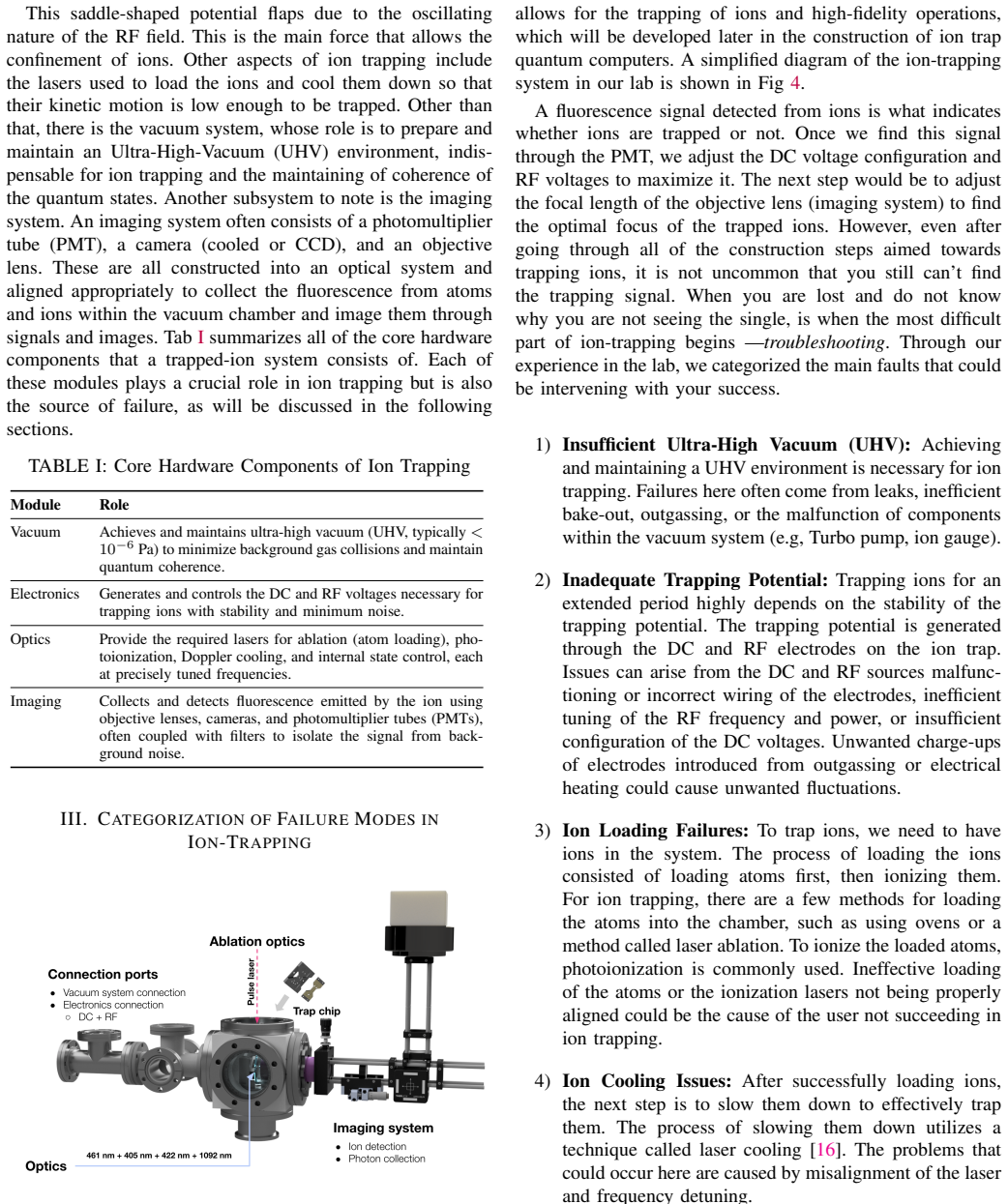
The central claim is that the order in which an experienced lab actually diagnoses an ion trap — check vacuum, check the trapping potential, check that atoms are loaded and ionized, check cooling, check detection — can be made explicit as a hierarchy of decision trees, and that the recurring failure modes at each stage are stable enough to be catalogued. The paper names those modes for each subsystem: leaks, outgassing, and component failure in vacuum; RF detuning, DC noise, and broken contacts in electronics; laser misalignment and frequency drift in optics; alignment errors and light leaks in imaging. It further claims that attaching qualitative cost annotations to each troubleshooting action converts this catalog into a prioritization tool: users and designers can see which failures justify hardware replacement, which are cheap to fix, and where investing in diagnostics or automation would pay off. The stated aim is not merely faster debugging but a groundwork for error-handled ion-trap systems whose diagnostics and maintainability are designed in from the start.
Load-bearing premise
The load-bearing premise — acknowledged in the paper's own discussion section as a limitation — is that failure modes and repair actions collected in one lab's strontium surface-electrode trap with laser-ablation loading and PMT detection are representative enough of ion-trap systems at large that a shared, structured troubleshooting framework carries practical value.
Editorial extensions
If this is right
- A person with limited ion-trap experience can diagnose a failure by following the trees, so the framework lowers the training barrier for new lab members and for engineers joining quantum-hardware teams.
- Because vacuum and electronics failures carry the highest time cost and disturbance risk, the cost table gives labs a principled reason to instrument those subsystems with monitoring and spare parts first.
- The qualitative cost annotations define the slots where real fault statistics can later be inserted, which is what a quantitative FMEA and software-assisted or automated debugging would require.
- If adopted by other labs, the modular trees become a shared vocabulary for reporting failures, letting the community extend the framework to other ion species, trap geometries, and control architectures.
- Standardized, documented troubleshooting is a precondition for turning single experimental rigs into reproducible products, which the paper argues is required for distributed quantum computing and quantum networks.
Reading between the lines
- The trees read naturally as executable runbooks, so an unstated next step is to compile them into a software diagnostic agent that logs each check and converts the qualitative cost estimates into measured distributions over time.
- A direct test of the framework's value would inject a known fault (for example, detuning the helical resonator or blocking the ablation spot) and measure whether a novice following the trees reaches the root cause faster and with fewer wrong detours than with unstructured debugging.
- The FMEA-style documentation move transfers to other quantum platforms whose operational knowledge is still lab-private, such as neutral-atom or superconducting systems, where the same bottleneck of undocumented troubleshooting applies.
- The framework's taxonomy implies a cost-of-ownership map for ion traps: optics failures are frequent but cheap, so alignment tooling is the high-leverage investment, while rare vacuum and RF failures dominate downtime and justify redundancy.
Signed reviews
Editorial analysis
A structured set of objections, weighed in public.
Referee Report
Summary. This paper proposes a structured troubleshooting framework for trapped-ion systems, developed from the authors' experience building and debugging a single surface-electrode trap with strontium ions, laser-ablation loading, and PMT-based detection. The framework categorizes failure modes in vacuum, electronics, optics, and imaging, and organizes them into modular decision trees (Figs. 5–10). The paper also presents a qualitative, FMEA-inspired impact assessment (Tables IV–VI) that assigns High/Medium/Low values for operational impact, time cost, and disturbance risk to representative failure modes. The abstract and introduction claim that each troubleshooting action is annotated with these cost and risk estimates, and that this structure will help standardize troubleshooting across labs and bridge physics and engineering practice. Section VI acknowledges that the framework is tailored to one setup and lacks quantitative fault data.
Significance. If the claims were fully supported, this would be a useful codification of tacit experimental knowledge, potentially reducing onboarding time for new ion-trap labs and providing a shared vocabulary for reliability discussions. The decision trees themselves are a concrete, reproducible artifact, and the qualitative severity tables give a reasonable starting point for prioritization. The paper is honest about its single-lab origin and the lack of quantitative data, which is appropriate for a first step. However, the central FMEA-annotation claim is not currently backed by the presented artifact: the figures contain no action-level annotations, and the qualitative tables are not connected to the decision-tree nodes. As a result, the framework as drawn is a set of diagnostic flowcharts, not the annotated troubleshooting system promised in the abstract. The paper's significance therefore depends on a revision that either supplies the missing annotations or recalibrates the claims.
major comments (3)
- [Abstract; §IV; Figs. 5–10; §V, Tab. IV] The abstract and Sec. V claim that each troubleshooting action is annotated with FMEA-inspired estimates of cost and operational risk, but no action node in Figs. 5–10 carries such annotations. Table IV assigns High/Medium/Low values only to failure-mode categories (e.g., outgassing, RF detuning), and no mapping is provided from those category-level values to specific action nodes in the decision trees. This is load-bearing because the stated value of the framework—enabling prioritization and bridging physics and engineering—depends on this annotation layer, which is absent from the presented artifact.
- [§VI; §I] Section VI concedes that the framework is tailored to one specific experimental setup and lacks quantitative fault data, yet Section I claims the framework provides 'a structure for standardizing knowledge across labs and fields.' No evidence of transferability is presented, and the single-lab origin means the claimed generality is unsupported. The scope of the claims should be narrowed to match the evidence, or a cross-lab comparison or validation study should be added.
- [§V-A; Tables IV–VI] The severity definitions in Tables V and VI are not connected to the assignments in Table IV by a stated rubric. For example, outgassing caused by bake-out failure is assigned Low disturbance risk, even though baking is an invasive procedure that can introduce new problems. Without a reproducible rule for assigning severity levels, the qualitative FMEA-inspired assessment cannot serve as the foundation for future quantitative work or for prioritization by other users.
minor comments (7)
- [§II, p. 3] 'underlining physical principles' should read 'underlying physical principles.'
- [§IV-D, Fig. 9] 'the best-performing poing' should read 'the best-performing point.'
- [§IV-D] 'cool the ions to their emotional ground state' should read 'motional ground state.'
- [Fig. 7] The node 'Further diagnosis on connection' is not expanded anywhere in the paper; as drawn, the tree cannot guide the user past this point, so please replace it with a concrete procedure or a reference to a connection-specific subtree.
- [Figs. 5–10] The Yes/No arrows are not consistently labeled at some branches, and 'Return to MAIN TREE' in Fig. 6 appears without a branch condition; adding explicit labels would improve the usability of the decision trees.
- [Reference [17]] Reference [17] is incomplete: it gives authors and a title but no journal, arXiv identifier, or other locator; please complete the citation.
- [§IV-A; §V] Table IV is referenced from Section IV-A but introduced in Section V; please add a forward reference and clarify how users should apply the qualitative severity values when traversing the decision trees.
Circularity Check
No significant circularity: the paper is a self-contained codification of experiential troubleshooting knowledge with qualitative, openly labeled expert judgments.
full rationale
The paper makes no quantitative predictions and contains no derivation chain that could reduce to its own inputs. Its central claim is that hands-on lab experience has been organized into decision trees and qualitative FMEA-inspired impact categories; the qualitative estimates in Tab. IV are explicitly presented as expert judgments rather than fitted values ('For this paper, we keep it at a qualitative analysis that lays out the foundation for quantitative evaluation in the future'). No parameter is fitted to data and then renamed as a prediction, no uniqueness theorem is imported from the authors' prior work, and no ansatz is smuggled in via self-citation. The references to prior work by the same authors (e.g., Ref. [1] and Ref. [17]) are contextual background, not load-bearing support for the framework's content. The reader's noted discrepancy between the abstract's claim that 'each troubleshooting action is annotated with estimates of cost and operational risk' and the absence of such annotations in the decision-tree figures is an internal-consistency or completeness concern, not a circularity concern. The framework is therefore self-contained with respect to circular-reasoning failure modes, warranting a score of 0.
Assumptions & free parameters
assumptions (3)
- ad hoc to paper The listed failure modes across vacuum, electronics, optics, and imaging are the dominant failures in ion-trap systems.
- domain assumption A fluorescence signal detected by a PMT is a reliable primary indicator of trapping success.
- domain assumption Ultra-high vacuum (typically below 10^-6 Pa) is necessary for ion trapping and quantum coherence.
Cite this review
Pith. "Pith review of A Troubleshooting Framework for Trapping Ions." pith.science (2026). https://pith.science/paper/KW3BYZMV
@misc{pith2026250500997,
  author       = {Pith},
  title        = {Pith review of: A Troubleshooting Framework for Trapping Ions},
  year         = {2026},
  howpublished = {\url{https://pith.science/paper/KW3BYZMV}},
  note         = {Machine review of arXiv:2505.00997}
}
read the original abstract
Practical knowledge about troubleshooting and error handling in trapped-ion systems remains largely undocumented and held within individual labs, creating a barrier to cross-disciplinary collaboration towards engineering scalable systems. This paper presents a structured troubleshooting framework for trapping ions, developed through hands-on experience in the lab. The framework categorizes standard failure modes across subsystems -- vacuum, electronics, optics, and imaging -- and organizes them into a modular decision-tree structure. Each troubleshooting action is annotated with estimates of cost and operational risk inspired by the principles of Failure Mode and Effects Analysis (FMEA). By categorizing failure modes and their associated costs, this work bridges the gap between physicists and engineers, enabling collaborative system design and setting the stage for turning experimental setups into robust, reproducible products. This framework provides a structured basis for future error-handled ion-trap systems, designed with diagnostics and maintainability in mind -- for use in distributed quantum computing and networks.
Figures


Figures from the paper (6 more)


Reference graph
Works this paper leans on
-
[1]
Architecture of a quantum multicomputer opti- mized for Shor’s factoring algorithm,
R. D. Van Meter III, “Architecture of a quantum multicomputer opti- mized for Shor’s factoring algorithm,” Ph.D. dissertation, Keio Univer- sity, 2006, available as arXiv:quant-ph/0607065
arXiv 2006
-
[2]
Architectural Principles for a Quantum Internet,
W. Kozlowski et al., “Architectural Principles for a Quantum Internet,” RFC 9340, Mar. 2023, doi:10.17487/RFC9340
doi:10.17487/rfc9340 2023
-
[3]
An optical interconnect for modular quantum computers,
D. Sakuma et al. , “An optical interconnect for modular quantum computers,” arXiv preprint arXiv:2412.09299 , 2024
arXiv 2024
-
[4]
Scaling the ion trap quantum processor,
C. Monroe and J. Kim, “Scaling the ion trap quantum processor,” Science, vol. 339, no. 6124, pp. 1164–1169, 2013, doi:10.1126/science.1231298
-
[5]
Blueprint for a microwave trapped ion quantum computer,
B. Lekitsch et al. , “Blueprint for a microwave trapped ion quantum computer,” Science Advances , vol. 3, no. 2, p. e1601540, 2017, doi:10.1126/sciadv.1601540
-
[6]
A high-fidelity quantum matter-link between ion-trap microchip modules,
M. Akhtar et al., “A high-fidelity quantum matter-link between ion-trap microchip modules,” Nature Communications , vol. 14, no. 1, p. 531, Feb. 2023, doi:10.1038/s41467-022-35285-3
-
[7]
Entanglement of trapped-ion qubits separated by 230 meters,
V . Krutyanskiy et al. , “Entanglement of trapped-ion qubits separated by 230 meters,” Phys. Rev. Lett. , vol. 130, p. 050803, Feb 2023, doi:10.1103/PhysRevLett.130.050803
-
[8]
Procedure for failure mode, effects, and criticality analysis (fmeca),
National Aeronautics and Space Administration, “Procedure for failure mode, effects, and criticality analysis (fmeca),” https://ntrs.nasa.gov/ citations/19700076494, 1966, nASA Technical Memorandum NASA- TM-X-65227, accessed via NASA Technical Reports Server
Show all 18 references
-
[9]
Failure mode and effect analysis (fmea) implementation: A literature review,
K. D. Sharma and S. Srivastava, “Failure mode and effect analysis (fmea) implementation: A literature review,” Journal of Advance Research in Aeronautics and Space Science , vol. 5, no. 1&2, pp. 1–17, Apr. 2018, [Online]. Available: https://www.researchgate.net/publication/333...
2018
-
[10]
Electromagnetic traps for charged and neutral particles,
W. Paul, “Electromagnetic traps for charged and neutral particles,” Nobel Lecture, 1990
1990
-
[11]
Quantum computations with cold trapped ions,
J. I. Cirac and P. Zoller, “Quantum computations with cold trapped ions,” Phys. Rev. Lett. , vol. 74, pp. 4091–4094, May 1995, doi:10.1103/PhysRevLett.74.4091
1995 doi
-
[12]
Architecture for a large- scale ion-trap quantum computer,
D. Kielpinski, C. Monroe, and D. Wineland, “Architecture for a large- scale ion-trap quantum computer,” Nature, vol. 417, pp. 709–11, 07 2002, doi:10.1038/nature00784
2002 doi
-
[13]
Microfabricated surface-electrode ion trap for scalable quantum information processing,
S. Seidelin et al. , “Microfabricated surface-electrode ion trap for scalable quantum information processing,” Phys. Rev. Lett. , vol. 96, p. 253003, Jun 2006, doi:10.1103/PhysRevLett.96.253003
2006 doi
-
[14]
Towards fault-tolerant quantum computing with trapped ions,
J. Benhelm, G. Kirchmair, C. F. Roos, and R. Blatt, “Towards fault-tolerant quantum computing with trapped ions,” Nature Physics , vol. 4, no. 6, p. 463–466, Apr. 2008, doi:10.1038/nphys961
2008 doi
-
[15]
Quantum dynamics of single trapped ions,
D. Leibfried, R. Blatt, C. Monroe, and D. Wineland, “Quantum dynamics of single trapped ions,” Rev. Mod. Phys. , vol. 75, pp. 281–324, Mar 2003, doi:10.1103/RevModPhys.75.281
2003 doi
-
[16]
Laser cooling of trapped ions,
J. Eschner, G. Morigi, F. Schmidt-Kaler, and R. Blatt, “Laser cooling of trapped ions,” J. Opt. Soc. Am. B , vol. 20, no. 5, pp. 1003–1015, May 2003, doi:10.1364/JOSAB.20.001003
2003 doi
-
[17]
Deterministic loading of a single strontium ion into a surface electrode trap using pulsed laser ablation,
A. Osada and A. Noguchi, “Deterministic loading of a single strontium ion into a surface electrode trap using pulsed laser ablation,” 2021
2021
-
[18]
A compact and efficient strontium oven for laser-cooling experiments,
M. Schioppo et al. , “A compact and efficient strontium oven for laser-cooling experiments,” Review of Scientific Instruments , vol. 83, no. 10, Oct. 2012, doi:10.1063/1.4756936. 8
2012 doi
Reviewed August 16, 2026 · model on record in the stance chip above.
Discussion (0). Continue with ORCID to comment.