REVIEW 4 major objections 6 minor 61 references
Deterministic-to-Stochastic Diverse Latent Feature Mapping for Human Motion Synthesis
T0 review · 4 major / 6 minor · reviewed 2026-08-16 · deepseek-v4-flash
Pith's one-line read A deterministic ODE plus a training-free stochastic sampler beats prior score-based and diffusion baselines on human motion synthesis while using fewer parameters.
desk verdict A competent flow-matching plus VQVAE motion synthesis pipeline whose diversity-generating sampler is written in a way that cannot be run as stated; the results are plausible but not reproducible until Eq. 13 is fixed. read the letter →
The pith
A machine-rendered reading of the paper's core claim, the machinery that carries it, and where it could break.
The reading
What carries the argument
The load-bearing object is the pair (DerODE, DivSDE). DerODE is a deterministic ODE whose drift is learned through the drift-estimate loss (Eq. 8) and the drift-consistency loss (Eq. 9) on optimal-transport-matched pairs $(z_0, z_1)$, so the learned vector field approximates the constant displacement $z_1 - z_0$ and the trajectories are straight. DivSDE is the reverse SDE $dz_t = -\frac{1}{1-t} z_t\,dt + \eta\sqrt{\frac{2t}{1-t}}\,dw_t$ from Proposition 3, whose score term is replaced by the closed-form Gaussian score $\frac{(1-t)\hat{z}_{0,i} - z_t}{t^2}$ with $\hat{z}_{0,i} = \text{DerODE}(\hat{z}_{1,i})$; this is what adds diversity without extra training. Proposition 1 supplies the drift formula $u(z,t) = \sigma'(t)\frac{z - \mu(t)}{\sigma(t)} + \mu'(t)$, which turns the chosen linear interpolation between latent data and Gaussian noise into the constant drift $z_1 - z_0$, making the whole second stage a parameter-light flow model between two fixed distributions.
What would settle it
Run the exact reverse update in Eq. 13 on a synthetic latent space with a known mixture-of-Gaussians target: if the two-sample distance between DivSDE samples and the true target does not shrink as $\eta \to 0$ and as the discretization step shrinks, or if the self-referential term in Eq. 13 makes the iteration unexecutable as written, then the claim that the stochastic sampler samples the latent motion distribution is not supported.
Extended reading notes
Core claim
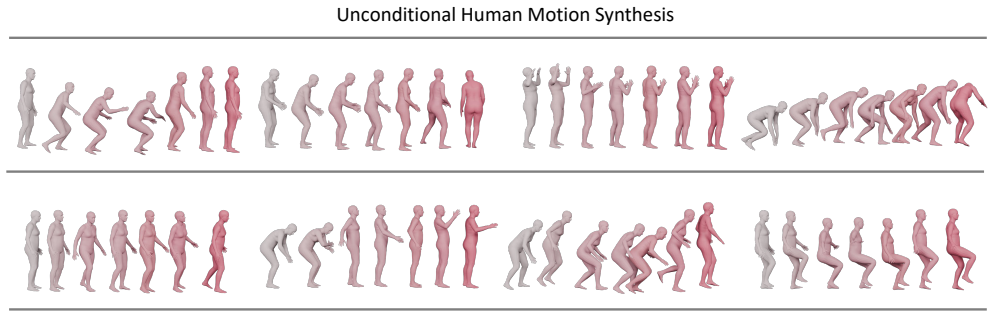
On the paper's own terms, the central claim is that accuracy and diversity can be decoupled: a deterministic ordinary differential equation (DerODE) maps Gaussian noise to the VQVAE latent space along straight paths, and a reverse stochastic differential equation (DivSDE) run only at sampling time turns that deterministic map into a diverse generator. The drift network is trained to predict the constant displacement $z_1 - z_0$ along optimal-transport couplings, with a drift-consistency regularizer that makes the prediction time-independent, so no score network is trained. At inference, DivSDE reuses the DerODE output $\hat{z}_{0,i}$ as the center of a Gaussian proxy score and adds controlled noise of strength $\eta$; larger $\eta$ gives more diversity. The paper reports that this two-stage recipe sets the best listed unconditional FID, KID, precision, recall, and diversity numbers on HumanAct12 and improves or matches conditional motion generation with tighter confidence intervals, all while using roughly half the parameters of the nearest baselines.
Load-bearing premise
The load-bearing premise is that the deterministic endpoint $\hat{z}_{0,i}$ from DerODE is a faithful proxy for the true latent motion distribution, so the reverse SDE's score computed from the Gaussian around $\hat{z}_{0,i}$ samples the correct distribution; the discrete update in Eq. 13 also references $z_{t,i}$ before it is updated, so as written the sampler is not directly implementable.
Editorial extensions
If this is right
- On HumanAct12 unconditional generation, DSDFM reports the best listed FID (12.86), KID (0.10), precision (0.75), recall (0.85), and diversity (18.41) while using 15M parameters, fewer than every compared baseline.
- On the action-to-motion task, DSDFM reports the best conditional FID (0.068 on HumanAct12) and accuracy (0.994) among compared methods, with tighter 95% confidence intervals on accuracy and diversity than MotionDiffuse.
- In the 500-epoch ablation, DSDFM cuts training time on HumanAct12 to 25.33 minutes versus 42.93 for VPSDE and 40.57 for VESDE, and at 500 inference steps reaches FID 12.86 compared to 15.63 and 14.92 for those SDE baselines.
- Because no score network is trained, the stochastic diversity stage can be tuned at sampling time by changing $\eta$, so a single trained model can move along the diversity-fidelity trade-off without retraining.
Reading between the lines
- Editorial inference: because DerODE and DivSDE operate entirely in a VQVAE latent space and never touch motion-specific structure, the same two-stage recipe should transfer to other continuous latent spaces such as images, video, or audio; the paper only demonstrates it on human motion.
- Editorial inference: the diversity strength $\eta$ is a one-parameter knob the paper does not sweep systematically; a natural testable extension is to plot FID versus diversity as $\eta$ varies and check whether the trade-off is monotone and where it saturates.
- Editorial inference: the shortcut of using the DerODE endpoint as the center of a Gaussian score can be read as amortized score estimation, which connects DSDFM to distillation and consistency-model ideas; the paper does not pursue that reading.
Signed reviews
Editorial analysis
A structured set of objections, weighed in public.
Referee Report
Summary. The paper introduces DSDFM, a two-stage generative model for conditional and unconditional human motion synthesis. Stage one trains a VQVAE to map human motion sequences into a discrete latent space. Stage two learns a deterministic transport map (DerODE) between a standard Gaussian prior and the latent motion distribution using an optimal-transport flow-matching objective with an additional drift-consistency loss. To increase sample diversity, the authors propose DivSDE, a training-free stochastic sampler that augments the deterministic ODE endpoint with a reverse-SDE-style update whose score term is computed from the DerODE output. Experiments on HumanAct12 and HumanML3D report state-of-the-art FID, KID, precision, recall, and diversity with fewer parameters than prior diffusion-based motion generators, together with reduced training and inference time.
Significance. If the proposed sampler were rigorously derived and reproducible, the core idea would be attractive: augmenting a deterministic flow-matching generator with a training-free stochastic refinement step that increases diversity without additional parameters is a practically valuable contribution. The use of optimal transport coupling and the drift-consistency regularizer for learning near-straight trajectories is also reasonable, and the authors provide proof sketches for Propositions 2 and 3. The conditional and unconditional evaluations cover standard benchmarks and compare against several recent methods. However, the central stochastic-sampling step, which underpins the headline diversity and parameter-efficiency claims, is not a well-defined stochastic process as written, and the reported numerical results therefore cannot be traced to the stated method.
major comments (4)
- [Eq. (13), Algorithm 1]
- [Proposition 3 and Eq. (13)]
- [Tables 1, 2, 5]
- [Section 4.2 and Table 2]
minor comments (6)
- [Eq. (13) vs. Algorithm 1]
- [Eqs. (6)-(7)]
- [Eq. (12), Appendix B]
- [Table 2]
- [Proposition 1]
- [General]
Circularity Check
DivSDE sampler in Eq. 13 is self-referential and its score proxy omits the eta^2 from Proposition 3, making the reported diversity mechanism not derivable as written; the training objective itself is not circular.
-
self definitional
[Section 4.2.2, Eq. (13); Algorithm 1 lines 6-10]
"Therefore, we can rewrite the discrete form of the backward process on DivSDE as follows: zi,t =zt+∆t,i + ∆t/1−tzt+∆t,i + 2t∆t/1−t (1−t)ez0,i−zt,i/t2 +ηε q 2t/1−t √ ∆t, (13)"
The left-hand side zi,t (equivalently zt,i) appears inside the score term on the right-hand side, ((1−t)ez0,i−zt,i)/t^2, so the new state is defined in terms of itself. Algorithm 1 confirms the self-reference: line 6 computes the score from zt,i before line 10 assigns zt,i. No fixed-point or implicit solver is supplied. Therefore the discrete reverse step is not an explicit Euler-Maruyama update and the stochastic output is not well-defined from the stated equations; the reported diversity samples cannot be traced to a well-posed process. This is a circular definition of the sampler's output.
-
other
[Section 4.2.2, Proposition 3 and Eq. (13); Algorithm 1 line 6]
"the probability of data distribution xt is p(zt) =N ((1−t)zi,η 2t2I) at the time step t ... Specifically, ∇ logp(zt) can be calculated via ∇ logp(zt) = (1−t)zi−zt/t2 ."
The implemented score is the score of N((1−t)zi, t^2I), i.e. η=1, not the score of the Proposition 3 marginal N((1−t)zi, η^2t^2I); the η^2 denominator is dropped while η is retained in the diffusion and noise terms. Additionally, zi is replaced by ez0,i = DerODE(ez1,i), the network's own deterministic prediction, rather than the true latent z0,i. Thus the reverse SDE does not sample the derived latent distribution: the diversity is generated by the hand-set additive noise term η·ε, so the diversity claim is effectively built into the chosen noise level rather than obtained from the stated stochastic process.
full rationale
DerODE training (Eqs. 5-10) is a standard optimal-transport flow-matching objective on real VQVAE latents: the drift target is z1−z0 from the OT coupling, and the consistency loss is a regularizer. This part is self-contained and not circular. The accuracy claims rest on an independently trained reconstruction model plus a flow network, and there is no fitted parameter renamed as a prediction and no load-bearing self-citation. The circularity is concentrated in the stochastic sampler: Eq. 13 defines zi,t in terms of zi,t on the RHS, and Algorithm 1 uses zt,i before assignment, with no implicit solve, so the update is not a well-defined Euler-Maruyama step. In addition, the score used in Eq. 13 and Algorithm 1 omits the η^2 from Proposition 3's variance η^2t^2I and uses the DerODE endpoint as a proxy for the true latent. These flaws are load-bearing for the diversity claim, but they are self-references and derivation errors rather than an attempt to pass a fitted quantity off as a prediction; the central training derivation is not circular.
Assumptions & free parameters
free parameters (3)
- lambda_cl =
0.3
- eta (diversity strength) =
0.1
- VQVAE codebook size =
512x512
assumptions (3)
- domain assumption The VQVAE latent space is approximately continuous so that a flow ODE and SDE in the codebook embedding space can transport the Gaussian prior to the data latent distribution.
- domain assumption The score of the latent data distribution can be approximated by the score of a Gaussian centered at the deterministic ODE output, specifically the proxy score used in Eq. 13 and Algorithm 1.
- standard math Standard Itô SDE existence and Fokker-Planck results used in Propositions 2 and 3 hold for the chosen drift and diffusion.
Cite this review
Pith. "Pith review of Deterministic-to-Stochastic Diverse Latent Feature Mapping for Human Motion Synthesis." pith.science (2026). https://pith.science/paper/JRR6GHUI
@misc{pith2026250500998,
  author       = {Pith},
  title        = {Pith review of: Deterministic-to-Stochastic Diverse Latent Feature Mapping for Human Motion Synthesis},
  year         = {2026},
  howpublished = {\url{https://pith.science/paper/JRR6GHUI}},
  note         = {Machine review of arXiv:2505.00998}
}
read the original abstract
Human motion synthesis aims to generate plausible human motion sequences, which has raised widespread attention in computer animation. Recent score-based generative models (SGMs) have demonstrated impressive results on this task. However, their training process involves complex curvature trajectories, leading to unstable training process. In this paper, we propose a Deterministic-to-Stochastic Diverse Latent Feature Mapping (DSDFM) method for human motion synthesis. DSDFM consists of two stages. The first human motion reconstruction stage aims to learn the latent space distribution of human motions. The second diverse motion generation stage aims to build connections between the Gaussian distribution and the latent space distribution of human motions, thereby enhancing the diversity and accuracy of the generated human motions. This stage is achieved by the designed deterministic feature mapping procedure with DerODE and stochastic diverse output generation procedure with DivSDE.DSDFM is easy to train compared to previous SGMs-based methods and can enhance diversity without introducing additional training parameters.Through qualitative and quantitative experiments, DSDFM achieves state-of-the-art results surpassing the latest methods, validating its superiority in human motion synthesis.
Figures


Figures from the paper (5 more)



Reference graph
Works this paper leans on
-
[1]
Listen, denoise, action! audio-driven motion synthesis with diffusion models
Simon Alexanderson, Rajmund Nagy, Jonas Beskow, and Gustav Eje Henter. Listen, denoise, action! audio-driven motion synthesis with diffusion models. ACM Transactions on Graphics (TOG), 42(4):1–20, 2023. 1
work page 2023
-
[2]
Implicit neural representations for variable length human motion generation
Pablo Cervantes, Yusuke Sekikawa, Ikuro Sato, and Koichi Shinoda. Implicit neural representations for variable length human motion generation. In European Conference on Com- puter Vision, pages 356–372. Springer, 2022. 2
work page 2022
-
[3]
Executing your commands via motion diffusion in latent space
Xin Chen, Biao Jiang, Wen Liu, Zilong Huang, Bin Fu, Tao Chen, and Gang Yu. Executing your commands via motion diffusion in latent space. In Proceedings of the IEEE/CVF Conference on Computer Vision and Pattern Recognition , pages 18000–18010, 2023. 2
2023
-
[4]
Empirical evaluation of gated recurrent neural networks on sequence modeling
Junyoung Chung, Caglar Gulcehre, KyungHyun Cho, and Yoshua Bengio. Empirical evaluation of gated recurrent neural networks on sequence modeling. arXiv preprint arXiv:1412.3555, 2014. 4
arXiv 2014
-
[5]
Efficient video prediction via sparsely conditioned flow matching
Aram Davtyan, Sepehr Sameni, and Paolo Favaro. Efficient video prediction via sparsely conditioned flow matching. In Proceedings of the IEEE/CVF International Conference on Computer Vision, pages 23263–23274, 2023. 2, 3
work page 2023
-
[6]
Diffusion models beat gans on image synthesis
Prafulla Dhariwal and Alexander Nichol. Diffusion models beat gans on image synthesis. Advances in neural information processing systems, 34:8780–8794, 2021. 3
2021
-
[7]
Wandr: Intention- guided human motion generation
Markos Diomataris, Nikos Athanasiou, Omid Taheri, Xi Wang, Otmar Hilliges, and Michael J Black. Wandr: Intention- guided human motion generation. In Proceedings of the IEEE/CVF Conference on Computer Vision and Pattern Recognition, pages 927–936, 2024. 1
work page 2024
-
[8]
Learning energy-based models by diffu- sion recovery likelihood
Ruiqi Gao, Yang Song, Ben Poole, Ying Nian Wu, and Diederik P Kingma. Learning energy-based models by diffu- sion recovery likelihood. arXiv preprint arXiv:2012.08125,
arXiv 2012
Show all 61 references
-
[9]
Ac- tion2motion: Conditioned generation of 3d human motions
Chuan Guo, Xinxin Zuo, Sen Wang, Shihao Zou, Qingyao Sun, Annan Deng, Minglun Gong, and Li Cheng. Ac- tion2motion: Conditioned generation of 3d human motions. In Proceedings of the 28th ACM International Conference on Multimedia, pages 2021–2029, 2020. 6, 13
2021
-
[10]
Generating diverse and natural 3d human motions from text
Chuan Guo, Shihao Zou, Xinxin Zuo, Sen Wang, Wei Ji, Xingyu Li, and Li Cheng. Generating diverse and natural 3d human motions from text. In Proceedings of the IEEE/CVF Conference on Computer Vision and Pattern Recognition , pages 5152–5161, 2022. 6, 13
2022
-
[11]
Momask: Generative masked modeling of 3d human motions
Chuan Guo, Yuxuan Mu, Muhammad Gohar Javed, Sen Wang, and Li Cheng. Momask: Generative masked modeling of 3d human motions. In Proceedings of the IEEE/CVF Conference on Computer Vision and Pattern Recognition, pages 1900– 1910, 2024. 2
1900
-
[12]
Denoising diffu- sion probabilistic models
Jonathan Ho, Ajay Jain, and Pieter Abbeel. Denoising diffu- sion probabilistic models. Advances in Neural Information Processing Systems, 33:6840–6851, 2020. 1, 2
2020
-
[13]
A deep learning framework for character motion synthesis and editing
Daniel Holden, Jun Saito, and Taku Komura. A deep learning framework for character motion synthesis and editing. ACM Transactions on Graphics (TOG), 35(4):1–11, 2016. 2
2016
-
[14]
Act as you wish: Fine-grained control of motion diffusion model with hierarchical semantic graphs
Peng Jin, Yang Wu, Yanbo Fan, Zhongqian Sun, Wei Yang, and Li Yuan. Act as you wish: Fine-grained control of motion diffusion model with hierarchical semantic graphs. Advances in Neural Information Processing Systems, 36, 2024. 1
2024
-
[15]
Audio2gestures: Generating di- verse gestures from speech audio with conditional variational autoencoders
Jing Li, Di Kang, Wenjie Pei, Xuefei Zhe, Ying Zhang, Zhenyu He, and Linchao Bao. Audio2gestures: Generating di- verse gestures from speech audio with conditional variational autoencoders. In Proceedings of the IEEE/CVF International Conference on Computer Vision, pages 11293–...
2021
-
[16]
Ai choreographer: Music conditioned 3d dance generation with aist++
Ruilong Li, Shan Yang, David A Ross, and Angjoo Kanazawa. Ai choreographer: Music conditioned 3d dance generation with aist++. In Proceedings of the IEEE/CVF International Conference on Computer Vision, pages 13401–13412, 2021. 1
2021
-
[17]
Learn to dance with aist++: Music conditioned 3d dance generation
Ruilong Li, Shan Yang, David A Ross, and Angjoo Kanazawa. Learn to dance with aist++: Music conditioned 3d dance generation. arXiv preprint arXiv:2101.08779, 2(3), 2021. 1
2021 arXiv
-
[18]
Motion-x: A large- scale 3d expressive whole-body human motion dataset
Jing Lin, Ailing Zeng, Shunlin Lu, Yuanhao Cai, Ruimao Zhang, Haoqian Wang, and Lei Zhang. Motion-x: A large- scale 3d expressive whole-body human motion dataset. In Advances in Neural Information Processing Systems, pages 25268–25280. Curran Associates, Inc., 2023. 1
2023
-
[19]
Flow matching for generative modeling
Yaron Lipman, Ricky TQ Chen, Heli Ben-Hamu, Maximilian Nickel, and Matt Le. Flow matching for generative modeling. arXiv preprint arXiv:2210.02747, 2022. 4
2022 arXiv
-
[20]
Yaron Lipman, Ricky T. Q. Chen, Heli Ben-Hamu, Maxim- ilian Nickel, and Matthew Le. Flow matching for genera- tive modeling. In The Eleventh International Conference on Learning Representations, 2023. 3, 4
2023
-
[21]
Exploiting variational domain- invariant user embedding for partially overlapped cross do- main recommendation
Weiming Liu, Xiaolin Zheng, Jiajie Su, Mengling Hu, Yan- chao Tan, and Chaochao Chen. Exploiting variational domain- invariant user embedding for partially overlapped cross do- main recommendation. In Proceedings of the 45th Interna- tional ACM SIGIR conference on research and...
2022
-
[22]
Joint internal multi-interest exploration and external domain alignment for cross domain sequential recommendation
Weiming Liu, Xiaolin Zheng, Chaochao Chen, Jiajie Su, Xint- ing Liao, Mengling Hu, and Yanchao Tan. Joint internal multi-interest exploration and external domain alignment for cross domain sequential recommendation. In Proceedings of the ACM web conference 2023, pages 383–394, 2023
2023
-
[23]
Contrastive proxy kernel stein path alignment for cross-domain cold-start recommenda- tion
Weiming Liu, Xiaolin Zheng, Jiajie Su, Longfei Zheng, Chaochao Chen, and Mengling Hu. Contrastive proxy kernel stein path alignment for cross-domain cold-start recommenda- tion. IEEE Transactions on Knowledge and Data Engineering, 35(11):11216–11230, 2023
2023
-
[24]
User distribution map- ping modelling with collaborative filtering for cross domain recommendation
Weiming Liu, Chaochao Chen, Xinting Liao, Mengling Hu, Jiajie Su, Yanchao Tan, and Fan Wang. User distribution map- ping modelling with collaborative filtering for cross domain recommendation. In Proceedings of the ACM Web Conference 2024, pages 334–343, 2024
2024
-
[25]
Learning accurate and bidirectional transformation via dy- namic embedding transportation for cross-domain recommen- dation
Weiming Liu, Chaochao Chen, Xinting Liao, Mengling Hu, Yanchao Tan, Fan Wang, Xiaolin Zheng, and Yew Soon Ong. Learning accurate and bidirectional transformation via dy- namic embedding transportation for cross-domain recommen- dation. In Proceedings of the AAAI Conference on ...
2024
-
[26]
Reducing item discrepancy via differentially private robust embedding alignment for privacy-preserving cross domain recommendation
Weiming Liu, Xiaolin Zheng, Chaochao Chen, Jiahe Xu, Xinting Liao, Fan Wang, Yanchao Tan, and Yew-Soon Ong. Reducing item discrepancy via differentially private robust embedding alignment for privacy-preserving cross domain recommendation. In Forty-first International Conferen...
2024
-
[27]
Flow straight and fast: Learning to generate and transfer data with rectified flow
Xingchao Liu, Chengyue Gong, and Qiang Liu. Flow straight and fast: Learning to generate and transfer data with rectified flow. arXiv preprint arXiv:2209.03003, 2022. 2, 3
2022 arXiv
-
[28]
Audio-driven co-speech gesture video generation
Xian Liu, Qianyi Wu, Hang Zhou, Yuanqi Du, Wayne Wu, Dahua Lin, and Ziwei Liu. Audio-driven co-speech gesture video generation. Advances in Neural Information Processing Systems, 35:21386–21399, 2022. 1
2022
-
[29]
Amass: Archive of motion capture as surface shapes
Naureen Mahmood, Nima Ghorbani, Nikolaus F Troje, Ger- ard Pons-Moll, and Michael J Black. Amass: Archive of motion capture as surface shapes. In Proceedings of the IEEE/CVF international conference on computer vision, pages 5442–5451, 2019. 6
2019
-
[30]
Symbolic music generation with diffusion models
Gautam Mittal, Jesse Engel, Curtis Hawthorne, and Ian Si- mon. Symbolic music generation with diffusion models. In Proceedings of the 22nd International Society for Music In- formation Retrieval Conference, 2021. 3
2021
-
[31]
Conditional image synthesis with auxiliary clas- sifier gans
Odena et al. Conditional image synthesis with auxiliary clas- sifier gans. In International conference on machine learning, pages 2642–2651. PMLR, 2017. 1
2017
-
[32]
Action- conditioned 3d human motion synthesis with transformer vae
Mathis Petrovich, Michael J Black, and G ¨ul Varol. Action- conditioned 3d human motion synthesis with transformer vae. In Proceedings of the IEEE/CVF International Conference on Computer Vision, pages 10985–10995, 2021. 1
2021
-
[33]
Temos: Generating diverse human motions from textual descriptions
Mathis Petrovich, Michael J Black, and G ¨ul Varol. Temos: Generating diverse human motions from textual descriptions. In European Conference on Computer Vision, pages 480–497. Springer, 2022. 1
2022
-
[34]
Computational optimal transport: With applications to data science
Gabriel Peyr´e, Marco Cuturi, et al. Computational optimal transport: With applications to data science. Foundations and Trends® in Machine Learning, 11(5-6):355–607, 2019. 4
2019
-
[35]
Modi: Uncondi- tional motion synthesis from diverse data
Sigal Raab, Inbal Leibovitch, Peizhuo Li, Kfir Aberman, Olga Sorkine-Hornung, and Daniel Cohen-Or. Modi: Uncondi- tional motion synthesis from diverse data. In Proceedings of the IEEE/CVF Conference on Computer Vision and Pattern Recognition, pages 13873–13883, 2023. 1, 2
2023
-
[36]
Assessing generative models via precision and recall
Mehdi SM Sajjadi, Olivier Bachem, Mario Lucic, Olivier Bousquet, and Sylvain Gelly. Assessing generative models via precision and recall. Advances in neural information processing systems, 31, 2018. 13
2018
-
[37]
Denoising diffusion implicit models
Jiaming Song, Chenlin Meng, and Stefano Ermon. Denoising diffusion implicit models. arXiv preprint arXiv:2010.02502,
2010 arXiv
-
[38]
Improved techniques for training score-based generative models
Yang Song and Stefano Ermon. Improved techniques for training score-based generative models. Advances in neural information processing systems, 33:12438–12448, 2020. 3
2020
-
[39]
SCORE-BASED GENERATIVE MODELING THROUGH STOCHASTIC DIFFERENTIAL EQUATIONS
Yang Song, Jascha Sohl-Dickstein, Diederik P Kingma, Abhishek Kumar, Stefano Ermon, and Ben Poole. SCORE-BASED GENERATIVE MODELING THROUGH STOCHASTIC DIFFERENTIAL EQUATIONS. 2021. 1, 2, 3, 4, 5
2021
-
[40]
Consistency models
Yang Song, Prafulla Dhariwal, Mark Chen, and Ilya Sutskever. Consistency models. arXiv preprint arXiv:2303.01469, 2023. 5
2023 arXiv
-
[41]
Action-guided 3d human motion pre- diction
Jiangxin Sun, Zihang Lin, Xintong Han, Jian-Fang Hu, Jia Xu, and Wei-Shi Zheng. Action-guided 3d human motion pre- diction. Advances in Neural Information Processing Systems, 34:30169–30180, 2021. 2
2021
-
[42]
Modeling human visual motion processing with trainable motion energy sensing and a self-attention network
Zitang Sun, Yen-Ju Chen, Yung-Hao Yang, and Shin ' ya Nishida. Modeling human visual motion processing with trainable motion energy sensing and a self-attention network. In Advances in Neural Information Processing Systems, pages 24335–24348. Curran Associates, Inc., 2023. 2
2023
-
[43]
Motion to dance music generation using latent diffusion model
Vanessa Tan, Junghyun Nam, Juhan Nam, and Junyong Noh. Motion to dance music generation using latent diffusion model. In SIGGRAPH Asia 2023 Technical Communica- tions, New York, NY , USA, 2023. Association for Computing Machinery. 2
2023
-
[44]
Temporal continual learning with prior compensation for human motion prediction
Jianwei Tang, Jiangxin Sun, Xiaotong Lin, Wei-Shi Zheng, Jian-Fang Hu, et al. Temporal continual learning with prior compensation for human motion prediction. Advances in Neural Information Processing Systems, 36, 2024. 1
2024
-
[45]
Guy Tevet, Sigal Raab, Brian Gordon, Yonatan Shafir, Daniel Cohen-Or, and Amit H. Bermano. Human Motion Diffusion Model, 2022. arXiv:2209.14916 [cs]. 2
2022 arXiv
-
[46]
Score-based generative modeling in latent space
Arash Vahdat, Karsten Kreis, and Jan Kautz. Score-based generative modeling in latent space. Advances in neural information processing systems, 34:11287–11302, 2021. 1, 3
2021
-
[47]
Neural discrete representation learning
Aaron Van Den Oord, Oriol Vinyals, et al. Neural discrete representation learning. Advances in neural information pro- cessing systems, 30, 2017. 2, 4
2017
-
[48]
Attention is all you need
Ashish Vaswani, Noam Shazeer, Niki Parmar, Jakob Uszko- reit, Llion Jones, Aidan N Gomez, Łukasz Kaiser, and Illia Polosukhin. Attention is all you need. Advances in neural information processing systems, 30, 2017. 4
2017
-
[49]
Incomplete multimodality-diffused emotion recognition
Yuanzhi Wang, Yong Li, and Zhen Cui. Incomplete multimodality-diffused emotion recognition. Advances in Neural Information Processing Systems, 36, 2024. 1
2024
-
[50]
Humanise: Language-conditioned human motion generation in 3d scenes
Zan Wang, Yixin Chen, Tengyu Liu, Yixin Zhu, Wei Liang, and Siyuan Huang. Humanise: Language-conditioned human motion generation in 3d scenes. In Advances in Neural In- formation Processing Systems, pages 14959–14971. Curran Associates, Inc., 2022. 2
2022
-
[51]
Human joint kinematics diffusion-refinement for stochastic motion prediction
Dong Wei, Huaijiang Sun, Bin Li, Jianfeng Lu, Weiqing Li, Xiaoning Sun, and Shengxiang Hu. Human joint kinematics diffusion-refinement for stochastic motion prediction. In Proceedings of the AAAI Conference on Artificial Intelligence, pages 6110–6118, 2023. 1
2023
-
[52]
Fast point cloud gener- ation with straight flows
Lemeng Wu, Dilin Wang, Chengyue Gong, Xingchao Liu, Yunyang Xiong, Rakesh Ranjan, Raghuraman Krishnamoor- thi, Vikas Chandra, and Qiang Liu. Fast point cloud gener- ation with straight flows. In Proceedings of the IEEE/CVF conference on computer vision and pattern recognition,...
2023
-
[53]
Mt-vae: Learning motion transformations to generate multimodal human dynamics
Xinchen Yan, Akash Rastogi, Ruben Villegas, Kalyan Sunkavalli, Eli Shechtman, Sunil Hadap, Ersin Yumer, and Honglak Lee. Mt-vae: Learning motion transformations to generate multimodal human dynamics. In Proceedings of the European conference on computer vision (ECCV), pages 26...
2018
-
[54]
Toward realistic 3d human motion prediction with a spatio-temporal cross- transformer approach
Hua Yu, Xuanzhe Fan, Yaqing Hou, Wenbin Pei, Hongwei Ge, Xin Yang, Dongsheng Zhou, Qiang Zhang, and Mengjie Zhang. Toward realistic 3d human motion prediction with a spatio-temporal cross- transformer approach. IEEE Transac- tions on Circuits and Systems for Video Technology, ...
2023
-
[55]
Divdiff: A conditional diffusion model for diverse human motion prediction
Hua Yu, Yaqing Hou, Wenbin Pei, Yew-Soon Ong, and Qiang Zhang. Divdiff: A conditional diffusion model for diverse human motion prediction. IEEE Transactions on Multimedia, pages 1–12, 2024. 2
2024
-
[56]
Towards efficient and diverse generative model for unconditional human motion synthesis
Hua Yu, Weiming Liu, Jiapeng Bai, Xu Gui, Yaqing Hou, YewSoon Ong, and Qiang Zhang. Towards efficient and diverse generative model for unconditional human motion synthesis. In Proceedings of the 32nd ACM International Conference on Multimedia, page 2535–2544, New York, NY , US...
2024
-
[57]
Dlow: Diversifying latent flows for diverse human motion prediction
Yuan et al. Dlow: Diversifying latent flows for diverse human motion prediction. In Computer Vision–ECCV 2020: 16th European Conference, Glasgow, UK, August 23–28, 2020, Proceedings, Part IX 16, pages 346–364. Springer, 2020. 1
2020
-
[58]
Physdiff: Physics-guided human motion diffusion model
Ye Yuan, Jiaming Song, Umar Iqbal, Arash Vahdat, and Jan Kautz. Physdiff: Physics-guided human motion diffusion model. In Proceedings of the IEEE/CVF International Con- ference on Computer Vision, pages 16010–16021, 2023. 1
2023
-
[59]
Generating human motion from textual descriptions with dis- crete representations
Jianrong Zhang, Yangsong Zhang, Xiaodong Cun, Yong Zhang, Hongwei Zhao, Hongtao Lu, Xi Shen, and Ying Shan. Generating human motion from textual descriptions with dis- crete representations. In Proceedings of the IEEE/CVF Con- ference on Computer Vision and Pattern Recognition...
2023
-
[60]
We are more than our joints: Predicting how 3d bodies move
Yan Zhang, Michael J Black, and Siyu Tang. We are more than our joints: Predicting how 3d bodies move. In Proceed- ings of the IEEE/CVF Conference on Computer Vision and Pattern Recognition, pages 3372–3382, 2021. 1
2021
-
[61]
Motiongpt: Finetuned llms are general-purpose motion gen- erators
Yaqi Zhang, Di Huang, Bin Liu, Shixiang Tang, Yan Lu, Lu Chen, Lei Bai, Qi Chu, Nenghai Yu, and Wanli Ouyang. Motiongpt: Finetuned llms are general-purpose motion gen- erators. In Proceedings of the AAAI Conference on Artificial Intelligence, pages 7368–7376, 2024. 1 Appendix ...
2024
Reviewed August 16, 2026 · model on record in the stance chip above.
Discussion (0). Continue with ORCID to comment.