Active Sybil attack and efficient defense strategy in IPFS DHT
Pith reviewed 2026-05-22 17:40 UTC · model grok-4.3
The pith
An active Sybil attack returns false data to eclipse IPFS content and evades current defenses in roughly 80 percent of lookups.
A machine-rendered reading of the paper's core claim, the machinery that carries it, and where it could break.
Core claim
The paper establishes that malicious nodes can perform an active Sybil attack by returning semantically correct yet intentionally false data, fully eclipsing content on recent Kubo IPFS versions through strategic placement that evades detection and by exploiting early termination of lookups. This attack succeeds in denying access to target content in approximately 80 percent of attempts even against the latest mitigation that combines statistical tests with wider publication. To counter it, the paper proposes SR-DHT-Store, which performs systematic region-based queries using a dynamically computed XOR distance to the target ID, thereby enabling efficient Sybil-resistant content publication,
What carries the argument
SR-DHT-Store, a content-publication method that issues systematic region-based queries based on a dynamically computed XOR distance to the target ID to achieve Sybil resistance without attack detection.
If this is right
- The active attack fully eclipses content on recent versions of the Kubo IPFS client.
- The attack denies access in approximately 80 percent of lookup attempts even when the latest statistical-detection-plus-wider-publication mitigation is active.
- SR-DHT-Store mitigates both the new active attack and prior passive Sybil attacks without depending on attack detection.
- The new method operates at lower overhead than detection-based approaches and supports incremental deployment.
- SR-DHT-Store can be combined with other defenses for layered protection.
Where Pith is reading between the lines
- The same region-query approach could be tested in other Kademlia-based systems to see whether it reduces eclipse success rates without IPFS-specific changes.
- A simulation that varies Sybil density while measuring lookup success with SR-DHT-Store would quantify the exact overhead savings claimed.
- Layering SR-DHT-Store with lightweight statistical checks might create a hybrid defense that catches novel attack variants the paper does not evaluate.
Load-bearing premise
The attack depends on being able to place Sybil nodes strategically enough to evade statistical detection while also relying on early termination of lookups inside the actual Kubo implementation.
What would settle it
Deploy the described active Sybil nodes against a target content item in a test network that uses the current mitigation and count how often a normal lookup succeeds; success rates consistently above 20 percent would contradict the reported denial rate.
Figures





read the original abstract
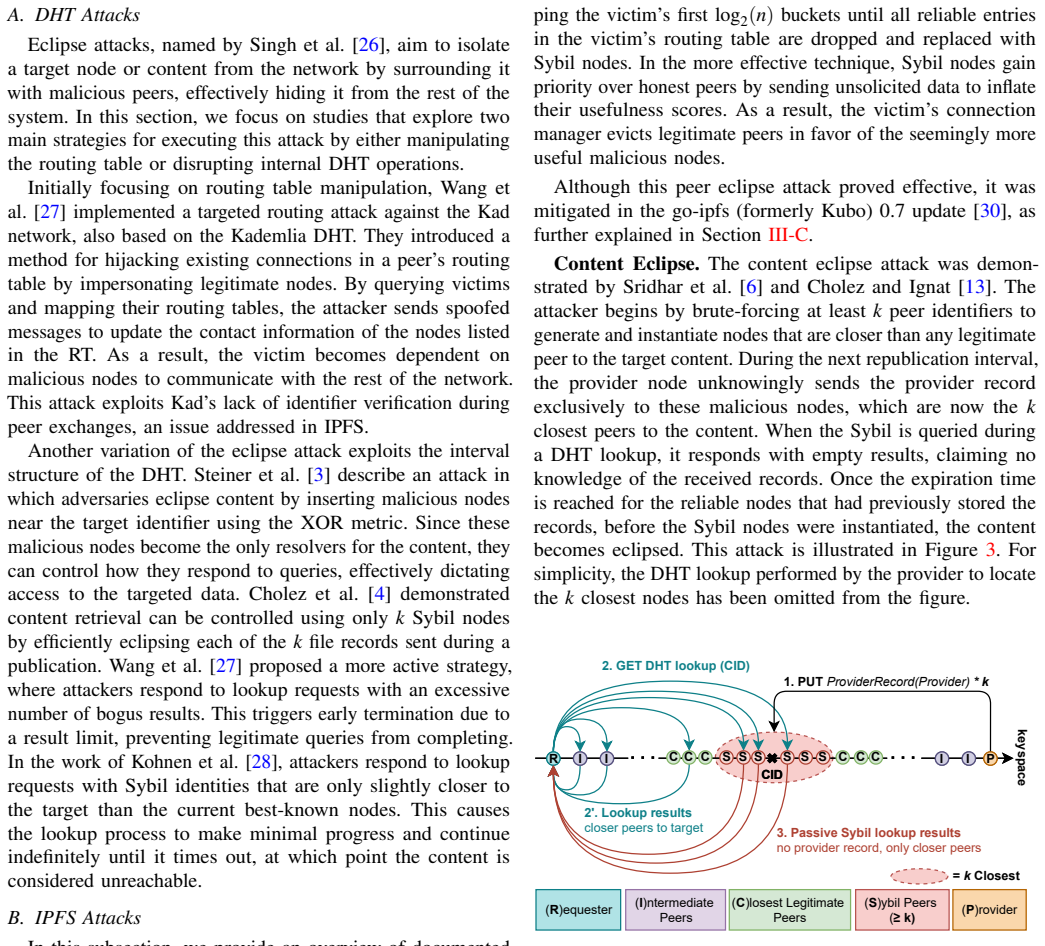
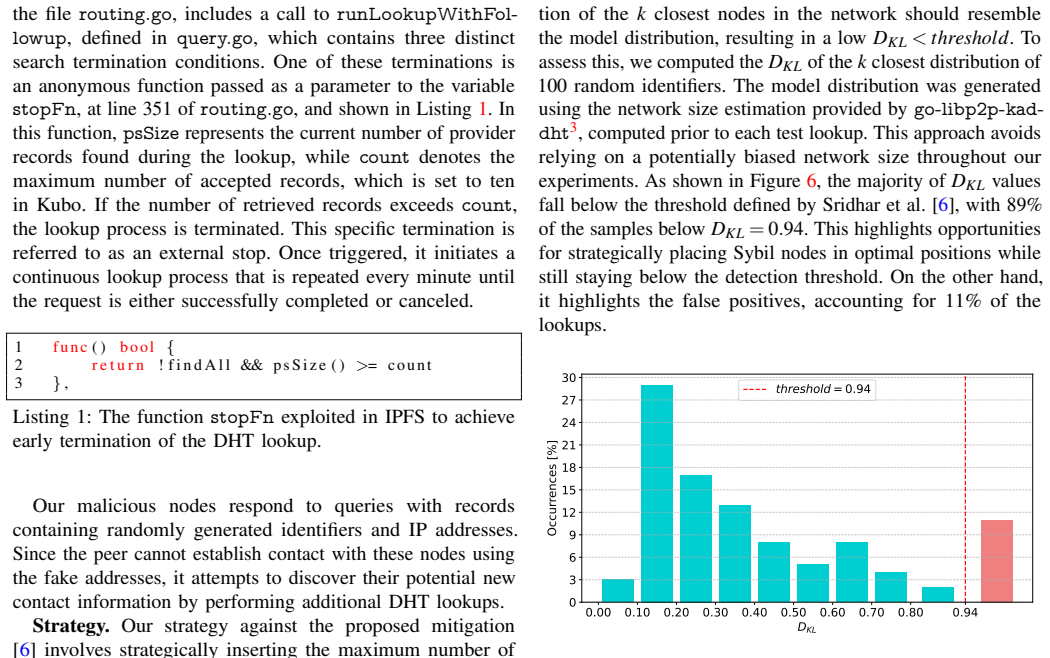
The InterPlanetary File System (IPFS) is a decentralized peer-to-peer (P2P) storage built on Kademlia, a Distributed Hash Table (DHT) structure commonly used in P2P systems and known for its proved scalability. However, DHTs susceptible to Sybil attacks, where a single entity controls multiple malicious nodes. Recent studies have shown that IPFS is affected by a passive content eclipse attack, leveraging Sybils, in which adversarial nodes hide received indexed information from other peers, making the content appear unavailable. Fortunately, the latest mitigation strategy coupling an attack detection based on statistical tests and a wider publication strategy upon detection was able to circumvent it. In this work, we present a new active attack in which malicious nodes return semantically correct but intentionally false data. The attack leverages strategic Sybil placement to evade detection and exploits an early termination in the actual Kubo, the main IPFS implementation. It achieves to fully eclipse content on recent Kubo versions. When evaluated against the most recent known mitigation, it successfully denies access to the target content in approximately 80% of lookup attempts. To address this vulnerability, we propose a new mitigation called SR-DHT-Store, which enables efficient, Sybil-resistant content publication without relying on attack detection. Instead, it uses systematic and precise use of region-based queries based on a dynamically computed XOR distance to the target ID. SR-DHT-Store can be combined with other defense mechanisms, fully mitigating passive and active Sybil attacks at a lower overhead while supporting an incremental deployment.
Editorial analysis
A structured set of objections, weighed in public.
Referee Report
Summary. The paper claims to introduce a new active Sybil attack on IPFS DHT in which malicious nodes return semantically correct but intentionally false data. The attack uses strategic Sybil placement to evade statistical detection from prior work and exploits an early termination in the actual Kubo implementation (distinct from the spec) to fully eclipse content on recent versions. When tested against the most recent known mitigation, it denies access in approximately 80% of lookup attempts. The authors propose SR-DHT-Store as a new defense that performs systematic region-based queries using a dynamically computed XOR distance to the target ID, enabling efficient Sybil-resistant publication without attack detection and supporting incremental deployment while mitigating both passive and active attacks at lower overhead.
Significance. If the central experimental claims are substantiated, the work would be significant for identifying a practical active attack vector that bypasses existing statistical defenses in a production DHT used by IPFS, and for proposing a detection-independent mitigation that is efficient, combinable with other mechanisms, and incrementally deployable. This could have direct implications for the security of decentralized storage and other Kademlia-based P2P systems.
major comments (2)
- [Attack description and evaluation] The central performance claims rest on an asserted early termination in Kubo's actual DHT lookup logic that accepts semantically correct but false responses before full verification or wider queries complete. No code citation, version hash, execution trace, or specific condition (e.g., in provider or value lookup paths) is supplied to demonstrate that this termination exists in the tested Kubo versions and enables the attack.
- [Evaluation against mitigation] The reported 80% denial rate against the prior mitigation is presented without any description of the experimental setup, number of trials, statistical significance, measurement methodology for lookup attempts, or controls for network conditions. This makes the quantitative result difficult to verify or reproduce from the manuscript.
minor comments (2)
- [Abstract] The abstract and introduction could more precisely define what constitutes 'semantically correct but intentionally false data' with a brief example of the crafted response format.
- [SR-DHT-Store description] Notation for the dynamically computed XOR distance in SR-DHT-Store should be introduced with an equation or pseudocode in the mitigation section for clarity.
Simulated Author's Rebuttal
We thank the referee for their thorough review and valuable feedback on our manuscript. We appreciate the opportunity to clarify and strengthen our presentation of the active Sybil attack and the proposed SR-DHT-Store defense. Below, we provide point-by-point responses to the major comments.
read point-by-point responses
-
Referee: [Attack description and evaluation] The central performance claims rest on an asserted early termination in Kubo's actual DHT lookup logic that accepts semantically correct but false responses before full verification or wider queries complete. No code citation, version hash, execution trace, or specific condition (e.g., in provider or value lookup paths) is supplied to demonstrate that this termination exists in the tested Kubo versions and enables the attack.
Authors: We agree that the manuscript requires additional technical details to substantiate the early termination claim. In the revised version, we will add the specific Kubo version hashes tested, direct citations to the relevant source code paths (e.g., in the provider and value lookup functions), and a description or pseudocode of the termination condition that accepts semantically correct but false responses before full verification completes. revision: yes
-
Referee: [Evaluation against mitigation] The reported 80% denial rate against the prior mitigation is presented without any description of the experimental setup, number of trials, statistical significance, measurement methodology for lookup attempts, or controls for network conditions. This makes the quantitative result difficult to verify or reproduce from the manuscript.
Authors: We acknowledge that the evaluation section lacks sufficient methodological detail. In the revised manuscript, we will include a complete description of the experimental setup, the number of trials, statistical significance measures, the exact methodology for counting denied lookup attempts, and controls for network conditions to support reproducibility of the 80% denial rate. revision: yes
Circularity Check
No significant circularity; claims rest on external implementation details and empirical evaluation
full rationale
The paper describes an active Sybil attack that exploits an early termination in the Kubo DHT lookup implementation and evaluates its success rate against a previously published mitigation strategy, then proposes SR-DHT-Store as a new defense using region-based queries and dynamic XOR distances. No load-bearing step reduces by construction to a fitted parameter, self-citation chain, or renamed input; the attack success and mitigation overhead are presented as externally testable via code inspection and experiments rather than derived tautologically from the paper's own assumptions. This is the normal case of a self-contained empirical security paper.
Axiom & Free-Parameter Ledger
axioms (1)
- domain assumption IPFS DHT is based on Kademlia and susceptible to Sybil attacks
Lean theorems connected to this paper
-
IndisputableMonolith/Foundation/Cost/FunctionalEquation.leanwashburn_uniqueness_aczel unclear?
unclearRelation between the paper passage and the cited Recognition theorem.
The attack leverages strategic Sybil placement to evade detection and exploits an early termination in the actual Kubo implementation... SR-DHT-Store uses systematic and precise use of region-based queries based on a dynamically computed XOR distance
-
IndisputableMonolith/Foundation/AbsoluteFloorClosure.leanabsolute_floor_iff_bare_distinguishability unclear?
unclearRelation between the paper passage and the cited Recognition theorem.
attack detection using the K-L Divergence... region-based queries... minCPL = ⌈log₂(N/k)⌉
What do these tags mean?
- matches
- The paper's claim is directly supported by a theorem in the formal canon.
- supports
- The theorem supports part of the paper's argument, but the paper may add assumptions or extra steps.
- extends
- The paper goes beyond the formal theorem; the theorem is a base layer rather than the whole result.
- uses
- The paper appears to rely on the theorem as machinery.
- contradicts
- The paper's claim conflicts with a theorem or certificate in the canon.
- unclear
- Pith found a possible connection, but the passage is too broad, indirect, or ambiguous to say the theorem truly supports the claim.
Reference graph
Works this paper leans on
-
[1]
J. R. Douceur, “The Sybil Attack,” inRevised Papers from the First Inter- national Workshop on Peer-to-Peer Systems, ser. IPTPS ’01. Springer- Verlag, 2002, pp. 251–260
work page 2002
-
[2]
Kademlia: A Peer-to-Peer Information System Based on the XOR Metric,
P. Maymounkov and D. Mazi`eres, “Kademlia: A Peer-to-Peer Information System Based on the XOR Metric,” inRevised Papers from the First International Workshop on Peer-to-Peer Systems, ser. IPTPS ’01. Springer-Verlag, 2003, pp. 53–65
work page 2003
-
[3]
Exploiting KAD: possible uses and misuses,
M. Steiner, T. En-Najjary, and E. W. Biersack, “Exploiting KAD: possible uses and misuses,”ACM SIGCOMM Computer Communication Review, vol. 37, no. 5, pp. 65–70, 2007. [Online]. Available: https://dl.acm.org/doi/10.1145/1290168.1290176
-
[4]
Monitoring and Controlling Content Access in KAD,
T. Cholez, I. Chrisment, and O. Festor, “Monitoring and Controlling Content Access in KAD,” in2010 IEEE International Conference on Communications, 2010, pp. 1–6. [Online]. Available: https: //ieeexplore.ieee.org/document/5502179
-
[5]
Detection and mitigation of localized attacks in a widely deployed P2P network,
T. Cholez, I. Chrisment, O. Festor, and G. Doyen, “Detection and mitigation of localized attacks in a widely deployed P2P network,” Peer-to-Peer Networking and Applications, vol. 6, no. 2, pp. 155–174,
-
[6]
Available: https://doi.org/10.1007/s12083-012-0137-7
[Online]. Available: https://doi.org/10.1007/s12083-012-0137-7
-
[7]
Content Censorship in the InterPlanetary File System,
S. Sridhar, O. Ascigil, N. Keizer, F. Genon, S. Pierre, Y . Psaras, E. Rivi `ere, and M. Kr ´ol, “Content Censorship in the InterPlanetary File System,” inProceedings 2024 Network and Distributed System Security Symposium, 2024. [Online]. Available: http://arxiv.org/abs/2307.12212
-
[8]
IPFS - Content Addressed, Versioned, P2P File System,
J. Benet, “IPFS - Content Addressed, Versioned, P2P File System,”
-
[9]
IPFS - Content Addressed, Versioned, P2P File System
[Online]. Available: http://arxiv.org/abs/1407.3561
work page internal anchor Pith review Pith/arXiv arXiv
-
[10]
“ipfs/kubo,” IPFS Project, 2025. [Online]. Available: https://github.com/i pfs/kubo
work page 2025
-
[11]
“Berty · Berty Technologies,” Berty Technologies, 2025, accessed: 2025-02-03. [Online]. Available: https://berty.tech
work page 2025
- [12]
-
[13]
A decentralized storage network for the world’s information,
Filecoin, “A decentralized storage network for the world’s information,” Filecoin, 2025, accessed: 2025-04-15. [Online]. Available: https: //filecoin.io/
work page 2025
-
[14]
libp2p - a modular network stack,
“libp2p - a modular network stack,” libp2p, 2025, accessed: 2025-02-03. [Online]. Available: https://libp2p.io/
work page 2025
-
[15]
Sybil Attack Strikes Again: Denying Content Access in IPFS with a Single Computer,
T. Cholez and C.-L. Ignat, “Sybil Attack Strikes Again: Denying Content Access in IPFS with a Single Computer,” inARES ’24: Proceedings of the 19th International Conference on Availability, Reliability and Security. ACM, 2024, pp. 1–7. [Online]. Available: https://inria.hal.science/hal-04666290
work page 2024
-
[16]
Blockchain-Based File Replication for Data Availability of IPFS Consumers,
F. Yang, Z. Ding, L. Jia, Y . Sun, and Q. Zhu, “Blockchain-Based File Replication for Data Availability of IPFS Consumers,”IEEE Transactions on Consumer Electronics, vol. 70, no. 1, pp. 1191–1204,
-
[17]
Available: https://ieeexplore.ieee.org/document/10430473
[Online]. Available: https://ieeexplore.ieee.org/document/10430473
-
[18]
Tackling Data Mining Risks: A Tripartite Covert Channel Merging Blockchain and IPFS,
Z. Chen, L. Zhu, P. Jiang, J. He, and Z. Zhang, “Tackling Data Mining Risks: A Tripartite Covert Channel Merging Blockchain and IPFS,”IEEE Transactions on Network Science and Engineering, vol. 12, no. 3, pp. 1831–1848, 2025. [Online]. Available: https: //ieeexplore.ieee.org/abstract/document/10878429
-
[19]
S/Kademlia: A practicable approach towards secure title-based routing,
I. Baumgart and S. Mies, “S/Kademlia: A practicable approach towards secure title-based routing,” in2007 International Conference on Parallel and Distributed Systems, 2007, pp. 1–8. [Online]. Available: https://ieeexplore.ieee.org/document/4447808
-
[20]
Pinata — crypto’s file storage,
“Pinata — crypto’s file storage,” 2025, accessed: 2025-07-10. [Online]. Available: https://pinata.cloud/
work page 2025
-
[21]
Filebase — the interplanetary development platform,
“Filebase — the interplanetary development platform,” 2025, accessed: 2025-07-10. [Online]. Available: https://filebase.com/
work page 2025
-
[22]
Merkle directed acyclic graphs (dag) — ipfs docs,
“Merkle directed acyclic graphs (dag) — ipfs docs,” 2025, accessed: 2025- 01-08. [Online]. Available: https://docs.ipfs.tech/concepts/merkle-dag/ 16
work page 2025
-
[23]
“Multiformats,” 2025, accessed: 2025-04-17. [Online]. Available: https://multiformats.io/
work page 2025
-
[24]
Work with pinning services — IPFS Docs,
“Work with pinning services — IPFS Docs,” 2025, accessed: 2025-01-24. [Online]. Available: https://docs.ipfs.tech/how-to/work-with-pinning-ser vices/
work page 2025
-
[25]
“Multiaddr — multiformats,” 2025, accessed: 2025-01-08. [Online]. Available: https://multiformats.io/multiaddr
work page 2025
-
[26]
go-libp2p-kad-dht/amino/defaults.go at master · libp2p/go-libp2p- kad-dht,
“go-libp2p-kad-dht/amino/defaults.go at master · libp2p/go-libp2p- kad-dht,” 2025, accessed: 2025-07-29. [Online]. Available: https: //github.com/libp2p/go-libp2p-kad-dht/blob/31c361257e16379b6dee2f c2981f75ea0935a102/amino/defaults.go
work page 2025
-
[27]
Distributed hash tables (dht) — ipfs docs,
“Distributed hash tables (dht) — ipfs docs,” 2025, accessed: 2025-07-29. [Online]. Available: https://docs.ipfs.tech/concepts/dht/
work page 2025
-
[28]
“Bitswap — IPFS Docs,” 2025, accessed: 2025-01-29. [Online]. Available: https://docs.ipfs.tech/concepts/bitswap/
work page 2025
-
[29]
Eclipse Attacks on Overlay Networks: Threats and Defenses,
A. Singh, T.-W. Ngan, P. Druschel, and D. S. Wallach, “Eclipse Attacks on Overlay Networks: Threats and Defenses,” inProceedings IEEE INFOCOM 2006. 25TH IEEE International Conference on Computer Communications, 2006, pp. 1–12. [Online]. Available: https://ieeexplore.ieee.org/document/4146884
-
[30]
P. Wang, J. Tyra, E. Chan-Tin, T. Malchow, D. F. Kune, N. Hopper, and Y . Kim, “Attacking the Kad network,” inProceedings of the 4th international conference on Security and privacy in communication netowrks, ser. SecureComm ’08. Association for Computing Machinery, 2008, pp. 1–10. [Online]. Available: https://dl.acm.org/doi/10.1145/1460877.1460907
-
[31]
Conducting and Optimizing Eclipse Attacks in the Kad Peer-to-Peer Network,
M. Kohnen, M. Leske, and E. P. Rathgeb, “Conducting and Optimizing Eclipse Attacks in the Kad Peer-to-Peer Network,” inProceedings of the 8th International IFIP-TC 6 Networking Conference, ser. NETWORKING ’09. Springer-Verlag, 2009, pp. 104–116. [Online]. Available: https://doi.org/10.1007/978-3-642-01399-7 9
-
[32]
Total Eclipse of the Heart – Disrupting the InterPlanetary File System,
B. Pr ¨unster, A. Marsalek, and T. Zefferer, “Total Eclipse of the Heart – Disrupting the InterPlanetary File System,” in31st USENIX Security Symposium, USENIX Security 2022. USENIX Association, 2022, pp. 3735–3752. [Online]. Available: https: //www.usenix.org/conference/usenixsecurity22/presentation/prunster
work page 2022
-
[33]
Hardening the ipfs public dht against eclipse attacks,
“Hardening the ipfs public dht against eclipse attacks,” IPFS Blog & News, 2020, accessed: 2025-02-08. [Online]. Available: https://blog.ipfs.tech/2020-10-30-dht-hardening/
work page 2020
-
[34]
“Peer diversity for routing table and querying by aarshkshah1992 · pull request #88 · libp2p/go-libp2p-kbucket,” GitHub, 2025, accessed: 2025-02-09. [Online]. Available: https://github.com/libp2p/go-libp2p-k bucket/pull/88
work page 2025
-
[35]
Release v0.34.0 · libp2p/go-libp2p,
“Release v0.34.0 · libp2p/go-libp2p,” GitHub, 2025, accessed: 2025-02-
work page 2025
-
[36]
Available: https://github.com/libp2p/go-libp2p/releases/tag /v0.34.0
[Online]. Available: https://github.com/libp2p/go-libp2p/releases/tag /v0.34.0
-
[37]
Where are the hard knapsack problems?
D. Pisinger, “Where are the hard knapsack problems?”Computers & Operations Research, vol. 32, no. 9, pp. 2271–2284, 2005. [Online]. Available: https://www.sciencedirect.com/science/article/pii/S030505480 400036X
work page 2005
-
[38]
Edwards-Curve Digital Signature Algorithm (EdDSA),
S. Josefsson and I. Liusvaara, “Edwards-Curve Digital Signature Algorithm (EdDSA),” 2017. [Online]. Available: https://datatracker.ietf.o rg/doc/rfc8032
work page 2017
-
[39]
The Exponentially Weighted Moving Average,
J. S. Hunter, “The Exponentially Weighted Moving Average,”Journal of Quality Technology, vol. 18, no. 4, pp. 203–210, 1986. [Online]. Available: https://doi.org/10.1080/00224065.1986.11979014 17
discussion (0)
Sign in with ORCID, Apple, or X to comment. Anyone can read and Pith papers without signing in.