REVIEW 4 major objections 5 minor 58 references
Uncovering complementary information sharing in spider monkey collective foraging using higher-order spatial networks
T0 review · 4 major / 5 minor · reviewed 2026-08-16 · deepseek-v4-flash
Pith's one-line read This paper finds persistent topological holes in the overlapping core ranges of spider monkeys and interprets them as evidence that different individuals hold complementary foraging knowledge, so the group as a whole tracks its patchy…
desk verdict A real theoretical benchmark and a novel TDA application in ecology, but the complementarity claim needs a null model before it carries weight. read the letter →
The pith
A machine-rendered reading of the paper's core claim, the machinery that carries it, and where it could break.
The reading
What carries the argument
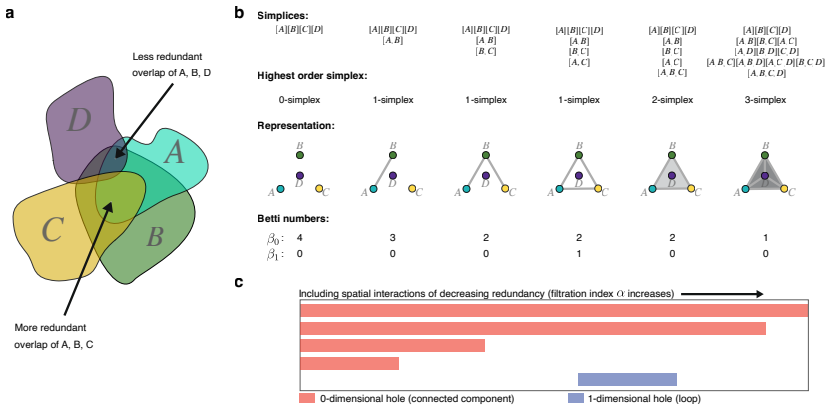
The machinery is a filtered simplicial complex: a higher-order network in which a simplex joins any set of individuals whose core ranges intersect, with each simplex weighted by its intersection/union ratio w and filtered by a parameter alpha measuring how far w sits from the predicted optimum w* = 1/(n+1). Persistent homology computes the Betti numbers, which count holes in each dimension, and their persistence across the filtration; maximal simplicial degree centrality identifies which subsets participate in the most connections.
What would settle it
A permutation null model that randomly rotates the observed core ranges around their centroids while preserving shape, then recomputes the simplicial complexes: if holes of dimension 1 and higher still persist in the randomized data, the holes cannot be evidence of knowledge complementarity.
Extended reading notes
Core claim
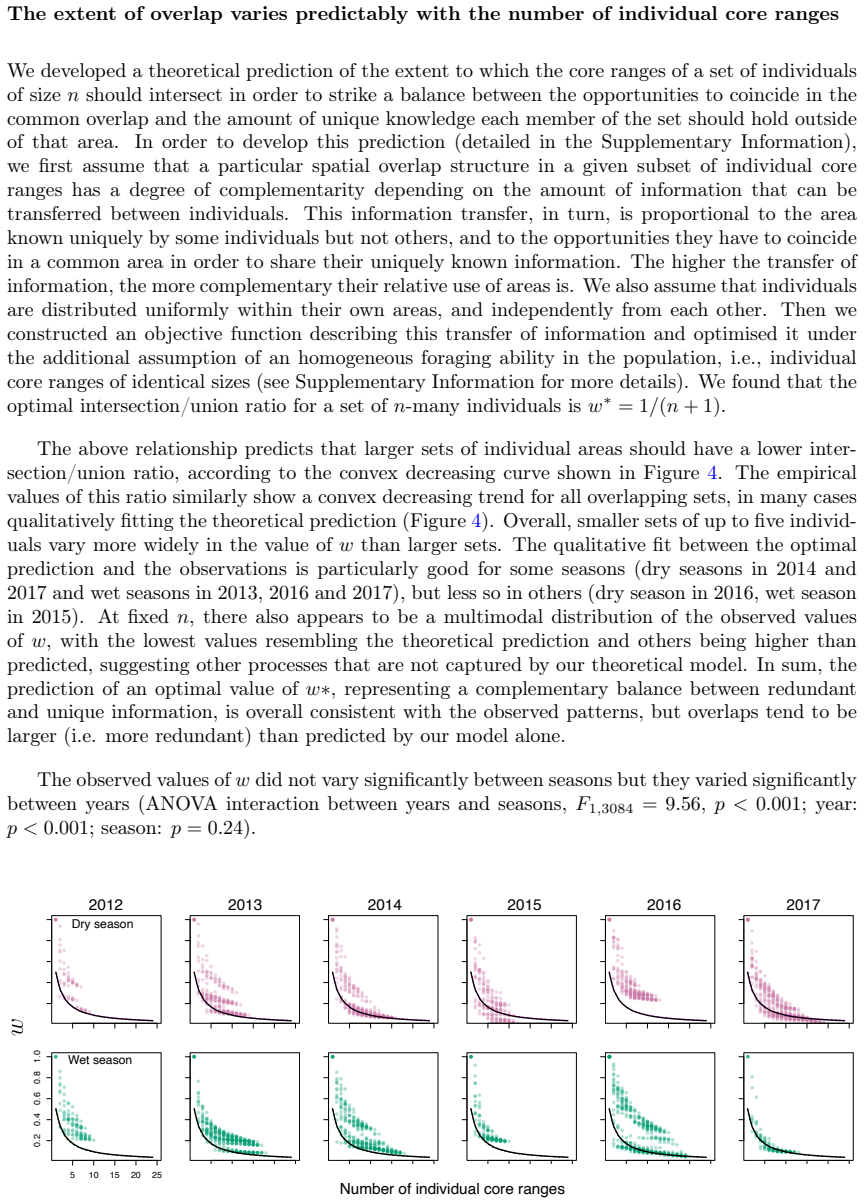
The paper's discovery is that the overlap geometry of spider monkey core ranges is balanced between redundancy and uniqueness in a way that maximizes information transfer. For any set of n individuals, an optimization model with uniform, independent movement predicts that the intersection/union ratio of their core ranges should be w* = 1/(n+1); the observed ratios follow this decreasing curve, especially for small sets. Filtering the resulting simplicial complexes from more to less redundant overlaps reveals persistent holes of dimensions 0 through 4, meaning that even as low-redundancy subsets are added, some areas are used by a subset of individuals and not by others. The authors read these holes as complementarity: shared areas provide the meeting ground where uniquely known foraging spots can be transmitted, and the persistence of the holes shows that this complementary knowledge structure is a stable feature across seasons.
Load-bearing premise
The load-bearing premise is that a monkey's core range is a map of what it knows about fruiting-tree locations; if the ranges instead reflect social attraction, shared sleeping sites, or habitat geometry, the holes in the overlap structure would not be evidence of complementary information sharing at all.
Editorial extensions
If this is right
- If the complementarity is real, the group's collective knowledge of fruiting-tree locations is larger than any member's, and fission-fusion social dynamics are a mechanism for maintaining that distributed memory.
- Subsets of intermediate size (roughly 4 to 6 individuals) should be the most important brokers of foraging information, since their overlap ratios are the most sensitive to membership changes and their simplicial centrality rises most steeply.
- The persistence barcodes of the overlap complex give a season-by-season readout of how much of the group's knowledge is held uniquely, which could be monitored as the environment changes.
- Because the same balance between redundant and unique area applies to any number of individuals, the w* = 1/(n+1) prediction gives a quantitative target for testing other fission-fusion species.
Reading between the lines
- An alternative reading of the holes, based on shared sleeping sites or social attraction rather than knowledge, could be tested by comparing simplicial complexes built from daytime foraging locations against those from nighttime sleeping locations; only the foraging-based complexes should show the complementarity signal.
- The optimality argument assumes uniform and independent movement inside core ranges; relaxing that to movement along known travel routes would shift w*, so the observed fit to 1/(n+1) is a baseline that should be rechecked against more detailed movement data.
- If the interpretation is right, the same hole-detection pipeline could be applied to other fission-fusion species, and the persistence of holes should predict the group's success at finding scarce fruit in the dry season, which the paper's small sample could not confirm.
- The paper's lack of a significant dry/wet season difference, despite a visible trend, suggests the relevant environmental variable is spatial rather than temporal patchiness; testing against spatial fruit distribution is the natural next step.
Signed reviews
Editorial analysis
A structured set of objections, weighed in public.
Referee Report
Summary. This paper applies persistent homology to the partial overlaps of individual spider-monkey core ranges across six years, split into dry and wet seasons. The authors define an intersection/union ratio w for every subset of n core ranges, derive a parameter-free optimal benchmark w* = 1/(n+1) from an information-transfer model in the Supplementary Information, and use deviations from w* as a filtration parameter α. They report persistent holes (Betti numbers) in the resulting simplicial complexes, interpret them as "pockets of unique knowledge" reflecting complementary foraging information, and introduce a filtration complementarity index (FCI) to compare seasons. They also examine maximal simplicial degree centrality across simplex sizes and find no robust demographic correlates. Code and data are deposited in a Zenodo repository.
Significance. If the central inference were supported, the paper would provide one of the first empirical demonstrations that higher-order overlap geometry in a fission-fusion society encodes complementary information, linking topological data analysis to collective intelligence. The derivation of w* = 1/(n+1) is a genuine parameter-free benchmark, the Supplementary Information proof is detailed, and the descriptive pipeline is reproducible from the deposited code and data. The paper is also honest about the proxy assumption regarding core ranges and about the low statistical power of the seasonal comparison. However, the leap from "holes exist in core-range overlap complexes" to "the group shares complementary foraging information" is currently untested against any null model or behavioural validation, which is the central weakness.
major comments (4)
- [Results: 'The structure of simplicial complexes shows holes at various dimensions'; Methods: 'Filtration procedure'] The claim that persistent holes 'reveal complementarity in the foraging information' is not tested against any null model for how independently located, geographically constrained core ranges would overlap. A null model that randomly places or relabels the observed core-range polygons within the study area, or permutes spatial locations while preserving polygon shapes and habitat boundaries, would show whether the observed Betti numbers and FCI values exceed chance level. Without such a baseline, the holes could be produced by the lake boundary, the shape of the forest fragment, or sleeping-site centrality rather than by sharing of foraging information.
- [Introduction, third paragraph] The entire interpretation rests on the unvalidated assumption that a 60% a-LoCoH core range represents the area where an individual 'knows the location of available fruiting trees relatively well.' The paper cites previous work ([11], [20]) but does not validate the proxy with the available behavioural data, such as visits to fruiting trees or the phenology records described in the Methods. Because holes are interpreted as 'pockets of unique knowledge,' the central conclusion is conditional on this assumption; the authors should either test it against known fruiting-tree locations or explicitly reframe the claims as being about overlap geometry rather than cognition.
- [Methods, 'Simplical complex construction'] The maximal simplex size nmax = 6 was selected post hoc as 'the largest which consistently resulted in non-trivial structures across all seasons.' The headline persistence barcodes and the FCI (Eq. 5) are computed on structures truncated at this data-dependent cutoff, and no robustness analysis is presented for Betti numbers or FCI across nmax (the Supplementary Information only checks centrality). The authors should show that the main qualitative results, including the multi-dimensional holes and the seasonal FCI comparison, are stable for nmax in, say, {4, 5, 6, 7, 8, 9}; otherwise the central results are conditional on a parameter chosen after seeing the data.
- [Supplementary Information, Section 1.2; Eq. (3)] The benchmark w* is derived under the assumption that all n core ranges have identical area (N_k = N), but the empirical core ranges vary substantially in area within seasons (Figure 3). Because w is the ratio of intersection to union, a single small core range can drive low w values for large n, and the filtration defined by Eq. (4) will then classify such sets as 'less redundant' even under a null of random overlap. The authors should test whether the persistence results are robust to using an area-corrected overlap measure or to restricting comparisons to sets with comparable range sizes.
minor comments (5)
- [Throughout] The term 'simplical' is misspelled in several places, including the Methods heading 'Simplical complex construction'; it should be 'simplicial.'
- [Figure 4] The axis labels 'n.d12' and 'w.d12' are cryptic; the figure would be clearer with labels such as 'number of individuals n' and 'intersection/union ratio w' for each panel.
- [Results, 'The extent of overlap varies predictably...'] The ANOVA on observed w values treats each subset of individuals as an independent observation, but subsets overlap heavily (the same individual appears in many sets). This should be acknowledged, and a permutation-based or mixed-effects approach would be more appropriate.
- [Methods, 'Filtration procedure'] The choice of f(alpha) = 5^{-alpha} is arbitrary, and while the authors correctly note that a monotone reparametrization preserves the filtration order, the FCI values and statements about persistence 'for several units of alpha' are not invariant to that choice. A brief statement that conclusions are robust to alternative decreasing functions f would strengthen the presentation.
- [Discussion] The sentence beginning 'Conversely, values below the predicted line are rare' is slightly ambiguous because Figure 4 shows many points both above and below the w* curve; it would help to specify that the statement refers to the bulk of the distribution or to a particular subset of seasons.
Circularity Check
No significant circularity: the w* = 1/(n+1) prediction is derived from an explicit optimization model and the persistence analysis is a descriptive application of that model, not a fitted-input prediction.
full rationale
I walked the paper's derivation chain and found no step where a claimed prediction or first-principles result reduces, by the paper's own equations or by self-citation, to its own inputs. The central theoretical quantity w* = 1/(n+1) is derived in the Supplementary Information from a stated optimization problem: an information-transfer objective T(O) is constructed from explicit assumptions (uniform space use, independent movement, cell-based knowledge), and the global maximizer is proven to be O* = (0,...,0,N/2), which yields w*_n = 1/(n+1). This is a genuine derivation, not a fit or a renamed empirical observation. The observed w values are then compared against this curve qualitatively, and the paper explicitly notes discrepancies (multimodality, values above prediction), so the comparison is not forced by construction. The filtration index alpha is defined relative to w* through wi = f(alpha)/(n(i)+1), but this is a reparametrization of the same overlap data and the paper notes that monotonic changes in f would not change the topological features. The existence of holes and their persistence are computed from the spatial overlaps, and the interpretation of those holes as 'complementarity' is an interpretive step explicitly flagged as conditional ('If we assume that a hole of any dimension... is the result of unique areas...'), not a derivation that assumes the conclusion. The choice of nmax = 6 is described as chosen upon observation, which is a methodological caveat, but it is not a parameter fitted to the data and then used to predict the same data; it is a stated modelling cutoff. Self-citations (e.g., refs. 11, 20, 51) provide empirical background for the proxy assumption that core ranges reflect foraging knowledge and for the 60% utilization distribution; these are prior empirical studies, and the current paper's central topological analysis does not reduce to them. No uniqueness theorem, ansatz smuggled via citation, or renamed known result was found. Therefore the paper is self-contained with respect to the w* derivation and the persistence analysis, and the circularity score is 0.
Assumptions & free parameters
free parameters (6)
- nmax (maximal simplex size) =
6
- f(alpha) filtration function =
5 - alpha
- Core range isopleth =
60% utilization distribution
- a parameter (a-LoCoH) =
15000
- alpha threshold for centrality =
4
- FCI dimension weighting =
d + 1
assumptions (7)
- domain assumption An individual's 60% core range represents its knowledge of fruiting-tree locations during a season.
- ad hoc to paper A topological hole in the overlap complex corresponds to areas used uniquely by some individuals, i.e., holes equal complementarity.
- domain assumption Downward closure: whenever n core ranges overlap, all subsets of those ranges also overlap.
- domain assumption Individuals use their core ranges uniformly and move independently (for the w* derivation).
- domain assumption Homogeneous foraging ability, equal core-range sizes Nk = N, for all individuals (for the w* derivation).
- standard math The global optimality proof of the quadratic information-transfer objective (Theorem 1 in SI) is correct.
- standard math Persistent homology computations in Gudhi are faithful implementations of simplicial homology.
invented entities (2)
-
Filtration complementarity index (FCI)
-
Optimal overlap benchmark w* = 1/(n+1)
independent evidence
Cite this review
Pith. "Pith review of Uncovering complementary information sharing in spider monkey collective foraging using higher-order spatial networks." pith.science (2026). https://pith.science/paper/O2J6FHBY
@misc{pith2026250501167,
  author       = {Pith},
  title        = {Pith review of: Uncovering complementary information sharing in spider monkey collective foraging using higher-order spatial networks},
  year         = {2026},
  howpublished = {\url{https://pith.science/paper/O2J6FHBY}},
  note         = {Machine review of arXiv:2505.01167}
}
read the original abstract
Collectives are often able to process information in a distributed fashion, surpassing each individual member's processing capacity. In fission-fusion dynamics, where group members come together and split from others often, sharing complementary information about uniquely known foraging areas could allow a group to track a heterogenous foraging environment better than any group member on its own. We analyse the partial overlaps between individual spider monkey core ranges, which we assume represent the knowledge of an individual during a given season. Sets of individuals with complementary overlaps are identified, showing a balance between redundantly and uniquely known portions, and we use simplicial complexes to represent these higher-order interactions. The structure of the simplicial complexes shows holes in various dimensions, revealing complementarity in the foraging information that is being shared. We propose that the complex spatial networks arising from fission-fusion dynamics allow for adaptive, collective processing of foraging information in dynamic environments.
Figures


Figures from the paper (12 more)


Reference graph
Works this paper leans on
-
[11]
Palacios-Romo, T., Castellanos, F. & Ramos-Fernandez, G. Uncovering the decision rules behind collective foraging in spider monkeys.Animal Behaviour149,121–133 (2019)
work page 2019
-
[20]
Smith-Aguilar, S. E., Ramos-Fernández, G. & Getz, W. M. Seasonal changes in socio-spatial structure in a group of free-living spider monkeys (Ateles geoffroyi).PloS one11,e0157228 (2016)
work page 2016
-
[1]
Complex systems: Network thinking.Artificial Intelligence170,1194–1212 (2006)
Mitchell, M. Complex systems: Network thinking.Artificial Intelligence170,1194–1212 (2006)
work page 2006
-
[2]
Bettencourt,L.M.Therulesofinformationaggregationandemergenceofcollectiveintelligent behavior.Topics in Cognitive Science1,598–620 (2009)
work page 2009
-
[3]
& Ramos-Fernandez, G.The causal role of synergy in collective problem-solvingPreprint
Garg, K., Moser, C., Dromiack, H., Anwarzai, Z. & Ramos-Fernandez, G.The causal role of synergy in collective problem-solvingPreprint. 2025. SocArXiv:https://osf.io/6r2h5_v2
work page 2025
-
[4]
Clark, C. W. & Mangel, M. Foraging and flocking strategies: information in an uncertain environment.The American Naturalist123,626–641 (1984)
work page 1984
-
[5]
Galef,B.G.&Giraldeau,L.-A.Socialinfluencesonforaginginvertebrates:causalmechanisms and adaptive functions.Animal Behaviour61,3–15.issn: 0003-3472 (2001)
work page 2001
-
[6]
Series B: Biological Sciences357,1549–1557 (2002)
Valone,T.J.&Templeton,J.J.Publicinformationfortheassessmentofquality:awidespread social phenomenon.Philosophical Transactions of the Royal Society of London. Series B: Biological Sciences357,1549–1557 (2002)
work page 2002
Show all 58 references
-
[7]
Kummer, H.Primate societies: Group techniques of ecological adaptation(Transaction Pub- lishers, 2006)
2006
-
[8]
A., Smedshaug, C
Sonerud, G. A., Smedshaug, C. A. & Bråthen, Ø. Ignorant hooded crows follow knowledgeable roost-mates to food: support for the information centre hypothesis.Proceedings of the Royal Society of London. Series B: Biological Sciences268,827–831 (2001)
2001
-
[9]
& Bon, R
Petit, O. & Bon, R. Decision-making processes: the case of collective movements.Behavioural processes84,635–647 (2010)
2010
-
[10]
King, A. J. & Sueur, C. Where next? Group coordination and collective decision making by primates.International journal of primatology32,1245–1267 (2011)
2011
-
[12]
Aureli, F.et al.Fission-fusion dynamics: new research frameworks.Current Anthropology49, 627–654 (2008)
2008
-
[13]
& Aureli, F
Ramos-Fernandez, G. & Aureli, F. inEncyclopedia of Animal Cognition and Behavior(eds Vonk, J. & Shackelford, T.) 1–8 (Springer International Publishing, Cham, 2018)
2018
-
[14]
& Boyer, D
Ramos-Fernández, G., Pinacho-Guendulain, B., Miranda-Pérez, A. & Boyer, D. No evidence of coordination between different subgroups in the fission–fusion society of spider monkeys (Ateles geoffroyi).International Journal of Primatology32,1367–1382 (2011)
2011
-
[15]
& Ramos-Fernández, G
Pinacho-Guendulain, B. & Ramos-Fernández, G. Influence of fruit availability on the fission– fusion dynamics of spider monkeys (Ateles geoffroyi).International Journal of Primatology 38,466–484 (2017)
2017
-
[16]
Sueur, C.et al.Collective decision-making and fission–fusion dynamics: a conceptual frame- work.Oikos120,1608–1617 (2011)
2011
-
[17]
Ramos-Fernández, G.et al.Quantifying uncertainty due to fission–fusion dynamics as a com- ponent of social complexity.Proceedings of the Royal Society B: Biological Sciences285, 20180532 (2018)
2018
-
[18]
& Dew, J
Di Fiore, A., Link, A. & Dew, J. L. inSpider monkeys: Behavior, ecology and evolution of the genus Ateles(ed Campbell, C. J.) 220–235 (Cambridge University Press Cambridge, UK, 2008). 15
2008
-
[19]
& Morales, J
Ramos-Fernández, G. & Morales, J. M. Unraveling fission-fusion dynamics: how subgroup properties and dyadic interactions influence individual decisions.Behavioral Ecology and So- ciobiology68,1225–1235 (2014)
2014
-
[21]
& Ramos-Fernández, G
Falcón-Cortés, A., Boyer, D. & Ramos-Fernández, G. Collective learning from individual experiences and information transfer during group foraging.Journal of the Royal Society Interface16,20180803 (2019)
2019
-
[22]
& Helbing, D
Moussaid, M., Garnier, S., Theraulaz, G. & Helbing, D. Collective information processing and pattern formation in swarms, flocks, and crowds.Topics in Cognitive Science1,469–497 (2009)
2009
-
[23]
Wallace, R. B. inSpider monkeys: Behavior, ecology and evolution of the genus Ateles(ed Campbell, C. J.) 138–154 (Cambridge University Press Cambridge, UK, 2008)
2008
-
[24]
Suarez, S. A. Diet and travel costs for spider monkeys in a nonseasonal, hyperdiverse envi- ronment.International Journal of Primatology27,411–436 (2006)
2006
-
[25]
J., Wilber, M
Silk, M. J., Wilber, M. Q. & Fefferman, N. H. Capturing complex interactions in disease ecology with simplicial sets.Ecology Letters25,2217–2231 (2022)
2022
-
[26]
Silk, M. J. Conceptual representations of animal social networks: an overview.Animal Be- haviour201,157–166 (2023)
2023
-
[27]
R., Fefferman, N
Iacopini, I., Foote, J. R., Fefferman, N. H., Derryberry, E. P. & Silk, M. J. Not your private tête-à-tête: leveraging the power of higher-order networks to study animal communication. Philosophical Transactions of the Royal Society B: Biological Sciences379(2024)
2024
-
[28]
& Barrat, A
Iacopini, I., Karsai, M. & Barrat, A. The temporal dynamics of group interactions in higher- order social networks.Nature Communications15(2024)
2024
-
[29]
Hasenjager, M. J. & Fefferman, N. H. Social ageing and higher-order interactions: social selectiveness can enhance older individuals’ capacity to transmit knowledge.Philosophical Transactions B379,20220461 (2024)
2024
-
[30]
& Tang, M
Lin, Z., Han, L., Feng, M., Liu, Y. & Tang, M. Higher-order non-Markovian social contagions in simplicial complexes.Communications Physics7(2024)
2024
-
[31]
& Sánchez Gómez, D.Centrality measures in simplicial complexes: applications of Topological Data Analysis to Network SciencePreprint
Hernández Serrano, D. & Sánchez Gómez, D.Centrality measures in simplicial complexes: applications of Topological Data Analysis to Network SciencePreprint. 2020. arXiv:1908. 02967 [math.AT]
2020
-
[32]
A., Tillmann, U., Grindrod, P
Otter, N., Porter, M. A., Tillmann, U., Grindrod, P. & Harrington, H. A. A roadmap for the computation of persistent homology.EPJ Data Science6.issn: 2193-1127 (Aug. 2017)
2017
-
[33]
Nature Methods17,261–272 (2020)
Virtanen, P.et al.SciPy 1.0: Fundamental Algorithms for Scientific Computing in Python. Nature Methods17,261–272 (2020)
2020
-
[34]
Marshall, J. A. & Reina, A. On aims and methods of collective animal behaviour.Animal Behaviour210,189–197 (2024)
2024
-
[35]
E., Krakauer, D
Ramos-Fernandez, G., Smith Aguilar, S. E., Krakauer, D. C. & Flack, J. C. Collective Com- putation in Animal Fission-Fusion Dynamics.Frontiers in Robotics and AI7.issn: 2296-9144 (2020)
2020
-
[36]
J.et al.Ecological knowledge, leadership, and the evolution of menopause in killer whales.Current Biology25,746–750 (2015)
Brent, L. J.et al.Ecological knowledge, leadership, and the evolution of menopause in killer whales.Current Biology25,746–750 (2015)
2015
-
[37]
& Vick, L
Ramos-Fernández, G., Boyer, D., Aureli, F. & Vick, L. G. Association networks in spider monkeys (Ateles geoffroyi).Behavioral Ecology and Sociobiology63,999–1013 (2009)
2009
-
[38]
& Forrest, S
Solé, R., Moses, M. & Forrest, S. Liquid brains, solid brains.Philosophical Transactions of the Royal Society B: Biological Sciences374,20190040 (2019)
2019
-
[39]
F., Esponda, F., Moses, M
Vining, W. F., Esponda, F., Moses, M. E. & Forrest, S. How does mobility help distributed systems compute?Philosophical Transactions of the Royal Society B: Biological Sciences374, 20180375 (2019). 16
2019
-
[40]
T., Todd, P
Hills, T. T., Todd, P. M., Lazer, D., Redish, A. D. & Couzin, I. D. Exploration versus ex- ploitation in space, mind, and society.Trends in Cognitive Sciences19,46–54 (2015)
2015
-
[41]
I., Rosas, F
Luppi, A. I., Rosas, F. E., Mediano, P. A., Menon, D. K. & Stamatakis, E. A. Information decomposition and the informational architecture of the brain.Trends in Cognitive Sciences (2024)
2024
-
[42]
Williams, P. L. & Beer, R. D. Nonnegative decomposition of multivariate information.arXiv preprint arXiv:1004.2515(2010)
2010 arXiv
-
[43]
Janmaat, K. R.et al.Spatio-temporal complexity of chimpanzee food: How cognitive adap- tations can counteract the ephemeral nature of ripe fruit.American Journal of Primatology 78,626–645 (2016)
2016
-
[44]
Hutchins, E.Cognition in the Wild(MIT press, 1995)
1995
-
[45]
Ramos-Fernández, G., Aureli, F., Schaffner, C. M. & Vick, L. G. Ecología, comportamiento y conservación de los monos araña (Ateles geoffroyi): 20 años de estudio en Punta Laguna, México.La primatología en Latinoamérica2,531–544 (2018)
2018
-
[46]
Ramos-Fernández, G.Patterns of association, feeding competition and vocal communication in spider monkeys, Ateles geoffroyiPhD thesis (University of Pennsylvania, 2001)
2001
-
[47]
Pinacho Guendulain, B.Patrones de agrupación de un grupo de monos araña de manos negras (Ateles geoffroyi) en Punta Laguna, YucatánMAthesis(InstitutoPolitécnicoNacional,2010)
2010
-
[48]
Bonilla Moheno, M.Forest recovery and management options in the Yucatan Peninsula, Mex- icoPhD thesis (University of California, Santa Cruz, 2008)
2008
-
[49]
M.et al.LoCoH: Nonparameteric Kernel Methods for Constructing Home Ranges and Utilization Distributions.PLOS ONE2,1–11 (Feb
Getz, W. M.et al.LoCoH: Nonparameteric Kernel Methods for Constructing Home Ranges and Utilization Distributions.PLOS ONE2,1–11 (Feb. 2007)
2007
-
[50]
J., Turner, W
Lyons, A. J., Turner, W. C. & Getz, W. M. Home range plus: a space-time characterization of movement over real landscapes.Movement Ecology1,1–14 (2013)
2013
-
[51]
E., Schaffner, C
Ramos-Fernandez, G., Smith Aguilar, S. E., Schaffner, C. M., Vick, L. G. & Aureli, F. Site Fidelity in Space Use by Spider Monkeys (Ateles geoffroyi) in the Yucatan Peninsula, Mexico. PLOS ONE8,1–10 (May 2013)
2013
-
[52]
& Turner, R.Spatial point patterns: methodology and applications with R(CRC press, 2015)
Baddeley, A., Rubak, E. & Turner, R.Spatial point patterns: methodology and applications with R(CRC press, 2015)
2015
-
[53]
R Core Team.R: A Language and Environment for Statistical ComputingR Foundation for Statistical Computing (Vienna, Austria, 2021)
2021
-
[54]
Acknowledgements This work was partly conducted during a sabbatical stay by GRF at the Global Research Centre for Diverse Intelligences at the University of St
The GUDHI Project.GUDHI User and Reference Manual(GUDHI Editorial Board, 2015). Acknowledgements This work was partly conducted during a sabbatical stay by GRF at the Global Research Centre for Diverse Intelligences at the University of St. Andrews, supported by a PASPA-DGAPA ...
2015
-
[55]
Individuals utilise the area in their core ranges uniformly
-
[56]
core ranges are composed of cells, representing, for example, points of knowledge
-
[57]
Movements of different individuals are independent
-
[58]
X PN j=1ε(1) j MNj # , which must exist, be finite and be non-zero sinceN̸= 0. Using the definition ofXwe can write K= min ε∈U′
Rate of information transfer for a given grouping of individuals is given by the number of cells known by the group known by at least one member of the group and not known by at least one member, multiplied by the probability of the interaction occurring. Suppose we haven-many...
2012
Reviewed August 16, 2026 · model on record in the stance chip above.
Discussion (0). Continue with ORCID to comment.