REVIEW 5 major objections 6 minor 16 references
Toward a Unified Theory of Catalysis
T0 review · 5 major / 6 minor · reviewed 2026-08-16 · deepseek-v4-flash
Pith's one-line read Catalysis can be described by one spatiotemporal volume integral, with transition-state theory as a limiting case.
desk verdict Definitional framework with unvalidated 'predictions'; the enzyme example contradicts its own central integral. read the letter →
The pith
A machine-rendered reading of the paper's core claim, the machinery that carries it, and where it could break.
The reading
What carries the argument
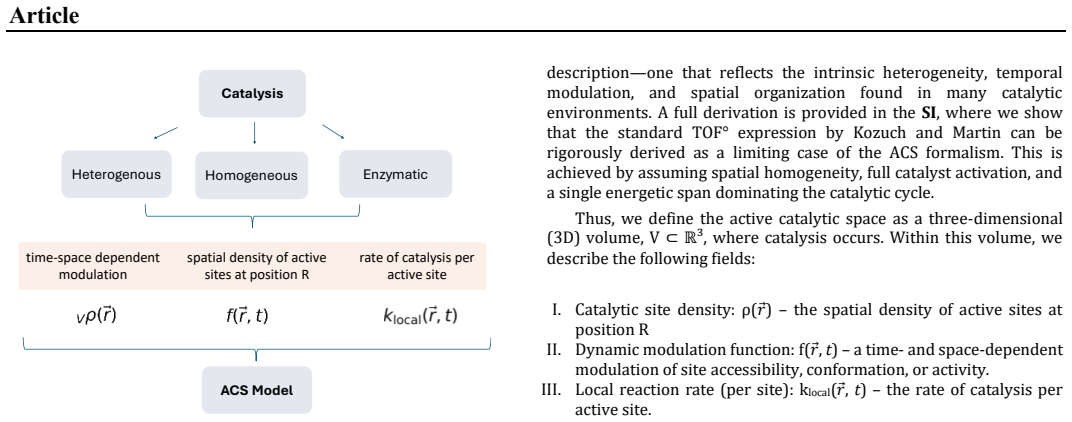
The load-bearing object is the active catalytic space: a volume $V \subset \mathbb R^3$ equipped with the three fields $\rho(\mathbf r)$, $f(\mathbf r,t)$, and $k_{\mathrm{local}}(\mathbf r,t)$. The workhorse is the product identity $d\mathrm{TOF} = \rho\, f\, k_{\mathrm{local}}\, dV$, integrated over the volume to give $\mathrm{TOF}(t)$ and once more over time to give the turnover number $\mathrm{TON}(T)$. This integral does the unifying work: it lets an enzyme's allostery be encoded in $f$, a metal's crystal facets in a piecewise-constant $\rho$ and $k_{\mathrm{local}}$, and a solution's microheterogeneity in a Gaussian $\rho$ with a decaying $k_{\mathrm{local}}$. The derivation of transition state theory as a limit is made by localizing the integrand at one configuration $\mathbf r^*$ and grouping $\rho f\,dV$ into the effective activated-state population $P^\ddagger$, leaving $\mathrm{TOF} = P^\ddagger (k_{\mathrm B}T/h)\, e^{-\Delta G^\ddagger/RT}$.
What would settle it
Measure turnover frequency for a catalytic surface whose site density is varied continuously, for example by diluting active sites with an inert spacer or changing surface coverage while holding the chemistry fixed. The ACS integral predicts TOF scales linearly with the integrated site density; if the per-site rate changes measurably with coverage or crowding, the prediction from Equation 3 will deviate from the measured rate. The size of that deviation directly quantifies the missing coupling terms that the exact multiplicative factorization omits.
Extended reading notes
Core claim
The central claim, stated on the paper's own terms, is that the instantaneous global turnover frequency of any catalyst is exactly $\mathrm{TOF}(t) = \int_V \rho(\mathbf r)\, f(\mathbf r,t)\, k_{\mathrm{local}}(\mathbf r,t)\, dV$, with $\rho$ the local density of catalytically competent sites, $f$ a space- and time-dependent factor describing accessibility, conformation, or environmental gating, and $k_{\mathrm{local}}$ the intrinsic rate of a single site. Each classical kinetic law is absorbed into one of these fields: saturating enzyme kinetics or electron-transfer rate expressions enter through $k_{\mathrm{local}}$, structural data enter through $\rho$, and fluctuating environments enter through $f$. The paper further asserts that transition state theory is the limiting case in which the integrand collapses to a single dominant configuration $\mathbf r^*$, and that the energetic-span TOF$^\circ$ formula used for benchmarking is derivable from this limit. In five worked systems, a single platinum atom, a two-facet platinum catalyst, bilirubin oxidase, a solvated ruthenium water-oxidation catalyst, and additional systems in the supplement, the framework yields TOF values that the paper reports as consistent with experimentally known ranges. The point of the framework is not to discard existing kinetics but to embed every existing rate law in a common spatiotemporal integral.
Load-bearing premise
The load-bearing premise is that the three factors in $d\mathrm{TOF}=\rho\, f\, k_{\mathrm{local}}\, dV$ are independent and purely multiplicative, meaning the per-site rate $k_{\mathrm{local}}$ is assumed not to change with local site density, crowding, or the modulation field; if real catalysts have site-to-site coupling or structure-dependent local rates, the volume integral does not equal the true turnover frequency.
Editorial extensions
If this is right
- Any catalyst can be scored by the same three fields, so an enzyme and an electrode can be compared directly in the same units rather than through field-specific metaphors.
- Spatially resolved measurements, such as imaging, scanning probes, and operando spectra, can be inserted directly into the integral, turning qualitative maps of reactive hot spots into quantitative TOF predictions.
- If the integral is exact, the standard transition-state and energetic-span formulas are diagnostic special cases, and deviations between them and the full integral identify when single-barrier thinking fails.
- The formula decomposes a catalyst's performance into three independent levers, raising local site density, improving temporal accessibility, or increasing intrinsic per-site rate, each with a calculable effect on total TOF.
- Because turnover number is defined as the time integral of the same expression, the framework connects instantaneous activity directly to long-term stability and deactivation behavior.
Reading between the lines
- Editorial inference: The multiplicative form treats each infinitesimal volume element as an independent catalytic population, so the framework is likely to fail for strongly coupled systems such as substrate channeling or surface spillover; measuring TOF while continuously varying site density would reveal the missing coupling terms.
- Editorial inference: The same structure could be applied to selectivity by promoting $k_{\mathrm{local}}$ to a vector of branch rates, making product distributions volume integrals over the same $\rho$ and $f$ fields, an extension the paper does not develop.
- Editorial inference: Because the paper parameterizes $f$ with sinusoidal or gated forms, the framework can be tested dynamically by applying a modulated perturbation and comparing the predicted TOF waveform's phase and amplitude with time-resolved experimental turnover.
- Editorial inference: With $\rho$, $f$, and $k_{\mathrm{local}}$ each independently measurable, the integrated equation acts as a consistency check on experimental data; large discrepancies between integrated and measured TOF would indicate missing cross-terms or a mis-assigned field.
Signed reviews
Editorial analysis
A structured set of objections, weighed in public.
Referee Report
Summary. The paper proposes a 'theory of the active catalytic space' (ACS) in which the turnover frequency is written as a volume integral over three fields: catalytic site density ρ(r), a dynamic modulation function f(r,t), and a local per-site rate k_local(r,t) (Eq. 3). The authors claim that this integral unifies heterogeneous, homogeneous, and enzymatic catalysis, that transition state theory emerges as a limiting case, and that the framework 'predicts turnover performance with high fidelity.' Applications are presented for a single platinum atom and for Pt{111}/{100} facets, for the enzyme bilirubin oxidase (BOD), and for a homogeneous ruthenium water-oxidation catalyst. The central mathematical object is a definition, and the paper's demonstrative examples largely consist of choosing functional forms and parameters to reproduce known rate ranges.
Significance. If the framework were actually predictive and able to subsume transition state theory as a limiting case, a unified spatiotemporal description of catalysis would be a valuable conceptual contribution. However, as written, Eq. (3) is a bookkeeping identity that has not been shown to have predictive content. The applications either reduce to normalization (single-atom Pt), to multiplication of chosen constants (Pt facets), to an ad hoc min() operation that contradicts the additive integral (BOD), or to fitted functions whose agreement with experiment is asserted rather than tested (Ru water oxidation). The paper does compile a useful table of experimental techniques for measuring spatial and temporal catalytic fields, and the dimensional analysis in the Methods is internally consistent, but those positive elements do not compensate for the absence of a derivation of the central claims. The manuscript does not provide machine-checked proofs, reproducible code, parameter-free derivations, or falsifiable predictions.
major comments (5)
- [Application for Enzyme Catalysis, Eqs. (16)-(18)] Eq. (16) writes the BOD turnover frequency as the sum of two volumetric integrals over the T1 and TNC sites, which is the direct application of Eq. (3). Eq. (17) then replaces that sum with the minimum of the two contributions, TOF_enzyme = min(ρT1 fT1 kT1, ρTNC fTNC kTNC). With the paper's own numbers, the sum is 674.8 + 81.76 = 756.6 s⁻¹, not the reported 81.76 s⁻¹. The min() operation is not derived from Eq. (3); it is an additional series constraint imposed by hand. Thus the BOD demonstration does not evaluate the central equation, and it cannot be used as evidence that Eq. (3) describes enzymatic catalysis.
- [Application for Homogeneous Catalysis, Eqs. (19)-(22)] The homogeneous example assigns a Gaussian ρ(r), a sinusoidal f(t) = 1 + 0.6 sin(2πt), and an exponential k_local(r) = 5 exp(-r/4), with no statement of how these forms or their parameters were determined from the system. The integration yields TOF_mean ≈ 723 s⁻¹, which is then said to be 'consistent with reported experimental ranges' for ruthenium water-oxidation catalysts. This is curve fitting, not prediction: the functional forms and coefficients are free parameters, and the agreement with experiment is asserted without any statistical or uncertainty quantification. The example therefore provides no falsifiable test of the ACS framework.
- [Application for Heterogenous Catalysis, Eqs. (5)-(9)] The single-atom platinum result TOF(t) = k0 follows entirely from the imposed normalization ∫ρ dV = 1. Substituting ρ = 1/V into Eq. (3) makes the integral equal to k0 by construction. This is tautological and does not test Eq. (3). In addition, modeling a single atom as a uniform density inside a sphere of arbitrary radius R is physically unmotivated; the reader is given no criterion for choosing R, so the 'dimensionally consistent integral framework' claim is not supported by this example.
- [Transition State Theory (TST) as a Limiting Case of ACS Framework] The paper states that 'a full derivation is provided in the SI' and then asserts that after grouping the density, modulation, and infinitesimal volume into P‡, the ACS expression becomes TOF = P‡ (kBT/h) exp(-ΔG‡/RT), 'formally equivalent' to TST. No derivation appears in the manuscript, and the SI is not available to the reader. The grouping of three independent fields into a single 'effective population' is not shown to follow from Eq. (3), and the treatment omits standard TST ingredients such as transmission coefficients and the distinction between Gibbs energy of activation and enthalpy/entropy contributions. As written, the claim that TST emerges as a limiting case is an assertion, not a derived result.
- [Equation (17) and dimensional analysis] Eq. (17) sets ρT1 = ρTNC = 1 and omits the volume element dV, so the quantities fT1 kT1 and fTNC kTNC have units of s⁻¹ and are per-site rates, not volume integrals over the catalytic space. This is dimensionally incompatible with Eq. (3) unless an implicit unit volume is introduced. Similarly, Eq. (10) writes three-dimensional volume integrals over V111 and V100 but evaluates them as area integrals with A111 and A100 (sites/m² × s⁻¹ × m²), mixing 3D and 2D domains. These inconsistencies obscure what quantity the theory actually predicts.
minor comments (6)
- [General / Figures] There are two different items labeled 'Figure 3': the platinum TOF map and the BOD site-resolved TOF schematic. The figures must be renumbered and cross-references updated.
- [References] Reference 9 is cited as the basis for the 'active catalytic space framework,' but that reference concerns heterogeneities of individual catalyst particles and does not define the ACS concept. The framework appears to be introduced in this manuscript, so the citation does not support the stated provenance.
- [Methods / Validation] The Methods state that 'The final TOF(t) values were benchmarked against known literature values for each case to ensure model consistency,' but no quantitative comparison, error bars, or benchmark data are reported anywhere in the main text. The reader cannot assess the claimed fidelity.
- [Equations (14)-(15)] Eq. (14) uses Marcus theory parameters λ and ΔG without defining them, and Eq. (15) uses [O2] without specifying the concentration value used in the BOD calculation. These definitions and values are needed to reproduce the numbers.
- [Conclusion / Scope] The conclusion states that the framework was 'demonstrated across five distinct case studies,' but the main text presents only three applications (Pt, BOD, Ru). The additional cases (carbonic anhydrase, lactate dehydrogenase, perovskite photoelectrode) are said to be in the SI, which is not part of the submitted manuscript; the count should be corrected or the additional cases included.
- [Typos] There are numerous typographical errors, e.g., 'integration overtime' (should be 'over time'), 'Fig, 2' (should be 'Fig. 2'), and inconsistent spacing around commas and mathematical symbols. A careful copyedit is needed.
Circularity Check
The framework's demonstrations reduce to assigned inputs: TST is inserted as k_local and then 'emerges', the single-atom case is normalization, the enzyme TOF is the chosen TNC term (contradicting Eq. 3's additivity), and the homogeneous Ru range is tuned by arbitrary functions.
-
self definitional
[Transition State Theory (TST) as a Limiting Case of ACS Framework]
"The density of active sites, the modulation factor, and the infinitesimal volume around the transition configuration can be grouped into a single term, P‡, which represents the effective population reaching the activated state. The resulting expression: TOF = P‡ · (kᴮT / h) · exp(–ΔG‡ / RT) is formally equivalent to the classical TST rate equation."
TST is not derived from Eq. (3); the paper first assumes the local rate at r* is the Boltzmann-type Eyring expression, then defines P‡ as the leftover product of ρ, f, and dV. The 'emergence' of TST is therefore just renaming the inserted k_local and absorbing the integral factors into a symbol. The limiting-case result is true by construction, not by inference from the ACS integral.
-
self definitional
[Application for Heterogenous Catalysis, Eqs. (5)-(9)]
"We approximate ρ(r⃗) as a constant value within a small spherical volume V surrounding the atom, normalized such that: ∫ ρ(r⃗) dV = 1 ... Substituting this into the TOF equation 3 and assuming constant local kinetics: TOF(t)=∭(1/V)·1·k0 dV. Thus, the TOF reduces to: TOF(t)=k0."
The normalization ∫ρ dV = 1 makes the volume integral collapse to k0 identically. The 'model demonstrates' result TOF = k0 is just the input local rate constant; no independent prediction is made. The exercise is a dimensional identity dressed as an application.
2 more flagged steps
-
fitted input called prediction
[Application for Enzyme Catalysis, Eqs. (13)-(18)]
"Thus, while the TOF can be expressed as a sum over the individual sites’ contributions, the enzyme’s overall activity is constrained by the slower of the two processes. This introduces a dependency on the minimum rate of the two steps: TOFenzyme = min(ρT1 fT1 kT1, ρTNC fTNC kTNC) ... TOF_TNC = f_TNC k_TNC = 0.85 × 96.18 = 81.76 s⁻¹ ... Given that the two sites operate in series, the overall TOF is limited by the slower step ... Thus, the total TOF of the enzyme becomes: TOFenzyme = min(TOFT1, TOFTNC) = min(674.8,81.76) = 81.76 s⁻¹."
Eq. (16) is the additive ACS volume integral over T1 and TNC, but the reported enzyme TOF comes from a separate min rule in Eq. (17), not from Eq. (3). The value 81.76 s⁻¹ is exactly the assigned TNC input f_TNC·k_TNC; the additive integral would give 674.8 + 81.76 = 756.6 s⁻¹. The headline enzyme result is therefore a fitted input, and the series-min postulate is introduced ad hoc, contradicting the central additive equation.
-
fitted input called prediction
[Application for Homogeneous Catalysis, Eqs. (19)-(22), Fig. 4]
"ρ(r⃗) = exp(−r²/2σ²) ... f(t) = 1 + 0.6·sin(2πt) ... k_local(r⃗) = 5·exp(−r/4) ... The integration of the ACS model ... yielded a mean turnover frequency of approximately TOF_mean ≈ 723 s⁻¹, with oscillation boundaries ... TOF_min ≈ 289 s⁻¹ and TOF_max ≈ 1156 s⁻¹. These values are consistent with reported experimental ranges for homogeneous ruthenium-based water oxidation catalysts, further supporting the applicability of the ACS framework."
The Gaussian site density, sinusoidal modulation, and exponential local-rate profile are arbitrary analytical forms with free constants chosen for the system, and their integrals yield a TOF range. Presenting that range as 'consistent with reported experimental ranges' is validation by construction: the output is entirely determined by the chosen inputs, and no measured data are used to fix or falsify the functions.
full rationale
The ACS central equation (3) is a definitional identity: once ρ, f, and k_local are specified, TOF is just their volume integral. The claim that TST emerges as a limiting case is tautological: the paper sets k_local(r*) = (kBT/h)exp(−ΔG‡/RT) and groups the remaining factors into P‡, so the 'derived' TST expression is the assumed local rate times a defined prefactor. The single-atom example reduces to TOF = k0 solely because ∫ρ dV is normalized to one, so it is an identity rather than a prediction. The enzyme BOD case is the clearest example of a constructed result: although Eq. (16) is the additive ACS integral over T1 and TNC sites, the paper replaces it with a min over sites (Eq. 17) and reports 81.76 s⁻¹, which is exactly the assigned f_TNC·k_TNC input; the integral itself would give 756.6 s⁻¹. Thus the headline enzyme result is not produced by Eq. (3) and is simply the chosen input. The homogeneous ruthenium example chooses Gaussian, sinusoidal, and exponential functions with free constants and then presents the resulting 289–1156 s⁻¹ range as consistent with reported experimental ranges; the agreement is by construction. The two-facet platinum example is arithmetic on assumed literature rates and does not constitute an independent prediction. No self-citation chain is involved; the circularity is internal to the derivation. The conclusion's claim that ACS 'predicts turnover performance with high fidelity' is unsupported because each demonstration either equals its input by construction or is tuned to match known values. The framework may have organizational value, but its central derivations are definitional rather than empirically forced, warranting a substantial circularity score of 8 rather than 10.
Assumptions & free parameters
free parameters (8)
- k_111 and k_100 (facet-specific rate constants) =
0.1 s^-1 and 0.05 s^-1
- A_111 and A_100 exposed areas =
0.5 m^2 and 0.3 m^2
- f_TNC modulation factor for bilirubin oxidase =
0.85
- k_T1 and k_TNC for bilirubin oxidase =
674.8 s^-1 and 96.18 s^-1
- Gaussian width sigma for homogeneous rho(r) =
not stated
- Integration limit Rmax for homogeneous system =
not stated
- Sinusoidal modulation f(t) parameters =
1 + 0.6 sin(2 pi t)
- Exponential local rate parameters =
k(r) = 5 exp(-r/4)
assumptions (7)
- domain assumption Catalytic activity can be represented as continuous fields rho(r), f(r,t), and k_local(r,t) over a volume V.
- domain assumption The total TOF is the product of rho, f, and k_local integrated over volume.
- standard math Transition state theory rate form k = (kBT/h) exp(-DeltaG double-dagger / RT) applies per site.
- domain assumption Marcus theory and Michaelis-Menten kinetics describe the two copper sites of bilirubin oxidase.
- ad hoc to paper A single dominant spatial configuration r* is sufficient to recover TST from ACS.
- ad hoc to paper Single-atom normalization integral of rho(r) dV = 1.
- ad hoc to paper Enzymatic TOF is the minimum of the T1 and TNC contributions after writing the total as a sum.
invented entities (1)
-
Active catalytic space (ACS)
Cite this review
Pith. "Pith review of Toward a Unified Theory of Catalysis." pith.science (2026). https://pith.science/paper/U74XOQKB
@misc{pith2026250501213,
  author       = {Pith},
  title        = {Pith review of: Toward a Unified Theory of Catalysis},
  year         = {2026},
  howpublished = {\url{https://pith.science/paper/U74XOQKB}},
  note         = {Machine review of arXiv:2505.01213}
}
read the original abstract
Catalysis lies at the heart of chemical reactivity, yet its foundational principles remain fragmented across the distinct domains of homogeneous, heterogeneous, and enzymatic systems Here, we propose a unifying theoretical model that integrates spatial and temporal dimensions into a single framework, offering a cohesive understanding of catalytic activity across diverse materials and conditions. This model builds upon established kinetic theories, incorporating local site density distributions, time-dependent modulations, and intrinsic reaction rates to deliver a comprehensive description of catalytic performance. By applying this approach, we demonstrate how seemingly disparate catalytic processes, from molecular complexes and single-atom catalysts to complex enzyme systems, can be interpreted through shared physical and chemical principles.
Figures
Reference graph
Works this paper leans on
-
[1]
List, B., Lerner, R. A. & Barbas, C. F. Proline-catalyzed direct asymmetric aldol reactions. J. Am. Chem. Soc. 122, 2395–2396 (2000). https://doi.org/10.1021/ja994280y
-
[2]
Nicewicz, D. A. & MacMillan, D. W. C. Merging photoredox catalysis with organocatalysis: the direct asymmetric alkylation of aldehydes. Science 322, 77–80 (2008). https://doi.org/10.1126/science.1161976
-
[3]
Turner, N. J. Directed evolution of enzymes for applied biocatalysis. Trends Biotechnol. 21, 474–478 (2003). https://doi.org/10.1016/j.tibtech.2003.09.001
-
[4]
Crudden, C., Horton, J., Ebralidze, I. et al. Ultra stable self-assembled monolayers of N-heterocyclic carbenes on gold. Nature Chem 6, 409–414 (2014). https://doi.org/10.1038/nchem.1891
-
[5]
Lehn, J.-M. Perspectives in supramolecular chemistry—from molecular recognition towards molecular information processing and self- organization. Angew. Chem. Int. Ed. 29, 1304–1319 (1990). https://doi.org/10.1002/anie.199013041
-
[6]
Li, F.-M., Xia, C. & Xia, B. Y. Exploration and insight of dynamic structure evolution for electrocatalysts. Acc. Mater. Res. 4, 427–437 (2023). https://doi.org/10.1021/accountsmr.2c00261
-
[7]
Ghosh, I., Shlapakov, N., Karl, T. A. et al. General cross-coupling reactions with adaptive dynamic homogeneous catalysis. Nature 619, 87–93 (2023). https://doi.org/10.1038/s41586-023-06087-4
-
[8]
Partington, J. Heterogeneous catalysis. Nature 115, 534 (1925). https://doi.org/10.1038/115534a0
Show all 16 references
-
[9]
& Weckhuysen, B
Buurmans, I. & Weckhuysen, B. H. Heterogeneities of individual catalyst particles in space and time as monitored by spectroscopy. Nat. Chem. 4, 873–886 (2012). https://doi.org/10.1038/nchem.1478
2012 doi
-
[10]
Turning over
Kozuch, S. & Martin, J. M. L. “Turning over” definitions in catalytic cycles. ACS Catal. 2, 2787–2794 (2012). https://doi.org/10.1021/cs3005264
2012 doi
-
[11]
Macedo, L.J.A., Hassan, A., Sedenho, G.C. et al. Assessing electron transfer reactions and catalysis in multicopper oxidases with operando X-ray absorption spectroscopy. Nat Commun 11, 316 (2020). https://doi.org/10.1038/s41467-019-14210-1
2020 doi
-
[12]
& Padhi, S
Vatsa, A. & Padhi, S. K. Catalytic water oxidation by a single-site [Ru(Fc- tpy)(bpy)(OH₂)]²⁺ complex and its mechanistic study. Inorg. Chim. Acta 504, 119444 (2020). https://doi.org/10.1016/j.ica.2020.119444
2020
-
[13]
Progress on homogeneous ruthenium complexes for water oxidation catalysis: experimental and computational insights
Opoku, E. Progress on homogeneous ruthenium complexes for water oxidation catalysis: experimental and computational insights. J. Chem. Rev. 2, 1–14 (2020). https://doi.org/10.22034/jcr.2020.108426
2020
-
[14]
& Alavi, A
Michaelides, A., Hu, P. & Alavi, A. Catalytic water formation on platinum: a first-principles study. J. Am. Chem. Soc. 123, 4235–4242 (2001). https://doi.org/10.1021/ja003576x
2001 doi
-
[15]
The nature of the metal–metal bond in bimetallic surfaces
Rodriguez, J. A. & Goodman, D. W. "The nature of the metal–metal bond in bimetallic surfaces." Science 257, 897–903 (1992). https://doi.org/10.1126/science.257.5072.897
1992 doi
-
[16]
Huang, Z. et al. Edge sites dominate the hydrogen evolution reaction on platinum nanocatalysts. Nat. Catal. 7, 678–688 (2024). https://doi.org/10.1038/s41929-024-01156-x Methods Implementation of the ACS formalism The ACS model was implemented by numerically evaluating the gen...
2024 doi
Reviewed August 16, 2026 · model on record in the stance chip above.
Discussion (0). Continue with ORCID to comment.