REVIEW 3 major objections 6 minor 2 cited by
Semileptonic Decays of $D \to \rho l^+ \nu$ and $D_{(s)} \to K^\ast l^+ \nu$ from Light-Cone Sum Rules
T0 review · 3 major / 6 minor · reviewed 2026-08-16 · deepseek-v4-flash
Pith's one-line read A QCD sum-rule calculation of charm decays to ρ and K* finds branching ratios 10–20% below experiment, pointing to missing finite-width and non-resonant effects.
desk verdict Solid twist-5 LCSR calculation, but the BCL extrapolation is too fragile to back the claimed 10–20% discrepancy. read the letter →
The pith
A machine-rendered reading of the paper's core claim, the machinery that carries it, and where it could break.
The reading
What carries the argument
The load-bearing object is the light-cone operator product expansion of a two-current correlation function, in which the highly virtual charm quark propagates near the light cone and the vector meson is encoded by twist-ordered two- and three-particle light-cone distribution amplitudes (LCDAs)—functions that give the momentum-fraction and spin structure of the quark-antiquark and quark-antiquark-gluon configurations of the meson. The OPE expression is turned into form factors through a Borel transformation and quark-hadron duality, and a truncated z-series parametrization extends the low-$q^2$ results to the whole kinematic range. The twist-by-twist breakdown is what allows the paper to verify OPE convergence and to quantify $1/m_c$ power corrections in the heavy-quark expansion.
What would settle it
A lattice QCD computation of the $D\to\rho$ and $D\to K^*$ form factors at $q^2$ above 0.4 GeV$^2$ would settle the issue. If lattice values rise above the extrapolated curves, the branching-ratio shortfall is an extrapolation artifact; if they agree, the gap is attributable to missing finite-width and non-resonant effects.
Extended reading notes
Core claim
The paper's central claim is that a twist-five-accurate light-cone sum rule computation of the $D\to V$ transition form factors—performed at leading order in QCD with two- and three-particle distribution amplitudes—produces a well-converged operator product expansion: twist-four and twist-five terms are numerically negligible, while the twist-three terms play a dominant role in some axial form factors, a pattern the authors explain through heavy-quark effective field theory. After using a z-series parametrization to extrapolate the form factors from the low-$q^2$ region where the sum rule is valid to the full kinematic range, the resulting branching ratios for $D^+\to\rho^0\ell^+\nu$, $D_s^+\to K^{*0}\ell^+\nu$, $D^0\to K^{*-}\ell^+\nu$, and $D^+\to \bar K^{*0}\ell^+\nu$ fall 10–20% short of the experimental world averages. Because the shortfall appears across the different channels, the paper concludes that the narrow-width and non-resonant QCD background effects, rather than the sum-rule inputs themselves, are the main physics missing from the standard description.
Load-bearing premise
The calculation assumes that the form factors, which are computed reliably only at small momentum transfer, can be extrapolated to the entire allowed kinematic range by a short fitted series that misses no important structure; any failure of that extrapolation would shift the predicted branching ratios and could account for part or all of the 10–20% gap.
Editorial extensions
If this is right
- The twist expansion of the form factors is under control: twist-four and twist-five contributions are negligible, so future LCSR calculations may truncate at twist three.
- Power corrections of order $1/m_c$ are numerically sizable for the $A_1$ and $A_2$ form factors, so leading heavy-quark-symmetry predictions for charm vector decays are not reliable at percent-level precision.
- Three-particle LCDA contributions are as large as two-particle twist-three ones and must be retained in any accurate sum-rule analysis of $D\to V$ transitions.
- The 10–20% branching-ratio deficit relative to experiment is a common feature of the $\rho$ and $K^*$ channels, signaling that finite-width and non-resonant effects must be added to the narrow-width factorisation before these decays can test the Standard Model.
- Lepton-mass effects are confined to the large-recoil end of the spectrum, so they cannot be the source of the discrepancy.
Reading between the lines
- If the missing width and non-resonant contributions indeed close the gap, then CKM extractions ($|V_{cd}|$, $|V_{cs}|$) and lepton-universality ratios built on narrow-width charm semileptonic decays carry an unquantified systematic shift of order 10–20%.
- A direct extension of this framework to the full four-body $D\to\pi\pi\ell\nu$ and $D\to K\pi\ell\nu$ amplitudes, treating the vector meson through its $\pi\pi$/$K\pi$ spectral function, would simultaneously test the width-effect interpretation and improve low-$q^2$ input for dispersion analyses.
- The same twist-five-accurate LCSR machinery applied to $B\to\rho\ell\nu$ would indicate whether the residual gap is specific to the charm scale or a general feature of heavy-to-light vector transitions.
Signed reviews
Editorial analysis
A structured set of objections, weighed in public.
Referee Report
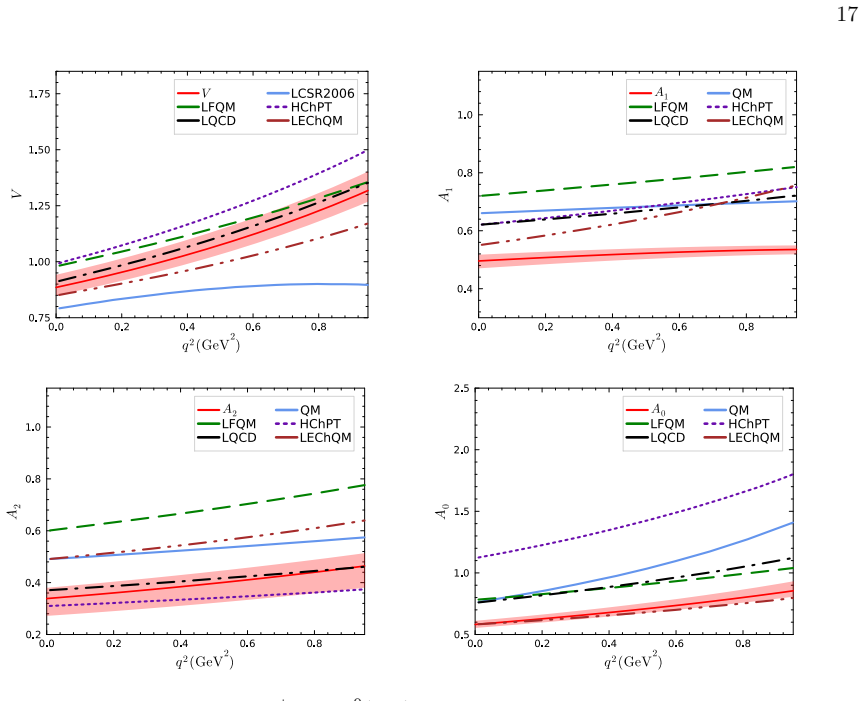
Summary. The paper presents a light-cone sum rule (LCSR) calculation of the D→ρ, D_s→K*, and D→K* semileptonic form factors at leading order in α_s, including two-particle and three-particle light-cone distribution amplitudes up to twist-5. The authors provide explicit OPE expressions for the correlation function, verify the twist convergence, interpret the twist-3 dominance of some axial form factors in the heavy quark effective theory, and use a third-order BCL z-expansion to extrapolate the LCSR results from q^2 ≤ 0.4 GeV^2 to the full kinematic range. They then compute branching ratios for four D_(s)→V ℓν modes and find central values that differ from PDG averages by 10%–20%, which they interpret as evidence that vector-meson width and non-resonant effects are important.
Significance. If the calculation is correct over the full q^2 range, the paper provides a complete higher-twist LCSR description of D→V form factors and updates the theoretical picture for charm semileptonic decays to vector mesons. The paper is careful about OPE convergence and offers explicit expressions, twist-by-twist decomposition, and comparisons with earlier LCSR, quark-model, and lattice determinations; the form-factor ratios r_V and r_2 are also compared with BESIII measurements. However, the central branching-ratio predictions, and hence the claimed 10%–20% discrepancy, rest on a BCL extrapolation that is not yet validated, and the discrepancy itself is within the quoted uncertainties. The physics conclusion about resonant-width and non-resonant effects is therefore not yet established.
major comments (3)
- [III C, Eq. (25), Table V] The BCL z-expansion is fitted only to LCSR results in 0 ≤ q^2 ≤ 0.4 GeV^2, corresponding to z ∈ [0.008, 0.023] for D→ρ; the physical endpoint q^2 = (m_D - m_V)^2 corresponds to z = 0, which lies outside the fitted interval. The fit yields a3 coefficients as large as 34 (Table V, V form factors) while a1 is O(1), and the table lists no uncertainties for any fitted coefficient. The paper gives no fit residuals, no stability check against truncation order (N = 1, 2, 3), and no covariance or propagation of the fit uncertainty. Since the branching ratios in Table VI are obtained by integrating over the full kinematic range, including q^2 > 0.4 GeV^2 not covered by the LCSR input, the claimed 10%–20% discrepancy with experiment is not an error-controlled statement. The authors should quantify the extrapolation uncertainty and demonstrate that the branching ratios are stable against the order of the BCL truncation.
- [III D, Table VI, Abstract] The claimed "10%–20% discrepancy" is not statistically significant with the quoted uncertainties. For example, D^+→ρ^0 e^+ν is 2.30^{+0.32}_{-0.25} versus PDG 1.90±0.10 (about 1.2σ), D^0→K^{*-} e^+ν is 45.2^{+6.2}_{-5.0} versus 54.0±1.0 (about 1.4σ), and D^+→\bar K^{*0} e^+ν is 42.7^{+5.7}_{-4.5} versus 52.7±1.5 (about 1.7σ). The abstract's wording "a 10%–20% discrepancy from experimental measurements is found" overstates the significance, and the conclusion that vector-meson width and non-resonant QCD background effects are required is therefore not established. The authors should either quantify the significance in a statistically meaningful way or soften the claim.
- [III C, Tables V and VI] The manuscript does not provide numerical tables of the LCSR form factors in the accessible region 0 ≤ q^2 ≤ 0.4 GeV^2, nor the uncertainties of the fitted BCL coefficients. This makes the extrapolation step non-reproducible and prevents a reader from assessing whether the large a3 coefficients are fit artifacts or genuine curvature. At minimum, the authors should supply the form-factor values (or a machine-readable ancillary file), the fit residuals, and the covariance matrix of the BCL parameters so that the extrapolation uncertainty can be independently checked.
minor comments (6)
- [II A, II B, III D] There are several typographical errors that should be corrected: "befinit" (Section II A), "frist" (Section II B), "configutations" and "repectively" (Section II B), "Tthe" (Section III D), and "observed derivations" (Section III B, likely "deviations").
- [Table VI] The table caption does not explain why each decay mode has two numerical entries; the text and caption should state explicitly that the two columns correspond to the electron and muon channels, respectively.
- [Eq. (25) and Table V] The notation is inconsistent: Eq. (25) uses α_i^k, while Table V lists a1, a2, a3 with no a0. The authors should define the normalization of the series (including the value of a0 or F_i(0)) and clarify whether "third order" means terms through z^3 or (z - z(0))^3, and how many parameters were actually fitted.
- [Eq. (28)] The quantity v is called the "velocity parameter" but is defined as v = 1 - m_l^2/q^2, which appears to be the square of the usual lepton velocity factor; the authors should clarify whether v or v^2 enters the decay width formula.
- [Table III and Appendix A] For the twist-four parameters ζ_4, ζ_4^T, and \tilde ζ_4^T, the table cites Ref. [21] but does not state the renormalization scale at which these values are defined; the scale should be specified in the table caption or text.
- [Abstract and Section IV] The abstract states that twist-four and twist-five contributions are "indeed negligible," while the introduction and summary emphasize that three-particle contributions are "substantial" for A1 and A2. These statements are not contradictory (the former refers to overall size, the latter to specific form factors), but the wording should be harmonized to avoid the appearance of inconsistency.
Circularity Check
No significant circularity: the form factors are computed from QCD via LCSR with external LCDA and lattice inputs, and the BCL fit is an internal parametrization whose results are benchmarked against, not fitted to, the experimental branching ratios.
full rationale
The derivation chain is self-contained in the sense required for a circularity finding. The D to V form factors are obtained from a light-cone OPE calculation of a correlation function, Eq. (7), with inputs consisting of vector-meson LCDA parameters from external QCD sum rules and lattice determinations (Refs. [40]-[43]), decay constants extracted from lattice or from independent V -> e+e- processes, and standard LCSR parameters (Borel mass and continuum threshold). No experimental semileptonic D -> V l nu branching ratio enters anywhere in the computation of the form factors. The BCL parametrization in Eq. (25) is fitted to the LCSR predictions themselves over the low-q^2 window 0 <= q^2 <= 0.4 GeV^2, as stated in Sec. III C: 'The coefficients ai's are unknown constants and are fixed by fitting to the LCSR predictions.' This is internal functional parametrization, not fitting to the target observables. The branching ratios in Table VI are then obtained by integrating the resulting form factors and comparing with PDG values; that comparison is an external benchmark. A skeptical concern about the robustness of the BCL extrapolation from a tiny z-range to the full kinematic region is an accuracy or model-dependence issue, not a circularity issue, and the authors themselves acknowledge the need for future lattice-constrained fits. The self-references (e.g., Ref. [20], an in-progress follow-up) are cited for future directions and not used as evidence for the central derivation. Therefore no self-definitional step, fitted-input-called-prediction, or load-bearing self-citation chain exists; the appropriate finding is no significant circularity.
Assumptions & free parameters
free parameters (5)
- Borel mass M^2 for D to rho =
4.5 +/- 1.0 GeV^2
- Borel mass M^2 for D_(s) to K* =
4.0 +/- 1.0 GeV^2
- Continuum threshold s0 =
7 +/- 0.5 GeV^2
- Charm quark mass m_c =
~1.33 GeV (implied)
- BCL coefficients a_i =
Given in Table V per form factor
assumptions (6)
- domain assumption The OPE near the light cone is valid for the correlation function in the region 0 <= q^2 <= m_c^2 - 2 m_c chi with chi ~ 500 MeV.
- domain assumption Quark-hadron duality: the continuum contribution above the threshold s0 is modeled by the OPE and subtracted via the Borel transformation.
- domain assumption The vector meson LCDAs are described by the conformal expansion truncated at second order in Gegenbauer moments, with parameters taken from Refs. [40,42,43,21].
- ad hoc to paper The BCL parametrization truncated at third order (Eq. 25) provides a valid extrapolation of the form factors from q^2 in [0,0.4] GeV^2 to the full kinematical range.
- domain assumption The final vector mesons are treated as stable particles in the branching ratio calculation (narrow-width approximation).
- domain assumption The heavy quark expansion at O(1/m_c) is valid and the series is under control.
Cite this review
Pith. "Pith review of Semileptonic Decays of $D \to \rho l^+ \nu$ and $D_{(s)} \to K^\ast l^+ \nu$ from Light-Cone Sum Rules." pith.science (2026). https://pith.science/paper/RLATGUBE
@misc{pith2026250501329,
  author       = {Pith},
  title        = {Pith review of: Semileptonic Decays of $D \to \rho l^+ \nu$ and $D_(s) \to K^\ast l^+ \nu$ from Light-Cone Sum Rules},
  year         = {2026},
  howpublished = {\url{https://pith.science/paper/RLATGUBE}},
  note         = {Machine review of arXiv:2505.01329}
}
abstract
We investigate the semileptonic decays of charmed mesons to light vector mesons within the framework of light-cone sum rules. Our calculation is performed at leading order in QCD coupling, incorporating contributions up to twist-five accuracy from both two-particle and three-particle light-cone distribution amplitudes. Transition form factors are predicted twist by twist to assess the convergence property of the operator product expansion. It is verified that the twist-four and twist-five contributions are indeed negligible for all the decays under consideration. Twist-three dominance is observed for some of the form factors, subject to heavy quark effective field theory interpretation. Branching ratios for the decays $D^+ \to \rho^0 \ell^+\nu_\ell$ , $D_s^+ \to K^{\ast0} \ell^+\nu_\ell$, $D^0 \to K^{\ast-} \ell^+\nu_\ell$ and $D^+ \to \bar{K}^{\ast0} \ell^+\nu_\ell$ are obtained, and a $10\%$--$20\%$ discrepancy from experimental measurements is found. Our finding indicates that the resonant-width and non-resonant QCD backgrounds effects should be potentially significant, implying the necessity to further implement their contributions in future precision studies of the semileptonic charm decays.
Figures


Figures from the paper (4 more)



Forward citations
Cited by 2 Pith papers
-
Vector mesons leading-twist longitudinal distribution amplitudes and related semi-leptonic decays within QCD sum rules
New QCD sum-rule calculation gives ξ-moments up to tenth order and PLP-model distribution amplitudes for ρ, K*, φ, which are then used to recalculate D_(s)→V semileptonic observables.
-
Scrutinizing lepton flavor universality and transition form factor correlation from charmed meson semileptonic decay into light strange vector $K^*$ meson
A light-cone sum-rule calculation predicts D_s^+→K^{*0} form factors and a muon/electron branching ratio R=0.950, consistent with the Standard Model.
Reference graph
Works this paper leans on
-
[1]
Two-particle LCDAs LCDAs are rigorously defined by the matrix elements sandwiched by the quark bilinears with light-cone separation, and are switched to the actual momenta and the near lightlike distance xin practice. In Refs. [56, 57], high-twist LCDAs of vector mesons are systematical studied in QCD based on conformal expansion with meson and quark mass...
-
[2]
Three-particle LCDAs The definition of three-particle LCDAs are quoted as [59] ⟨V(p,η ∗)|¯q1(0)gGµν(¯vx)σαβq2(x)|0⟩ =f ⊥ Vm2 V η∗·x 2p·x h pαpµg⊥ βν−pβpµg⊥ αν−pαpνg⊥ βµ +pβpνg⊥ αµ i T(¯v,px) +f ⊥ Vm2 V h pαη∗ ⊥µg⊥ βν−pβη∗ ⊥µg⊥ αν−pαη∗ ⊥νg⊥ βµ +pβη∗ ⊥νg⊥ αµ i T (4) 1 (¯v,px) +f ⊥ Vm2 V h pµη∗ ⊥αg⊥ βν−pµη∗ ⊥βg⊥ αν−pνη∗ ⊥αg⊥ βµ +pνη∗ ⊥βg⊥ αµ i T (4) 2 (¯v,px...
-
[3]
Y. S. Amhiset al.[HFLAV], Phys. Rev. D107(2023) no.5, 052008
work page 2023
-
[4]
Navaset al.[Particle Data Group], Phys
S. Navaset al.[Particle Data Group], Phys. Rev. D110(2024) no.3, 030001
2024
- [5]
-
[6]
M. Ablikimet al.[BESIII], Phys. Rev. Lett.121(2018) no.17, 171803
work page 2018
- [7]
- [8]
Show all 61 references
-
[9]
X. W. Kang, B. Kubis, C. Hanhart and U. G. Meißner, Phys. Rev. D89(2014), 053015
2014
-
[10]
Ablikimet al.[BESIII], Phys
M. Ablikimet al.[BESIII], Phys. Rev. Lett.122(2019) no.6, 062001
2019
-
[11]
Ablikimet al.[BESIII], Phys
M. Ablikimet al.[BESIII], Phys. Rev. D110(2024) no.11, 112018
2024
-
[12]
Cheng, A
S. Cheng, A. Khodjamirian and J. Virto, JHEP05(2017), 157
2017
-
[13]
Hambrock and A
C. Hambrock and A. Khodjamirian, Nucl. Phys. B905(2016), 373-390
2016
-
[14]
Cheng, A
S. Cheng, A. Khodjamirian and J. Virto, Phys. Rev. D96(2017) no.5, 051901 24
2017
-
[15]
Cheng, Phys
S. Cheng, Phys. Rev. D99(2019) no.5, 053005
2019
-
[16]
P. Böer, T. Feldmann and D. van Dyk, JHEP02(2017), 133
2017
-
[17]
Leskovec, S
L. Leskovec, S. Meinel, M. Petschlies, J. Negele, S. Paul and A. Pochinsky, Phys. Rev. Lett.134 (2025) no.16, 161901
2025
- [18]
-
[19]
Cheng, [arXiv:2502.07333 [hep-ph]]
S. Cheng, [arXiv:2502.07333 [hep-ph]]
-
[20]
Y. J. Shi, W. Wang and S. Zhao, Eur. Phys. J. C77(2017) no.7, 452
2017
-
[21]
Ablikimet al.[BESIII], Phys
M. Ablikimet al.[BESIII], Phys. Rev. Lett.134(2025) no.1, 011803
2025
-
[22]
Shan Cheng, Ling-Yun Dai, Xiao-En Huang and De-Liang Yao,Bl4 andD l4 decays from QCD, in progress
-
[23]
Y. L. Wu, M. Zhong and Y. B. Zuo, Int. J. Mod. Phys. A21(2006), 6125-6172
2006
-
[24]
H. B. Fu, W. Cheng, L. Zeng, D. D. Hu and T. Zhong, Phys. Rev. Res.2(2020) no.4, 043129
2020
-
[25]
Ball, Phys
P. Ball, Phys. Rev. D48(1993), 3190-3203
1993
-
[26]
Feldmann, B
T. Feldmann, B. Müller and D. Seidel, JHEP08(2017), 105
2017
-
[27]
Scora and N
D. Scora and N. Isgur, Phys. Rev. D52(1995), 2783-2812
1995
-
[28]
H. Y. Cheng, C. K. Chua and C. W. Hwang, Phys. Rev. D69(2004), 074025
2004
-
[29]
R. C. Verma, J. Phys. G39(2012), 025005
2012
-
[30]
H. Y. Cheng and X. W. Kang, Eur. Phys. J. C77(2017) no.9, 587 [erratum: Eur. Phys. J. C77 (2017) no.12, 863]
2017
-
[31]
N. R. Soni, M. A. Ivanov, J. G. Körner, J. N. Pandya, P. Santorelli and C. T. Tran, Phys. Rev. D 98(2018) no.11, 114031
2018
-
[32]
M. A. Ivanov, J. G. Körner, J. N. Pandya, P. Santorelli, N. R. Soni and C. T. Tran, Front. Phys. (Beijing)14(2019) no.6, 64401
2019
-
[33]
R. N. Faustov, V. O. Galkin and X. W. Kang, Phys. Rev. D101(2020) no.1, 013004
2020
-
[34]
Fajfer and J
S. Fajfer and J. F. Kamenik, Phys. Rev. D72(2005), 034029
2005
-
[35]
Sekihara and E
T. Sekihara and E. Oset, Phys. Rev. D92(2015) no.5, 054038
2015
-
[36]
Khodjamirian, R
A. Khodjamirian, R. Ruckl, S. Weinzierl, C. W. Winhart and O. I. Yakovlev, Phys. Rev. D62 (2000), 114002
2000
-
[37]
Khodjamirian, C
A. Khodjamirian, C. Klein, T. Mannel and N. Offen, Phys. Rev. D80(2009), 114005
2009
-
[38]
Offen, F
N. Offen, F. A. Porkert and A. Schäfer, Phys. Rev. D88(2013) no.3, 034023
2013
-
[39]
D. L. Yao, P. Fernandez-Soler, M. Albaladejo, F. K. Guo and J. Nieves, Eur. Phys. J. C78(2018) no.4, 310
2018
-
[40]
Kuberskiet al.[RQCD and ALPHA], JHEP07(2024), 090
S. Kuberskiet al.[RQCD and ALPHA], JHEP07(2024), 090
2024
-
[41]
Ablikimet al.[BESIII], Phys
M. Ablikimet al.[BESIII], Phys. Rev. Lett.127(2021) no.17, 171801
2021
-
[42]
Bharucha, D
A. Bharucha, D. M. Straub and R. Zwicky, JHEP08(2016), 098
2016
-
[43]
Alltonet al.[RBC-UKQCD], Phys
C. Alltonet al.[RBC-UKQCD], Phys. Rev. D78(2008), 114509
2008
-
[44]
Arthur, P
R. Arthur, P. A. Boyle, D. Brommel, M. A. Donnellan, J. M. Flynn, A. Juttner, T. D. Rae and C. T. C. Sachrajda, Phys. Rev. D83(2011), 074505
2011
-
[45]
Ball and G
P. Ball and G. W. Jones, JHEP03(2007), 069 25
2007
-
[46]
Dobbset al.[CLEO], Phys
S. Dobbset al.[CLEO], Phys. Rev. Lett.110(2013) no.13, 131802
2013
-
[47]
Ablikimet al.[BESIII], Phys
M. Ablikimet al.[BESIII], Phys. Rev. Lett.122(2019) no.6, 061801
2019
-
[48]
Ablikimet al.[BESIII], JHEP03(2025), 197
M. Ablikimet al.[BESIII], JHEP03(2025), 197
2025
-
[49]
Melikhov and B
D. Melikhov and B. Stech, Phys. Rev. D62(2000), 014006
2000
-
[50]
Palmer and J
T. Palmer and J. O. Eeg, Phys. Rev. D89(2014) no.3, 034013
2014
-
[51]
Abadaet al.[SPQcdR], Nucl
A. Abadaet al.[SPQcdR], Nucl. Phys. B Proc. Suppl.119(2003), 625-628
2003
-
[52]
Bourrely, I
C. Bourrely, I. Caprini and L. Lellouch, Phys. Rev. D79(2009), 013008 [erratum: Phys. Rev. D82 (2010), 099902]
2009
-
[53]
Zhang, X
L. Zhang, X. W. Kang, X. H. Guo, L. Y. Dai, T. Luo and C. Wang, JHEP02(2021), 179
2021
-
[54]
Beleñoet al.[Belle], Phys
C. Beleñoet al.[Belle], Phys. Rev. D103(2021) no.11, 112001
2021
-
[55]
Wang, in private discussions
Y-M. Wang, in private discussions
-
[56]
D. L. Yao, L. Y. Dai, H. Q. Zheng and Z. Y. Zhou, Rept. Prog. Phys.84(2021) no.7, 076201
2021
-
[57]
V. L. Chernyak and A. R. Zhitnitsky, Phys. Rept.112(1984), 173
1984
-
[58]
P. Ball, V. M. Braun, Y. Koike and K. Tanaka, Nucl. Phys. B529(1998), 323-382
1998
-
[59]
Ball and V
P. Ball and V. M. Braun, Nucl. Phys. B543(1999), 201-238
1999
-
[60]
P. Ball, V. M. Braun and A. Lenz, JHEP08(2007), 090
2007
-
[61]
Ball and V
P. Ball and V. M. Braun, Phys. Rev. D58(1998), 094016
1998
Reviewed August 16, 2026 · model on record in the stance chip above.
Discussion (0). Continue with ORCID to comment.