REVIEW 3 major objections 4 minor 53 references
Bridging the Atmospheric Circulations of Hot and Warm Giant Exoplanets
T0 review · 3 major / 4 minor · reviewed 2026-08-16 · deepseek-v4-flash
Pith's one-line read The large-scale circulation of tidally locked giant planets is set by dynamical numbers, not by equilibrium temperature.
desk verdict A useful two-planet simulation study with a clear qualitative result, but the causal attribution to the Rossby deformation scale is not isolated by the design; worth sending to referees with a demand for control runs. read the letter →
The pith
A machine-rendered reading of the paper's core claim, the machinery that carries it, and where it could break.
The reading
What carries the argument
The argument is carried by a parameter-similarity construction rather than by a single formula. The planets are chosen so that their Rossby number $Ro$, Froude number $Fr$, Burger number $Bu = (L_D/L)^2$, and deformation scale $L_D$ are comparable; the qualitative circulation is then read as a function of this dynamical regime. Within that regime, $L_D$ does the quantitative work: it sets the horizontal length scale over which waves and vortices interact, so a larger $L_D$ widens the equatorial jet, softens its potential-vorticity gradients, and lets polar vortices couple to and precess around the equatorial flow. The interpretation of the deep Rossby waves uses the quasi-geostrophic $\beta$-plane dispersion relation $c_p = -\beta/(n(n+1)/R^2 + 1/L_D^2)$, which with the planets' parameters predicts a dominant total wavenumber $n \approx 3$ and the observed mode-2, period-about-$3\tau_p$ waves, matching the simulations.
What would settle it
Run the same simulations with the two planets' thermal forcing profiles swapped or reshaped while keeping their dynamical parameters fixed, and check whether the circulation pattern stays qualitatively the same; alternatively, monitor long-baseline phase curves of both planets and look for the predicted flux oscillation amplitudes and periods of roughly $4\tau_p$ for KELT-11b and $3\tau_p$ for WASP-39b.
Extended reading notes
Core claim
On the paper's own terms, the result is that two tidally locked gas giants with markedly different equilibrium temperatures, KELT-11b and WASP-39b, develop atmospherically similar circulation when their key dynamical numbers match. The common pattern consists of a broad prograde equatorial flow with turbulent vortices and Rossby-wave undulations, quasi-zonal flow in the extratropics, and a cyclonic ring around an anticyclonic polar vortex in each hemisphere. Quantitative contrasts are attributed to the Rossby deformation scale $L_D$: the hot planet's larger $L_D$ (about $1.5R$) produces broader, roughly 60 to 100 percent stronger equatorial potential-vorticity features, more pronounced wave undulations, and polar vortices that are displaced from the pole and precess with a period near $4\tau_p$, whereas the warm planet's smaller $L_D$ (about $R$) produces a narrower jet, sharper potential-vorticity gradients on the jet flanks, and centered polar vortices. The paper's central claim is that the qualitative circulation regime depends on the dynamical parameter set, with equilibrium temperature entering mainly through its secondary influence on $L_D$, not as the controlling variable.
Load-bearing premise
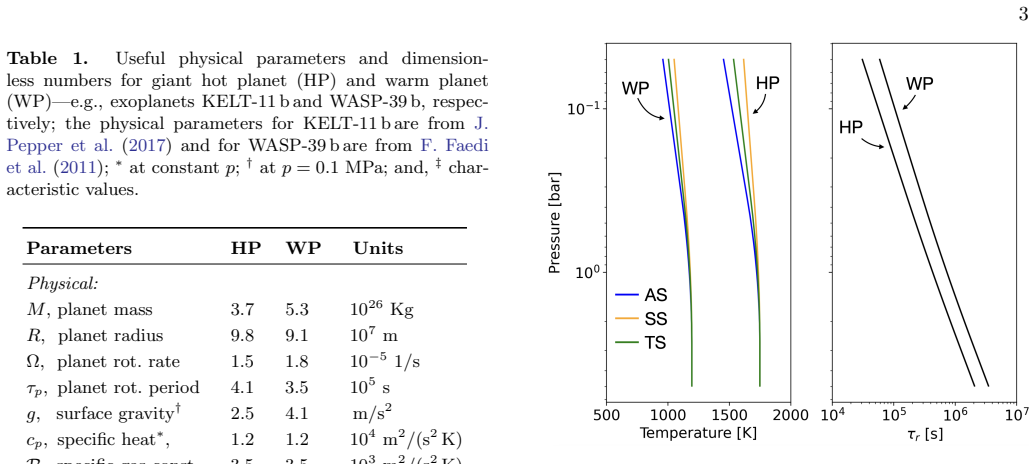
Everything rests on the two planets being given essentially the same day-night forcing pattern, with the vertical profile of the temperature difference having the same shape and going to zero at 1 bar, so the shared circulation may largely reflect the shared forcing rather than the shared dynamical numbers standing alone.
Editorial extensions
If this is right
- Giant exoplanets currently classified as hot or warm should be expected to share the same qualitative circulation whenever their Rossby, Froude, and Burger numbers and deformation scale are similar, regardless of equilibrium temperature.
- The Rossby deformation scale, not temperature, sets the width and strength of the equatorial jet, the geometry of polar vortices, and therefore the amplitude and period of time-variable disk-integrated flux.
- Phase-curve and emission-map observations from current and upcoming space telescopes can be used to infer which dynamical regime a planet sits in, because the simulations predict specific flux oscillation periods and amplitudes near $4\tau_p$ for the hot planet and $3\tau_p$ for the warm planet.
- If the thermal forcing is made strong and deep, as for HD 209458b, the circulation of both planets becomes predominantly azonal, so forcing strength controls whether the quasi-zonal regime is realized at all.
Reading between the lines
- I would read the paper as implying that the hot versus warm giant-planet division is not a dynamical classification; replacing it with a similarity grouping in $(Ro, Fr, Bu, L_D)$ space would make circulation predictions portable across planets that are observationally very different.
- A direct extension is to simulate a planet with WASP-39b's temperature but KELT-11b's deformation scale, or vice versa; the paper's logic predicts the circulation should follow $L_D$, not temperature.
- Because the two forcing profiles were intentionally given the same shape, the cleanest test of the paper's interpretation is a twin simulation in which the forcing shapes are allowed to differ; if the circulation pattern breaks, forcing shape is doing part of the organizing work.
- The predicted flux oscillation periods of a few orbit periods are within reach of long-baseline JWST phase-curve monitoring, so the dynamical-similarity claim is observationally testable rather than purely numerical.
Signed reviews
Editorial analysis
A structured set of objections, weighed in public.
Referee Report
Summary. The manuscript presents high-resolution (T341L50) pseudospectral primitive-equation simulations of two tidally locked giant exoplanets, a hot planet modeled after KELT-11 b and a warmer planet modeled after WASP-39 b. The thermal forcing uses Newtonian relaxation with equilibrium temperature and relaxation time profiles constructed from an as-yet-unpublished self-consistent model. The authors report that, despite markedly different equilibrium temperatures, the two simulations develop qualitatively similar circulation patterns: quasi-zonal flows, turbulent equatorial flow, persistent polar anticyclones, and wavenumber-2 Rossby waves. They attribute quantitative differences in flow width, amplitude, vortex precession, and disk-integrated flux variability to the difference in Rossby deformation length L_D, and they use a quasigeostrophic beta-plane dispersion relation to identify the dominant Rossby mode as n ≈ 3.
Significance. If the causal attribution were established, the paper would make a useful contribution: it would show that qualitative circulation regimes of hot and warm tidally locked giants are controlled by nondimensional dynamical parameters (Rossby, Froude, Burger numbers) rather than by equilibrium temperature alone, with direct implications for interpreting phase curves and JWST/Ariel observations. The paper has real strengths: the code is well-tested and convergence-checked, both planets are run at identical resolution for long integration times, and the diagnostics (potential vorticity, relative vorticity, Hovmöller plots, disk-averaged flux time series) are appropriate and clearly presented. However, the central causal claim is underdetermined by the current experimental design: the two simulations share nearly identical thermal forcing geometry and vertical anomaly shape, so the qualitative similarity may reflect the forcing rather than the dynamical parameters, and no control experiment varies L_D while holding other parameters fixed. The unpublished forcing model also limits reproducibility.
major comments (3)
- [Section 3, Figure 1, Table 1] The central claim that the qualitative circulation similarity is caused by comparable Rossby and Froude numbers, and that quantitative differences are caused by L_D, is underdetermined by the present design. Both planets are forced with the same lateral modulation cos λ cos φ and, by construction, the same vertical anomaly profile (ΔT_DN ≈ 100 K at 0.05 bar, decreasing linearly in log p to zero at 1 bar), yet they also differ in mass, radius, gravity, rotation rate, scale height, Brunt–Väisälä frequency, and wind speed (Table 1). The identical forcing shape alone could plausibly produce the observed qualitative similarity, and the HP/WP differences could be due to any of the simultaneously varying parameters rather than specifically to L_D. The authors should add a control experiment that varies L_D while holding the forcing profiles and other dynamical numbers fixed, or at minimum an experiment that swaps the Teq(p) and τ_r(p) profiles between the two planets; without such a test the attribution to L_D is not established.
- [Section 2.2] The Teq(p) profiles that drive both simulations are computed with a self-consistent radiative-transfer/empirical model whose full description, validation, and fit parameters are deferred to an unpublished companion paper ('Skinner et al., in prep.'). Since the forcing profiles enter every result and their identical vertical structure is central to the similarity interpretation, this is a load-bearing reproducibility gap. The manuscript should either provide the essential details of the polynomial fit and validation or cite a publicly available published description; as written, the reader cannot check whether the two planets' forcing profiles are indeed physically consistent or whether the similarity of the circulations is an artifact of the assumed forcing.
- [Section 3, Eq. (2)] The Rossby wave analysis is presented as a prediction ("Equation 2 predicts the dominant linear mode has n ≈ 3"), but it is actually a consistency check: the phase speed c_p is measured from the simulation, the zonal wavenumber m = 2 is read off the same fields, and Eq. (2) is then inverted to obtain n. The mode structure is subsequently confirmed by visual inspection of the same fields. This circularity does not invalidate the identification, but it should be reframed honestly as a consistency check. The claim would be stronger if the authors specified a mode a priori and compared the predicted phase speed with the measured one, or if they presented the inferred n as a diagnostic rather than an independent prediction.
minor comments (4)
- [Section 3, p. 6] The text states that both planets have Ro ≲ 0.15 and Bu = O(1) in mid-to-high latitude regions, while Table 1 lists characteristic Rossby numbers of 0.45 and 0.32; please clarify that the former values are local, away from the equatorial jet, so the two statements are not contradictory.
- [Section 3, Eq. (3)] The text says "emissivity is assumed to be zero" immediately after defining a Stefan–Boltzmann disk-averaged flux; a zero-emissivity body emits no thermal flux. This is presumably a typo for emissivity equal to unity (or a blackbody), and it should be corrected.
- [Abstract and Section 4] There are several typographical errors that should be fixed, including "Rossby waves that gives rise" in the abstract and "distinct, differences" in Section 4.
- [Figure 5 discussion, Section 3] The statement that the p = 0.95 bar model fluxes "match closely to full radiative transfer (RT) fluxes" is not supported by any comparison shown in the paper, since the dynamical model does not include radiative transfer; please clarify the provenance of this claim.
Circularity Check
Rossby wave 'prediction' is a postdiction; central simulation comparison is not circular.
-
fitted input called prediction
[Section 3, Rossby wave paragraph and Eq. (2)]
"We estimate the wave phase speed cp of the Rossby waves from cp = ω/m, where ω is the observed angular frequency of the wave and m = 2. Both are directly measured by detailed analyses of the fields. A wave period of τβ ∼ 3τp is also obtained by visual inspection of Fig. 4. ... Using values of β, cp calculated from the physical parameters of both planets in Table 1, equation 2 predicts the dominant linear mode has n≈ 3. ... The presence of this structure is confirmed by visual inspection of the v fields in the deeper atmospheric regions."
The 'prediction' of meridional wavenumber n≈3 is not an independent prediction: cp is obtained by measuring ω from the v-field oscillations and fixing m=2 from the same fields, so the dispersion relation is inverted to solve for n from the very wave whose structure is then said to be 'confirmed' by those fields. This is a consistency check or postdiction, not a first-principles prediction. Calling it a prediction presents the diagnostic use of the dispersion relation as an independent test of the theory.
full rationale
The central simulation result is not circular: the circulations are emergent outputs of time-integrating the primitive equations from rest under Newtonian forcing, not quantities defined in terms of the dynamical parameters. The choice of KELT-11b and WASP-39b for comparable Rossby, Froude, and Burger numbers is a study-design selection, not a derivation that forces the qualitative similarity by construction. The identical dayside forcing geometry is a potential confound for the causal attribution to dynamical parameters, but that is a validity limitation, not a circular step. The unpublished forcing model ('will be detailed elsewhere') and self-citations for BoB and the cosλ cosφ forcing are reproducibility gaps, not load-bearing circular arguments. The only circularity-adjacent step is the Rossby wave 'prediction,' which is actually a postdiction from measured wave properties. Because this step is peripheral to the main simulation-based comparison, the overall circularity score is low.
Assumptions & free parameters
free parameters (3)
- Empirical Teq(p) profile polynomial coefficients =
Not given; derived from Changeat et al. 2022 statistical trends
- Thermal relaxation timescale tau_r(p) =
Taken from J. Y-K. Cho (2008) terminator profiles
- Model domain depth and resolution (T341L50, p in [0,5] bar) =
T341L50; p in [0,5] bar
assumptions (4)
- domain assumption Primitive equations in zeta-delta-Theta form with hydrostatic balance are an adequate description of these exoplanet atmospheres.
- domain assumption Newtonian relaxation with cos(lon)cos(lat) day-night forcing approximates the real thermal forcing.
- domain assumption Quasi-geostrophic beta-plane dispersion relation applies to the deep Rossby waves.
- domain assumption The chosen planets' physical parameters (mass, radius, rotation rate, etc.) are accurate.
Cite this review
Pith. "Pith review of Bridging the Atmospheric Circulations of Hot and Warm Giant Exoplanets." pith.science (2026). https://pith.science/paper/S2MTLVXC
@misc{pith2026250501397,
  author       = {Pith},
  title        = {Pith review of: Bridging the Atmospheric Circulations of Hot and Warm Giant Exoplanets},
  year         = {2026},
  howpublished = {\url{https://pith.science/paper/S2MTLVXC}},
  note         = {Machine review of arXiv:2505.01397}
}
read the original abstract
We perform high-resolution atmospheric flow simulations of hot and warm giant exoplanets that are tidally locked. The modeled atmospheres are representative of those on KELT-11b and WASP-39b, which possess markedly different equilibrium temperatures but reside in a similar dynamical regime: in this regime, their key dynamical numbers (e.g., Rossby and Froude numbers) are comparable. Despite their temperature difference, both planets exhibit qualitatively similar atmospheric circulation patterns, which are characterized by turbulent equatorial flows, anticyclonic polar vortices, and large-scale Rossby waves that gives rise to quasi-zonal flows in the extra-tropics (i.e., near ~20 degrees). Quantitative differences between the KELT-11b and WASP-39b atmospheres reflect their different Rossby deformation scales, which influence the horizontal length scale of wave--vortex interactions and the overall structure of the circulation.
Figures


Figures from the paper (2 more)


Reference graph
Works this paper leans on
-
[1]
1972, Monthly Weather Review, 100, 487, doi: 10.1175/1520-0493(1972)100⟨0487:FFFTI⟩2.3.CO;2
Asselin, R. 1972, Monthly Weather Review, 100, 487, doi: 10.1175/1520-0493(1972)100⟨0487:FFFTI⟩2.3.CO;2
-
[2]
Boyd, J. P. 2000, Chebyshev & Fourier Spectral Methods, 2nd edn. (Mineola, NY: Dover Publications) B¨ oning, V. G. A., Dietrich, W., & Wicht, J. 2024, https://arxiv.org/abs/2407.12434
work page Pith review arXiv 2000
- [3]
-
[4]
Changeat, Q., Edwards, B., Al-Refaie, A. F., et al. 2022, The Astrophysical Journal Supplement Series, 260, 3, doi: 10.3847/1538-4365/ac5cc2
-
[5]
Changeat, Q., Skinner, J. W., Cho, J. Y-K., et al. 2024, The Astrophysical Journal Supplement Series, 270, 34, doi: 10.3847/1538-4365/ad1191
- [6]
- [7]
-
[8]
Cho, J. Y-K., Menou, K., Hansen, B. M. S., & Seager, S. 2003, The Astrophysical Journal Letters, 587, 117, doi: 10.1086/375016
doi:10.1086/375016 2003
Show all 53 references
-
[9]
Y-K., Menou, K., Hansen, B
Cho, J. Y-K., Menou, K., Hansen, B. M. S., & Seager, S. 2008, The Astrophysical Journal, 675, 817, doi: 10.1086/524718
2008 doi
-
[10]
Y-K., Polichtchouk, I., & Thrastarson, H
Cho, J. Y-K., Polichtchouk, I., & Thrastarson, H. Th. 2015, Monthly Notices of the Royal Astronomical Society, 454, 3423, doi: 10.1093/mnras/stv1947
2015 doi
-
[11]
Y-K., & Polvani, L
Cho, J. Y-K., & Polvani, L. M. 1996, Physics of Fluids, 8, 1531, doi: 10.1063/1.868929
1996 doi
-
[12]
Y-K., Skinner, J
Cho, J. Y-K., Skinner, J. W., & Thrastarson, H. Th. 2021, The Astrophysical Journal Letters, 913, 832, doi: 10.3847/2041-8213/abfd37
2021 doi
-
[13]
1967, IBM journal of Research and Development, 11, 215
Courant, R., Friedrichs, K., & Lewy, H. 1967, IBM journal of Research and Development, 11, 215
1967
-
[14]
2024, Astronomy & Astrophysics, 688, A15
Damasso, M., Polychroni, D., Locci, D., et al. 2024, Astronomy & Astrophysics, 688, A15
2024
-
[15]
2020, Astronomy & Astrophysics, 633, A2, doi: 10.1051/0004-6361/201936110
Debras, F., Mayne, N., Baraffe, I., et al. 2020, Astronomy & Astrophysics, 633, A2, doi: 10.1051/0004-6361/201936110
2020 doi
-
[16]
Dobbs-Dixon, I., & Lin, D. N. C. 2008, The Astrophysical Journal, 673, doi: 10.1086/523786
2008 doi
-
[17]
2008, Journal of the Atmospheric Sciences, 65, 855
Dritschel, D., & McIntyre, M. 2008, Journal of the Atmospheric Sciences, 65, 855
2008
-
[18]
2022, The Astronomical Journal, 164, 15
Edwards, B., & Tinetti, G. 2022, The Astronomical Journal, 164, 15
2022
-
[19]
Edwards, B., Tsiaras, A., Changeat, Q., & Yip, K. H. 2024, RAS Techniques and Instruments, 3, 415
2024
-
[20]
C., Anderson, D
Faedi, F., Barros, S. C., Anderson, D. R., et al. 2011, Astronomy & Astrophysics, 531, A40
2011
-
[21]
D., Radica, M., Welbanks, L., et al
Feinstein, A. D., Radica, M., Welbanks, L., et al. 2023, Nature, 614, 670
2023
-
[22]
1982, Atmosphere-Ocean Dynamics, Atmosphere-Ocean Dynamics No
Gill, A. 1982, Atmosphere-Ocean Dynamics, Atmosphere-Ocean Dynamics No. v. 30 (Elsevier Science)
1982
-
[23]
Hammond, M., & Lewis, N. T. 2021, Proceedings of the National Academy of Sciences, 118, e2022705118
2021
-
[24]
Heng, K., Menou, K., & Phillipps, P. J. 2011, MNRAS, 413, 2380, doi: 10.1111/j.1365-2966.2011.18315.x
2011
-
[25]
Heng, K., & Showman, A. P. 2014, doi: 10.1146/annurev-earth-060614-105146
2014 doi
-
[26]
2004, An Introduction to Dynamic Meteorology, 4th edn
Holton, J.-R. 2004, An Introduction to Dynamic Meteorology, 4th edn. (Elsevier Academic Press)
2004
-
[27]
Y., & Changeat, Q
Kafle, J., Cho, J. Y., & Changeat, Q. 2025, arXiv preprint arXiv:2504.11679
2025 arXiv
-
[28]
2024, Astronomy & Astrophysics, 692, A222
Kiefer, S., Bach-Møller, N., Samra, D., et al. 2024, Astronomy & Astrophysics, 692, A222
2024
-
[29]
Komacek, T. D. 2025, arXiv preprint arXiv:2502.19394
2025 arXiv
-
[30]
D., & Showman, A
Komacek, T. D., & Showman, A. P. 2016, The Astrophysical Journal, 821, 16
2016
-
[31]
2013, The Astrophysical Journal, 778, 183
Desert, J.-M. 2013, The Astrophysical Journal, 778, 183
2013
-
[32]
Lipps, F. B. 1964, Tellus, 16, 535
1964
-
[33]
Liu, B., & Showman, A. P. 2013, The Astrophysical Journal, 770, doi: 10.1088/0004-637X/770/1/42
2013 doi
-
[34]
F., et al
Ma, S., Saba, A., Al-Refaie, A. F., et al. 2025, arXiv preprint arXiv:2504.07823
2025 arXiv
-
[35]
J., Debras, F., Baraffe, I., et al
Mayne, N. J., Debras, F., Baraffe, I., et al. 2017, A&A, 604, 79, doi: 10.1051/0004-6361/201730465 10 Skinner & Wei
2017 doi
-
[36]
S., Sethunadh, J., & Hartogh, P
Medvedev, A. S., Sethunadh, J., & Hartogh, P. 2013, Icarus, 225, 228 Mendon¸ ca, J. M., Tsai, S.-m., Malik, M., Grimm, S. L., &
2013
-
[37]
2018, The Astrophysical Journal, 869, 107, doi: 10.3847/1538-4357/aaed23
Heng, K. 2018, The Astrophysical Journal, 869, 107, doi: 10.3847/1538-4357/aaed23
2018 doi
-
[38]
E., Collins, K
Pepper, J., Rodriguez, J. E., Collins, K. A., et al. 2017, The Astronomical Journal, 153, 215
2017
-
[39]
Y-K., Watkins, C., et al
Polichtchouk, I., Cho, J. Y-K., Watkins, C., et al. 2014, Icarus, 229, 355, doi: 10.1016/j.icarus.2013.11.027
2014 doi
-
[40]
2010, The Astrophysical Journal, 714, 1334, doi: 10.1088/0004-637X/714/2/1334
Rauscher, E., & Menou, K. 2010, The Astrophysical Journal, 714, 1334, doi: 10.1088/0004-637X/714/2/1334
2010 doi
-
[41]
Rivier, L., Loft, R., & Polvani, L. M. 2002, Monthly Weather Review, 130, doi: 10.1175/1520- 0493(2002)130⟨1384:AESDCF⟩2.0.CO;2
2002 doi
-
[42]
Robert, A. J. 1966, Journal of the Meteorological Society of Japan. Ser. II, 44, 237, doi: 10.2151/jmsj1965.44.5 237
1966 doi
-
[43]
2023, Astronomy & Astrophysics, 669, A142
Samra, D., Helling, C., Chubb, K., et al. 2023, Astronomy & Astrophysics, 669, A142
2023
-
[44]
K., Rivier, L., Loft, R., & Polvani, L
Scott, R. K., Rivier, L., Loft, R., & Polvani, L. M. 2004, NCAR Technical Report, 456, doi: doi:10.5065/D698850K
2004 doi
-
[45]
P., & Guillot, T
Showman, A. P., & Guillot, T. 2002, Astronomy & Astrophysics, 385, 166, doi: 10.1051/0004-6361:20020101
2002 doi
-
[46]
W., & Cho, J
Skinner, J. W., & Cho, J. Y.-K. 2025, The Astrophysical Journal, 982, 64
2025
-
[47]
W., & Cho, J
Skinner, J. W., & Cho, J. Y-K. 2021, Monthly Notices of the Royal Astronomical Society, 504, 5172, doi: 10.1093/mnras/stab971
2021 doi
-
[48]
W., & Cho, J
Skinner, J. W., & Cho, J. Y-K. 2022, Monthly Notices of the Royal Astronomical Society, 511, 3584, doi: 10.1093/mnras/stab2809
2022 doi
-
[49]
W., N¨ attil¨ a, J., & Cho, J
Skinner, J. W., N¨ attil¨ a, J., & Cho, J. Y-K. 2023, Phys. Rev. Lett., 131, 231201, doi: 10.1103/PhysRevLett.131.231201
2023 doi
-
[50]
Th., & Cho, J
Thrastarson, H. Th., & Cho, J. Y-K. 2010, The Astrophysical Journal, 716, 144, doi: 10.1088/0004-637X/716/1/144
2010 doi
-
[51]
Th., & Cho, J
Thrastarson, H. Th., & Cho, J. Y-K. 2011, The Astrophysical Journal, 729, 117, doi: 10.1088/0004-637X/729/2/117
2011 doi
-
[52]
2018, The Astronomical Journal, 155, 156
Tsiaras, A., Waldmann, I., Zingales, T., et al. 2018, The Astronomical Journal, 155, 156
2018
-
[53]
A., Clark, J
Wittenmyer, R. A., Clark, J. T., Trifonov, T., et al. 2022, The Astronomical Journal, 163, 82
2022
Reviewed August 16, 2026 · model on record in the stance chip above.
Discussion (0). Continue with ORCID to comment.