REVIEW 3 major objections 4 minor 88 references
Burstiness and interpersonal foraging between human infants and caregivers in the vocal domain
T0 review · 3 major / 4 minor · reviewed 2026-08-16 · deepseek-v4-flash
Pith's one-line read In daylong home recordings, infants and adult caregivers both vocalize again sooner after the other responds, even after statistically removing the natural burst-and-lull clustering of vocalizations.
desk verdict A genuinely new control for burstiness in vocal turn-taking with a consistent but overstated result; deserves review and a null simulation. read the letter →
The pith
A machine-rendered reading of the paper's core claim, the machinery that carries it, and where it could break.
The reading
What carries the argument
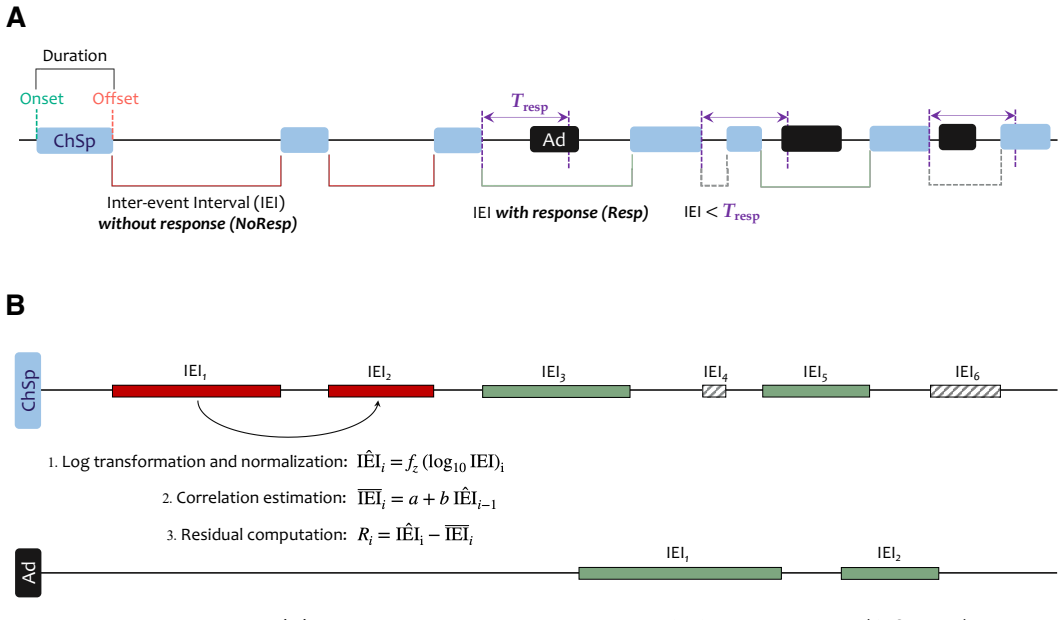
The load-bearing object is the inter-event interval (IEI), the time from the offset of one vocalization to the onset of the next vocalization of the same kind, either infant speech-related or adult. The analysis first logs and normalizes IEIs, then fits a linear mixed-effects model predicting the current IEI from the previous IEI; the residuals from that model are the clustering-controlled outcome. A binary comparison is then made between residuals whose first vocalization was followed by a partner vocal onset within a response window Tresp, called 'Resp', and residuals with no such onset, called 'NoResp', with short intervals and intervals interrupted by the infant's own non-speech sounds excluded. This two-step residualization is the mechanism that separates the response signal from the endogenous burst-lull structure.
What would settle it
Generate surrogate daylong vocalization series that reproduce the observed positive correlation between successive gaps but contain no true social coupling, for example by placing partner responses at random positions, then apply the paper's two-step residual comparison; if the negative response coefficient persists in the surrogates, the control is incomplete and the reported effect is not evidence of social facilitation.
Extended reading notes
Core claim
In the paper's own terms, the discovery is that social engagement has a facilitatory, turn-by-turn effect on vocal timing that survives statistical control for the burstiness of vocal behavior. Successive inter-event intervals (IEIs), defined from the offset of one speech-related vocalization to the onset of the next, are positively correlated in daylong recordings for infants aged 3, 6, 9, and 18 months and for adult caregivers, with standardized coefficients around 0.23 to 0.33. After regressing the current IEI on the previous IEI to form residuals, IEIs whose first vocalization received a partner response within a response window of about 2 to 10 seconds are shorter than IEIs with no response; for a 5-second window the standardized response effects range from -0.09 to -0.15 for infant gaps and -0.11 to -0.17 for adult gaps, significant at p < 0.001 in the daylong automated data. The shortening appears for response windows of at least 2 to 3 seconds, while very short windows around 1 second or less produce artifactual positive effects due to the duration of the intervening sound. Human-listener validation data trend in the same direction and are clearest for infant-directed adult vocalizations.
Load-bearing premise
The argument assumes that subtracting the prediction from the immediately previous gap removes all of the burstiness-driven confound; if bouts of activity linger across more than one gap, the shorter gaps after responses could still reflect shared activity state rather than the response itself.
Editorial extensions
If this is right
- Contingent caregiver responses appear to promote immediate subsequent infant vocalization in naturalistic, daylong home settings, extending short laboratory demonstrations to real-world interaction.
- The effect is bidirectional: infant responses likewise shorten adult caregivers' next vocal gap, so the interaction behaves like a mutually reinforcing loop rather than a one-way caregiver-to-infant input.
- Analyses should use response windows of at least about 2 to 3 seconds; shorter windows around 1 second or less are dominated by sound-duration artifacts and should not be interpreted as social effects.
- The successive-IEI residual method provides a reusable statistical control for burstiness in any event-based interactive time series, such as gestures or nonhuman animal vocal turn-taking.
- In human-labeled validation data, the adult side of the effect was clearest for infant-directed adult vocalizations, suggesting that directedness is part of what makes the interpersonal foraging loop work.
Reading between the lines
- The authors control for only the most recent gap, so their own limitation implies a sharper test not performed here: adding several previous gaps or a burst-context variable could reveal whether one-lag control leaves residual confounding.
- Because the recordings are observational, the causal reading is an inference; a simulation that reintroduces burstiness without any true social effect and runs the same residual comparison would show how much bias the control actually removes.
- If interpersonal foraging is general, the same residual method could hunt for contingent-response effects in other modalities and species, predicting that response windows and effect sizes differ with the vocal repertoire.
- The age-related decline in the infant successive-IEI correlation suggests a developmental shift toward more exploratory vocal timing; an untested corollary is that infants with steeper declines may show stronger response-shortening effects or faster language growth later.
Signed reviews
Editorial analysis
A structured set of objections, weighed in public.
Referee Report
Summary. The paper proposes and applies an analytic approach, inspired by flight-time analyses in foraging research, to test whether receiving a social vocal response shortens the next inter-event interval (IEI) for infant and adult vocalizations after controlling for the positive correlation between successive IEIs. Using daylong LENA recordings from 54 infants at 3, 6, 9, and 18 months (200 recordings, over 2,400 hours) plus human-labeled 5-minute validation excerpts, the authors compute IEIs, label each IEI as Resp, NoResp, or NA based on a response window Tresp, and compare residual IEIs from a previous-IEI regression between Resp and NoResp cases. They report positive correlations between successive IEIs for both infants and adults, and negative response effects for Tresp ≥ 2 s (adults) or ≥ 3 s (infants) in the daylong data, with weaker and only partially significant validation results. The findings are interpreted as evidence for an 'interpersonal foraging' process in which social responses facilitate immediate subsequent vocalization.
Significance. If the central claim holds, the paper provides large-scale naturalistic evidence that contingent vocal responses are followed by earlier subsequent vocalizations in both infants and caregivers, addressing a confound that has limited prior event-level studies. The proposed successive-IEI residual method is a potentially transferable tool for studying turn-by-turn effects in other modalities and species. The paper has notable strengths: a large daylong corpus, transparent reporting of the full Tresp sweep, validation with human annotations, and public code and data availability. The main risk is that the single-lag control may not fully remove burstiness-driven confounding, and the validation results are only partially significant; these issues are fixable with additional analyses.
major comments (3)
- [Section 4.4 and Discussion, limitation paragraph] The two-step control for burstiness uses only the immediately preceding IEI when predicting the current IEI. Given the hierarchical, multi-timescale clustering reported in Section 2.1 and Supplementary Fig. S9, an AR(1)-style residual can still contain a latent activity state in which both partner responses and short focal IEIs are more probable. Because Resp IEIs are over-represented inside bursts and NoResp IEIs in lulls, the negative response beta could arise even without any response-driven facilitation. The paper flags this limitation in the Discussion but does not quantify it. A null simulation in which the same burst structure is preserved but response receipt has no causal effect on the next IEI is needed to show that the proposed two-step procedure does not produce negative response betas by construction. Alternatively, the control should be extended to include higher-order IEI lags or burst-context indicators.
- [Section 4.4, second-stage model] The second-stage linear model treats residual IEIs as independent observations. With hundreds of thousands of IEIs drawn from 200 recordings and 54 infants, this can inflate significance levels. The paper already uses mixed-effects models with infant ID as a random effect for the first-stage and age-trend analyses, so it would be straightforward to apply the same clustering to the response-effect test, or to report cluster-robust standard errors or recording-level response betas. Without this, the strong p<0.001 claims in Section 2.2 rest on an independence assumption that is unlikely to hold for repeated IEIs within a recording.
- [Section 2.2, Figure 4, and Tables S12-S13] The choice of Tresp ≥ 2 s or ≥ 3 s as the 'most stable and interpretable' range is made after inspecting the sweep across response windows, and no multiple-comparison correction across Tresp values is reported. This post-hoc selection risk is compounded by the validation results: for the representative Tresp = 5 s, only the H: Child-directed Adult dataset reaches p<0.001 for adult IEIs (Table S13), while H: All Adult gives beta = 0.04 (p = 0.30), and infant IEI effects in the human-labeled data do not reach the strict threshold (Table S12). The bidirectional claim therefore rests heavily on the LENA daylong labels. The authors should either pre-specify the Tresp range, correct for multiple comparisons, or temper the conclusions to reflect the partial validation support.
minor comments (4)
- [Methods 4.3] The phrase 'response reciept' should be corrected to 'response receipt'.
- [Introduction, paragraph 2] The reference 'see Fig. 1 and 27' should be clarified; presumably it refers to Fig. 1 and Supplementary Fig. S27, but the label is incomplete.
- [Supplementary Section S6.3 and Fig. S23 caption] The text refers to 'Fig. 1C and D', but the main-text Fig. 1 has only panels A and B; the reference should be updated to the correct figure panels.
- [Abstract and Discussion] The phrase 'independent of burstiness' is stronger than what the analysis supports given the single-lag control; consider wording such as 'after controlling for the immediately preceding IEI' to match the actual method.
Circularity Check
No significant circularity: the response-effect test is run on residuals from an independently fit previous-IEI control, and the foraging framing is rhetorical rather than load-bearing.
full rationale
The paper's central claim is that, after controlling for the positive correlation between successive inter-event intervals, a partner response within Tresp is associated with a shorter subsequent IEI. The control is computed before any response grouping: current IEI is regressed on previous IEI (with participant random effects), and only the residuals enter the Resp-vs-NoResp comparison. Response status is defined by whether a partner vocalization onset occurs within Tresp after the offset of the focal vocalization, not by the length of the outcome IEI, so the contrast is not definitionally tied to the predicted quantity. The Tresp sweep from 0.5 s to 10 s is a sensitivity analysis with an explicit explanation of why very short windows introduce intervening-sound-duration artifacts; it is not a parameter fitted to produce the headline result. The main inferential weakness, acknowledged by the authors in the Discussion, is that only the most recent IEI is used as the control, so higher-order burstiness or shared activity state could remain in the residuals; that is an identification limitation and a candidate for null-simulation testing, not a circularity. The self-citation of the prior vocal-foraging paper [27] supplies framing, terminology, and dataset provenance, but the statistical derivation in the present paper does not depend on any unverified claim imported from that citation. External validation with human-labeled 5-minute excerpts provides independent support for the LENA-based analyses. No step in the derivation reduces by construction to its own input, and no fitted parameter is renamed as a prediction. Score 0 is therefore appropriate.
Assumptions & free parameters
free parameters (1)
- Response window Tresp =
Swept 0.5 to 10 s; interpretable range selected post hoc as >=2 s (adult) and >=3 s (infant)
assumptions (3)
- domain assumption LENA automated labels accurately identify infant speech-related and adult vocalization onsets and offsets.
- domain assumption Regression on the single previous IEI removes burstiness confound.
- domain assumption No unmeasured shared state explains both response receipt and shorter next IEI.
Cite this review
Pith. "Pith review of Burstiness and interpersonal foraging between human infants and caregivers in the vocal domain." pith.science (2026). https://pith.science/paper/7KGFVMBO
@misc{pith2026250501545,
  author       = {Pith},
  title        = {Pith review of: Burstiness and interpersonal foraging between human infants and caregivers in the vocal domain},
  year         = {2026},
  howpublished = {\url{https://pith.science/paper/7KGFVMBO}},
  note         = {Machine review of arXiv:2505.01545}
}
read the original abstract
Vocal responses from caregivers are believed to promote more frequent and more advanced infant vocalizations. However, studies that examine this relationship typically do not account for the fact that infant and adult vocalizations are distributed in hierarchical clusters over the course of the day. These bursts and lulls create a challenge for accurately detecting the effects of adult input at immediate turn-by-turn timescales within real-world behavior, as adult responses tend to happen during already occurring bursts of infant vocalizations. Analyzing daylong audio recordings of real-world vocal communication between human infants (ages 3, 6, 9, and 18 months) and their adult caregivers, we first show that both infant and caregiver vocalization events are clustered in time, as evidenced by positive correlations between successive inter-event intervals (IEIs). We propose an approach informed by flight time analyses in foraging studies to assess whether the timing of a vocal agent's next vocalization is modified by inputs from another vocal agent, controlling for the first agent's previous IEI. For both infants and adults, receiving a social response predicts that the individual will vocalize again sooner than they would have in the absence of a response. Overall, our results are consistent with a view of infant-caregiver vocal interactions as an 'interpersonal foraging' process with inherent multi-scale dynamics wherein social responses are among the resources the individuals are foraging for. The analytic approaches introduced here have broad utility to study communication in other modalities, contexts, and species.
Figures


Figures from the paper (1 more)

Reference graph
Works this paper leans on
-
[1]
Babbling and early speech: Continuity and individual differences
John L Locke. Babbling and early speech: Continuity and individual differences. First Language , 9(6):191--205, 1989
1989
-
[2]
The emergence of the speech capacity
D Kimbrough Oller. The emergence of the speech capacity . Psychology Press, 2000
2000
-
[3]
Cross-species parallels in babbling: animals and algorithms
Sita M Ter Haar, Ahana A Fernandez, Maya Gratier, Mirjam Kn \"o rnschild, Claartje Levelt, Roger K Moore, Michiel Vellema, Xiaoqin Wang, and D Kimbrough Oller. Cross-species parallels in babbling: animals and algorithms. Philosophical Transactions of the Royal Society B , 376(1836):20200239, 2021
2021
-
[4]
Social and endogenous infant vocalizations
Helen L Long, Dale D Bowman, Hyunjoo Yoo, Megan M Burkhardt-Reed, Edina R Bene, and D Kimbrough Oller. Social and endogenous infant vocalizations. PloS one , 15(8):e0224956, 2020
2020
-
[5]
Social feedback to infants' babbling facilitates rapid phonological learning
Michael H Goldstein and Jennifer A Schwade. Social feedback to infants' babbling facilitates rapid phonological learning. Psychological science , 19(5):515--523, 2008
2008
-
[6]
Social interaction shapes babbling: Testing parallels between birdsong and speech
Michael H Goldstein, Andrew P King, and Meredith J West. Social interaction shapes babbling: Testing parallels between birdsong and speech. Proceedings of the National Academy of Sciences , 100(13):8030--8035, 2003
2003
-
[7]
The social functions of babbling: acoustic and contextual characteristics that facilitate maternal responsiveness
Rachel R Albert, Jennifer A Schwade, and Michael H Goldstein. The social functions of babbling: acoustic and contextual characteristics that facilitate maternal responsiveness. Developmental science , 21(5):e12641, 2018
2018
-
[8]
The development of structured vocalizations in songbirds and humans: a comparative analysis
Dina Lipkind, Andreea Geambasu, and Clara C Levelt. The development of structured vocalizations in songbirds and humans: a comparative analysis. Topics in Cognitive Science , 12(3):894--909, 2020
2020
Show all 88 references
-
[9]
Infant-directed speech is modulated by infant feedback
Nicholas A Smith and Laurel J Trainor. Infant-directed speech is modulated by infant feedback. Infancy , 13(4):410--420, 2008
2008
-
[10]
Infant-adult vocal interaction dynamics depend on infant vocal type, child-directedness of adult speech, and timeframe
Gina M Pretzer, Lukas D Lopez, Eric A Walle, and Anne S Warlaumont. Infant-adult vocal interaction dynamics depend on infant vocal type, child-directedness of adult speech, and timeframe. Infant Behavior and Development , 57:101325, 2019
2019
-
[11]
Patricia K. Kuhl. Early language acquisition: cracking the speech code. Nature Reviews Neuroscience , 5:831--843
-
[12]
Goldstein, Heidi R
Michael H. Goldstein, Heidi R. Waterfall, Arnon Lotem, Joseph Y. Halpern, Jennifer A. Schwade, Luca Onnis, and Shimon Edelman. General cognitive principles for learning structure in time and space. Trends in Cognitive Sciences , 14(6):249--258, 2010
2010
-
[13]
C. S. Tamis-LeMonda , Y. Kuchirko, and L. Song. Why is infant language learning facilitated by parental responsiveness? Current Directions in Psychological Science , 23(2):121--126, 2014
2014
-
[14]
Bobb, and Eve V
Marisa Casillas, Susan C. Bobb, and Eve V. Clark. Turn-taking, timing, and planning in early language acquisition. Journal of Child Language , 43(6):1310--1337, 2016
2016
-
[15]
A. S. Warlaumont. Infant vocal learning and speech production , pages 602--631. Cambridge University Press, 2020
2020
-
[16]
Rohlfing, Giuseppe Leonardi, Iris Nomikou, Joanna Raczaszek-Leonardi, and Eyke H\" u llermeier
Katharina J. Rohlfing, Giuseppe Leonardi, Iris Nomikou, Joanna Raczaszek-Leonardi, and Eyke H\" u llermeier. Multimodal turn-taking: Motivations, methodological challenges, and novel approaches. IEEE Transactions on Cognitive and Developmental Systems , 12(2):260--271, 2020
2020
-
[17]
Tamis-LeMonda, Marc H
Catherine S. Tamis-LeMonda, Marc H. Bornstein, and Lisa Baumwell. Maternal responsiveness and children's achievement of language milestones. Child Development , 72(3):748--767, 2001
2001
-
[18]
Caregivers' contingent comments to 9-month-old infants: Relationships with later language
Pamela Rosenthal Rollins. Caregivers' contingent comments to 9-month-old infants: Relationships with later language. Applied Psycholinguistics , 24:221--234, 2003
2003
-
[19]
Naja Ferjan Ram\` i rez, Sarah Roseberry Lytle, and Patricia K. Kuhl. Parent coaching increases conversational turns and advances infant language development. Proceedings of the National Academy of Sciences of the United States of America , 117(7):3484--3491, 2019
2019
-
[20]
Your turn, my turn
Trinh Nguyen, Lucie Zimmer, and Stefanie Hoehl. Your turn, my turn. neural synchrony in mother--infant proto-conversation. Philosophical Transactions of the Royal Society B , 378:20210488, 2023
2023
-
[21]
Elmlinger, and Michael H
Vivian Hanwen Zhang, Steven L. Elmlinger, and Michael H. Goldstein. Developmental cascades of vocal turn-taking connect prelinguistic vocalizing with early language. Infant Behavior and Development , 75:101945, 2024
2024
-
[22]
Turn taking affects the quality of infant vocalizations
Kathleen Bloom, Ann Russell, and Karen Wassenberg. Turn taking affects the quality of infant vocalizations. Journal of Child Language , 14(2):211--227, 1987
1987
-
[23]
N. M. Leezenbaum, S. B. Campbell, D. Butler, and J. M. Iverson. Maternal verbal responses to communication of infants at low and heightened risk of autism. Autism , 18:694--703, 2013
2013
-
[24]
Gros-Louis, M
J. Gros-Louis, M. J. West, and A. P. King. Maternal responsiveness and the development of directed vocalizing in social interactions. Infancy , 19:385--408, 2014
2014
-
[25]
A social feedback loop for speech development and its reduction in autism
Anne S Warlaumont, Jeffrey A Richards, Jill Gilkerson, and D Kimbrough Oller. A social feedback loop for speech development and its reduction in autism. Psychological science , 25(7):1314--1324, 2014
2014
-
[26]
Elmlinger, Jennifer A
Steven L. Elmlinger, Jennifer A. Schwade, Laura Vollmer, and Michael H. Goldstein. Learning how to learn from social feedback: The origins of early vocal development. Developmental Science , 26(2):e13296
-
[27]
Exploratory dynamics of vocal foraging during infant-caregiver communication
VPS Ritwika, Gina M Pretzer, Sara Mendoza, Christopher Shedd, Christopher T Kello, Ajay Gopinathan, and Anne S Warlaumont. Exploratory dynamics of vocal foraging during infant-caregiver communication. Scientific reports , 10(1):10469, 2020
2020
-
[28]
D. H. Abney, A. S. Warlaumont, D. K. Oller, and S. Wallot. Multiple coordination patterns in infant and adult vocalizations. Infancy , 22(4):514--539, 2017
2017
-
[29]
A. S. Warlaumont, K. Sobowale, and C. M. Fausey. Daylong mobile audio recordings reveal multitimescale dynamics in infants' vocal productions and auditory experiences. Current Directions in Psychological Science , 21(1):12--19, 2022
2022
-
[30]
L \'e vy flight search patterns of wandering albatrosses
Gandhimohan M Viswanathan, Vsevolod Afanasyev, Sergey V Buldyrev, Eugene J Murphy, Peter A Prince, and H Eugene Stanley. L \'e vy flight search patterns of wandering albatrosses. Nature , 381(6581):413--415, 1996
1996
-
[31]
The physics of foraging: an introduction to random searches and biological encounters
Gandhimohan M Viswanathan, Marcos GE Da Luz, Ernesto P Raposo, and H Eugene Stanley. The physics of foraging: an introduction to random searches and biological encounters . Cambridge University Press, 2011
2011
-
[32]
L \'e vy walk patterns in the foraging movements of spider monkeys (ateles geoffroyi)
Gabriel Ramos-Fern \'a ndez, Jos \'e L Mateos, Octavio Miramontes, Germinal Cocho, Hern \'a n Larralde, and Barbara Ayala-Orozco. L \'e vy walk patterns in the foraging movements of spider monkeys (ateles geoffroyi). Behavioral ecology and Sociobiology , 55:223--230, 2004
2004
-
[33]
Foraging success of biological l \'e vy flights recorded in situ
Nicolas E Humphries, Henri Weimerskirch, Nuno Queiroz, Emily J Southall, and David W Sims. Foraging success of biological l \'e vy flights recorded in situ. Proceedings of the National Academy of Sciences , 109(19):7169--7174, 2012
2012
-
[34]
Scaling laws of marine predator search behaviour
David W Sims, Emily J Southall, Nicolas E Humphries, Graeme C Hays, Corey JA Bradshaw, Jonathan W Pitchford, Alex James, Mohammed Z Ahmed, Andrew S Brierley, Mark A Hindell, et al. Scaling laws of marine predator search behaviour. Nature , 451(7182):1098--1102, 2008
2008
-
[35]
The role of semantic clustering in optimal memory foraging
Priscilla Montez, Graham Thompson, and Christopher T Kello. The role of semantic clustering in optimal memory foraging. Cognitive science , 39(8):1925--1939, 2015
1925
-
[36]
Optimal foraging in semantic memory
Thomas T Hills, Michael N Jones, and Peter M Todd. Optimal foraging in semantic memory. Psychological review , 119(2):431, 2012
2012
-
[37]
Spivey, and Tyler Marghetis
Soran Malaie, Michael J. Spivey, and Tyler Marghetis. Divergent and convergent creativity are different kinds of foraging. Psychological Science , 35(7):749--759, 2024
2024
-
[38]
A guide to area-restricted search: a foundational foraging behaviour
Arik Dorfman, Thomas T Hills, and Inon Scharf. A guide to area-restricted search: a foundational foraging behaviour. Biological Reviews , 97(6):2076--2089, 2022
2022
-
[39]
Optimal foraging in a uniform habitat: the search mechanism of the green lacewing
Alan B Bond. Optimal foraging in a uniform habitat: the search mechanism of the green lacewing. Animal Behaviour , 28(1):10--19, 1980
1980
-
[40]
Host-plant finding by insects: orientation, sensory input and search patterns
JH Visser. Host-plant finding by insects: orientation, sensory input and search patterns. Journal of insect physiology , 34(3):259--268, 1988
1988
-
[41]
Dopamine and glutamate control area-restricted search behavior in caenorhabditis elegans
Thomas Hills, Penelope J Brockie, and Andres V Maricq. Dopamine and glutamate control area-restricted search behavior in caenorhabditis elegans. Journal of Neuroscience , 24(5):1217--1225, 2004
2004
-
[42]
Robertson, John Guckenheimer, Amy M
Steven S. Robertson, John Guckenheimer, Amy M. Masnick, and Leigh F. Bacher. The dynamics of infant visual foraging. Developmental Science , 7(2):194--200, 2004
2004
-
[43]
Robertson, Sarah Enos Watamura, and Makeba Parramore Wilbourn
Steven S. Robertson, Sarah Enos Watamura, and Makeba Parramore Wilbourn. Attentional dynamics of infant visual foraging. Proceedings of the National Academy of Sciences of the United States of America , 109(28):11460--11464, 2012
2012
-
[44]
Linda B. Smith. Cognition as a dynamic system: Principles from embodiment. Developmental Review , 25(3--4):278--298, 2005
2005
-
[45]
M. H. Bornstein, D. L. Putnick, L. R. Cote, O. M. Haynes, and J. T. D. Suwalsky. Mother-infant contingent vocalizations in 11 countries. Psychological Science , 26(8):1272--1284, 2015
2015
-
[46]
E. E. Hilbrink, M. Gattis, and S. C. Levinson. Early developmental changes in the timing of turn-taking: A longitudinal study of mother-infant interaction. Frontiers in Psychology , 6:1492, 2015
2015
-
[47]
Early development of turn-taking in vocal interaction between mothers and infants
Maya Gratier, Emmanuel Devouche, Bahia Guellai, Rubia Infanti, Ebru Yilmaz, and Erika Parlato-Oliveira. Early development of turn-taking in vocal interaction between mothers and infants. Frontiers in Psychology , 6:1167, 2015
2015
-
[48]
Dominguez, E
S. Dominguez, E. Devouche, G. Apter, and M. Gratier. The roots of turn-taking in the neonatal period. Infant and Child Development , 25:240--255, 2016
2016
-
[49]
Speech and Computer
Ian Spencer Howard and Piers Ruston Messum. A computational model of infant speech development. In XII International Conference" Speech and Computer"(SPECOM'2007) , pages 756--765, 2007
2007
-
[50]
A. S. Warlaumont and M. K. Finnegan. Learning to produce syllabic speech sounds via reward-modulated neural plasticity. PLOS ONE , 11(1):e0145096, 2016
2016
-
[51]
Rheingold, Jacob L
Harriet L. Rheingold, Jacob L. Gewirtz, and Helen W. Ross. Social conditioning of vocalizations in infants. Comparative and Physiological Psychology , 52(1):68--73, 1959
1959
-
[52]
Social and nonsocial conditioning of infant vocalizations
Paul Weisberg. Social and nonsocial conditioning of infant vocalizations. Child Development , 34(2):377--388, 1963
1963
-
[53]
Nathani and R
S. Nathani and R. E. Stark. Can conditioning procedures yield representative infant vocalizations in the laboratory? First Language , 16(48):365--387, 1996
1996
-
[54]
Donald K. Routh. Conditioning of vocal response differentiation in infants. Developmental Psychology , 1(3):219]]226, 1969
1969
-
[55]
A. L. Harbison, T. G. Woynaroski, J. Tapp, J. W. Wade, A. S. Warlaumont, and P. J. Yoder. A new measure of child vocal reciprocity in children with autism spectrum disorder. Autism Research , 11:903--915, 2018
2018
-
[56]
Richards
Jill Gilkerson and Jeffrey A. Richards. A guide to understanding the design and purpose of the LENA system. Technical Report LTR-12, LENA Foundation, 2020
2020
-
[57]
Information foraging
Peter Pirolli and Stuart Card. Information foraging. Psychological Review , 106(4):643--675, 1999
1999
-
[58]
Human memory retrieval as l \'e vy foraging
Theo Rhodes and Michael T Turvey. Human memory retrieval as l \'e vy foraging. Physica A: Statistical Mechanics and its Applications , 385(1):255--260, 2007
2007
-
[59]
Exploration versus exploitation in space, mind, and society
Thomas T Hills, Peter M Todd, David Lazer, A David Redish, and Iain D Couzin. Exploration versus exploitation in space, mind, and society. Trends in cognitive sciences , 19(1):46--54, 2015
2015
-
[60]
Long, Edina R
Hyunjoo Yoo, Pumpki Lei Su, Gordon Ramsay, Helen L. Long, Edina R. Bene, and D. Kimbrough Oller. Infant vocal category exploration as a foundation for speech development. PLOS One , 19(5):e0299140, 2024
2024
-
[61]
Altmann, Janet B
Eduardo G. Altmann, Janet B. Pierrehumbert, and Adilson E. Motter. Beyond word frequency: Bursts, lulls, and scaling in the temporal distributions of words. PLOS One , 4(11):e7678, 2009
2009
-
[62]
Hadar Karmazyn-Raz and Linda B. Smith. Sampling statistics are like story creation: a network analysis of parent-toddler exploratory play. Philosophical Transactions of the Royal Society B , 378:20210358, 2022
2022
-
[63]
Distinguishing between social reinforcement and social elicitation
Kathleen Bloom. Distinguishing between social reinforcement and social elicitation. Journal of Experimental Child Psychology , 38(1):93--102, 1984
1984
-
[64]
The value of vocalizing: Five-month-old infants associate their own noncry vocalizations with responses from caregivers
Michael H Goldstein, Jennifer A Schwade, and Marc H Bornstein. The value of vocalizing: Five-month-old infants associate their own noncry vocalizations with responses from caregivers. Child development , 80(3):636--644, 2009
2009
-
[65]
Warlaumont, Daniel Messinger, Edina Bene, Suneeti Nathani Iyer, Chia-Chang Lee, Brittany Lambert, and D
Beau Franklin, Anne S. Warlaumont, Daniel Messinger, Edina Bene, Suneeti Nathani Iyer, Chia-Chang Lee, Brittany Lambert, and D. Kimbrough Oller. Effects of parental interaction on infant vocalization rate, variability and vocal type. Language Learning and Development , 10(3):2...
2013
-
[66]
Santos, E.P
M.C. Santos, E.P. Raposo, G.M. Viswanathan, and M.G.E. da Luz . Can collective searches profit from Lévy walk strategies? Journal of Physics A: Mathematical and Theoretical , 42:434017, 2009
2009
-
[67]
Calabrese, Thomas Mueller, Kirk A
Ricardo Mart \'e nez-Garc \'i a, Justin M. Calabrese, Thomas Mueller, Kirk A. Olson, and Crist \'o bal L \'o pez. Optimizing the search for resources by sharing informaiton: Mongolian gazelles as a case study. Physical Review Letters , 110:248106, 2013
2013
-
[68]
Golnaraghi, David A
F. Golnaraghi, David A. Quint, and Ajay Gopinathan. Optimal foraging strategies for mutually avoiding competitors. Journal of Theoretical Biology , 570:111537, 2023
2023
-
[69]
Rowland, Nairán Ramírez-Esparza, Lisa R
Elika Bergelson, Melanie Soderstrom, Iris-Corinna Schwarz, Caroline F. Rowland, Nairán Ramírez-Esparza, Lisa R. Hamrick, Ellen Marklund, Marina Kalashnikova, Ava Guez, Marisa Casillas, Lucia Benetti, Petra van Alphen, and Alejandrina Cristia. Everydat language input and produc...
2023
-
[70]
Automated monitoring of behavior reveals bursty interaction patterns and rapid spreading dynamics in honeybee social networks
Tim Gernat, Vikyath D Rao, Martin Middendorf, Harry Dankowicz, Nigel Goldenfeld, and Gene E Robinson. Automated monitoring of behavior reveals bursty interaction patterns and rapid spreading dynamics in honeybee social networks. Proceedings of the National Academy of Sciences ...
2018
-
[71]
Comparison of methods for rhythm analysis of complex animals’ acoustic signals
Lara S Burchardt and Mirjam Kn \"o rnschild. Comparison of methods for rhythm analysis of complex animals’ acoustic signals. PLoS Computational Biology , 16(4):e1007755, 2020
2020
-
[72]
Developmental determinants of structure in zebra finch song
Philip H Price. Developmental determinants of structure in zebra finch song. journal of comparative and physiological psychology , 93(2):260, 1979
1979
-
[73]
The developmental dynamics of marmoset monkey vocal production
Daniel Y Takahashi, Alicia R Fenley, Yayoi Teramoto, Darshana Z Narayanan, Jeremy I Borjon, Peter Holmes, and Asif A Ghazanfar. The developmental dynamics of marmoset monkey vocal production. Science , 349(6249):734--738, 2015
2015
-
[74]
Origins of Human Communication
Michael Tomasello. Origins of Human Communication . MIT Press, 2008
2008
-
[75]
Turn-taking skills in mammals: A systematic review into development and acquisition
Filipa Abreu and Simone Pika. Turn-taking skills in mammals: A systematic review into development and acquisition. Frontiers in Ecology and Evolution , 10:987253, 2022
2022
-
[76]
Takahashi, Alicia R
Daniel Y. Takahashi, Alicia R. Fenley, and Asif A. Ghazanfar. Early development of turn-taking with parents shapes vocal acoustics in infant marmoset monkeys. Philosophical Transactions of the Royal Society B , 371:20150370, 2016
2016
-
[77]
Kosie and Casey Lew-Williams
Jessica E. Kosie and Casey Lew-Williams. Infant-directed communication: Examining the many dimensions of everyday caregiver-infant interactions. Developmental Science , 27(5):e13515, 2024
2024
-
[78]
J. M. Iverson and S. Goldin-Meadow. Gesture paves the way for language development. Psychological Science , 16(5):367--372, 2005
2005
-
[79]
Burkhardt-Reed, Helen L
Megan M. Burkhardt-Reed, Helen L. Long, Dale D. Bowman, Edina R. Bene, and D. Kimbrough Oller. The origin of language and relative roles of voice and gesture in early communication development. Infant Behavior and Development , 65:101648, 2021
2021
-
[80]
Acquisition of turn-taking in sign language conversations: An overview of language modality and turn structure
Laura Horton and Jenny Singleton. Acquisition of turn-taking in sign language conversations: An overview of language modality and turn structure. Frontiers in Psychology , 13:935342, 2022
2022
-
[81]
Nijmegen: Max Planck Institute for Psycholinguistics, The Language Archive
ELAN [Computer Software]. Nijmegen: Max Planck Institute for Psycholinguistics, The Language Archive . https://archive.mpi.nl/tla/elan, 2024
2024
-
[82]
Warlaumont, Gina M
Anne S. Warlaumont, Gina M. Pretzer, Sara Mendoza, Sara Schneider, Jimel Mutrie, Lukas Lopez, Eric A. Walle, and Christopher T. Kello. San Joaquin Valley HomeBank Corpus (formerly the Warlaumont HomeBank Corpus ), 2024
2024
-
[83]
Warlaumont, Elika Bergelson, Alejandrina Cristia, Melanie Soderstrom, Paul De Palma , and Brian MacWhinney
Mark VanDam, Anne S. Warlaumont, Elika Bergelson, Alejandrina Cristia, Melanie Soderstrom, Paul De Palma , and Brian MacWhinney . HomeBank : An online repository of daylong child-centered audio recordings. Seminars in Speech and Language , 37(2):128--142
-
[84]
Dongxin Xu, Umit Yapanel, Sharmi Gray, and Charles T. Baer. The LENA Language Environment Analysis system: The Interpreted Time Segments (ITS) file. Technical Report LTR-04-2, LENA Foundation, 2008
2008
-
[85]
Head/tail breaks: A new classification scheme for data with a heavy-tailed distribution
Bin Jiang. Head/tail breaks: A new classification scheme for data with a heavy-tailed distribution. The Professional Geographer , 65(3):482--494, 2013
2013
-
[86]
Power-law distributions in empirical data
Aaron Clauset, Cosma Rohilla Shalizi, and Mark EJ Newman. Power-law distributions in empirical data. SIAM review , 51(4):661--703, 2009
2009
-
[87]
A thorough evaluation of the Language Environment Analysis ( LENA ) system
Alejandrina Cristia, Marvin Lavechin, Camila Scaff, Melanie Soderstrom, Caroline Rowland, Okko R\" a s\" a nen, John Bunce, and Elika Bergelson. A thorough evaluation of the Language Environment Analysis ( LENA ) system. Behavior Research Methods , 53:467--486, 2020
2020
-
[88]
On the histogram as a density estimator: L 2 theory
David Freedman and Persi Diaconis. On the histogram as a density estimator: L 2 theory. Zeitschrift f \"u r Wahrscheinlichkeitstheorie und verwandte Gebiete , 57(4):453--476, 1981
1981
Reviewed August 16, 2026 · model on record in the stance chip above.
Discussion (0). Continue with ORCID to comment.