REVIEW 4 major objections 5 minor 33 references
A Domain Adaptation of Large Language Models for Classifying Mechanical Assembly Components
T0 review · 4 major / 5 minor · reviewed 2026-08-16 · deepseek-v4-flash
Pith's one-line read Fine-tuned GPT-3.5 classifies mechanical part functions at 89% accuracy
desk verdict A routine fine-tuning paper with a real OSDR result and an overreaching ABC claim: the ABC labels are never validated, so the 'high-quality functional data' headline is not supported. read the letter →
The pith
A machine-rendered reading of the paper's core claim, the machinery that carries it, and where it could break.
The reading
What carries the argument
The carrying mechanism is supervised domain adaptation by fine-tuning, implemented as conditional text prediction over a prompt composed of the function classes, their definitions, a part name, and an assembly name. The fine-tuned model's distribution is shifted toward assembly-design labels by minimizing cross-entropy over the OSDR function-labeled data, and the hyperparameters (epochs, batch size, learning-rate multiplier) are selected by evaluation on a held-out test set. This is what lets the model generate function labels for unlabeled CAD parts: it is the same language-modeling machinery, repurposed with a domain-specific prompt and label vocabulary.
What would settle it
Select a random sample of the 6,786 ABC parts labeled by the fine-tuned model, have human designers assign one of the eight function classes to each from the part's name and assembly context, and measure agreement; if agreement is near the OSDR-chance level rather than the 89 percent test accuracy, the name-based transfer assumption fails.
Extended reading notes
Core claim
The central discovery is that supervised domain adaptation via fine-tuning is sufficient to move a foundation language model from general language competence to mechanical-function classification. With a prompt that supplies the eight function classes and their textual definitions and asks for the function of a named part within a named assembly, fine-tuned GPT-3.5 Turbo reaches 89 percent test accuracy on a 10 percent OSDR training sample, and the same model assigns labels to 6,786 ABC parts with 99 percent of outputs falling inside the predefined classes. The paper attributes the improvement to the model's ability to incorporate contextual function definitions, something earlier machine-learning classifiers such as graph neural networks could not do directly. It therefore positions the fine-tuned model as a generator of synthesized, function-labeled design data rather than only a classifier.
Load-bearing premise
The load-bearing premise is that matching part names between the OSDR training data and the ABC target data transfers the model's classification accuracy to ABC, but the paper never validates any ABC function label against ground truth.
Editorial extensions
If this is right
- Function annotation of large unlabeled CAD repositories can be automated with a small labeled source set, replacing manual and subjective annotation.
- The injected class definitions make the classifier's reasoning visible: a user can inspect which of the eight function definitions the model is choosing between.
- Using less source training data improved test accuracy, so overfitting on the source repository is a real risk and small, balanced samples may be preferable.
- The generated ABC labels form a new function-labeled dataset that can support conceptual-design reasoning, retrieval, and downstream behavioral models.
Reading between the lines
- The 99 percent figure only measures whether predicted labels sit inside the eight-class vocabulary, not whether they are correct; a human validation on a random ABC sample would be the direct test of the 'high-quality' claim.
- Name-based matching between OSDR and ABC is the paper's transfer bridge; if the naming conventions differ, accuracy on ABC could be far lower even though OSDR test accuracy is high.
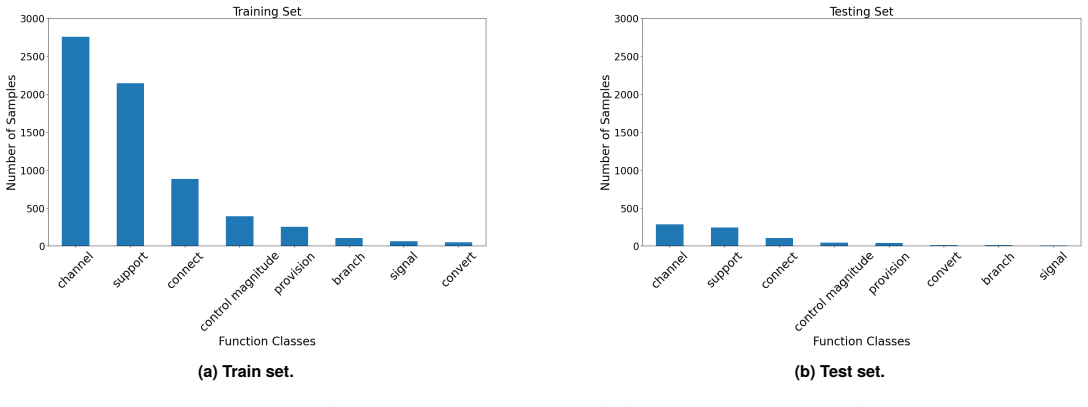
- Because the OSDR label distribution is dominated by 'channel' and 'support,' the model will likely over-annotate those classes on any new dataset; rebalancing or prior correction is a natural next step.
- A stronger test would compare fine-tuned model labels on ABC parts with labels derived from geometric or visual features, testing whether function can be inferred from form.
Signed reviews
Editorial analysis
A structured set of objections, weighed in public.
Referee Report
Summary. This paper proposes a supervised domain-adaptation framework that fine-tunes GPT-3.5 Turbo on the Oregon State Design Repository (OSDR) to classify mechanical assembly component functions into eight predefined classes, and then applies the fine-tuned model to the ABC CAD dataset to generate function labels. The central claimed results are an OSDR test accuracy of about 89% when using only 10% of the training data (Table 4) and that 99% of the ABC outputs fall within the predefined function classes (Figure 8). The authors interpret these results as evidence that the domain-adapted LLM can generate high-quality functional data that supports early-phase conceptual design.
Significance. If the accuracy and transfer claims were validated, the proposed pipeline would offer a practical, scalable alternative to manual function annotation in mechanical design, and the paper provides a useful case study of fine-tuning a commercial LLM on a design repository. The experimental setup is clearly described, and the authors provide detailed metric tables and comparisons with pre-trained GPT models, which is a strength. However, two load-bearing issues prevent the central claim from being accepted as evidence: the OSDR results are obtained by selecting hyperparameters on the test set, and the ABC 'evaluation' never checks the semantic correctness of the transferred labels. The paper's own Discussion section concedes the key limitation. If the authors add a proper validation protocol and external or human-validated assessment of the ABC labels, the contribution would be significantly strengthened.
major comments (4)
- [Section 4, Eq. (8), and Table 4] The optimization procedure selects hyperparameters by maximizing evaluation metrics computed on the held-out test set (Eq. (7) defines M on D_test, and Eq. (8) chooses H' by the 'highest values of evaluation metrics'). This makes the reported 89% test accuracy an optimistic selection over the hyperparameter grid rather than an unbiased estimate of generalization. The inverse scaling in Table 4, where test accuracy drops from 0.89 at 10% training data to 0.63 at 90%, is unexplained and is exactly the pattern one would expect if each training-size configuration was tuned on the test set. A proper evaluation should use a separate validation split for hyperparameter selection, a fixed test set, and ideally repeated runs with variance reporting.
- [Section 5.1.2 and Figure 8] The evaluation on the ABC dataset is not an accuracy evaluation: the only quantitative check is that 99% of the predicted labels fall inside the eight predefined function classes. Because the model's output layer is a softmax over exactly those eight classes (Eq. (3)), a high in-class rate is a syntactic constraint-satisfaction check, not a measure of semantic correctness. The name-based matching between OSDR and ABC does not guarantee functional equivalence, since the same part name can have different functions in different assemblies. There is no ground-truth function label for ABC parts, no human evaluation, and no comparison with an alternative classifier such as the GNN of Ferrero et al. [7]. The claim that the model generates 'high-quality functional data' therefore rests entirely on an untested transfer assumption.
- [Section 6 and Abstract] The paper's own Discussion states that 'the DA prediction results heavily depend on the predefined function labels, limiting the domain-adapted classifier's ability to distinguish other possible function classes.' This limitation directly contradicts the abstract's assertion that the domain-adapted LLM 'can generate high-quality functional data.' The 99% in-class rate is presented in Section 5.3 as a success, but Section 6 acknowledges it as a constraint of the label set rather than evidence of quality. The central conclusion should be revised to state that the model produces labels within a predefined taxonomy, not that the labels are correct or high-quality.
- [Section 5.3, Table 4, and Section 6] The macro-averaged F1 scores in Table 4 are substantially lower than the weighted scores (e.g., 0.64 vs. 0.89 for the 10% training run), reflecting poor performance on rare classes. Figure 8 shows that the ABC predictions concentrate heavily on 'channel' and 'support', matching the OSDR class imbalance. This means that the reported high weighted accuracy is driven by majority classes, and the claim that the model provides comprehensive functional annotations for mechanical parts is not supported for minority function classes.
minor comments (5)
- [Section 4, around Eq. (5)-(7)] There are typographical errors in the text: 'numebr' should be 'number' and 'evalution' should be 'evaluation'.
- [Section 4, Eq. (5)-(6)] The notation in the loss and update equations is inconsistent: the double sum in Eq. (5) iterates over epochs and batches, but Eq. (6) updates W_y with a single gradient expression without epoch or batch indices. The equations should be aligned to make the optimization loop clear.
- [Table 3 and Table 4] The tables are difficult to parse because multiple metrics are packed into one row with no separating blank columns. Splitting the tables or using a clearer multi-row layout would improve readability.
- [Figure 8] The bar chart in Figure 8 lacks axis labels and a caption that explains what quantity is being plotted (counts vs. percentages). Adding axis labels and a caption would make the figure self-contained.
- [Table 5] The comparison with pre-trained GPT models is reported as single-point accuracies without confidence intervals or repeated runs, so it is unclear whether the improvements are statistically meaningful.
Circularity Check
The ABC 'high-quality functional data' claim rests on a self-definitional in-class rate, while the OSDR evaluation retains independent but test-selected support.
-
self definitional
[Sec. 5.3 (Results, Fig. 8); Sec. 6 (Discussion); Sec. 4 Eq. 9]
"As shown, %99 of the classified labels fall within the pre-defined function classes, with only %1 of the samples being misclassified. ... Third, the DA prediction results heavily depend on the predefined function labels, limiting the domain-adapted classifier's ability to distinguish other possible function classes."
By Eq. 9, the classifier output is defined as 'ŷ ∈ D_L', where D_L is the set of the eight predefined function classes, and the prompt supplies exactly those classes and definitions. Therefore the rate of outputs falling inside D_L is ~100% by construction; using that in-class rate as the evidence that ABC annotations are 'high-quality functional data' (abstract) makes the claimed quality a restatement of the output-space constraint, not a correctness measure. Section 6's own concession that the results 'depend heavily on the predefined function labels' confirms the metric is a constraint-satisfaction count, not a validation of the transferred labels. No ABC ground truth, human evaluation, or baseline comparison is provided.
full rationale
Most of the pipeline is not circular: fine-tuning GPT-3.5 Turbo on OSDR function labels and measuring held-out OSDR accuracy is an internally meaningful experiment, and the paper's self-citations (Ferrero et al. [7], Ataei et al. [21], Li et al. [30]) are background or comparisons rather than load-bearing justifications of the ABC transfer. The circular element is confined to the ABC evaluation: the only quantitative evidence offered for 'high-quality functional data' is that 99% of outputs fall inside the eight predefined classes, which is forced by Eq. 9's constraint that predictions lie in D_L and by the prompt enumerating those classes. Section 6 itself concedes the dependence on predefined labels, so the paper's own Discussion flags this limitation. Separately, the OSDR numbers are weakened by selecting hyperparameters via test-set accuracy (Section 4, Eq. 8), making the reported test accuracy a selection maximum rather than an unbiased estimate; I treat that as a methodological risk rather than as circularity. The score of 6 reflects one central 'prediction' (the quality of newly generated ABC functional data) that reduces by construction to the model's output-alphabet constraint, while the OSDR classification retains independent content.
Assumptions & free parameters
free parameters (4)
- Number of epochs (E) =
Grid-searched; specific optimum not clearly stated (Table 3)
- Batch size (B) =
Grid-searched; specific optimum not clearly stated (Table 3)
- Learning rate multiplier (LR) =
Grid-searched; specific optimum not clearly stated (Table 3)
- Training sample size =
10% (681 samples)
assumptions (4)
- domain assumption OSDR function labels are correct and complete ground truth.
- domain assumption Part name and assembly name text features are sufficient to infer function.
- domain assumption Name-based matching between OSDR and ABC indicates functional similarity.
- domain assumption The OpenAI fine-tuning API behaves like the cross-entropy training described.
Cite this review
Pith. "Pith review of A Domain Adaptation of Large Language Models for Classifying Mechanical Assembly Components." pith.science (2026). https://pith.science/paper/7LJEW2K6
@misc{pith2026250501627,
  author       = {Pith},
  title        = {Pith review of: A Domain Adaptation of Large Language Models for Classifying Mechanical Assembly Components},
  year         = {2026},
  howpublished = {\url{https://pith.science/paper/7LJEW2K6}},
  note         = {Machine review of arXiv:2505.01627}
}
read the original abstract
The conceptual design phase represents a critical early stage in the product development process, where designers generate potential solutions that meet predefined design specifications based on functional requirements. Functional modeling, a foundational aspect of this phase, enables designers to reason about product functions before specific structural details are determined. A widely adopted approach to functional modeling is the Function-Behavior-Structure (FBS) framework, which supports the transformation of functional intent into behavioral and structural descriptions. However, the effectiveness of function-based design is often hindered by the lack of well-structured and comprehensive functional data. This scarcity can negatively impact early design decision-making and hinder the development of accurate behavioral models. Recent advances in Large Language Models (LLMs), such as those based on GPT architectures, offer a promising avenue to address this gap. LLMs have demonstrated significant capabilities in language understanding and natural language processing (NLP), making them suitable for automated classification tasks. This study proposes a novel LLM-based domain adaptation (DA) framework using fine-tuning for the automated classification of mechanical assembly parts' functions. By fine-tuning LLMs on domain-specific datasets, the traditionally manual and subjective process of function annotation can be improved in both accuracy and consistency. A case study demonstrates fine-tuning GPT-3.5 Turbo on data from the Oregon State Design Repository (OSDR), and evaluation on the A Big CAD (ABC) dataset shows that the domain-adapted LLM can generate high-quality functional data, enhancing the semantic representation of mechanical parts and supporting more effective design exploration in early-phase engineering.
Figures


Figures from the paper (5 more)



Reference graph
Works this paper leans on
-
[7]
Classi- fyingcomponentfunctioninproductassemblieswithgraph neural networks,
V. Ferrero, B. DuPont, K. Hassani, and D. Grandi, “Classi- fyingcomponentfunctioninproductassemblieswithgraph neural networks,”Journal of Mechanical Design, vol. 144, no. 2, p. 021406, 2022
work page 2022
- [1]
-
[2]
Digital twin driven smart product design framework,
M.Zhang,F.Sui,A.Liu,F.Tao,andA.Y.C.Nee,“Digital twin driven smart product design framework,” inDigital Twin Driven Smart Design, Elsevier, 2020, pp. 3–32
work page 2020
-
[3]
S. M. Ibbotson and S. Kara, “An approach to identify the factors that affect a product’s life time energy consumption during the concept design stage,”Procedia CIRP, vol. 70, pp. 223–228, 2018
work page 2018
-
[4]
Digital twin driven conceptual design,
Y. Wang, A. Liu, F. Tao, and A. Y. C. Nee, “Digital twin driven conceptual design,” inDigital Twin Driven Smart Design, Elsevier, 2020, pp. 33–66
work page 2020
-
[5]
Current research in the con- ceptual design of mechanical products,
W. Hsu and I. M. Y. Woon, “Current research in the con- ceptual design of mechanical products,”Computer-Aided Design, vol. 30, no. 5, pp. 377–389, 1998
work page 1998
-
[6]
Function-behavior-structure model of de- sign: An alternative approach,
S. Al-Fedaghi, “Function-behavior-structure model of de- sign: An alternative approach,” International Journal of Advanced Computer Science and Applications, vol. 7, no. 7, 2016
work page 2016
-
[8]
A functional basis for engineering design: reconciling and evolving previous efforts,
J. Hirtz, R. B. Stone, D. A. McAdams, S. Szykman, and K. L. Wood, “A functional basis for engineering design: reconciling and evolving previous efforts,”Research in En- gineering Design, vol. 13, pp. 65–82, 2002
work page 2002
Show all 33 references
-
[9]
A review on large language models: Architectures, ap- plications, taxonomies, open issues and challenges,
M.A.K.Raiaan,M.S.H.Mukta,K.Fatema,N.M.Fahad, S.Sakib,M.M.J.Mim,J.Ahmad,M.E.Ali,andS.Azam, “A review on large language models: Architectures, ap- plications, taxonomies, open issues and challenges,”IEEE Access, vol. 12, pp. 26839–26874, 2024
2024
-
[10]
ChatGPT: A comprehensive review on back- ground, applications, key challenges, bias, ethics, limi- tations and future scope,
P. P. Ray, “ChatGPT: A comprehensive review on back- ground, applications, key challenges, bias, ethics, limi- tations and future scope,”Internet of Things and Cyber- Physical Systems, vol. 3, pp. 121–154, 2023
2023
-
[11]
Domain specialization as the key to make large language mod- els disruptive: A comprehensive survey,
C. Ling, X. Zhao, J. Lu, C. Deng, C. Zheng, J. Wang, T. Chowdhury, Y. Li, H. Cui, X. Zhang, et al., “Domain specialization as the key to make large language mod- els disruptive: A comprehensive survey,”arXiv preprint arXiv:2305.18703, 2023. 7 (a) Train set. (b) Test set. FIGUR...
2023 arXiv
-
[12]
Classifyingfunctionsfor mechanical design,
C.F.KirschmanandG.M.Fadel,“Classifyingfunctionsfor mechanical design,” 1998. [Online]. Available: [Publisher not specified]
1998
-
[13]
Automatic annotation of functional semantics for 3D product model based on latent functional semantics,
Z. Han, H. Zhang, W. He, L. Ba, and Q. Yuan, “Automatic annotation of functional semantics for 3D product model based on latent functional semantics,”Scientific Program- ming, vol. 2023, no. 1, p. 9885859, 2023
2023
-
[14]
A compre- hensiveoverviewoflargelanguagemodels,
H. Naveed, A. U. Khan, S. Qiu, M. Saqib, S. Anwar, M. Usman, N. Akhtar, N. Barnes, and A. Mian, “A compre- hensiveoverviewoflargelanguagemodels,” arXivpreprint arXiv:2307.06435, 2023
2023 arXiv
-
[15]
Transform- ers: ‘Theendofhistory’fornaturallanguageprocessing?,
A. Chernyavskiy, D. Ilvovsky, and P. Nakov, “Transform- ers: ‘Theendofhistory’fornaturallanguageprocessing?,” in Joint European Conference on Machine Learning and Knowledge Discovery in Databases, Springer, 2021, pp. 677–693. 8 (a) Confusion Matrix for Testing Set for the Fine...
2021
-
[16]
A survey on large language models: Applications, challenges, lim- itations, and practical usage,
M. U. Hadi, R. Qureshi, A. Shah, M. Irfan, A. Zafar, M. B. Shaikh, N. Akhtar, J. Wu, S. Mirjalili, et al., “A survey on large language models: Applications, challenges, lim- itations, and practical usage,”Authorea Preprints, vol. 3, 2023
2023
-
[17]
Attengluco: Multimodaltransformer-based blood glucose forecasting on AI-READI dataset,
E. Farahmand, R. R. Azghan, N. T. Chatrudi, E. Kim, G. K. Gudur, E. Thomaz, G. Pedrielli, P. Turaga, and H. Ghasemzadeh,“Attengluco: Multimodaltransformer-based blood glucose forecasting on AI-READI dataset,”arXiv preprint arXiv:2502.09919, 2025
2025 arXiv
-
[18]
Using large language models to automate and ex- pedite reinforcement learning with reward machine,
S. M. Alsadat, J.-R. Gaglione, D. Neider, U. Topcu, and Z. Xu, “Using large language models to automate and ex- pedite reinforcement learning with reward machine,”arXiv preprint arXiv:2402.07069, 2024
2024 arXiv
-
[19]
L. Chen, H. Zuo, Z. Cai, Y. Yin, Y. Zhang, L. Sun, P. Childs, and B. Wang, “Toward controllable generative de- 9 FIGURE 8: GENERATED SYNTHESIZED FUNCTIONS OF ABC ME- CHANICAL ASSEMBL Y PARTS sign: A conceptual design generation approach leveraging the Function–Behavior–Structu...
2024
-
[20]
LLM4CAD: Multi-modal large languagemodelsfor3Dcomputer-aideddesigngeneration,
X. Li, Y. Sun, and Z. Sha, “LLM4CAD: Multi-modal large languagemodelsfor3Dcomputer-aideddesigngeneration,” inInternationalDesignEngineeringTechnicalConferences andComputersandInformationinEngineeringConference , vol. 88407, pp. V006T06A015, 2024
2024
-
[21]
Elicitron: A large language model agent-based simulation framework for design requirements elicitation,
M. Ataei, H. Cheong, D. Grandi, Y. Wang, N. Morris, and A. Tessier, “Elicitron: A large language model agent-based simulation framework for design requirements elicitation,” Journal of Computing and Information Science in Engi- neering, vol. 25, no. 2, 2025
2025
-
[22]
Monitoring blockchain cryp- tocurrency transactions to improve the trustworthiness of the fourth industrial revolution (Industry 4.0),
K. Sabri-Laghaie, S. Jafarzadeh Ghoushchi, F. Elham- bakhsh, and A. Mardani, “Monitoring blockchain cryp- tocurrency transactions to improve the trustworthiness of the fourth industrial revolution (Industry 4.0),”Algorithms, vol. 13, no. 12, p. 312, 2020
2020
-
[23]
Developing a method for modeling and monitoring of dynamic networks using latent variables,
F. Elhambakhsh and M. Saidi-Mehrabad, “Developing a method for modeling and monitoring of dynamic networks using latent variables,”International Journal of Industrial Engineering & Production Research, vol. 32, no. 1, pp. 29–36, 2021
2021
-
[24]
A latentspacemodelandHotelling’sT 2controlcharttomoni- torthenetworksofCovid-19symptoms,
F. Elhambakhsh, K. Sabri-Laghaie, and R. Noorossana, “A latentspacemodelandHotelling’sT 2controlcharttomoni- torthenetworksofCovid-19symptoms,” JournalofApplied Statistics, vol. 50, no. 11–12, pp. 2450–2472, 2023
2023
-
[25]
TheSCANmethod to monitor cryptocurrency transactions,
F.ElhambakhshandK.Sabri-Laghaie,“TheSCANmethod to monitor cryptocurrency transactions,” International Journal of Industrial Engineering, vol. 33, no. 1, pp. 1–14, 2022
2022
-
[26]
V.B.Parthasarathy,A.Zafar,A.Khan,andA.Shahid,“The ultimate guide to fine-tuning LLMs from basics to break- throughs: An exhaustive review of technologies, research, best practices, applied research challenges and opportuni- ties,”arXiv preprint arXiv:2408.13296, 2024
2024 arXiv
-
[27]
Supervised domain adaptation by transferring both the parameter set and its gradient,
S.Goodman,H.Greenspan,andJ.Goldberger,“Supervised domain adaptation by transferring both the parameter set and its gradient,” Neurocomputing, vol. 560, p. 126828, 2023
2023
-
[28]
Development of a functional basisfordesign,
R. B. Stone and K. L. Wood, “Development of a functional basisfordesign,”in Int.DesignEngineeringTechnicalCon- ferences and Computers and Information in Engineering Conference, vol. 19739, pp. 261–275, 1999
1999
-
[29]
Attention is all you need,
A. Vaswani, N. Shazeer, N. Parmar, J. Uszkoreit, L. Jones, A. N. Gomez, Ł. Kaiser, and I. Polosukhin, “Attention is all you need,”Advances in Neural Information Processing Systems, vol. 30, 2017
2017
-
[30]
Integrating graph retrieval- augmented generation with large language models for sup- plier discovery,
Y. Li, H. Ko, and F. Ameri, “Integrating graph retrieval- augmented generation with large language models for sup- plier discovery,”Journal of Computing and Information Science in Engineering, vol. 25, no. 2, 2025
2025
-
[31]
Introduction of a data schema to support a design reposi- tory,
M. R. Bohm, R. B. Stone, T. W. Simpson, and E. D. Steva, “Introduction of a data schema to support a design reposi- tory,”Computer-AidedDesign, vol.40, no.7, pp.801–811, 2008
2008
-
[32]
Product design support: Exploringadesignrepositorysystem,
M. R. Bohm and R. B. Stone, “Product design support: Exploringadesignrepositorysystem,”in ASMEInt.Mech. Eng.CongressandExposition ,vol.47047,pp.55–65,2004
2004
-
[33]
ABC: A big CAD model dataset for geometric deep learning,
S. Koch, A. Matveev, Z. Jiang, F. Williams, A. Artemov, E. Burnaev, M. Alexa, D. Zorin, and D. Panozzo, “ABC: A big CAD model dataset for geometric deep learning,” in Proc. IEEE/CVF Conf. on Computer Vision and Pattern Recognition (CVPR), 2019, pp. 9601–9611. 10
2019
Reviewed August 16, 2026 · model on record in the stance chip above.
Discussion (0). Continue with ORCID to comment.