REVIEW 5 major objections 6 minor 26 references
Resilient Vehicular Communications under Imperfect Channel State Information
T0 review · 5 major / 6 minor · reviewed 2026-08-16 · deepseek-v4-flash
Pith's one-line read A two-phase learning framework lets C-V2X networks recover QoS from unknown CSI-error distributions, cutting excess V2V delay by 35–56% and lifting V2I throughput by 14–16%.
desk verdict Genuinely new two-phase resilience formulation for C-V2X under unknown CSI error, but the reported power-allocation gains are unsubstantiated because the simulations fix every transmit power to the same value. read the letter →
The pith
A machine-rendered reading of the paper's core claim, the machinery that carries it, and where it could break.
The reading
What carries the argument
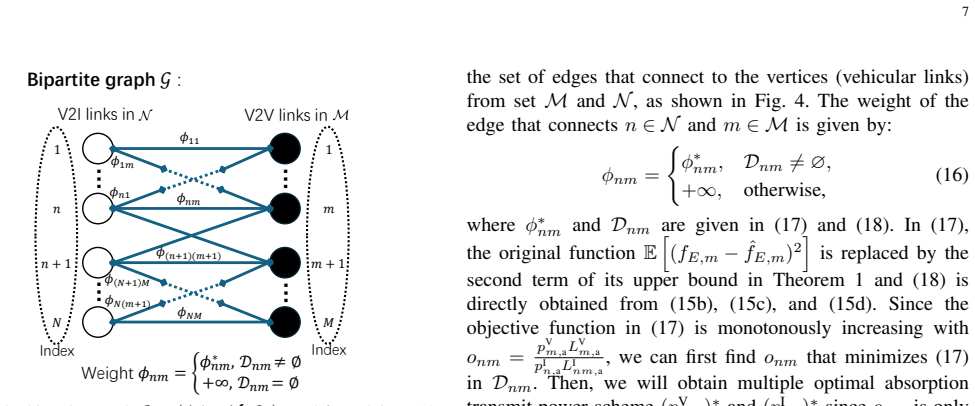
The engine that carries the argument is the deconvolution estimator built on Eq. (9). Because the RSU knows the large-scale fading of the involved links and the Gauss-Markov coefficient $\delta_{m,t}$ of the direct V2V channel, the normalized difference between measured and nominal received signal strength on a V2V receiver is a sum of the unknown additive error $e_{nm,t}$ and an independent exponential variable $Y$ with rate $\lambda_Y = p^I_{n,a} L^I_{nm,a}/(p^V_{m,a} L^V_{m,a}(1-\delta_m^2))$. Since the PDF of $Y$ is known, the target PDF is obtained in the Fourier domain as $\mathcal{F}\{f_{E,m}\} = \mathcal{F}\{f_Z\} / \mathcal{F}\{f_Y\}$, with the numerator approximated empirically from the collected samples. Theorem 1 bounds the mean-square error of this estimator, and that bound becomes the absorption-phase objective, while the hazard rate of Eq. (13) — the conditional probability that an already-violated delay stays close to its requirement — constrains how much the learning phase may degrade QoS. In the adaptation phase, the estimated PDF is inserted into a Parseval-theorem evaluation of the delay-satisfaction probability, after which power control reduces to a one-dimensional search over $c_t = \gamma_V p^I_{n,t} L^I_{nm,t}/(p^V_{m,t} L^V_{m,t}(1-\delta_m^2))$.
What would settle it
Take a channel trace in which the large-scale fading on a V2V direct link drifts measurably within one absorption window (for instance, a vehicle accelerating from 10 to 20 m/s over the $T=1000$ slots), feed the recorded RSS samples into the estimator in Eq. (11), and compare the recovered PDF to the true additive-error distribution obtained by subtracting the known channel components; if the empirical MSE violates the upper bound of Theorem 1, or if the adaptation-phase delay CDF no longer separates from the benchmarks, the constant-large-scale assumption is the cause.
Extended reading notes
Core claim
The central claim is that the unknown probability density of the additive error corrupting V2V-to-V2I interference links can be recovered from ordinary received-signal-strength measurements through the deconvolution identity $Z = e_{nm} + Y$, where the independent term $Y$ is exponential with a rate set by the ratio of the absorption-phase powers. With that density in hand, the probability that a V2V link meets its delay requirement becomes a computable quantity, and the paper proves an upper bound on the mean-square error of this computed probability (Theorem 2), then minimizes it by a one-dimensional power search. In the simulated Manhattan-mobility scenario, the resulting design reduces conditional V2V delay (delay values exceeding the requirement) by 35% against a Gaussian-error model-based design and by 56% against a high-probability-region data-driven design, while improving average V2I throughput by 14% and 16%.
Load-bearing premise
The scheme's load-bearing premise is that the large-scale fading of every congested link is known and constant over the absorption window, the RSU has perfect knowledge of the V2I uplink and V2V-to-V2I interference channels, and the direct V2V link's small-scale fading follows a Gauss-Markov/Jakes model with a known coefficient, so the only unknown left is the additive interference error whose distribution is the deconvolution target.
Editorial extensions
If this is right
- A roadside unit can meet QoS requirements without any prior statistical model of the CSI error: the only inputs are received-signal-strength feedback, large-scale fading estimates, and the known Jakes coefficient.
- The hazard-rate constraint gives the operator a tunable knob $\lambda_m$: raising it protects absorption-phase V2V delay at the cost of a less accurate error PDF, so link-criticality priorities can be encoded directly into the optimization.
- The Theorem 2 bound means the quality of adaptation depends jointly on the accuracy of the learned error PDF and on the instantaneous CSI quality, so adding absorption samples or shortening the CSI feedback delay both improve the final QoS.
- In the simulated Manhattan-mobility setting, the proposed design reduces the conditional V2V delay (delay above 15 ms) by 35% and 56% relative to the Gaussian-error and high-probability-region benchmarks, while raising average V2I throughput by 14% and 16%.
Reading between the lines
- The paper fixes the hazard-rate weights $\lambda_m$ before absorption; an untested extension is to adapt them across links or time, e.g., raising $\lambda_m$ for safety-critical V2V links and lowering it for throughput-oriented ones, so the network spends estimation effort where QoS is hardest to recover.
- The deconvolution kernel requires exactly one known contamination distribution $Y$; the same estimator could be reused in other settings where a measurement is a sum of an unknown distribution and a known exponential one, such as residual co-channel interference estimation after subtracting a known serving-signal component.
- Because the RB matching is decided once during absorption, the learned error PDF is not yet used to re-pair V2V and V2I links during adaptation; periodically re-solving the bipartite matching with the estimated PDF could yield further throughput gains beyond the reported 14–16%.
- The claim that adaptation is achieved 'without compromising' absorption QoS holds under the hazard-rate interpretation, not under a strict satisfaction-probability guarantee: the paper's own Fig. 7a shows about 70% V2V delay satisfaction during absorption at $\lambda_V=0.5$, below the 95% target, so an operator who treats $P_0$ as an absolute constraint must re-tune $\lambda$.
Signed reviews
Editorial analysis
A structured set of objections, weighed in public.
Referee Report
Summary. The paper proposes a two-phase resilience framework for C-V2X networks operating under imperfect CSI with an unknown error distribution. In the absorption phase, the RSU estimates the PDF of the CSI error via a deconvolution-based estimator built from RSS measurements, and jointly optimizes RB matching and absorption powers under hazard-rate constraints. In the adaptation phase, the estimated PDF is used in a real-time power allocation problem that minimizes the MSE between estimated and true QoS satisfaction probabilities. Simulation results report 35% and 56% reductions in conditional V2V delay and 14% and 16% improvements in average V2I throughput over model-based and data-driven benchmarks, respectively.
Significance. If the results hold, the framework is a meaningful contribution to resilient V2X resource management: it combines a statistically grounded deconvolution estimator with a hazard-rate-based QoS metric, and it explicitly quantifies the absorption-adaptation tradeoff. The paper includes analytical upper bounds, closed-form absorption power solutions, and a low-complexity adaptation algorithm, and the simulation study covers 100,000 channel realizations. However, the experimental support for the central claim is weakened by the degenerate power bounds in Section VI, and several proof steps are outsourced or rely on unquantified truncation assumptions.
major comments (5)
- [Section VI, first paragraph] The simulation fixes pV_min = pV_max = pI_min = pI_max = 10 dBm. With these bounds, the absorption-phase solution in (19) and the adaptation-phase feasible interval in (31d) collapse to single points, so Algorithms 1 and 2 have no power-allocation degree of freedom. Consequently, the reported 35% and 56% conditional-delay reductions and 14% and 16% throughput gains in Figs. 8 and 9 and in the abstract cannot be attributed to the proposed power optimization; at most they can reflect matching and PDF estimation. The authors should either correct what appears to be a typographical error and rerun the simulations with non-degenerate transmit-power ranges, or explicitly reframe the paper's claims around matching and estimation rather than power allocation.
- [Section IV-B, Theorem 1] The proof of Theorem 1 is entirely delegated to the conference version [1], with no argument in the present manuscript. Since Theorem 1 provides the MSE upper bound that defines the absorption-phase objective and the edge weights in (16)-(18), the journal manuscript is not self-contained and the correctness of the absorption-phase optimization cannot be verified from the submitted text. Please include the proof or a complete proof sketch.
- [Section II-B and Eq. (9)] The model assumes perfect knowledge of large-scale fading, perfect CSI at the RSU for the V2I uplink and V2V-to-V2I interference channels, and a Gauss-Markov/Jakes model with known coefficient delta_m,t for the V2V direct link; only the additive error e_nm has an unknown distribution. If any of these premises fails, the quantity in (9) mixes several unknown error sources and the deconvolution estimate is not the PDF needed for adaptation. The Abstract and Section I claim that the framework handles 'arbitrary unknown imperfect CSI,' which overstates the scope; the claims should be qualified to the unknown distribution of a single additive error component under the stated structural assumptions.
- [Abstract and Section VI, Fig. 7a] The claim that the adaptation-phase gains are achieved 'without compromising the network's QoS in the absorption phase' is contradicted by Fig. 7a, where for lambda_V = 0.5 the probability of meeting the V2V delay requirement is about 70%, far below the target P0 = 95%, and about 1% lower than the Gaussian benchmark. The text acknowledges this as a deliberate tradeoff, so the abstract and conclusion should describe the absorption-phase QoS sacrifice accurately.
- [Appendix B and C, Propositions 1 and Corollary 2] The monotonicity of u(c_t) is established only under the unquantified condition (30), with the argument that K2 can be chosen 'large enough.' The simulations use K2 = 10, and the condition depends on lambda_Y, which is determined by the absorption powers; the paper does not verify (30) for the simulated parameters. The monotonicity of beta(c_t) in Corollary 2 is stated without proof. Because Algorithm 2 relies on both monotonicity properties for its bisection and one-dimensional search, the theoretical guarantee is incomplete in the simulated regime. In addition, the proof of Theorem 2 in Appendix B uses the truncation constant K in (43)-(46) while the statement uses K2; this inconsistency should be corrected.
minor comments (6)
- [Throughout] The term 'probability distribution function' (Abstract, Sections I and IV-B) should be 'probability density function' for f_E,m.
- [Eq. (5)] The expression for b_m,t appears to contain an index error: the term involving p^V_{n,t} L^V_{nm}|g^V_{nm}|^2 should likely be the V2I interference term p^I_{n,t} L^I_{nm}|g^I_{nm}|^2. Please verify and correct.
- [Eq. (9) and following text] 'Z is essentially a sequence of i.i.d. samples' should refer to the random variable Z = e_nm + Y; the sequence is {z_{m,k}}.
- [Eqs. (12) and (26)] The notation ∫_{w≥|Kπ|} should be written as ∫_{|w|≥Kπ} for clarity.
- [Section VI] The sentence 'The large-scale fading is assumed to vary every 1,000 time slots, i.e., T = 1,000' should be rephrased: T denotes the absorption-window length, and the large-scale fading is constant over this window.
- [Table I] Table I gives the path-loss model for h^I_n but not the explicit formulas for the WINNER+B1 models used for h^V_m, h^I_nm, and h^V_mn; please provide the complete expressions.
Circularity Check
The main circularity signal is the delegation of Theorem 1's proof to the authors' own conference paper [1]; that theorem is load-bearing for the absorption-phase optimization. The deconvolution and adaptation derivations are otherwise self-contained, and the equal-power-bound simulation issue is a correctness risk rather than a circularity.
-
self citation load bearing
[Section IV-B, Theorem 1 (after Eq. 12)]
"Proof. See the proof in the conference version [1]."
Theorem 1 supplies the upper bound (12) that is the analytical foundation for the absorption-phase design. The paper states that minimizing the original upper-level objective is equivalent to minimizing the second term of (12), and Eq. (17) constructs the absorption power design from that bound. The proof of this load-bearing theorem is not included in the manuscript; it is delegated to [1], a preliminary conference version by overlapping authors (Shui, Saad, and Chen). No independent derivation, machine check, or external verification of the bound is provided in this paper. Other central results (Lemma 1, Theorem 2, Proposition 1) are proved in appendices, which shows that the omitted proof is specific to the theorem that drives the absorption/adaptation capability claim.
full rationale
The deconvolution estimator in Eqs. (9)-(11) is based on external statistics literature (Stefanski-Carroll, Butucea-Comte, Johannes) and is evaluated on simulated data drawn from the same error distribution used to train it; that is standard practice and not circular. The adaptation-phase probability estimate (23) and power design (29)-(32) are derived in the paper, with proofs in the appendices. The headline quantitative claims are benchmark comparisons, not fitted parameters renamed as predictions. The only circularity signal is Theorem 1's proof being delegated to the authors' own conference paper [1]; since that theorem is load-bearing for the absorption optimization, the score is 4 rather than 0. Separately, Section VI sets pV_min = pV_max = pI_min = pI_max = 10 dBm, which collapses each transmit-power feasible region to a single point and makes the claimed power-allocation optimization degenerate in the reported evaluation; this is a serious correctness/validation risk for attributing the reported gains to the power design, but it is not a circularity of the derivation chain and therefore does not by itself raise the circularity score.
Assumptions & free parameters
free parameters (2)
- Hazard-rate weights lambda_m =
lambda_1 = ... = lambda_M = 0.5 in main simulations
- Truncation constants K, K1, K2 =
K unspecified; K1 = K2 = 10
assumptions (6)
- domain assumption Large-scale fading L_t is perfectly estimated and constant over the T-slot absorption window.
- domain assumption V2I uplink channel gains and V2V-to-V2I interference gains are perfectly known at the RSU, i.e., gI_hat_{n,t}=gI_{n,t} and gV_hat_{mn,t}=gV_{mn,t}.
- domain assumption V2V direct-link small-scale fading follows a first-order Gauss-Markov/Jakes process with known coefficient delta_{m,t} and Rayleigh error term e_{m,t} ~ CN(0,1).
- domain assumption Error term e_{nm,t} is i.i.d. across time slots and independent of e_{m,t}.
- domain assumption Additive noise sigma^2 is negligible in the derivation of F{Phi_t} in Eq. (24) and of the feasible V2I throughput constraint in Eq. (29b).
- ad hoc to paper Truncation parameters K (Theorem 1), K1, and K2 can be chosen large enough that remainder integrals are negligible.
Cite this review
Pith. "Pith review of Resilient Vehicular Communications under Imperfect Channel State Information." pith.science (2026). https://pith.science/paper/OERLIRDI
@misc{pith2026250501687,
  author       = {Pith},
  title        = {Pith review of: Resilient Vehicular Communications under Imperfect Channel State Information},
  year         = {2026},
  howpublished = {\url{https://pith.science/paper/OERLIRDI}},
  note         = {Machine review of arXiv:2505.01687}
}
read the original abstract
Cellular vehicle-to-everything (C-V2X) networks provide a promising solution to improve road safety and traffic efficiency. One key challenge in such systems lies in meeting quality-of-service (QoS) requirements of vehicular communication links given limited network resources, particularly under imperfect channel state information (CSI) conditions caused by the highly dynamic environment. In this paper, a novel two-phase framework is proposed to instill resilience into C-V2X networks under unknown imperfect CSI. The resilience of the C-V2X network is defined, quantified, and optimized the first time through two principal dimensions: absorption phase and adaptation phase. Specifically, the probability distribution function (PDF) of the imperfect CSI is estimated during the absorption phase through dedicated absorption power scheme and resource block (RB) assignment. The estimated PDF is further used to analyze the interplay and reveal the tradeoff between these two phases. Then, a novel metric named hazard rate (HR) is exploited to balance the C-V2X network's prioritization on absorption and adaptation. Finally, the estimated PDF is exploited in the adaptation phase to recover the network's QoS through a real-time power allocation optimization. Simulation results demonstrate the superior capability of the proposed framework in sustaining the QoS of the C-V2X network under imperfect CSI. Specifically, in the adaptation phase, the proposed design reduces the vehicle-tovehicle (V2V) delay that exceeds QoS requirement by 35% and 56%, and improves the average vehicle-to-infrastructure (V2I) throughput by 14% and 16% compared to the model-based and data-driven benchmarks, respectively, without compromising the network's QoS in the absorption phase.
Figures


Figures from the paper (4 more)


Reference graph
Works this paper leans on
-
[1]
A Resilience Perspective on C-V2X Communication Networks under Imperfect CSI,
T. Shui, W. Saad, and M. Chen, “A Resilience Perspective on C-V2X Communication Networks under Imperfect CSI,” 2024. [Online]. Available: https://arxiv.org/abs/2411.10925
arXiv 2024
-
[2]
A Tutorial on 5G NR V2X Communications,
M. H. C. Garcia, A. Molina-Galan, M. Boban, J. Gozalvez, B. Coll- Perales, T. S ¸ahin, and A. Kousaridas, “A Tutorial on 5G NR V2X Communications,” IEEE Communications Surveys & Tutorials , vol. 23, no. 3, pp. 1972–2026, 2021
1972
-
[3]
Distributed Online Caching for High- Definition Maps in Autonomous Driving Systems,
X. Xu, S. Gao, and M. Tao, “Distributed Online Caching for High- Definition Maps in Autonomous Driving Systems,” IEEE Wireless Communications Letters, vol. 10, no. 7, pp. 1390–1394, 2021
work page 2021
-
[4]
B. Liu, W. Han, W. Jiang, D. Jia, E. Wang, J. Wang, and C. Qiao, “A Novel V2V-Based Temporary Warning Network for Safety Message Dis- semination in Urban Environments,” IEEE Internet of Things Journal , vol. 9, no. 24, pp. 25 136–25 149, 2022
work page 2022
-
[5]
Joint Communication and Control for Wireless Autonomous Vehicular Platoon Systems,
T. Zeng, O. Semiari, W. Saad, and M. Bennis, “Joint Communication and Control for Wireless Autonomous Vehicular Platoon Systems,”IEEE Transactions on Communications, vol. 67, no. 11, pp. 7907–7922, 2019
work page 2019
-
[6]
Joint Spectrum and Power Allocation for V2X Communications With Imperfect CSI,
P. Wang, W. Wu, J. Liu, G. Chai, and L. Feng, “Joint Spectrum and Power Allocation for V2X Communications With Imperfect CSI,” IEEE Transactions on Vehicular Technology , vol. 72, no. 12, pp. 16 338– 16 353, 2023
2023
-
[7]
Resource Allocation Modes in C-V2X: From LTE-V2X to 5G-V2X,
K. Sehla, T. M. T. Nguyen, G. Pujolle, and P. B. Velloso, “Resource Allocation Modes in C-V2X: From LTE-V2X to 5G-V2X,” IEEE Internet of Things Journal , vol. 9, no. 11, pp. 8291–8314, 2022
work page 2022
-
[8]
Resilience and Criticality: Brothers in Arms for 6G,
R.-J. Reifert, Y . Karacora, C. Chaccour, A. Sezgin, and W. Saad, “Resilience and Criticality: Brothers in Arms for 6G,” 2024. [Online]. Available: https://arxiv.org/abs/2412.03661
arXiv 2024
Show all 26 references
-
[9]
Robust Resource Allocation for Vehicular Communications With Imperfect CSI,
W. Wu, R. Liu, Q. Yang, and T. Q. S. Quek, “Robust Resource Allocation for Vehicular Communications With Imperfect CSI,” IEEE Transactions on Wireless Communications, vol. 20, no. 9, pp. 5883–5897, Sep. 2021
2021
-
[10]
Resource Allocation for D2D- Based V2X Communication With Imperfect CSI,
X. Li, L. Ma, Y . Xu, and R. Shankaran, “Resource Allocation for D2D- Based V2X Communication With Imperfect CSI,” IEEE Internet of Things Journal, vol. 7, no. 4, pp. 3545–3558, April 2020
2020
-
[11]
Fuzzy Matching Learning for Dynamic Resource Allocation in Cellular V2X Network,
C. Fan, B. Li, Y . Wu, J. Zhang, Z. Yang, and C. Zhao, “Fuzzy Matching Learning for Dynamic Resource Allocation in Cellular V2X Network,” IEEE Transactions on Vehicular Technology , vol. 70, no. 4, pp. 3479– 3492, April 2021
2021
-
[12]
Learning-Based Robust Resource Allocation for Ultra-Reliable V2X Communications,
W. Wu, R. Liu, Q. Yang, H. Shan, and T. Q. S. Quek, “Learning-Based Robust Resource Allocation for Ultra-Reliable V2X Communications,” IEEE Transactions on Wireless Communications , vol. 20, no. 8, pp. 5199–5211, Aug 2021
2021
-
[13]
Learning-Based Resource Allocation for Ultra-Reliable V2X Networks With Partial CSI,
G. Chai, W. Wu, Q. Yang, R. Liu, and F. R. Yu, “Learning-Based Resource Allocation for Ultra-Reliable V2X Networks With Partial CSI,” IEEE Transactions on Communications, vol. 70, no. 10, pp. 6532– 6546, Oct 2022
2022
-
[14]
Data-Driven Resource Allocation and Group Formation for Platoon in V2X Networks With CSI Uncertainty,
G. Chai, W. Wu, Q. Yang, and F. R. Yu, “Data-Driven Resource Allocation and Group Formation for Platoon in V2X Networks With CSI Uncertainty,” IEEE Transactions on Communications , vol. 71, no. 12, pp. 7117–7132, Dec 2023
2023
-
[15]
Platoon Partition and Resource Allocation for Ultra-Reliable V2X Networks,
G. Chai, W. Wu, Q. Yang, M. Qin, Y . Wu, and F. R. Yu, “Platoon Partition and Resource Allocation for Ultra-Reliable V2X Networks,” IEEE Transactions on Vehicular Technology , vol. 73, no. 1, pp. 147– 161, Jan 2024
2024
-
[16]
Resource Allocation for D2D-Enabled Vehicular Communications,
L. Liang, G. Y . Li, and W. Xu, “Resource Allocation for D2D-Enabled Vehicular Communications,” IEEE Transactions on Communications , vol. 65, no. 7, pp. 3186–3197, July 2017
2017
-
[17]
Advancements in Vehicular Communication Technologies: C-V2X and NR-V2X Com- parison,
M. M. Saad, M. T. R. Khan, S. H. A. Shah, and D. Kim, “Advancements in Vehicular Communication Technologies: C-V2X and NR-V2X Com- parison,” IEEE Communications Magazine, vol. 59, no. 8, pp. 107–113, August 2021
2021
-
[18]
3GPP NR Sidelink Transmissions Toward 5G V2X,
S.-Y . Lien, D.-J. Deng, C.-C. Lin, H.-L. Tsai, T. Chen, C. Guo, and S.- M. Cheng, “3GPP NR Sidelink Transmissions Toward 5G V2X,” IEEE Access, vol. 8, pp. 35 368–35 382, 2020
2020
-
[19]
Radio Resource Management for D2D-Based V2V Communication,
W. Sun, E. G. Str ¨om, F. Br ¨annstr¨om, K. C. Sou, and Y . Sui, “Radio Resource Management for D2D-Based V2V Communication,” IEEE Transactions on Vehicular Technology , vol. 65, no. 8, pp. 6636–6650, 2016
2016
-
[20]
Two-Timescale Resource Man- agement for Ultrareliable and Low-Latency Vehicular Communications,
G. Ding, J. Yuan, G. Yu, and Y . Jiang, “Two-Timescale Resource Man- agement for Ultrareliable and Low-Latency Vehicular Communications,” IEEE Transactions on Communications , vol. 70, no. 5, pp. 3282–3294, 2022
2022
-
[21]
Adaptive estimation of linear functionals in the convolution model and applications,
C. Butucea and F. Comte, “Adaptive estimation of linear functionals in the convolution model and applications,” Bernoulli, vol. 15, no. 1, pp. 69 – 98, 2009
2009
-
[22]
Deconvolving kernel density estima- tors,
L. A. Stefanski and R. J. Carroll, “Deconvolving kernel density estima- tors,” Statistics, vol. 21, no. 2, pp. 169–184, 1990
1990
-
[23]
D. C. Brody, L. P. Hughston, and A. Macrina, Beyond Hazard Rates: A New Framework for Credit-Risk Modelling . Boston, MA: Birkh ¨auser Boston, 2007, pp. 231–257
2007
-
[24]
Deconvolution with unknown error distribution,
J. Johannes, “Deconvolution with unknown error distribution,” The Annals of Statistics , vol. 37, no. 5A, pp. 2301 – 2323, 2009
2009
-
[25]
Dependence Control for Reliability Optimization in Vehicular Networks,
T. Zeng, O. Semiari, W. Saad, and M. Bennis, “Dependence Control for Reliability Optimization in Vehicular Networks,” in Proc. IEEE Global Communications Conference (GLOBECOM) , Waikoloa, HI, USA, Dec. 2019, pp. 1–6
2019
-
[26]
WINNER II channel models,
P. Kyosti, “WINNER II channel models,” IST-WINNER II D , vol. 1, 2007
2007
Reviewed August 16, 2026 · model on record in the stance chip above.
Discussion (0). Continue with ORCID to comment.