REVIEW 4 major objections 4 minor 64 references
Kinks in generalized scalar field models and their scattering properties
T0 review · 4 major / 4 minor · reviewed 2026-08-16 · deepseek-v4-flash
Pith's one-line read This paper argues that in two generalized scalar-field models, raising one integer n makes kinks compact or half-compact and suppresses the two-bounce collision windows.
desk verdict Useful new kink models with a solid analytic core, but the scattering conclusions rest on under-documented numerics that need a convergence pass. read the letter →
The pith
A machine-rendered reading of the paper's core claim, the machinery that carries it, and where it could break.
The reading
What carries the argument
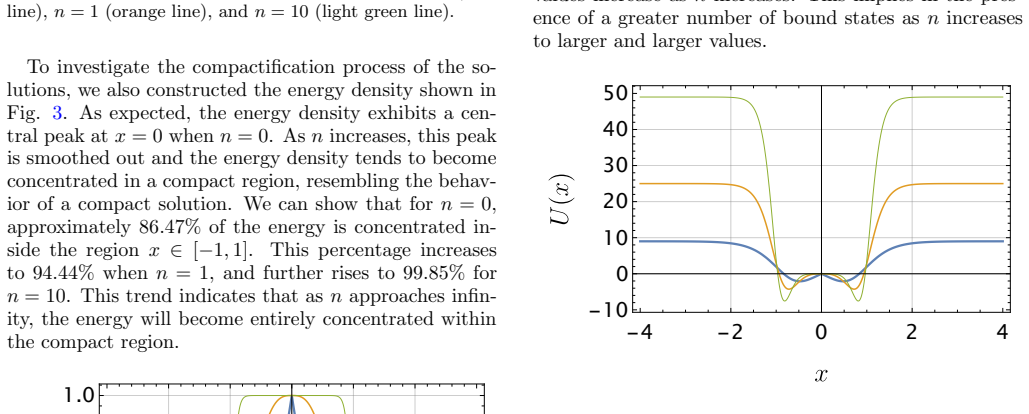
The load-bearing object is the stability potential $U(x)$ obtained from linear perturbations around the kink, together with the number of vibrational (shape) modes it supports. In the BPS formalism this potential is constructed from the superpotential $W(\phi)$ via $U=W_{\phi\phi}^{2}+W_{\phi}W_{\phi\phi\phi}$ evaluated on the solution; its bound states are the internal modes that exchange energy with the translational mode during a collision. The paper's mechanism is that raising $n$ deepens and widens the well of $U$, adding many bound states, and that this multiplicity blocks the clean resonant energy exchange responsible for two-bounce windows. The explicit solutions and energy-density profiles carry the compactification part of the argument, while the mode counts in the two tables carry the scattering part.
What would settle it
Run the same collisions for model (12) at $n=3$ with a finer grid, $\delta x=0.01$ instead of $0.05$, and with an independent spectral method for the stability equation; if the reported bound states do not survive refinement, or if any two-bounce resonance window reappears for $n\ge 2$ at some velocity, the proposed mode-suppression mechanism fails.
Extended reading notes
Core claim
On its own terms, the central claim is that the absolute value of the scalar field, raised to a tunable odd power, is enough to redesign kink solutions and their scattering. For the two-minimum model $W(\phi)=\phi-\frac{\phi\lvert\phi\rvert^{2n+1}}{2n+2}$, the kink obeys $\phi_x=\pm(1-\lvert\phi\rvert^{2n+1})$ and is given implicitly through a hypergeometric function; as $n$ increases the profile straightens inside a shrinking interval and the energy concentrates there, with 86.47 percent of the energy inside $[-1,1]$ for $n=0$, 94.44 percent for $n=1$, and 99.85 percent for $n=10$. The stability potential $U(x)=(2n+1)\big((4n+1)\phi^{4n}-2n\lvert\phi\rvert^{2n-1}\big)$ develops more and more bound states, from one at $n=0$ to seventeen at $n=6$, and collisions that at $n=1$ still show thin two-bounce windows lose those windows as $n$ grows. For the three-minimum model $W(\phi)=\phi^2\left(\frac{1}{2}-\frac{\lvert\phi\rvert^{2n+1}}{2n+3}\right)$, the solution $\phi(x)=\left(\frac{e^{(2n+1)x}}{e^{(2n+1)x}+2n+1}\right)^{1/(2n+1)}$ is explicit; the kink becomes one-sidedly compact, the perturbation potential is asymmetric when $n\ge 1$, and collisions again move from resonance windows to bion-like behavior and oscillatory pulses as the bound-state count rises. The paper attributes the disappearance of the windows to suppression of resonant energy exchange by the many vibrational modes.
Load-bearing premise
The load-bearing premise is that the numerically computed lists of internal vibration frequencies and the classification of each collision are correct: the paper gives no convergence tests or error estimates for its spatial grid or eigenvalue solver, so numerical artifacts could create or erase the extra modes that supposedly suppress the two-bounce windows.
Editorial extensions
If this is right
- In model (12), increasing $n$ pushes the kink toward a true compact solution: the energy inside $[-1,1]$ rises from 86.47 percent at $n=0$ to 94.44 percent at $n=1$ and 99.85 percent at $n=10$.
- In model (19), the single kink at $n\ge 1$ has no vibrational modes, yet the antikink-kink pair has a deep central well with a tower of bound states; the paper uses this pair spectrum to explain why two-bounce windows are absent there too.
- For both models, increasing $n$ suppresses two-bounce resonance windows and raises the critical velocity, with high-$n$ collisions replaced by bion-like annihilation and long-lived oscillating pulses.
- The bound-state count grows sharply with $n$ (for example, 2, 5, 6, 9, 13, and 17 modes for $n=1,\ldots,6$ in model (12)), so the model offers a tunable ladder of internal modes.
- Half-integer values of $n$ are also allowed, and the paper notes that $n=0.5$ recovers the $\phi^4$ model in the first family, connecting the new families to established kink models.
Reading between the lines
- Beyond the paper: if the mechanism is generic, any potential deformation that adds a tower of bound states to the kink sector should erase two-bounce windows, not only the absolute-value powers studied here; this could be checked against known polynomial potentials with tunable higher-order terms.
- Beyond the paper: the asymmetric half-compact kink of model (19) makes kink-antikink and antikink-kink scattering inequivalent by construction, so comparing the two collision channels across $n$ isolates the role of potential asymmetry from the mere number of modes.
- Beyond the paper: since half-integer $n$ is allowed and reproduces known models at $n=0.5$, a systematic scan over fractional $n$ could map the transition curve where each resonance window disappears, giving a quantitative prediction that a high-resolution simulation could test.
Signed reviews
Editorial analysis
A structured set of objections, weighed in public.
Referee Report
Summary. The manuscript studies two families of generalized scalar field models built from superpotentials containing absolute-value couplings: W(phi)=phi-phi|phi|^{2n+1}/(2n+2) in Eq. (12) and W(phi)=phi^2(1/2-|phi|^{2n+1}/(2n+3)) in Eq. (19). For the first family the kink is given implicitly by Eq. (15) and becomes increasingly compact as n grows; for the second the explicit solution (22) becomes half-compact on one side. The authors derive the linear stability potentials, count bound states numerically in Tables I and II, and perform kink-antikink, antikink-kink, and kink-antikink scattering simulations. Their central observation is that as n increases the number of vibrational modes grows and the two-bounce resonance windows are progressively suppressed, with bions and oscillating pulses dominating the collision outcomes; they attribute this to the suppression of resonant energy exchange by the abundance of modes. The analytic parts of the paper, including the n=0 limits, the n=0.5 phi^4/phi^6-type reductions, and the stability potentials, appear internally consistent.
Significance. If the numerical results are correct, the paper provides a simple tunable family of models in which compactification of the kink profile is accompanied by a growing number of bound states and by a qualitative change in scattering behavior from resonant two-bounce windows to bion and oscillating-pulse dynamics. This would usefully extend the mechanism of Refs. [29,30] to new potentials and give future workers concrete models for studying mode-rich kink collisions. The analytic derivations are a genuine strength: the implicit solution (15), the explicit solution (22), and the stability potentials (17) and (24) are derived from the BPS formalism and reduce correctly to known cases. However, the central claim, as quantified by the mode counts and the scattering phase diagrams, currently rests on numerical results for which no convergence or accuracy information is supplied, so the significance is contingent on those results being robust.
major comments (4)
- [III (Tables I–II) and IV (Figs. 11–16)] The central quantitative claims—the growing number of bound states and the disappearance of two-bounce windows—rest on numerical results for which no convergence or accuracy information is given. The scattering section specifies delta_x=0.05, zmax=200, periodic boundaries, and a fifth-order Runge-Kutta integrator, but the Schroedinger eigenvalue solver is not identified, and no test at smaller delta_x, larger zmax, or varied accuracy tolerances is reported. Because the explanation for the scattering behavior is that the extra modes suppress resonant energy exchange, the mode counts and the absence of windows must be demonstrated to be grid- and solver-independent; as written, a numerical artifact cannot be excluded.
- [Table II and §IV.B] The bound-state counts in Table II are computed for a pair separated by 2x0=16, while the scattering simulations in §IV.B use initial positions x0=±10, i.e., an initial separation of 20. The text states that increasing x0 increases the number of vibrational modes, so the tabulated spectrum is not the spectrum operative in the collisions. The table should be recomputed at the initial separation used in the scattering runs, or the text should explain why the difference is immaterial.
- [§IV, Figs. 11, 14, and 16] The velocity scans are presented only as color maps, with no statement of the velocity resolution delta_v or the criterion used to classify bion, one-bounce, two-bounce, and oscillating-pulse outcomes. Thin resonance windows (for example, the n=1 first-model windows and the m=2 window in the top panel of Fig. 14) could be missed or misclassified at coarse resolution. The authors should report delta_v and show at least one zoomed scan demonstrating that the apparent suppression of two-bounce windows for n≥2 is not a resolution effect.
- [§IV.A and §IV.B] For model (12), the explanation invokes the single-kink bound states of Table I, but the collision dynamics involve a two-kink configuration whose composite stability potential is not analyzed. Since the proposed suppression mechanism is specifically about the number of modes available during the collision, the authors should either compute the bound states of the relevant kink-antikink configuration for the first model or explicitly argue that the single-kink spectrum is the controlling quantity; without this, the causal attribution to multiple vibrational modes remains suggestive rather than demonstrated.
minor comments (4)
- [§IV, figure captions] The phrase "center os mass" appears in the captions of Figs. 11, 12, 13, 14, and 16 and should read "center of mass."
- [Eq. (16)] The hypergeometric series uses n as the summation index while n is also the model parameter; renaming the summation index would avoid confusion.
- [§III] The text initially defines n as an integer (n=0,1,2,...) and only later allows half-integer values; this generalization should be stated explicitly at the start of Section III.
- [Reference [28]] Reference [28] is incomplete: "Phys. D 9" should identify the journal as Physical Review D (Phys. Rev. D 9, 1 (1983)).
Circularity Check
No significant circularity: compactification, mode counts, and two-bounce suppression are computed from the stated models; self-citations are contextual or interpretive.
full rationale
None of the paper's load-bearing derivations reduces to its own inputs or to a self-citation. The two superpotentials (12) and (19) are stated explicitly, and the compact/half-compact behavior is obtained by solving the first-order BPS equations (14) and (20), with analytic solutions (15) and (22); no parameter is fitted afterward to force the observed profiles. The bound-state counts in Tables I and II come from direct numerical solution of the Schrodinger-like equations (7) with the stability potentials (17) and (23)-(24), and the scattering outcomes in Figs. 9-16 are direct evolutions of the stated equations of motion, so the disappearance of two-bounce windows is an observed numerical result rather than an output manufactured from a fitted parameter. The causal interpretation (many vibrational modes suppress resonant energy exchange) cites the earlier paper [30], including by a current co-author, but [30] is an external result in a different model family and is used only as an explanatory mechanism; removing it would not alter the computed spectra or collision diagrams. The base absolute-value models are also taken from prior self-citations [23,52], but only as the n=0 limit and as context, not as a source of the claimed higher-n phenomena. The lack of convergence tests for the finite-difference grid and eigenvalue solver is a correctness/reproducibility concern, not a circularity, since no quantity in the derivation is defined in terms of the quantity it is said to predict.
Assumptions & free parameters
assumptions (6)
- standard math The BPS first-order formalism (dφ/dx = ±W_φ) yields all minimal-energy static solutions of Eq. (2).
- standard math The stability potential U(x) = W_φφ^2 + W_φ W_φφφ in Eq. (8) correctly governs linear perturbations.
- standard math The hypergeometric expression Eq. (15) is the correct implicit solution of Eq. (14) for all real φ in [-1,1].
- domain assumption The finite-difference PDE solver with delta_x=0.05, zmax=200 and periodic boundary conditions converges to the true kink-antikink dynamics.
- domain assumption The numerical Schrödinger eigenvalue solutions used for Tables I and II correctly count all bound states.
- ad hoc to paper The superpotentials (12) and (19) are physically admissible choices that capture the intended |φ|-coupling effects.
Cite this review
Pith. "Pith review of Kinks in generalized scalar field models and their scattering properties." pith.science (2026). https://pith.science/paper/5PTDX524
@misc{pith2026250501775,
  author       = {Pith},
  title        = {Pith review of: Kinks in generalized scalar field models and their scattering properties},
  year         = {2026},
  howpublished = {\url{https://pith.science/paper/5PTDX524}},
  note         = {Machine review of arXiv:2505.01775}
}
read the original abstract
This work investigates kink solutions in one-dimensional scalar field theories. We begin with a review of the formalism used to obtain these solutions, presenting the BPS formalism and linear stability analysis. Next, we explore new models involving real scalar fields, generated by distinct potentials, with a focus on the topological structures responsible for the formation of kinks. Finally, we study collisions between the solutions obtained in two distinct models, analyzing their dynamic implications.
Figures


Figures from the paper (10 more)


Reference graph
Works this paper leans on
- [23]
- [30]
-
[1]
Rajaraman, Solitons and Instantons , North Holland (1982)
R. Rajaraman, Solitons and Instantons , North Holland (1982)
work page 1982
-
[2]
A. Vilenkin and E. P. S. Shellard, Cosmic Strings and Other Topological Defects , Cambridge University Press (2000)
work page 2000
-
[3]
Manton and P
N. Manton and P. Sutcliffe, Topological Solitons, Cam- bridge University Press (2004)
2004
-
[4]
Bogomol’nyi, Sov
E.B. Bogomol’nyi, Sov. J. Nucl. Phys. 24, 449 (1976)
1976
- [5]
-
[6]
Bazeia, C
D. Bazeia, C. B. Gomes, L. Losano and R. Menezes, Phys. Lett. B 633, 415 (2006)
2006
Show all 64 references
-
[7]
Bazeia, F
D. Bazeia, F. A. Brito and F. G. Costa, Phys. Lett. B 661, 179 (2008)
2008
-
[8]
Chiba, A
T. Chiba, A. De Felice and S. Tsujikawa, Phys. Rev. D 90, 023516 (2014)
2014
-
[9]
J. R. L. Santos, A. De Souza Dutra, O. C. Winter and R. A. C. Correa, Adv. High Energy Phys. 2019, 5431067 (2019)
2019
- [10]
-
[11]
Adam and A
C. Adam and A. Wereszczynski, Phys. Rev. D 98, 116001 (2018)
2018
-
[12]
Bazeia, L
D. Bazeia, L. Losano and J. M. C. Malbouisson, Phys. Rev. D 66, 101701 (2002)
2002
-
[13]
Bazeia, J
D. Bazeia, J. Menezes and R. Menezes, Phys. Rev. Lett. 91, 241601 (2003)
2003
-
[14]
Bazeia, M
D. Bazeia, M. A. Gonzalez Leon, L. Losano and J. Mateos Guilarte, Phys. Rev. D 73, 105008 (2006)
2006
-
[15]
J., Fasolino A., Katsnelson M
Buijnsters F. J., Fasolino A., Katsnelson M. I., Phys. Rev. Lett. 113, 217202 (2014)
2014
-
[16]
L. P. Chimento, M. I. Forte, R. Lazkoz and M. G. Richarte, Phys. Rev. D 79, 043502 (2009)
2009
-
[17]
Bazeia, M
D. Bazeia, M. A. Marques and R. Menezes, Phys. Rev. D 96, 025010 (2017)
2017
-
[18]
Rosenau and J
P. Rosenau and J. M. Hyman, Phys. Rev. Lett. 70, 564 (1993)
1993
-
[19]
Dusuel, P
S. Dusuel, P. Michaux, M. Remoissenet Phys. Rev. E 57, 2320 (1998)
1998
-
[20]
Barashenkov and O.F
I.V. Barashenkov and O.F. Oxtoby, Phys. Rev. E 80, 026608 (2009)
2009
-
[21]
Andrade, M
I. Andrade, M. A. Marques and R. Menezes, Annals Phys. 473, 169915 (2025)
2025
-
[22]
Theodorakis, Phys
S. Theodorakis, Phys. Rev. D 60, 125004 (1999)
1999
-
[24]
O. N. Karp´ ıˇ sek, L. Rafaj and F. Blaschke, Prog. Theor. Exp. Phys. 2024, 113A01 (2024)
2024
-
[25]
Kudryavtsev, Pis’ma Zh
A.E. Kudryavtsev, Pis’ma Zh. Eksp. Teor. Fiz. 22, 178 (1975) [JETP Lett. 22, 82 (1975)]
1975
-
[26]
Getmanov, Pis’ma Zh
B.S. Getmanov, Pis’ma Zh. Eksp. Teor. Fiz. 24, 323 (1976)
1976
-
[27]
Sugiyama, Progress of Theor
T. Sugiyama, Progress of Theor. Phys. 61, 5 (1979)
1979
-
[28]
D. K. Campbell, J. F. Schonfeld, C. A. Wingate, Phys. D 9, 1 (1983)
1983
-
[29]
identified a two-bounce window structure, even with the absence of a vibrational mode for an isolated kink or antikink. In Ref. [30] it was further shown that the appearance of extra shape modes causes a suppression of the resonant structure. Throughout this trend, multiple re...
2025 arXiv
-
[31]
F. C. Simas, Adalto R. Gomes, K. Z. Nobrega, J. C. R. E. Oliveira, J. High Energ. Phys. 2016, 104 (2016)
2016
-
[32]
Christov, Robert J
Ivan C. Christov, Robert J. Decker, A. Demirkaya, Vakhid A. Gani, P.G. Kevrekidis, Avinash Khare, Avadh Saxena, Phys. Rev. Lett. 122, 171601 (2019)
2019
-
[33]
V. A. Gani, A. Moradi Marjaneh, K. Javidan, Eur. Phys. J. C 81, 1124 (2021)
2021
-
[34]
Jo˜ ao G. F. Campos and Azadeh Mohammadi, Phys. Lett. B 818, 136361 (2021)
2021
-
[35]
F. C. E. Lima, R. Casana, C. A. S. Almeida, Eur. Phys. J. C, 84, 1266 (2024)
2024
-
[36]
Santos, Fabiano C
Jairo S. Santos, Fabiano C. Simas, Adalto R. Gomes, J. High Energ. Phys. 2025, 157 (2025)
2025
-
[37]
Alonso Izquierdo, L
A. Alonso Izquierdo, L. M. Nieto, J. Queiroga-Nunes, Phys. Rev. D 103, 045003 (2021)
2021
-
[38]
Campos, A
J.G.F. Campos, A. Mohammadi, J. High Energ. Phys. 09, 067 (2021)
2021
-
[39]
Halavanau, T
A. Halavanau, T. Romanczukiewicz, Y. Shnir, Phys. Rev. D 86, 085027 (2012)
2012
-
[40]
Katsura, Phys
H. Katsura, Phys. Rev. D 89, 085019 (2014)
2014
-
[41]
Mukhopadhyay, E
M. Mukhopadhyay, E. I. Sfakianakis, T. Vachaspati, G. Zahariade, J. High Energy Phys. 04, 118 (2022)
2022
-
[42]
C. Adam, K. Oles, T. Romanczukiewicz, A. Wereszczyn- ski, Phys. Rev. Lett. 122, 241601 (2019)
2019
-
[43]
C. Adam, K. Oles, T. Romanczukiewicz, A. Wereszczyn- ski, W. Zakrzewski, J. High Energ. Phys. 2021, 147 (2021)
2021
-
[44]
Jo˜ ao G. F. Campos, Fabiano C. Simas, D. Bazeia, J. High Energy Phys. 10, 124 (2023)
2023
-
[45]
Takyi, H
I. Takyi, H. Weigel, Phys. Rev. D 94, 085008 (2016)
2016
-
[46]
N. S. Manton, K. Oles, T. Romanczukiewicz, A. Wereszczynski, Phys. Rev. Lett. 127, 071601 (2021)
2021
-
[47]
N. S. Manton, T. Romanczukiewicz, Phys. Rev. D 107, 085012 (2023)
2023
-
[48]
Blaschke, T
F. Blaschke, T. Romanczukiewicz, K. Slawinska, A. Wereszczynski, Phys. Rev. E 110, 014203 (2024)
2024
-
[49]
N. V. Alexeeva, I. V. Barashenkov, Alain Dika, Raphael De Sousa, J. High Energ. Phys. 10, 136 (2024)
2024
-
[50]
E. J. Copeland, M. Gleiser, H. R. Muller, Phys. Rev. D 52, 1920 (1995)
1995
-
[51]
Dymnikova, L
I. Dymnikova, L. Koziel, M. Khlopov, S. Rubin, Grav.Cosmol. 6, 311-318, (2000)
2000
-
[52]
Bazeia, J
D. Bazeia, J. Menezes, M. M. Santos, Phys. Lett. B 521, 418 (2001)
2001
-
[53]
Bazeia, L
D. Bazeia, L. Losano, M. A. Marques, R. Menezes, Phys. Lett. B 736, 515 (2014)
2014
-
[54]
X. Li, L. Long, [arXiv:2407.14479 [hep-th]]
-
[55]
Bazeia, A
D. Bazeia, A. R. Gomes, F. C. Simas, Eur. Phys. J. C 81, 532 (2021)
2021
-
[56]
Bazeia, M
D. Bazeia, M. A. Marques, R. Menezes, Eur. Phys. J. Plus 138, 735 (2023)
2023
-
[57]
Bazeia, E
D. Bazeia, E. I. B. Rodrigues, J. Mag. Magnetic Materials 432, 112 (2017)
2017
-
[58]
Bazeia, M
D. Bazeia, M. A. Marques, R. Menezes, Phys. Rev. D 92, 084058 (2015)
2015
-
[59]
A. M. Marjaneh, F. C. Simas, D. Bazeia, Annals Phys. 470, 169777 (2024)
2024
-
[60]
Lozano-Mayo, M
J. Lozano-Mayo, M. Torres-Labansat, J. Phys. Comm. 5, 025004 (2021)
2021
-
[61]
A. J. Balseyro Sebastian, D. Bazeia, M. A. Marques, EPL 141, 34003 (2023)
2023
-
[62]
B. A. Malomed, A. A. Mepomnyashchy, Phys. Rev. A 42, 6009 (1990)
1990
-
[63]
Bazeia, E
D. Bazeia, E. Belendryasova, V. A. Gani, Eur. Phys. J. C 78, 340 (2018). 12
2018
-
[64]
V. A. Gani, A. M. Marjaneh, A. Askari, E. Be- lendryasova, D. Saadatmand, Eur. Phys. J. C 78, 345 (2018)
2018
Reviewed August 16, 2026 · model on record in the stance chip above.
Discussion (0). Continue with ORCID to comment.