REVIEW 4 major objections 4 minor 64 references
Performing all-atom molecular dynamics simulations of intrinsically disordered proteins with replica exchange solute tempering
T0 review · 4 major / 4 minor · reviewed 2026-08-16 · deepseek-v4-flash
Pith's one-line read REST2 makes all-atom sampling of disordered proteins practical.
desk verdict A practical, correctly derived REST2 tutorial for IDP simulations, with a real—but fixable—reproducibility gap between the tested software versions and the installation instructions. read the letter →
The pith
A machine-rendered reading of the paper's core claim, the machinery that carries it, and where it could break.
The reading
What carries the argument
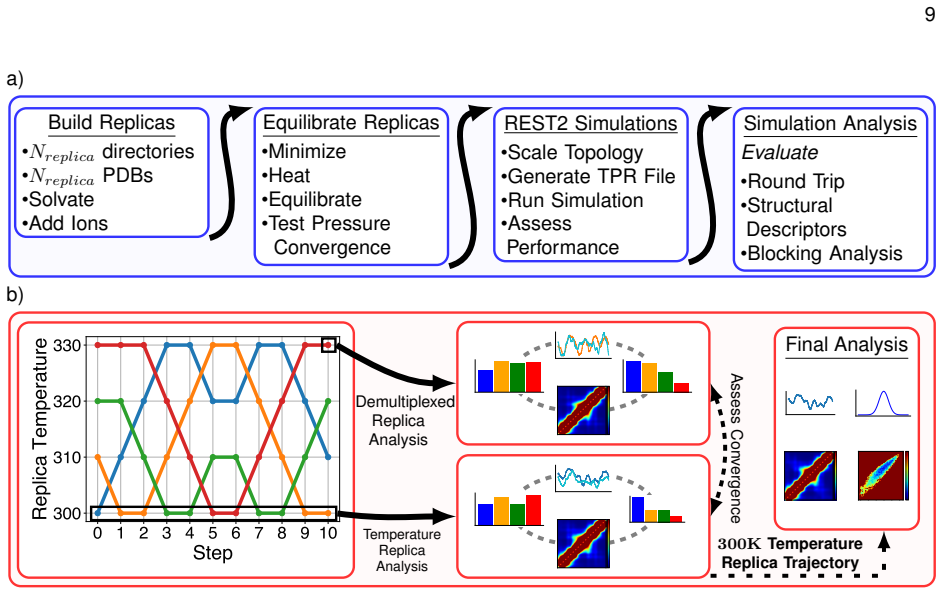
The central object is the REST2 Hamiltonian, $E_n^{\text{REST2}} = \frac{\beta_n}{\beta_0} E_{pp} + \sqrt{\frac{\beta_n}{\beta_0}} E_{pw} + E_{ww}$, where the effective solute temperature is set through $\beta_n/\beta_0 = T_0/T_n$; this is what lets a replica thermostated at 300 K behave as though its solute were at 600 K. Its companion is the exchange acceptance criterion, $\Delta_{n,n+1} = (\beta_n - \beta_{n+1})\left[E_{pp}(X_{n+1}) - E_{pp}(X_n) + \frac{\sqrt{\beta_0}}{\sqrt{\beta_n} + \sqrt{\beta_{n+1}}}\left(E_{pw}(X_{n+1}) - E_{pw}(X_n)\right)\right]$, in which the water–water energy does not appear. These equations determine the scaled topology for each rung of the solute-temperature ladder and the probability that neighboring replicas swap coordinates. The convergence analysis then turns on demultiplexed replicas—trajectories that follow labeled coordinate sets as they diffuse up and down the ladder—compared through blocking error bars.
What would settle it
Take the tutorial's α-synuclein 121–140 system and compare the radius-of-gyration distribution and secondary-structure populations of the 300 K base replica against a long unbiased conventional MD run using the same force field and water model; agreement within the blocking error bars would confirm the REST2 implementation. A cheaper internal check is that exchange acceptance between adjacent rungs stays near or above 20% and that every demultiplexed replica makes round trips from the base rung to the top rung rather than lingering at 300 K.
Extended reading notes
Core claim
On its own terms, the chapter establishes that the REST2 variant of replica exchange supports a complete, practical all-atom IDP simulation workflow. The solute–solute energy is scaled by $\beta_n/\beta_0$, the solute–solvent energy by $\sqrt{\beta_n/\beta_0}$, and water–water interactions are left unscaled, which removes the solvent–solvent energy from the exchange acceptance criterion and lets a logarithmic ladder of effective solute temperatures be spanned with far fewer replicas than temperature replica exchange requires. The paper argues that with equilibrated boxes, scaled topologies built from one unified topology, and exchange attempts every 1.6 ps, the base replica at 300 K samples the unbiased ensemble, and it shows convergence diagnostics—rung-wise averages, demultiplexed-replica round trips, and blocking error estimates—on residues 121–140 of α-synuclein.
Load-bearing premise
The load-bearing premise is that the enhanced-sampling plugin's partial_tempering script and the MD engine's replica-exchange machinery implement the REST2 scaling and acceptance criterion exactly as written; if those external tools carry a bug, or are used with mismatched versions, the 300 K replica will not sample the unbiased Boltzmann ensemble and every tutorial result is void.
Editorial extensions
If this is right
- A single processed topology file can be scaled mechanically into replica-specific topologies for the whole solute-temperature ladder, so preparing a REST2 run does not require rebuilding each replica from scratch.
- Because water–water energies are absent from the exchange criterion, adjacent rungs overlap enough that a 300–450 K ladder needs roughly an order of magnitude fewer replicas than tREMD would need for the same range.
- The 300 K trajectory from a well-mixed REST2 run is the object to compare with experimental IDP observables, provided the chosen force field and water model are known to describe disordered states.
- High exchange acceptance rates alone do not prove convergence; the paper's demultiplexed-replica and blocking analyses are the checks that make the base-replica statistics meaningful.
- The same setup generalizes to the REHT and REST3 variants, which modify the scaling to counteract the collapse of IDPs at high solute temperatures.
Reading between the lines
- If the protocol is correct, the same machinery could be applied to a disordered domain within a larger folded protein by limiting the scaled 'solute' region to the disordered segment; the effective-temperature interpretation would then need re-derivation.
- The paper's reported high-temperature collapse of IDPs under REST2 suggests a direct three-way test: compare per-rung radius of gyration for REST2, REST3, and tREMD at matched effective temperatures; the discussion predicts the strongest compaction at the top rungs under REST2 alone.
- The blocking-error comparison between demultiplexed replicas could be converted into an automated stopping criterion—stop production when all replicas' mean properties agree within one pooled error bar—turning the post hoc convergence judgment into a rule.
- The requirement that every replica contain the same number of water molecules could be relaxed by rescaling box dimensions instead, but the paper's equal-box protocol is the safer default because the exchange statistics assume matched solvent degrees of freedom.
Signed reviews
Editorial analysis
A structured set of objections, weighed in public.
Referee Report
Summary. This manuscript is a methods/tutorial chapter that describes how to set up, perform, and analyze all-atom molecular dynamics simulations of intrinsically disordered proteins (IDPs) using replica exchange with solute tempering (REST2) in GROMACS and PLUMED. The authors review the theory of REST and REST2, including the Hamiltonian scaling in Eq. (5) and the Metropolis acceptance criterion in Eq. (8), and then provide a step-by-step workflow: generating starting structures, solvating and equilibrating replicas, creating scaled topology files with PLUMED's partial_tempering script, running the replica-exchange simulation, and analyzing temperature and demultiplexed replicas. The accompanying GitHub repository provides input files, starting structures, and analysis scripts. The example simulation is a 20-residue C-terminal fragment of α-synuclein with 10 replicas spanning an effective solute temperature range of 300–450 K, and Figures 2–4 show temperature diffusion and structural analyses (radius of gyration, helical content, intramolecular contacts).
Significance. If the protocol is reproducible, this manuscript is a valuable community resource for IDP simulation, as it consolidates the REST2 theory, setup commands, and analysis strategies into a single tutorial with freely available input files and scripts. The theoretical section is accurate: Eqs. (5) and (8) correctly match the published REST2 formulation, and the workflow is internally coherent. The authors also provide practical diagnostics (round-trip times, per-replica probability of visiting the base temperature, blocking analysis) that are useful for assessing convergence. The main risk is that the exact commands and software versions as printed in the notes may not reproduce the example, which for a methods chapter is a load-bearing issue for the central claim of a working recipe.
major comments (4)
- [Materials / Note 1] The Materials section states that the tutorial was performed with GROMACS 2022.5 and PLUMED 2.9.0, but Note 1 instructs users to clone the current PLUMED2 repository and to build GROMACS with GMX_version=2024.3. A user following Note 1 therefore obtains a different toolchain from the one that produced Figures 2–4. Since REST2 relies on PLUMED's partial_tempering topology scaling and GROMACS's replica-exchange machinery, both of which have changed across these versions, the protocol's reproducibility is not established as written. Please align the installation instructions with the tested versions, or re-run the example with the newer toolchain and report the resulting acceptance ratios and round-trip statistics.
- [Note 1] The installation commands in Note 1 contain concrete errors that will prevent a following user from building the software: the branch name `v$GMX_version$` has a stray `$`; the line `echo ' export PLUMED_ROOT=$HOME/opt '` is not redirected to `.bashrc` and is missing the `export`; and the `PLUMED_KERNEL` path `/usr/share/lib/libplumedKernel.so` does not match the `$HOME/opt` prefix used earlier in the same note. These instructions should be corrected.
- [Note 9] The awk command used to stride replica_index.xvg contains a syntax error (`$1 ==0 $`) and the remaining logic prints the time-0 line and then a line with the time shifted by −80 ps (e.g., the 80 ps entry becomes 0 ps), producing duplicate frame times rather than a clean 80 ps spaced index. Since this command is the basis for constructing demultiplexed trajectories in the analysis workflow, it must be corrected, or the intended code from the repository should be transcribed faithfully.
- [Methods / Running REST2 Simulations] The manuscript does not state the total production simulation time per replica used to generate Figures 2–4. Without this information, a reader cannot reproduce the example or judge whether the reported convergence diagnostics correspond to a practically achievable run length. Please report the simulated time per replica (and the aggregate time across replicas) used for the example.
minor comments (4)
- [Theory] There is a typographical error: "Hamlitonion" should be "Hamiltonian" in the paragraph preceding Eq. (5).
- [Throughout] The manuscript contains numerous typos, including "containg", "simulatiosn", "uncoverged", "choosen", "seperately", "disucssion", and "the the" in the Software section. These should be corrected in a final pass.
- [Notes 5–7] The MDP filename appears as both "minimz.mdp" and "minimiz.mdp"; please use a single consistent name in the main text and notes.
- [Simulation Analysis] The name "Flyvberg" should be "Flyvbjerg" when referring to the blocking analysis; this appears in the analysis section and in the bibliography entry [41].
Circularity Check
No circularity: tutorial protocol with theory from external literature; example is illustrative; no fitted-parameter predictions.
full rationale
This paper is a methods/protocol tutorial, not a derivation of a new result. Its central claim is a how-to guide for setting up, running, and analyzing REST2 simulations of IDPs. The REST2 Hamiltonian scaling (Eq. 5) and exchange acceptance criterion (Eq. 8) are presented as established theory from Wang, Friesner, and Berne and from the PLUMED/GROMACS implementation literature; they are not derived from the tutorial's own example. No parameter is fitted to the example simulation and then renamed a prediction; the Rg, helical-content, contact, and round-trip analyses in Figures 2-4 are demonstrations of the suggested analysis workflow, not a test of the method. The authors do cite their own prior force-field and alpha-synuclein work (refs. 4 and 25), but these citations supply an input force field and a test construct for the tutorial, not the justification for REST2 itself, so they are not load-bearing in a circular sense. The internal discrepancy between Materials (GROMACS 2022.5 and PLUMED 2.9.0) and Note 1 (GROMACS 2024.3 with current PLUMED) is a reproducibility/consistency concern, not a circularity one: following the notes may not reproduce the exact tested toolchain, but the instructions do not assume the outcome they purport to demonstrate. The derivation chain, such as it is, is self-contained in the sense that it imports its equations from external, independently published sources and validates nothing by the tutorial's own outputs. There is no self-definitional reduction, no fitted input passed off as prediction, and no uniqueness theorem imported from the authors. Score 0.
Assumptions & free parameters
free parameters (1)
- Solute temperature ladder =
300 K to 450 K, 10 rungs, geometric scaling
assumptions (4)
- domain assumption REST2, as defined by Eq. 5, preserves detailed balance and samples the unbiased Boltzmann distribution at the base temperature when the acceptance criterion (Eq. 8) is used.
- domain assumption The a99SB-disp force field and accompanying water model accurately model IDPs.
- domain assumption The PLUMED partial_tempering script and GROMACS replica exchange implementation correctly execute the REST2 scaled Hamiltonians.
- ad hoc to paper The example simulation (10 replicas, 300-450 K, 6.5 nm box, 8763 water molecules) is sufficiently converged for illustration.
Cite this review
Pith. "Pith review of Performing all-atom molecular dynamics simulations of intrinsically disordered proteins with replica exchange solute tempering." pith.science (2026). https://pith.science/paper/34AP4RUP
@misc{pith2026250501860,
  author       = {Pith},
  title        = {Pith review of: Performing all-atom molecular dynamics simulations of intrinsically disordered proteins with replica exchange solute tempering},
  year         = {2026},
  howpublished = {\url{https://pith.science/paper/34AP4RUP}},
  note         = {Machine review of arXiv:2505.01860}
}
read the original abstract
All-atom molecular dynamics (MD) computer simulations are a valuable tool for characterizing the conformational ensembles of intrinsically disordered proteins (IDPs). IDP conformational ensembles are highly heterogeneous and contain structures with many distinct topologies separated by large free-energy barriers. Sampling the vast conformational space of IDPs in explicit solvent all-atom MD simulations is extremely challenging, and enhanced sampling methods are generally required to obtain statistically meaningful descriptions of IDP conformational ensembles. Replica exchange solute tempering (REST) methods, where multiple coupled simulations of a system are performed in parallel with selectively modified potential energy functions, are a powerful approach for efficiently sampling the conformational space of IDPs. In this chapter, we demonstrate how to set-up, perform and analyze all-atom MD simulations of IDPs with REST enhanced sampling methods.
Figures


Figures from the paper (1 more)

Reference graph
Works this paper leans on
-
[1]
The molecular basis for cellular function of intrinsically disordered protein regions
Alex S Holehouse and Birthe B Kragelund. The molecular basis for cellular function of intrinsically disordered protein regions. Nature Reviews Molecular Cell Biology, 25(3):187–211, 2024
2024
-
[2]
Dissecting the biophysics and biology of in- trinsically disordered proteins
Priya R Banerjee, Alex S Holehouse, Richard Kriwacki, Paul Robustelli, Hao Jiang, Alexander I Sobolevsky, Jennifer M Hurley, and Joshua T Mendell. Dissecting the biophysics and biology of in- trinsically disordered proteins. Trends in biochemical sciences, 2023
work page 2023
-
[3]
Principles of protein structural ensemble determination
Massimiliano Bonomi, Gabriella T Heller, Carlo Camilloni, and Michele Vendruscolo. Principles of protein structural ensemble determination. Current opinion in structural biology, 42:106–116, 2017
work page 2017
-
[4]
Paul Robustelli, Stefano Piana, and David E. Shaw. Developing a molecular dynamics force field for both folded and disordered protein states. Proceedings of the National Academy of Sciences of the United States of America, 115:E4758–E4766, 5 2018
work page 2018
-
[5]
Folding-upon-binding pathways of an intrinsically disordered protein from a deep markov state model
Thomas R Sisk and Paul Robustelli. Folding-upon-binding pathways of an intrinsically disordered protein from a deep markov state model. Proceedings of the National Academy of Sciences , 121(6): e2313360121, 2024
work page 2024
-
[6]
Jiaqi Zhu, Xavier Salvatella, and Paul Robustelli. Small molecules targeting the disordered trans- activation domain of the androgen receptor induce the formation of collapsed helical states. Nature Communications, 13(1):6390, 2022
work page 2022
-
[7]
Donchev, Paul Robustelli, and David E
Stefano Piana, Alexander G. Donchev, Paul Robustelli, and David E. Shaw. Water dispersion interac- tions strongly influence simulated structural properties of disordered protein states.Journal of Physical Chemistry B, 119:5113–5123, 2015. doi: 10.1021/jp508971m
-
[8]
Charmm36m: an improved force field for folded and intrin- sically disordered proteins
Jing Huang, Sarah Rauscher, Grzegorz Nawrocki, Ting Ran, Michael Feig, Bert L De Groot, Helmut Grubmüller, and Alexander D MacKerell Jr. Charmm36m: an improved force field for folded and intrin- sically disordered proteins. Nature methods, 14(1):71–73, 2017
work page 2017
Show all 64 references
-
[9]
Balanced protein–water interactions improve prop- erties of disordered proteins and non-specific protein association
Robert B Best, Wenwei Zheng, and Jeetain Mittal. Balanced protein–water interactions improve prop- erties of disordered proteins and non-specific protein association. Journal of chemical theory and computation, 10(11):5113–5124, 2014. 25 26 BIBLIOGRAPHY
2014
-
[10]
Stefano Piana, Paul Robustelli, Dazhi Tan, Songela Chen, and David E. Shaw. Development of a force field for the simulation of single-chain proteins and protein-protein complexes. Journal of Chemical Theory and Computation, 16:2494–2507, 4 2020
2020
-
[11]
Enhanced sam- pling methods for molecular dynamics simulations
Jérôme Hénin, Tony Leliévre, Michael R Shirts, Omar Valsson, and Lucie Delemotte. Enhanced sam- pling methods for molecular dynamics simulations. arXiv preprint arXiv:2202.04164, 2022
2022 arXiv
-
[12]
Replica-exchange molecular dynamics method for protein folding
Yuji Sugita and Yuko Okamoto. Replica-exchange molecular dynamics method for protein folding. Chemical Physics Letters, 314:141–151, 11 1999
1999
-
[13]
Parallel tempering algorithm for conformational studies of biological molecules
Ulrich HE Hansmann. Parallel tempering algorithm for conformational studies of biological molecules. Chemical Physics Letters, 281(1-3):140–150, 1997
1997
-
[14]
Friesner, and B
Pu Liu, Byungchan Kim, Richard A. Friesner, and B. J. Berne. Replica exchange with solute tempering: A method for sampling biological systems in explicit water. Proceedings of the National Academy of Sciences of the United States of America, 102:13749–13754, 9 2005. ISSN 00278424
2005
-
[15]
Friesner, and B
Lingle Wang, Richard A. Friesner, and B. J. Berne. Replica exchange with solute scaling: A more efficient version of replica exchange with solute tempering (rest2). The Journal of Physical Chemistry B, 115:9431–9438, 8 2011. ISSN 1520-6106
2011
-
[16]
Hamiltonian replica exchange in gromacs: a flexible implementation
Giovanni Bussi. Hamiltonian replica exchange in gromacs: a flexible implementation. Molecular Physics, 112(3-4):379–384, 2014
2014
-
[17]
Gromacs: fast, flexible, and free.Journal of computational chemistry, 26:1701–18, 12 2005
David Van Der Spoel, Erik Lindahl, Berk Hess, Gerrit Groenhof, Alan E Mark, and Herman J C Berend- sen. Gromacs: fast, flexible, and free.Journal of computational chemistry, 26:1701–18, 12 2005. ISSN 0192-8651
2005
-
[18]
Gromacs: High performance molecular simulations through multi-level parallelism from laptops to supercomputers
Mark James Abraham, Teemu Murtola, Roland Schulz, Szilárd Páll, Jeremy C Smith, Berk Hess, and Erik Lindahl. Gromacs: High performance molecular simulations through multi-level parallelism from laptops to supercomputers. SoftwareX, 1:19–25, 2015
2015
-
[19]
Broglia, and Michele Parrinello
Massimiliano Bonomi, Davide Branduardi, Giovanni Bussi, Carlo Camilloni, Davide Provasi, Paolo Raiteri, Davide Donadio, Fabrizio Marinelli, Fabio Pietrucci, Ricardo A. Broglia, and Michele Parrinello. Plumed: A portable plugin for free-energy calculations with molecular dynami...
1961 doi
-
[20]
Tribello, Massimiliano Bonomi, Davide Branduardi, Carlo Camilloni, and Giovanni Bussi
Gareth A. Tribello, Massimiliano Bonomi, Davide Branduardi, Carlo Camilloni, and Giovanni Bussi. Plumed 2: New feathers for an old bird. Computer Physics Communications, 185:604–613, 2 2014. ISSN 0010-4655. doi: 10.1016/J.CPC.2013.09.018
2014 doi
-
[21]
Flexible selection of the solute region in replica exchange with solute tempering: Application to protein-folding simulations
Motoshi Kamiya and Yuji Sugita. Flexible selection of the solute region in replica exchange with solute tempering: Application to protein-folding simulations. The Journal of chemical physics, 149(7), 2018. BIBLIOGRAPHY 27
2018
-
[22]
Replica exchange with solute tempering for protein conformational sampling
Yichong Lao, Michael O’Connor, and Xuhui Huang. Replica exchange with solute tempering for protein conformational sampling. Journal of Chemical Theory and Computation, 2024
2024
-
[23]
High resolution ensemble descrip- tion of metamorphic and intrinsically disordered proteins using an efficient hybrid parallel tempering scheme
Rajeswari Appadurai, Jayashree Nagesh, and Anand Srivastava. High resolution ensemble descrip- tion of metamorphic and intrinsically disordered proteins using an efficient hybrid parallel tempering scheme. Nature Communications 2021 12:1, 12:1–11, 2 2021. doi: 10.1038/s41467-0...
2021 doi
-
[24]
Re-balancing replica exchange with solute temper- ing for sampling dynamic protein conformations
Yumeng Zhang, Xiaorong Liu, and Jianhan Chen. Re-balancing replica exchange with solute temper- ing for sampling dynamic protein conformations. Journal of Chemical Theory and Computation , 19: 1602–1614, 3 2023
2023
-
[25]
Pan, and David E
Paul Robustelli, Alain Ibanez-De-Opakua, Cecily Campbell-Bezat, Fabrizio Giordanetto, Stefan Becker, Markus Zweckstetter, Albert C. Pan, and David E. Shaw. Molecular basis of small-molecule binding to α-synuclein. Journal of the American Chemical Society, 144:2501–2510, 2 2022...
2022 doi
-
[26]
Canonical sampling through velocity rescaling
Giovanni Bussi, Davide Donadio, Michele Parrinello, and J Chem Phys. Canonical sampling through velocity rescaling. J. Chem. Phys, 126:14101, 2007. doi: 10.1063/1.2408420. URL https://doi.org/ 10.1063/1.2408420
2007 doi
-
[27]
Replica exchange with solute tempering: efficiency in large scale systems
Xuhui Huang, Morten Hagen, Byungchan Kim, Richard A Friesner, Ruhong Zhou, and Bruce J Berne. Replica exchange with solute tempering: efficiency in large scale systems. The Journal of Physical Chemistry B, 111(19):5405–5410, 2007
2007
-
[28]
Replica temperatures for uniform exchange and efficient roundtrip times in explicit solvent parallel tempering simulations
Meher K Prakash, Alessandro Barducci, and Michele Parrinello. Replica temperatures for uniform exchange and efficient roundtrip times in explicit solvent parallel tempering simulations. Journal of chemical theory and computation, 7(7):2025–2027, 2011
2025
-
[29]
Heterogeneous parallelization and acceleration of molecular dynamics simulations in gromacs
Szilárd Páll, Artem Zhmurov, Paul Bauer, Mark Abraham, Magnus Lundborg, Alan Gray, Berk Hess, and Erik Lindahl. Heterogeneous parallelization and acceleration of molecular dynamics simulations in gromacs. The Journal of Chemical Physics, 153(13), 2020
2020
-
[30]
VMD – Visual Molecular Dynamics
William Humphrey, Andrew Dalke, and Klaus Schulten. VMD – Visual Molecular Dynamics. Journal of Molecular Graphics, 14:33–38, 1996
1996
-
[31]
The PyMOL molecular graphics system, version 1.8
LLC Schrödinger. The PyMOL molecular graphics system, version 1.8. Available at: https://pymol. org/, November 2015
2015
-
[32]
C.Stephen Chan, and Zhenquan Hu
Shuguang Yuan, H. C.Stephen Chan, and Zhenquan Hu. Using pymol as a platform for computa- tional drug design. Wiley Interdisciplinary Reviews: Computational Molecular Science , 7:e1298, 3
-
[33]
Guido Van Rossum and Fred L. Drake. Python 3 Reference Manual. CreateSpace, Scotts Valley, CA,
-
[34]
Matplotlib: Visualization with python, August 2024
The Matplotlib Development Team. Matplotlib: Visualization with python, August 2024
2024
-
[35]
J. D. Hunter. Matplotlib: A 2d graphics environment. Computing in Science & Engineering, 9(3):90–95,
-
[36]
Harris, K
Charles R. Harris, K. Jarrod Millman, Stéfan J. van der Walt, Ralf Gommers, Pauli Virtanen, David Cournapeau, Eric Wieser, Julian Taylor, Sebastian Berg, Nathaniel J. Smith, Robert Kern, Matti Picus, Stephan Hoyer, Marten H. van Kerkwijk, Matthew Brett, Allan Haldane, Jaime Fe...
2020
-
[37]
Oliphant, Matt Haberland, Tyler Reddy, David Courna- peau, Evgeni Burovski, Pearu Peterson, Warren Weckesser, Jonathan Bright, Stéfan J
Pauli Virtanen, Ralf Gommers, Travis E. Oliphant, Matt Haberland, Tyler Reddy, David Courna- peau, Evgeni Burovski, Pearu Peterson, Warren Weckesser, Jonathan Bright, Stéfan J. van der Walt, Matthew Brett, Joshua Wilson, K. Jarrod Millman, Nikolay Mayorov, Andrew R. J. Nelson,...
2020
-
[38]
McGibbon, Kyle A
Robert T. McGibbon, Kyle A. Beauchamp, Matthew P . Harrigan, Christoph Klein, Jason M. Swails, Carlos X. Hernández, Christian R. Schwantes, Lee Ping Wang, Thomas J. Lane, and Vijay S. Pande. Mdtraj: A modern open library for the analysis of molecular dynamics trajectories.Biop...
2015 doi
-
[39]
Denning, Thomas B
Naveen Michaud-Agrawal, Elizabeth J. Denning, Thomas B. Woolf, and Oliver Beckstein. Mdanalysis: A toolkit for the analysis of molecular dynamics simulations. Journal of Computational Chemistry, 32: 2319–2327, 7 2011. doi: 10.1002/jcc.21787
2011 doi
-
[40]
Mdanalysis: A python package for the rapid analysis of molecular dynamics simulations
Richard Gowers, Max Linke, Jonathan Barnoud, Tyler Reddy, Manuel Melo, Sean Seyler, Jan Do- ma´nski, David Dotson, Sébastien Buchoux, Ian Kenney, and Oliver Beckstein. Mdanalysis: A python package for the rapid analysis of molecular dynamics simulations. In PROC. OF THE 15th P...
2016 doi
-
[41]
Flyvbjerg and H
H. Flyvbjerg and H. G. Petersen. Error estimates on averages of correlated data. The Journal of Chemical Physics, 91:461–466, 7 1989. ISSN 0021-9606. doi: 10.1063/1.457480. BIBLIOGRAPHY 29
1989 doi
-
[42]
pyblock: A python module for performing a reblocking analysis on serially-correlated data, 2020
James Spencer. pyblock: A python module for performing a reblocking analysis on serially-correlated data, 2020. URL http://github.com/jsspencer/pyblock
2020
-
[43]
Gromacs 2022.5 source code (2022.5), 2023
Berk Hess Paul Bauer and Erik Lindahl. Gromacs 2022.5 source code (2022.5), 2023
2022
-
[44]
Force field development and simulations of intrinsically disor- dered proteins
Jing Huang and Alexander D MacKerell. Force field development and simulations of intrinsically disor- dered proteins. Current Opinion in Structural Biology, 48:40–48, 2 2018. doi: 10.1016/j.sbi.2017.10.008
2018 doi
-
[45]
Water dispersion inter- actions strongly influence simulated structural properties of disordered protein states
Stefano Piana, Alexander G Donchev, Paul Robustelli, and David E Shaw. Water dispersion inter- actions strongly influence simulated structural properties of disordered protein states. The journal of physical chemistry B, 119(16):5113–5123, 2015
2015
-
[46]
de Groot
Vytautas Gapsys, Servaas Michielssens, Daniel Seeliger, and Bert L. de Groot. pmx: Automated pro- tein structure and topology generation for alchemical perturbations. Journal of Computational Chem- istry, 36:348–354, 2 2015. doi: 10.1002/jcc.23804
2015 doi
-
[47]
Avogadro: an advanced semantic chemical editor, visualization, and analysis platform
Marcus D Hanwell, Donald E Curtis, David C Lonie, Tim Vandermeersch, Eva Zurek, and Geoffrey R Hutchison. Avogadro: an advanced semantic chemical editor, visualization, and analysis platform. Journal of Cheminformatics, 4:17, 12 2012. doi: 10.1186/1758-2946-4-17
2012 doi
-
[48]
General purpose water model can improve atomistic simulations of intrinsically disordered proteins
Parviz Seifpanahi Shabane, Saeed Izadi, and Alexey V Onufriev. General purpose water model can improve atomistic simulations of intrinsically disordered proteins. Journal of chemical theory and com- putation, 15(4):2620–2634, 2019
2019
-
[49]
Lotthammer, Garrett M
Jeffrey M. Lotthammer, Garrett M. Ginell, Daniel Griffith, Ryan J. Emenecker, and Alex S. Holehouse. Direct prediction of intrinsically disordered protein conformational properties from sequence. Nature Methods, 21:465–476, 3 2024. doi: 10.1038/s41592-023-02159-5
2024 doi
-
[50]
The analytical flory random coil is a simple-to-use reference model for unfolded and disordered proteins
Jhullian J Alston, Garrett M Ginell, Andrea Soranno, and Alex S Holehouse. The analytical flory random coil is a simple-to-use reference model for unfolded and disordered proteins. The Journal of Physical Chemistry B, 127(21):4746–4760, 2023
2023
-
[51]
A. D. MacKerell, D. Bashford, M. Bellott, R. L. Dunbrack, J. D. Evanseck, M. J. Field, S. Fischer, J. Gao, H. Guo, S. Ha, D. Joseph-McCarthy, L. Kuchnir, K. Kuczera, F . T. K. Lau, C. Mattos, S. Michnick, T. Ngo, D. T. Nguyen, B. Prodhom, W. E. Reiher, B. Roux, M. Schlenkrich,...
1998
-
[52]
H. J. C. Berendsen, J. P . M. Postma, W. F . van Gunsteren, A. DiNola, and J. R. Haak. Molecular dynamics with coupling to an external bath. The Journal of Chemical Physics , 81:3684–3690, 10
-
[53]
A. S. Lemak and N. K. Balabaev. On the berendsen thermostat. Molecular Simulation, 13:177–187, 9
-
[54]
Fluctuation formulas in molecular-dynamics simulations with the weak coupling heat bath
Tetsuya Morishita. Fluctuation formulas in molecular-dynamics simulations with the weak coupling heat bath. The Journal of Chemical Physics, 113:2976–2982, 8 2000. doi: 10.1063/1.1287333
-
[55]
Dynamic attractor for the berendsen thermostat an the slow dynamics of biomacromolecules
V L Golo and K V Sha ˘itan. Dynamic attractor for the berendsen thermostat an the slow dynamics of biomacromolecules. Biofizika, 47:611–7, 2002
2002
-
[56]
Michael R. Shirts. Simple quantitative tests to validate sampling from thermodynamic ensembles. Journal of Chemical Theory and Computation, 9:909–926, 2 2013. doi: 10.1021/ct300688p
2013 doi
-
[57]
Crystal structure and pair potentials: A molecular-dynamics study
Michele Parrinello and Aneesur Rahman. Crystal structure and pair potentials: A molecular-dynamics study. Physical review letters, 45(14):1196, 1980
1980
-
[58]
Elucidating the folding problem ofα-helices: local motifs, long-range electrostatics, ionic-strength dependence and prediction of nmr parameters
Emmanuel Lacroix, Ana Rosa Viguera, and Luis Serrano. Elucidating the folding problem ofα-helices: local motifs, long-range electrostatics, ionic-strength dependence and prediction of nmr parameters. Journal of molecular biology, 284(1):173–191, 1998
1998
-
[59]
John Jumper, Richard Evans, Alexander Pritzel, Tim Green, Michael Figurnov, Olaf Ronneberger, Kathryn Tunyasuvunakool, Russ Bates, Augustin Žídek, Anna Potapenko, Alex Bridgland, Clemens Meyer, Simon A. A. Kohl, Andrew J. Ballard, Andrew Cowie, Bernardino Romera-Paredes, Stani...
2021
-
[60]
H. M. Berman. The protein data bank. Nucleic Acids Research, 28:235–242, 1 2000. doi: 10.1093/ nar/28.1.235
2000
- [1984]
-
[1994]
doi: 10.1080/08927029408021981
-
[2007]
doi: 10.1109/MCSE.2007.55
2007 doi
-
[2017]
doi: 10.1002/WCMS.1298
ISSN 1759-0884. doi: 10.1002/WCMS.1298. URL https://onlinelibrary.wiley.com/doi/ full/10.1002/wcms.1298https://onlinelibrary.wiley.com/doi/abs/10.1002/wcms.1298https: //wires.onlinelibrary.wiley.com/doi/10.1002/wcms.1298. 28 BIBLIOGRAPHY
Reviewed August 16, 2026 · model on record in the stance chip above.
Discussion (0). Continue with ORCID to comment.