REVIEW 3 major objections 6 minor 13 references
The NA60+ experiment at SPS
T0 review · 3 major / 6 minor · reviewed 2026-08-16 · deepseek-v4-flash
Pith's one-line read This paper claims the proposed NA60+ experiment can measure SPS-energy muon pairs and charm that no other program can reach.
desk verdict A clear status report of NA60+ with useful R&D updates; the main soft spot is that the prototype's across-wire resolution (500 um) does not yet meet the claimed 200 um requirement for muon matching. read the letter →
The pith
A machine-rendered reading of the paper's core claim, the machinery that carries it, and where it could break.
The reading
What carries the argument
The central object is the matched double-spectrometer: the vertex spectrometer measures muon and hadron tracks before the absorber, and the muon system measures them after, so that matching hits in the two systems gives the momentum resolution needed for rare dimuon signals. The enabling hardware claims are large stitched silicon sensors for the vertex spectrometer, and multi-wire proportional chambers with stripped cathode readout for the muon system, with a design spatial resolution of about 200 microns for effective matching. The tracking simulation uses a common tracking software package, and beam tests of prototype chambers demonstrate the required resolution; these two pieces together carry the feasibility argument.
What would settle it
Fabricate a full-size stitched sensor module and measure its material budget and resolution; if the 0.1% radiation-length target or the 5 micron point resolution is not met, the vertex spectrometer cannot provide the required matching, and the claimed unique access to these SPS observables would not be realized.
Extended reading notes
Core claim
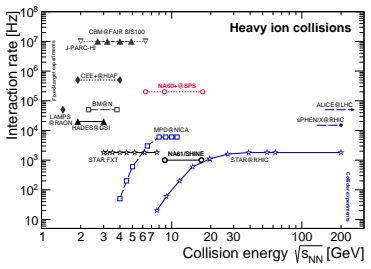
On its own terms, the contribution claims that the proposed NA60+ apparatus can measure rare muon-pair and charm observables in the SPS energy range at an interaction rate that is unique among existing and planned programs. The detector is a two-part system: a vertex spectrometer of five silicon pixel stations in a 1.47 T dipole, built from stitched 15x15 $cm^{2}$ sensors with 0.1% radiation length and 5 micron resolution, and a muon spectrometer of large-area gaseous readout chambers around the repurposed MNP33 dipole magnet. Muons are tracked before and after the hadron absorber, and matching the two tracks improves momentum resolution; the paper reports that prototype muon chambers reach the needed spatial resolution. With this setup, NA60+ would measure thermal dimuon radiation, in-medium vector and axial-vector spectral functions near chiral restoration, J/psi and psi' production, and open charm, none of which, it argues, can be accurately measured at SPS energies by any other program.
Load-bearing premise
The whole physics reach depends on stitched silicon sensors reaching 15x15 $cm^{2}$ area, 0.1% radiation length, and 5 micron resolution, a technology still in R&D with the first large-area sensors expected only in 2026.
Editorial extensions
If this is right
- The SPS would gain a high-rate muon-pair program spanning Pb+Pb down to p+Be collisions, covering systems no other planned experiment at this energy can measure accurately.
- Thermal dimuon spectra could map the caloric curve of the quark-gluon plasma at high baryochemical potential, where the phase transition may be first-order.
- Measurements of J/psi and psi' production in Pb+Pb would extend the charmonium suppression pattern first seen at SPS energies.
- Open charm reconstructed in the vertex spectrometer would constrain the transport properties of the deconfined medium at these energies.
- The prototype beam tests already show the muon-chamber resolution needed for the experiment (about 500 microns across the wires and 100 microns along the wires), so the main open risk moves to the stitched silicon sensors.
Reading between the lines
- If the stitched-sensor R&D succeeds, the same large-area, low-material silicon technology could be reused by other fixed-target or collider trackers that need coverage at the scale of square decimeters with minimal multiple scattering.
- The decision to switch from a toroidal magnet to the MNP33 dipole, made for cost and availability, changes the muon-system acceptance; a direct simulation comparing the thermal-dilepton acceptance of the two geometries would quantify whether any physics reach is lost.
- The paper's 'no other program' claim is implicitly tied to the present planning horizon; a natural test is to re-evaluate it each time a planned facility updates its beam-energy or rate capabilities.
- Because the beam tests of the muon chambers were done without the hadron absorber in place, a prototype run with the absorber installed would directly test the 200 micron matching resolution under realistic occupancy and backgrounds.
Signed reviews
Editorial analysis
A structured set of objections, weighed in public.
Referee Report
Summary. This paper presents the status of the proposed NA60+ experiment at the CERN SPS, a fixed-target muon-pair program covering the center-of-mass range roughly 5–17 GeV per nucleon pair. The apparatus comprises a vertex spectrometer (VS) of five silicon pixel stations inside a 1.47 T dipole magnet, with large-area stitched silicon sensors developed in collaboration with ALICE ITS3, and a muon system (MS) based on multi-wire proportional chambers with stripped cathode readout, now designed around the recycled MNP33 dipole magnet. The paper reports initial VS tracking results obtained with the ACTS package, beam-test measurements of two MS readout-module prototypes from 2023–24, and physics projections for thermal dileptons, chiral restoration, charmonium suppression, and open charm, where the physics curves are taken from independent theoretical calculations. The stated central claim is that NA60+ can measure observables in the SPS energy range that cannot be accurately accessed by any other existing or planned experiment.
Significance. If the performance goals are realized, NA60+ would fill a unique niche in the high-baryon-density QCD program by providing high-rate muon-pair and charm measurements in the SPS energy range, complementing CBM@FAIR and other facilities. The paper's strengths are its direct prototype beam-test data, the use of independent model predictions without fitted parameters, and the pragmatic switch to the MNP33 dipole after the cost and civil-engineering assessment of the toroid. The paper is, however, a status report rather than a full feasibility demonstration: the central matching and tracking claims rely on a small number of prototype and simulation numbers, and the paper provides little quantitative detail on efficiencies, backgrounds, or the matching algorithm. The reported resolution values for the muon-chamber prototype do not yet meet the stated requirement for one coordinate, which is a load-bearing gap that must be addressed.
major comments (3)
- [Section 2 (MS readout prototype)] The paper states that effective VS-MS matching requires a readout-chamber spatial resolution of about 200 µm, and later claims that 'It was demonstrated that the spatial resolution required by the experiment can be achieved.' The reported prototype resolutions, however, are 500 µm across the wires and 100 µm along the wires. The across-wire value is a factor of 2.5 worse than the stated requirement. Without an analysis showing that the matching efficiency and the resulting muon momentum resolution are preserved despite this coarser coordinate—for example, a simulation that uses the measured resolution and properly accounts for the orientation of the poorer coordinate relative to the bending plane—the central performance claim is not supported. The caveat that 'these parameters will change during the detector optimization' does not constitute a demonstration. The authors should either provide such an analysis or explicitly state that the requirement is not yet met.
- [Section 2 (VS silicon sensors)] The feasibility of the vertex spectrometer is premised on stitched silicon sensors with 15×15 cm2 transverse dimensions, a thickness of 0.1% radiation length, and 5 µm resolution. These specifications are presented as established parameters, yet the text notes that the first large-area sensors are expected only in 2026. The paper should clearly distinguish between design goals and demonstrated performance, and discuss the possible consequences for the experiment—particularly for VS-MS matching and momentum resolution—if the material budget, stitching yield, or resolution fall short of the stated targets.
- [Section 2 (tracking efficiency)] The VS tracking efficiency in Fig. 4 (right panel) is described only as 'rising above 100 MeV,' with no numerical efficiency values, no definition of the efficiency denominator, and no fake-rate estimate. Since open-charm measurements and the VS-MS matching that underpins the dimuon physics both depend on the low-pT tracking performance, the paper should provide at least the efficiency values, the simulated multiplicity, and the magnetic-field configuration so that the reader can assess whether the claimed 'significant progress' is quantitatively consistent with the physics requirements.
minor comments (6)
- [Abstract / Section 1] The abstract and introduction describe the energy range as '5 to 17 GeV,' while Section 1 gives '6 < sqrt(sNN) < 17.3 GeV'; these numbers should be made consistent.
- [Figure 4 caption] The caption spells the tracking software as 'ATCS' but the correct acronym is ACTS, as in Ref. [9].
- [Section 2 (prototype resolution)] The prototype resolution values of 500 µm and 100 µm are quoted without the number of events, the fit function, or statistical uncertainties; adding these would strengthen the claim.
- [Figure 2 caption] The caption says the curves are taken from Refs. [3–8], but some panels apparently represent projected NA60+ sensitivities; the provenance of each panel should be clarified.
- [References] Reference [6] contains a stray opening quotation mark in the title; the formatting should be corrected.
- [Section 1] The phrase 'allowing data collection at the highest rate in SPS√sNN interval of energies' is awkward and should be rephrased for clarity.
Circularity Check
No circularity: the physics projections rely on external published models and direct prototype measurements, with no fitted input relabeled as a prediction.
full rationale
The paper contains no derivation chain in which a predicted quantity is defined from a target quantity or fitted to the data it claims to predict. The physics projections (caloric curve, rho-a1 mixing, J/Psi over Drell-Yan, open-charm nuclear modification factor) are imported as curves 'taken from Refs. [3–8]', which are external published calculations and measurements by Rapp, Galatyuk, ALICE, and NA50; they are not derived from NA60+ data or from NA60+'s own assumptions. The performance statements about the NA60+ apparatus come from ACTS tracking simulations and from direct beam tests of two MS readout prototypes. The beam-test passage explicitly says that 'the spatial resolution required by the experiment can be achieved' and then reports measured values, while also stating 'These parameters will change during the detector optimization.' That is an admitted engineering caveat, not a circular step: the prototype measurement is direct empirical evidence, and the caveat concerns future design optimization rather than a quantity that was defined in terms of itself. The only self-citation is Ref. [1], the collaboration's Letter of Intent, which is used to identify the proposed experiment and does not carry any load in the physics or performance derivations. No equation in the paper defines an output in terms of the same output, and no fitted parameter is renamed as a prediction. The central claims are feasibility projections supported by external benchmarks and by R&D measurements, so no significant circularity is present.
Assumptions & free parameters
assumptions (4)
- domain assumption A QGP is formed in SPS heavy-ion collisions and emits thermal dimuons.
- domain assumption Chiral symmetry restoration near the phase transition modifies vector and axial-vector spectral functions.
- domain assumption The MNP33 magnet from the NA62 program will be available and can be adapted to the NA60+ configuration.
- domain assumption Stitched silicon sensors can achieve 5 um resolution and 0.1% radiation length over 15x15 cm2 areas.
Cite this review
Pith. "Pith review of The NA60+ experiment at SPS." pith.science (2026). https://pith.science/paper/6EQMEEFR
@misc{pith2026250501994,
  author       = {Pith},
  title        = {Pith review of: The NA60+ experiment at SPS},
  year         = {2026},
  howpublished = {\url{https://pith.science/paper/6EQMEEFR}},
  note         = {Machine review of arXiv:2505.01994}
}
abstract
A new apparatus, NA60+, is proposed for measuring muon pairs in the center-of-mass region from 5 to 17 GeV at CERN SPS in various collisional systems from Pb+Pb and down to $p$+Be. The physics scope of the new detector will cover topics from the measurement of thermal radiation coming from the hot and dense medium to chiral symmetry restoration, strangeness, and charm production. The proposed detector consists of a vertex spectrometer based on novel technology, allowing the production of large silicon sensors and a large-acceptance muon spectrometer based on gaseous detectors. With its high beam intensity, the new apparatus provides access to rare observables that have been scarcely studied until now. The new detector will come into operation after the Long Shutdown 3 of the LHC (past 2029) and is aimed at the first data-taking with Pb and proton beams. In this contribution, we review the project and recent R\&D effort, including the technical aspects and the studies of the physics performances for the observables.
Figures


Figures from the paper (4 more)


Reference graph
Works this paper leans on
-
[1]
The Collaboration, Letter of Intent: the NA60+ experiment, arXiv:2212.14452 (2022) CERN-SPSC-2022-036 / SPSC-I-259
arXiv 2022
-
[2]
Galatyuk, Future facilities for high _B physics, Nucl
T. Galatyuk, Future facilities for high _B physics, Nucl. Phys. A982, (2019) 163--169
work page 2019
-
[3]
R. Rapp and H. van Hees, Thermal Dileptons as Fireball Thermometer and Chronometer, Phys. Lett. B753 (2016) 586--590
work page 2016
-
[4]
T. Galatyuk, P.M. Hohler, R. Rapp, F. Seck, and J. Stroth, Thermal Dileptons from Coarse-Grained Transport as Fireball Probes at SIS Energies, Eur. Phys. J. A52 (2016) 5--131
work page 2016
-
[5]
C. Jung, F. Rennecke, R.-A. Tripolt, L. von Smekal, and J. Wambach, In-Medium Spectral Functions of Vector- and Axial-Vector Mesons from the Functional Renormalization Group, Phys. Rev. D95 (2017) 036020
work page 2017
-
[6]
The NA50 Collaboration, Evidence for deconfinement of quarks and gluons from the suppression pattern measured in collisions at the CERN SPS, Phys. Lett. B477 (2000), 28--36"
work page 2000
-
[7]
The NA50 Collaboration, production in collisions at 158-GeV/nucleon, Eur. Phys. J. C49 (2007) 559--567
work page 2007
-
[8]
ALICE Collaboration, Measurement of prompt D_s^+ -meson production and azimuthal anisotropy in collisions at =5.02 TeV Phys. Lett. B827 (2022) 136986
work page 2022
Show all 13 references
-
[9]
X. Ai, C. Allaire, N. Calace, et al A Common Tracking Software Project Comput. Softw. Big. Sci.6 (2022) 8
2022
-
[10]
The NA62 Collaboration, The Beam and detector of the NA62 experiment at CERN JINST12 (2017) P05025
2017
-
[11]
J.R. Fry, G. Ruggiero and F. Bergsma, Precision magnetic field mapping for CERN experiment NA62, J. Phys. G43 (2016) 125004
2016
-
[12]
, " * write output.state after.block = add.period write newline
ENTRY address archive author booktitle chapter collaboration edition editor eid eprint howpublished institution isbn issn journal key month note number numpages organization pages publisher school series title type url doi volume year label extra.label sort.label short.list IN...
-
[13]
write FUNCTION output.bibitem newline
" write FUNCTION output.bibitem newline " " " " * write cite write " " write newline "" before.all 'output.state := FUNCTION n.dashify 't := "" t empty not t #1 #1 substring "-" = t #1 #2 substring "--" = not "--" * t #2 global.max substring 't := t #1 #1 substring "-" = "-" *...
Reviewed August 16, 2026 · model on record in the stance chip above.
Discussion (0). Continue with ORCID to comment.