REVIEW 3 major objections 6 minor 2 cited by
A Synergistic Framework of Nonlinear Acoustic Computing and Reinforcement Learning for Real-World Human-Robot Interaction
T0 review · 3 major / 6 minor · reviewed 2026-08-16 · deepseek-v4-flash
Pith's one-line read The paper argues that nonlinear acoustic equations (Westervelt/KZK) tuned in real time by a reinforcement-learning controller can beat both linear methods and pure deep learning for noisy human-robot interaction.
desk verdict A product whitepaper dressed as a research paper: the nonlinear-acoustic+RL framework is never actually connected to the reported benchmarks, and the paper's own conclusion concedes real-world validation is still future work. read the letter →
The pith
A machine-rendered reading of the paper's core claim, the machinery that carries it, and where it could break.
The reading
What carries the argument
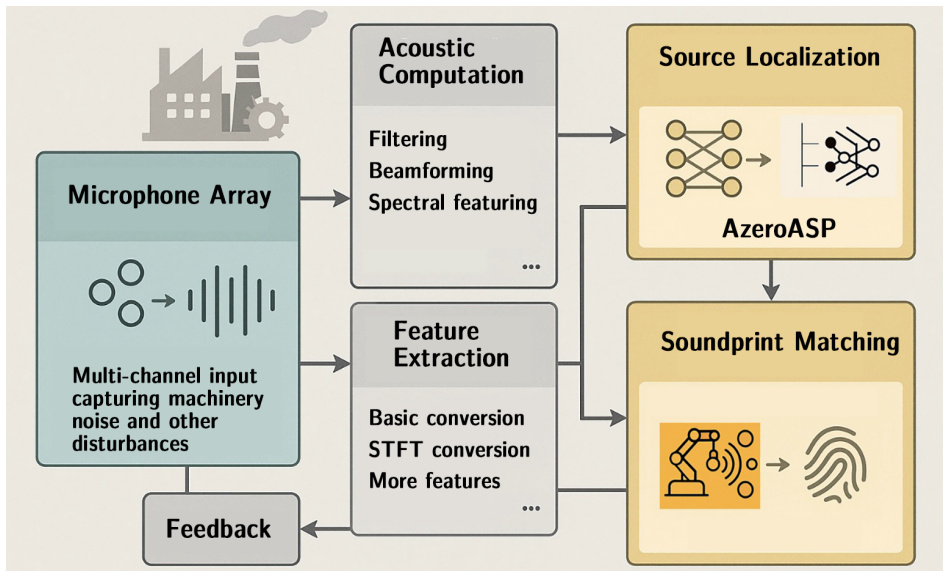
The load-bearing object is the Westervelt equation $\partial^2 p/\partial t^2 - c^2\nabla^2 p = \alpha\,\partial^2(p^2)/\partial t^2$, whose quadratic term acts as a source for second-harmonic generation and shock formation, together with the paraxial KZK extension that adds diffraction and thermoviscous absorption. Around these equations the paper wraps a PPO-driven control loop whose actions are incremental adjustments to the model parameters ($\alpha$, $\beta_{NL}$, $\delta$, beamforming weights) and whose reward balances recognition accuracy, latency, and energy use. The nonlinear terms supply physical structure the RL agent can exploit, while the RL agent supplies the real-time adaptation that the bare equations lack.
What would settle it
Run the Section 4 benchmark suite with the same Azero pipeline but with the Westervelt/KZK nonlinear terms zeroed and the PPO controller frozen; if MOS-LQO, WER, and localization error stay essentially unchanged, the experiments are not testing the proposed framework's contribution.
Extended reading notes
Core claim
On the paper's own account, the central discovery claim is that embedding physically informed nonlinear wave equations in a reinforcement-learning control loop yields a self-tuning acoustic front end whose performance exceeds linear processing and pure deep learning in demanding acoustic environments. The proposed mechanism is a feedback loop: the Westervelt and KZK equations provide the physical model of harmonic generation, shock formation, and diffraction, while a PPO agent continuously adjusts propagation coefficients, filter gains, and beamforming weights to match changing conditions. The reported evidence comes from the Azero product family: AzeroVEP reaches MOS-LQO 4.29 versus 2.8 for RNNoise at 20 dB babble noise, AzeroASR reaches WER 3.86 percent and 5.12 percent on the Fleurs Chinese and English sets, and localization error drops from about 15 degrees to 3 degrees with a fivefold throughput gain. Section 6.1 concedes these results come from existing benchmark datasets and that real-world validation is future work.
Load-bearing premise
The whole argument rests on the assumption that the benchmark results in Section 4 come from systems that actually use the proposed nonlinear acoustic plus reinforcement-learning framework; the paper never states that they do, and Section 6.1 says only existing benchmark datasets were used.
Editorial extensions
If this is right
- If the framework works as claimed, far-field speech recognition in industrial and traffic noise can hold above 96 percent accuracy, with a 12 dB SNR improvement in 100 dB environments.
- Nonlinear terms give the front end a physical account of harmonic generation and shock formation, which should make it more reliable at high sound pressure levels and in strongly reverberant enclosures than linear models.
- The RL loop replaces manual hand-tuning: the same pipeline can be deployed in factories, cars, auditoriums, and homes without per-environment parameter engineering.
- On-device deployment becomes realistic because reported real-time factors stay at or below roughly 0.1, and the voice-cloning and AzeroGPT modules inherit the noise-robust front end.
Reading between the lines
- The paper reports product-level benchmarks for AzeroVEP, AzeroASR, AzeroTTS, and AzeroGPT without showing that those products execute the Section 2 equations and PPO loop; the convincing test would be an ablation that disables the nonlinear terms and the RL controller without touching the rest of the pipeline.
- If the nonlinear-RL loop is genuinely responsible for the gains, the method should transfer most strongly to regimes where nonlinearity is unavoidable, such as high-intensity focused sound, shock-forming fields, and extreme reverberation, and should be compared there against linear beamforming plus a standard neural enhancer.
- A clean experimental extension would measure how many RL interactions the controller needs to re-adapt when the room impulse response or noise type changes; that number would tell whether the 'real-time adaptation' claim holds on edge hardware.
Signed reviews
Editorial analysis
A structured set of objections, weighed in public.
Referee Report
Summary. The manuscript proposes a hybrid framework that integrates nonlinear acoustic wave equations (Westervelt and KZK) with reinforcement learning for far-field human-robot interaction. Section 2 presents the physical equations and a PPO-based adaptive control loop; Section 3 describes a set of commercial products (AzeroVEP, AzeroASR, AzeroTTS, AzeroGPT); Section 4 reports benchmark results for those products; Section 5 surveys applications; Section 6 concludes that the hybrid surpasses classical linear and purely data-driven baselines. The paper also states in Section 6.1 that only existing benchmark datasets were used and that real-world validation remains future work.
Significance. If the central claim were established, embedding nonlinear acoustic propagation models inside an RL-controlled front-end could be a meaningful direction for robot audition and far-field speech processing. The paper articulates that ambition and provides standard textbook equations, but the manuscript's actual strengths are limited: there is no parameter-free derivation, no machine-checked proof, and no experimental protocol that links the Section 2 theory to the Section 4 results. The benchmark tables are extensive but, as written, cannot be used to validate the proposed framework. The explicit concession in Section 6.1 that only existing benchmark datasets were used further weakens the central claim of real-world superiority.
major comments (3)
- [§4, §6.1] The experimental section is disconnected from the proposed framework. The benchmark results in Tables 1-10 evaluate AzeroVEP, AzeroASR, AzeroTTS, and AzeroGPT as standalone products, but the paper never states that these systems implement the Westervelt/KZK equations (Eqs. 2-5) or the PPO objective in Eq. (6). Section 6.1 explicitly concedes that 'the current work is based on evaluations using existing benchmark datasets,' so the claimed superiority over traditional linear methods and purely data-driven baselines is not supported by any presented comparison. This is the load-bearing gap of the paper.
- [§2.1.2, Eqs. (3)-(5)] The KZK equation is written with a nonlinear term ∂³(p²)/∂τ³, but the canonical KZK/Westervelt paraxial form uses ∂²(p²)/∂τ² with prefactor β/(2ρ0c³); only the absorption term, δ/(2c³)∂³p/∂τ³, is third-order in τ. As printed, the physical equations are not the standard equations claimed. Since the theoretical foundation depends on these equations, this error undermines the paper's claim of a physically informed framework.
- [§3.2, §3.4] Headline performance improvements are asserted without experimental detail: localization error reduction from 15° to 3° and a fivefold speedup (Section 3.2), and a 58 dB voice-clarity improvement at 120 dB noise (Section 3.4). No measurement protocol, baseline definition, error bars, or statistical comparison is provided for any of these numbers. These claims are central to the paper's stated contributions and cannot be evaluated or reproduced.
minor comments (6)
- [§4.2] The text refers to 'Table 1' and 'Table 2' for the LibriSpeech results, but the corresponding tables are numbered Table 2 and Table 3. Please correct the cross-references.
- [Table 6] The table title misspells 'Fleurs' as 'Fluers', and the French column header is truncated to 'F'. Please fix the typo and formatting.
- [§2.2.2, Eq. (6)] The likelihood ratio rt(θ) and the advantage estimator Ât are used in the PPO objective but never defined. Please define rt(θ) = πθ(at|st)/πθ_old(at|st) and specify how the advantage is estimated.
- [§6.1] The concession that only existing benchmark datasets were used contradicts the abstract's claim of validation in 'demanding real-world scenarios.' Please reconcile these statements.
- [Figures] Figures 6-11 are referenced in the text but are not present in the provided manuscript. Please ensure they are included in the final PDF.
- [Code/Data Availability] The GitHub repository link is given, but the repository contents and reproduction instructions are not described. Please state which results can be reproduced and how.
Circularity Check
No circular reduction: the Westervelt/KZK+RL framework is not shown to generate the Section 4 product benchmarks, so the gap is evidential rather than circular.
full rationale
The paper's asserted derivation chain is not circular in the sense defined by the review criteria. Section 2 presents standard nonlinear acoustics equations (Westervelt and KZK) and a generic PPO objective; no parameter is fitted to a subset of the reported results and then renamed as a prediction of those same results. Section 3 introduces the Azero product family, and Section 4 reports benchmark numbers for AzeroVEP, AzeroTTS, AzeroASR, and AzeroGPT, but the paper never states that those products solve Eq. (2), Eq. (5), or Eq. (6), nor does it show that removing the nonlinear acoustic model changes the benchmark outcomes. The Section 4 results are therefore not derived from the framework by construction, which means the claimed superiority is unsupported as an empirical matter rather than equivalent to its inputs. Section 6.1 explicitly concedes: 'the current work is based on evaluations using existing benchmark datasets, and the true potential of this approach has yet to be fully explored in real-world environments,' further confirming an evidence gap rather than a logical circularity. The authors cite their own prior work in a few places (e.g., references [10] and [11]), but those citations support product-level or peripheral claims and are not used to justify the Westervelt/KZK equations or the RL objective, so they are not load-bearing for the central derivation. Consequently, no specific circular step can be quoted, and the correct finding is no significant circularity (score 0), with the caveat that the theory-to-experiment link needs independent verification under a correctness assessment, not under the circularity rubric.
Assumptions & free parameters
free parameters (4)
- Nonlinear coefficient alpha in Westervelt equation (Eq. 2) =
not reported
- Absorption coefficient delta in KZK equation (Eq. 3) =
not reported
- Beamforming weights w_m (Eq. 9) =
not reported
- RL policy parameters theta in PPO objective (Eq. 6) =
not reported
assumptions (5)
- standard math The second-order perturbation expansion of the compressible Navier-Stokes equations yields the Westervelt equation (Eq. 2).
- standard math The paraxial approximation and retarded-time frame yield the KZK equation (Eq. 3).
- domain assumption Nonlinear acoustic effects such as harmonic generation and shock formation are significant in typical human-robot interaction environments with ordinary speech-level sources.
- ad hoc to paper Benchmark performance of AzeroVEP, AzeroASR, AzeroTTS, and AzeroGPT is attributable to the nonlinear acoustic and RL framework.
- domain assumption An RL agent can tune acoustic processing parameters better than manual tuning in real time.
Cite this review
Pith. "Pith review of A Synergistic Framework of Nonlinear Acoustic Computing and Reinforcement Learning for Real-World Human-Robot Interaction." pith.science (2026). https://pith.science/paper/GFWY25TF
@misc{pith2026250501998,
  author       = {Pith},
  title        = {Pith review of: A Synergistic Framework of Nonlinear Acoustic Computing and Reinforcement Learning for Real-World Human-Robot Interaction},
  year         = {2026},
  howpublished = {\url{https://pith.science/paper/GFWY25TF}},
  note         = {Machine review of arXiv:2505.01998}
}
read the original abstract
This paper introduces a novel framework integrating nonlinear acoustic computing and reinforcement learning to enhance advanced human-robot interaction under complex noise and reverberation. Leveraging physically informed wave equations (e.g., Westervelt, KZK), the approach captures higher-order phenomena such as harmonic generation and shock formation. By embedding these models in a reinforcement learning-driven control loop, the system adaptively optimizes key parameters (e.g., absorption, beamforming) to mitigate multipath interference and non-stationary noise. Experimental evaluations, covering far-field localization, weak signal detection, and multilingual speech recognition, demonstrate that this hybrid strategy surpasses traditional linear methods and purely data-driven baselines, achieving superior noise suppression, minimal latency, and robust accuracy in demanding real-world scenarios. The proposed system demonstrates broad application prospects in AI hardware, robot, machine audition, artificial audition, and brain-machine interfaces.
Figures


Figures from the paper (8 more)


Forward citations
Cited by 2 Pith papers
-
The Sound of Risk: A Multimodal Physics-Informed Acoustic Model for Forecasting Market Volatility and Enhancing Market Interpretability
Emotional changes in executives' voices and words during earnings calls explain 43.8% of out-of-sample 30-day volatility even though they do not predict stock return direction.
-
A Survey on World Models Grounded in Acoustic Physical Information
A survey that frames acoustic signals as physical information for world models and reviews PINNs, generative models, and self-supervised learning toward that end.
Reference graph
Works this paper leans on
-
[1]
L. Rabiner and B.-H. Juang,Fundamentals of speech recognition. Prentice-Hall, Inc., 1993
work page 1993
-
[2]
Nonlinear acoustics in china,
Q. Zuwen, “Nonlinear acoustics in china,”WULI-BEIJING-, vol. 28, no. 10, pp. 593–599, 1999
1999
-
[3]
T.Hori, Z.Chen, H.Erdogan, J.R.Hershey, J.LeRoux, V.Mitra, andS.Watanabe, “Multi-microphone speechrecognitionintegratingbeamforming, robustfeatureextraction, andadvanceddnn/rnnbackend,” Computer speech & language, vol. 46, pp. 401–418, 2017
work page 2017
-
[4]
Deep learning,
Y. LeCun, Y. Bengio, and G. Hinton, “Deep learning,”nature, vol. 521, no. 7553, pp. 436–444, 2015
2015
-
[5]
Speech recognition with deep recurrent neural networks,
A. Graves, A.-r. Mohamed, and G. Hinton, “Speech recognition with deep recurrent neural networks,” in 2013 IEEE international conference on acoustics, speech and signal processing. Ieee, 2013, pp. 6645–6649
2013
-
[6]
A survey on deep reinforcement learning for audio-based applications,
S. Latif, H. Cuayáhuitl, F. Pervez, F. Shamshad, H. S. Ali, and E. Cambria, “A survey on deep reinforcement learning for audio-based applications,”Artificial Intelligence Review, vol. 56, no. 3, pp. 2193–2240, 2023
work page 2023
-
[7]
The foundation of modern acoustic theory,
D. Ma, “The foundation of modern acoustic theory,”Science Press, 2004. 32
work page 2004
-
[8]
Deep clustering: Discriminative embeddings for segmentation and separation,
J. R. Hershey, Z. Chen, J. Le Roux, and S. Watanabe, “Deep clustering: Discriminative embeddings for segmentation and separation,” in2016 IEEE international conference on acoustics, speech and signal processing (ICASSP). IEEE, 2016, pp. 31–35
work page 2016
Show all 28 references
-
[9]
P. C. Loizou,Speech enhancement: theory and practice. CRC press, 2007
2007
-
[10]
High speed fir digital filtering on gpu,
X. Chen, Y. Deng, X. Cheng, X. Li, and J. Tian, “High speed fir digital filtering on gpu,”Journal of Computer-Aided Design & Computer Graphics, vol. 22, no. 9, pp. 1435–1442, 2010
2010
-
[11]
Challenges and contributing factors in the utilization of large language models (llms),
X. Chen, L. Li, L. Chang, Y. Huang, Y. Zhao, Y. Zhang, and D. Li, “Challenges and contributing factors in the utilization of large language models (llms),”arXiv preprint arXiv:2310.13343, 2023
2023 arXiv
-
[12]
Far-field automatic speech recognition,
R. Haeb-Umbach, J. Heymann, L. Drude, S. Watanabe, M. Delcroix, and T. Nakatani, “Far-field automatic speech recognition,”Proceedings of the IEEE, vol. 109, no. 2, pp. 124–148, 2020
2020
-
[13]
Multi-modal human–environment interaction,
R. Wasinger and W. Wahlster, “Multi-modal human–environment interaction,” inTrue visions: the emergence of ambient intelligence. Springer, 2006, pp. 291–306
2006
-
[14]
R. S. Sutton and A. G. Barto,Reinforcement Learning: An Introduction. MIT Press, 2018
2018
-
[15]
Supervisedspeechseparationbasedondeeplearning: Anoverview,
D.WangandJ.Chen, “Supervisedspeechseparationbasedondeeplearning: Anoverview,” IEEE/ACM transactions on audio, speech, and language processing, vol. 26, no. 10, pp. 1702–1726, 2018
2018
-
[16]
A hybrid dsp/deep learning approach to real-time full-band speech enhancement,
J.-M. Valin, “A hybrid dsp/deep learning approach to real-time full-band speech enhancement,” in2018 IEEE 20th international workshop on multimedia signal processing (MMSP). IEEE, 2018, pp. 1–5
2018
-
[17]
Benesty, J
J. Benesty, J. Chen, and Y. Huang,Microphone array signal processing. Springer Science & Business Media, 2008, vol. 1
2008
-
[18]
Fireredasr: Open-source industrial-grade mandarin speech recognition models from encoder-decoder to llm integration,
K.-T. Xu, F.-L. Xie, X. Tang, and Y. Hu, “Fireredasr: Open-source industrial-grade mandarin speech recognition models from encoder-decoder to llm integration,”arXiv preprint arXiv:2501.14350, 2025
2025 arXiv
-
[19]
Kimi-audio technical report,
D. Ding, Z. Ju, Y. Leng, S. Liu, T. Liu, Z. Shang, K. Shen, W. Song, X. Tan, H. Tanget al., “Kimi-audio technical report,”arXiv preprint arXiv:2504.18425, 2025
2025 arXiv
-
[20]
Funaudiollm: Voice understanding and generation foundation models for natural interaction between humans and llms,
K. An, Q. Chen, C. Deng, Z. Du, C. Gao, Z. Gao, Y. Gu, T. He, H. Hu, K. Huet al., “Funaudiollm: Voice understanding and generation foundation models for natural interaction between humans and llms,” arXiv preprint arXiv:2407.04051, 2024
2024 arXiv
-
[21]
Paraformer: Fast and accurate parallel transformer for non-autoregressive end-to-end speech recognition,
Z. Gao, S. Zhang, I. McLoughlin, and Z. Yan, “Paraformer: Fast and accurate parallel transformer for non-autoregressive end-to-end speech recognition,”arXiv preprint arXiv:2206.08317, 2022
2022 arXiv
-
[22]
Robustspeechrecognition via large-scale weak supervision,
A.Radford, J.W.Kim, T.Xu, G.Brockman, C.McLeavey, andI.Sutskever, “Robustspeechrecognition via large-scale weak supervision,” inInternational conference on machine learning. PMLR, 2023, pp. 28492–28518
2023
-
[23]
Scaling speech technology to 1,000+ languages,
V. Pratap, A. Tjandra, B. Shi, P. Tomasello, A. Babu, S. Kundu, A. Elkahky, Z. Ni, A. Vyas, M. Fazel- Zarandi et al., “Scaling speech technology to 1,000+ languages,”Journal of Machine Learning Research, vol. 25, no. 97, pp. 1–52, 2024
2024
-
[24]
Geriatric audiology,
P. Dawes, “Geriatric audiology,” 2015
2015
-
[25]
Adeeplearningsolutiontothemarginalstabilityproblems of acoustic feedback systems for hearing aids,
C.Zheng, M.Wang, X.Li, andB.C.Moore, “Adeeplearningsolutiontothemarginalstabilityproblems of acoustic feedback systems for hearing aids,”The Journal of the Acoustical Society of America, vol. 152, no. 6, pp. 3616–3634, 2022
2022
-
[26]
Multi-modal data fusion in enhancing human-machine interaction for robotic applications: a survey,
T. K. Mohd, N. Nguyen, and A. Y. Javaid, “Multi-modal data fusion in enhancing human-machine interaction for robotic applications: a survey,”arXiv preprint arXiv:2202.07732, 2022. 33
2022 arXiv
-
[27]
Schalk and J
G. Schalk and J. Mellinger,A practical guide to brain–computer interfacing with BCI2000: General- purpose software for brain-computer interface research, data acquisition, stimulus presentation, and brain monitoring. Springer Science & Business Media, 2010
2010
-
[28]
Brain-computer interface: applications to speech decoding and synthesis to augment communication,
S. Luo, Q. Rabbani, and N. E. Crone, “Brain-computer interface: applications to speech decoding and synthesis to augment communication,”Neurotherapeutics, vol. 19, no. 1, pp. 263–273, 2022. 34
2022
Reviewed August 16, 2026 · model on record in the stance chip above.
Discussion (0). Continue with ORCID to comment.