REVIEW 3 major objections 6 minor 61 references
TeDA: Boosting Vision-Lanuage Models for Zero-Shot 3D Object Retrieval via Testing-time Distribution Alignment
T0 review · 3 major / 6 minor · reviewed 2026-08-16 · deepseek-v4-flash
Pith's one-line read TeDA adapts CLIP at test time with pseudo-labeled multi-view pairs and InternVL text cues, beating training-required and training-free methods on four 3D retrieval benchmarks.
desk verdict TeDA is a clever test-time adaptation for 3D retrieval with large reported gains, but the KL gradient is mis-derived and key hyperparameters are tuned on the test benchmarks, so the margins are not yet fully trustworthy. read the letter →
The pith
A machine-rendered reading of the paper's core claim, the machinery that carries it, and where it could break.
The reading
What carries the argument
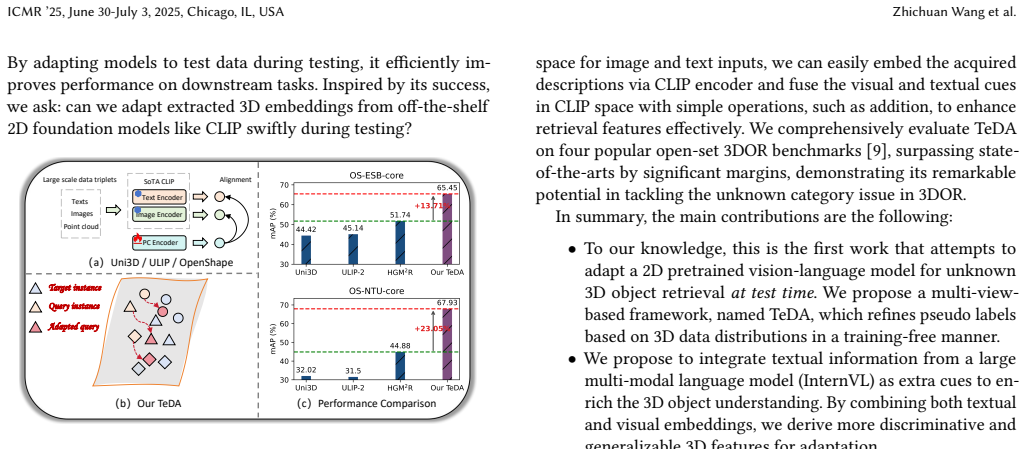
The load-bearing object is the iterative distribution-alignment loop over the query feature matrix $Q$. Starting from CLIP's pooled multi-view embeddings, TeDA computes a softmax similarity matrix between targets $X$ and queries $Q$ (Eq. 5), thresholds the highest entry per target row to make one-hot pseudo-labels $P'$ (Eq. 6), and then takes gradient steps on the KL divergence between the soft retrieval distribution and $P'$ (Eqs. 7-9), which has the closed-form update $\Delta Q = X^T(X \cdot Q^T / \tau_i - P')$. The text side is a second channel: InternVL descriptions are embedded by CLIP's text encoder and fused by $\tanh(g + \lambda f_{\text{text}})$, exploiting CLIP's aligned image-text space. The mechanism's job is to contract query features toward the nearest reliable targets so that the final retrieval scores $R = Q \cdot X^T$ become sharper on unseen classes.
What would settle it
Take a benchmark with known category labels and run TeDA while logging the pseudo-labels selected at each iteration; if the precision of the selected pseudo-labels against ground-truth matches is at or below chance for unseen categories, or if the reported mAP gains vanish when the same pipeline is run with pseudo-labels replaced by random labels, then the gains are not caused by correct distribution alignment.
Extended reading notes
Core claim
TeDA's central claim is that the distribution gap between CLIP's 2D natural-image training and 3D multi-view test data can be largely closed at test time, without retraining, by treating each query object as its own class and pushing its embedding toward high-confidence target instances. The refinement is driven by pseudo-labels: a target is assigned to a query when the softmax similarity exceeds a threshold, and the query features are updated by gradient descent on the KL divergence between the pseudo-label distribution and the current retrieval distribution. A second claim is that complementary text descriptions generated by InternVL and embedded in CLIP space add stable semantic cues that further help unseen categories. Together these mechanisms let TeDA surpass not only zero-shot baselines but also methods that train on the benchmark data, and the same recipe transfers to depth-map projections on Objaverse-LVIS.
Load-bearing premise
The whole adaptation hinges on the initial CLIP similarity being a trustworthy guide: TeDA assumes the highest-scoring query-target pairs it converts into one-hot pseudo-labels are genuine matches, and if that nearest-neighbor structure is wrong for an unseen category, the iterative updates drag query features toward incorrect targets.
Editorial extensions
If this is right
- On the four open-set benchmarks, a training-free CLIP adaptation outperforms every compared training-required method, including HGM2R, so task-specific 3D training is not required for top retrieval accuracy on these splits.
- Adding InternVL-generated text features improves retrieval on all four benchmarks, with the largest gain (8.43 mAP on OS-ABO-core) on datasets dominated by common, nameable objects.
- The framework extends beyond gray multi-view renders to depth maps: on Objaverse-LVIS it reaches 20.35 mAP, surpassing ULIP-2's 18.15 without point-cloud pretraining.
- Because the CLIP backbone stays frozen and only test-time embeddings are optimized, future improvement in the frozen encoder should translate directly into better TeDA retrieval.
Reading between the lines
- Our inference: the pseudo-label threshold $\alpha$ acts as a self-trust knob; a principled way to set it without test labels would be to compare the distribution of max-softmax scores before and after adaptation and choose a point that stabilizes—an auto-calibration step the paper does not explore.
- Our inference: if the initial CLIP nearest-neighbor structure is systematically wrong for a broad unseen category, the iterative updates will amplify that error; one testable guard would be to restrict updates to query-target pairs whose similarity is high in both visual and text channels, or to add a small entropy regularizer on the pseudo-label distribution.
- Our inference: the method's reliance on InternVL captions suggests a failure mode when the LLM misnames an object class; prompting for shape-only descriptions (the paper's Q2) already degrades results, so caption accuracy is likely a first-order factor in the text-fusion gain.
- Our inference: TeDA's formulation is agnostic to the feature source; applying the same KL pseudo-label loop to features from other multimodal encoders (e.g., a stronger open CLIP variant) would test whether the alignment mechanism, rather than the specific features, drives the reported gains.
Signed reviews
Editorial analysis
A structured set of objections, weighed in public.
Referee Report
Summary. TeDA proposes a training-free, test-time adaptation method for zero-shot 3D object retrieval. Given a query set and a target set of 3D objects, the method renders each object into multi-view images, extracts CLIP image features, generates an InternVL textual description per object, and fuses visual and textual features by weighted addition followed by tanh normalization. It then iteratively refines the query embeddings by minimizing a KL divergence between a softmax similarity distribution (between targets and learnable query embeddings) and a pseudo-label distribution obtained by thresholding the softmax similarities computed with the original query embeddings. The authors evaluate TeDA on four open-set 3D object retrieval benchmarks (OS-ESB-core, OS-NTU-core, OS-MN40-core, OS-ABO-core) and report large mAP/NDCG improvements over both training-required baselines such as HGM2R and training-free baselines such as ULIP, Uni3D, and MV-CLIP. They also include ablations over the fusion weight, pseudo-label threshold, temperature, number of views, fusion scheme, and normalization, plus an extension to depth-map inputs on Objaverse-LVIS.
Significance. If the reported results survive proper validation, TeDA is a conceptually simple and appealing alternative to trained 3D retrieval models: it requires no 3D training data, no fine-tuning of CLIP, and only adapts extracted embeddings at test time. The paper is, to my knowledge, the first to frame this task as test-time distribution alignment for 3D retrieval, and the empirical gains over strong baselines are large (e.g., 65.45 vs. 51.74 mAP over HGM2R on OS-ESB-core with OpenCLIP ViT-L/14). The work also contributes a practical multi-view-plus-text representation for open-set 3D categories. However, the significance is tempered by two load-bearing issues: the stated gradient update does not match the claimed KL objective, and key hyperparameters are tuned directly on the test benchmarks, both of which undermine the current evidence for the method's general effectiveness.
major comments (3)
- [Section 3.3, Eq. (8)] The update rule in Eq. (8) is not the gradient of the KL divergence in Eq. (7). With P = softmax(XQ^T / tau_i) and P' fixed, the correct gradient of sum_i KL(P'_i || P_i) with respect to Q is (1/tau_i) * (P - P')^T X, not X^T (XQ^T/tau_i - P'). The latter omits the softmax over the logits. This is not a notational difference: the two expressions behave differently (e.g., the raw logits are unbounded and the update direction is not the natural gradient of the stated objective). The authors should either correct Eq. (8) to include the softmax, or explicitly state that Eq. (8) is an approximate or alternative update and reconcile it with the claim that the method minimizes KL divergence.
- [Section 4.3, Tables 4 and Figures 5-6] Key hyperparameters are selected on the same test benchmarks that produce the headline results in Table 1, without a validation split. Specifically, alpha=0.6 is chosen by maximizing mAP on OS-ABO-core (Table 4), lambda is tuned on OS-MN40-core and OS-ABO-core (Figure 5), and tau_i is tuned on OS-MN40-core (Figure 6), and all of these are then used for the Table 1 results on those datasets. This test-set selection can inflate the reported margins relative to baselines that use fixed or previously validated hyperparameters, and it limits the confidence that the improvement generalizes. The authors should report results using hyperparameters chosen on a held-out validation set or through nested cross-validation, and provide error bars over multiple runs.
- [Section 3.3, Eq. (6) and Section 4.3] The pseudo-label accuracy is never measured, despite being load-bearing for the adaptation. The method selects query-target pairs with the highest initial CLIP similarity, converts them to one-hot targets, and then pulls query features toward those targets. If the initial nearest-neighbor structure is wrong for some unseen categories, the iterative update can amplify errors. The paper should report, at minimum, the precision of the selected pseudo-labels (e.g., the fraction of query-target pairs above alpha that share the same ground-truth category), the fraction of samples above the threshold, and the effect of alpha on a validation split. Without this, the reported gains may partly reflect a self-confirming loop on easy pairs rather than a robust adaptation principle.
minor comments (6)
- [Title and Abstract] The title contains a typo: 'Lanuage' should be 'Language'.
- [Figure 2 caption] The caption contains 'pretraind' and should be 'pretrained'.
- [Table 1 and Figure 3] There are inconsistent abbreviations: 'Uin3D' in Table 1 should be 'Uni3D', and 'InforNCE' in Figure 3 should be 'InfoNCE'.
- [Section 4.4, Table 7] The table title says 'ZS-Objaverse-Core' but the text and the surrounding description refer to 'Objaverse-LVIS'. Please make the dataset name consistent.
- [References] Reference [55] is titled as a multimodal emotion recognition method, yet it is used in the context of 3D object retrieval auto-encoder methods. This is mismatched; please verify the citation or replace it with the correct source.
- [Section 3.3, Eq. (5)] The two softmax distributions P' and P use different temperatures, tau_t and tau_i, but the roles of the two temperatures are only explained later in the ablation section. Please state their roles when the equation is introduced.
Circularity Check
TeDA's self-training loop makes gains on high-confidence pairs partly self-confirming, and key hyperparameters are tuned on the same test benchmarks used in the headline comparison.
-
self definitional
[Section 3.3, Eqs. (5)-(10)]
"P′ = Softmax(XQ𝑇/𝜏𝑡); P = Softmax(XQ𝑇/𝜏𝑖) (5) ... if max(P′[𝑖, :]) > 𝛼 & 𝑗 = arg max(P′[𝑖, :]) ... 1 ... (6) ... min_Q 𝐿(P′, P(Q)) = Σ𝑖 𝐷KL(P′𝑖∥ P𝑖) (7) ... R = Q·X𝑇 (10)"
The pseudo-label matrix P′ is constructed from the initial query-target similarity matrix XQ^T in Eq. (5), then thresholded to one-hot form in Eq. (6). The optimization in Eq. (7) minimizes the KL divergence between the updated retrieval distribution P(Q) and this same P′, and the final retrieval score in Eq. (10) is again the bilinear similarity Q·X^T. Therefore, for every target-query pair retained above α, high final similarity is imposed by the objective rather than established by any independent label or validation. The paper does not report pseudo-label accuracy against ground truth or use a held-out validation split, so the improvement on confident pairs is partly a sharpening of the initial ranking by construction.
-
fitted input called prediction
[Section 4.3, Table 4 and Implementation Details]
"We conducted ablation experiments on the OS-ABO-core dataset to evaluate the impact of 𝛼, as shown in Table 4. ... In all experiments of this paper, we selected 𝛼 = 0.6, which achieved the best performance, as the threshold."
The pseudo-label threshold α is selected on the OS-ABO-core test benchmark, and the same OS-ABO-core result (72.12 mAP with OpenCLIP ViT-L/14) is then reported in the main comparison in Table 1. Thus the headline OS-ABO-core number is not an independent prediction; it is obtained after fitting α to that exact benchmark. The same pattern holds for λ tuned on OS-MN40-core and OS-ABO-core in Figure 5 and for τ_i tuned on OS-MN40-core in Figure 6. This makes the reported evaluation partially self-referential and weakens the claim that the gains are evidence of a general adaptation principle.
full rationale
TeDA is an explicitly transductive, self-boosting method: the pseudo-labels that drive adaptation are computed from the same CLIP query-target similarity matrix that is later evaluated, and the final retrieval is optimized to match those pseudo-labels. This is a genuine self-referential loop, not merely a robustness concern, because the objective Eq. (7) is defined in terms of a thresholded version of the initial retrieval distribution and the final score Eq. (10) is the same bilinear form. The gains on confident pairs are therefore partly guaranteed by construction, which is the core circular element. The additional tuning of α, λ, and τ_i directly on the test benchmarks used in Table 1 turns some of the headline results into fitted values rather than independent evaluations. However, the method is not fully circular: no ground-truth labels are used during adaptation, the CLIP and InternVL features are external to the retrieval metric, and the evaluation is run on fixed public benchmarks, so the framework has independent content and could in principle fail on other data. The paper also does not hide its self-boosting design, and the gradient mismatch in Eq. (8) is a correctness issue rather than a circularity. Overall, the central empirical claim is partially self-confirming, but not equivalent to its input by definition.
Assumptions & free parameters
free parameters (6)
- Fusion weight lambda =
0.2 on OS-MN40-core, 0.5 on OS-ABO-core, tuned per dataset
- Pseudo-label threshold alpha =
0.6
- Temperature tau_i for query-target softmax =
not stated, swept in Figure 6
- Temperature tau_t for pseudo-label softmax =
0.03
- Optimization schedule =
lr=10, halved when gradient norm increases; 2000 iterations
- View count M =
24
assumptions (4)
- domain assumption Multi-view 2D projections processed by CLIP mean-pooling are a sufficient initial representation of 3D objects for retrieval.
- domain assumption High-confidence nearest-neighbor query-target pairs in initial CLIP feature space are semantically correct matches.
- domain assumption InternVL-generated one-sentence captions are accurate enough to improve retrieval for unseen categories.
- ad hoc to paper Eq. (8) is the gradient of the KL divergence in Eq. (7).
Cite this review
Pith. "Pith review of TeDA: Boosting Vision-Lanuage Models for Zero-Shot 3D Object Retrieval via Testing-time Distribution Alignment." pith.science (2026). https://pith.science/paper/MHRCF6XL
@misc{pith2026250502325,
  author       = {Pith},
  title        = {Pith review of: TeDA: Boosting Vision-Lanuage Models for Zero-Shot 3D Object Retrieval via Testing-time Distribution Alignment},
  year         = {2026},
  howpublished = {\url{https://pith.science/paper/MHRCF6XL}},
  note         = {Machine review of arXiv:2505.02325}
}
read the original abstract
Learning discriminative 3D representations that generalize well to unknown testing categories is an emerging requirement for many real-world 3D applications. Existing well-established methods often struggle to attain this goal due to insufficient 3D training data from broader concepts. Meanwhile, pre-trained large vision-language models (e.g., CLIP) have shown remarkable zero-shot generalization capabilities. Yet, they are limited in extracting suitable 3D representations due to substantial gaps between their 2D training and 3D testing distributions. To address these challenges, we propose Testing-time Distribution Alignment (TeDA), a novel framework that adapts a pretrained 2D vision-language model CLIP for unknown 3D object retrieval at test time. To our knowledge, it is the first work that studies the test-time adaptation of a vision-language model for 3D feature learning. TeDA projects 3D objects into multi-view images, extracts features using CLIP, and refines 3D query embeddings with an iterative optimization strategy by confident query-target sample pairs in a self-boosting manner. Additionally, TeDA integrates textual descriptions generated by a multimodal language model (InternVL) to enhance 3D object understanding, leveraging CLIP's aligned feature space to fuse visual and textual cues. Extensive experiments on four open-set 3D object retrieval benchmarks demonstrate that TeDA greatly outperforms state-of-the-art methods, even those requiring extensive training. We also experimented with depth maps on Objaverse-LVIS, further validating its effectiveness. Code is available at https://github.com/wangzhichuan123/TeDA.
Figures


Figures from the paper (4 more)


Reference graph
Works this paper leans on
-
[1]
Angel X Chang, Thomas Funkhouser, Leonidas Guibas, Pat Hanrahan, Qixing Huang, Zimo Li, Silvio Savarese, Manolis Savva, Shuran Song, Hao Su, et al
-
[2]
Zhe Chen, Jiannan Wu, Wenhai Wang, Weijie Su, Guo Chen, Sen Xing, Muyan Zhong, Qinglong Zhang, Xizhou Zhu, Lewei Lu, et al . 2024. Internvl: Scaling up vision foundation models and aligning for generic visual-linguistic tasks. In CVPR. 24185–24198
work page 2024
-
[3]
Silin Cheng, Xiwu Chen, Xinwei He, Zhe Liu, and Xiang Bai. 2021. Pra-net: Point relation-aware network for 3d point cloud analysis. IEEE TIP 30 (2021), 4436–4448
work page 2021
-
[4]
Matt Deitke, Dustin Schwenk, Jordi Salvador, Luca Weihs, Oscar Michel, Eli VanderBilt, Ludwig Schmidt, Kiana Ehsani, Aniruddha Kembhavi, and Ali Farhadi
-
[5]
Carlos Esteves, Yinshuang Xu, Christine Allen-Blanchette, and Kostas Daniilidis
-
[6]
Chun-Mei Feng, Kai Yu, Yong Liu, Salman Khan, and Wangmeng Zuo. 2023. Diverse data augmentation with diffusions for effective test-time prompt tuning. In ICCV. 2704–2714
work page 2023
-
[7]
Yutong Feng, Yifan Feng, Haoxuan You, Xibin Zhao, and Yue Gao. 2019. Meshnet: Mesh neural network for 3d shape representation. In AAAI, Vol. 33. 8279–8286
work page 2019
-
[8]
Yifan Feng, Yue Gao, Xibin Zhao, Yandong Guo, Nihar Bagewadi, Nhat-Tan Bui, Hieu Dao, Shankar Gangisetty, Ripeng Guan, Xie Han, et al . 2022. SHREC’22 track: Open-set 3D object retrieval. Computers & Graphics 107 (2022), 231–240
work page 2022
Show all 61 references
-
[9]
Yifan Feng, Shuyi Ji, Yu-Shen Liu, Shaoyi Du, Qionghai Dai, and Yue Gao. 2023. Hypergraph-based multi-modal representation for open-set 3D object retrieval. IEEE TPAMI (2023)
2023
-
[10]
Yifan Feng, Zizhao Zhang, Xibin Zhao, Rongrong Ji, and Yue Gao. 2018. Gvcnn: Group-view convolutional neural networks for 3d shape recognition. In CVPR. 264–272
2018
-
[11]
Yulan Guo, Hanyun Wang, Qingyong Hu, Hao Liu, Li Liu, and Mohammed Bennamoun. 2020. Deep learning for 3d point clouds: A survey. IEEE TPAMI 43, 12 (2020), 4338–4364
2020
-
[12]
Zhizhong Han, Honglei Lu, Zhenbao Liu, Chi-Man Vong, Yu-Shen Liu, Matthias Zwicker, Junwei Han, and CL Philip Chen. 2019. 3D2SeqViews: Aggregating se- quential views for 3D global feature learning by CNN with hierarchical attention aggregation. IEEE TIP 28, 8 (2019), 3986–3999
2019
-
[13]
Xinwei He, Song Bai, Jiajia Chu, and Xiang Bai. 2020. An improved multi-view convolutional neural network for 3D object retrieval. IEEE TIP 29 (2020), 7917– 7930
2020
-
[14]
Xinwei He, Tengteng Huang, Song Bai, and Xiang Bai. 2019. View n-gram network for 3d object retrieval. In ICCV. 7515–7524
2019
-
[15]
Xinwei He, Yang Zhou, Zhichao Zhou, Song Bai, and Xiang Bai. 2018. Triplet- center loss for multi-view 3d object retrieval. In CVPR. 1945–1954
2018
-
[16]
Peng Hu, Liangli Zhen, Dezhong Peng, and Pei Liu. 2019. Scalable deep multi- modal learning for cross-modal retrieval. In Proceedings of the 42nd international ACM SIGIR conference on research and development in information retrieval . 635– 644
2019
-
[17]
Gabriel Ilharco, Mitchell Wortsman, Ross Wightman, Cade Gordon, Nicholas Carlini, Rohan Taori, Achal Dave, Vaishaal Shankar, Hongseok Namkoong, John Miller, Hannaneh Hajishirzi, Ali Farhadi, and Ludwig Schmidt. 2021. OpenCLIP
2021
-
[18]
Subramaniam Jayanti, Yagnanarayanan Kalyanaraman, Natraj Iyer, and Karthik Ramani. 2006. Developing an engineering shape benchmark for CAD models. Computer-Aided Design 38, 9 (2006), 939–953
2006
-
[19]
Longlong Jing, Elahe Vahdani, Jiaxing Tan, and Yingli Tian. 2021. Cross-modal center loss for 3D cross-modal retrieval. In CVPR. 3142–3151
2021
-
[20]
Asako Kanezaki, Yasuyuki Matsushita, and Yoshifumi Nishida. 2018. Rotationnet: Joint object categorization and pose estimation using multiviews from unsuper- vised viewpoints. In CVPR. 5010–5019
2018
-
[21]
Adilbek Karmanov, Dayan Guan, Shijian Lu, Abdulmotaleb El Saddik, and Eric Xing. 2024. Efficient Test-Time Adaptation of Vision-Language Models. In CVPR. 14162–14171
2024
-
[22]
Yaqian Liang, Shanshan Zhao, Baosheng Yu, Jing Zhang, and Fazhi He. 2022. Meshmae: Masked autoencoders for 3d mesh data analysis. In ECCV. 37–54
2022
-
[23]
Sergey Linok, Tatiana Zemskova, Svetlana Ladanova, Roman Titkov, and Dmitry Yudin. 2024. Beyond Bare Queries: Open-Vocabulary Object Retrieval with 3D Scene Graph. arXiv preprint arXiv:2406.07113 (2024)
2024 arXiv
-
[24]
Minghua Liu, Ruoxi Shi, Kaiming Kuang, Yinhao Zhu, Xuanlin Li, Shizhong Han, Hong Cai, Fatih Porikli, and Hao Su. 2023. Openshape: Scaling up 3d shape representation towards open-world understanding. NeurIPS 36 (2023)
2023
-
[25]
Yongcheng Liu, Bin Fan, Shiming Xiang, and Chunhong Pan. 2019. Relation-shape convolutional neural network for point cloud analysis. In CVPR. 8895–8904
2019
-
[26]
Daniel Maturana and Sebastian Scherer. 2015. Voxnet: A 3d convolutional neural network for real-time object recognition. In IROS. 922–928
2015
-
[27]
Aaron van den Oord, Yazhe Li, and Oriol Vinyals. 2018. Representation learning with contrastive predictive coding. arXiv preprint arXiv:1807.03748 (2018)
2018 arXiv
-
[28]
Charles R Qi, Hao Su, Kaichun Mo, and Leonidas J Guibas. 2017. Pointnet: Deep learning on point sets for 3d classification and segmentation. In CVPR. 652–660
2017
-
[29]
Charles Ruizhongtai Qi, Li Yi, Hao Su, and Leonidas J Guibas. 2017. Pointnet++: Deep hierarchical feature learning on point sets in a metric space. NeurIPS 30 (2017)
2017
-
[30]
Qi Qian, Yuanhong Xu, and Juhua Hu. 2024. Intra-modal proxy learning for zero-shot visual categorization with clip. NeurIPS 36 (2024)
2024
-
[31]
Alec Radford, Jong Wook Kim, Chris Hallacy, Aditya Ramesh, Gabriel Goh, Sandhini Agarwal, Girish Sastry, Amanda Askell, Pamela Mishkin, Jack Clark, et al. 2021. Learning transferable visual models from natural language supervision. In ICML. 8748–8763
2021
-
[32]
Manli Shu, Weili Nie, De-An Huang, Zhiding Yu, Tom Goldstein, Anima Anand- kumar, and Chaowei Xiao. 2022. Test-time prompt tuning for zero-shot general- ization in vision-language models. NeurIPS 35 (2022), 14274–14289
2022
-
[33]
Kihyuk Sohn, David Berthelot, Nicholas Carlini, Zizhao Zhang, Han Zhang, Colin A Raffel, Ekin Dogus Cubuk, Alexey Kurakin, and Chun-Liang Li. 2020. Fixmatch: Simplifying semi-supervised learning with consistency and confidence. NeurIPS 33 (2020), 596–608
2020
-
[34]
Dan Song, Xinwei Fu, Weizhi Nie, Wenhui Li, and Anan Liu. 2023. MV-CLIP: Multi- View CLIP for Zero-shot 3D Shape Recognition. arXiv preprint arXiv:2311.18402 (2023)
2023 arXiv
-
[35]
Hang Su, Subhransu Maji, Evangelos Kalogerakis, and Erik Learned-Miller. 2015. Multi-view convolutional neural networks for 3d shape recognition. In ICCV. 945–953
2015
-
[36]
Yu Sun, Xiaolong Wang, Zhuang Liu, John Miller, Alexei Efros, and Moritz Hardt. 2020. Test-time training with self-supervision for generalization under distribution shifts. In ICML. PMLR, 9229–9248
2020
-
[37]
Thomas Varsavsky, Mauricio Orbes-Arteaga, Carole H Sudre, Mark S Graham, Parashkev Nachev, and M Jorge Cardoso. 2020. Test-time unsupervised domain adaptation. In Medical Image Computing and Computer Assisted Intervention– MICCAI 2020: 23rd International Conference, Lima, Peru...
2020
-
[38]
Dequan Wang, Evan Shelhamer, Shaoteng Liu, Bruno Olshausen, and Trevor Darrell. 2020. Tent: Fully test-time adaptation by entropy minimization. arXiv preprint arXiv:2006.10726 (2020)
2020 arXiv
-
[39]
Peng-Shuai Wang, Yang Liu, Yu-Xiao Guo, Chun-Yu Sun, and Xin Tong. 2017. O-cnn: Octree-based convolutional neural networks for 3d shape analysis. ACM TOG 36, 4 (2017), 1–11
2017
-
[40]
Yue Wang, Yongbin Sun, Ziwei Liu, Sanjay E Sarma, Michael M Bronstein, and Justin M Solomon. 2019. Dynamic graph cnn for learning on point clouds. ACM TOG 38, 5 (2019), 1–12
2019
-
[41]
Yiling Wu, Shuhui Wang, and Qingming Huang. 2019. Multi-modal semantic autoencoder for cross-modal retrieval. Neurocomputing 331 (2019), 165–175
2019
-
[42]
Zhirong Wu, Shuran Song, Aditya Khosla, Fisher Yu, Linguang Zhang, Xiaoou Tang, and Jianxiong Xiao. 2015. 3d shapenets: A deep representation for volu- metric shapes. In CVPR. 1912–1920
2015
-
[43]
Zhirong Wu, Yuanjun Xiong, Stella X Yu, and Dahua Lin. 2018. Unsupervised feature learning via non-parametric instance discrimination. In Proceedings of the IEEE conference on computer vision and pattern recognition . 3733–3742
2018
-
[44]
Yang Xu, Yifan Feng, and Lin Bie. 2024. Triadic Elastic Structure Representation for Open-Set Incremental 3D Object Retrieval. In ICMR. 20–28
2024
-
[45]
Yang Xu, Yifan Feng, and Yu Jiang. 2024. Structure-aware residual-center rep- resentation for self-supervised open-set 3d cross-modal retrieval. In 2024 IEEE International Conference on Multimedia and Expo (ICME) . IEEE, 1–6
2024
-
[46]
Yang Xu, Yifan Feng, Jun Zhang, Jun-Hai Yong, and Yue Gao. 2024. Assembly Fuzzy Representation on Hypergraph for Open-Set 3D Object Retrieval. NeurIPS 37 (2024), 125098–125115
2024
-
[47]
Yang Xu, Yifan Feng, Jun Zhang, Jun-Hai Yong, and Yue Gao. 2024. Semi-Open 3D Object Retrieval via Hierarchical Equilibrium on Hypergraph. NeurIPS 37 (2024), 63250–63267
2024
-
[48]
Le Xue, Mingfei Gao, Chen Xing, Roberto Martín-Martín, Jiajun Wu, Caiming Xiong, Ran Xu, Juan Carlos Niebles, and Silvio Savarese. 2023. Ulip: Learning a unified representation of language, images, and point clouds for 3d understanding. In CVPR. 1179–1189
2023
-
[49]
Le Xue, Ning Yu, Shu Zhang, Artemis Panagopoulou, Junnan Li, Roberto Martín- Martín, Jiajun Wu, Caiming Xiong, Ran Xu, Juan Carlos Niebles, et al . 2024. Ulip-2: Towards scalable multimodal pre-training for 3d understanding. In CVPR. 27091–27101
2024
-
[50]
Haoxuan You, Yifan Feng, Rongrong Ji, and Yue Gao. 2018. Pvnet: A joint convolutional network of point cloud and multi-view for 3d shape recognition. In ACM MM. 1310–1318
2018
-
[51]
Marvin Zhang, Sergey Levine, and Chelsea Finn. 2022. Memo: Test time robust- ness via adaptation and augmentation. NeurIPS 35 (2022), 38629–38642
2022
-
[52]
Marvin Zhang, Henrik Marklund, Nikita Dhawan, Abhishek Gupta, Sergey Levine, and Chelsea Finn. 2021. Adaptive risk minimization: Learning to adapt to domain shift. NeurIPS 34 (2021), 23664–23678
2021
-
[53]
Renrui Zhang, Ziyu Guo, Wei Zhang, Kunchang Li, Xupeng Miao, Bin Cui, Yu Qiao, Peng Gao, and Hongsheng Li. 2022. Pointclip: Point cloud understanding ICMR ’25, June 30-July 3, 2025, Chicago, IL, USA Zhichuan Wang et al. by clip. In CVPR. 8552–8562
2022
-
[54]
Hengshuang Zhao, Li Jiang, Chi-Wing Fu, and Jiaya Jia. 2019. Pointweb: Enhanc- ing local neighborhood features for point cloud processing. In CVPR. 5565–5573
2019
-
[55]
Jiahao Zheng, Sen Zhang, Zilu Wang, Xiaoping Wang, and Zhigang Zeng. 2022. Multi-channel weight-sharing autoencoder based on cascade multi-head attention for multimodal emotion recognition. IEEE TMM (2022)
2022
-
[56]
Da-Wei Zhou, Han-Jia Ye, and De-Chuan Zhan. 2021. Learning placeholders for open-set recognition. In CVPR. 4401–4410
2021
-
[57]
Junsheng Zhou, Jinsheng Wang, Baorui Ma, Yu-Shen Liu, Tiejun Huang, and Xinlong Wang. 2024. Uni3d: Exploring unified 3d representation at scale. In ICLR
2024
-
[58]
Xiangyang Zhu, Renrui Zhang, Bowei He, Ziyu Guo, Ziyao Zeng, Zipeng Qin, Shanghang Zhang, and Peng Gao. 2023. Pointclip v2: Prompting clip and gpt for powerful 3d open-world learning. In ICCV. 2639–2650
2023
-
[2015]
arXiv preprint arXiv:1512.03012 (2015)
Shapenet: An information-rich 3d model repository. arXiv preprint arXiv:1512.03012 (2015)
2015 arXiv
-
[2019]
Equivariant multi-view networks. In ICCV. 1568–1577
-
[2023]
Objaverse: A universe of annotated 3d objects. In CVPR. 13142–13153
Reviewed August 16, 2026 · model on record in the stance chip above.
Discussion (0). Continue with ORCID to comment.