REVIEW 4 major objections 5 minor 37 references
Quaternion Sparse Decomposition for Multi-focus Color Image Fusion
T0 review · 4 major / 5 minor · reviewed 2026-08-16 · deepseek-v4-flash
Pith's one-line read The paper claims that a fully quaternion-domain pipeline—quaternion sparse decomposition, dual-scale focus maps, and quaternion structural similarity refinement—produces state-of-the-art multi-focus color image fusion and outperforms the…
desk verdict A genuine quaternion-domain fusion pipeline with honest ablations, but the SOTA claim rests on tiny margins, per-dataset parameter fitting, and no significance tests. read the letter →
The pith
A machine-rendered reading of the paper's core claim, the machinery that carries it, and where it could break.
The reading
What carries the argument
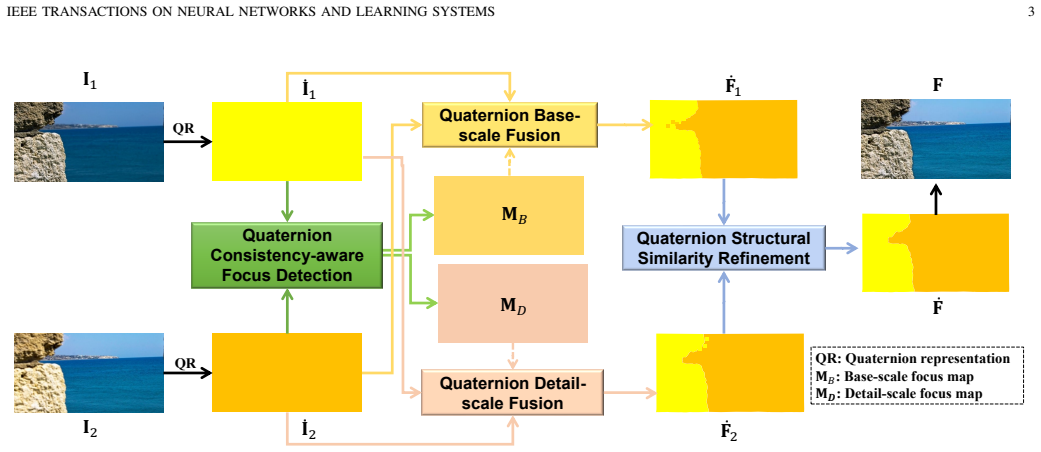
The load-bearing object is the quaternion focal element decomposition (QFED) of Eq. (3): $\dot{I} = \dot{B} + \dot{D} + \dot{E}$, where $\dot{B}$ is a low-rank structural layer over patch groups, $\dot{D}$ is sparse fine detail, and $\dot{E}$ is a Gaussian residual, solved iteratively by quaternion ADMM. This model supplies the two quantities that drive everything downstream: the low-rank coefficient matrix $\dot{Z}$ and the detail layer $\dot{D}$. Eqs. (14) and (15) turn them into dual-scale focus measures, $l_B = \|\nabla_1 \dot{d}\|_1 + \|\nabla_2 \dot{d}\|_1 + \theta\|\dot{z}\|_2$ and $l_D = \phi(\|\nabla_1 \dot{d}_s\|_1 + \|\nabla_2 \dot{d}_s\|_1)$, whose patch-wise comparisons (Eqs. (16)-(17)) generate the base and detail focus maps. A second mechanism, the weighted quaternion structural similarity (WQSSIM) of Eq. (20), re-scores each candidate fused patch against both sources and selects the better one, correcting regions where the focus maps mislabeled.
What would settle it
Synthesize defocused versions of sharp color images by convolving them with known defocus kernels at increasing radii, run QFED on each version, and compare the per-patch values of Eqs. (14) and (15); any patch class in which a more-blurred patch scores higher than the sharp patch would break the focus-map decisions and the whole fusion inherits the error.
Extended reading notes
Core claim
QMCIF's central claim is that multi-focus color fusion should be carried out entirely in the quaternion domain, where the three color channels stay coupled as the imaginary components of one number. The framework decomposes each input quaternion image $\dot{I}$ into a low-rank structural base layer $\dot{B}$, a sparse detail layer $\dot{D}$, and a residual $\dot{E}$ by solving the quaternion focal element decomposition (QFED) of Eq. (3); from the resulting coefficient matrices and detail layers it builds patch-wise base-scale and detail-scale focus maps. Fusing the two scales separately and then selecting, patch by patch, the candidate whose weighted quaternion structural similarity (WQSSIM) to the sharper source is higher yields the final result. The experiments report that this pipeline achieves the highest fusion performance on the lytro, mffw, and MFI-WHU datasets across most of the six objective metrics, with the clearest gains on phase-congruency ($Q_P$), edge-structural-similarity ($Q_E$), and human-perception ($Q_{CB}$) scores, and that it surpasses the quaternion higher-order-singular-value-decomposition baseline QHOSVD.
Load-bearing premise
Everything rests on the assumption that the two scalar focus measures of Eqs. (14) and (15) decrease monotonically as defocus blur increases for every patch class—low-gradient, highly textured, and boundary regions—so that the sharper patch always wins; the paper does not validate this per patch, only visually and through aggregate metrics.
Editorial extensions
If this is right
- Fusing color images in the quaternion domain, rather than per channel or after grayscale conversion, improves edge-structure and human-perception fusion scores across the lytro, mffw, and MFI-WHU datasets.
- Dual-scale focus maps let the method handle both high-texture and low-gradient regions, the failure modes of the singular-value-energy selection used by the quaternion baseline QHOSVD.
- The QSSR refinement step corrects mislabeled patches from the initial base/detail fusion, which is what removes ghosting and boundary blur in the reported mffw results.
- The framework extends from two-image fusion to fusing three images on the lytro3 and mffw3 sets without changing the core mechanism, producing clean outputs where comparison methods show artifacts.
- Ablation experiments indicate that removing any QFED term, fusing at a single scale, replacing adaptive QSSR weights with fixed weights, or dropping the quaternion representation lowers quantitative fusion scores.
Reading between the lines
- Not claimed by the paper: the monotonicity of Eqs. (14) and (15) under blur could be tested directly on synthetic defocus and, if it holds, the same measures could serve as a no-reference per-patch focus quality estimator for single images.
- Not claimed by the paper: because QFED is a generic color-structure decomposer, its base/detail split could be carried into other color-imaging tasks such as denoising, deblurring, or colorization, where quaternion channel coupling may give the same cross-channel consistency.
- Not claimed by the paper: the hand-set parameters (patch size, $\alpha$, $\beta$, $\gamma$) invite a learned or adaptive variant, which could close the remaining gaps to pixel-wise methods on the $Q_{MI}$ and $Q_Y$ metrics.
Signed reviews
Editorial analysis
A structured set of objections, weighed in public.
Referee Report
Summary. The manuscript proposes QMCIF, a quaternion-domain framework for multi-focus color image fusion. It introduces a quaternion focal element decomposition (QFED) model that separates each color image into a low-rank base layer (via a pretrained quaternion dictionary) and a sparse detail layer, solved by quaternion ADMM with complete update equations. Patch-wise dual-scale focus maps are then generated from base coefficient energy and amplified detail gradient energy, guiding a base-detail fusion strategy; a weighted quaternion structural similarity (WQSSIM) refinement selects final patches. Experiments compare QMCIF with 11 methods on the lytro, mffw, and MFI-WHU datasets using six fusion metrics, and ablation studies examine patch size, fusion stages, adaptive weighting, and quaternion versus real representation. An extension to three-image fusion is demonstrated visually on lytro3 and mffw3.
Significance. If the performance claims are upheld, the paper contributes a self-contained, non-learning quaternion fusion pipeline with explicit optimization steps, broad comparison across three public datasets, and ablations supporting each component. The framework is notable for performing focus detection, fusion, and refinement entirely in the quaternion domain, avoiding per-channel processing. However, the significance is currently moderated by three issues: the central outperformance claim rests on third-decimal metric differences without variance or significance testing; key parameters are selected on the same datasets used for the final comparison; and the focus measures in Eqs. (14)-(17) are assumed to rank defocus blur correctly for all patch classes without per-patch validation. These issues are fixable and do not invalidate the algorithmic contribution, but they must be addressed before the empirical claims can be accepted.
major comments (4)
- [Section IV-B and Table III] Parameter selection is performed on the same datasets as the final evaluation, which introduces circularity. In Section IV-B, alpha and beta are selected by maximizing QE+QCB on mffw samples, are set to 1.5 and 0.5 for lytro and MFI-WHU based on those datasets, and lambda is chosen using QMI on lytro and mffw. Table III then reports the performance of this tuned configuration on exactly those datasets. Because the 11 competing methods are not given the same per-dataset hyperparameter optimization, part of the reported advantage may be fitted to the evaluation target. The authors should either fix parameters using a separate validation set, report sensitivity across a range of settings, or use nested evaluation, and state clearly which protocol is used.
- [Section IV-C, Table III] The claims that QMCIF 'outperforms state-of-the-art methods' and 'significantly outperforms QHOSVD' are not supported by statistical evidence. No standard deviations, per-sample breakdowns, or paired significance tests are reported, and many winning margins are in the third decimal place (e.g., lytro QE: 0.8814 vs. 0.8802 for DBMFIF; mffw QG: 0.7348 vs. 0.7320 for MFIF-GAN). On some metrics QMCIF is not the best (lytro QMI: 1.1656 vs. 1.1920 for MCCSR-Net; MFI-WHU QY: 0.9887 vs. 0.9890 for MGIMF and MFIF-GAN). The authors should provide per-image results and paired tests (e.g., Wilcoxon signed-rank) for the six metrics, and should reserve 'significantly' for differences that are statistically supported.
- [Section III-B2, Eqs. (14)-(17)] The focus detection pipeline assumes that the scalar measures lB and lD decrease monotonically as defocus blur increases for all patch classes, including low-gradient, highly textured, and boundary patches. This monotonicity does not follow from the QFED model in Eq. (3), since blur can create spurious gradients in smooth regions and can redistribute dictionary coefficients rather than uniformly reduce them. Because the QSSR weights tau1 and tau2 in Eq. (21) are themselves derived from lD, a mislabeled patch biases both the initial fusion and the refinement correction. The authors should add per-patch validation, for example on synthetically blurred images with known blur radius, stratified by patch type, or provide a formal argument establishing the required monotonicity.
- [Definition 5, Eqs. (2), (20), (22)] As printed, QSSIM in Eq. (2) is defined as (a)^b with quaternion-valued quantities, which makes QSSIM and hence WQSSIM in Eq. (20) quaternion-valued. Equation (22) then compares WQSSIM values using the ordering operator '>', which is undefined for quaternions. The authors should specify explicitly how QSSIM is reduced to a real scalar (e.g., the standard real-valued formulation of Kolaman and Yadid-Pecht) and how WQSSIM is ranked. Without this clarification, the patch selection rule in Eq. (22) is not well defined.
minor comments (5)
- [Section IV-A] In the list of competing methods, 'convolutional sparse coding-bsed' contains a typo and should read 'based'.
- [Section IV-C] The text refers to 'GFDF' in the MFI-WHU discussion ('slightly worse than GFDF and MFIF-GAN'), but GFDF is not defined or listed among the 11 comparison methods; please clarify which method this is.
- [Section III-D] The sentence introducing Eq. (20) says 'let f denote a local patch of a base-scale or detail-scale fusion result F2 or F2'; the second 'F2' should presumably be 'F1'.
- [Section IV-B, Table II] The ablation in Table II does not state which dataset it is computed on; the surrounding text should specify the dataset (apparently mffw) and the number of image pairs used.
- [Section V] The conclusion says the framework 'fuses two-scale quaternion matrices and compares them with the input quaternion representations'; this is vague and should be rephrased to describe the actual patch-level WQSSIM selection.
Circularity Check
Hyperparameters α, β, and λ are selected by maximizing QE+QCB and QMI on the same lytro, mffw, and MFI-WHU datasets whose Table III results are then reported as state-of-the-art comparisons; this is bounded test-set fitting, while the QFED derivation chain itself is self-contained.
-
fitted input called prediction
[Section IV-B (Parameter Sensitivity, Fig. 5), compared with Table III and Section IV-C]
"α and β are set to 1.5 and 2 on mffw dataset as this setting yields the highest combined quality score. For lytro and MFI-WHU datasets, we select the optimal parameters α and β in this manner and they are set to 1.5 and 0.5. In Fig. 5 (b), QMI achieves its peak performance at λ = 0.05. We adoptλ = 0.05 consistently for all datasets since λ exhibits less sensitivity to fusion quality variations. The parameter settings are uniformly employed in all subsequent experiments and evaluations."
The paper tunes the QFED regularization parameters α, β, and λ by maximizing the quality metrics QE+QCB and QMI on the very datasets (lytro, mffw, and MFI-WHU) for which Table III then reports the 'Ours' row and Section IV-C claims that 'our framework significantly outperforms QHOSVD'. Thus part of the quantitative advantage over the eleven baselines is not a prediction from fixed first-principles settings; it is an optimized fit on the evaluation benchmarks. The QFED update equations, the fusion rules, and the external baseline comparisons are independent and not circular, but the headline comparison is partially forced by selecting hyperparameters against the same test data and metrics used in the final evaluation.
full rationale
The core derivation chain is self-contained: the QFED model in Eq. (3) is solved by a quaternion ADMM algorithm (Eqs. (4)-(12)); the focus measures lB and lD in Eqs. (14)-(15) are explicit functions of the solved detail layer and coefficient matrices; and the fusion and refinement rules in Eqs. (18)-(22) are deterministic functions of the focus maps and QSSIM. No load-bearing result is imported through a self-citation chain: Lemmas 1 and 2 are standard quaternion optimization facts, QSSIM is cited to external work [27], and the eleven competing methods are independent baselines. The one genuine circularity is hyperparameter selection: α, β, and λ are chosen by maximizing QE+QCB and QMI on the same lytro, mffw, and MFI-WHU datasets whose Table III results are then reported as 'Ours' and used to assert significant outperformance in Section IV-C. The patch size 8×8 is likewise selected on mffw in Table IV and then used in the reported comparisons. This does not make the framework itself circular, and the comparisons against eleven external methods retain independent content, but the specific quantitative claim of superiority over QHOSVD and other methods is partly fitted to the evaluation target rather than predicted from fixed settings. A score of 4 reflects this bounded but real test-set-fitting circularity; apart from that, the derivation chain stands on its own.
Assumptions & free parameters
free parameters (8)
- alpha (base-gradient regularization) =
1.5 (mffw); 1.5 (lytro, MFI-WHU)
- beta (detail sparsity weight) =
2 (mffw); 0.5 (lytro, MFI-WHU)
- lambda (noise Frobenius weight) =
0.05
- theta (coefficient-energy weight in lB) =
1
- gamma (Laplacian enhancement scale) =
0.2
- r (detail amplification window radius) =
3
- patch size sqrt(d) =
8x8 for QCAFD; 5e-5*MN for detail/QSSR
- pretrained quaternion dictionary A =
unspecified
assumptions (5)
- standard math Quaternion nuclear norm and soft-thresholding lemmas hold as stated
- domain assumption A color image decomposes as B+D+E with B low-rank under dictionary A, D sparse, E Gaussian noise
- domain assumption Gradient energy of the detail layer and coefficient energy decrease monotonically with defocus blur
- standard math Quaternion FFT with periodic boundary conditions solves the B-subproblem
- domain assumption QSSIM is a well-defined quaternion-domain similarity measure
Cite this review
Pith. "Pith review of Quaternion Sparse Decomposition for Multi-focus Color Image Fusion." pith.science (2026). https://pith.science/paper/MMN2XVBU
@misc{pith2026250502365,
  author       = {Pith},
  title        = {Pith review of: Quaternion Sparse Decomposition for Multi-focus Color Image Fusion},
  year         = {2026},
  howpublished = {\url{https://pith.science/paper/MMN2XVBU}},
  note         = {Machine review of arXiv:2505.02365}
}
read the original abstract
Multi-focus color image fusion refers to integrating multiple partially focused color images to create a single all-in-focus color image. However, existing methods struggle with complex real-world scenarios due to limitations in handling color information and intricate textures. To address these challenges, this paper proposes a quaternion multi-focus color image fusion framework to perform high-quality color image fusion completely in the quaternion domain. This framework introduces 1) a quaternion sparse decomposition model to jointly learn fine-scale image details and structure information of color images in an iterative fashion for high-precision focus detection, 2) a quaternion base-detail fusion strategy to individually fuse base-scale and detail-scale results across multiple color images for preserving structure and detail information, and 3) a quaternion structural similarity refinement strategy to adaptively select optimal patches from initial fusion results and obtain the final fused result for preserving fine details and ensuring spatially consistent outputs. Extensive experiments demonstrate that the proposed framework outperforms state-of-the-art methods.
Figures


Figures from the paper (6 more)


Reference graph
Works this paper leans on
-
[1]
Multi-focus image fusion: A survey of the state of the art,
Y . Liu, L. Wang, J. Cheng, C. Li, and X. Chen, “Multi-focus image fusion: A survey of the state of the art,” Information Fusion , vol. 64, pp. 71–91, 2020
work page 2020
-
[2]
A lightweight pixel-level unified image fusion network,
J. Liu, S. Li, H. Liu, R. Dian, and X. Wei, “A lightweight pixel-level unified image fusion network,” IEEE Transactions on Neural Networks and Learning Systems , 2023
work page 2023
-
[3]
Pixel-level image fusion: A survey of the state of the art,
S. Li, X. Kang, L. Fang, J. Hu, and H. Yin, “Pixel-level image fusion: A survey of the state of the art,” information Fusion, vol. 33, pp. 100–112, 2017
work page 2017
-
[4]
Samf: small-area-aware multi- focus image fusion for object detection,
X. Li, X. Li, H. Tan, and J. Li, “Samf: small-area-aware multi- focus image fusion for object detection,” in ICASSP 2024-2024 IEEE International Conference on Acoustics, Speech and Signal Processing (ICASSP). IEEE, 2024, pp. 3845–3849
work page 2024
-
[5]
Depth-distilled multi-focus image fusion,
F. Zhao, W. Zhao, H. Lu, Y . Liu, L. Yao, and Y . Liu, “Depth-distilled multi-focus image fusion,” IEEE Transactions on Multimedia , vol. 25, pp. 966–978, 2021
work page 2021
-
[6]
Mfif-gan: A new generative adversarial network for multi-focus image fusion,
Y . Wang, S. Xu, J. Liu, Z. Zhao, C. Zhang, and J. Zhang, “Mfif-gan: A new generative adversarial network for multi-focus image fusion,” Signal Processing: Image Communication , vol. 96, p. 116295, 2021
work page 2021
-
[7]
Exploit the best of both end-to-end and map-based methods for multi-focus image fusion,
J. Zhang, Q. Liao, H. Ma, J.-H. Xue, W. Yang, and S. Liu, “Exploit the best of both end-to-end and map-based methods for multi-focus image fusion,” IEEE Transactions on Multimedia , 2024
work page 2024
-
[8]
X. Xie, B. Guo, P. Li, S. He, and S. Zhou, “Swinmff: toward high- fidelity end-to-end multi-focus image fusion via swin transformer-based network,” The Visual Computer , pp. 1–24, 2024
work page 2024
Show all 37 references
-
[9]
Focus affinity perception and super-resolution embedding for multifocus image fusion,
H. Li, M. Yuan, J. Li, Y . Liu, G. Lu, Y . Xu, Z. Yu, and D. Zhang, “Focus affinity perception and super-resolution embedding for multifocus image fusion,” IEEE Transactions on Neural Networks and Learning Systems , vol. 36, no. 3, pp. 4311–4325, 2024
2024
-
[10]
Image fusion via vision-language model,
Z. Zhao, L. Deng, H. Bai, Y . Cui, Z. Zhang, Y . Zhang, H. Qin, D. Chen, J. Zhang, P. Wang, and L. V . Gool, “Image fusion via vision-language model,” in Proceedings of the International Conference on Machine Learning (ICML), 2024
2024
-
[11]
A self-supervised residual feature learning model for multifocus image fusion,
Z. Wang, X. Li, H. Duan, and X. Zhang, “A self-supervised residual feature learning model for multifocus image fusion,” IEEE Transactions on Image Processing , vol. 31, pp. 4527–4542, 2022
2022
-
[12]
When multi-focus image fusion networks meet traditional edge- preservation technology,
Z. Wang, X. Li, L. Zhao, H. Duan, S. Wang, H. Liu, and X. Zhang, “When multi-focus image fusion networks meet traditional edge- preservation technology,” International Journal of Computer Vision, vol. 131, no. 10, pp. 2529–2552, 2023
2023
-
[13]
Guided filter-based multi-focus image fusion through focus region detection,
X. Qiu, M. Li, L. Zhang, and X. Yuan, “Guided filter-based multi-focus image fusion through focus region detection,” Signal Processing: Image Communication, vol. 72, pp. 35–46, 2019
2019
-
[14]
Multifocus image fusion and restoration with sparse representation,
B. Yang and S. Li, “Multifocus image fusion and restoration with sparse representation,” IEEE transactions on Instrumentation and Measure- ment, vol. 59, no. 4, pp. 884–892, 2009
2009
-
[15]
Multi-focus image fusion based on multi-scale gradients and image matting,
J. Chen, X. Li, L. Luo, and J. Ma, “Multi-focus image fusion based on multi-scale gradients and image matting,” IEEE Transactions on Multimedia, vol. 24, pp. 655–667, 2021
2021
-
[16]
A scheme for edge-based multi-focus color image fusion,
M. Roy and S. Mukhopadhyay, “A scheme for edge-based multi-focus color image fusion,” Multimedia Tools and Applications , vol. 79, pp. 24 089–24 117, 2020
2020
-
[17]
Multi-focus image fusion by hessian matrix based decomposition,
B. Xiao, G. Ou, H. Tang, X. Bi, and W. Li, “Multi-focus image fusion by hessian matrix based decomposition,” IEEE Transactions on Multimedia, vol. 22, no. 2, pp. 285–297, 2019
2019
-
[18]
Generation and recombination for multifocus image fusion with free number of inputs,
H. Li, D. Wang, Y . Huang, Y . Zhang, and Z. Yu, “Generation and recombination for multifocus image fusion with free number of inputs,” IEEE Transactions on Circuits and Systems for Video Technology , vol. 34, no. 7, pp. 6009–6023, 2023
2023
-
[19]
Quaternion-based sparse repre- sentation of color image,
L. Yu, Y . Xu, H. Xu, and H. Zhang, “Quaternion-based sparse repre- sentation of color image,” in 2013 IEEE International Conference on Multimedia and Expo (ICME) . IEEE, 2013, pp. 1–7. IEEE TRANSACTIONS ON NEURAL NETWORKS AND LEARNING SYSTEMS 11
2013
-
[20]
Region level based multi-focus image fusion using quaternion wavelet and normalized cut,
Y . Liu, J. Jin, Q. Wang, Y . Shen, and X. Dong, “Region level based multi-focus image fusion using quaternion wavelet and normalized cut,” Signal Processing, vol. 97, pp. 9–30, 2014
2014
-
[21]
Quaternion higher- order singular value decomposition and its applications in color image processing,
J. Miao, K. I. Kou, D. Cheng, and W. Liu, “Quaternion higher- order singular value decomposition and its applications in color image processing,” Information Fusion, vol. 92, pp. 139–153, 2023
2023
-
[22]
Automatic color image stitching using quaternion rank-1 alignment,
J. Li and Y . Zhou, “Automatic color image stitching using quaternion rank-1 alignment,” in Proceedings of the IEEE/CVF Conference on Computer Vision and Pattern Recognition , 2022, pp. 19 720–19 729
2022
-
[23]
Two-dimensional quaternion pca and sparse pca,
X. Xiao and Y . Zhou, “Two-dimensional quaternion pca and sparse pca,” IEEE transactions on neural networks and learning systems , vol. 30, no. 7, pp. 2028–2042, 2018
2018
-
[24]
A general framework for constrained convex quaternion optimization,
J. Flamant, S. Miron, and D. Brie, “A general framework for constrained convex quaternion optimization,” IEEE Transactions on Signal Process- ing, vol. 70, pp. 254–267, 2021
2021
-
[25]
Low-rank quaternion approximation for color image processing,
Y . Chen, X. Xiao, and Y . Zhou, “Low-rank quaternion approximation for color image processing,” IEEE Transactions on Image Processing , vol. 29, pp. 1426–1439, 2019
2019
-
[26]
Optimization in quaternion dynamic systems: Gradient, hessian, and learning algorithms,
D. Xu, Y . Xia, and D. P. Mandic, “Optimization in quaternion dynamic systems: Gradient, hessian, and learning algorithms,” IEEE transactions on neural networks and learning systems , vol. 27, no. 2, pp. 249–261, 2015
2015
-
[27]
Quaternion structural similarity: a new quality index for color images,
A. Kolaman and O. Yadid-Pecht, “Quaternion structural similarity: a new quality index for color images,”IEEE Transactions on Image Processing, vol. 21, no. 4, pp. 1526–1536, 2011
2011
-
[28]
Quaternion-based weighted nuclear norm minimization for color image restoration,
C. Huang, Z. Li, Y . Liu, T. Wu, and T. Zeng, “Quaternion-based weighted nuclear norm minimization for color image restoration,” Pat- tern Recognition, vol. 128, p. 108665, 2022
2022
-
[29]
Mffw: A new dataset for multi-focus image fusion,
S. Xu, X. Wei, C. Zhang, J. Liu, and J. Zhang, “Mffw: A new dataset for multi-focus image fusion,” arXiv preprint arXiv:2002.04780 , 2020
2002 arXiv
-
[30]
Towards reducing severe defocus spread effects for multi-focus image fusion via an optimization based strategy,
S. Xu, L. Ji, Z. Wang, P. Li, K. Sun, C. Zhang, and J. Zhang, “Towards reducing severe defocus spread effects for multi-focus image fusion via an optimization based strategy,” IEEE Transactions on Computational Imaging, vol. 6, pp. 1561–1570, 2020
2020
-
[31]
Image fusion with convolutional sparse representation,
Y . Liu, X. Chen, R. K. Ward, and Z. J. Wang, “Image fusion with convolutional sparse representation,” IEEE signal processing letters , vol. 23, no. 12, pp. 1882–1886, 2016
2016
-
[32]
Zmff: Zero-shot multi-focus image fusion,
X. Hu, J. Jiang, X. Liu, and J. Ma, “Zmff: Zero-shot multi-focus image fusion,” Information Fusion, vol. 92, pp. 127–138, 2023
2023
-
[33]
Task-customized mixture of adapters for general image fusion,
P. Zhu, Y . Sun, B. Cao, and Q. Hu, “Task-customized mixture of adapters for general image fusion,” in Proceedings of the IEEE/CVF Conference on Computer Vision and Pattern Recognition , 2024, pp. 7099–7108
2024
-
[34]
Unfolding coupled convolutional sparse representation for multi-focus image fusion,
K. Zheng, J. Cheng, and Y . Liu, “Unfolding coupled convolutional sparse representation for multi-focus image fusion,” Information Fusion , p. 102974, 2025
2025
-
[35]
Multi-focus image fusion using dictionary-based sparse representation,
M. Nejati, S. Samavi, and S. Shirani, “Multi-focus image fusion using dictionary-based sparse representation,” Information Fusion, vol. 25, pp. 72–84, 2015
2015
-
[36]
Mff-gan: An unsuper- vised generative adversarial network with adaptive and gradient joint constraints for multi-focus image fusion,
H. Zhang, Z. Le, Z. Shao, H. Xu, and J. Ma, “Mff-gan: An unsuper- vised generative adversarial network with adaptive and gradient joint constraints for multi-focus image fusion,” Information Fusion, vol. 66, pp. 40–53, 2021
2021
-
[37]
Multi-focus image fusion with dense sift,
Y . Liu, S. Liu, and Z. Wang, “Multi-focus image fusion with dense sift,” Information Fusion, vol. 23, pp. 139–155, 2015
2015
Reviewed August 16, 2026 · model on record in the stance chip above.
Discussion (0). Continue with ORCID to comment.