REVIEW 2 major objections 5 minor 38 references
A Numerical Investigation of the Aeroelastic Interaction between Transonic Buffet and Structural Nonlinearity
T0 review · 2 major / 5 minor · reviewed 2026-08-16 · deepseek-v4-flash
Pith's one-line read Pitch freeplay can make transonic shock buffet lock onto heave superharmonics, producing 2:1 and 3:1 subharmonic resonances with heave limit-cycle amplitudes up to about 37 times the no-freeplay baseline.
desk verdict Plausible new result on buffet-freeplay superharmonic lock-in, but the flutter exclusion rests on an unvalidated first-order flow approximation that needs a cross-check before the LCOs can be attributed to buffet rather than flutter. read the letter →
The pith
A machine-rendered reading of the paper's core claim, the machinery that carries it, and where it could break.
The reading
What carries the argument
The central object is a two-degree-of-freedom heave-pitch NACA 0012 section with pitch freeplay modeled as a bilinear spring (zero restoring moment inside $\pm\alpha_s$), coupled to URANS aerodynamics through an embedded equation of motion. The load-bearing mechanism is superharmonic lock-in: each impact with the freeplay deadzone boundary injects energy into harmonics $p\omega_h$; when the buffet frequency $k_{sb}$ sits close to $p\hat{k}_h$, the aerodynamic force locks onto that superharmonic, while the structure responds at the subharmonic $\omega_h$. Shock-location tracking and the equivalent angle of attack $\alpha_e=\alpha_0+\alpha-\dot h/U_\infty$ are used to show how the shock and structure synchronize and why the shock dwells downstream in the 3:1 case.
What would settle it
A wind-tunnel test of a NACA 0012 section with pitch freeplay $\alpha_s=0.5^\circ$ at $M_\infty=0.72$, $\alpha_0=6^\circ$, and $\hat{k}_h=0.45$ should show a stable heave LCO about 37 times the no-freeplay amplitude with the lift spectrum locked onto $3\hat{k}_h$; observing only small forced oscillations, or finding the large LCO only when the system is close to the flutter boundary, would settle against the claim.
Extended reading notes
Core claim
The paper claims that structural nonlinearity alone can move a buffet-driven airfoil from forced-harmonic-oscillator behavior into aerodynamic lock-in at superharmonics of the heave mode. With $\alpha_s=0.25^\circ$ freeplay and $\hat{k}_h\gtrsim0.515$, the lift locks onto $2\hat{k}_h$ while the heave responds at $\hat{k}_h$ (2:1 resonance), giving heave LCO amplification of 16 times, and 24 times with $\alpha_s=0.5^\circ$; with the larger freeplay and $\hat{k}_h<0.49$, a 3:1 resonance locks onto $3\hat{k}_h$, with heave amplification of about 37 times and pitch amplification of about 2 times. The lock-in band sits at $\hat{k}_h=0.4$–$0.555$ with $\hat{k}_\alpha=0.755$, well below the previously known lock-in range near unity. The paper also reports that shock motion synchronizes with structural motion (phase about $8.6^\circ$ with heave rate in the 2:1 case) and that during the 3:1 cycle the large heave rate pushes the equivalent angle of attack below the buffet onset angle, pinning the shock downstream. Sensitivity runs show that 2% structural damping or a doubled mass ratio suppresses the resonance, while 0.5% damping already reduces it substantially.
Load-bearing premise
The flutter check assumes that artificially increasing numerical diffusion in the flow solver removes the shock-buffet oscillations while leaving the linear flutter boundary believable; if that is wrong, the large limit cycles could be flutter rather than buffet-freeplay lock-in.
Editorial extensions
If this is right
- Heave LCO amplitudes of 16–24 times (2:1) and about 37 times (3:1) the linear baseline occur with pitch freeplay at heave frequency ratios $\hat{k}_h=0.4$–$0.555$, far below the canonical lock-in range near $\hat{k}_h\approx1$.
- The onset of 2:1 lock-in requires only small freeplay ($0.1^\circ<\alpha_s<0.25^\circ$), while 3:1 lock-in needs larger freeplay ($0.25^\circ<\alpha_s<0.5^\circ$), so modest hinge wear can abruptly change the response.
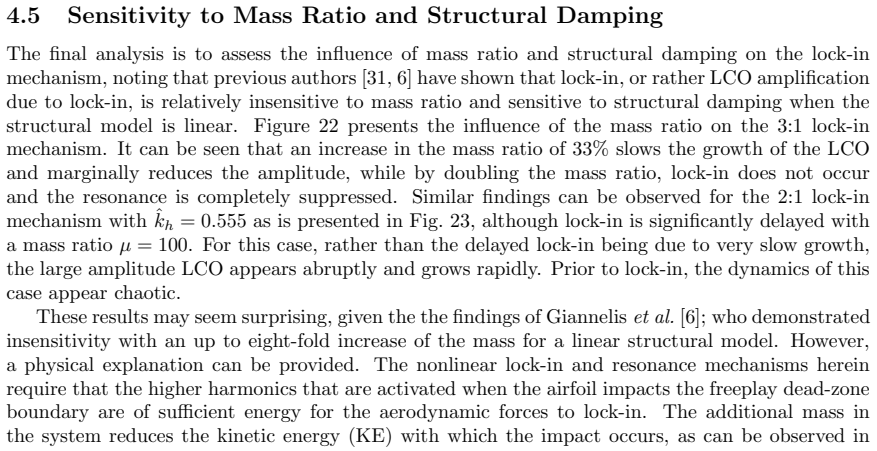
- Structural damping of 2% completely suppresses the 3:1 lock-in, and doubling the mass ratio also suppresses it, making the resonance far more sensitive to these parameters than linear-model lock-in.
- During 3:1 lock-in the aerodynamic forces respond at $3\omega_h$ while the structure responds at $\omega_h$, a subharmonic resonance, with the shock pinned downstream when the equivalent angle of attack drops below the buffet onset angle.
- Flutter screening indicates the test points lie below the linear flutter boundary, with the system at 96% of flutter speed at $\hat{k}_h=0.4$, so the large LCOs are attributed to buffet-freeplay interaction rather than post-flutter motion.
Reading between the lines
- The same superharmonic lock-in mechanism should arise with other stiffness nonlinearities, such as cubic hardening or bilinear damping, because the energy-redistribution step does not depend on the deadzone specifically; substituting the force law in the structural equation would test this directly.
- The equivalent-angle-of-attack pinning mechanism predicts that moving the freestream angle of attack closer to the buffet onset angle should narrow or shift the 3:1 lock-in band, since the large heave rate would no longer push $\alpha_e$ below onset; this is testable with the same solver.
- If these subharmonic resonances survive on a finite wing, certification fatigue spectra for tail surfaces and control-surface hinges with freeplay should include buffet-induced subharmonic loads even when the structural mode frequency lies well below the buffet frequency.
- The 2-D URANS setting leaves open whether spanwise shock cells on a finite wing broaden or suppress the lock-in band; a half-span wing simulation would indicate whether the mechanism survives three-dimensional buffet.
Signed reviews
Editorial analysis
A structured set of objections, weighed in public.
Referee Report
Summary. The paper presents URANS simulations of a NACA0012 airfoil at M∞=0.72 and α0=6°, coupled to a two-degree-of-freedom heave-pitch structural model with pitch freeplay. The authors first validate the rigid-airfoil buffet prediction against the McDevitt-Okuno experiment, then sweep the heave frequency ratio (0.4–0.555) and freeplay angle (0°, 0.25°, 0.5°). They report that with sufficiently large freeplay, the aerodynamic force spectrum locks onto superharmonics 2kh or 3kh of the heave natural frequency while the structure oscillates at kh, producing 2:1 and 3:1 subharmonic resonances with heave limit-cycle amplitudes 16–37 times the linear baseline. The sensitivity of these phenomena to structural-to-fluid mass ratio and structural damping is also examined. The paper claims this is the first demonstration of buffet-freeplay lock-in.
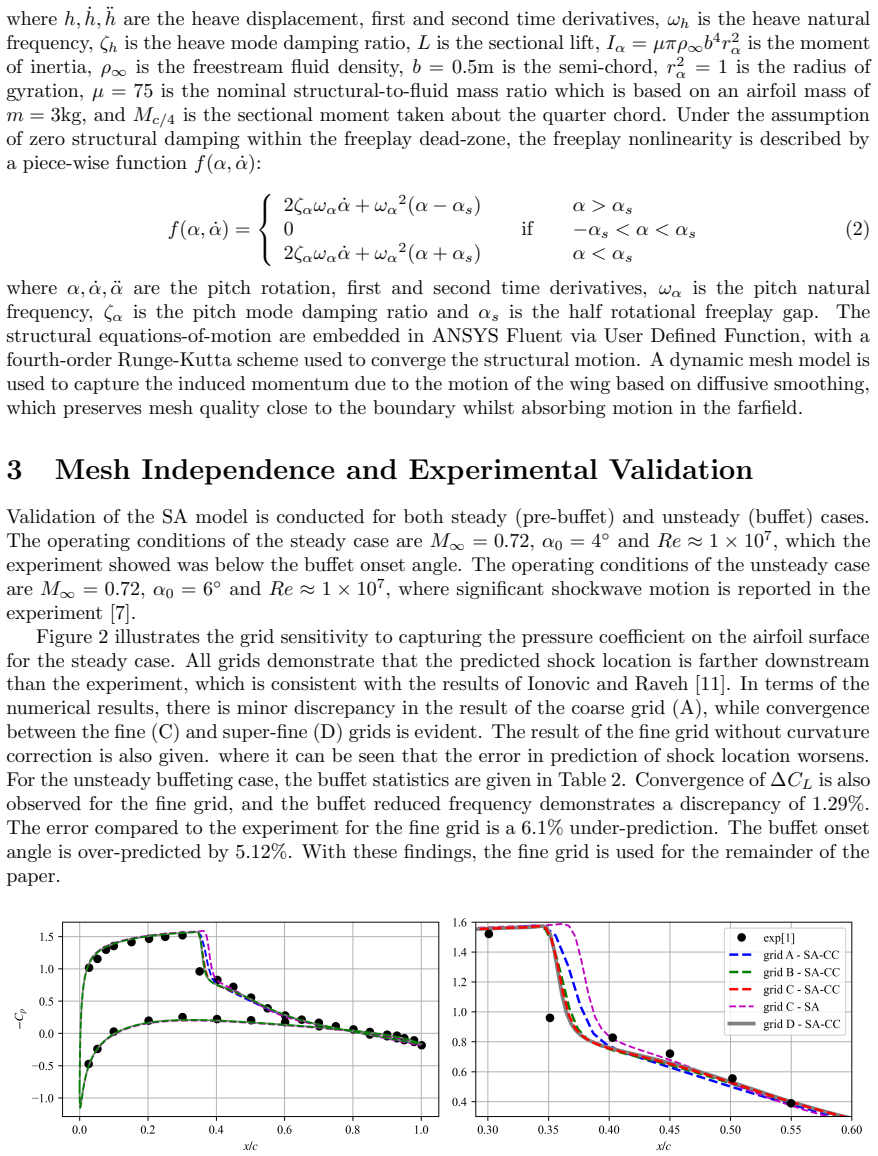
Significance. If the reported phenomenon is confirmed, this is a novel aeroelastic interaction: freeplay-induced superharmonic excitation of the shock-buffet flow at frequency ratios well below the previously reported lock-in range, with potentially significant implications for fatigue and flight safety. The paper's strengths include the careful rigid-airfoil validation (buffet frequency within 1.29% of experiment), mesh refinement for the rigid configuration, and the use of time-frequency analysis, shock-trajectory tracking, and Lissajous curves to characterize the mechanisms. The kinetic-energy interpretation of the mass-ratio effect is a plausible physical explanation. The principal caveat is that the flutter exclusion, which is essential to the interpretation of the LCOs as buffet-driven rather than post-flutter, rests on an ad-hoc first-order spatial discretization that is not cross-validated against the buffeting flow.
major comments (2)
- [§4.1, Figs. 4–6] The flutter exclusion relies entirely on reducing the momentum equation to first-order spatial accuracy to suppress the buffet instability, and the time-marching check in Fig. 6 uses the same first-order flow. Figure 4 shows that the first-order solution has a different mean shock location (at the maximum downstream position of the buffeting flow) than the second-order buffet flow, so the linear flutter boundary computed from this altered flow may not represent the actual buffet flow. Because the system is predicted to be at 96% of the flutter speed at the lowest heave frequency (kh=0.4) and the large-amplitude LCOs occur at or near this condition, the possibility that these LCOs are freeplay-triggered post-flutter motions rather than buffet lock-in is not eliminated. Please provide a cross-check using a buffet-stable flow that retains second-order accuracy (e.g., a flow-stabilization method) or a time-marching aeroelastic simulation with the second-order scheme at a lower velocity index to confirm that all reported LCOs are sub-flutter.
- [§§4.2–4.5] The coupled aeroelastic simulations are not subject to mesh or time-step sensitivity studies. The validation in §3 is for the rigid airfoil only; the dynamic-mesh, moving-airfoil, and freeplay-impact processes may have different resolution requirements. Since the reported amplification factors (16×, 24×, ~37×) and the abrupt transition between 3:1 and 2:1 lock-in near kh≈0.49 are central quantitative results, a grid and Δτ convergence study for at least one 2:1 case (e.g., kh=0.555, αs=0.5°) and one 3:1 case (e.g., kh=0.45, αs=0.5°) is needed to demonstrate that these observations are not numerical artifacts.
minor comments (5)
- [§4.2 and Fig. 13] There are several typographical errors: in §4.2, 'the structure oscillating oscillating at kh' should read 'oscillating at kh'; in the Fig. 13 caption, 'aligns wirg' should read 'aligns with'; in §5, 'signification interest' should read 'significant interest'; in §4.2, 'the the increase' should read 'the increase'.
- [Eq. (2) and §4] The text uses αs to denote the half freeplay gap, but the phrase 'freeplay αs=0.25°' may be ambiguous; please state explicitly that αs is the half-gap rather than the full gap, and confirm that the baseline aeroelastic results are computed with zero structural damping in both modes.
- [Fig. 11] The Short-Time Fourier Transform in Fig. 11 is used to support the beating transient discussion, but the window function, window length, and overlap are not specified; a brief note on these parameters would improve reproducibility.
- [Abstract and Introduction] The claim of 'for the first time' is strong, especially in light of the authors' own related work reported in reference [38]. Please calibrate the novelty statement to distinguish the specific new mechanisms reported here from the earlier conference paper.
- [§2.1] The computational cost of the 1×10^6 time-step simulations is not reported; a statement of typical wall-clock time and core count would help readers assess the practical feasibility of the study.
Circularity Check
No significant circularity: the central lock-in result emerges from coupled CFD simulation rather than from fitted inputs or self-citation chains.
full rationale
The paper is a numerical parameter study in which the load-bearing lock-in and resonance observations emerge from coupled URANS/structural simulations, not from an analytical derivation that identifies its conclusion with its premise. No model constant is fitted to the observed LCO amplitudes or frequencies: the structural parameters (kh, kalpha, mu, zeta, alpha_s) are prescribed inputs, and the 2:1/3:1 classifications are assigned post hoc from PSD and time-domain data. The validation against the McDevitt-Okuno experiment in Section III provides external support for the flow solver. Self-citations [33] (RFA details), [37] (s-DOF flutter caveat), and [38] (alpha_s=0.1 threshold) are not load-bearing: [33] supplements a standard external method (Roger RFA), [37] is corroborated by an external reference, and [38] sets a secondary onset threshold that is not required for the main 2:1/3:1 lock-in demonstration at alpha_s = 0.25 and 0.5 degrees. The concern raised about the first-order momentum flutter screening in Section 4.1 is a modeling-approximation and robustness issue, not circularity, because the flutter boundary is computed from a separately stabilized flow and is not used as a fitted input to produce the observed LCOs. Frequency-ratio sweeps prescribe the ratios at which resonances could be sought, but the actual lock-in is evidenced by synchronized shock motion, phase data, and PSD content rather than being enforced by construction. No circular step can be exhibited; the derivation chain is self-contained against external benchmarks.
Assumptions & free parameters
assumptions (5)
- domain assumption URANS with Spalart-Allmaras and curvature correction accurately represents transonic shock buffet and its interaction with structural motion.
- ad hoc to paper First-order momentum artificial diffusion provides a trustworthy linear flutter baseline.
- domain assumption The two-degree-of-freedom uncoupled heave-pitch model with pitch freeplay is representative of a wing section.
- domain assumption The frequency-domain rational function approximation flutter solution accurately extrapolates to the buffet condition.
- domain assumption Dynamic mesh diffusive smoothing does not contaminate the aerodynamic forces.
Cite this review
Pith. "Pith review of A Numerical Investigation of the Aeroelastic Interaction between Transonic Buffet and Structural Nonlinearity." pith.science (2026). https://pith.science/paper/VDLBS64B
@misc{pith2026250502412,
  author       = {Pith},
  title        = {Pith review of: A Numerical Investigation of the Aeroelastic Interaction between Transonic Buffet and Structural Nonlinearity},
  year         = {2026},
  howpublished = {\url{https://pith.science/paper/VDLBS64B}},
  note         = {Machine review of arXiv:2505.02412}
}
read the original abstract
Transonic shock buffet is a nonlinear, unsteady aerodynamic phenomenon characterized by self-sustained, periodic shock oscillations that can critically affect aircraft structural integrity. While the aerodynamic aspects of shock buffet have been widely studied, its interaction with nonlinear structural dynamics remains largely unexplored. This paper presents, for the first time, a numerical investigation of aeroelastic interactions arising from the coupling of shock buffet with a nonlinear structural model featuring pitch freeplay. Using unsteady Reynolds-Averaged Navier-Stokes (URANS) simulations coupled with a two-degree-of-freedom heave-pitch airfoil model, the study reveals that structural nonlinearity can induce aerodynamic lock-in to superharmonics of the heave natural frequency, resulting in 2:1 and 3:1 resonance mechanisms and large-amplitude heave limit cycles. These newly identified resonance behaviors expand the current understanding of transonic aeroelastic instabilities. The influence of key parameters such as structural-to-fluid mass ratio and structural damping on these phenomena is also systematically examined. This work introduces a novel class of aeroelastic lock-in mechanisms with significant implications for transonic flight dynamics and aircraft design.
Figures


Figures from the paper (24 more)




Reference graph
Works this paper leans on
-
[1]
C. Riso, Advances in aeroelastic prediction and design optimization for next-generation aerospace vehicles, International Forum on Aeroelasticity and Structural Dynamics (The Hague, The Netherlands, 2024)
work page 2024
-
[2]
S. He, Z. Yang, Y. Gu, Nonlinear dynamics of an aeroelastic airfoil with free-play in transonic flow, Nonlinear Dynamics 87 (2017) 2099–2125. doi:10.1007/s11071-016-3176-4
-
[3]
S. He, S. Guo, W. Li, D. Yang, Y. Gu, Z. Yang, Nonlinear aeroelastic behavior of an airfoil with free-play in transonic flow, Mechanical Systems and Signal Processing 138 (2020) 106539. doi:10.1016/j.ymssp.2019.106539
arXiv 2020
-
[4]
M. Candon, E. Hale, M. Balajewicz, A. Delgado-Gutierez, P. Marzocca, Parameterization of nonlinear aeroelastic reduced order models via direct interpolation of taylor partial derivatives, Nonlinear Dynamics (2024) 1–22 doi:10.1007/s11071-024-09976-z
-
[5]
M. Candon, E. Hale, A. Delgado-Guti´ errez, P. Marzocca, M. Balajewicz, Optimal sparsity in nonlinear nonparametric reduced order models for transonic aeroelastic systems, AIAA Journal 62 (10) (2024) 3841–3856. doi:10.2514/1.J064047
-
[6]
N. F. Giannelis, G. A. Vio, G. Dimitriadis, Dynamic interactions of a supercritical aerofoil in the presence of transonic shock buffet, Proceedings of the 27th International Conference on Noise and Vibration Engineering, Leuven, Belgium (2016). 18
work page 2016
-
[7]
J. B. McDevitt, A. F. Okuno, Static and dynamic pressure measurements on a naca0012 airfoil in the ames high reynolds number facility (NASATR NASA-TP-2485, 1985)
work page 1985
-
[9]
S. Koike, M. Ueno, K. Nakakita, A. Hashimoto, Unsteady pressure measurement of transonic buffet on nasa common research model, 34 th AIAA Applied Aerodynamics Conference (Wash- ington D.C. 2016). doi:10.2514/6.2016-4044
Show all 38 references
-
[10]
Sugioka, K
Y. Sugioka, K. Nakakita, S. Koike, T. Nonomura, K. Asai, Characteristic unsteady pressure field on a civil aircraft wing related to the onset of transonic buffet, Experiments in Fluids 62 (1) (2021) 1–18. doi:10.1007/s00348-020-03118-y
2021 doi
-
[11]
Iovnovich, D
M. Iovnovich, D. E. Raveh, Reynolds-averaged navier-stokes study of the shock buffet instability mechanism, AIAA Journal 50 (4) (2012) 880–890. doi:10.2514/1.J051329
2012 doi
-
[12]
N. F. Giannelis, G. A. Vio, O. Levinski, Influence of mach number and angle of attack on the two-dimensional transonic buffet phenomenon, Aerospace Science and Technology 78 (10.1016/j.ast.2018.03.045) 89–101
2018 doi
-
[13]
D. J. Lusher, A. Sansica, A. Hashimoto, Effect of tripping and domain width on transonic buffet on periodic nasa-crm airfoils, AIAA Journal 62 (11) (2024) 4411–4430. doi:10.2514/1. J063979
2024 doi
-
[14]
D. E. Raveh, Numerical study of an oscillating airfoil in transonic buffeting flows, AIAA Journal 3 (47) (2009) 505–515
2009
-
[15]
J. Quan, C. Zhang, W. andGao, Z. Ye, Characteristic analysis of lock-in for an elastically suspended airfoil in transonic buffet flow, Chinese Journal of Aeronautics 29 (1) (2015) 129–
2015
-
[16]
C. Gao, W. Zhang, X. Li, Y. Liu, J. Quan, Z. Ye, Y. Jiang, Mechanism of frequency lock-in in transonic buffeting flow, Journal of Fluid Mechanics 818 (2017) 528–561. doi:10.1017/jfm. 2017.120
2017 doi
-
[17]
C. Gao, W. Zhang, Transonic aeroelasticity: A new perspective from the fluid mode, Progress in Aerospace Sciences 113 (2020) 100596. doi:10.1016/j.paerosci.2019.100596
2020
-
[18]
M. D. Conner, D. M. Tang, E. H. Dowell, L. Virgin, Nonlinear behavior of a typical airfoil section with control surface freeplay: A numerical and experimental study, Journal of Fluids and Structures 11 (1) (1997) 89–109. doi:10.1006/jfls.1996.0068
1997
-
[19]
B. H. K. Lee, S. J. Price, Y. S. Wong, Nonlinear aeroelastic analysis of airfoils: Bifurcations and chaos, Progress in Aerospace Sciences 35 (1999) 205–334. doi:10.1016/S0376-0421(98) 00015-3
1999 doi
-
[20]
K. A. Kousen, O. O. Bendiksen, Limit cycle phenomena in computational transonic aeroelas- ticity, Journal of Aircraft 31 (6) (1994) 1257–1263
1994
-
[21]
D. H. Kim, I. Lee, Transonic and low-supersonic aeroelastic analysis of a two-degree-of freedom airfoil with a freeplay nonlinearity, Journal of Sound and Vibration 234 (5) (2000) 859–880
2000
-
[22]
E. H. Dowell, H. P. Thomas, K. C. Hall, Transonic limit cycle oscillation analysis using reduced order aerodynamic models, Journal of Fluids and Structures 19 (1) (2003) 17–27
2003
-
[23]
Candon, R
M. Candon, R. Carrese, H. Ogawa, P. Marzocca, C. Mouser, O. Levinski, W. Silva, Char- acterization of a 3dof aeroelastic system with freeplay and aerodynamic nonlinearities part i: Higher–order spectra, Mechanical Systems and Signal Processing 118 (2019) 781–807. doi:10.1016/j...
2019 doi
-
[24]
L. D. H., P. C. Chen, Nonlinear aeroelastic studies on a folding wing configuration with free-play hinge nonlinearity, 47th Structures, Structural Dynamics, and Materials Conference (Newport, RI 2006). doi:10.2514/6.2006-1734
2006 doi
-
[25]
D. M. Tang, E. H. Dowell, Flutter and limit-cycle oscillation for a wing-store model with freeplay, Journal of Aircraft 43 (2) (2006) 487–503
2006
-
[26]
Levinski, Application of dynamic pressure measurement for empenage buffet, 28 th Interna- tional Congress of the Aeronautical Sciences (Brisbane, Australia, 2012)
O. Levinski, Application of dynamic pressure measurement for empenage buffet, 28 th Interna- tional Congress of the Aeronautical Sciences (Brisbane, Australia, 2012)
2012
-
[27]
Levinski, D
O. Levinski, D. Conser, C. Mouser, S. Koschel, R. Carrese, M. Candon, , P. Marzocca, An innovative high fidelity approach to individual aircraft tracking, 61st Structures, Structural Dynamics, and Materials Conference, Orlando, FL (2020). doi:10.2514/6.2020-1647
2020 doi
-
[28]
Workbench Users Guide Release 2024 R1, Ansys Academic Research, 2024
2024
-
[29]
P. R. Spalart, S. Allmaras, A one-equation turbulence model for aerodynamic flows, 30 th AIAA Aerospace Sciences Meeting (Reno, NV, 1992). doi:10.2514/6.1992-439
1992 doi
-
[30]
P. R. Spalart, M. Shur, On the sensitization of turbulence models to rotation and curva- ture, Aerospace Science and Technology 1 (5) (1997) 297–302. doi:10.1016/S1270-9638(97) 90051-1
1997 doi
-
[31]
D. E. Raveh, E. H. Dowell, Aeroelastic responses of elastically suspended airfoil systems in transonic buffeting flow, AIAA Journal 52 (5) (2014) 926–934
2014
-
[32]
K. L. Roger, Airplane math modeling methods for active control design (Structural Aspects of Active Controls, AGARD-CP-228, 1977)
1977
-
[33]
Candon, Physical insights, characteristics and diagnosis of structural freeplay nonlinearity in transonic aeroelastic systems: A system identification based approach, Ph.D
M. Candon, Physical insights, characteristics and diagnosis of structural freeplay nonlinearity in transonic aeroelastic systems: A system identification based approach, Ph.D. thesis, Royal Melbourne Institute of Technology, Melbourne, AU (December 2019). URL https://researchr...
2019
-
[34]
Rivera, B
J. Rivera, B. Dansberry, R. Bennet, M. Durham, W. Silva, Naca 0012 benchmark model ex- perimental flutterresults with unsteady pressure distributions, 33 rd Structures, Structural Dy- namics, and Materials Conference (Dallas, TX, 1992). doi:10.2514/6.1992-2396
1992 doi
-
[35]
E. H. Dowell, Coupled-mode versus single-degree-of-freedom flutter: The third parameter in flutter, AIAA Journal 62 (2) (2024) 864–868. doi:10.2514/1.J063255
2024 doi
-
[36]
Stanford, P
B. Stanford, P. Chwalowski, K. Jocobson, Transonic limit cycle oscillations of the benchmark supercritical wing, International Forum on Aeroelasticity and Structural Dynamics (The Hague, The Netherlands, 2024)
2024
-
[37]
Candon, A
M. Candon, A. Delgado-Gutierrez, P. Marzocca, M. Balajewicz, E. H. Dowell, Nonlinear aeroe- lastic reduced order modeling with optimized sparse multi-input volterra kernels, AIAA Journal (In Press, 2025). doi:10.2514/1.J064780
2025 doi
-
[38]
Candon, V
M. Candon, V. Muscarello, W. Verhagen, A. Das, P. Marzocca, F. Toffol, S. Ricci, H. Ogawa, The interaction between shock buffet and freeplay nonlinearity: A numerical investigation, 66th Structures, Structural Dynamics, and Materials Conference (Orlando, FL 2025). doi: 10.2514...
2025 doi
-
[143]
doi:10.1016/j.cja.2015.12.002
2015 doi
Reviewed August 16, 2026 · model on record in the stance chip above.
Discussion (0). Continue with ORCID to comment.