REVIEW 3 major objections 5 minor 50 references
Robust Duality Learning for Unsupervised Visible-Infrared Person Re-Identification
T0 review · 3 major / 5 minor · reviewed 2026-08-16 · deepseek-v4-flash
Pith's one-line read Unsupervised visible-infrared person re-identification can be made robust to pseudo-label noise by combining adaptive sample reweighting, two mutually supervising networks, and cluster alignment; the paper's RoDE framework reports…
desk verdict Solid empirical gains for unsupervised VI-ReID, but the core robust loss is mathematically mis-specified and the method is not reproducible from the written equations. read the letter →
The pith
A machine-rendered reading of the paper's core claim, the machinery that carries it, and where it could break.
The reading
What carries the argument
The load-bearing mechanism is Cluster Consistency Matching (CCM), an alignment step that builds a cost matrix $S_{ij} = \exp\left(1 - \cos(c_i, c_j)\right)$ between normalized cluster centers and solves a binary linear-sum assignment, applied twice: once to match visible and infrared clusters within each model, and once to match clusters between the two models. This produces the starred pseudo-labels that each network uses to supervise the other. Around it sit two supporting mechanisms: the Robust Adaptive Learning loss $L_{\mathrm{ra}} = -\sum_i p_i^{\gamma_i}$, whose per-sample exponent is set by a two-component Gaussian mixture over losses, and the dual-network alternating training schedule that prevents a single model from accumulating its own errors. The alignment is what converts two independent noisy labelers into a single consistent teacher.
What would settle it
A controlled test would replace CCM's aligned assignments with random permutations of cluster labels across the two models while keeping RAL and the dual-network training intact; if Rank-1 on SYSU-MM01 does not collapse far below the reported 62.88%, then the paper's explanation that cluster alignment is the load-bearing component would be refuted, and the gains would have to be attributed to the reweighting and duality alone.
Extended reading notes
Core claim
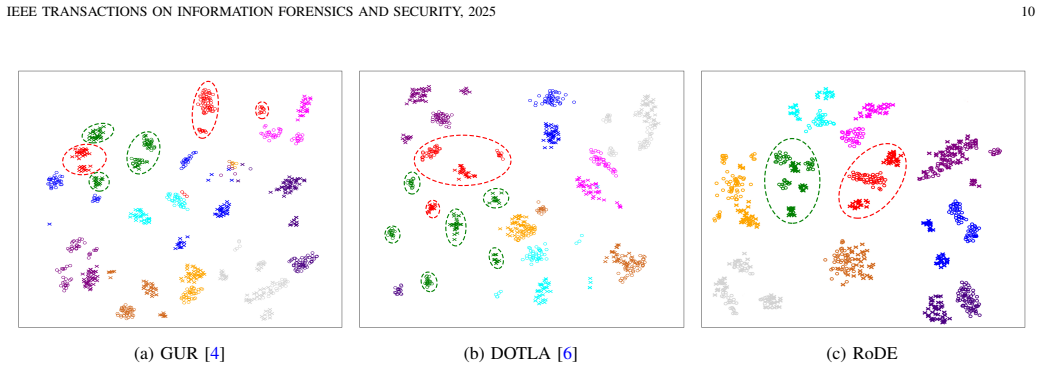
The paper's contribution is the explicit treatment of Pseudo-Label Noise (PLN) as a three-headed problem in unsupervised visible-infrared re-identification. Its Robust Adaptive Learning (RAL) mechanism uses a two-component Gaussian mixture over per-sample losses to label each sample clean or noisy, then sets a per-sample exponent $\gamma_i$ in the robust loss $L_{\mathrm{ra}} = -\sum p^{\gamma_i}$ so clean samples are optimized strongly and suspected noisy ones are down-weighted. Its Robust Duality Learning (RDL) trains two networks with different initializations, each optimized on the pseudo-labels produced by the other, so that no single model grows overconfident in its own errors. Its Cluster Consistency Matching (CCM) then aligns the two networks' clusters both across visible and infrared modalities and across the two models, using linear-sum assignment on normalized cosine similarities between cluster centers, before the cross-supervision is applied. The paper shows that removing the cross-model alignment collapses Rank-1 on SYSU-MM01 from 62.88% to 3.56%, which is its evidence that consistent cluster correspondence is what makes the duality strategy viable.
Load-bearing premise
Cluster Consistency Matching assumes that after normalization a cluster center's nearest counterpart in the other modality or model is usually its true partner, so the assignment step is mostly correct; the paper's own analysis finds a persistent mismatching rate of 15% to 35%.
Editorial extensions
If this is right
- On SYSU-MM01 All-Search, RoDE reports 62.88% Rank-1 and 57.91% mAP, the best unsupervised result in the paper's comparison and close to several supervised methods.
- The ablation in which cross-model CCM is removed drops SYSU-MM01 Rank-1 to 3.56%, implying that consistent alignment between the two supervising networks is necessary for the dual-training strategy to work at all.
- On RegDB V2T, RoDE reports 88.77% Rank-1, a 3.18-point improvement over the strongest unsupervised baseline in the table.
- The paper's loss distribution analysis shows that dual models separate clean from noisy samples far better than a single model, supporting the claim that error accumulation is mitigated by cross-supervision.
- The robustness analysis shows cluster mismatching persists at 15-35%, so the method is tolerant of, rather than immune to, residual alignment errors.
Reading between the lines
- Because the residual cluster mismatch rate stays at 15-35%, the obvious next step the authors do not state is to replace the fixed linear-sum assignment with a learned matching cost or a soft alignment, which could raise the ceiling further without changing the dual-training design.
- The three-way decomposition of pseudo-label noise—overfitting, error accumulation, and cluster correspondence—is a transferable vocabulary for other unsupervised cross-modal retrieval tasks such as text-image or sketch-photo matching, where cluster pseudo-labels are equally unreliable.
- The GMM clean/noisy split assumes per-sample loss correlates with label correctness; if hard but correctly labeled samples consistently receive high loss, the $\gamma_i$ weighting might suppress useful examples, a boundary that future work could test by inspecting which samples the GMM flags.
Signed reviews
Editorial analysis
A structured set of objections, weighed in public.
Referee Report
Summary. The manuscript introduces RoDE, an unsupervised visible-infrared person re-identification framework designed to train under pseudo-label noise. It decomposes the problem into three challenges: noise overfitting, error accumulation, and noisy cluster correspondence. The proposed method combines a Robust Adaptive Learning (RAL) mechanism with a robust loss and adaptive per-sample weights, a Robust Duality Learning (RDL) pipeline that alternately trains two models using each other's pseudo-labels, and a Cluster Consistency Matching (CCM) mechanism that aligns clusters across modalities and models. Experiments on SYSU-MM01, RegDB, and LLCM report state-of-the-art unsupervised results, together with ablations, parameter analysis, and robustness studies. The central claim is that the combination of RAL, RDL, and CCM enables robust learning from pseudo-label noise in UVI-ReID.
Significance. If the learning objective is correctly specified, the paper addresses a relevant and under-explored problem and provides a fairly complete empirical study: three benchmarks, comparisons with 26 methods, ablations of all three components, and dedicated robustness analyses. The dual-model training and cluster-consistency matching are sensible ideas, and the reported gains over prior unsupervised methods are substantial. However, the significance is currently tempered by an internal inconsistency in the core RAL loss: as printed, Eq. (7) does not have the claimed cross-entropy limit, and the adaptive weighting in Eq. (9) is self-referential through Eq. (18). Because these issues affect the mechanism that is central to the paper's claims, the manuscript requires revision before the results can be accepted.
major comments (3)
- [Section III-B, Eq. (7) and Property 1] The stated Property 1(1) is mathematically incorrect. For fixed p in (0,1), p^gamma tends to 1 as gamma tends to 0, so each summand of Lra tends to -1 and the gradient with respect to the logit, -gamma p^gamma (1-p), tends to 0; cross-entropy has gradient p-1. To obtain the claimed limit one needs a normalized generalized cross-entropy such as (1-p^gamma)/gamma. Since RAL is the component claimed to mitigate noise overfitting and is retained in every ablation, the published equations do not describe the objective that produced the reported results; please correct Eq. (7) or Property 1 and re-state the actual loss used.
- [Section III-B/E, Eqs. (8)-(9) and Eq. (18)] The adaptive weight gamma_i is defined via a GMM over per-sample losses ell_i^P, where the text states ell_i^P is calculated by L_i^P in Eq. (18). However, Eq. (18) itself contains p^{gamma_i} with the same gamma_i, making the definition circular unless gamma_i is computed from an unweighted loss or from a previous iteration, which is not stated. Please specify the exact computation order and the loss used for GMM fitting.
- [Section IV-H.3, Figure 9(e/f)] The robustness analysis reports that cross-modal and cross-model mismatching rates persist at 15% to 35% even after CCM. Since CCM is what enables the dual-model pipeline, this residual mismatch is substantial, and the paper should provide additional evidence that RAL and RDL tolerate it, for example an oracle-alignment upper bound, a sensitivity analysis with injected mismatch, or an analysis of which samples are reweighted. As written, the claim that noisy cluster correspondence is resolved is stronger than the evidence.
minor comments (5)
- [Section III-A, Eq. (4)] The notation eyP_i and eyQ_i is used for pseudo-labels, but the sentence 'xP_i belongs to the clustering center eyP_i' is imprecise; please define these as pseudo-label indices assigned by clustering.
- [Section III-B] The text says 'detailed proofs for Property 1 are available in the Appendix,' but no appendix is included in the manuscript; please add the appendix or remove the reference.
- [Section IV-F, Table III] The labels 'RoDE w/o RAL (Lalpha_ra)' and 'RoDE w/o RAL (Lbeta_ra)' are confusing because Lalpha_ra and Lbeta_ra are themselves robust losses; please rename to clarify which RAL component is removed.
- [Section IV-E, Figure 5] The gray shaded 'recommended parameter range' is not quantified; please state the range and the fixed values of other hyperparameters used in the parameter analysis.
- [Section IV-H.1] The loss-distribution plots in Figures 9(a)-(d) would be more informative with quantitative overlap measures, such as the AUC of clean/noisy separation or estimated noise rates, rather than visual inspection alone.
Circularity Check
RAL's adaptive gamma is self-referential: Eq. (9) derives gamma_i from per-sample losses that Eq. (18) defines using gamma_i; external benchmarks keep the headline claim non-circular, but the core robust objective is not uniquely determined as printed.
-
self definitional
[Section III-B (Eq. 9) and Section III-E (Eq. 18)]
"Specifically, we first define the per-sample loss as ℓP ={ℓP_i}N P_i=1 to measure the difference between predictions and pseudo-labels, where ℓP_i is calculated by LP_i (See Equation (18)). ... γi = log((1−wi)0.25/µ + 1), ... LP_i =−λpγi((eyP_i|Z)⋆|xP_i)−(1−λ)pγi((eyQ_i|Z)⋆|xP_i)."
The adaptive weight γ_i is defined from the GMM posterior w_i, and w_i is computed from the per-sample losses ℓ^P_i. The paper explicitly says ℓ^P_i is calculated by L^P_i of Eq. (18). But Eq. (18) itself contains p^{γ_i}, so γ_i appears on both sides of its own definition: γ_i = F( ℓ^P_i(γ_i) ). No previous-iteration value, detached copy, or fixed-point procedure is specified anywhere in the method or Algorithm 1. Thus the RAL weighting—the component credited with mitigating noise overfitting and retained in every ablation—is not uniquely determined by the printed equations. The training objective that produced the reported results is unrecoverable without adding an unstated rule for breaking this self-reference.
full rationale
RoDE's headline accuracy claims are evaluated on SYSU-MM01, RegDB, and LLCM with fixed retrieval protocols, so the reported SOTA numbers have independent external content and are not circular: the test metrics come from held-out data rather than from the training objective. The one genuine circularity I can exhibit is inside the RAL mechanism: the per-sample exponent γ_i is defined via a GMM over per-sample losses, and those losses are declared to be L^P_i from Eq. (18), which itself contains p^{γ_i}. This is a self-definitional loop in the core robust-learning component, though it does not infect the external evaluation. I am not counting the mathematically false Property 1 limit (p^γ→1, not CE, as γ→0) as circularity; that is a separate correctness flaw, and the promised appendix proof is absent from this version. The self-citations [23]–[25] are contextual related-work references, not load-bearing uniqueness theorems, so they do not raise the score. Overall, the benchmark comparison is honest and external, but the central adaptive-weighting equation is circular as printed, giving partial circularity rather than a fully collapsed derivation.
Assumptions & free parameters
free parameters (6)
- lambda (trade-off weight) =
~0.6
- tau (temperature) =
0.05
- eta (memory updating rate) =
0.15
- mu (sharpening scale in gamma) =
not specified
- GMM mixture parameters =
fitted during training
- DBSCAN hyperparameters =
not specified
assumptions (4)
- domain assumption Cluster centers of the same identity are more similar across modalities and models than centers of different identities, so linear-sum assignment can align them.
- domain assumption The per-sample loss distribution is bi-modal, so a two-component GMM separates clean and noisy samples.
- domain assumption Two networks with the same architecture but different initializations produce diverse pseudo-labels and avoid convergence to the same mistakes.
- domain assumption Pre-trained weights shared by both backbones provide a common feature basis that narrows the modality gap.
Cite this review
Pith. "Pith review of Robust Duality Learning for Unsupervised Visible-Infrared Person Re-Identification." pith.science (2026). https://pith.science/paper/2WKMN55E
@misc{pith2026250502549,
  author       = {Pith},
  title        = {Pith review of: Robust Duality Learning for Unsupervised Visible-Infrared Person Re-Identification},
  year         = {2026},
  howpublished = {\url{https://pith.science/paper/2WKMN55E}},
  note         = {Machine review of arXiv:2505.02549}
}
read the original abstract
Unsupervised visible-infrared person re-identification (UVI-ReID) aims to retrieve pedestrian images across different modalities without costly annotations, but faces challenges due to the modality gap and lack of supervision. Existing methods often adopt self-training with clustering-generated pseudo-labels but implicitly assume these labels are always correct. In practice, however, this assumption fails due to inevitable pseudo-label noise, which hinders model learning. To address this, we introduce a new learning paradigm that explicitly considers Pseudo-Label Noise (PLN), characterized by three key challenges: noise overfitting, error accumulation, and noisy cluster correspondence. To this end, we propose a novel Robust Duality Learning framework (RoDE) for UVI-ReID to mitigate the effects of noisy pseudo-labels. First, to combat noise overfitting, a Robust Adaptive Learning mechanism (RAL) is proposed to dynamically emphasize clean samples while down-weighting noisy ones. Second, to alleviate error accumulation-where the model reinforces its own mistakes-RoDE employs dual distinct models that are alternately trained using pseudo-labels from each other, encouraging diversity and preventing collapse. However, this dual-model strategy introduces misalignment between clusters across models and modalities, creating noisy cluster correspondence. To resolve this, we introduce Cluster Consistency Matching (CCM), which aligns clusters across models and modalities by measuring cross-cluster similarity. Extensive experiments on three benchmarks demonstrate the effectiveness of RoDE.
Figures


Figures from the paper (6 more)




Reference graph
Works this paper leans on
-
[1]
Dma: Dual modality-aware alignment for visible-infrared person re-identification,
Z. Cui, J. Zhou, and Y . Peng, “Dma: Dual modality-aware alignment for visible-infrared person re-identification,” IEEE Transactions on In- formation Forensics and Security , 2024
work page 2024
-
[2]
Z. Wu and M. Ye, “Unsupervised visible-infrared person re-identification via progressive graph matching and alternate learning,” inProceedings of the IEEE/CVF Conference on Computer Vision and Pattern Recognition, pp. 9548–9558, 2023
work page 2023
-
[3]
Z. Pang, C. Wang, L. Zhao, Y . Liu, and G. Sharma, “Cross-modality hierarchical clustering and refinement for unsupervised visible-infrared person re-identification,” IEEE Transactions on Circuits and Systems for Video Technology, 2023
work page 2023
-
[4]
B. Yang, J. Chen, and M. Ye, “Towards grand unified representation learning for unsupervised visible-infrared person re-identification,” in Proceedings of the IEEE/CVF International Conference on Computer Vision, pp. 11069–11079, 2023
work page 2023
-
[5]
B. Yang, M. Ye, J. Chen, and Z. Wu, “Augmented dual-contrastive aggregation learning for unsupervised visible-infrared person re- identification,” in Proceedings of the 30th ACM International Conference on Multimedia, pp. 2843–2851, 2022
work page 2022
-
[6]
D. Cheng, X. Huang, N. Wang, L. He, Z. Li, and X. Gao, “Unsupervised visible-infrared person reid by collaborative learning with neighbor- guided label refinement,” in Proceedings of the 31st ACM International Conference on Multimedia , pp. 7085–7093, 2023
work page 2023
-
[7]
J. Shi, Y . Zhang, X. Yin, Y . Xie, Z. Zhang, J. Fan, Z. Shi, and Y . Qu, “Dual pseudo-labels interactive self-training for semi-supervised visible- infrared person re-identification,” in Proceedings of the IEEE/CVF International Conference on Computer Vision , pp. 11218–11228, 2023
work page 2023
-
[8]
Learning with twin noisy labels for visible-infrared person re-identification,
M. Yang, Z. Huang, P. Hu, T. Li, J. Lv, and X. Peng, “Learning with twin noisy labels for visible-infrared person re-identification,” in Proceedings of the IEEE/CVF Conference on Computer Vision and Pattern Recognition, pp. 14308–14317, 2022
work page 2022
Show all 50 references
-
[9]
Inter-modality simi- larity learning for unsupervised multi-modality person re-identification,
Z. Pang, L. Zhao, Y . Liu, G. Sharma, and C. Wang, “Inter-modality simi- larity learning for unsupervised multi-modality person re-identification,” IEEE Transactions on Circuits and Systems for Video Technology, 2024. IEEE TRANSACTIONS ON INFORMATION FORENSICS AND SECURITY , 2025 12
2024
-
[10]
Inter-intra modality knowledge learning and clustering noise alleviation for unsupervised visible-infrared person re-identification,
Z. Li, H. Liu, X. Peng, and W. Jiang, “Inter-intra modality knowledge learning and clustering noise alleviation for unsupervised visible-infrared person re-identification,” IEEE Transactions on Knowledge & Data Engineering, no. 01, pp. 1–14, 2024
2024
-
[11]
Dual self- paced cross-modal hashing,
Y . Sun, J. Dai, Z. Ren, Y . Chen, D. Peng, and P. Hu, “Dual self- paced cross-modal hashing,” in Proceedings of the AAAI Conference on Artificial Intelligence , vol. 38, pp. 15184–15192, 2024
2024
-
[12]
Bi-directional center- constrained top-ranking for visible thermal person re-identification,
M. Ye, X. Lan, Z. Wang, and P. C. Yuen, “Bi-directional center- constrained top-ranking for visible thermal person re-identification,” IEEE Transactions on Information Forensics and Security , vol. 15, pp. 407–419, 2019
2019
-
[13]
Hsme: Hypersphere manifold embedding for visible thermal person re-identification,
Y . Hao, N. Wang, J. Li, and X. Gao, “Hsme: Hypersphere manifold embedding for visible thermal person re-identification,” in Proceedings of the AAAI Conference on Artificial Intelligence , vol. 33, pp. 8385– 8392, 2019
2019
-
[14]
Discover cross-modality nuances for visible-infrared person re- identification,
Q. Wu, P. Dai, J. Chen, C.-W. Lin, Y . Wu, F. Huang, B. Zhong, and R. Ji, “Discover cross-modality nuances for visible-infrared person re- identification,” in Proceedings of the IEEE/CVF Conference on Com- puter Vision and Pattern Recognition , pp. 4330–4339, 2021
2021
-
[15]
Dual-stream transformer with distribution alignment for visible-infrared person re- identification,
Z. Chai, Y . Ling, Z. Luo, D. Lin, M. Jiang, and S. Li, “Dual-stream transformer with distribution alignment for visible-infrared person re- identification,” IEEE Transactions on Circuits and Systems for Video Technology, 2023
2023
-
[16]
Style-agnostic representation learning for visible-infrared person re-identification,
J. Wu, H. Liu, W. Shi, M. Liu, and W. Li, “Style-agnostic representation learning for visible-infrared person re-identification,” IEEE Transactions on Multimedia, 2023
2023
-
[17]
Learning common- ality, divergence and variety for unsupervised visible-infrared person re-identification,
J. Shi, X. Yin, Y . Zhang, Y . Xie, Y . Qu, et al. , “Learning common- ality, divergence and variety for unsupervised visible-infrared person re-identification,” in The Thirty-eighth Annual Conference on Neural Information Processing Systems , 2024
2024
-
[18]
Multi-memory matching for unsupervised visible-infrared person re- identification,
J. Shi, X. Yin, Y . Chen, Y . Zhang, Z. Zhang, Y . Xie, and Y . Qu, “Multi-memory matching for unsupervised visible-infrared person re- identification,” in European Conference on Computer Vision , pp. 456– 474, Springer, 2025
2025
-
[19]
Optimal transport for label-efficient visible-infrared person re-identification,
J. Wang, Z. Zhang, M. Chen, Y . Zhang, C. Wang, B. Sheng, Y . Qu, and Y . Xie, “Optimal transport for label-efficient visible-infrared person re-identification,” in European Conference on Computer Vision, pp. 93– 109, Springer, 2022
2022
-
[20]
Rasa: Relation and sensitivity aware representation learning for text- based person search,
Y . Bai, M. Cao, D. Gao, Z. Cao, C. Chen, Z. Fan, L. Nie, and M. Zhang, “Rasa: Relation and sensitivity aware representation learning for text- based person search,” arXiv preprint arXiv:2305.13653 , 2023
2023 arXiv
-
[21]
An empirical study of clip for text-based person search,
M. Cao, Y . Bai, Z. Zeng, M. Ye, and M. Zhang, “An empirical study of clip for text-based person search,” in Proceedings of the AAAI Conference on Artificial Intelligence , vol. 38, pp. 465–473, 2024
2024
-
[22]
Image-text re- trieval: A survey on recent research and development,
M. Cao, S. Li, J. Li, L. Nie, and M. Zhang, “Image-text re- trieval: A survey on recent research and development,” arXiv preprint arXiv:2203.14713, 2022
2022 arXiv
-
[23]
Romo: Robust unsupervised multimodal learning with noisy pseudo labels,
Y . Li, Y . Qin, Y . Sun, D. Peng, X. Peng, and P. Hu, “Romo: Robust unsupervised multimodal learning with noisy pseudo labels,” IEEE Transactions on Image Processing , 2024
2024
-
[24]
Rono: robust dis- criminative learning with noisy labels for 2d-3d cross-modal retrieval,
Y . Feng, H. Zhu, D. Peng, X. Peng, and P. Hu, “Rono: robust dis- criminative learning with noisy labels for 2d-3d cross-modal retrieval,” in Proceedings of the IEEE/CVF Conference on Computer Vision and Pattern Recognition, pp. 11610–11619, 2023
2023
-
[25]
Robust multi-view clustering with noisy correspondence,
Y . Sun, Y . Qin, Y . Li, D. Peng, X. Peng, and P. Hu, “Robust multi-view clustering with noisy correspondence,”IEEE Transactions on Knowledge and Data Engineering , 2024
2024
-
[26]
Learning with noisy correspondence for cross-modal matching,
Z. Huang, G. Niu, X. Liu, W. Ding, X. Xiao, H. Wu, and X. Peng, “Learning with noisy correspondence for cross-modal matching,” Ad- vances in Neural Information Processing Systems , vol. 34, pp. 29406– 29419, 2021
2021
-
[27]
Jo-src: A contrastive approach for combating noisy labels,
Y . Yao, Z. Sun, C. Zhang, F. Shen, Q. Wu, J. Zhang, and Z. Tang, “Jo-src: A contrastive approach for combating noisy labels,” in Proceedings of the IEEE/CVF Conference on Computer Vision and Pattern Recognition, pp. 5192–5201, 2021
2021
-
[28]
mixup: Beyond empirical risk minimization,
H. Zhang, M. Cisse, Y . N. Dauphin, and D. Lopez-Paz, “mixup: Beyond empirical risk minimization,” arXiv preprint arXiv:1710.09412 , 2017
2017 arXiv
-
[29]
Learning cross-modal retrieval with noisy labels,
P. Hu, X. Peng, H. Zhu, L. Zhen, and J. Lin, “Learning cross-modal retrieval with noisy labels,” in Proceedings of the IEEE/CVF Conference on Computer Vision and Pattern Recognition , pp. 5403–5413, 2021
2021
-
[30]
A density-based algorithm for discovering clusters in large spatial databases with noise,
M. Ester, H.-P. Kriegel, J. Sander, X. Xu, et al. , “A density-based algorithm for discovering clusters in large spatial databases with noise,” in ACM Knowledge Discovery and Data Mining , vol. 96, pp. 226–231, 1996
1996
-
[31]
Deep learning for person re-identification: A survey and outlook,
M. Ye, J. Shen, G. Lin, T. Xiang, L. Shao, and S. C. Hoi, “Deep learning for person re-identification: A survey and outlook,” IEEE Transactions on Pattern Analysis and Machine Intelligence , vol. 44, no. 6, pp. 2872– 2893, 2021
2021
-
[32]
Channel augmented joint learning for visible-infrared recognition,
M. Ye, W. Ruan, B. Du, and M. Z. Shou, “Channel augmented joint learning for visible-infrared recognition,” in Proceedings of the IEEE/CVF International Conference on Computer Vision , pp. 13567– 13576, 2021
2021
-
[33]
Structure-aware positional transformer for visible-infrared person re-identification,
C. Chen, M. Ye, M. Qi, J. Wu, J. Jiang, and C.-W. Lin, “Structure-aware positional transformer for visible-infrared person re-identification,”IEEE Transactions on Image Processing , vol. 31, pp. 2352–2364, 2022
2022
-
[34]
Cross-modality transformer with modality mining for visible-infrared person re-identification,
T. Liang, Y . Jin, W. Liu, and Y . Li, “Cross-modality transformer with modality mining for visible-infrared person re-identification,” IEEE Transactions on Multimedia , 2023
2023
-
[35]
Learning progressive modality-shared transformers for effective visible-infrared person re-identification,
H. Lu, X. Zou, and P. Zhang, “Learning progressive modality-shared transformers for effective visible-infrared person re-identification,” in Proceedings of the AAAI Conference on Artificial Intelligence , vol. 37, pp. 1835–1843, 2023
2023
-
[36]
Self-paced contrastive learning with hybrid memory for domain adaptive object re-id,
Y . Ge, F. Zhu, D. Chen, R. Zhao, et al., “Self-paced contrastive learning with hybrid memory for domain adaptive object re-id,” Advances in Neural Information Processing Systems, vol. 33, pp. 11309–11321, 2020
2020
-
[37]
Mutual mean-teaching: Pseudo label refinery for unsupervised domain adaptation on person re-identification,
Y . Ge, D. Chen, and H. Li, “Mutual mean-teaching: Pseudo label refinery for unsupervised domain adaptation on person re-identification,” ArXiv preprint arXiv:2001.01526, 2020
2001 arXiv
-
[38]
Intra-inter camera similarity for unsupervised person re-identification,
S. Xuan and S. Zhang, “Intra-inter camera similarity for unsupervised person re-identification,” in Proceedings of the IEEE/CVF Conference on Computer Vision and Pattern Recognition , pp. 11926–11935, 2021
2021
-
[39]
Camera-aware proxies for unsupervised person re-identification,
M. Wang, B. Lai, J. Huang, X. Gong, and X.-S. Hua, “Camera-aware proxies for unsupervised person re-identification,” in Proceedings of the AAAI Conference on Artificial Intelligence , vol. 35, pp. 2764–2772, 2021
2021
-
[40]
Homogeneous-to- heterogeneous: Unsupervised learning for rgb-infrared person re- identification,
W. Liang, G. Wang, J. Lai, and X. Xie, “Homogeneous-to- heterogeneous: Unsupervised learning for rgb-infrared person re- identification,” IEEE Transactions on Image Processing , vol. 30, pp. 6392–6407, 2021
2021
-
[41]
Part-based pseudo label refinement for unsupervised person re-identification,
Y . Cho, W. J. Kim, S. Hong, and S.-E. Yoon, “Part-based pseudo label refinement for unsupervised person re-identification,” in Proceedings of the IEEE/CVF Conference on Computer Vision and Pattern Recognition, pp. 7308–7318, 2022
2022
-
[42]
Unveiling the power of clip in unsupervised visible-infrared person re-identification,
Z. Chen, Z. Zhang, X. Tan, Y . Qu, and Y . Xie, “Unveiling the power of clip in unsupervised visible-infrared person re-identification,” in Proceedings of the 31st ACM International Conference on Multimedia , pp. 3667–3675, 2023
2023
-
[43]
Diversity feature constraint based on heterogeneous data for unsupervised person re-identification,
T. Si, F. He, P. Li, Y . Song, and L. Fan, “Diversity feature constraint based on heterogeneous data for unsupervised person re-identification,” Information Processing & Management, vol. 60, no. 3, p. 103304, 2023
2023
-
[44]
Translation, association and augmentation: Learning cross-modality re-identification from single- modality annotation,
B. Yang, J. Chen, X. Ma, and M. Ye, “Translation, association and augmentation: Learning cross-modality re-identification from single- modality annotation,” IEEE Transactions on Image Processing , 2023
2023
-
[45]
Rgb-infrared cross-modality person re-identification,
A. Wu, W.-S. Zheng, H.-X. Yu, S. Gong, and J. Lai, “Rgb-infrared cross-modality person re-identification,” in Proceedings of the IEEE International Conference on Computer Vision , pp. 5380–5389, 2017
2017
-
[46]
Person recognition system based on a combination of body images from visible light and thermal cameras,
D. T. Nguyen, H. G. Hong, K. W. Kim, and K. R. Park, “Person recognition system based on a combination of body images from visible light and thermal cameras,” Sensors, vol. 17, no. 3, p. 605, 2017
2017
-
[47]
Learning by aligning: Visible- infrared person re-identification using cross-modal correspondences,
H. Park, S. Lee, J. Lee, and B. Ham, “Learning by aligning: Visible- infrared person re-identification using cross-modal correspondences,” in Proceedings of the IEEE/CVF International Conference on Computer Vision, pp. 12046–12055, 2021
2021
-
[48]
Towards a unified middle modal- ity learning for visible-infrared person re-identification,
Y . Zhang, Y . Yan, Y . Lu, and H. Wang, “Towards a unified middle modal- ity learning for visible-infrared person re-identification,” in Proceedings of the 29th ACM International Conference on Multimedia , pp. 788–796, 2021
2021
-
[49]
Diverse embedding expansion network and low-light cross-modality benchmark for visible-infrared person re- identification,
Y . Zhang and H. Wang, “Diverse embedding expansion network and low-light cross-modality benchmark for visible-infrared person re- identification,” in Proceedings of the IEEE/CVF Conference on Com- puter Vision and Pattern Recognition , pp. 2153–2162, 2023
2023
-
[50]
Delving into probabilistic uncertainty for unsupervised domain adaptive person re-identification,
J. Han, Y .-L. Li, and S. Wang, “Delving into probabilistic uncertainty for unsupervised domain adaptive person re-identification,” in Proceedings of the AAAI Conference on Artificial Intelligence , vol. 36, pp. 790–798, 2022
2022
Reviewed August 16, 2026 · model on record in the stance chip above.
Discussion (0). Continue with ORCID to comment.