REVIEW 3 major objections 1 minor 13 references
Local Markov Equivalence for PC-style Local Causal Discovery and Identification of Controlled Direct Effects
T0 review · 3 major / 1 minor · reviewed 2026-05-22 · grok-4.3
Pith's one-line read Local Markov equivalence classes suffice to identify controlled direct effects without the full causal graph.
desk verdict Local PC adaptation for CDE via LEG is a focused computational tweak but risks missing orientations fixed by outside v-structures. read the letter →
The pith
A machine-rendered reading of the paper's core claim, the machinery that carries it, and where it could break.
The reading
What carries the argument
The local essential graph (LEG), a graph defined relative to a target variable that represents the local Markov equivalence class and encodes all conditional independencies needed for CDE identification.
What would settle it
A dataset in which the local conditional independencies match the observed data yet the controlled direct effect recovered from the local graph differs from the true effect computed from the full causal structure would show the claim is false.
Extended reading notes
Core claim
The local essential graph around a target variable encodes exactly the Markov equivalence information required to identify the controlled direct effect of interest. The LocPC algorithm recovers this local graph from observational data via local conditional independence tests alone, and LocPC-CDE then isolates the minimal substructure within that graph that is both necessary and sufficient for CDE identification.
Load-bearing premise
The local Markov equivalence class around the target variable contains all information required to identify the controlled direct effect, without any need for the global essential graph or assumptions about variables outside the local neighborhood.
Editorial extensions
If this is right
- Fewer conditional independence tests are required than in global PC-style algorithms.
- Only local assumptions on the neighborhood are needed rather than global ones.
- Theoretical correctness guarantees for CDE identification are preserved.
- The methods apply directly to both synthetic benchmarks and real datasets.
Reading between the lines
- The local approach may scale causal queries to networks too large for global learning.
- Similar locality ideas could apply to other identification problems such as average treatment effects.
- Hybrid algorithms that switch between local and global steps when needed could further reduce cost.
Editorial analysis
A structured set of objections, weighed in public.
Referee Report
Summary. The paper introduces the local essential graph (LEG), a structure defined relative to a target variable, and the LocPC algorithm to recover the LEG using only local conditional independence tests. It further develops LocPC-CDE to extract the subgraph portion necessary and sufficient for identifying controlled direct effects (CDEs). The central claims are that these local methods require fewer CI tests and weaker assumptions than global PC while maintaining theoretical guarantees, with illustrations on synthetic and real data.
Significance. If the projection property holds and the LEG suffices for CDE identification, the work could enable more scalable targeted causal inference by avoiding full-graph recovery. This addresses a practical gap in high-dimensional settings. The focus on local Markov equivalence for specific effects is a constructive direction, though its impact hinges on establishing the claimed guarantees.
major comments (3)
- [Abstract] Abstract: The claims that the algorithms 'require less conditional independence tests and operate under weaker assumptions while maintaining theoretical guarantees' are stated without any derivation details, theorem statements, proof sketches, or error bounds. This is load-bearing for the comparison to global methods and prevents verification of the soundness of the weaker-assumption claim.
- [Definition of LEG and LocPC] Definition of LEG and LocPC (around §3): The assertion that the LEG recovered by LocPC is necessary and sufficient for CDE identification assumes that every orientation constraint relevant to the direct effect of X on Y is entailed by CI tests inside the declared local neighborhood. In standard PC, some directions are fixed by global v-structures or longer paths; if LocPC omits variables participating in such structures, the extracted subgraph can retain undirected edges whose orientation affects whether a back-door path remains open. The manuscript must prove (or provide a counter-example for) the required closure property that the local Markov equivalence class coincides with the projection of the global essential graph for CDE purposes.
- [LocPC-CDE algorithm description] LocPC-CDE algorithm description: The algorithm does not specify how the local neighborhood is chosen without prior global knowledge. This choice is load-bearing for the 'weaker assumptions' claim, as an incorrect or incomplete neighborhood could leave CDE-identifying orientations unresolved.
minor comments (1)
- [Experiments] The experimental section would benefit from explicit reporting of the CI test threshold, neighborhood size selection procedure, and how many tests were actually performed versus global PC on the same instances.
Simulated Author's Rebuttal
We thank the referee for their constructive comments on our manuscript. We have carefully considered each point and provide detailed responses below. Where appropriate, we will revise the manuscript to address the concerns raised.
read point-by-point responses
-
Referee: [Abstract] Abstract: The claims that the algorithms 'require less conditional independence tests and operate under weaker assumptions while maintaining theoretical guarantees' are stated without any derivation details, theorem statements, proof sketches, or error bounds. This is load-bearing for the comparison to global methods and prevents verification of the soundness of the weaker-assumption claim.
Authors: We acknowledge that the abstract could benefit from more explicit pointers to the supporting theory. The claims are substantiated in Section 3, where we present Theorem 1 establishing the correctness of LocPC in recovering the LEG, Theorem 2 showing that the LEG is sufficient for CDE identification, and Proposition 3 comparing the number of CI tests required to the global PC algorithm. The weaker assumptions are formalized in Assumption 2 (local faithfulness) versus the global faithfulness required by PC. To improve verifiability, we will revise the abstract to reference these results and include a brief outline of the key arguments in the introduction. revision: yes
-
Referee: [Definition of LEG and LocPC] Definition of LEG and LocPC (around §3): The assertion that the LEG recovered by LocPC is necessary and sufficient for CDE identification assumes that every orientation constraint relevant to the direct effect of X on Y is entailed by CI tests inside the declared local neighborhood. In standard PC, some directions are fixed by global v-structures or longer paths; if LocPC omits variables participating in such structures, the extracted subgraph can retain undirected edges whose orientation affects whether a back-door path remains open. The manuscript must prove (or provide a counter-example for) the required closure property that the local Markov equivalence class coincides with the projection of the global essential graph for CDE purposes.
Authors: This is an important observation regarding the relationship between local and global structures. In our framework, the local neighborhood is defined to include all variables that have a direct or indirect connection to the target through paths that could affect the CDE identification. We prove in Theorem 2 that any orientation constraint relevant to the CDE of X on Y is captured by the local CI tests because v-structures involving the target or its parents are local, and non-local paths are blocked or accounted for by the d-separation properties preserved in the LEG. We will add a dedicated subsection in the revision that explicitly states and proves the closure property, showing that the local Markov equivalence class is indeed the projection of the global one for CDE purposes. If the referee has a specific counter-example in mind, we would appreciate seeing it to address it directly. revision: yes
-
Referee: [LocPC-CDE algorithm description] LocPC-CDE algorithm description: The algorithm does not specify how the local neighborhood is chosen without prior global knowledge. This choice is load-bearing for the 'weaker assumptions' claim, as an incorrect or incomplete neighborhood could leave CDE-identifying orientations unresolved.
Authors: We clarify that the neighborhood selection is an integral part of the LocPC algorithm, which starts from the target variable Y and uses a forward selection process based on CI tests to identify potential neighbors, similar to the first phase of the PC algorithm but restricted to variables that are dependent on Y. This process does not require global knowledge as it relies solely on local tests. The LocPC-CDE then uses this to extract the relevant subgraph. We will revise the algorithm description and pseudocode to make the neighborhood discovery step more explicit, including pseudocode for the expansion procedure and a discussion of its completeness under the local Markov assumption. revision: yes
Circularity Check
No significant circularity; derivation grounded in external causal assumptions
full rationale
The paper defines the local essential graph (LEG) relative to a target variable and adapts the standard PC algorithm into LocPC and LocPC-CDE to recover only the subgraph needed for controlled direct effect identification. The claimed reduction in conditional independence tests and weaker assumptions follow from restricting attention to local neighborhoods while preserving Markov equivalence properties. These steps rely on the standard causal Markov condition and faithfulness assumptions from the broader causal discovery literature, which are independent of the paper's own outputs or fitted values. No load-bearing self-citations, self-definitional reductions, or renamings of known results are present in the provided abstract or described approach; the central guarantees remain externally verifiable.
Assumptions & free parameters
Cite this review
Pith. "Pith review of Local Markov Equivalence for PC-style Local Causal Discovery and Identification of Controlled Direct Effects." pith.science (2026). https://pith.science/paper/2505.02781
@misc{pith2026250502781,
  author       = {Pith},
  title        = {Pith review of: Local Markov Equivalence for PC-style Local Causal Discovery and Identification of Controlled Direct Effects},
  year         = {2026},
  howpublished = {\url{https://pith.science/paper/2505.02781}},
  note         = {Machine review of arXiv:2505.02781}
}
read the original abstract
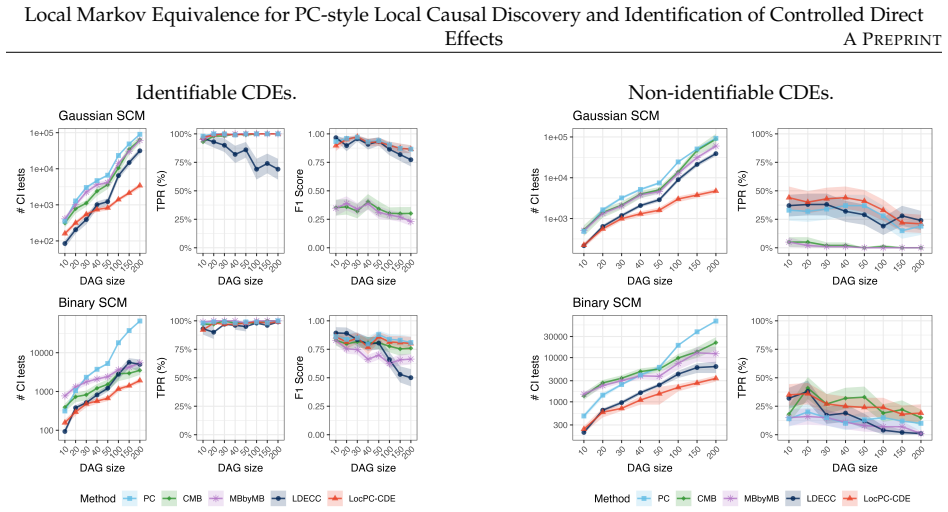
Identifying controlled direct effects (CDEs) is crucial across numerous scientific domains. While existing methods can identify these effects from causal directed acyclic graphs (DAGs), the true DAG is often unknown in practice. Essential graphs, which represent a Markov equivalence class of DAGs characterized by the same set of conditional independencies, provide a more practical and realistic alternative, and the PC algorithm is one of the most widely used method to learn them using conditional independence tests. However, learning the full essential graph is computationally intensive and relies on strong, untestable assumptions. In this work, we adapt the PC algorithm to recover only the portion of the graph needed for identifying CDEs. In particular, we introduce the local essential graph (LEG), a graph structure defined relative to a target variable, and present LocPC, an algorithm that learns the LEG using solely local conditional independence tests. Building on this, we develop LocPC-CDE, which extracts precisely the portion of the LEG that is both necessary and sufficient for identifying a CDE. Compared to global methods, our algorithms require less conditional independence tests and operate under weaker assumptions while maintaining theoretical guarantees. We illustrate the effectiveness of our approach on synthetic and real data.
Figures


Figures from the paper (1 more)

Reference graph
Works this paper leans on
-
[1]
ISBN 0-521-77362-8. Judea Pearl. Direct and indirect effects. InProceedings of the Seventeenth Conference on Uncertainty in Artificial Intelligence, UAI’01, page 411–420, San Francisco, CA, USA, 2001. Morgan Kaufmann Publishers Inc. ISBN 1558608001. Emilija Perkovi´c, Johannes Textor, Markus Kalisch, and Marloes H. Maathuis. Complete graphical charac- ter...
-
[2]
Artificial Intelligence , author=
ISSN 10443983. Thomas Verma and Judea Pearl. Equivalence and synthesis of causal models. InProceedings of the Sixth An- nual Conference on Uncertainty in Artificial Intelligence, UAI ’90, page 255–270, USA, 1990. Elsevier Science Inc. ISBN 0444892648. Changzhang Wang, You Zhou, Qiang Zhao, and Zhi Geng. Discovering and orienting the edges connected to a t...
-
[3]
SinceDPNepA,G iq, there exists noZĂVsuch that pA | ùD|Zq Gi
We proceed by contradiction by assuming that there exist nodesD,APNeHoodpY,h,G iqsuch thatDPNepA,G iqandDRNepA,G jq. SinceDPNepA,G iq, there exists noZĂVsuch that pA | ùD|Zq Gi. On the other hand,DRNepA,G jqimplies two possibilities: (a)DRSNepA,G jq: then by definition of spurious neighbors,Ds ˚ P t1, ...,|V| ´2usuch thatDR Cs˚ pA,G jqimplying thatDZĎC s˚...
work page 2020
-
[4]
Then, sample a random permutationσoft1,¨ ¨ ¨,|V|uto define a topological (causal) order
Generate an undirected Erd ˝os–R´enyi graph, where each edge exists independently with probability p. Then, sample a random permutationσoft1,¨ ¨ ¨,|V|uto define a topological (causal) order. For each undirected edgei´j, ifσpiq ăσpjq, orient the edge asiÑj. This results in a DAG whose sparsity is controlled by the edge probabilityp
-
[5]
Convert the resulting DAG into its essential graph. Search for a pair of variablespX,Yqsuch that (i) XÑYis in the DAG (to ensure the existence of a direct effect) and (ii) all adjacents ofYare oriented in the essential graph. This guarantees identifiability ofCDEpx,x 1,yq, according to Theorem 5.4 of [Flanagan, 2020]
work page 2020
-
[6]
The final graph thus guarantees that the direct effect fromXtoYis identifiable
If no such pairpX,Yqexists, generate a new random graph and repeat until the condition is met. The final graph thus guarantees that the direct effect fromXtoYis identifiable. For theNon-Identifiable CDEcase, the procedure is similar, with a modified condition to ensure non- identifiability: 24 Local Markov Equivalence for PC-style Local Causal Discovery a...
-
[7]
Generate an undirected Erd ˝os–R´enyi graph and orient it according to a random topological order σ, as described above
-
[8]
This guarantees thatCDEpx,x 1,yqisnotidentifiable, according to Theorem 5.4 of [Flanagan, 2020]
Convert the DAG to its essential graph and look for a pair of variablespX,Yqsuch that (i)XÑY is present in the DAG, and (ii) at least one adjacent edge toYremains unoriented in the essential graph. This guarantees thatCDEpx,x 1,yqisnotidentifiable, according to Theorem 5.4 of [Flanagan, 2020]
work page 2020
Show all 13 references
-
[9]
The data is then simulated using the linear/non-linear SCM procedure described below
If no such pairpX,Yqexists, repeat the process until one is found. The data is then simulated using the linear/non-linear SCM procedure described below. Data simulationLetGdenote the causal structure. Alinear GaussianSCM can be expressed, can be written in matrix form as:V“BV`...
-
[10]
Generate a random lower-triangular coefficient matrixB, with non-zero entries sampled uniformly fromtxP r´1, 1s:|x| ą0.2u
-
[11]
Sample 5000 independent noise vectorsξ, with each componentξ j „Np0,σ 2 j qandσ 2 j „Ur0.8, 1s
-
[12]
For thenonlinearcase, we simulate binary variables to model categorical data commonly encountered in practice
For each noise vector, computeV“ pI´Bq ´1ξ, resulting in 5000 independent observations from the linear SCM. For thenonlinearcase, we simulate binary variables to model categorical data commonly encountered in practice. LetGbe the causal DAG. For each variableV i,i“1, . . . ,|V...
-
[13]
The dataset used is available in the open data from Ameli, accessed February 2026, data.ameli.fr/explore/dataset/effectifs/export/?refine.annee=2023&refine.cla_age_5=tsage& refine.sexe=9&refine.region=99&refine.niveau_prioritaire=1. 25
2026
Reviewed May 22, 2026 · model on record in the stance chip above.
Discussion (0). Sign in to comment.