REVIEW 4 major objections 5 minor 1 cited by
MUSAR: Exploring Multi-Subject Customization from Single-Subject Dataset via Attention Routing
T0 review · 4 major / 5 minor · reviewed 2026-08-16 · deepseek-v4-flash
Pith's one-line read Attention routing lets a diffusion-transformer model learn multi-subject generation from single-subject data.
desk verdict A genuinely useful idea — multi-subject customization trained from single-subject data via diptychs and attention routing — but the key routing mechanism is supported by one qualitative figure and the quantitative evaluation needs error bars and stronger baselines. Worth peer review, not desk reject. read the letter →
The pith
A machine-rendered reading of the paper's core claim, the machinery that carries it, and where it could break.
The reading
What carries the argument
The load-bearing mechanism is the dynamic attention mask of Eq. (4), computed from a noise-condition affinity matrix (Eq. (3)): for each noisy image token, the average similarity to the prompt tokens of each reference subject is measured, the token is assigned to the argmax condition, and the multi-modal attention matrix is set to $-\infty$ for all other conditions. The mask lives inside FLUX.1-dev's multi-modal self-attention, so it requires no extra network. Supporting it, static attention routing zeroes out prompt-condition and inter-condition attention blocks in the same matrix, and dual-branch LoRA applies a rank-4 LoRA to noisy-image tokens and a rank-128 LoRA to subject tokens.
What would settle it
Run MUSAR on same-category pairs such as two similar toys and inspect the per-token affinity matrix $S^*$ at early timesteps: if many tokens that ultimately render as subject A attend more strongly to subject B's prompt tokens under high noise, the routing assumption is violated. A quantitative check would compare per-subject DINO and CLIP-I on same-category versus different-category pairs; if same-category fidelity is clearly lower while outputs show blended attributes, dynamic routing has not eliminated entanglement.
Extended reading notes
Core claim
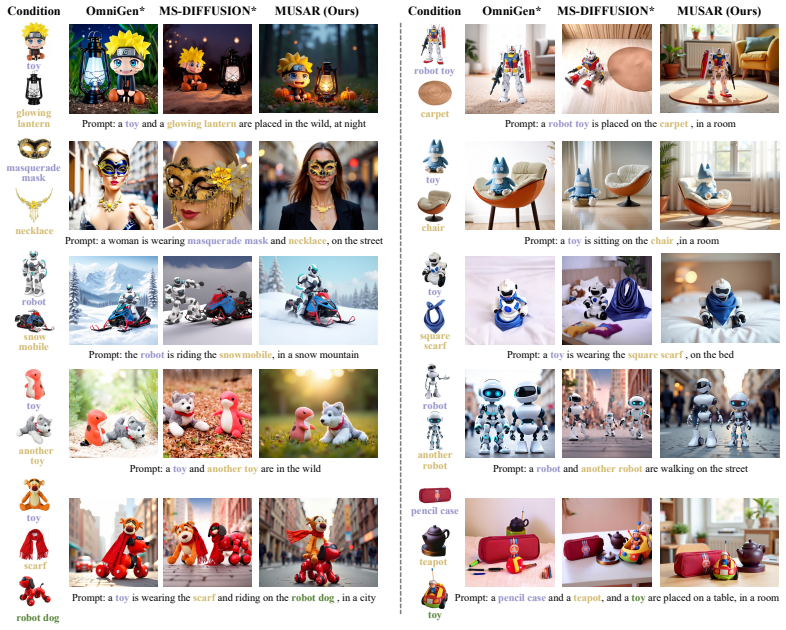
On its own terms, the paper's discovery is that a diffusion-transformer customization model can generalize from diptych pairs synthesized out of single-subject samples to coherent multi-subject scenes. The argument rests on two corrections, each with one role: debiased diptych learning fixes the distribution shift introduced by synthetic two-column data, and dynamic attention routing solves the residual same-category entanglement by reading the model's own text-image attention. With only single-subject training, the system reports higher DINO and CLIP-I scores than multi-subject-trained baselines on the authors' multi-subject DreamBench subset, while staying competitive on text alignment. The paper's ablation shows that removing dynamic routing produces visible cross-subject confusion, such as one object adopting another object's color.
Load-bearing premise
The load-bearing premise is that FLUX.1-dev's self-attention reliably tells which reference subject each noisy image token belongs to at every denoising step; the paper supports this with a single qualitative attention-map visualization, so if early or low-noise attention is noisy, routing could lock tokens to the wrong subject and hurt identity fidelity.
Editorial extensions
If this is right
- A training pipeline that uses only single-subject images can replace large multi-subject datasets for this task, cutting data collection and annotation costs.
- The same fine-tuned model handles one, two, or more reference subjects at inference, because dynamic routing scales with the number of conditions in the token sequence.
- Attention routing can be added to an existing DiT backbone as a mask, without changing the base architecture or requiring inference-time fine-tuning.
- Subjects of the same category remain distinguishable because each image region is forced to pull features from exactly one reference subject.
- Because static routing blocks text-prompt-to-condition flow, the text prompt cannot override the reference identities of the subjects.
Reading between the lines
- The same routing recipe could be lifted to other DiT text-to-image models, since it assumes only that pretrained self-attention aligns image tokens with the right prompt words, a property the paper verifies qualitatively on FLUX.1-dev.
- A natural stress test is subject count: the paper demonstrates up to three subjects, but per-token hard assignment should in principle scale to many more, limited only by how reliably the affinity argmax separates near-identical subjects.
- Diptych construction is a specialization of a more general trick: pairing samples from any single-condition dataset to create pseudo multi-condition training data, so this debiased synthesis style may transfer to style or relation customization.
- One practical extension the authors leave implicit is treating background tokens separately; currently every token, including background, is forced into a subject, which the paper calls negligible but could be handled by an explicit no-subject route.
Signed reviews
Editorial analysis
A structured set of objections, weighed in public.
Referee Report
Summary. The manuscript introduces MUSAR, a framework for multi-subject text-to-image customization built on FLUX.1-dev. To avoid the need for multi-subject training data, it constructs diptych training targets from single-subject samples and introduces de-biased diptych learning with static attention routing and dual-branch LoRA. To reduce attribute entanglement, it proposes dynamic attention routing (Eq. 4), which hard-assigns each noisy image token to the condition with the highest prompt-token affinity and masks attention to all other conditions. Experiments compare MUSAR against OmniGen, MS-Diffusion, OminiControl, and DSD on single- and multi-subject DreamBench evaluations, reporting higher DINO and CLIP-I scores in most settings, together with qualitative ablations.
Significance. If substantiated, the contribution is significant: it removes the need for curated multi-subject datasets, is architecturally simple, and offers a plausible mechanism for cross-subject decoupling in DiT-based customization. The paper's strengths are a clear formulation of diptych learning, an attention-routing mechanism that is parameter-free at inference, and comparison against strong DiT baselines. The main gaps are that the load-bearing premise of dynamic routing is only qualitatively supported, and the quantitative evaluation lacks the statistical rigor needed to confirm small margins. The proposed method is therefore interesting and worth further investigation, but the current evidence is too thin for the strength of the central claims.
major comments (4)
- [§3.3, Eq. (4)] The hard argmax mask in Eq. (4) is applied at every denoising step, so a misassigned token at high noise (where S* is computed from near-Gaussian latents and the affinity signal is weak) is locked out of its correct condition for the remainder of generation. The only evidence for the premise that noisy-token-to-subject affinity is reliable is the qualitative visualization in Fig. 5. Please provide quantitative validation of this load-bearing mechanism: for example, routing accuracy against ground-truth subject masks as a function of timestep, a comparison with an oracle router that uses ground-truth masks, a sensitivity study as the number of conditions c increases, and a direct measurement of the claim that forcing background tokens to a condition is negligible.
- [Table 1 and §4.3] The reported multi-subject margins are small (DINO 0.704 vs. 0.691 for OmniGen; CLIP-I 0.720 vs. 0.716), yet no error bars, confidence intervals, or significance tests are reported despite the use of four seeds. The multi-subject benchmark is only 80 hand-built prompts (60 pairs and 20 triplets), which weakly supports the generalization claim. In addition, the statement that MUSAR 'achieves the highest scores across four metrics' is imprecise: it does not achieve the best CLIP-T in either the single-subject setting (30.29 vs. 31.06 for DSD) or the multi-subject setting (33.90 vs. 34.20 for MS-Diffusion); it obtains the best score on four of the six metrics. Please report per-prompt statistics, significance tests, and a public or clearly specified evaluation set, and consider a user study or interaction-specific metric for the claimed 'interaction naturalness.'
- [§4.4] The ablation study is qualitative only (Fig. 8), and the 'w/o Diptych Biases Mitigation' condition removes static attention routing and dual-branch LoRA simultaneously, so the observed degradation cannot be attributed to either component. Please add a quantitative ablation table using the same metrics as Table 1, with error bars, and separate ablations for static routing and dual LoRA so that each design choice is individually validated.
- [§4.1 and §4.3] Scalability to more subjects is stated as a contribution ('scalable generalization performance with increasing reference subjects'), and 20 triplets are included in the evaluation, but Table 1 aggregates pairs and triplets into a single multi-subject number. Please report the multi-subject metrics separately for c=2 and c=3, and describe how dynamic attention routing behaves when c exceeds the training value of 2. Without this breakdown, the scalability claim is not directly supported by the reported numbers.
minor comments (5)
- [§4.2, Table 1] There are several typos: 'MURSAR' should be 'MUSAR' in §4.2, 'Mothod' should be 'Method' in Table 1, and 'OminiControl' is spelled inconsistently alongside 'OmniGen.'
- [§3.3] The sentence 'assigns a condition for all all noise tokens' contains a duplicated 'all'; please correct it.
- [Figure 5] The caption says 'Each row displays dynamic routing probabilities per condition,' but the rows are not labeled and it is unclear what the color scale represents; please add labels and a legend.
- [References] References [9] and [10] appear to be the same paper (textual inversion) with different venue information; they should be consolidated.
- [§4.1] The paper states that training uses a resolution of 512x512, while FLUX.1-dev is commonly used at higher resolutions; please comment on the effect of this resolution choice on the reported fidelity metrics.
Circularity Check
No significant circularity: MUSAR's training and evaluation are disjoint, and its attention-routing mechanism is not fitted to the evaluation data.
full rationale
Walking the derivation chain, MUSAR's multi-subject capability is learned from diptych pairs synthesized from single-subject Subject200K data and evaluated on DreamBench-based pairs and triplets, so the training and test distributions are separate and no evaluation metric is used as a training target. Dynamic attention routing (Eqs. 2-4) is a hard masking rule derived from FLUX.1-dev's self-attention affinities; it is not fitted to the evaluation outputs, and its success is an empirical claim supported by external CLIP-I, DINO, and CLIP-T scores plus ablations. Static attention routing and dual-branch LoRA mitigate diptych-induced training biases rather than encoding the test outcome. The author self-citations that appear in the paper ([12] PuLID, [18] RealCustom) are used only in related-work context or as a comparative motivation for dynamic routing, and neither is load-bearing for the central derivation. No equation in the method reduces by construction to the claimed result, and no fitted parameter is renamed as a prediction, so the paper is not circular.
Assumptions & free parameters
free parameters (4)
- LoRA ranks =
128 (subject), 4 (noise image)
- Training stage schedule =
20k/10k/10k iterations with 80/20 diptych mix and same-category final stage
- Diptych prompt template =
two-column left/right template with 'another' modifier
- Training condition count c=2
assumptions (4)
- domain assumption FLUX.1-dev self-attention reliably maps each noisy image token to the correct prompt subject at all denoising timesteps.
- domain assumption Diptych images formed by concatenating two single-subject target images approximate the multi-subject distribution closely enough that corrected training transfers to natural multi-object prompts.
- domain assumption Averaging CLIP-I and DINO similarity over all reference images measures multi-subject identity preservation.
- domain assumption Subject200K samples with quality score 5 and 512x512 training resolution preserve enough identity detail for customization.
Cite this review
Pith. "Pith review of MUSAR: Exploring Multi-Subject Customization from Single-Subject Dataset via Attention Routing." pith.science (2026). https://pith.science/paper/DV7PNE2R
@misc{pith2026250502823,
  author       = {Pith},
  title        = {Pith review of: MUSAR: Exploring Multi-Subject Customization from Single-Subject Dataset via Attention Routing},
  year         = {2026},
  howpublished = {\url{https://pith.science/paper/DV7PNE2R}},
  note         = {Machine review of arXiv:2505.02823}
}
read the original abstract
Current multi-subject customization approaches encounter two critical challenges: the difficulty in acquiring diverse multi-subject training data, and attribute entanglement across different subjects. To bridge these gaps, we propose MUSAR - a simple yet effective framework to achieve robust multi-subject customization while requiring only single-subject training data. Firstly, to break the data limitation, we introduce debiased diptych learning. It constructs diptych training pairs from single-subject images to facilitate multi-subject learning, while actively correcting the distribution bias introduced by diptych construction via static attention routing and dual-branch LoRA. Secondly, to eliminate cross-subject entanglement, we introduce dynamic attention routing mechanism, which adaptively establishes bijective mappings between generated images and conditional subjects. This design not only achieves decoupling of multi-subject representations but also maintains scalable generalization performance with increasing reference subjects. Comprehensive experiments demonstrate that our MUSAR outperforms existing methods - even those trained on multi-subject dataset - in image quality, subject consistency, and interaction naturalness, despite requiring only single-subject dataset.
Figures


Figures from the paper (5 more)




Forward citations
Cited by 1 Pith paper
-
Scone: Bridging Composition and Distinction in Subject-Driven Image Generation via Unified Understanding-Generation Modeling
Scone unifies subject understanding and generation in a two-stage trained model to improve both composition and distinction in multi-subject image generation, outperforming prior open-source models on new benchmarks.
Reference graph
Works this paper leans on
-
[1]
Blended diffusion for text-driven editing of natural images
Omri Avrahami, Dani Lischinski, and Ohad Fried. Blended diffusion for text-driven editing of natural images. In Proceedings of the IEEE/CVF Conference on Computer Vision and Pattern Recognition (CVPR), pages 18208–18218, June 2022
2022
-
[2]
Stable flow: Vital layers for training-free image editing, 2024
Omri Avrahami, Or Patashnik, Ohad Fried, Egor Nemchinov, Kfir Aberman, Dani Lischinski, and Daniel Cohen-Or. Stable flow: Vital layers for training-free image editing, 2024
2024
-
[3]
Diffusion self-distillation for zero-shot customized image generation
Shengqu Cai, Eric Chan, Yunzhi Zhang, Leonidas Guibas, Jiajun Wu, and Gordon Wet- zstein. Diffusion self-distillation for zero-shot customized image generation. arXiv preprint arXiv:2411.18616, 2024
arXiv 2024
-
[4]
Emerging properties in self-supervised vision transformers, 2021
Mathilde Caron, Hugo Touvron, Ishan Misra, Hervé Jégou, Julien Mairal, Piotr Bojanowski, and Armand Joulin. Emerging properties in self-supervised vision transformers, 2021
2021
-
[5]
Anydoor: Zero-shot object-level image customization
Xi Chen, Lianghua Huang, Yu Liu, Yujun Shen, Deli Zhao, and Hengshuang Zhao. Anydoor: Zero-shot object-level image customization. In CVPR, pages 6593–6602, 2024
work page 2024
-
[6]
Unireal: Universal image generation and editing via learning real-world dynamics
Xi Chen, Zhifei Zhang, He Zhang, Yuqian Zhou, Soo Ye Kim, Qing Liu, Yijun Li, Jianming Zhang, Nanxuan Zhao, Yilin Wang, et al. Unireal: Universal image generation and editing via learning real-world dynamics. arXiv preprint arXiv:2412.07774, 2024
arXiv 2024
-
[7]
Diffusion models beat gans on image synthesis
Prafulla Dhariwal and Alexander Nichol. Diffusion models beat gans on image synthesis. In NeurIPS, 2021. 10
work page 2021
-
[8]
Scaling rectified flow transform- ers for high-resolution image synthesis
Patrick Esser, Sumith Kulal, Andreas Blattmann, Rahim Entezari, Jonas Müller, Harry Saini, Yam Levi, Dominik Lorenz, Axel Sauer, Frederic Boesel, et al. Scaling rectified flow transform- ers for high-resolution image synthesis. In ICML, 2024
work page 2024
Show all 49 references
-
[9]
An image is worth one word: Personalizing text-to-image generation using textual inversion
Rinon Gal, Yuval Alaluf, Yuval Atzmon, Or Patashnik, Amit H Bermano, Gal Chechik, and Daniel Cohen-Or. An image is worth one word: Personalizing text-to-image generation using textual inversion. In ICLR, 2023
2023
-
[10]
An image is worth one word: Personalizing text-to-image generation using textual inversion
Rinon Gal, Yuval Alaluf, Yuval Atzmon, Or Patashnik, Amit Haim Bermano, Gal Chechik, and Daniel Cohen-or. An image is worth one word: Personalizing text-to-image generation using textual inversion. In The Eleventh International Conference on Learning Representations, 2023
2023
-
[11]
Bermano, Gal Chechik, and Daniel Cohen-Or
Rinon Gal, Moab Arar, Yuval Atzmon, Amit H. Bermano, Gal Chechik, and Daniel Cohen-Or. Encoder-based domain tuning for fast personalization of text-to-image models. ACM Trans. Graph., 42(4), July 2023
2023
-
[12]
Pulid: Pure and lightning id customization via contrastive alignment
Zinan Guo, Yanze Wu, Chen Zhuowei, Peng Zhang, Qian He, et al. Pulid: Pure and lightning id customization via contrastive alignment. 2024
2024
-
[13]
Svdiff: Compact parameter space for diffusion fine-tuning
Ligong Han, Yinxiao Li, Han Zhang, Peyman Milanfar, Dimitris Metaxas, and Feng Yang. Svdiff: Compact parameter space for diffusion fine-tuning. In Proceedings of the IEEE/CVF International Conference on Computer Vision (ICCV), pages 7323–7334, October 2023
2023
-
[14]
Denoising diffusion probabilistic models
Jonathan Ho, Ajay Jain, and Pieter Abbeel. Denoising diffusion probabilistic models. In Advances in Neural Information Processing Systems, volume 33, pages 6840–6851, 2020
2020
-
[15]
Lora: Low-rank adaptation of large language models
Edward J Hu, Yelong Shen, Phillip Wallis, Zeyuan Allen-Zhu, Yuanzhi Li, Shean Wang, Lu Wang, and Weizhu Chen. Lora: Low-rank adaptation of large language models. In ICLR, 2022
2022
-
[16]
Group diffusion transformers are unsupervised multitask learners
Lianghua Huang, Wei Wang, Zhi-Fan Wu, Huanzhang Dou, Yupeng Shi, Yutong Feng, Chen Liang, Yu Liu, and Jingren Zhou. Group diffusion transformers are unsupervised multitask learners. arXiv preprint arxiv:2410.15027, 2024
2024 arXiv
-
[17]
In-context lora for diffusion transformers
Lianghua Huang, Wei Wang, Zhi-Fan Wu, Yupeng Shi, Huanzhang Dou, Chen Liang, Yutong Feng, Yu Liu, and Jingren Zhou. In-context lora for diffusion transformers. arXiv preprint arxiv:2410.23775, 2024
2024 arXiv
-
[18]
Realcustom: Narrowing real text word for real-time open-domain text-to-image customization
Mengqi Huang, Zhendong Mao, Mingcong Liu, Qian He, and Yongdong Zhang. Realcustom: Narrowing real text word for real-time open-domain text-to-image customization. In Proceed- ings of the IEEE/CVF Conference on Computer Vision and Pattern Recognition (CVPR), pages 7476–7485, June 2024
2024
-
[19]
Elucidating the design space of diffusion-based generative models
Tero Karras, Miika Aittala, Timo Aila, and Samuli Laine. Elucidating the design space of diffusion-based generative models. In Advances in Neural Information Processing Systems, volume 35, pages 26565–26577. Curran Associates, Inc., 2022
2022
-
[20]
Multi- concept customization of text-to-image diffusion
Nupur Kumari, Bingliang Zhang, Richard Zhang, Eli Shechtman, and Jun-Yan Zhu. Multi- concept customization of text-to-image diffusion. In Proceedings of the IEEE/CVF Conference on Computer Vision and Pattern Recognition (CVPR), pages 1931–1941, June 2023
1931
-
[21]
Black Forest Labs. Flux. https://github.com/black-forest-labs/flux , 2024
2024
-
[22]
One diffusion to generate them all
Duong H Le, Tuan Pham, Sangho Lee, Christopher Clark, Aniruddha Kembhavi, Stephan Mandt, Ranjay Krishna, and Jiasen Lu. One diffusion to generate them all. arXiv preprint arXiv:2411.16318, 2024
2024 arXiv
-
[23]
Yaron Lipman, Ricky T. Q. Chen, Heli Ben-Hamu, Maximilian Nickel, and Matthew Le. Flow matching for generative modeling. In The Eleventh International Conference on Learning Representations, 2023
2023
-
[24]
Repaint: Inpainting using denoising diffusion probabilistic models
Andreas Lugmayr, Martin Danelljan, Andres Romero, Fisher Yu, Radu Timofte, and Luc Van Gool. Repaint: Inpainting using denoising diffusion probabilistic models. In Proceedings of the IEEE/CVF Conference on Computer Vision and Pattern Recognition (CVPR) , pages 11461–11471, June 2022
2022
-
[25]
Subject-diffusion: Open domain personal- ized text-to-image generation without test-time fine-tuning
Jian Ma, Junhao Liang, Chen Chen, and Haonan Lu. Subject-diffusion: Open domain personal- ized text-to-image generation without test-time fine-tuning. In SIGGRAPH Asia, 2024
2024
-
[26]
Ace++: Instruction-based image creation and editing via context-aware content filling
Chaojie Mao, Jingfeng Zhang, Yulin Pan, Zeyinzi Jiang, Zhen Han, Yu Liu, and Jingren Zhou. Ace++: Instruction-based image creation and editing via context-aware content filling. arXiv preprint arXiv:2501.02487, 2025. 11
2025 arXiv
-
[27]
SDEdit: Guided image synthesis and editing with stochastic differential equations
Chenlin Meng, Yutong He, Yang Song, Jiaming Song, Jiajun Wu, Jun-Yan Zhu, and Stefano Ermon. SDEdit: Guided image synthesis and editing with stochastic differential equations. In International Conference on Learning Representations, 2022
2022
-
[28]
T2i-adapter: Learning adapters to dig out more controllable ability for text-to-image diffusion models
Chong Mou, Xintao Wang, Liangbin Xie, Yanze Wu, Jian Zhang, Zhongang Qi, and Ying Shan. T2i-adapter: Learning adapters to dig out more controllable ability for text-to-image diffusion models. In Proceedings of the AAAI conference on artificial intelligence, volume 38, pages 42...
2024
-
[29]
Scalable diffusion models with transformers
William Peebles and Saining Xie. Scalable diffusion models with transformers. In ICCV, 2023
2023
-
[30]
Sdxl: Improving latent diffusion models for high-resolution image synthesis
Dustin Podell, Zion English, Kyle Lacey, Andreas Blattmann, Tim Dockhorn, Jonas Müller, Joe Penna, and Robin Rombach. Sdxl: Improving latent diffusion models for high-resolution image synthesis. In ICLR, 2024
2024
-
[31]
Learning transferable visual models from natural language supervision
Alec Radford, Jong Wook Kim, Chris Hallacy, Aditya Ramesh, Gabriel Goh, Sandhini Agarwal, Girish Sastry, Amanda Askell, Pamela Mishkin, Jack Clark, et al. Learning transferable visual models from natural language supervision. In ICML, 2021
2021
-
[32]
Learning transferable visual models from natural language supervision, 2021
Alec Radford, Jong Wook Kim, Chris Hallacy, Aditya Ramesh, Gabriel Goh, Sandhini Agar- wal, Girish Sastry, Amanda Askell, Pamela Mishkin, Jack Clark, Gretchen Krueger, and Ilya Sutskever. Learning transferable visual models from natural language supervision, 2021
2021
-
[33]
High-resolution image synthesis with latent diffusion models
Robin Rombach, Andreas Blattmann, Dominik Lorenz, Patrick Esser, and Björn Ommer. High-resolution image synthesis with latent diffusion models. In CVPR, 2022
2022
-
[34]
Dreambooth: Fine tuning text-to-image diffusion models for subject-driven generation
Nataniel Ruiz, Yuanzhen Li, Varun Jampani, Yael Pritch, Michael Rubinstein, and Kfir Aberman. Dreambooth: Fine tuning text-to-image diffusion models for subject-driven generation. In CVPR, 2023
2023
-
[35]
Dreambooth: Fine tuning text-to-image diffusion models for subject-driven generation
Nataniel Ruiz, Yuanzhen Li, Varun Jampani, Yael Pritch, Michael Rubinstein, and Kfir Aberman. Dreambooth: Fine tuning text-to-image diffusion models for subject-driven generation. In Proceedings of the IEEE/CVF Conference on Computer Vision and Pattern Recognition (CVPR), page...
2023
-
[36]
Palette: Image-to-image diffusion models
Chitwan Saharia, William Chan, Huiwen Chang, Chris Lee, Jonathan Ho, Tim Salimans, David Fleet, and Mohammad Norouzi. Palette: Image-to-image diffusion models. In ACM SIGGRAPH 2022 Conference Proceedings, 2022
2022
-
[37]
Deep unsuper- vised learning using nonequilibrium thermodynamics
Jascha Sohl-Dickstein, Eric Weiss, Niru Maheswaranathan, and Surya Ganguli. Deep unsuper- vised learning using nonequilibrium thermodynamics. In Proceedings of the 32nd International Conference on Machine Learning, volume 37, pages 2256–2265, 07–09 Jul 2015
2015
-
[38]
Consistency models
Yang Song, Prafulla Dhariwal, Mark Chen, and Ilya Sutskever. Consistency models. In Proceedings of the 40th International Conference on Machine Learning, volume 202, pages 32211–32252, 23–29 Jul 2023
2023
-
[39]
Generative modeling by estimating gradients of the data distribution
Yang Song and Stefano Ermon. Generative modeling by estimating gradients of the data distribution. In Advances in Neural Information Processing Systems , volume 32. Curran Associates, Inc., 2019
2019
-
[40]
Ominicontrol: Minimal and universal control for diffusion transformer
Zhenxiong Tan, Songhua Liu, Xingyi Yang, Qiaochu Xue, and Xinchao Wang. Ominicontrol: Minimal and universal control for diffusion transformer. arXiv:2411.15098, 2024
2024 arXiv
-
[41]
p+: Extended textual conditioning in text-to-image generation
Andrey V oynov, Qinghao Chu, Daniel Cohen-Or, and Kfir Aberman. p+: Extended textual conditioning in text-to-image generation. arXiv preprint arXiv:2303.09522, 2023
2023 arXiv
-
[42]
Ms-diffusion: Multi- subject zero-shot image personalization with layout guidance
Xierui Wang, Siming Fu, Qihan Huang, Wanggui He, and Hao Jiang. Ms-diffusion: Multi- subject zero-shot image personalization with layout guidance. In ICLR, 2025
2025
-
[43]
Elite: Encoding visual concepts into textual embeddings for customized text-to-image generation
Yuxiang Wei, Yabo Zhang, Zhilong Ji, Jinfeng Bai, Lei Zhang, and Wangmeng Zuo. Elite: Encoding visual concepts into textual embeddings for customized text-to-image generation. In ICCV, 2023
2023
-
[44]
Omnigen: Unified image generation
Shitao Xiao, Yueze Wang, Junjie Zhou, Huaying Yuan, Xingrun Xing, Ruiran Yan, Chaofan Li, Shuting Wang, Tiejun Huang, and Zheng Liu. Omnigen: Unified image generation. arXiv preprint arXiv:2409.11340, 2024
2024 arXiv
-
[45]
Smartbrush: Text and shape guided object inpainting with diffusion model
Shaoan Xie, Zhifei Zhang, Zhe Lin, Tobias Hinz, and Kun Zhang. Smartbrush: Text and shape guided object inpainting with diffusion model. In Proceedings of the IEEE/CVF Conference on Computer Vision and Pattern Recognition (CVPR), pages 22428–22437, June 2023. 12
2023
-
[46]
Ip-adapter: Text compatible image prompt adapter for text-to-image diffusion models
Hu Ye, Jun Zhang, Sibo Liu, Xiao Han, and Wei Yang. Ip-adapter: Text compatible image prompt adapter for text-to-image diffusion models. arXiv:2308.06721, 2023
2023 arXiv
-
[47]
Adding conditional control to text-to-image diffusion models, 2023
Lvmin Zhang, Anyi Rao, and Maneesh Agrawala. Adding conditional control to text-to-image diffusion models, 2023
2023
-
[48]
Ssr-encoder: Encoding selective subject representation for subject-driven generation
Yuxuan Zhang, Yiren Song, Jiaming Liu, Rui Wang, Jinpeng Yu, Hao Tang, Huaxia Li, Xu Tang, Yao Hu, Han Pan, et al. Ssr-encoder: Encoding selective subject representation for subject-driven generation. In CVPR, 2024
2024
-
[49]
Egsde: Unpaired image-to-image transla- tion via energy-guided stochastic differential equations
Min Zhao, Fan Bao, Chongxuan LI, and Jun Zhu. Egsde: Unpaired image-to-image transla- tion via energy-guided stochastic differential equations. In Advances in Neural Information Processing Systems, volume 35, pages 3609–3623. Curran Associates, Inc., 2022. 13
2022
Reviewed August 16, 2026 · model on record in the stance chip above.
Discussion (0). Continue with ORCID to comment.