REVIEW 4 major objections 5 minor 54 references
GeoERM: Geometry-Aware Multi-Task Representation Learning on Riemannian Manifolds
T0 review · 4 major / 5 minor · reviewed 2026-08-16 · deepseek-v4-flash
Pith's one-line read Treating task representations as points on the Stiefel manifold and updating them with Riemannian gradients and polar retraction improves multi-task estimation accuracy and robustness.
desk verdict A reasonable geometry-aware twist on pERM whose robustness claim overreaches; worth reviewing and revising, but not a shift. read the letter →
The pith
A machine-rendered reading of the paper's core claim, the machinery that carries it, and where it could break.
The reading
What carries the argument
The load-bearing object is the Stiefel manifold $\mathrm{St}(p,r)$, the set of $p \times r$ matrices with orthonormal columns, which gives a curved search space for task representations. The argument runs on two explicit manifold operations: the Riemannian gradient $\tilde{\nabla}_{A^{(t)}} f = \nabla_{A^{(t)}} \bar f - A^{(t)} \mathrm{sym}((A^{(t)})^\top \nabla_{A^{(t)}} \bar f)$, which projects the Euclidean gradient onto the tangent space, and the polar retraction $R_{A^{(t)}}(H) = (A^{(t)}+H)(I_r+H^\top H)^{-1/2}$, which maps the update back onto the manifold while preserving orthonormality. Together they replace the Euclidean update plus naive projection step that can fail Riemannian convergence conditions, and they keep the per-iteration cost comparable to Euclidean baselines.
What would settle it
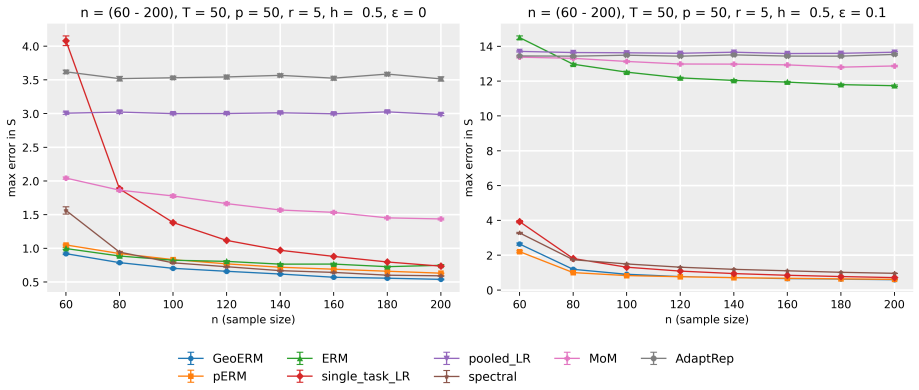
Run a synthetic experiment at fixed $n=100$, $p=50$, $r=5$, $h=0.5$ with an increasing fraction of outlier tasks whose coefficient vectors are drawn with large magnitude but whose feature distributions match the normal tasks; if GeoERM's maximum error on the normal tasks approaches or exceeds that of pERM once the outlier fraction passes some threshold, the claim that manifold geometry alone shields the shared representation from outlier distortion would be contradicted.
Extended reading notes
Core claim
The central claim is that explicitly enforcing the Stiefel-manifold geometry of task representation matrices, rather than imposing orthogonality after the fact, yields better and more robust multi-task estimates. GeoERM factorizes each task parameter as $\beta^{(t)} = A^{(t)}\theta^{(t)}$ with $A^{(t)} \in \mathrm{St}(p,r)$, adds a penalty pulling each $A^{(t)}$ toward a shared center $A$ on the same manifold, and optimizes the objective by projecting Euclidean gradients onto the tangent space and applying the polar retraction $R_A(H) = (A+H)(I_r+H^\top H)^{-1/2}$. The paper reports that on synthetic heterogeneous-task experiments and on the Human Activity Recognition benchmark, this procedure achieves the lowest maximum estimation error among non-outlier tasks and the lowest classification error across all tested representation dimensions, while remaining robust when a fraction of tasks are outliers.
Load-bearing premise
The paper's robustness claim rests on the assumption that outlier tasks, optimized jointly with normal tasks in a single objective, do not distort the learned shared manifold structure; no outlier-identification or down-weighting step enforces this, so if outliers pull the shared center the guarantee fails.
Editorial extensions
If this is right
- Every iterate of the representation matrices stays exactly on the Stiefel manifold, so orthonormality is preserved during training rather than repaired afterwards.
- The two-step structure inherited from pERM-style MTL is preserved, so GeoERM can be applied to any matrix-factorized MTL model with the same per-iteration cost as Euclidean updates.
- Empirically, the method lowers maximum estimation error on the hardest normal tasks, which is the metric the authors use to show reduced negative transfer.
- On the Human Activity Recognition benchmark, GeoERM reports the lowest classification error at every tested representation dimension, with its best result about $1.02\%$ at $r=10$.
- Robustness to outliers and adversarial label noise is attributed to the geometry-aware update itself, since the algorithm optimizes all tasks in a single objective without a separate outlier-removal stage.
Reading between the lines
- The authors leave implicit that polar retraction is a drop-in replacement for the Euclidean update in existing pERM-style pipelines, so the robustness gain could be tested by ablating only the projection-and-retraction step while keeping the penalty structure fixed.
- A natural extension is to ask whether outlier robustness would improve further if Step 1 first identified or down-weighted outlier tasks before fitting the shared center A; the paper's current algorithm does not do this, so such an extension is a testable modification rather than a claim.
- If the empirical gains generalize, geometry-aware updates could be applied to other matrix-valued representation spaces, such as Grassmann manifolds for subspaces or SPD manifolds for covariance representations, where the same projection-and-retraction pattern applies.
- The paper's own discussion points to the need for Riemannian concentration inequalities; a concrete next step is to prove a finite-sample error bound for the Stiefel-constrained estimator, which would turn the empirical robustness claim into a testable statistical statement.
Signed reviews
Editorial analysis
A structured set of objections, weighed in public.
Referee Report
Summary. The paper proposes GeoERM, a multi-task representation learning framework that constrains task-specific representation matrices A^(t) to the Stiefel manifold and optimizes them with Riemannian gradient projection followed by polar retraction. The objective (Eq. (1)) combines per-task losses with a penalty that aligns each A^(t) to a shared center A; a second step refines task coefficients by ridge-type shrinkage toward the learned low-rank structure. The authors claim that this geometry-aware optimization improves estimation accuracy, reduces negative transfer, and remains stable under adversarial label noise, and they support this with synthetic experiments under task heterogeneity and outlier contamination, plus a real-data study on the UCI HAR dataset.
Significance. If the empirical claims held, the paper would provide a simple, general recipe for injecting manifold geometry into existing matrix-factorized MTL methods at the same per-iteration cost. Positive features include the clear algorithm, the release of code, the use of a public benchmark, and the explicit use of retraction to maintain orthonormality. However, the advertised robustness claim is not supported by the algorithm as written or by the experiments: outlier tasks are included in the joint optimization without any robust mechanism, and no adversarial label-noise experiment is actually conducted. The theoretical content is limited to standard retraction facts and a citation of Riemannian gradient descent, which does not cover the Adam-based implementation. The central idea is reasonable and independently testable, but the current evidence is conditional.
major comments (4)
- [Section 2.1, Eq. (1), Algorithm 1] The claim that distinguishing normal from outlier tasks "prevents outlier tasks from distorting the learned manifold-based structure" is not realized by the algorithm. Equation (1) minimizes an unweighted average over all T tasks, with no outlier indicator, robust loss, trimming, or down-weighting, and Algorithm 1 lines 5-12 updates every A^(t) and the shared center A using gradients of that same objective. An outlier task with arbitrary beta^(t) can therefore pull its own A^(t), and through the penalty term, shift the shared center A away from the normal tasks' subspace. No mechanism or theoretical bound is provided to show this shift is negligible. The paper needs either a robustification mechanism (e.g., robust loss, trimming, or outlier detection) or a substantially weakened claim.
- [Abstract and Section 3.2] The abstract advertises stability "under adversarial label noise," but no experiment in the manuscript manipulates labels. The simulation's "outlier tasks" draw coefficients from Uniform(-3,3) and features from N(0,2), which is coefficient and feature contamination, not label noise. The HAR experiment contains no label corruption either. To support the advertised claim, the authors should add experiments with actual flipped or adversarially corrupted labels, or amend the abstract and contribution statements.
- [Section 2.2 and Algorithm 1] The convergence discussion in Section 2.2 invokes the Riemannian gradient descent result of Absil et al. (2008), but the implemented GeoERM uses the Adam optimizer (Section 3.1) combined with polar retraction. The descent-type inequality and stationarity conclusion for Riemannian gradient descent do not automatically transfer to Adam with retraction, and no separate convergence analysis is given for Algorithm 1. The paper should either provide a convergence guarantee for the actual algorithm or explicitly limit the theoretical claim to the geometric invariance of the iterates.
- [Section 3.2 and Figures 2-7] The figures reporting maximum estimation error contain no error bars, confidence bands, or other measures of variability, even though the text says results were averaged over 100 iterations. Without variability information, the claimed consistent improvements over baselines cannot be assessed statistically. Adding error bars or standard-error tables is necessary to support the comparative claims.
minor comments (5)
- [Eq. (1)] The displayed objective is missing a summation over t in the penalty term; as written, the penalty depends on an unbound index t. It should be sum over t of the norm term.
- [Algorithm 1, line 5] The algorithm refers to "Euclidean gradients of \bar f (Eq. (1))", but Eq. (1) defines the full objective and the notation f versus \bar f is only introduced in Section 2.3. Please make the notation consistent.
- [Section 3.1] The citation "Kingma and Adam (2015)" should be "Kingma and Ba (2015)".
- [Section 4] The sentence "Our theoretical analysis established the geometric foundations" overstates the paper's theoretical content; the paper contains retraction properties and a citation of a standard descent result, but no convergence or error-bound theorems for GeoERM itself.
- [Section 3.2] The text says results are averaged over 100 iterations but does not clarify whether these are independent data-generating repetitions or optimization runs; please specify.
Circularity Check
No significant circularity: GeoERM's geometry claim is independently testable; self-citations to Tian et al. are transparent and non-load-bearing.
full rationale
GeoERM's central claim—that Riemannian updates on Stiefel-manifold representation matrices improve MTL—is not derived from the quantities it predicts. The objective (Eq. (1)) and Algorithm 1 are stated explicitly; no fitted parameter is renamed as a prediction, and the evaluation metric (max error over regular tasks) is not an input to the optimization. The paper repeatedly cites Tian et al. (2023), a preprint co-authored by Yang Feng, for the two-step framework, the penalty form, the hyperparameters (lambda = sqrt(r(p+log T)), gamma = sqrt(p+log T)), and the n ≳ p + log T condition. These citations are transparent and not load-bearing for the geometric contribution, which is tested against external baselines on synthetic and HAR data. One internal weakness is flagged rather than scored as circular: Section 2.1 says the normal/outlier distinction 'prevents outlier tasks from distorting the learned manifold-based structure,' but Eq. (1) and Algorithm 1 average over all T tasks with no outlier down-weighting; this is a correctness/robustness gap, not a circular reduction.
Assumptions & free parameters
free parameters (4)
- lambda =
sqrt(r(p + logT))
- gamma =
sqrt(p + logT)
- learning_rate_alpha =
0.01
- rank_r =
5 in simulations; 5, 10, 15 in HAR
assumptions (6)
- domain assumption Each task's true coefficient vector factorizes as beta = A theta with A orthonormal, for normal tasks.
- ad hoc to paper Outlier tasks may take arbitrary coefficients and still do not distort the learned manifold structure when included in the joint Step 1 optimization.
- ad hoc to paper Adam combined with polar retraction retains the convergence and geometric fidelity formalized for Riemannian gradient descent.
- domain assumption The Frobenius penalty ||A(t)(A(t))^T - A A^T||^2 adequately enforces subspace alignment for the shared representation.
- standard math The Stiefel manifold St(p,r) with the Euclidean metric has tangent and normal spaces as described in Section C.1, and the orthogonal projection onto the tangent space is given by Eq. (3).
- standard math The polar retraction R_A(H) = (A+H)(I + H^T H)^{-1/2} is a valid smooth retraction on St(p,r).
Cite this review
Pith. "Pith review of GeoERM: Geometry-Aware Multi-Task Representation Learning on Riemannian Manifolds." pith.science (2026). https://pith.science/paper/4WS7UKKM
@misc{pith2026250502972,
  author       = {Pith},
  title        = {Pith review of: GeoERM: Geometry-Aware Multi-Task Representation Learning on Riemannian Manifolds},
  year         = {2026},
  howpublished = {\url{https://pith.science/paper/4WS7UKKM}},
  note         = {Machine review of arXiv:2505.02972}
}
read the original abstract
Multi-Task Learning (MTL) seeks to boost statistical power and learning efficiency by discovering structure shared across related tasks. State-of-the-art MTL representation methods, however, usually treat the latent representation matrix as a point in ordinary Euclidean space, ignoring its often non-Euclidean geometry, thus sacrificing robustness when tasks are heterogeneous or even adversarial. We propose GeoERM, a geometry-aware MTL framework that embeds the shared representation on its natural Riemannian manifold and optimizes it via explicit manifold operations. Each training cycle performs (i) a Riemannian gradient step that respects the intrinsic curvature of the search space, followed by (ii) an efficient polar retraction to remain on the manifold, guaranteeing geometric fidelity at every iteration. The procedure applies to a broad class of matrix-factorized MTL models and retains the same per-iteration cost as Euclidean baselines. Across a set of synthetic experiments with task heterogeneity and on a wearable-sensor activity-recognition benchmark, GeoERM consistently improves estimation accuracy, reduces negative transfer, and remains stable under adversarial label noise, outperforming leading MTL and single-task alternatives.
Figures


Figures from the paper (4 more)



Reference graph
Works this paper leans on
-
[1]
write newline
" write newline "" before.all 'output.state := FUNCTION n.dashify 't := "" t empty not t #1 #1 substring "-" = t #1 #2 substring "--" = not "--" * t #2 global.max substring 't := t #1 #1 substring "-" = "-" * t #2 global.max substring 't := while if t #1 #1 substring * t #2 global.max substring 't := if while FUNCTION word.in bbl.in " " * FUNCTION format....
-
[2]
(2008), Optimization algorithms on matrix manifolds\/ , Princeton University Press
Absil, P.-A., Mahony, R., and Sepulchre, R. (2008), Optimization algorithms on matrix manifolds\/ , Princeton University Press
work page 2008
- [3]
-
[4]
Bastani, H. (2021), Predicting with proxies: Transfer learning in high dimension, Management Science\/ , 67, 2964--2984
work page 2021
-
[5]
Baxter, J. (2000), A model of inductive bias learning, Journal of artificial intelligence research\/ , 12, 149--198
work page 2000
-
[6]
Ben-David, S., Blitzer, J., Crammer, K., Kulesza, A., Pereira, F., and Vaughan, J. W. (2010), A theory of learning from different domains, Machine learning\/ , 79, 151--175
work page 2010
-
[7]
Multilingual Knowledge Graph Completion via Ensemble Knowledge Transfer
Chen, X., Chen, M., Fan, C., Uppunda, A., Sun, Y., and Zaniolo, C. (2020), Multilingual knowledge graph completion via ensemble knowledge transfer, arXiv preprint arXiv:2010.03158\/
work page Pith review arXiv 2020
-
[8]
Chua, K., Lei, Q., and Lee, J. D. (2021), How fine-tuning allows for effective meta-learning, Advances in Neural Information Processing Systems\/ , 34, 8871--8884
work page 2021
Show all 54 references
-
[9]
(2021), Exploiting shared representations for personalized federated learning, in International conference on machine learning\/ , PMLR
Collins, L., Hassani, H., Mokhtari, A., and Shakkottai, S. (2021), Exploiting shared representations for personalized federated learning, in International conference on machine learning\/ , PMLR
2021
-
[10]
(2008), Learning from Multiple Sources
Crammer, K., Kearns, M., and Wortman, J. (2008), Learning from Multiple Sources. Journal of machine learning research\/ , 9
2008
-
[11]
(2020), The advantage of conditional meta-learning for biased regularization and fine tuning, Advances in Neural Information Processing Systems\/ , 33, 964--974
Denevi, G., Pontil, M., and Ciliberto, C. (2020), The advantage of conditional meta-learning for biased regularization and fine tuning, Advances in Neural Information Processing Systems\/ , 33, 964--974
2020
-
[12]
(2022), Learning tensor representations for meta-learning, in International Conference on Artificial Intelligence and Statistics\/ , PMLR
Deng, S., Guo, Y., Hsu, D., and Mandal, D. (2022), Learning tensor representations for meta-learning, in International Conference on Artificial Intelligence and Statistics\/ , PMLR
2022
-
[13]
(2014), Decaf: A deep convolutional activation feature for generic visual recognition, in International conference on machine learning\/ , PMLR
Donahue, J., Jia, Y., Vinyals, O., Hoffman, J., Zhang, N., Tzeng, E., and Darrell, T. (2014), Decaf: A deep convolutional activation feature for generic visual recognition, in International conference on machine learning\/ , PMLR
2014
-
[14]
S., Hu, W., Kakade, S
Du, S. S., Hu, W., Kakade, S. M., Lee, J. D., and Lei, Q. (2020), Few-shot learning via learning the representation, provably, arXiv preprint arXiv:2002.09434\/
2020 arXiv
-
[15]
and Wang, K
Duan, Y. and Wang, K. (2023), Adaptive and robust multi-task learning, The Annals of Statistics\/ , 51, 2015--2039
2023
-
[16]
C., Feldman, V., Hu, L., and Talwar, K
Duchi, J. C., Feldman, V., Hu, L., and Talwar, K. (2022), Subspace recovery from heterogeneous data with non-isotropic noise, Advances in Neural Information Processing Systems\/ , 35, 5854--5866
2022
-
[17]
(2019), Scaling and benchmarking self-supervised visual representation learning, in Proceedings of the ieee/cvf International Conference on computer vision\/
Goyal, P., Mahajan, D., Gupta, A., and Misra, I. (2019), Scaling and benchmarking self-supervised visual representation learning, in Proceedings of the ieee/cvf International Conference on computer vision\/
2019
-
[18]
(2022), Robust angle-based transfer learning in high dimensions, arXiv preprint arXiv:2210.12759\/
Gu, T., Han, Y., and Duan, R. (2022), Robust angle-based transfer learning in high dimensions, arXiv preprint arXiv:2210.12759\/
2022 arXiv
-
[19]
H., and Duan, R
Gu, T., Lee, P. H., and Duan, R. (2023), COMMUTE: communication-efficient transfer learning for multi-site risk prediction, Journal of biomedical informatics\/ , 137, 104243
2023
-
[20]
(2017), Learning invariant feature spaces to transfer skills with reinforcement learning, arXiv preprint arXiv:1703.02949\/
Gupta, A., Devin, C., Liu, Y., Abbeel, P., and Levine, S. (2017), Learning invariant feature spaces to transfer skills with reinforcement learning, arXiv preprint arXiv:1703.02949\/
2017 arXiv
-
[21]
(2022), Multi-task manifold learning for small sample size datasets, Neurocomputing\/ , 473, 138--157
Ishibashi, H., Higa, K., and Furukawa, T. (2022), Multi-task manifold learning for small sample size datasets, Neurocomputing\/ , 473, 138--157
2022
-
[22]
(2010), A dirty model for multi-task learning, Advances in neural information processing systems\/ , 23
Jalali, A., Sanghavi, S., Ruan, C., and Ravikumar, P. (2010), A dirty model for multi-task learning, Advances in neural information processing systems\/ , 23
2010
-
[23]
Jie, B., Zhang, D., Cheng, B., Shen, D., and Initiative, A. D. N. (2015), Manifold regularized multitask feature learning for multimodality disease classification, Human brain mapping\/ , 36, 489--507
2015
-
[24]
Kingma, D. P. and Adam, J. L. B. (2015), A method for stochastic optimization. Int. Conf. Learn, Representations (ICLR)\/ , 6
2015
-
[25]
(2020), On the sample complexity of adversarial multi-source pac learning, in International Conference on Machine Learning\/ , PMLR
Konstantinov, N., Frantar, E., Alistarh, D., and Lampert, C. (2020), On the sample complexity of adversarial multi-source pac learning, in International Conference on Machine Learning\/ , PMLR
2020
-
[26]
and Orabona, F
Kuzborskij, I. and Orabona, F. (2013), Stability and hypothesis transfer learning, in International Conference on Machine Learning\/ , PMLR
2013
-
[27]
--- (2017), Fast rates by transferring from auxiliary hypotheses, Machine Learning\/ , 106, 171--195
2017
-
[28]
(2023), Targeting underrepresented populations in precision medicine: A federated transfer learning approach, The Annals of Applied Statistics\/ , 17, 2970--2992
Li, S., Cai, T., and Duan, R. (2023), Targeting underrepresented populations in precision medicine: A federated transfer learning approach, The Annals of Applied Statistics\/ , 17, 2970--2992
2023
-
[29]
T., and Li, H
Li, S., Cai, T. T., and Li, H. (2022), Transfer learning for high-dimensional linear regression: Prediction, estimation and minimax optimality, Journal of the Royal Statistical Society Series B: Statistical Methodology\/ , 84, 149--173
2022
-
[30]
and Reimherr, M
Lin, H. and Reimherr, M. (2022), Transfer learning for functional linear regression with structural interpretability, arXiv preprint arXiv:2206.04277\/
2022 arXiv
-
[31]
B., and Van De Geer, S
Lounici, K., Pontil, M., Tsybakov, A. B., and Van De Geer, S. (2009), Taking advantage of sparsity in multi-task learning, arXiv preprint arXiv:0903.1468\/
2009 arXiv
-
[32]
Luo, Y., Tao, D., Geng, B., Xu, C., and Maybank, S. J. (2012), Manifold regularized multitask learning for semi-supervised multilabel image classification, IEEE Transactions on Image Processing\/ , 22, 523--536
2012
-
[33]
(2016), The benefit of multitask representation learning, Journal of Machine Learning Research\/ , 17, 1--32
Maurer, A., Pontil, M., and Romera-Paredes, B. (2016), The benefit of multitask representation learning, Journal of Machine Learning Research\/ , 17, 1--32
2016
-
[34]
(2019), Pytorch: An imperative style, high-performance deep learning library, Advances in neural information processing systems\/ , 32
Paszke, A., Gross, S., Massa, F., Lerer, A., Bradbury, J., Chanan, G., Killeen, T., Lin, Z., Gimelshein, N., Antiga, L., et al. (2019), Pytorch: An imperative style, high-performance deep learning library, Advances in neural information processing systems\/ , 32
2019
-
[35]
(2018), Do Outliers Ruin Collaboration? in International Conference on Machine Learning\/ , PMLR
Qiao, M. (2018), Do Outliers Ruin Collaboration? in International Conference on Machine Learning\/ , PMLR
2018
-
[36]
and Valiant, G
Qiao, M. and Valiant, G. (2017), Learning discrete distributions from untrusted batches, arXiv preprint arXiv:1711.08113\/
2017 arXiv
-
[37]
(2019), Transfusion: Understanding transfer learning for medical imaging, Advances in neural information processing systems\/ , 32
Raghu, M., Zhang, C., Kleinberg, J., and Bengio, S. (2019), Transfusion: Understanding transfer learning for medical imaging, Advances in neural information processing systems\/ , 32
2019
-
[38]
(2022), Transfer learning via representation learning, in Federated and Transfer Learning\/ , Springer, 233--257
Rostami, M., He, H., Chen, M., and Roth, D. (2022), Transfer learning via representation learning, in Federated and Transfer Learning\/ , Springer, 233--257
2022
-
[39]
Sch \"o lkopf, B., Herbrich, R., and Smola, A. J. (2001), A generalized representer theorem, in International conference on computational learning theory\/ , Springer
2001
-
[40]
K., Jain, P., Netrapalli, P., and Oh, S
Thekumparampil, K. K., Jain, P., Netrapalli, P., and Oh, S. (2021), Statistically and computationally efficient linear meta-representation learning, Advances in Neural Information Processing Systems\/ , 34, 18487--18500
2021
-
[41]
and Feng, Y
Tian, Y. and Feng, Y. (2023), Transfer learning under high-dimensional generalized linear models, Journal of the American Statistical Association\/ , 118, 2684--2697
2023
-
[42]
(2023), Learning from similar linear representations: Adaptivity, minimaxity, and robustness, arXiv preprint arXiv:2303.17765\/
Tian, Y., Gu, Y., and Feng, Y. (2023), Learning from similar linear representations: Adaptivity, minimaxity, and robustness, arXiv preprint arXiv:2303.17765\/
2023 arXiv
-
[43]
(2022), Unsupervised multi-task and transfer learning on gaussian mixture models, arXiv preprint arXiv:2209.15224\/
Tian, Y., Weng, H., and Feng, Y. (2022), Unsupervised multi-task and transfer learning on gaussian mixture models, arXiv preprint arXiv:2209.15224\/
2022
-
[44]
(2021), Provable meta-learning of linear representations, in International Conference on Machine Learning\/ , PMLR
Tripuraneni, N., Jin, C., and Jordan, M. (2021), Provable meta-learning of linear representations, in International Conference on Machine Learning\/ , PMLR
2021
-
[45]
(2020), On the theory of transfer learning: The importance of task diversity, Advances in neural information processing systems\/ , 33, 7852--7862
Tripuraneni, N., Jordan, M., and Jin, C. (2020), On the theory of transfer learning: The importance of task diversity, Advances in neural information processing systems\/ , 33, 7852--7862
2020
-
[46]
Wainwright, M. J. (2019), High-dimensional statistics: A non-asymptotic viewpoint\/ , volume 48, Cambridge university press
2019
-
[47]
T., Patel, R., Kim, N., Tenney, I., Huang, Y., Yu, K., et al
Wang, A., Hula, J., Xia, P., Pappagari, R., McCoy, R. T., Patel, R., Kim, N., Tenney, I., Huang, Y., Yu, K., et al. (2018), Can you tell me how to get past sesame street? sentence-level pretraining beyond language modeling, arXiv preprint arXiv:1812.10860\/
2018 arXiv
-
[48]
M., Wilson, T
Xiao, L., Stephen, J. M., Wilson, T. W., Calhoun, V. D., and Wang, Y.-P. (2019), A manifold regularized multi-task learning model for IQ prediction from two fMRI paradigms, IEEE Transactions on Biomedical Engineering\/ , 67, 796--806
2019
-
[49]
and Bastani, H
Xu, K. and Bastani, H. (2021), Multitask learning and bandits via robust statistics, arXiv preprint arXiv:2112.14233\/
2021 arXiv
-
[50]
and Yang, Q
Zhang, Y. and Yang, Q. (2018), An overview of multi-task learning, National Science Review\/ , 5, 30--43
2018
-
[51]
--- (2021), A survey on multi-task learning, IEEE transactions on knowledge and data engineering\/ , 34, 5586--5609
2021
-
[52]
(2023), SOFARI: High-Dimensional Manifold-Based Inference, arXiv preprint arXiv:2309.15032\/
Zheng, Z., Zhou, X., Fan, Y., and Lv, J. (2023), SOFARI: High-Dimensional Manifold-Based Inference, arXiv preprint arXiv:2309.15032\/
2023 arXiv
-
[53]
(2021), Multi-source learning via completion of block-wise overlapping noisy matrices, arXiv preprint arXiv:2105.10360\/
Zhou, D., Cai, T., and Lu, J. (2021), Multi-source learning via completion of block-wise overlapping noisy matrices, arXiv preprint arXiv:2105.10360\/
2021 arXiv
-
[54]
(2024), Doubly robust augmented model accuracy transfer inference with high dimensional features, Journal of the American Statistical Association\/ , 1--26
Zhou, D., Liu, M., Li, M., and Cai, T. (2024), Doubly robust augmented model accuracy transfer inference with high dimensional features, Journal of the American Statistical Association\/ , 1--26
2024
Reviewed August 16, 2026 · model on record in the stance chip above.
Discussion (0). Continue with ORCID to comment.