REVIEW 3 major objections 4 minor 1 cited by
PLAID: A Unified Data Model for Machine Learning on Heterogeneous Physics Simulations
T0 review · 3 major / 4 minor · reviewed 2026-08-16 · deepseek-v4-flash
Pith's one-line read The paper introduces PLAID, a data model that stores heterogeneous physics-simulation datasets—meshes, remeshing, mixed element types, time steps, tags—and releases six benchmark datasets plus baselines to support it.
desk verdict PLAID is a genuine dataset-and-library contribution whose 'full complexity' claim outruns the evidence; the artifacts deserve review, but the paper needs to either demonstrate schema expressiveness or soften the claim. read the letter →
The pith
A machine-rendered reading of the paper's core claim, the machinery that carries it, and where it could break.
The reading
What carries the argument
The central object is the PLAID sample, a tree of CGNS bases and zones: each zone stores a mesh (nodes, element connectivity, and optional node or element tags) and named fields at a given location, such as a vertex, cell center, or face center, with an explicit time coordinate. The work it does is to make geometry and solution fields first-class, queryable objects, so heterogeneous simulation outputs become homogeneous for machine-learning pipelines. Default argument handling in the library makes simple cases, such as one mesh with one time step and vertex fields, accessible without boilerplate, while explicit zone, location, and time arguments unlock mixed and time-varying cases.
What would settle it
Attempt to encode a single simulation that simultaneously has non-conforming mixed-dimensional interfaces, topology change between time steps, and fields defined on cell centers that appear and disappear; if the PLAID library or schema requires modification or loses information, the generality claim is overstated.
Extended reading notes
Core claim
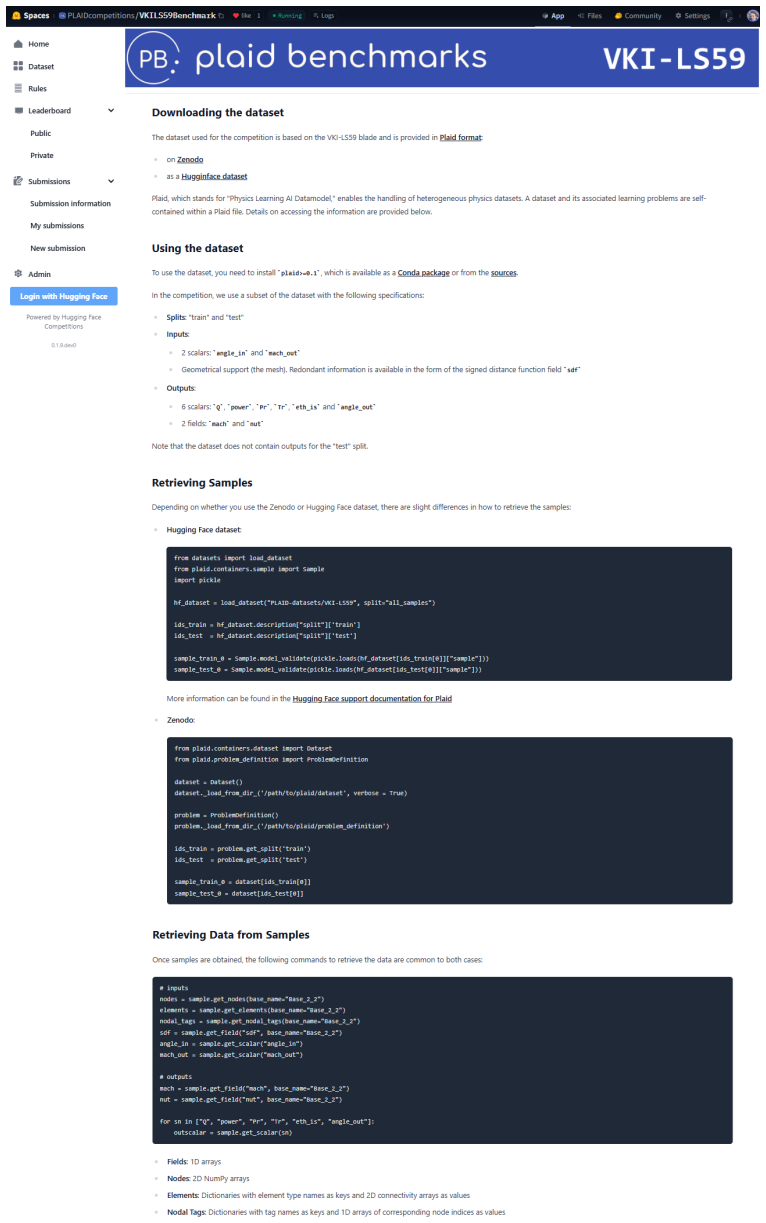
PLAID formalizes each simulation sample as a hierarchy of named zones inside a scientific data file; each zone holds its own mesh and fields, which can be addressed by location (for example vertices, cell centers, or face centers) and by time step. Meshes and fields may appear, disappear, or change across time steps, allowing remeshing and erosion; repeated meshes can be linked rather than copied; and different zones can live in different spatial dimensions, as in a two-dimensional flow field with a one-dimensional blade surface. The paper claims that this schema, together with a read/write library and human-readable sidecar files, is sufficiently generic and extensible for heterogeneous physics-learning datasets, and it validates the claim by publishing six new datasets and three re-encoded variants of an existing CFD benchmark, reporting relative-root-mean-square-error benchmarks for several representative model families.
Load-bearing premise
The paper assumes, rather than proves, that this schema can represent every combination of the advertised features—simultaneous remeshing, mixed element topologies, multiple spatial dimensions, and time-varying fields—and its evidence is six datasets that happen to encode successfully.
Editorial extensions
If this is right
- A dataset encoded in PLAID can vary geometry and mesh across samples and, within one sample, across time steps, so training data can reflect remeshing and element erosion without bespoke converters.
- Because all datasets share the same reader and scoring metric, surrogate models can be compared across structural mechanics and CFD using a single evaluation protocol.
- The released datasets provide a common testbed for generalization under geometric variability, with baseline errors that future submissions can update through the open leaderboards.
- The data model supports fields that appear and disappear over time, fields defined on different subdomains, and meshes linked across time steps, covering tasks like surface-only outputs on a blade embedded in a fluid domain.
Reading between the lines
- If the format is adopted beyond this collection, its real test is whether future datasets tick the same boxes without schema changes; the paper's roadmap does not demonstrate this, so adoption is an open empirical question.
- The benchmark ranking pattern, with morphing-based and implicit-neural-field approaches leading on steady-state datasets and a Fourier operator method on the time-dependent one, suggests that no single architecture is likely to sweep the collection, which makes the leaderboard useful for method selection but also puts weight on how RRMSEs are aggregated across fields and scalars.
- A testable extension would be to convert an existing popular benchmark not designed for remeshing into PLAID and measure whether models transfer across the original and the PLAID encodings; if results shift materially, the format is not neutral.
Signed reviews
Editorial analysis
A structured set of objections, weighed in public.
Referee Report
Summary. The paper introduces PLAID, a datamodel built on CGNS for representing and sharing physics-simulation datasets for machine learning, together with a Python library, six released datasets (structural mechanics and CFD, plus AirfRANS variants), and benchmark results from several ML methods (MeshGraphNets, MMGP, Vi-Transformer/Augur, DAFNO, MARIO). The artifacts are publicly released on GitLab, Zenodo, and Hugging Face, with online leaderboards. The paper claims the datamodel supports time-dependent problems, remeshing, mixed-element unstructured meshes, node/element tagging, and multiple spatial dimensions and topologies, and that it 'preserves the full complexity' of simulation data.
Significance. If the expressiveness claims are substantiated, PLAID would fill a real gap: existing physics-ML datasets are fragmented and often tied to narrow formats, and a CGNS-based standard with streaming support via Hugging Face is a credible route to community benchmarks. Concrete strengths include the released artifacts (datasets with documented splits, evaluation code, online leaderboards), the use of a mature standard (CGNS), and the breadth of physical settings (nonlinear structural mechanics, RANS CFD). The benchmark results are useful as reference numbers, even though the paper does not claim state-of-the-art performance. The principal weakness is the gap between the headline claim ('full complexity', 'wide range of use cases') and the evidence: the released datasets exercise only a subset of the advertised features, and no schema-level proof or stress-test is provided for the unexercised combinations. The paper also relies partly on in-house or affiliated baselines for benchmarking, which should be disclosed more prominently.
major comments (3)
- [Section 3 and Table 2] The paper asserts in Section 3 that the PLAID/CGNS model supports time-dependent remeshing, mixed-element unstructured meshes, and fields that change over time, and the abstract claims it 'preserves the full complexity' of simulation data. However, none of the released datasets exercise these features: every mesh in Table 2 is single-element-type (tri or quad), the only time-dependent dataset (2D_ElPlDynamics) is explicitly described in Appendix B.3 as having a mesh that stays constant through the time sequence, and no dataset contains fields that appear or disappear over time. The evidence for the central expressiveness claim is therefore only API-level, not schema-level or dataset-level. Please either provide a stronger demonstration (for example, a synthetic dataset or round-trip tests covering time-dependent remeshing, mixed elements, and field-topology changes) or re-scope the claim to what the released data actually show.
- [Sections 4.2.1, 4.2.2, 4.2.4] The abstract and Section 3 claim that the datamodel 'preserves the full complexity of simulation data', but several released datasets deliberately reduce complexity: Rotor37 'only keeps the steady-state solution at the boundary of the blade' (Section 4.2.1), 2D_profile 'only keeps the steady-state solution on a zone cropped close to the profile' (Section 4.2.2), and the AirfRANS variants are provided in original, clipped, and remeshed forms (Section 4.2.4). These are appropriate benchmark choices, but the phrase 'full complexity' should be qualified to refer to the datamodel's representational capacity rather than to the contents of the released datasets.
- [Section 5.1 and Table 4] The benchmark section does not provide uncertainty estimates (for example, multiple seeds) and does not apply a uniform set of methods across all datasets: DAFNO is evaluated only on 2D_ElPlDynamics, MMGP is not applied to 2D_ElPlDynamics or 2D_MultiScHypEl (as stated in Appendix A.2.2), and no method is evaluated on all six datasets. I do not view this as fatal, since the paper explicitly labels the results as non-exhaustive and non-definitive, but the main text should state these coverage limits alongside Table 4 rather than leaving them entirely to the appendices.
minor comments (4)
- [General] There are several typos and template artifacts, for example 'fiels' in Table 2, 'mush be specified' in Appendix B.3, 'tentatives' in Appendix C, and the first page still contains 'Preprint. Under review.' and 'arXiv:2505.02974v2' formatting; a careful copyedit is needed.
- [Abstract/Introduction] The repository URL is inconsistent: the abstract says github.com/PLAID-lib/plaid, while Section 1 and reference [64] say gitlab.com/drti/plaid; the authors should state the canonical location.
- [Section 5.2] The field RRMSE normalizes per sample by the maximum reference value rather than by the L2 norm; this is a legitimate choice, but it should be justified because it makes the metric sensitive to outlier nodes in the reference field.
- [Section 4.2.4] The sentence 'In addition to the six original datasets, we provide three variants of AirfRANS in PLAID format' counts the six PLAID datasets plus AirfRANS variants, but the wording is ambiguous about whether AirfRANS itself is one of the 'six original datasets' or an additional seventh; please clarify.
Circularity Check
No significant circularity: PLAID's central claims rest on shipped datasets, an external CGNS standard, and independent benchmark evaluations.
full rationale
The paper is an engineering/data-release contribution rather than a derivation chain, and I found no step in which an output is defined in terms of its own input, a fitted parameter is renamed as a prediction, or a load-bearing premise is justified only by a self-citation. The main claim that PLAID defines a generic, extensible datamodel is supported by the adoption of the external CGNS standard [65], by the accompanying library commands, and by the six released datasets; none of these reduce to the paper's own conclusions. The benchmark section evaluates MMGP, Vi-Transformer/Augur, DAFNO, and MARIO on held-out test splits using RRMSE scores; these are empirical results, not predictions forced by construction. Some benchmark contributors are affiliated with or identical to the authors (MMGP from the same group, Augur affiliated, MARIO from a co-author), but that is not a circularity issue: the methods are independent ML approaches and their results do not justify the datamodel's validity. The paper itself notes in Section 6 that the datamodel may not fully address emerging use cases, which is a scope limitation rather than a circular step. The potential gap between the advertised expressiveness ('remeshing, mixed-element unstructured meshes, ... multiple spatial dimensions and topologies') and the subset exercised by the released datasets is a correctness/scope risk, not an internal circularity, because the claim is asserted with external evidence rather than derived from itself.
Assumptions & free parameters
free parameters (5)
- MMGP PCA modes (shape and field per dataset) =
8/8 (Tensile2d), 32/64 (Rotor37), 16/32 (2D_profile), 13/5-3 or 40-1 (VKI-LS59)
- MMGP polynomial decoder order for VKI-LS59 =
3 for mach, 1 for nut
- Transformer and Augur hyperparameters =
See Tables 8 and 9
- DAFNO Fourier modes =
20 x 20
- MARIO hyperparameters =
See Tables 13 and 14
assumptions (4)
- domain assumption CGNS provides a complete, lossless representation for the heterogeneous simulation data PLAID aims to store.
- domain assumption The six released simulations are representative of realistic industrial structural mechanics and CFD scenarios.
- domain assumption The RRMSE scores defined in Section 5.2 are a valid measure of surrogate-model quality for the benchmark claims.
- domain assumption The withheld test labels and online scoring service remain available and unbiased over time.
Cite this review
Pith. "Pith review of PLAID: A Unified Data Model for Machine Learning on Heterogeneous Physics Simulations." pith.science (2026). https://pith.science/paper/FVZNKPAN
@misc{pith2026250502974,
  author       = {Pith},
  title        = {Pith review of: PLAID: A Unified Data Model for Machine Learning on Heterogeneous Physics Simulations},
  year         = {2026},
  howpublished = {\url{https://pith.science/paper/FVZNKPAN}},
  note         = {Machine review of arXiv:2505.02974}
}
read the original abstract
Machine learning-based surrogate models have emerged as a powerful tool to accelerate simulation-driven scientific workflows, but their adoption is limited by the lack of large-scale, diverse, and standardized datasets for physics-based simulations. Existing benchmarks often focus on narrow domains or rely on simplified data models, and fail to capture the heterogeneity arising from variable geometries, meshes, and topologies, which is critical for assessing generalization in realistic settings. We introduce PLAID (Physics-Learning AI Data model), a unified and extensible data layer for heterogeneous physics simulations. It preserves the full complexity of simulation data while enabling efficient and scalable machine learning workflows, together with a library for dataset construction and manipulation~(\href{https://github.com/PLAID-lib/plaid}{github.com/PLAID-lib/plaid}). We release six datasets covering structural mechanics and computational fluid dynamics, designed to reflect realistic industrial scenarios and provide standardized benchmarks. The framework includes reproducible evaluation protocols and is integrated with Hugging Face to enable open, community-driven benchmarking with active user participation (\href{https://huggingface.co/PLAIDcompetitions}{huggingface.co/PLAIDcompetitions}).
Figures


Figures from the paper (14 more)




Forward citations
Cited by 1 Pith paper
-
Towards scalable surrogate models based on Neural Fields for large scale aerodynamic simulations
MARIO, a modulated conditional neural field with learned SDF geometry codes, predicts RANS flow fields and surface pressures with reported order-of-magnitude accuracy gains on the AirfRANS scarce task and strong resul...
Reference graph
Works this paper leans on
-
[1]
Challenges and opportunities in numerical weather prediction
Jerald A Brotzge, Don Berchoff, DaNa L Carlis, Frederick H Carr, Rachel Hogan Carr, Jordan J Gerth, Brian D Gross, Thomas M Hamill, Sue Ellen Haupt, Neil Jacobs, et al. Challenges and opportunities in numerical weather prediction. Bulletin of the American Meteorological Society, 104(3):E698–E705, 2023
2023
-
[2]
The virtual physiological human: ten years after
Marco Viceconti and Peter Hunter. The virtual physiological human: ten years after. Annual review of biomedical engineering, 18(1):103–123, 2016
2016
-
[3]
Agent-based models of financial markets
Egle Samanidou, Elmar Zschischang, Dietrich Stauffer, and Thomas Lux. Agent-based models of financial markets. Reports on Progress in Physics, 70(3):409, 2007
2007
-
[4]
The finite element method for solid and structural mechanics
Olgierd Cecil Zienkiewicz and Robert Leroy Taylor. The finite element method for solid and structural mechanics. Elsevier, 2005
2005
-
[5]
Numerical recipes 3rd edition: The art of scientific computing
William H Press. Numerical recipes 3rd edition: The art of scientific computing. Cambridge university press, 2007
2007
-
[6]
The finite element method in engineering science, volume 1977
Olgierd Cecil Zienkiewicz and PB Morice. The finite element method in engineering science, volume 1977. McGraw-hill London, 1971
1977
-
[7]
Random forests
Leo Breiman. Random forests. Machine learning, 45:5–32, 2001
2001
-
[8]
Williams and C.E
C.K.I. Williams and C.E. Rasmussen. Gaussian processes for machine learning, volume 2. MIT press Cambridge, MA, 2006
2006
Show all 104 references
-
[9]
UQLab: A Framework for Uncertainty Quantification in Matlab, pages 2554–2563
Stefano Marelli and Bruno Sudret. UQLab: A Framework for Uncertainty Quantification in Matlab, pages 2554–2563. 2015
2015
-
[10]
OpenTURNS: An Industrial Software for Uncertainty Quantification in Simulation, pages 1–38
Michaël Baudin, Anne Dutfoy, Bertrand Iooss, and Anne-Laure Popelin. OpenTURNS: An Industrial Software for Uncertainty Quantification in Simulation, pages 1–38. Springer International Publishing, Cham, 2016
2016
-
[11]
B. M. Adams, W. J. Bohnhoff, K. R. Dalbey, M. S. Ebeida, J. P. Eddy, M. S. Eldred, R. W. Hooper, P. D. Hough, K. T. Hu, J. D. Jakeman, M. Khalil, K. A. Maupin, J. A. Monschke, E. E. Prudencio, E. M. Ridgway, P. Robbe, A. A. Rushdi, D. T. Seidl, J. A. Stephens, L. P. Swiler, an...
2024
-
[12]
Sébastien Da Veiga, Clément Bénard, Thierry Gonon, et al. Lagun. https://gitlab.com/ drti/lagun, 2025
2025
-
[13]
Design optimization using hyper-reduced-order models
David Amsallem, Matthew Zahr, Youngsoo Choi, and Charbel Farhat. Design optimization using hyper-reduced-order models. Structural and Multidisciplinary Optimization, 51(4):919– 940, 2015
2015
-
[14]
Casenave, N
F. Casenave, N. Akkari, F. Bordeu, C. Rey, and D. Ryckelynck. A nonintrusive distributed reduced-order modeling framework for nonlinear structural mechanics—application to elas- toviscoplastic computations. International Journal for Numerical Methods in Engineering, 121(1):32–53, 2020
2020
-
[15]
Daniel, F
T. Daniel, F. Casenave, N. Akkari, and D. Ryckelynck. Model order reduction assisted by deep neural networks (rom-net). Advanced Modeling and Simulation in Engineering Sciences, 7:1–27, 2020
2020
-
[16]
Model reduction of dynamical systems on nonlinear mani- folds using deep convolutional autoencoders
Kookjin Lee and Kevin T Carlberg. Model reduction of dynamical systems on nonlinear mani- folds using deep convolutional autoencoders. Journal of Computational Physics, 404:108973, 2020
2020
-
[17]
A fast and accurate physics-informed neural network reduced order model with shallow masked autoencoder
Youngkyu Kim, Youngsoo Choi, David Widemann, and Tarek Zohdi. A fast and accurate physics-informed neural network reduced order model with shallow masked autoencoder. Journal of Computational Physics, 451:110841, 2022
2022
-
[18]
Registration-based model reduction of parameterized PDEs with spatio-parameter adaptivity
Nicolas Barral, Tommaso Taddei, and Ishak Tifouti. Registration-based model reduction of parameterized PDEs with spatio-parameter adaptivity. Journal of Computational Physics , 499:112727, 2024. 10
2024
-
[19]
MMGP: a Mesh Morphing Gaus- sian Process-based machine learning method for regression of physical problems under non- parametrized geometrical variability
Fabien Casenave, Brian Staber, and Xavier Roynard. MMGP: a Mesh Morphing Gaus- sian Process-based machine learning method for regression of physical problems under non- parametrized geometrical variability. Advances in Neural Information Processing Systems, 36, 2024
2024
-
[20]
Elasticity-based morphing technique and application to reduced-order modeling
Abbas Kabalan, Fabien Casenave, Felipe Bordeu, Virginie Ehrlacher, and Alexandre Ern. Elasticity-based morphing technique and application to reduced-order modeling. Applied Mathematical Modelling, 141:115929, 2025
2025
-
[21]
O-MMGP: Optimal Mesh Morphing Gaussian Process regression for solving PDEs with non-parametric geometric variations
Abbas Kabalan, Fabien Casenave, Felipe Bordeu, and Virginie Ehrlacher. O-MMGP: Optimal Mesh Morphing Gaussian Process regression for solving PDEs with non-parametric geometric variations. arXiv preprint arXiv:2502.11632, 2025
2025
-
[22]
Learning signals defined on graphs with optimal transport and Gaussian process regression, 2025
Raphaël Carpintero Perez, Sébastien da Veiga, Josselin Garnier, and Brian Staber. Learning signals defined on graphs with optimal transport and Gaussian process regression, 2025
2025
-
[23]
Gaussian process regression with Sliced Wasserstein Weisfeiler-Lehman graph kernels
Raphaël Carpintero Perez, Sébastien Da Veiga, Josselin Garnier, and Brian Staber. Gaussian process regression with Sliced Wasserstein Weisfeiler-Lehman graph kernels. In International Conference on Artificial Intelligence and Statistics, pages 1297–1305. PMLR, 2024
2024
-
[24]
Gilmer, S.S
J. Gilmer, S.S. Schoenholz, P.F. Riley, O. Vinyals, and G.E. Dahl. Neural message passing for quantum chemistry. In International conference on machine learning, pages 1263–1272. PMLR, 2017
2017
-
[25]
Pfaff, M
T. Pfaff, M. Fortunato, A. Sanchez-Gonzalez, and P.W. Battaglia. Learning mesh-based simulation with graph networks. In International Conference on Learning Representations, 2021
2021
-
[26]
Fortunato, T
M. Fortunato, T. Pfaff, P. Wirnsberger, A. Pritzel, and P. Battaglia. Multiscale meshgraphnets. arXiv preprint arXiv:2210.00612, 2022
2022 arXiv
-
[27]
Allen, T
K.R. Allen, T. Lopez-Guevara, K. Stachenfeld, A. Sanchez-Gonzalez, P. Battaglia, J. Ham- rick, and T. Pfaff. Physical design using differentiable learned simulators. arXiv preprint arXiv:2202.00728, 2022
2022 arXiv
-
[28]
Harsch and S
L. Harsch and S. Riedelbauch. Direct prediction of steady-state flow fields in meshed domain with graph networks. arXiv preprint arXiv:2105.02575, 2021
2021 arXiv
-
[29]
Baque, E
P. Baque, E. Remelli, F. Fleuret, and P. Fua. Geodesic convolutional shape optimization. In International Conference on Machine Learning, pages 472–481. PMLR, 2018
2018
-
[30]
M. Lino, C. Cantwell, A.A. Bharath, and S. Fotiadis. Simulating continuum mechanics with multi-scale graph neural networks. arXiv preprint arXiv:2106.04900, 2021
2021 arXiv
-
[31]
M. Lino, S. Fotiadis, A.A. Bharath, and C.D. Cantwell. Multi-scale rotation-equivariant graph neural networks for unsteady eulerian fluid dynamics. Physics of Fluids, 34(8), 2022
2022
-
[32]
Y . Cao, M. Chai, M. Li, and C. Jiang. Efficient learning of mesh-based physical simulation with bi-stride multi-scale graph neural network. 2023
2023
-
[33]
Nvidia physicsnemo: An open-source framework for physics-based deep learning in science and engineering
PhysicsNeMo Contributors. Nvidia physicsnemo: An open-source framework for physics-based deep learning in science and engineering. https://github.com/NVIDIA/ physicsnemo, February 2023
2023
-
[34]
Matthias Fey and Jan E. Lenssen. Fast graph representation learning with PyTorch Geometric. In ICLR Workshop on Representation Learning on Graphs and Manifolds, 2019
2019
-
[35]
Deep graph library: A graph-centric, highly-performant package for graph neural networks
Minjie Wang, Da Zheng, Zihao Ye, Quan Gan, Mufei Li, Xiang Song, Jinjing Zhou, Chao Ma, Lingfan Yu, Yu Gai, Tianjun Xiao, Tong He, George Karypis, Jinyang Li, and Zheng Zhang. Deep graph library: A graph-centric, highly-performant package for graph neural networks. arXiv prepr...
1909 arXiv
-
[36]
Towards a foundation model for partial differential equations: Multioperator learning and extrapolation
Jingmin Sun, Yuxuan Liu, Zecheng Zhang, and Hayden Schaeffer. Towards a foundation model for partial differential equations: Multioperator learning and extrapolation. Phys. Rev. E, 111:035304, Mar 2025
2025
-
[37]
Multiple physics pretraining for spatiotemporal surrogate models
Michael McCabe, Bruno Régaldo-Saint Blancard, Liam Parker, Ruben Ohana, Miles Cranmer, Alberto Bietti, Michael Eickenberg, Siavash Golkar, Geraud Krawezik, Francois Lanusse, Mariel Pettee, Tiberiu Tesileanu, Kyunghyun Cho, and Shirley Ho. Multiple physics pretraining for spati...
2024
-
[38]
Multiple physics pretraining for physical surrogate models, 2024
Michael McCabe, Bruno Régaldo-Saint Blancard, Liam Holden Parker, Ruben Ohana, Miles Cranmer, Alberto Bietti, Michael Eickenberg, Siavash Golkar, Geraud Krawezik, Francois Lanusse, Mariel Pettee, Tiberiu Tesileanu, Kyunghyun Cho, and Shirley Ho. Multiple physics pretraining fo...
2024
-
[39]
Omnijet-α: the first cross-task foundation model for particle physics
Joschka Birk, Anna Hallin, and Gregor Kasieczka. Omnijet-α: the first cross-task foundation model for particle physics. Machine Learning: Science and Technology, 5(3):035031, aug 2024
2024
-
[40]
Liu Yang, Siting Liu, Tingwei Meng, and Stanley J. Osher. In-context operator learning with data prompts for differential equation problems. Proceedings of the National Academy of Sciences, 120(39), September 2023
2023
-
[41]
Gpt-4 technical report
Josh Achiam, Steven Adler, Sandhini Agarwal, Lama Ahmad, Ilge Akkaya, Florencia Leoni Aleman, Diogo Almeida, Janko Altenschmidt, Sam Altman, Shyamal Anadkat, et al. Gpt-4 technical report. arXiv preprint arXiv:2303.08774, 2023
2023 arXiv
-
[42]
LLaMA: Open and efficient founda- tion language models, 2023
Hugo Touvron, Thibaut Lavril, Gautier Izacard, Xavier Martinet, Marie-Anne Lachaux, Timo- thée Lacroix, Baptiste Rozière, Naman Goyal, Eric Hambro, Faisal Azhar, Aurelien Rodriguez, Armand Joulin, Edouard Grave, and Guillaume Lample. LLaMA: Open and efficient founda- tion lang...
2023
-
[43]
The llama 4 herd: The beginning of a new era of natively multimodal ai innovation,
Meta AI. The llama 4 herd: The beginning of a new era of natively multimodal ai innovation,
-
[44]
The pile: An 800gb dataset of diverse text for language modeling
Leo Gao, Stella Biderman, Sid Black, Laurence Golding, Travis Hoppe, Charles Foster, Jason Phang, Horace He, Anish Thite, Noa Nabeshima, et al. The pile: An 800gb dataset of diverse text for language modeling. arXiv preprint arXiv:2101.00027, 2020
2020 arXiv
-
[45]
The refinedweb dataset for falcon llm: outperforming curated corpora with web data, and web data only
Guilherme Penedo, Quentin Malartic, Daniel Hesslow, Ruxandra Cojocaru, Alessandro Cap- pelli, Hamza Alobeidli, Baptiste Pannier, Ebtesam Almazrouei, and Julien Launay. The refinedweb dataset for falcon llm: outperforming curated corpora with web data, and web data only. arXiv ...
2023 arXiv
-
[46]
LLMDataHub: Awesome Datasets for LLM Training, 2023
Junhao Zhao. LLMDataHub: Awesome Datasets for LLM Training, 2023. https://github. com/Zjh-819/LLMDataHub
2023
-
[47]
Datasets for large language models: A comprehensive survey, 2024
Yang Liu, Jiahuan Cao, Chongyu Liu, Kai Ding, and Lianwen Jin. Datasets for large language models: A comprehensive survey, 2024
2024
-
[48]
Laion- 5b: An open large-scale dataset for training next generation image-text models
Christoph Schuhmann, Romain Beaumont, Richard Vencu, Cade Gordon, Ross Wightman, Mehdi Cherti, Theo Coombes, Aarush Katta, Clayton Mullis, Mitchell Wortsman, et al. Laion- 5b: An open large-scale dataset for training next generation image-text models. Advances in Neural Inform...
2022
-
[49]
Vision datasets: A benchmark for vision-based industrial inspection, 2023
Haoping Bai, Shancong Mou, Tatiana Likhomanenko, Ramazan Gokberk Cinbis, Oncel Tuzel, Ping Huang, Jiulong Shan, Jianjun Shi, and Meng Cao. Vision datasets: A benchmark for vision-based industrial inspection, 2023
2023
-
[50]
Panda-70m: Captioning 70m videos with multiple cross-modality teachers, 2024
Tsai-Shien Chen, Aliaksandr Siarohin, Willi Menapace, Ekaterina Deyneka, Hsiang wei Chao, Byung Eun Jeon, Yuwei Fang, Hsin-Ying Lee, Jian Ren, Ming-Hsuan Yang, and Sergey Tulyakov. Panda-70m: Captioning 70m videos with multiple cross-modality teachers, 2024
2024
-
[51]
Pdebench: An extensive benchmark for scientific machine learning
Makoto Takamoto, Timothy Praditia, Raphael Leiteritz, Daniel MacKinlay, Francesco Alesiani, Dirk Pflüger, and Mathias Niepert. Pdebench: An extensive benchmark for scientific machine learning. Advances in Neural Information Processing Systems, 35:1596–1611, 2022
2022
-
[52]
Towards multi-spatiotemporal-scale generalized pde modeling
Jayesh K Gupta and Johannes Brandstetter. Towards multi-spatiotemporal-scale generalized pde modeling. arXiv preprint arXiv:2209.15616, 2022
2022 arXiv
-
[53]
PINNacle: A Comprehensive Benchmark of Physics- Informed Neural Networks for Solving PDEs
Zhongkai Hao, Jiachen Yao, Chang Su, Hang Su, Ziao Wang, Fanzhi Lu, Zeyu Xia, Yichi Zhang, Songming Liu, Lu Lu, et al. PINNacle: A Comprehensive Benchmark of Physics- Informed Neural Networks for Solving PDEs. arXiv preprint arXiv:2306.08827, 2023
2023 arXiv
-
[54]
Benchmarking autoregressive conditional diffusion models for turbulent flow simulation
Georg Kohl, Li-Wei Chen, and Nils Thuerey. Benchmarking autoregressive conditional diffusion models for turbulent flow simulation. arXiv, 2023
2023
-
[55]
Airfrans: High fidelity computational fluid dynamics dataset for approximating reynolds-averaged navier–stokes solutions
Florent Bonnet, Jocelyn Mazari, Paola Cinnella, and Patrick Gallinari. Airfrans: High fidelity computational fluid dynamics dataset for approximating reynolds-averaged navier–stokes solutions. Advances in Neural Information Processing Systems, 35:23463–23478, 2022. 12
2022
-
[56]
La- grangebench: A lagrangian fluid mechanics benchmarking suite
Artur Toshev, Gianluca Galletti, Fabian Fritz, Stefan Adami, and Nikolaus Adams. La- grangebench: A lagrangian fluid mechanics benchmarking suite. Advances in Neural Informa- tion Processing Systems, 36, 2024
2024
-
[57]
The era5 global reanalysis
Hans Hersbach, Bill Bell, Paul Berrisford, Shoji Hirahara, András Horányi, Joaquín Muñoz- Sabater, Julien Nicolas, Carole Peubey, Raluca Radu, Dinand Schepers, et al. The era5 global reanalysis. Quarterly Journal of the Royal Meteorological Society , 146(730):1999–2049, 2020
1999
-
[58]
David Neelin, David Randall, Sara Shamekh, Mark A Taylor, Nathan Urban, Janni Yuval, Guang Zhang, and Michael Pritchard
Sungduk Yu, Walter Hannah, Liran Peng, Jerry Lin, Mohamed Aziz Bhouri, Ritwik Gupta, Björn Lütjens, Justus Christopher Will, Gunnar Behrens, Julius Busecke, Nora Loose, Charles I Stern, Tom Beucler, Bryce Harrop, Benjamin R Hillman, Andrea Jenney, Savannah Ferretti, Nana Liu, ...
2024
-
[59]
Eagle: Large-scale learning of turbulent fluid dynamics with mesh transformers
Steeven Janny, Aurélien Benetteau, Madiha Nadri, Julie Digne, Nicolas Thome, and Christian Wolf. Eagle: Large-scale learning of turbulent fluid dynamics with mesh transformers. In International Conference on Learning Representations (ICLR), 2023
2023
-
[60]
BubbleML: A multi-physics dataset and benchmarks for machine learning
Sheikh Md Shakeel Hassan, Arthur Feeney, Akash Dhruv, Jihoon Kim, Youngjoon Suh, Jaiyoung Ryu, Yoonjin Won, and Aparna Chandramowlishwaran. BubbleML: A multi-physics dataset and benchmarks for machine learning. In Advances in Neural Information Processing Systems, 2023
2023
-
[61]
Chen, Jack Guo, Davy Brouzet, Mohsen Talei, Bruno Savard, Alexei Y
Wai Tong Chung, Bassem Akoush, Pushan Sharma, Alex Tamkin, Ki Sung Jung, Jacqueline H. Chen, Jack Guo, Davy Brouzet, Mohsen Talei, Bruno Savard, Alexei Y . Poludnenko, and Matthias Ihme. Turbulence in focus: Benchmarking scaling behavior of 3D volumetric super- resolution with...
2023
-
[62]
Drivaerml: High-fidelity computational fluid dynamics dataset for road-car external aerodynamics, 2024
Neil Ashton, Charles Mockett, Marian Fuchs, Louis Fliessbach, Hendrik Hetmann, Thilo Knacke, Norbert Schonwald, Vangelis Skaperdas, Grigoris Fotiadis, Astrid Walle, Burkhard Hupertz, and Danielle Maddix. Drivaerml: High-fidelity computational fluid dynamics dataset for road-ca...
2024
-
[63]
The well: a large-scale collection of diverse physics simulations for machine learning
Ruben Ohana, Michael McCabe, Lucas Meyer, Rudy Morel, Fruzsina Agocs, Miguel Beneitez, Marsha Berger, Blakesly Burkhart, Stuart Dalziel, Drummond Fielding, et al. The well: a large-scale collection of diverse physics simulations for machine learning. Advances in Neural Informa...
2024
-
[64]
PLAID: Physics Learning AI Datamodel
Fabien Casenave, Xavier Roynard, et al. PLAID: Physics Learning AI Datamodel. https: //gitlab.com/drti/plaid, 2025
2025
-
[65]
Seven keys for practical understanding and use of cgns
Marc Poinot and Christopher L Rumsey. Seven keys for practical understanding and use of cgns. In 2018 AIAA Aerospace Sciences Meeting, page 1503, 2018
2018
-
[66]
huggingface/datasets: 2.8.0, December 2022
Quentin Lhoest, Albert Villanova del Moral, Patrick von Platen, Thomas Wolf, Mario Šaško, Yacine Jernite, Abhishek Thakur, Lewis Tunstall, Suraj Patil, Mariama Drame, Julien Chau- mond, Julien Plu, Joe Davison, Simon Brandeis, Victor Sanh, Teven Le Scao, Kevin Canwen Xu, Nicol...
2022
-
[67]
MUSCAT: Mesh Utilities and Solver for Computational Analysis Toolkit
Felipe Bordeu et al. MUSCAT: Mesh Utilities and Solver for Computational Analysis Toolkit. https://gitlab.com/drti/muscat, 2025
2025
-
[68]
Basictools: a numerical simulation toolbox
Felipe Bordeu, Fabien Casenave, and Julien Cortial. Basictools: a numerical simulation toolbox. Journal of Open Source Software, 8(86):5142, 2023
2023
-
[69]
Tensile2d: 2D quasistatic non-linear structural mechanics solutions, under geometrical variations , February 2025
Fabien Casenave, Xavier Roynard, and Brian Staber. Tensile2d: 2D quasistatic non-linear structural mechanics solutions, under geometrical variations , February 2025. 13
2025
-
[70]
Zset: nonlinear material & structure analysis suite
Mines ParisTech and ONERA the French aerospace lab. Zset: nonlinear material & structure analysis suite. http://www.zset-software.com, 1981-present
1981
-
[71]
2D_Multiscale_Hyperelasticity: a 2D quasistatic non-linear structural mechanics with finite elasticity and topology variations , February 2025
Brian Staber and Fabien Casenave. 2D_Multiscale_Hyperelasticity: a 2D quasistatic non-linear structural mechanics with finite elasticity and topology variations , February 2025
2025
-
[72]
Baratta, Joseph P
Igor A. Baratta, Joseph P. Dean, Jørgen S. Dokken, Michal Habera, Jack S. Hale, Chris N. Richardson, Marie E. Rognes, Matthew W. Scroggs, Nathan Sime, and Garth N. Wells. DOLFINx: the next generation FEniCS problem solving environment. preprint, 2023
2023
-
[73]
Computational homogenization of heterogeneous materials with finite ele- ments, volume 258
Julien Yvonnet. Computational homogenization of heterogeneous materials with finite ele- ments, volume 258. Springer, 2019
2019
-
[74]
2D_ElastoPlastoDynamics: 2D dynamic non-linear structural mechanics dataset, with a non-linear non-local constitutive law , April 2025
William PIAT and Fabien Casenave. 2D_ElastoPlastoDynamics: 2D dynamic non-linear structural mechanics dataset, with a non-linear non-local constitutive law , April 2025
2025
-
[75]
Openradioss: Open-source finite element solver for dynamic event analysis, 2022
OpenRadioss Community. Openradioss: Open-source finite element solver for dynamic event analysis, 2022. https://openradioss.org/
2022
-
[76]
Rotor37: a 3D CFD RANS dataset, under geometrical variations of a compressor blade , February 2025
Xavier Roynard, Fabien Casenave, and Brian Staber. Rotor37: a 3D CFD RANS dataset, under geometrical variations of a compressor blade , February 2025
2025
-
[77]
The onera elsa cfd software: input from research and feedback from industry
Cambier, Laurent, Heib, Sébastien, and Plot, Sylvie. The onera elsa cfd software: input from research and feedback from industry. Mechanics & Industry, 14(3):159–174, 2013
2013
-
[78]
2D_profile: 2D external aero CFD RANS dataset, under geometrical variations , April 2025
Fabien Casenave and Nissrine Akkari. 2D_profile: 2D external aero CFD RANS dataset, under geometrical variations , April 2025
2025
-
[79]
VKI-LS59: a 2D internal aero CFD RANS dataset, under geometrical variations , February 2025
Michele Alessandro Bucci, Luca Saverio, and Fabien Casenave. VKI-LS59: a 2D internal aero CFD RANS dataset, under geometrical variations , February 2025
2025
-
[80]
Broadcast: A high-order compressible cfd toolbox for stability and sensitivity using algorithmic differentia- tion
Arthur Poulain, Cédric Content, Denis Sipp, Georgios Rigas, and Eric Garnier. Broadcast: A high-order compressible cfd toolbox for stability and sensitivity using algorithmic differentia- tion. Computer Physics Communications, 283:108557, 2023
2023
-
[81]
AirfRANS_original, February 2025
Xavier Roynard, Fabien Casenave, and Brian Staber. AirfRANS_original, February 2025
2025
-
[82]
AirfRANS_clipped, February 2025
Xavier Roynard, Fabien Casenave, and Brian Staber. AirfRANS_clipped, February 2025
2025
-
[83]
AirfRANS_remeshed, February 2025
Xavier Roynard, Fabien Casenave, and Brian Staber. AirfRANS_remeshed, February 2025
2025
-
[84]
ML4CFD Competition: Restrospec- tive Analysis
Mouadh Yagoubi, David Danan, Milad Leyli-Abadi, et al. ML4CFD Competition: Restrospec- tive Analysis. Work in progress, 2025
2025
-
[86]
Domain Agnostic Fourier Neural Operators, 2023
Ning Liu, Siavash Jafarzadeh, and Yue Yu. Domain Agnostic Fourier Neural Operators, 2023
2023
-
[87]
MARIO: Multiscale Aerodynamic Resolution Invariant Operator, 2025
Giovanni Catalani. MARIO: Multiscale Aerodynamic Resolution Invariant Operator, 2025. https://github.com/giovannicatalani/MARIO
2025
-
[88]
Neural fields for rapid aircraft aerodynamics simulations
Giovanni Catalani, Siddhant Agarwal, Xavier Bertrand, Frédéric Tost, Michael Bauerheim, and Joseph Morlier. Neural fields for rapid aircraft aerodynamics simulations. Scientific Reports, 14(1):25496, 2024
2024
-
[89]
Kipf and Max Welling
Thomas N. Kipf and Max Welling. Semi-supervised classification with graph convolutional networks, 2017
2017
-
[90]
Morphing techniques for model order reduction with non parametric geometrical variabilities
Abbas Kabalan, Fabien Casenave, Felipe Bordeu, Virginie Ehrlacher, and Alexandre Ern. Morphing techniques for model order reduction with non parametric geometrical variabilities. In 16ème Colloque National en Calcul de Structures, 2024
2024
-
[91]
Learning latent representations in high- dimensional state spaces using polynomial manifold constructions
Rudy Geelen, Laura Balzano, and Karen Willcox. Learning latent representations in high- dimensional state spaces using polynomial manifold constructions. In 2023 62nd IEEE Conference on Decision and Control (CDC), pages 4960–4965. IEEE, 2023
2023
-
[92]
Registration-based model reduction of parameterized PDEs with spatio-parameter adaptivity
Nicolas Barral, Tommaso Taddei, and Ishak Tifouti. Registration-based model reduction of parameterized PDEs with spatio-parameter adaptivity. Journal of Computational Physics , 499:112727, 2024. 14
2024
-
[93]
Reformer: The efficient transformer
Nikita Kitaev, Łukasz Kaiser, and Anselm Levskaya. Reformer: The efficient transformer. arXiv preprint arXiv:2001.04451, 2020
2001 arXiv
-
[94]
Linformer: Self-attention with linear complexity
Sinong Wang, Belinda Z Li, Madian Khabsa, Han Fang, and Hao Ma. Linformer: Self-attention with linear complexity. arXiv preprint arXiv:2006.04768, 2020
2006 arXiv
-
[95]
An image is worth 16x16 words: Transformers for image recognition at scale, 2021
Alexey Dosovitskiy, Lucas Beyer, Alexander Kolesnikov, Dirk Weissenborn, Xiaohua Zhai, Thomas Unterthiner, Mostafa Dehghani, Matthias Minderer, Georg Heigold, Sylvain Gelly, Jakob Uszkoreit, and Neil Houlsby. An image is worth 16x16 words: Transformers for image recognition at...
2021
-
[96]
Transformer based contextual model for sentiment analysis of customer reviews: A fine-tuned bert
Ashok Kumar Durairaj and Anandan Chinnalagu. Transformer based contextual model for sentiment analysis of customer reviews: A fine-tuned bert. International Journal of Advanced Computer Science and Applications, 12(11), 2021
2021
-
[97]
An improved transformer-based model for detecting phishing, spam, and ham: A large language model approach, 2023
Suhaima Jamal and Hayden Wimmer. An improved transformer-based model for detecting phishing, spam, and ham: A large language model approach, 2023
2023
-
[98]
Revisiting transformer-based models for long document classification, 2022
Xiang Dai, Ilias Chalkidis, Sune Darkner, and Desmond Elliott. Revisiting transformer-based models for long document classification, 2022
2022
-
[99]
Alvarez, and Ping Luo
Enze Xie, Wenhai Wang, Zhiding Yu, Anima Anandkumar, Jose M. Alvarez, and Ping Luo. Segformer: Simple and efficient design for semantic segmentation with transformers, 2021
2021
-
[100]
Point transformer, 2021
Hengshuang Zhao, Li Jiang, Jiaya Jia, Philip Torr, and Vladlen Koltun. Point transformer, 2021
2021
-
[101]
Transcfd: A transformer-based decoder for flow field prediction
Jundou Jiang, Guanxiong Li, Yi Jiang, Laiping Zhang, and Xiaogang Deng. Transcfd: A transformer-based decoder for flow field prediction. Engineering Applications of Artificial Intelligence, 123:106340, 2023
2023
-
[102]
Point transformer v3: Simpler, faster, stronger, 2024
Xiaoyang Wu, Li Jiang, Peng-Shuai Wang, Zhijian Liu, Xihui Liu, Yu Qiao, Wanli Ouyang, Tong He, and Hengshuang Zhao. Point transformer v3: Simpler, faster, stronger, 2024
2024
-
[103]
Metis – unstructured graph partitioning and sparse matrix ordering system, version 2.0
George Karypis and Vipin Kumar. Metis – unstructured graph partitioning and sparse matrix ordering system, version 2.0. 01 1995
1995
-
[104]
PLAID - datasets / Te ns ile 2d
Luisa M Zintgraf, Kyriacos Shiarlis, Vitaly Kurin, Katja Hofmann, and Shimon Whiteson. Fast context adaptation via meta-learning, 2019. A Details on the ML models used in the benchmark We briefly present the main competing methods that we used for the benchmark. We also highli...
2019
-
[2025]
https://ai.meta.com/blog/llama-4-multimodal-intelligence
Reviewed August 16, 2026 · model on record in the stance chip above.
Discussion (0). Continue with ORCID to comment.