REVIEW 3 major objections 6 minor 26 references
PiCo: Enhancing Text-Image Alignment with Improved Noise Selection and Precise Mask Control in Diffusion Models
T0 review · 3 major / 6 minor · reviewed 2026-08-15 · deepseek-v4-flash
Pith's one-line read PiCo claims that ranking initial noises and steering cross-attention with pixel-level referring masks improves text-image alignment in diffusion models without any fine-tuning.
desk verdict A useful training-free noise-selection plus mask-control pipeline, honestly reported but with a core evaluation category compromised by the authors' own admission that CLIPSeg's color bias leaks into both modules. read the letter →
The pith
A machine-rendered reading of the paper's core claim, the machinery that carries it, and where it could break.
The reading
What carries the argument
The carrying mechanism is a pair of training-free modules. Noise selection computes an overall noise score as the sum of an image-text matching score $\cos(F_1(I_P), F_2(P))$ and per-concept scores $v^{\max}\cdot\delta + v^{\mathrm{avg}}/v^{\max}$ from CLIPSeg segmentations of fast, 5-step denoised images; this ranks a candidate seed set so only the best noises proceed. Referring mask control converts CLIPSeg segmentations of intermediate latents into validated, augmented concept masks $\hat{M}^{\mathrm{aug}}_r$, applies them to cross-attention maps by element-wise multiplication $A^{l,t}_{a:b} := A^{l,t}_{a:b}\odot\hat{M}^{\mathrm{aug}}_r$, and multiplies all non-owned regions by $\prod_{g\neq r}(1-\hat{M}_g)$ to keep concepts from bleeding into each other. The named central object is the referring mask itself: a pixel-level segmentation from CLIPSeg prompted with the concept text, rather than a semantic mask inferred from attention activations.
What would settle it
On the color subset of T2I-Compbench, run PiCo twice: once with the raw CLIPSeg masks and once with the color-bias regions (e.g., a yellow leash segmented for "yellow dog") removed by IoU filtering. If the selected noises or the human-judged "Both" rates change substantially, the claimed color-binding gains depend on the unreliable masks; if nothing changes, the bias is not load-bearing.
Extended reading notes
Core claim
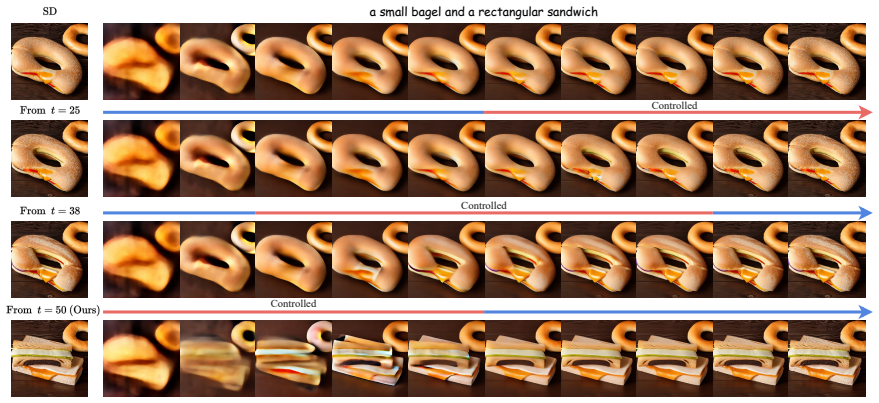
The central claim is that the two failure modes in compositional text-to-image generation, missing objects and incorrectly bound attributes, can be attacked at inference time without any fine-tuning. First, noise is not neutral: the paper claims that a cheap 5-step denoising of a candidate noise, scored by CLIPSeg-based image-text matching on the full prompt and by concept-level mask aggregation on parsed sub-prompts, predicts whether that noise will support all concepts. Second, attention control should be driven not by detected boxes or cross-attention heatmaps but by referring-segmentation masks: a concept mask amplifies the attended region for that concept, an exclusive mask suppresses other concepts' regions, and a conflict-elimination step assigns overlapping pixels to the strongest concept. Applying these masks in the first half of denoising is said to produce images that keep all objects and bind colors, shapes, and textures correctly.
Load-bearing premise
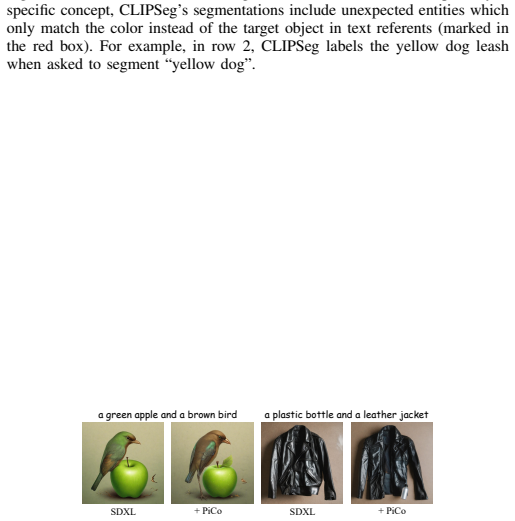
The whole pipeline assumes that CLIPSeg, when prompted with a concept phrase, actually isolates that concept in the coarse intermediate image; the authors' own appendix shows that for color attributes CLIPSeg often highlights objects that only share the color, so wrong masks also feed wrong noise scores.
Editorial extensions
If this is right
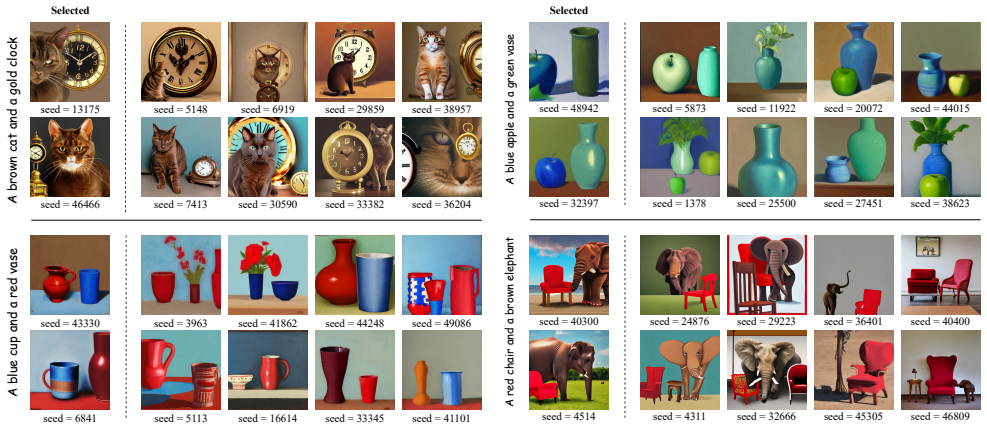
- If the claims hold, a user can get a prompt-faithful image from a small set of seeds in one pass instead of sampling many images and eyeballing the results.
- Training-free attention masking means the same module can be dropped into existing Stable-Diffusion-family models, and the paper reports compatibility with SDXL.
- Both-object rates rise and none-object rates fall across every baseline when the selected noises are used, suggesting seed quality alone explains a large part of the observed attribute-binding failures.
- Because the masks come from referring segmentation rather than a fixed object vocabulary, the method handles unusual concepts such as "rectangular sandwich" and "pink cat" without retraining.
- The pairwise human evaluation claims PiCo wins alignment votes against Attend-and-Excite, BoxDiff, GORS, and Magnet under the same selected noise.
Reading between the lines
- The paper's own limitation appendix shows CLIPSeg has a color bias: prompted with "yellow dog" it can segment a yellow leash. A natural extension, which the authors sketch, is to compute IoU between color-region and entity-region masks so the color-attribute cases do not rely on biased regions.
- If the noise-ranking idea is right, it turns seed selection into a prompt-conditioned ranking problem; the same scoring could be used to curate seeds for other conditional generators or to build a seed library for recurring prompts.
- The reliance on a dependency parser for concept extraction means the method's ceiling on complex sentences is set by the parser; for prompts where parsing fails, the pipeline silently drops or mangles concepts.
- Mask control is only applied in early denoising; an adaptive stopping rule based on mask confidence, rather than a fixed $T_c=25$, could recover cases where mid-stage intervention is needed.
Signed reviews
Editorial analysis
A structured set of objections, weighed in public.
Referee Report
Summary. The paper proposes PiCo, a training-free method for improving text-image alignment in diffusion models. PiCo has two components: a noise selection module that scores initial noises using fast 5-step denoising and a combination of an image-text matching score with per-concept CLIPSeg segmentation scores (Eqs. 1-4), and a referring mask control module that obtains CLIPSeg segmentations of intermediate latents, validates and augments them into concept masks and exclusive masks, and multiplies them into cross-attention maps (Eqs. 5-13). The method is evaluated on subsets of T2I-Compbench and CC-500, using human evaluation (annotated concept counts and pairwise comparisons) and objective metrics (CLIPScore, VQAScore, DINO-Score, CLIP-I, FID), comparing against Stable Diffusion, Attend-and-Excite, BoxDiff, GORS, and Magnet. The authors report that PiCo achieves higher correct-concept rates and wins pairwise comparisons, and that the noise selection module improves all tested methods when selected noises are used.
Significance. If the results are substantiated, PiCo would offer a practical, training-free way to reduce object neglect and attribute binding errors in compositional text-to-image generation. The focus on initial-noise quality is relatively underexplored relative to attention-based guidance, and the use of a referring segmentation model for pixel-level mask control is a reasonable alternative to bounding-box or attention-derived masks. The paper includes extensive ablation studies on the main hyperparameters and demonstrates compatibility with SDXL. However, the primary evidence rests on human evaluations that lack statistical details, and the method's reliance on CLIPSeg is partially compromised by a color bias that the authors themselves document but do not correct. The significance of the central claim is therefore currently qualified.
major comments (3)
- [Section II-B and II-C, Appendix E] The acknowledged CLIPSeg color bias directly contaminates both main modules of PiCo. In Eq. (4), the concept score is computed from CLIPSeg segmentations of concept images; in Eqs. (7)-(11), the cross-attention control uses CLIPSeg masks of intermediate latents. Appendix E states that CLIPSeg 'tends to include the areas associated with these objects' that match only the color attribute rather than the target entity, gives the example of segmenting a yellow leash for 'yellow dog', and calls this 'detrimental to our objectives.' The authors propose an IoU-based correction but do not implement or evaluate it, and they provide no quantitative analysis of how often such color-biased masks occur on the evaluated prompts. Because color binding is one of the three attribute-binding subcategories in T2I-Compbench and the headline results aggregate over it, the reported gains on that core category could partly be an artifact of reinforcing incorrect segmentations. This undermines the central claim for a core benchmark category and must be addressed, for example by quantifying the frequency of color-biased masks, excluding or correcting such cases, and reporting the color-subcategory results separately.
- [Section III-A, Tables I and II] The human evaluation is the primary evidence for the central claims, but it lacks statistical rigor. The paper reports percentages such as 'Both' rates and pairwise win rates (e.g., 41.8% vs 34.7-39.5% in Table I, and 51.7% vs 20.8% for alignment in Table II) without confidence intervals, annotator counts, inter-annotator agreement, or a clear description of the number of comparisons per baseline. The text says that 500 images with two objects were sampled for subjective evaluation, but it is unclear how many annotators rated each image and whether each pairwise comparison was repeated across annotators. Without this information, the differences between PiCo and several baselines could fall within the noise of subjective ratings. Reporting error bars and the annotation protocol is necessary to support the headline improvement.
- [Section III-A, Tables III-VI] A large number of hyperparameters (δ, α_l, α_h, β_l, β_h, γ, T_s, T_c, r_s, the percentile threshold, and the validation thresholds) are selected via ablation studies on the same T2I-Compbench subset that is later used for the final evaluation. There is no separate validation set or nested cross-validation. This creates a risk of overfitting to this particular benchmark, and the reported gains may not transfer to other prompt distributions. The authors should demonstrate robustness by evaluating on a held-out benchmark or by reporting sensitivity of the main results across a range of hyperparameter values.
minor comments (6)
- [Section III-A] The description of the random vs selected noise evaluation is ambiguous. The text says 'All baselines use random noises ... and PiCo's selected noises ... to generate images, respectively,' while Table I's caption states that selected noises from PiCo are assigned to all methods for a fair comparison. Please clarify the protocol: which methods are shown in the 'Random' and 'Selected' columns, and whether all methods share the same selected noises in the 'Selected' columns.
- [Section II-B and Appendix D] The hyperparameter δ in Eq. (4) is subsequently called σ in the Appendix D ablation text (e.g., 'setting σ to 1'). Use consistent notation to avoid confusion.
- [References] The reference list contains formatting errors, e.g., 'and ohters' in reference [1], and the entry for OpenAI's GPT-4o is incomplete.
- [Figure 2 caption] The caption 'Each case uses the same initialized noise, which is output by the noise selection module' should clarify that all compared methods in the figure are given the same selected noise, since otherwise the reader may misunderstand which method produced the selected noise.
- [Section III-A] The relationship between the 5,000 generated images (500 prompts × 10 seeds) and the 500 images sampled for subjective evaluation is not explained. Please specify how many images were shown to each annotator, how many annotators were used, and whether each image was compared against all five baselines.
- [Table VI] The column header 'Both/Single' in Table VI is not defined. Define whether this is a combined metric or the sum of the 'Both' and 'Single' rates.
Circularity Check
No significant circularity: PiCo's components are empirically evaluated against external human judgments and benchmark metrics, not derived from their own outputs.
full rationale
PiCo makes an empirical, training-free method claim. The noise selection module scores candidate noises via CLIPSeg-based ITM and concept scores (Eqs. 1-4), and the referring mask control module modulates cross-attention with CLIPSeg masks (Eqs. 7-12); neither defines its target quantity in terms of the reported outcome. The headline results are human-annotated 'Both/None' rates and pairwise comparisons (Tables I-II), and objective metrics (CLIPScore, VQAScore, DINO) are external to the method's own scores. No fitted parameter is renamed as a prediction: the hyperparameters (Ts, rs, delta, gamma, Tc) are set by ablations and are not used to manufacture the compared outputs. The only self-citation is to the authors' prior Magnet paper [9] for the unreliability of automatic metrics and as a baseline; this is not load-bearing because the paper's central evaluation is human judgment, and no uniqueness or theoretical claim rests on [9]. Appendix E's admitted CLIPSeg color bias is a correctness/robustness limitation that could weaken color-attribute results, but it is not circular: the method's success is not assumed by its construction. Therefore no circular step meets the evidentiary bar.
Assumptions & free parameters
free parameters (7)
- delta (noise score weight) =
2
- alpha_l, alpha_h (mask validation thresholds) =
0.7, 1500
- beta_l, beta_h, gamma (mask augmentation) =
0.5, 0.7, 15
- T_s (fast denoising steps) =
5
- T_c (mask control stop timestep) =
25
- r_s (candidate set ratio) =
10
- 90-th percentile threshold =
90
assumptions (4)
- domain assumption The same initial noise leads to similar high-level features at different denoising steps [16].
- domain assumption CLIPSeg segmentations of intermediate noisy latents are accurate enough to guide cross-attention.
- domain assumption Stanza dependency parsing extracts the correct visual concepts from arbitrary prompts.
- domain assumption Cross-attention maps at early denoising stages determine layout and are controllable.
Cite this review
Pith. "Pith review of PiCo: Enhancing Text-Image Alignment with Improved Noise Selection and Precise Mask Control in Diffusion Models." pith.science (2026). https://pith.science/paper/6V6OVXHR
@misc{pith2026250503203,
  author       = {Pith},
  title        = {Pith review of: PiCo: Enhancing Text-Image Alignment with Improved Noise Selection and Precise Mask Control in Diffusion Models},
  year         = {2026},
  howpublished = {\url{https://pith.science/paper/6V6OVXHR}},
  note         = {Machine review of arXiv:2505.03203}
}
read the original abstract
Advanced diffusion models have made notable progress in text-to-image compositional generation. However, it is still a challenge for existing models to achieve text-image alignment when confronted with complex text prompts. In this work, we highlight two factors that affect this alignment: the quality of the randomly initialized noise and the reliability of the generated controlling mask. We then propose PiCo (Pick-and-Control), a novel training-free approach with two key components to tackle these two factors. First, we develop a noise selection module to assess the quality of the random noise and determine whether the noise is suitable for the target text. A fast sampling strategy is utilized to ensure efficiency in the noise selection stage. Second, we introduce a referring mask module to generate pixel-level masks and to precisely modulate the cross-attention maps. The referring mask is applied to the standard diffusion process to guide the reasonable interaction between text and image features. Extensive experiments have been conducted to verify the effectiveness of PiCo in liberating users from the tedious process of random generation and in enhancing the text-image alignment for diverse text descriptions.
Figures


Figures from the paper (14 more)






Reference graph
Works this paper leans on
-
[1]
High-resolution image synthesis with latent diffusion models,
Robin Rombach, Andreas Blattmann, and ohters, “High-resolution image synthesis with latent diffusion models,” 2021
work page 2021
-
[2]
Hierarchical text-conditional image generation with clip latents,
Aditya Ramesh, Prafulla Dhariwal, Alex Nichol, et al., “Hierarchical text-conditional image generation with clip latents,” 2022
work page 2022
-
[3]
Gligen: Open-set grounded text-to-image generation,
Yuheng Li, Haotian Liu, Qingyang Wu, Fangzhou Mu, Jianwei Yang, Jianfeng Gao, Chunyuan Li, and Yong Jae Lee, “Gligen: Open-set grounded text-to-image generation,” CVPR, 2023
work page 2023
-
[4]
Training-free structured diffusion guidance for compositional text-to-image synthesis,
Weixi Feng, Xuehai He, Tsu-Jui Fu, et al., “Training-free structured diffusion guidance for compositional text-to-image synthesis,” 2023
work page 2023
-
[5]
Svdiff: Compact parameter space for diffusion fine-tuning,
Ligong Han, Yinxiao Li, Han Zhang, Peyman Milanfar, Dimitris Metaxas, and Feng Yang, “Svdiff: Compact parameter space for diffusion fine-tuning,” in ICCV, 2023, pp. 7323–7334
work page 2023
-
[6]
Mixture of diffusers for scene composition and high resolution image generation,
´Alvaro Barbero Jim ´enez, “Mixture of diffusers for scene composition and high resolution image generation,” arXiv:2302.02412, 2023
arXiv 2023
-
[7]
Training-free layout control with cross-attention guidance,
Minghao Chen, Iro Laina, and Andrea Vedaldi, “Training-free layout control with cross-attention guidance,” 2023
work page 2023
-
[8]
Good seed makes a good crop: Discovering secret seeds in text-to-image diffusion models,
Katherine Xu, Lingzhi Zhang, and Jianbo Shi, “Good seed makes a good crop: Discovering secret seeds in text-to-image diffusion models,” arXiv:2405.14828, 2024
arXiv 2024
Show all 26 references
-
[9]
Magnet: We never know how text-to-image diffusion models work, until we learn how vision-language models function,
Chenyi Zhuang, Ying Hu, and Pan Gao, “Magnet: We never know how text-to-image diffusion models work, until we learn how vision-language models function,” arXiv:2409.19967, 2024
2024 arXiv
-
[10]
Compositional text-to- image synthesis with attention map control of diffusion models,
Ruichen Wang, Zekang Chen, Chen Chen, et al., “Compositional text-to- image synthesis with attention map control of diffusion models,” 2023
2023
-
[11]
Detector guidance for multi-object text-to-image generation,
Luping Liu, Zijian Zhang, et al., “Detector guidance for multi-object text-to-image generation,” arXiv:2306.02236, 2023
2023 arXiv
-
[12]
Get what you want, not what you don’t: Image content suppression for text-to-image diffusion models,
Senmao Li, Joost van de Weijer, Taihang Hu, Fahad Shahbaz Khan, Qibin Hou, Yaxing Wang, and Jian Yang, “Get what you want, not what you don’t: Image content suppression for text-to-image diffusion models,” arXiv:2402.05375, 2024
2024 arXiv
-
[13]
Enhancing image layout control with loss-guided diffusion models,
Zakaria Patel and Kirill Serkh, “Enhancing image layout control with loss-guided diffusion models,” arXiv:2405.14101, 2024
2024 arXiv
-
[14]
Linguistic binding in diffusion models: Enhancing attribute correspondence through attention map alignment,
Royi Rassin, Eran Hirsch, et al., “Linguistic binding in diffusion models: Enhancing attribute correspondence through attention map alignment,” NIPS, vol. 36, 2024
2024
-
[15]
Image segmentation using text and image prompts,
Timo L ¨uddecke and Alexander Ecker, “Image segmentation using text and image prompts,” in CVPR, 2022, pp. 7086–7096
2022
-
[16]
Denoising diffusion implicit models,
Jiaming Song, Chenlin Meng, and Stefano Ermon, “Denoising diffusion implicit models,” arXiv:2010.02502, 2020
2010 arXiv
-
[17]
Attend-and-excite: Attention-based semantic guidance for text-to-image diffusion models,
Hila Chefer, Yuval Alaluf, Yael Vinker, Lior Wolf, and Daniel Cohen-Or, “Attend-and-excite: Attention-based semantic guidance for text-to-image diffusion models,” 2023
2023
-
[18]
Stanza: A python natural language processing toolkit for many human languages,
Peng Qi, Yuhao Zhang, Yuhui Zhang, Jason Bolton, and Christopher D Manning, “Stanza: A python natural language processing toolkit for many human languages,” arXiv:2003.07082, 2020
2003 arXiv
-
[19]
You only look once: Unified, real-time object detection,
J Redmon, “You only look once: Unified, real-time object detection,” in CVPR, 2016
2016
-
[20]
T2i- compbench: A comprehensive benchmark for open-world compositional text-to-image generation,
Kaiyi Huang, Kaiyue Sun, Enze Xie, Zhenguo Li, and Xihui Liu, “T2i- compbench: A comprehensive benchmark for open-world compositional text-to-image generation,” NIPS, vol. 36, pp. 78723–78747, 2023
2023
-
[21]
Boxdiff: Text-to-image synthesis with training-free box-constrained diffusion,
Jinheng Xie, Yuexiang Li, Yawen Huang, Haozhe Liu, Wentian Zhang, Yefeng Zheng, and Mike Zheng Shou, “Boxdiff: Text-to-image synthesis with training-free box-constrained diffusion,” in ICCV, 2023, pp. 7452– 7461
2023
-
[22]
Microsoft coco: Common objects in context,
Tsung-Yi Lin, Michael Maire, Serge Belongie, James Hays, Pietro Per- ona, Deva Ramanan, Piotr Doll ´ar, and C Lawrence Zitnick, “Microsoft coco: Common objects in context,” in ECCV. Springer, 2014, pp. 740– 755
2014
-
[23]
Learning transferable visual models from natural language supervision,
Alec Radford, Jong Wook Kim, Chris Hallacy, et al., “Learning transferable visual models from natural language supervision,” in ICML. PMLR, 2021, pp. 8748–8763
2021
-
[24]
Clipscore: A reference-free evaluation metric for image captioning,
Jack Hessel, Ari Holtzman, Maxwell Forbes, Ronan Le Bras, and Yejin Choi, “Clipscore: A reference-free evaluation metric for image captioning,” arXiv:2104.08718, 2021
2021 arXiv
-
[25]
Genai-bench: Evaluating and improving compositional text-to-visual generation,
Baiqi Li, Zhiqiu Lin, Deepak Pathak, et al., “Genai-bench: Evaluating and improving compositional text-to-visual generation,” arXiv:2406.13743, 2024
2024 arXiv
-
[26]
Introducing gpt-4o and more tools to chatgpt free users,
OpenAI, “Introducing gpt-4o and more tools to chatgpt free users,” URL, https://openai.com/index/gpt-4o-and-more-tools-to-chatgpt-free/, 2024. APPENDIX A. Preliminaries Latent Diffusion Model (LDM) . Exemplified by Stable Diffusion (SD) [1], LDM performs the diffusion process ...
2024
Reviewed August 15, 2026 · model on record in the stance chip above.
Discussion (0). Continue with ORCID to comment.