REVIEW 3 major objections 4 minor 1 cited by
GUAVA: Generalizable Upper Body 3D Gaussian Avatar
T0 review · 3 major / 4 minor · reviewed 2026-08-15 · deepseek-v4-flash
Pith's one-line read From a single photograph, GUAVA reconstructs an animatable, expressive upper-body 3D Gaussian avatar in one forward pass of about 0.1 seconds, and the resulting avatar supports real-time animation and novel-view rendering.
desk verdict Real novelty in feed-forward upper-body avatars, but the untested tracker and the overstated speed claim are the soft spots a referee should probe. read the letter →
The pith
A machine-rendered reading of the paper's core claim, the machinery that carries it, and where it could break.
The reading
What carries the argument
The load-bearing object is the 'Ubody Gaussian' set, a concatenation of two rigged Gaussian groups in canonical space. Template Gaussians inherit positions directly from EHM vertices and read appearance by projection sampling $f^i_p = \mathcal{S}(F_a, P(v_i, RT_s))$ of a DINOv2-derived appearance feature map. UV Gaussians are rigged to mesh triangles through barycentric coordinates, each defined by local displacement $\Delta\mu$, triangle index $k$, and interpolated position $t$; inverse texture mapping explicitly projects each UV pixel's mesh position into screen space, samples the appearance feature map there, and filters invisible pixels with a mesh rasterizer, so $F_{uv}$ feeds a StyleUNet and convolutional decoder that predicts attributes. Animation works by transforming rigged Gaussians into world coordinates via $r' = R_t r$, $\mu' = \sigma R_t \Delta\mu + t$, $s' = \sigma s$, with the deformed EHM mesh from linear blend skinning providing $R_t$ and $\sigma$. A StyleUNet refiner decoding splatted latent features into the final image carries the last stage of fidelity.
What would settle it
Perturb the detected 2D keypoints used in EHM tracking by a few pixels on a fixed set of source images and measure the drop in self-reenactment PSNR: a sharp drop would show the reconstruction quality rides on keypoint-based registration rather than on the refiner's inpainting. Alternatively, register tracked EHMs against ground-truth 3D scans of the same subjects and check whether pixel-level registration error predicts the corrupted texture regions the paper's own ablations exhibit.
Extended reading notes
Core claim
The paper's central claim is that an animatable upper-body avatar can be reconstructed from a single image by a single feed-forward network, with no per-identity optimization. To make this work it introduces EHM, an expressive human template that replaces the SMPLX head with FLAME so fine facial expressions survive tracking, and a two-stage tracker that refines coarse SMPLX, FLAME, and MANO estimates using 2D keypoint losses plus 3D guidance from the tracked sub-models. Appearance is transferred into the avatar through two complementary routes: template Gaussians that sample image features at projected mesh vertices, and UV Gaussians rigged to mesh triangles that receive screen-space features remapped into UV space by an explicit inverse texture-mapping step. Both sets are concatenated into 'Ubody Gaussians' in canonical space, deformed into pose space via linear blend skinning using the target tracking parameters, splatted into a coarse feature map, and refined by a StyleUNet refiner. On self- and cross-reenactment benchmarks the paper reports higher rendering quality than 2D diffusion-based animators and per-identity 3D Gaussian avatars, with about 0.1 s reconstruction and about 50 FPS animation and rendering.
Load-bearing premise
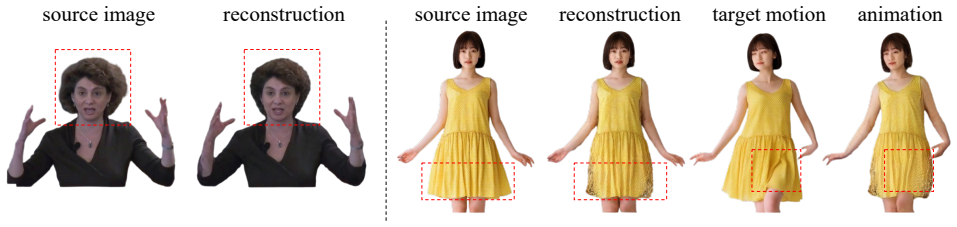
The load-bearing premise is that the EHM tracking step aligns the template mesh to the source image accurately enough that projection sampling and inverse texture mapping read the correct appearance features, and the paper never measures tracking error against ground-truth 3D data.
Editorial extensions
If this is right
- A single frame of webcam video could become a driveable 3D avatar in real time, enabling avatar workflows that currently require minutes to hours of per-person optimization.
- Because identity lives in a 3D canonical Gaussian space rather than in a 2D diffusion prior, identity should remain stable across large pose changes — the regime where 2D animation methods drift.
- Replacing the SMPLX head with FLAME raises the expressiveness ceiling for body templates, so other body-model pipelines could adopt the same head swap for fine facial expression control.
- At roughly 0.1 s reconstruction and 50 FPS rendering, the practical bottleneck for such avatar systems shifts from reconstruction to tracking accuracy and training-data coverage, matching the paper's stated limitations with hair, loose clothing, and frontal-only views.
Reading between the lines
- A natural testable extension the paper does not explore is to train the same pipeline on synthetic multi-view or 360° data; since the paper attributes degraded back views to its frontal-only training set, data diversity is the clearest lever toward full-circle avatars.
- Because the UV branch explicitly separates triangle-rigged geometry from appearance sampled in UV space, the same inverse texture mapping could transfer appearance between identities or re-texture an avatar without retraining.
- The tracking premise could be probed directly: perturbing the detected 2D keypoints in the source image by a few pixels and measuring the drop in self-reenactment PSNR would isolate how much of the quality budget depends on keypoint-based registration versus the refiner's inpainting.
- The ablation pattern (template Gaussians alone hold PSNR near 25.82 versus 25.87 full, while UV Gaussians and the refiner buy most of the perceptual sharpness) suggests a deployable quality tier: cheaper configurations could omit the refiner when LPIPS is less critical.
Signed reviews
Editorial analysis
A structured set of objections, weighed in public.
Referee Report
Summary. GUAVA proposes a single-image feed-forward pipeline that reconstructs an animatable upper-body 3D Gaussian avatar in a canonical space, using a custom expressive human model (EHM) built by replacing the SMPLX head with FLAME, an iterative tracking procedure, projection sampling, inverse texture mapping, and a neural refiner. The method is trained on a large video dataset and evaluated on self-reenactment and cross-reenactment against 2D diffusion-based methods (MimicMotion, Champ, MagicPose) and 3D video-based methods (GART, GaussianAvatar, ExAvatar), reporting superior rendering quality, identity preservation, sub-second reconstruction from a tracked image, and real-time animation at around 50 FPS. The paper also includes ablations of the refiner, inverse texture mapping, UV Gaussians, and EHM, plus candid discussion of failure cases such as fluffy hair, loose clothing, and lack of full 360-degree coverage.
Significance. If the claims hold, GUAVA is a useful step toward practical generalizable avatars: it replaces per-ID optimization with a single forward pass, supports expressive face and hand control through the EHM template, and is substantially faster than 2D diffusion baselines. The architecture is internally consistent, the ablations target each component and show the expected qualitative and quantitative drops, and the paper provides unusually detailed implementation and failure-case discussion in the supplementary material. The central risk is that the method's reliance on accurate tracking is never validated directly, and the headline speed figure is not measured end-to-end; these issues are fixable with additional experiments and reporting, but they currently prevent full confidence in the stated contributions.
major comments (3)
- [Sec. 3.1, App. B.5, Eq. (2), Sec. 3.2] The accuracy of the EHM tracker is an untested, load-bearing premise. Equation (2) and the inverse texture mapping in Sec. 3.2 sample appearance features at screen positions derived from the tracked mesh, so even a small mis-registration can directly corrupt the reconstructed avatar. The paper never measures tracking accuracy: it reports no per-vertex or keypoint error against ground-truth 3D registration, no synthetic test with known EHM parameters, and no sensitivity analysis with respect to tracker noise. Downstream rendering metrics are a weak proxy because the same tracker generates the training supervision (so the decoders and refiner can adapt to consistent bias), the refiner can inpaint appearance-level errors, and the evaluation is on frontal, in-distribution frames. The w/o-EHM ablation (Table 4, PSNR 25.60 vs 25.87) shows that the headline metrics are first-order sensitive to tracking quality. I recommend adding a quantitative tracking evaluation, for example on synthetic renderings with ground-truth EHM parameters, and a robustness study that perturbs the camera or pose initialization and reports downstream metrics.
- [Abstract, Sec. 4.2, App. B.5] The claimed 0.1 s reconstruction time is not end-to-end and is misleading as stated. The Abstract and Fig. 1 advertise sub-second reconstruction from a single image, while Sec. 4.2 specifies "from a tracked image in just 0.1s". The EHM tracking itself is an iterative optimization: App. B.5 describes 1000 iterations for face tracking, 500 iterations for eye pose, plus an additional body optimization with Eq. (8). No end-to-end timing from a raw input image is reported. Since fast reconstruction is one of the paper's central contributions over both 2D and 3D baselines, the authors should either measure and report the full pipeline time including tracking, or unambiguously state in the abstract and comparisons that the speed figure excludes tracking.
- [Tables 1-4] The quantitative comparisons lack error bars and statistical tests, which weakens the claim of significant improvement. All tables report only point estimates; in Table 4, the differences between the full model and w/o inverse (25.87 vs 25.65 PSNR) and w/o EHM (25.87 vs 25.60 PSNR) are small relative to the variance expected over the 58 test identities. I recommend reporting per-sequence standard deviations or confidence intervals and paired significance tests for the main comparisons and ablations.
minor comments (4)
- [Sec. 3.4] "thier" should be "their" in the sentence introducing the position regularization loss.
- [Sec. 4.2] "MicmicMotion" is a typo for "MimicMotion" in the qualitative comparison paragraph.
- [References] References [77] and [78] are duplicate entries for the same Stable Diffusion paper; one should be removed.
- [Table 2 and App. B.3] The evaluation protocol is not fully apples-to-apples: 3D baselines are trained on the first half of each video while GUAVA uses only the first frame, and 2D baselines are masked with ground-truth masks for some metrics. The paper should state explicitly which preprocessing is applied to GUAVA as well and report unmasked numbers as a supplementary check.
Circularity Check
No significant circularity: GUAVA's reconstruction is a trained feed-forward model evaluated on held-out videos with external metrics; the cited co-authored components are not load-bearing to the central claim.
full rationale
The paper's central claim is that a single forward pass over one image predicts Ubody Gaussians that render animatable upper-body avatars, evaluated by PSNR/L1/SSIM/LPIPS against held-out target frames and by ArcFace IPS for cross-reenactment (Sec. 4.1-4.2, Tables 1-3). This is supervised learning with external benchmarks, not a derivation whose output is defined by fitted inputs. Eq. 2 and inverse texture mapping (Sec. 3.2, App. B.4) sample appearance features at tracked mesh projections, but the tracked parameters are obtained by keypoint optimization (Eqs. 7-8) rather than being the quantity GUAVA predicts; the rendering loss is computed against real target frames, so success is not guaranteed by construction. The paper's own ablations (Table 4) and failure cases (App. C.3, Limitation) show that the components can fail, confirming that the evaluation is not tautological. Several supporting citations are to co-authored prior work (TEASER [56] for initial FLAME parameters, GPAvatar [16] for the training strategy), but these are initialization and training-scheme references, not uniqueness claims or fitted constants that force the reported results; the central reconstruction quality is established by independent held-out evaluation against external 2D and 3D baselines. The untested accuracy of EHM tracking (App. B.5) is a validity and robustness concern about a load-bearing preprocessing assumption, but it is not circularity: no predicted quantity reduces to the tracker output by definition, and downstream metrics are external even if they are a weak proxy for registration accuracy. Overall, no step in the paper's derivation chain equates its output to its input by construction or imports an unverified self-citation as the load-bearing argument.
Assumptions & free parameters
free parameters (7)
- face loss weight lambda_f =
0.25
- hand loss weight lambda_h =
0.1
- position regularization weight lambda_p =
0.01
- scale regularization weight lambda_s =
1.0
- position threshold epsilon_pos =
3.0
- scale threshold epsilon_sca =
0.6
- LPIPS loss weight lambda_lpips =
0.025 (0.05 after 10k iters)
assumptions (5)
- domain assumption The SMPL, FLAME, and MANO parametric models provide a valid low-dimensional space for body, face, and hand shape/pose.
- standard math Linear blend skinning (LBS) is an adequate deformation model for upper-body animation.
- domain assumption 3D Gaussian splatting (3DGS) with latent feature rendering and a neural refiner can faithfully represent and render an avatar.
- domain assumption 2D keypoint detectors (DWPose, FaceAlignment, MediaPipe, InsightFace) provide sufficiently accurate supervision for tracking.
- domain assumption The collected YouTube/OSX/HowToSign dataset is representative of the intended test distribution (upper-body, frontal, expressive people).
invented entities (1)
-
EHM (Expressive Human Model)
Cite this review
Pith. "Pith review of GUAVA: Generalizable Upper Body 3D Gaussian Avatar." pith.science (2026). https://pith.science/paper/TBJBVC73
@misc{pith2026250503351,
  author       = {Pith},
  title        = {Pith review of: GUAVA: Generalizable Upper Body 3D Gaussian Avatar},
  year         = {2026},
  howpublished = {\url{https://pith.science/paper/TBJBVC73}},
  note         = {Machine review of arXiv:2505.03351}
}
read the original abstract
Reconstructing a high-quality, animatable 3D human avatar with expressive facial and hand motions from a single image has gained significant attention due to its broad application potential. 3D human avatar reconstruction typically requires multi-view or monocular videos and training on individual IDs, which is both complex and time-consuming. Furthermore, limited by SMPLX's expressiveness, these methods often focus on body motion but struggle with facial expressions. To address these challenges, we first introduce an expressive human model (EHM) to enhance facial expression capabilities and develop an accurate tracking method. Based on this template model, we propose GUAVA, the first framework for fast animatable upper-body 3D Gaussian avatar reconstruction. We leverage inverse texture mapping and projection sampling techniques to infer Ubody (upper-body) Gaussians from a single image. The rendered images are refined through a neural refiner. Experimental results demonstrate that GUAVA significantly outperforms previous methods in rendering quality and offers significant speed improvements, with reconstruction times in the sub-second range (0.1s), and supports real-time animation and rendering.
Figures


Figures from the paper (9 more)



Forward citations
Cited by 1 Pith paper
-
VisualSpeaker: Visually-Guided 3D Avatar Lip Synthesis
VisualSpeaker supervises photorealistic 3D Gaussian Splatting renders with a pretrained lip-reading model, reducing lip vertex error by 56.1% on MEAD versus an ablated baseline and improving perceived lip clarity in a...
Reference graph
Works this paper leans on
-
[1]
Instant Volumetric Head Avatars, 2023. 2
2023
-
[2]
Rignerf: Fully controllable neural 3d portraits
ShahRukh Athar, Zexiang Xu, Kalyan Sunkavalli, Eli Shechtman, and Zhixin Shu. Rignerf: Fully controllable neural 3d portraits. In Proceedings of the IEEE/CVF con- ference on Computer Vision and Pattern Recognition, pages 20364–20373, 2022. 2
2022
-
[3]
Vidu: a highly consistent, dynamic and skilled text-to-video generator with diffusion models
Fan Bao, Chendong Xiang, Gang Yue, Guande He, Hongzhou Zhu, Kaiwen Zheng, Min Zhao, Shilong Liu, Yaole Wang, and Jun Zhu. Vidu: a highly consistent, dynamic and skilled text-to-video generator with diffusion models. arXiv preprint arXiv:2405.04233, 2024. 3
arXiv 2024
-
[4]
Stable video diffusion: Scaling latent video diffusion models to large datasets
Andreas Blattmann, Tim Dockhorn, Sumith Kulal, Daniel Mendelevitch, Maciej Kilian, Dominik Lorenz, Yam Levi, Zion English, Vikram V oleti, Adam Letts, et al. Stable video diffusion: Scaling latent video diffusion models to large datasets. arXiv preprint arXiv:2311.15127, 2023. 2
arXiv 2023
-
[5]
How far are we from solving the 2d & 3d face alignment problem? (and a dataset of 230,000 3d facial landmarks)
Adrian Bulat and Georgios Tzimiropoulos. How far are we from solving the 2d & 3d face alignment problem? (and a dataset of 230,000 3d facial landmarks). In International Conference on Computer Vision, 2017. 3, 5, 15
2017
-
[6]
Openpose: Realtime multi-person 2d pose estimation using part affinity fields
Zhe Cao, Gines Hidalgo, Tomas Simon, Shih-En Wei, and Yaser Sheikh. Openpose: Realtime multi-person 2d pose estimation using part affinity fields. IEEE transactions on pattern analysis and machine intelligence , 43(1):172–186,
-
[7]
Magicpose: Realistic human poses and facial expressions retargeting with identity-aware diffu- sion
Di Chang, Yichun Shi, Quankai Gao, Jessica Fu, Hongyi Xu, Guoxian Song, Qing Yan, Yizhe Zhu, Xiao Yang, and Mohammad Soleymani. Magicpose: Realistic human poses and facial expressions retargeting with identity-aware diffu- sion. arXiv preprint arXiv:2311.12052, 2023. 3, 6, 14
arXiv 2023
-
[8]
Videocrafter1: Open diffusion models for high-quality video generation, 2023
Haoxin Chen, Menghan Xia, Yingqing He, Yong Zhang, Xiaodong Cun, Shaoshu Yang, Jinbo Xing, Yaofang Liu, Qifeng Chen, Xintao Wang, Chao Weng, and Ying Shan. Videocrafter1: Open diffusion models for high-quality video generation, 2023. 2
2023
Show all 118 references
-
[9]
Videocrafter2: Overcoming data limitations for high-quality video diffu- sion models, 2024
Haoxin Chen, Yong Zhang, Xiaodong Cun, Menghan Xia, Xintao Wang, Chao Weng, and Ying Shan. Videocrafter2: Overcoming data limitations for high-quality video diffu- sion models, 2024. 2
2024
-
[10]
Generalizable human gaussians from single-view image, 2024
Jinnan Chen, Chen Li, Jianfeng Zhang, Hanlin Chen, Buzhen Huang, and Gim Hee Lee. Generalizable human gaussians from single-view image, 2024. 3
2024
-
[11]
Sl- gaussian: Fast language gaussian splatting in sparse views
Kangjie Chen, BingQuan Dai, Minghan Qin, Dongbin Zhang, Peihao Li, Yingshuang Zou, and Haoqian Wang. Sl- gaussian: Fast language gaussian splatting in sparse views. arXiv preprint arXiv:2412.08331, 2024. 3
2024 arXiv
-
[12]
Mobrecon: Mobile-friendly hand mesh reconstruction from monocular image
Xingyu Chen, Yufeng Liu, Dong Yajiao, Xiong Zhang, Chongyang Ma, Yanmin Xiong, Yuan Zhang, and Xiaoyan Guo. Mobrecon: Mobile-friendly hand mesh reconstruction from monocular image. In Proceedings of the IEEE/CVF Conference on Computer Vision and Pattern Recognition (CVPR), 2022. 2
2022
-
[13]
Adversarially- guided portrait matting
Sergej Chicherin and Karen Efremyan. Adversarially- guided portrait matting. arXiv preprint arXiv:2305.02981,
-
[14]
Vasileios Choutas, Georgios Pavlakos, Timo Bolkart, Dim- itrios Tzionas, and Michael J. Black. Monocular expressive body regression through body-driven attention. In Euro- pean Conference on Computer Vision (ECCV), 2020. 1
2020
-
[15]
Generalizable and an- imatable gaussian head avatar
Xuangeng Chu and Tatsuya Harada. Generalizable and an- imatable gaussian head avatar. Advances in Neural Infor- mation Processing Systems, 37:57642–57670, 2025. 3, 5
2025
-
[16]
Gpavatar: Generaliz- able and precise head avatar from image (s)
Xuangeng Chu, Yu Li, Ailing Zeng, Tianyu Yang, Lijian Lin, Yunfei Liu, and Tatsuya Harada. Gpavatar: Generaliz- able and precise head avatar from image (s). arXiv preprint arXiv:2401.10215, 2024. 3, 5
2024 arXiv
-
[17]
Emoca: Emotion driven monocular face capture and ani- mation
Radek Dan ˇeˇcek, Michael J Black, and Timo Bolkart. Emoca: Emotion driven monocular face capture and ani- mation. In Proceedings of the IEEE/CVF Conference on Computer Vision and Pattern Recognition , pages 20311– 20322, 2022. 2
2022
-
[18]
The menpo benchmark for multi-pose 2d and 3d facial landmark localisation and tracking
Jiankang Deng, Anastasios Roussos, Grigorios Chrysos, Evangelos Ververas, Irene Kotsia, Jie Shen, and Stefanos Zafeiriou. The menpo benchmark for multi-pose 2d and 3d facial landmark localisation and tracking. IJCV, 2018. 3, 5, 15
2018
-
[19]
Arcface: Additive angular margin loss for deep face recognition
Jiankang Deng, Jia Guo, Xue Niannan, and Stefanos Zafeiriou. Arcface: Additive angular margin loss for deep face recognition. In CVPR, 2019. 6
2019
-
[20]
Portrait4d: Learning one-shot 4d head avatar synthesis using synthetic data
Yu Deng, Duomin Wang, Xiaohang Ren, Xingyu Chen, and Baoyuan Wang. Portrait4d: Learning one-shot 4d head avatar synthesis using synthetic data. In Proceedings of the IEEE/CVF Conference on Computer Vision and Pattern Recognition, pages 7119–7130, 2024. 3
2024
-
[21]
Portrait4d- v2: Pseudo multi-view data creates better 4d head synthe- sizer
Yu Deng, Duomin Wang, and Baoyuan Wang. Portrait4d- v2: Pseudo multi-view data creates better 4d head synthe- sizer. In European Conference on Computer Vision, pages 316–333. Springer, 2024. 3
2024
-
[22]
Soft-gated warping-gan for pose-guided person image synthesis
Haoye Dong, Xiaodan Liang, Ke Gong, Hanjiang Lai, Jia Zhu, and Jian Yin. Soft-gated warping-gan for pose-guided person image synthesis. Advances in neural information processing systems, 31, 2018. 3
2018
-
[23]
Hamba: Single-view 3d hand reconstruction with graph-guided bi- scanning mamba
Haoye Dong, Aviral Chharia, Wenbo Gou, Francisco Vi- cente Carrasco, and Fernando D De la Torre. Hamba: Single-view 3d hand reconstruction with graph-guided bi- scanning mamba. Advances in Neural Information Process- ing Systems, 37:2127–2160, 2025. 2
2025
-
[24]
Megaportraits: One-shot megapixel neural head avatars
Nikita Drobyshev, Jenya Chelishev, Taras Khakhulin, Alek- sei Ivakhnenko, Victor Lempitsky, and Egor Zakharov. Megaportraits: One-shot megapixel neural head avatars. In Proceedings of the 30th ACM International Conference on Multimedia, pages 2663–2671, 2022. 5
2022
-
[25]
How2Sign: A Large-scale Multimodal Dataset for Continuous American Sign Lan- guage
Amanda Duarte, Shruti Palaskar, Lucas Ventura, Deepti Ghadiyaram, Kenneth DeHaan, Florian Metze, Jordi Tor- res, and Xavier Giro-i Nieto. How2Sign: A Large-scale Multimodal Dataset for Continuous American Sign Lan- guage. In Conference on Computer Vision and Pattern Recognitio...
2021
-
[26]
Yao Feng, Vasileios Choutas, Timo Bolkart, Dimitrios Tzionas, and Michael J. Black. Collaborative regression of expressive bodies using moderation. In International Con- ference on 3D Vision (3DV), 2021. 1, 3, 5, 15 9
2021
-
[27]
Black, and Timo Bolkart
Yao Feng, Haiwen Feng, Michael J. Black, and Timo Bolkart. Learning an animatable detailed 3D face model from in-the-wild images. ACM Transactions on Graphics (ToG), Proc. SIGGRAPH, 40(8), 2021. 2
2021
-
[28]
Dynamic neural radiance fields for monocu- lar 4d facial avatar reconstruction
Guy Gafni, Justus Thies, Michael Zollh ¨ofer, and Matthias Nießner. Dynamic neural radiance fields for monocu- lar 4d facial avatar reconstruction. In Proceedings of the IEEE/CVF Conference on Computer Vision and Pattern Recognition (CVPR), pages 8649–8658, 2021. 1, 2
2021
-
[29]
Relightable 3d gaussians: Re- alistic point cloud relighting with brdf decomposition and ray tracing
Jian Gao, Chun Gu, Youtian Lin, Zhihao Li, Hao Zhu, Xun Cao, Li Zhang, and Yao Yao. Relightable 3d gaussians: Re- alistic point cloud relighting with brdf decomposition and ray tracing. In European Conference on Computer Vision, pages 73–89. Springer, 2024. 3
2024
-
[30]
Humans in 4d: Re- constructing and tracking humans with transformers
Shubham Goel, Georgios Pavlakos, Jathushan Rajasegaran, Angjoo Kanazawa, and Jitendra Malik. Humans in 4d: Re- constructing and tracking humans with transformers. In Proceedings of the IEEE/CVF International Conference on Computer Vision (ICCV), pages 14783–14794, 2023. 2
2023
-
[31]
Generative adversarial networks.Com- munications of the ACM, 63(11):139–144, 2020
Ian Goodfellow, Jean Pouget-Abadie, Mehdi Mirza, Bing Xu, David Warde-Farley, Sherjil Ozair, Aaron Courville, and Yoshua Bengio. Generative adversarial networks.Com- munications of the ACM, 63(11):139–144, 2020. 3
2020
-
[32]
Animatediff: Animate your personalized text- to-image diffusion models without specific tuning
Yuwei Guo, Ceyuan Yang, Anyi Rao, Zhengyang Liang, Yaohui Wang, Yu Qiao, Maneesh Agrawala, Dahua Lin, and Bo Dai. Animatediff: Animate your personalized text- to-image diffusion models without specific tuning. arXiv preprint arXiv:2307.04725, 2023. 3
2023 arXiv
-
[33]
Depth-aware generative adversarial network for talking head video generation
Fa-Ting Hong, Longhao Zhang, Li Shen, and Dan Xu. Depth-aware generative adversarial network for talking head video generation. In Proceedings of the IEEE/CVF conference on computer vision and pattern recognition , pages 3397–3406, 2022. 3
2022
-
[34]
Animate anyone: Consistent and controllable image-to-video synthesis for character animation
Li Hu, Xin Gao, Peng Zhang, Ke Sun, Bang Zhang, and Liefeng Bo. Animate anyone: Consistent and controllable image-to-video synthesis for character animation. arXiv preprint arXiv:2311.17117, 2023. 2
2023 arXiv
-
[35]
Gaussianavatar: Towards realistic human avatar model- ing from a single video via animatable 3d gaussians
Liangxiao Hu, Hongwen Zhang, Yuxiang Zhang, Boyao Zhou, Boning Liu, Shengping Zhang, and Liqiang Nie. Gaussianavatar: Towards realistic human avatar model- ing from a single video via animatable 3d gaussians. In IEEE/CVF Conference on Computer Vision and Pattern Recognition (C...
2024
-
[36]
Gauhuman: Articu- lated gaussian splatting from monocular human videos
Shoukang Hu, Tao Hu, and Ziwei Liu. Gauhuman: Articu- lated gaussian splatting from monocular human videos. In Proceedings of the IEEE/CVF conference on computer vi- sion and pattern recognition, pages 20418–20431, 2024. 3
2024
-
[37]
Eva-gaussian: 3d gaussian-based real-time hu- man novel view synthesis under diverse camera settings
Yingdong Hu, Zhening Liu, Jiawei Shao, Zehong Lin, and Jun Zhang. Eva-gaussian: 3d gaussian-based real-time hu- man novel view synthesis under diverse camera settings. arXiv preprint arXiv:2410.01425, 2024. 3
2024 arXiv
-
[38]
2d gaussian splatting for geometrically ac- curate radiance fields
Binbin Huang, Zehao Yu, Anpei Chen, Andreas Geiger, and Shenghua Gao. 2d gaussian splatting for geometrically ac- curate radiance fields. In ACM SIGGRAPH 2024 confer- ence papers, pages 1–11, 2024. 3
2024
-
[39]
One-shot implicit animatable avatars with model-based priors
Yangyi Huang, Hongwei Yi, Weiyang Liu, Haofan Wang, Boxi Wu, Wenxiao Wang, Binbin Lin, Debing Zhang, and Deng Cai. One-shot implicit animatable avatars with model-based priors. In IEEE Conference on Computer Vi- sion (ICCV), 2023. 3
2023
-
[40]
In- stantavatar: Learning avatars from monocular video in 60 seconds
Tianjian Jiang, Xu Chen, Jie Song, and Otmar Hilliges. In- stantavatar: Learning avatars from monocular video in 60 seconds. In Proceedings of the IEEE/CVF Conference on Computer Vision and Pattern Recognition , pages 16922– 16932, 2023. 1
2023
-
[41]
Dreampose: Fashion image-to-video synthesis via stable diffusion
Johanna Karras, Aleksander Holynski, Ting-Chun Wang, and Ira Kemelmacher-Shlizerman. Dreampose: Fashion image-to-video synthesis via stable diffusion. In 2023 IEEE/CVF International Conference on Computer Vision (ICCV), pages 22623–22633. IEEE, 2023. 2, 3
2023
-
[42]
3d gaussian splatting for real-time radiance field rendering
Bernhard Kerbl, Georgios Kopanas, Thomas Leimk ¨uhler, and George Drettakis. 3d gaussian splatting for real-time radiance field rendering. ACM Transactions on Graphics, 42(4), 2023. 2, 4
2023
-
[43]
Sampling is Matter: Point-guided 3d human mesh reconstruction
Jeonghwan Kim, Mi-Gyeong Gwon, Hyunwoo Park, Hyuk- min Kwon, Gi-Mun Um, and Wonjun Kim. Sampling is Matter: Point-guided 3d human mesh reconstruction. In CVPR, 2023. 2
2023
-
[44]
Variational diffusion models
Diederik Kingma, Tim Salimans, Ben Poole, and Jonathan Ho. Variational diffusion models. Advances in neural in- formation processing systems, 34:21696–21707, 2021. 2
2021
-
[45]
Adam: A method for stochastic optimization
Diederik P Kingma and Jimmy Ba. Adam: A method for stochastic optimization. arXiv preprint arXiv:1412.6980 ,
-
[46]
Gart: Gaussian articulated tem- plate models
Jiahui Lei, Yufu Wang, Georgios Pavlakos, Lingjie Liu, and Kostas Daniilidis. Gart: Gaussian articulated tem- plate models. In Proceedings of the IEEE/CVF conference on computer vision and pattern recognition, pages 19876– 19887, 2024. 3, 6, 14
2024
-
[47]
Tava: Template-free animatable volumetric actors
Ruilong Li, Julian Tanke, Minh V o, Michael Zollh ¨ofer, J¨urgen Gall, Angjoo Kanazawa, and Christoph Lassner. Tava: Template-free animatable volumetric actors. In Eu- ropean Conference on Computer Vision , pages 419–436. Springer, 2022. 2
2022
-
[48]
Tianye Li, Timo Bolkart, Michael. J. Black, Hao Li, and Javier Romero. Learning a model of facial shape and ex- pression from 4D scans. ACM Transactions on Graphics, (Proc. SIGGRAPH Asia), 36(6):194:1–194:17, 2017. 1, 2, 3, 15, 17
2017
-
[49]
Animatable gaussians: Learning pose-dependent gaussian maps for high-fidelity human avatar modeling
Zhe Li, Zerong Zheng, Lizhen Wang, and Yebin Liu. Animatable gaussians: Learning pose-dependent gaussian maps for high-fidelity human avatar modeling. In Proceed- ings of the IEEE/CVF Conference on Computer Vision and Pattern Recognition (CVPR), 2024. 2, 5
2024
-
[50]
Efficient neural radiance fields for interactive free-viewpoint video
Haotong Lin, Sida Peng, Zhen Xu, Yunzhi Yan, Qing Shuai, Hujun Bao, and Xiaowei Zhou. Efficient neural radiance fields for interactive free-viewpoint video. In SIGGRAPH Asia Conference Proceedings, 2022. 3
2022
-
[51]
Motion-x: A large- scale 3d expressive whole-body human motion dataset.Ad- vances in Neural Information Processing Systems, 2023
Jing Lin, Ailing Zeng, Shunlin Lu, Yuanhao Cai, Ruimao Zhang, Haoqian Wang, and Lei Zhang. Motion-x: A large- scale 3d expressive whole-body human motion dataset.Ad- vances in Neural Information Processing Systems, 2023. 1, 2 10
2023
-
[52]
One-stage 3d whole-body mesh recovery with compo- nent aware transformer
Jing Lin, Ailing Zeng, Haoqian Wang, Lei Zhang, and Yu Li. One-stage 3d whole-body mesh recovery with compo- nent aware transformer. In Proceedings of the IEEE/CVF Conference on Computer Vision and Pattern Recognition , pages 21159–21168, 2023. 1, 6
2023
-
[53]
Liquid warping gan: A unified framework for human motion imitation, appearance transfer and novel view synthesis
Wen Liu, Zhixin Piao, Jie Min, Wenhan Luo, Lin Ma, and Shenghua Gao. Liquid warping gan: A unified framework for human motion imitation, appearance transfer and novel view synthesis. In Proceedings of the IEEE/CVF interna- tional conference on computer vision , pages 5904–5913,
-
[54]
Animatable 3d gaussian: Fast and high- quality reconstruction of multiple human avatars
Yang Liu, Xiang Huang, Minghan Qin, Qinwei Lin, and Haoqian Wang. Animatable 3d gaussian: Fast and high- quality reconstruction of multiple human avatars. In Pro- ceedings of the 32nd ACM International Conference on Multimedia, pages 1120–1129, 2024. 3
2024
-
[55]
Texvo- cab: texture vocabulary-conditioned human avatars
Yuxiao Liu, Zhe Li, Yebin Liu, and Haoqian Wang. Texvo- cab: texture vocabulary-conditioned human avatars. InPro- ceedings of the IEEE/CVF Conference on Computer Vision and Pattern Recognition, pages 1715–1725, 2024. 1
2024
-
[56]
Teaser: Token enhanced spatial modeling for ex- pressions reconstruction
Yunfei Liu, Lei Zhu, Lijian Lin, Ye Zhu, Ailing Zhang, and Yu Li. Teaser: Token enhanced spatial modeling for ex- pressions reconstruction. arXiv preprint arXiv:2502.10982,
-
[57]
Matthew Loper, Naureen Mahmood, Javier Romero, Ger- ard Pons-Moll, and Michael J. Black. SMPL: A skinned multi-person linear model. ACM Trans. Graphics (Proc. SIGGRAPH Asia), 34(6):248:1–248:16, 2015. 2, 14, 17
2015
-
[58]
Me- diapipe: A framework for building perception pipelines
Camillo Lugaresi, Jiuqiang Tang, Hadon Nash, Chris Mc- Clanahan, Esha Uboweja, Michael Hays, Fan Zhang, Chuo- Ling Chang, Ming Guang Yong, Juhyun Lee, et al. Me- diapipe: A framework for building perception pipelines. arXiv preprint arXiv:1906.08172, 2019. 3, 5, 15
1906 arXiv
-
[59]
Latte: Latent diffusion transformer for video generation
Xin Ma, Yaohui Wang, Gengyun Jia, Xinyuan Chen, Zi- wei Liu, Yuan-Fang Li, Cunjian Chen, and Yu Qiao. Latte: Latent diffusion transformer for video generation. arXiv preprint arXiv:2401.03048, 2024. 3
2024 arXiv
-
[60]
Srinivasan, Matthew Tancik, Jonathan T
Ben Mildenhall, Pratul P. Srinivasan, Matthew Tancik, Jonathan T. Barron, Ravi Ramamoorthi, and Ren Ng. Nerf: Representing scenes as neural radiance fields for view syn- thesis. In ECCV, 2020. 1, 2
2020
-
[61]
Accurate 3d hand pose estimation for whole-body 3d hu- man mesh estimation
Gyeongsik Moon, Hongsuk Choi, and Kyoung Mu Lee. Accurate 3d hand pose estimation for whole-body 3d hu- man mesh estimation. In Computer Vision and Pattern Recognition Workshop (CVPRW), 2022. 1, 2
2022
-
[62]
Expressive whole-body 3d gaussian avatar
Gyeongsik Moon, Takaaki Shiratori, and Shunsuke Saito. Expressive whole-body 3d gaussian avatar. InECCV, 2024. 3, 6, 14, 17
2024
-
[63]
Maxime Oquab, Timoth ´ee Darcet, Theo Moutakanni, Huy V . V o, Marc Szafraniec, Vasil Khalidov, Pierre Fernan- dez, Daniel Haziza, Francisco Massa, Alaaeldin El-Nouby, Russell Howes, Po-Yao Huang, Hu Xu, Vasu Sharma, Shang-Wen Li, Wojciech Galuba, Mike Rabbat, Mido Ass- ran, N...
2023
-
[64]
Humansplat: Generalizable single-image human gaus- sian splatting with structure priors
Panwang Pan, Zhuo Su, Chenguo Lin, Zhen Fan, Yongjie Zhang, Zeming Li, Tingting Shen, Yadong Mu, and Yebin Liu. Humansplat: Generalizable single-image human gaus- sian splatting with structure priors. In Advances in Neural Information Processing Systems (NeurIPS), 2024. 3
2024
-
[65]
Pytorch: An imperative style, high-performance deep learning library
Adam Paszke, Sam Gross, Francisco Massa, Adam Lerer, James Bradbury, Gregory Chanan, Trevor Killeen, Zeming Lin, Natalia Gimelshein, Luca Antiga, et al. Pytorch: An imperative style, high-performance deep learning library. Advances in neural information processing systems , 32,
-
[66]
Georgios Pavlakos, Vasileios Choutas, Nima Ghorbani, Timo Bolkart, Ahmed A. A. Osman, Dimitrios Tzionas, and Michael J. Black. Expressive body capture: 3D hands, face, and body from a single image. In Proceedings IEEE Conf. on Computer Vision and Pattern Recognition (CVPR), pa...
2019
-
[67]
Re- constructing hands in 3D with transformers
Georgios Pavlakos, Dandan Shan, Ilija Radosavovic, Angjoo Kanazawa, David Fouhey, and Jitendra Malik. Re- constructing hands in 3D with transformers. In CVPR,
-
[68]
Re- constructing hands in 3d with transformers
Georgios Pavlakos, Dandan Shan, Ilija Radosavovic, Angjoo Kanazawa, David Fouhey, and Jitendra Malik. Re- constructing hands in 3d with transformers. In Proceedings of the IEEE/CVF Conference on Computer Vision and Pat- tern Recognition, pages 9826–9836, 2024. 3
2024
-
[69]
An- imatable neural radiance fields for modeling dynamic hu- man bodies
Sida Peng, Junting Dong, Qianqian Wang, Shangzhan Zhang, Qing Shuai, Xiaowei Zhou, and Hujun Bao. An- imatable neural radiance fields for modeling dynamic hu- man bodies. In ICCV, 2021. 1
2021
-
[70]
Neural body: Implicit neural representations with structured latent codes for novel view synthesis of dynamic humans
Sida Peng, Yuanqing Zhang, Yinghao Xu, Qianqian Wang, Qing Shuai, Hujun Bao, and Xiaowei Zhou. Neural body: Implicit neural representations with structured latent codes for novel view synthesis of dynamic humans. In Proceed- ings of the IEEE/CVF conference on computer vision a...
2021
-
[71]
Gaussianavatars: Photorealistic head avatars with rigged 3d gaussians
Shenhan Qian, Tobias Kirschstein, Liam Schoneveld, Da- vide Davoli, Simon Giebenhain, and Matthias Nießner. Gaussianavatars: Photorealistic head avatars with rigged 3d gaussians. In Proceedings of the IEEE/CVF Conference on Computer Vision and Pattern Recognition , pages 20299...
2024
-
[72]
Geometry-contrastive gan for fa- cial expression transfer
Fengchun Qiao, Naiming Yao, Zirui Jiao, Zhihao Li, Hui Chen, and Hongan Wang. Geometry-contrastive gan for fa- cial expression transfer. arXiv preprint arXiv:1802.01822,
-
[73]
Langsplat: 3d language gaussian splat- ting
Minghan Qin, Wanhua Li, Jiawei Zhou, Haoqian Wang, and Hanspeter Pfister. Langsplat: 3d language gaussian splat- ting. In Proceedings of the IEEE/CVF Conference on Com- puter Vision and Pattern Recognition, pages 20051–20060,
-
[74]
High-fidelity 3d head avatars reconstruction through spatially-varying expression conditioned neural radiance field
Minghan Qin, Yifan Liu, Yuelang Xu, Xiaochen Zhao, Yebin Liu, and Haoqian Wang. High-fidelity 3d head avatars reconstruction through spatially-varying expression conditioned neural radiance field. In Proceedings of the AAAI Conference on Artificial Intelligence , pages 4569– 4...
2024
-
[75]
Learn- ing transferable visual models from natural language super- vision
Alec Radford, Jong Wook Kim, Chris Hallacy, Aditya Ramesh, Gabriel Goh, Sandhini Agarwal, Girish Sastry, Amanda Askell, Pamela Mishkin, Jack Clark, et al. Learn- ing transferable visual models from natural language super- vision. In International conference on machine learning...
2021
-
[76]
3d facial expressions through analysis- by-neural-synthesis
George Retsinas, Panagiotis P Filntisis, Radek Danecek, Victoria F Abrevaya, Anastasios Roussos, Timo Bolkart, and Petros Maragos. 3d facial expressions through analysis- by-neural-synthesis. In Proceedings of the IEEE/CVF Con- ference on Computer Vision and Pattern Recognitio...
2024
-
[77]
High-resolution image synthesis with latent diffusion models, 2021
Robin Rombach, Andreas Blattmann, Dominik Lorenz, Patrick Esser, and Bj ¨orn Ommer. High-resolution image synthesis with latent diffusion models, 2021. 3
2021
-
[78]
High-resolution image synthesis with latent diffusion models, 2021
Robin Rombach, Andreas Blattmann, Dominik Lorenz, Patrick Esser, and Bj ¨orn Ommer. High-resolution image synthesis with latent diffusion models, 2021. 2, 3
2021
-
[79]
Javier Romero, Dimitrios Tzionas, and Michael J. Black. Embodied hands: Modeling and capturing hands and bod- ies together. ACM Transactions on Graphics, (Proc. SIG- GRAPH Asia), 36(6), 2017. 2
2017
-
[80]
Relightable gaussian codec avatars
Shunsuke Saito, Gabriel Schwartz, Tomas Simon, Junxuan Li, and Giljoo Nam. Relightable gaussian codec avatars. In Proceedings of the IEEE/CVF conference on computer vision and pattern recognition, pages 130–141, 2024. 3
2024
-
[81]
Neural localizer fields for continuous 3d human pose and shape estimation
Istv ´an S ´ar´andi and Gerard Pons-Moll. Neural localizer fields for continuous 3d human pose and shape estimation. Advances in Neural Information Processing Systems , 37: 140032–140065, 2025. 2
2025
-
[82]
SplattingAvatar: Realistic Real-Time Human Avatars with Mesh-Embedded Gaussian Splatting
Zhijing Shao, Zhaolong Wang, Zhuang Li, Duotun Wang, Xiangru Lin, Yu Zhang, Mingming Fan, and Zeyu Wang. SplattingAvatar: Realistic Real-Time Human Avatars with Mesh-Embedded Gaussian Splatting. In Proceedings of the IEEE/CVF Conference on Computer Vision and Pattern Recogniti...
2024
-
[83]
Deformable gans for pose-based human image generation
Aliaksandr Siarohin, Enver Sangineto, St ´ephane Lath- uiliere, and Nicu Sebe. Deformable gans for pose-based human image generation. In Proceedings of the IEEE con- ference on computer vision and pattern recognition , pages 3408–3416, 2018. 3
2018
-
[84]
First order motion model for image animation
Aliaksandr Siarohin, St ´ephane Lathuili `ere, Sergey Tulyakov, Elisa Ricci, and Nicu Sebe. First order motion model for image animation. In Conference on Neural Information Processing Systems (NeurIPS), 2019. 3
2019
-
[85]
Make-a-video: Text-to-video generation without text-video data
Uriel Singer, Adam Polyak, Thomas Hayes, Xi Yin, Jie An, Songyang Zhang, Qiyuan Hu, Harry Yang, Oron Ashual, Oran Gafni, et al. Make-a-video: Text-to-video generation without text-video data. arXiv preprint arXiv:2209.14792,
-
[86]
Denois- ing diffusion implicit models
Jiaming Song, Chenlin Meng, and Stefano Ermon. Denois- ing diffusion implicit models. arXiv:2010.02502, 2020. 3
2010 arXiv
-
[87]
Score- based generative modeling through stochastic differential equations
Yang Song, Jascha Sohl-Dickstein, Diederik P Kingma, Abhishek Kumar, Stefano Ermon, and Ben Poole. Score- based generative modeling through stochastic differential equations. In International Conference on Learning Repre- sentations, 2021. 3
2021
-
[88]
Human motion transfer with 3d constraints and detail enhancement
Yang-Tian Sun, Qian-Cheng Fu, Yue-Ren Jiang, Zitao Liu, Yu-Kun Lai, Hongbo Fu, and Lin Gao. Human motion transfer with 3d constraints and detail enhancement. IEEE Transactions on Pattern Analysis and Machine Intelligence, 45(4):4682–4693, 2022. 3
2022
-
[89]
Instantid: Zero-shot identity-preserving gen- eration in seconds
Qixun Wang, Xu Bai, Haofan Wang, Zekui Qin, and An- thony Chen. Instantid: Zero-shot identity-preserving gen- eration in seconds. arXiv preprint arXiv:2401.07519, 2024. 3
2024 arXiv
-
[90]
Arah: Animatable volume rendering of articulated human sdfs
Shaofei Wang, Katja Schwarz, Andreas Geiger, and Siyu Tang. Arah: Animatable volume rendering of articulated human sdfs. In European Conference on Computer Vision,
-
[91]
Disco: Disentangled control for realistic human dance generation
Tan Wang, Linjie Li, Kevin Lin, Yuanhao Zhai, Chung- Ching Lin, Zhengyuan Yang, Hanwang Zhang, Zicheng Liu, and Lijuan Wang. Disco: Disentangled control for realistic human dance generation. arXiv preprint arXiv:2307.00040, 2023. 2
2023 arXiv
-
[92]
One- shot free-view neural talking-head synthesis for video con- ferencing
Ting-Chun Wang, Arun Mallya, and Ming-Yu Liu. One- shot free-view neural talking-head synthesis for video con- ferencing. In Proceedings of the IEEE/CVF conference on computer vision and pattern recognition, pages 10039– 10049, 2021. 3
2021
-
[93]
Magicvideo-v2: Multi- stage high-aesthetic video generation
Weimin Wang, Jiawei Liu, Zhijie Lin, Jiangqiao Yan, Shuo Chen, Chetwin Low, Tuyen Hoang, Jie Wu, Jun Hao Liew, Hanshu Yan, et al. Magicvideo-v2: Multi- stage high-aesthetic video generation. arXiv preprint arXiv:2401.04468, 2024. 3
2024 arXiv
-
[94]
Gac-gan: A general method for appearance-controllable human video motion transfer
Dongxu Wei, Xiaowei Xu, Haibin Shen, and Kejie Huang. Gac-gan: A general method for appearance-controllable human video motion transfer. IEEE Transactions on Multi- media, 23:2457–2470, 2020. 3
2020
-
[95]
Srinivasan, Jonathan T
Chung-Yi Weng, Brian Curless, Pratul P. Srinivasan, Jonathan T. Barron, and Ira Kemelmacher-Shlizerman. Hu- manNeRF: Free-viewpoint rendering of moving people from monocular video. In Proceedings of the IEEE/CVF Conference on Computer Vision and Pattern Recognition (CVPR), pag...
2022
-
[96]
Tune-a-video: One-shot tuning of image diffusion models for text-to-video generation
Jay Zhangjie Wu, Yixiao Ge, Xintao Wang, Stan Weixian Lei, Yuchao Gu, Yufei Shi, Wynne Hsu, Ying Shan, Xiaohu Qie, and Mike Zheng Shou. Tune-a-video: One-shot tuning of image diffusion models for text-to-video generation. In Proceedings of the IEEE/CVF International Conference...
2023
-
[97]
Flashavatar: High-fidelity head avatar with efficient gaus- sian embedding
Jun Xiang, Xuan Gao, Yudong Guo, and Juyong Zhang. Flashavatar: High-fidelity head avatar with efficient gaus- sian embedding. In The IEEE Conference on Computer Vi- sion and Pattern Recognition (CVPR), 2024. 2
2024
-
[98]
One shot, one talk: Whole-body talking avatar from a single image
Jun Xiang, Yudong Guo, Leipeng Hu, Boyang Guo, Yancheng Yuan, and Juyong Zhang. One shot, one talk: Whole-body talking avatar from a single image. arXiv preprint arXiv:2412.01106, 2024. 3
2024 arXiv
-
[99]
Gaussian head avatar: Ultra high-fidelity head avatar via dynamic gaussians
Yuelang Xu, Benwang Chen, Zhe Li, Hongwen Zhang, Lizhen Wang, Zerong Zheng, and Yebin Liu. Gaussian head avatar: Ultra high-fidelity head avatar via dynamic gaussians. In Proceedings of the IEEE/CVF Conference on Computer Vision and Pattern Recognition (CVPR), 2024. 5 12
2024
-
[100]
Videogpt: Video generation using vq-vae and transformers
Wilson Yan, Yunzhi Zhang, Pieter Abbeel, and Aravind Srinivas. Videogpt: Video generation using vq-vae and transformers. arXiv preprint arXiv:2104.10157, 2021. 3
2021 arXiv
-
[101]
Ef- fective whole-body pose estimation with two-stages distil- lation
Zhendong Yang, Ailing Zeng, Chun Yuan, and Yu Li. Ef- fective whole-body pose estimation with two-stages distil- lation. In Proceedings of the IEEE/CVF International Con- ference on Computer Vision, pages 4210–4220, 2023. 3, 5, 15
2023
-
[102]
Magvit: Masked generative video transformer
Lijun Yu, Yong Cheng, Kihyuk Sohn, Jos ´e Lezama, Han Zhang, Huiwen Chang, Alexander G Hauptmann, Ming- Hsuan Yang, Yuan Hao, Irfan Essa, et al. Magvit: Masked generative video transformer. In Proceedings of the IEEE/CVF Conference on Computer Vision and Pattern Recognition, p...
2023
-
[103]
Glamr: Global occlusion-aware human mesh recovery with dynamic cameras
Ye Yuan, Umar Iqbal, Pavlo Molchanov, Kris Kitani, and Jan Kautz. Glamr: Global occlusion-aware human mesh recovery with dynamic cameras. In Proceedings of the IEEE/CVF Conference on Computer Vision and Pattern Recognition (CVPR), 2022. 2
2022
-
[104]
Gavatar: An- imatable 3d gaussian avatars with implicit mesh learning
Ye Yuan, Xueting Li, Yangyi Huang, Shalini De Mello, Koki Nagano, Jan Kautz, and Umar Iqbal. Gavatar: An- imatable 3d gaussian avatars with implicit mesh learning. In Proceedings of the IEEE/CVF Conference on Computer Vision and Pattern Recognition, pages 896–905, 2024. 3
2024
-
[105]
Gaussian in the wild: 3d gaussian splatting for unconstrained image collections
Dongbin Zhang, Chuming Wang, Weitao Wang, Peihao Li, Minghan Qin, and Haoqian Wang. Gaussian in the wild: 3d gaussian splatting for unconstrained image collections. In European Conference on Computer Vision, pages 341–359. Springer, 2024. 3
2024
-
[106]
Hravatar: High-quality and relightable gaussian head avatar
Dongbin Zhang, Yunfei Liu, Lijian Lin, Ye Zhu, Kangjie Chen, Minghan Qin, Yu Li, and Haoqian Wang. Hravatar: High-quality and relightable gaussian head avatar. In Pro- ceedings of the Computer Vision and Pattern Recognition Conference, pages 26285–26296, 2025. 3
2025
-
[107]
Adding conditional control to text-to-image diffusion models
Lvmin Zhang, Anyi Rao, and Maneesh Agrawala. Adding conditional control to text-to-image diffusion models. In Proceedings of the IEEE/CVF international conference on computer vision, pages 3836–3847, 2023. 2
2023
-
[108]
The unreasonable effectiveness of deep features as a perceptual metric
Richard Zhang, Phillip Isola, Alexei A Efros, Eli Shecht- man, and Oliver Wang. The unreasonable effectiveness of deep features as a perceptual metric. In CVPR, 2018. 5, 14
2018
-
[109]
Accurate 3d face reconstruction with facial component tokens
Tianke Zhang, Xuangeng Chu, Yunfei Liu, Lijian Lin, Zhendong Yang, Zhengzhuo Xu, Chengkun Cao, Fei Yu, Changyin Zhou, Chun Yuan, and Yu Li. Accurate 3d face reconstruction with facial component tokens. In Proceed- ings of the IEEE/CVF International Conference on Com- puter Vis...
2023
-
[110]
Mim- icmotion: High-quality human motion video generation with confidence-aware pose guidance
Yuang Zhang, Jiaxi Gu, Li-Wen Wang, Han Wang, Junqi Cheng, Yuefeng Zhu, and Fangyuan Zou. Mim- icmotion: High-quality human motion video generation with confidence-aware pose guidance. arXiv preprint arXiv:2406.19680, 2024. 3, 6, 14
2024 arXiv
-
[111]
Havatar: High-fidelity head avatar via facial model conditioned neural radiance field
Xiaochen Zhao, Lizhen Wang, Jingxiang Sun, Hongwen Zhang, Jinli Suo, and Yebin Liu. Havatar: High-fidelity head avatar via facial model conditioned neural radiance field. ACM Trans. Graph., 2023. Just Accepted. 2
2023
-
[112]
Gps- gaussian: Generalizable pixel-wise 3d gaussian splatting for real-time human novel view synthesis
Shunyuan Zheng, Boyao Zhou, Ruizhi Shao, Boning Liu, Shengping Zhang, Liqiang Nie, and Yebin Liu. Gps- gaussian: Generalizable pixel-wise 3d gaussian splatting for real-time human novel view synthesis. In Proceedings of the IEEE/CVF conference on computer vision and pat- tern ...
2024
-
[113]
B¨uhler, Xu Chen, Michael J
Yufeng Zheng, Victoria Fern ´andez Abrevaya, Marcel C. B¨uhler, Xu Chen, Michael J. Black, and Otmar Hilliges. I M Avatar: Implicit morphable head avatars from videos. In Computer Vision and Pattern Recognition (CVPR), 2022. 1
2022
-
[114]
Interactive conversational head generation, 2023
Mohan Zhou, Yalong Bai, Wei Zhang, Ting Yao, and Tiejun Zhao. Interactive conversational head generation, 2023. 7
2023
-
[115]
Champ: Controllable and consistent human image animation with 3d parametric guidance
Shenhao Zhu, Junming Leo Chen, Zuozhuo Dai, Yinghui Xu, Xun Cao, Yao Yao, Hao Zhu, and Siyu Zhu. Champ: Controllable and consistent human image animation with 3d parametric guidance. In European Conference on Com- puter Vision (ECCV), 2024. 3, 6, 14
2024
-
[116]
Idol: Instant photorealistic 3d human creation from a single image
Yiyu Zhuang, Jiaxi Lv, Hao Wen, Qing Shuai, Ailing Zeng, Hao Zhu, Shifeng Chen, Yujiu Yang, Xun Cao, and Wei Liu. Idol: Instant photorealistic 3d human creation from a single image. In Proceedings of the Computer Vision and Pattern Recognition Conference, pages 26308–26319,
-
[118]
This results in SMPLX having less expressive facial expressiveness compared to FLAME, a limitation also noted in ExAvatar (Sec
integrates SMPL [57] and FLAME [48], its expres- sion space is newly trained on full-body scans, which may overlook fine facial details. This results in SMPLX having less expressive facial expressiveness compared to FLAME, a limitation also noted in ExAvatar (Sec. 3.1) [62]. E...
-
[2025]
The list of items included is: • Video demo at Project page with a brief description in Appendix A
17 13 GUA V A: Generalizable Upper Body 3D Gaussian Avatar Supplementary Material Overview This supplementary material presents more details and ad- ditional results not included in the main paper due to page limitation. The list of items included is: • Video demo at Project p...
Reviewed August 15, 2026 · model on record in the stance chip above.
Discussion (0). Continue with ORCID to comment.