Fixed-Length Dense Fingerprint Representation with Alignment and Robust Enhancement
Pith reviewed 2026-05-22 16:11 UTC · model grok-4.3
The pith
A fixed-length dense fingerprint descriptor with pose alignment and dual enhancement supports accurate matching across rolled, plain, latent, and contactless images.
A machine-rendered reading of the paper's core claim, the machinery that carries it, and where it could break.
Core claim
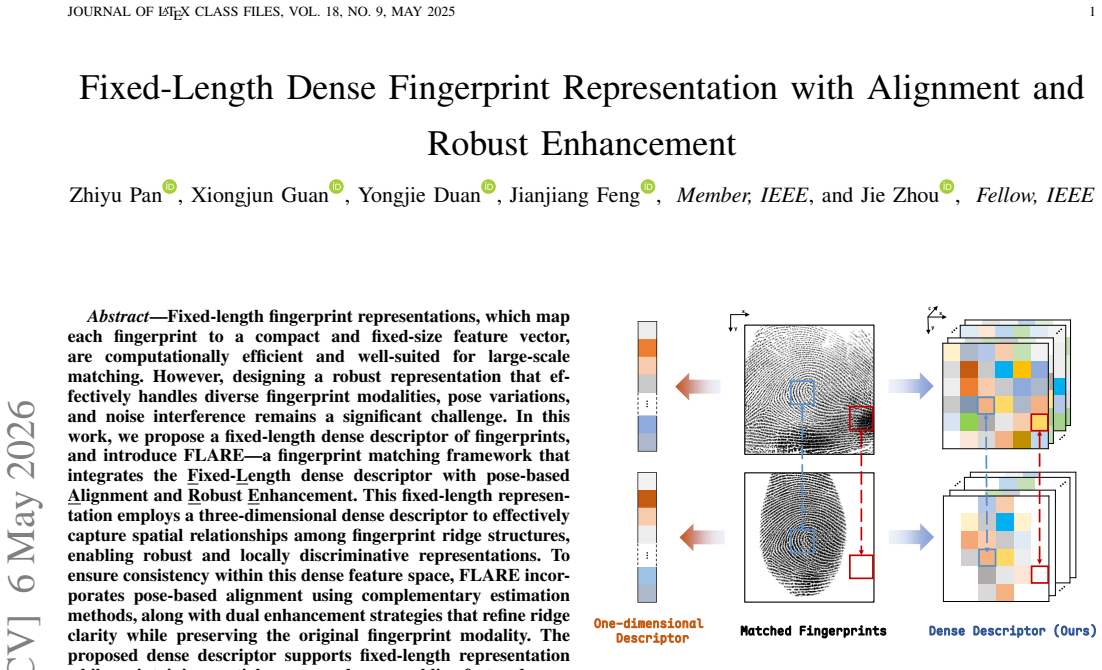
FLARE integrates a fixed-length dense descriptor that captures spatial relationships among fingerprint ridge structures to produce robust and locally discriminative representations. Complementary pose estimation methods together with dual enhancement strategies maintain consistency and modality preservation in the feature space. The resulting representation supports fixed-length vectors while retaining spatial correspondence, enabling fast and accurate similarity computation that outperforms existing methods across rolled, plain, latent, and contactless fingerprints, especially in cross-modality and low-quality scenarios.
What carries the argument
The three-dimensional dense descriptor that captures spatial relationships among fingerprint ridge structures, producing a fixed-length representation with preserved spatial correspondence for direct similarity computation.
If this is right
- Fixed-length vectors with spatial correspondence allow direct and fast similarity computation without variable-length alignment overhead.
- Superior matching accuracy holds across rolled, plain, latent, and contactless fingerprints.
- Performance gains are largest in cross-modality and low-quality conditions compared with prior representations.
- Ablation results confirm that both alignment and enhancement modules contribute to the accuracy of the dense descriptor matching.
Where Pith is reading between the lines
- Fixed-length dense vectors could lower storage and search costs in large-scale fingerprint databases.
- The spatial correspondence property may support localized verification or visualization of matched ridge regions.
- The design might transfer to other ridge-based biometrics such as palmprints when similar alignment and enhancement steps are applied.
Load-bearing premise
The three-dimensional dense descriptor captures spatial relationships among ridge structures to yield robust and locally discriminative representations while pose alignment and dual enhancement keep features consistent across modalities.
What would settle it
On standard mixed-modality fingerprint benchmarks, removing the dense descriptor, alignment module, or enhancement steps produces no measurable drop in matching accuracy for low-quality or cross-modality pairs.
Figures


read the original abstract
Fixed-length fingerprint representations, which map each fingerprint to a compact and fixed-size feature vector, are computationally efficient and well-suited for large-scale matching. However, designing a robust representation that effectively handles diverse fingerprint modalities, pose variations, and noise interference remains a significant challenge. In this work, we propose a fixed-length dense descriptor of fingerprints, and introduce FLARE-a fingerprint matching framework that integrates the Fixed-Length dense descriptor with pose-based Alignment and Robust Enhancement. This fixed-length representation employs a three-dimensional dense descriptor to effectively capture spatial relationships among fingerprint ridge structures, enabling robust and locally discriminative representations. To ensure consistency within this dense feature space, FLARE incorporates pose-based alignment using complementary estimation methods, along with dual enhancement strategies that refine ridge clarity while preserving the original fingerprint modality. The proposed dense descriptor supports fixed-length representation while maintaining spatial correspondence, enabling fast and accurate similarity computation. Extensive experiments demonstrate that FLARE achieves superior performance across rolled, plain, latent, and contactless fingerprints, significantly outperforming existing methods in cross-modality and low-quality scenarios. Further analysis validates the effectiveness of the dense descriptor design, as well as the impact of alignment and enhancement modules on the accuracy of dense descriptor matching. Experimental results highlight the effectiveness and generalizability of FLARE as a unified and scalable solution for robust fingerprint representation and matching. The implementation and code will be publicly available at https://github.com/Yu-Yy/FLARE.
Editorial analysis
A structured set of objections, weighed in public.
Referee Report
Summary. The manuscript proposes FLARE, a fingerprint matching framework that combines a fixed-length dense descriptor based on a three-dimensional representation to capture spatial ridge relationships, pose-based alignment using complementary estimation methods, and dual enhancement strategies to preserve modality while refining ridge clarity. It claims this enables fast similarity computation and superior performance over existing methods across rolled, plain, latent, and contactless fingerprints, especially in cross-modality and low-quality scenarios, with supporting experiments and planned public code release.
Significance. If the empirical results hold and the design choices are shown to be necessary, the work could provide a practical, scalable fixed-length representation for large-scale fingerprint systems that unifies handling of diverse modalities and noise levels.
major comments (2)
- [Abstract] Abstract: The central performance claim rests on the assertion that the three-dimensional dense descriptor 'effectively capture[s] spatial relationships among fingerprint ridge structures' to produce 'robust and locally discriminative representations' that survive fixed-length encoding and cross-modality alignment. No derivation, necessity argument, or ablation is supplied showing that the 3D construction is required or that the fixed-length step preserves the claimed local spatial correspondences rather than collapsing them.
- [Abstract] Abstract: The manuscript states that 'extensive experiments demonstrate that FLARE achieves superior performance' and 'significantly outperforming existing methods,' yet provides no quantitative tables, dataset details, baseline descriptions, or statistical significance tests in the visible text. This leaves the support for the cross-modality and low-quality superiority claims unverifiable from the supplied material.
Simulated Author's Rebuttal
We thank the referee for the constructive feedback on our manuscript. The comments highlight opportunities to better connect the abstract claims to the supporting material in the full paper. We address each point below and have revised the abstract accordingly to improve clarity and verifiability.
read point-by-point responses
-
Referee: [Abstract] Abstract: The central performance claim rests on the assertion that the three-dimensional dense descriptor 'effectively capture[s] spatial relationships among fingerprint ridge structures' to produce 'robust and locally discriminative representations' that survive fixed-length encoding and cross-modality alignment. No derivation, necessity argument, or ablation is supplied showing that the 3D construction is required or that the fixed-length step preserves the claimed local spatial correspondences rather than collapsing them.
Authors: We appreciate the referee's call for stronger justification of the 3D design. The full manuscript motivates and derives the three-dimensional dense descriptor in Section 3.1, explaining how the additional dimension encodes spatial ridge relationships beyond standard 2D representations. Section 4.3 provides ablation experiments that compare the 3D descriptor against 2D baselines, confirming improved local discriminability and cross-modality robustness. Section 3.3 further details how the dense feature maps retain spatial correspondences prior to fixed-length encoding, avoiding collapse of local structure. We have updated the abstract to reference these analyses explicitly. revision: yes
-
Referee: [Abstract] Abstract: The manuscript states that 'extensive experiments demonstrate that FLARE achieves superior performance' and 'significantly outperforming existing methods,' yet provides no quantitative tables, dataset details, baseline descriptions, or statistical significance tests in the visible text. This leaves the support for the cross-modality and low-quality superiority claims unverifiable from the supplied material.
Authors: We agree that the abstract, being a concise summary, does not include numerical results or dataset specifics. The full manuscript presents these in Section 4, with tables reporting performance across rolled, plain, latent, and contactless datasets, baseline comparisons, and relevant statistical details. To make the superiority claims more immediately verifiable, we have incorporated key quantitative highlights and dataset references into the revised abstract. revision: yes
Circularity Check
No circularity: empirical integration validated by experiments
full rationale
The paper presents FLARE as an empirical framework combining a 3D dense descriptor, pose-based alignment, and dual enhancement strategies, with performance claims supported by extensive experiments across modalities rather than any mathematical derivation chain. No equations, fitted parameters renamed as predictions, or self-citation load-bearing steps are present in the provided text that would reduce the central claims to inputs by construction. The design choices are justified through ablation studies and cross-modality results, making the work self-contained against external benchmarks without circular reductions.
Axiom & Free-Parameter Ledger
Lean theorems connected to this paper
-
IndisputableMonolith/Foundation/AlexanderDuality.leanalexander_duality_circle_linking unclear?
unclearRelation between the paper passage and the cited Recognition theorem.
This fixed-length representation employs a three-dimensional dense descriptor to effectively capture spatial relationships among fingerprint ridge structures
-
IndisputableMonolith/Cost/FunctionalEquation.leanwashburn_uniqueness_aczel unclear?
unclearRelation between the paper passage and the cited Recognition theorem.
FLARE incorporates pose-based alignment using complementary estimation methods, along with dual enhancement strategies
What do these tags mean?
- matches
- The paper's claim is directly supported by a theorem in the formal canon.
- supports
- The theorem supports part of the paper's argument, but the paper may add assumptions or extra steps.
- extends
- The paper goes beyond the formal theorem; the theorem is a base layer rather than the whole result.
- uses
- The paper appears to rely on the theorem as machinery.
- contradicts
- The paper's claim conflicts with a theorem or certificate in the canon.
- unclear
- Pith found a possible connection, but the passage is too broad, indirect, or ambiguous to say the theorem truly supports the claim.
Reference graph
Works this paper leans on
-
[1]
D. Maltoni, D. Maio, A. K. Jain, and J. Feng,Handbook of Fingerprint Recognition, 3rd ed. Springer Nature, Cham, Switzerland, 2022
work page 2022
-
[2]
An introduction to biometric recognition,
A. Jain, A. Ross, and S. Prabhakar, “An introduction to biometric recognition,”IEEE Transactions on Circuits and Systems for Video Technology, vol. 14, no. 1, pp. 4–20, 2004
work page 2004
-
[3]
FingerCode: A filterbank for fingerprint representation and matching,
A. K. Jain, S. Prabhakar, L. Hong, and S. Pankanti, “FingerCode: A filterbank for fingerprint representation and matching,” inProceedings of the IEEE/CVF Conference on Computer Vision and Pattern Recognition, vol. 2. IEEE, 1999, pp. 187–193
work page 1999
-
[4]
Y . Wang, J. Hu, and D. Phillips, “A fingerprint orientation model based on 2D Fourier expansion (FOMFE) and its application to singular- point detection and fingerprint indexing,”IEEE Transactions on Pattern Analysis and Machine Intelligence, vol. 29, no. 4, pp. 573–585, 2007
work page 2007
-
[5]
Contactless fingerprint identification using level zero features,
A. Kumar and Y . Zhou, “Contactless fingerprint identification using level zero features,” inProceedings of the IEEE/CVF Conference on Computer Vision and Pattern Recognition WorkShop, 2011, pp. 114– 119
work page 2011
-
[6]
Binary feature vector fingerprint repre- sentation from minutiae vicinities,
J. Bringer and V . Despiegel, “Binary feature vector fingerprint repre- sentation from minutiae vicinities,” in2010 F ourth IEEE International Conference on Biometrics: Theory, Applications and Systems, 2010, pp. 1–6
work page 2010
-
[7]
Minutia Cylinder-Code: A new representation and matching technique for fingerprint recognition,
R. Cappelli, M. Ferrara, and D. Maltoni, “Minutia Cylinder-Code: A new representation and matching technique for fingerprint recognition,”IEEE Transactions on Pattern Analysis and Machine Intelligence, vol. 32, no. 12, pp. 2128–2141, 2010
work page 2010
-
[8]
PFVNet: A partial fingerprint verification network learned from large fingerprint matching,
Z. He, J. Zhang, L. Pang, and E. Liu, “PFVNet: A partial fingerprint verification network learned from large fingerprint matching,”IEEE Transactions on Information F orensics and Security, vol. 17, pp. 3706– 3719, 2022
work page 2022
-
[9]
Ifvit: Interpretable fixed-length representation for fingerprint matching via vision transformer,
Y . Qiu, H. Chen, X. Dong, Z. Lin, I. Yi Liao, M. Tistarelli, and Z. Jin, “Ifvit: Interpretable fixed-length representation for fingerprint matching via vision transformer,”IEEE Transactions on Information F orensics and Security, vol. 20, pp. 559–573, 2025
work page 2025
-
[10]
Joint identity verification and pose alignment for partial fingerprints,
X. Guan, Z. Pan, J. Feng, and J. Zhou, “Joint identity verification and pose alignment for partial fingerprints,”IEEE Transactions on Information F orensics and Security, vol. 20, pp. 249–263, 2025
work page 2025
-
[11]
Automated latent fingerprint recognition,
K. Cao and A. K. Jain, “Automated latent fingerprint recognition,”IEEE Transactions on Pattern Analysis and Machine Intelligence, vol. 41, no. 4, pp. 788–800, 2019
work page 2019
-
[12]
MinNet: Minutia patch em- bedding network for automated latent fingerprint recognition,
H. ˙I. ¨Ozt¨urk, B. Selbes, and Y . Artan, “MinNet: Minutia patch em- bedding network for automated latent fingerprint recognition,” in2022 IEEE/CVF Conference on Computer Vision and Pattern Recognition Workshops, 2022, pp. 1626–1634
work page 2022
-
[13]
Latent fingerprint matching via dense minutia descriptor,
Z. Pan, Y . Duan, X. Guan, J. Feng, and J. Zhou, “Latent fingerprint matching via dense minutia descriptor,” in2024 IEEE International Joint Conference on Biometrics (IJCB), 2024, pp. 1–10
work page 2024
-
[14]
Fingerprint indexing and matching: An integrated approach,
K. Cao and A. K. Jain, “Fingerprint indexing and matching: An integrated approach,” in2017 IEEE International Joint Conference on Biometrics, 2017, pp. 437–445
work page 2017
-
[15]
Fingerprint indexing based on pyramid deep convolutional feature,
D. Song and J. Feng, “Fingerprint indexing based on pyramid deep convolutional feature,” in2017 IEEE International Joint Conference on Biometrics (IJCB), 2017, pp. 200–207
work page 2017
-
[16]
Learning a fixed-length fingerprint representation,
J. J. Engelsma, K. Cao, and A. K. Jain, “Learning a fixed-length fingerprint representation,”IEEE Transactions on Pattern Analysis and Machine Intelligence, vol. 43, no. 6, pp. 1981–1997, 2021
work page 1981
-
[17]
AFR-Net: Attention-driven fingerprint recognition network,
S. A. Grosz and A. K. Jain, “AFR-Net: Attention-driven fingerprint recognition network,”IEEE Transactions on Biometrics, Behavior , and Identity Science, vol. 6, no. 1, pp. 30–42, 2024
work page 2024
-
[18]
Latent fingerprint recognition: Fusion of local and global em- beddings,
——, “Latent fingerprint recognition: Fusion of local and global em- beddings,”IEEE Transactions on Information F orensics and Security, vol. 18, pp. 5691–5705, 2023
work page 2023
-
[19]
Latent fingerprint indexing: Robust representation and adaptive candidate list,
S. Gu, J. Feng, J. Lu, and J. Zhou, “Latent fingerprint indexing: Robust representation and adaptive candidate list,”IEEE Transactions on Information F orensics and Security, vol. 17, pp. 908–923, 2022
work page 2022
-
[20]
Robust partial fingerprint recognition,
Y . Zhang, R. Zhao, Z. Zhao, N. Ramakrishnan, M. Aggarwal, G. Medioni, and Q. Ji, “Robust partial fingerprint recognition,” in Proceedings of the IEEE/CVF Conference on Computer Vision and Pattern Recognition, 2023, pp. 1011–1020
work page 2023
-
[21]
Detection and rectification of distorted fingerprints,
X. Si, J. Feng, J. Zhou, and Y . Luo, “Detection and rectification of distorted fingerprints,”IEEE Transactions on Pattern Analysis and Machine Intelligence, vol. 37, no. 3, pp. 555–568, 2015
work page 2015
-
[22]
Fingerprint pose estimation based on faster r-cnn,
J. Ouyang, J. Feng, J. Lu, Z. Guo, and J. Zhou, “Fingerprint pose estimation based on faster r-cnn,” in2017 IEEE International Joint Conference on Biometrics (IJCB), 2017, pp. 268–276. JOURNAL OF LATEX CLASS FILES, VOL. 18, NO. 9, MAY 2025 15
work page 2017
-
[23]
Joint estimation of pose and singular points of fingerprints,
Q. Yin, J. Feng, J. Lu, and J. Zhou, “Joint estimation of pose and singular points of fingerprints,”IEEE Transactions on Information F orensics and Security, vol. 16, pp. 1467–1479, 2021
work page 2021
-
[24]
Estimating fingerprint pose via dense voting,
Y . Duan, J. Feng, J. Lu, and J. Zhou, “Estimating fingerprint pose via dense voting,”IEEE Transactions on Information F orensics and Security, vol. 18, pp. 2493–2507, 2023
work page 2023
-
[25]
Finger pose estimation for under- screen fingerprint sensor,
X. Guan, Z. Pan, J. Feng, and J. Zhou, “Finger pose estimation for under- screen fingerprint sensor,”arXiv preprint arXiv:2505.02481, 2025
-
[26]
Neurotechnology. VeriFinger SDK. Accessed: Apr. 18, 2025. [Online]. Available: https://www.neurotechnology.com/verifinger.html
work page 2025
-
[27]
FingerGAN: A constrained fingerprint gen- eration scheme for latent fingerprint enhancement,
Y . Zhu, X. Yin, and J. Hu, “FingerGAN: A constrained fingerprint gen- eration scheme for latent fingerprint enhancement,”IEEE Transactions on Pattern Analysis and Machine Intelligence, vol. 45, no. 7, pp. 8358– 8371, 2023
work page 2023
-
[28]
FingerNet: An unified deep network for fingerprint minutiae extraction,
Y . Tang, F. Gao, J. Feng, and Y . Liu, “FingerNet: An unified deep network for fingerprint minutiae extraction,” in2017 IEEE International Joint Conference on Biometrics. IEEE, 2017, pp. 108–116
work page 2017
-
[29]
Latent fingerprint image enhancement based on progressive generative adversarial network,
X. Huang, P. Qian, and M. Liu, “Latent fingerprint image enhancement based on progressive generative adversarial network,” in2020 IEEE/CVF Conference on Computer Vision and Pattern Recognition Workshops (CVPRW), 2020, pp. 3481–3489
work page 2020
-
[30]
U-net: Convolutional networks for biomedical image segmentation,
O. Ronneberger, P. Fischer, and T. Brox, “U-net: Convolutional networks for biomedical image segmentation,” inMedical image computing and computer-assisted intervention–MICCAI 2015: 18th international con- ference, Munich, Germany, October 5-9, 2015, proceedings, part III 18. Springer, 2015, pp. 234–241
work page 2015
-
[31]
Neural discrete representation learning,
A. van den Oord, O. Vinyals, and K. Kavukcuoglu, “Neural discrete representation learning,” inProceedings of the 31st International Con- ference on Neural Information Processing Systems, ser. NIPS’17. Red Hook, NY , USA: Curran Associates Inc., 2017, p. 6309–6318
work page 2017
-
[32]
Fixed-length dense descriptor for efficient fingerprint matching,
Z. Pan, Y . Duan, J. Feng, and J. Zhou, “Fixed-length dense descriptor for efficient fingerprint matching,” in2024 IEEE International Workshop on Information F orensics and Security (WIFS), 2024, pp. 1–6
work page 2024
-
[33]
Fingerprint indexing based on pyramid deep convolutional feature,
D. Song and J. Feng, “Fingerprint indexing based on pyramid deep convolutional feature,” in2017 IEEE International Joint Conference on Biometrics. IEEE, 2017, pp. 200–207
work page 2017
-
[34]
Aggregating minutia-centred deep convolutional features for fingerprint indexing,
D. Song, Y . Tang, and J. Feng, “Aggregating minutia-centred deep convolutional features for fingerprint indexing,”Pattern Recognition, vol. 88, pp. 397–408, 2019
work page 2019
-
[35]
Minutiae-awarely learning fingerprint representation for fingerprint indexing,
S. Wu, B. Liu, Z. Wang, Z. Jia, and J. Feng, “Minutiae-awarely learning fingerprint representation for fingerprint indexing,” in2022 IEEE International Joint Conference on Biometrics, pp. 1–8
-
[36]
Localization of corresponding points in fingerprints by complex filtering,
K. Nilsson and J. Bigun, “Localization of corresponding points in fingerprints by complex filtering,”Pattern Recognition Letters, vol. 24, no. 13, pp. 2135–2144, 2003
work page 2003
-
[37]
Reference point detection for fingerprint recognition,
X. Jiang, M. Liu, and A. Kot, “Reference point detection for fingerprint recognition,” inProceedings of the 17th International Conference on Pattern Recognition, 2004. ICPR 2004., vol. 1, 2004, pp. 540–543 V ol.1
work page 2004
-
[38]
On the spatial distribution of fingerprint singularities,
R. Cappelli and D. Maltoni, “On the spatial distribution of fingerprint singularities,”IEEE Transactions on Pattern Analysis and Machine Intelligence, vol. 31, no. 4, pp. 742–448, 2009
work page 2009
-
[39]
Localized dictionaries based orientation field estimation for latent fingerprints,
X. Yang, J. Feng, and J. Zhou, “Localized dictionaries based orientation field estimation for latent fingerprints,”IEEE Transactions on Pattern Analysis and Machine Intelligence, vol. 36, no. 5, pp. 955–969, 2014
work page 2014
-
[40]
Efficient rectification of distorted fingerprints,
S. Gu, J. Feng, J. Lu, and J. Zhou, “Efficient rectification of distorted fingerprints,”IEEE Transactions on Information F orensics and Security, vol. 13, no. 1, pp. 156–169, 2018
work page 2018
-
[41]
Semi-automatic enhancement of very low quality fingerprints,
R. Cappelli, D. Maio, and D. Maltoni, “Semi-automatic enhancement of very low quality fingerprints,” in2009 Proceedings of 6th International Symposium on Image and Signal Processing and Analysis, 2009, pp. 678–683
work page 2009
-
[42]
Orientation field estimation for latent fingerprint enhancement,
J. Feng, J. Zhou, and A. K. Jain, “Orientation field estimation for latent fingerprint enhancement,”IEEE Transactions on Pattern Analysis and Machine Intelligence, vol. 35, no. 4, pp. 925–940, 2013
work page 2013
-
[43]
Detecting texts of arbitrary orientations in natural images,
C. Yao, X. Bai, W. Liu, Y . Ma, and Z. Tu, “Detecting texts of arbitrary orientations in natural images,” in2012 IEEE Conference on Computer Vision and Pattern Recognition, 2012, pp. 1083–1090
work page 2012
-
[44]
Bid dataset: a challenge dataset for document processing tasks,
A. de S ´a Soares, R. B. das Neves Junior, and B. L. D. Bezerra, “Bid dataset: a challenge dataset for document processing tasks,” in Conference on Graphics, Patterns and Images (SIBGRAPI). SBC, 2020, pp. 143–146
work page 2020
-
[45]
The mnist database of handwritten digit images for machine learning research,
L. Deng, “The mnist database of handwritten digit images for machine learning research,”IEEE Signal Processing Magazine, vol. 29, no. 6, pp. 141–142, 2012
work page 2012
-
[46]
Conditional image generation with pixelcnn decoders,
A. v. d. Oord, N. Kalchbrenner, O. Vinyals, L. Espeholt, A. Graves, and K. Kavukcuoglu, “Conditional image generation with pixelcnn decoders,” inProceedings of the 30th International Conference on Neural Information Processing Systems, ser. NIPS’16. Red Hook, NY , USA: Curran Associates Inc., 2016, pp. 4797–4805
work page 2016
-
[47]
Recovering realistic texture in image super-resolution by deep spatial feature transform,
X. Wang, K. Yu, C. Dong, and C. C. Loy, “Recovering realistic texture in image super-resolution by deep spatial feature transform,” inProceedings of the IEEE conference on computer vision and pattern recognition, 2018, pp. 606–615
work page 2018
-
[48]
The unreasonable effectiveness of deep features as a perceptual metric,
R. Zhang, P. Isola, A. A. Efros, E. Shechtman, and O. Wang, “The unreasonable effectiveness of deep features as a perceptual metric,” in 2018 IEEE/CVF Conference on Computer Vision and Pattern Recogni- tion, 2018, pp. 586–595
work page 2018
-
[49]
Deep residual learning for image recognition,
K. He, X. Zhang, S. Ren, and J. Sun, “Deep residual learning for image recognition,” inProceedings of the IEEE conference on computer vision and pattern recognition, 2016, pp. 770–778
work page 2016
-
[50]
A. Vaswani, N. Shazeer, N. Parmar, J. Uszkoreit, L. Jones, A. N. Gomez, Ł. Kaiser, and I. Polosukhin, “Attention is all you need,”Advances in Neural Information Processing Systems, vol. 30, 2017
work page 2017
-
[51]
Cosface: Large margin cosine loss for deep face recognition,
H. Wang, Y . Wang, Z. Zhou, X. Ji, D. Gong, J. Zhou, Z. Li, and W. Liu, “Cosface: Large margin cosine loss for deep face recognition,” inProceedings of the IEEE conference on computer vision and pattern recognition, 2018, pp. 5265–5274
work page 2018
-
[52]
Decoupled Weight Decay Regularization
I. Loshchilov and F. Hutter, “Decoupled weight decay regularization,” arXiv preprint arXiv:1711.05101, 2017
work page internal anchor Pith review Pith/arXiv arXiv 2017
-
[53]
Fingerprint indexing with pose constraint,
Y . Su, J. Feng, and J. Zhou, “Fingerprint indexing with pose constraint,” Pattern Recognition, vol. 54, pp. 1–13, 2016
work page 2016
-
[54]
G. Fiumara, P. Flanagan, J. Grantham, K. Ko, K. Marshall, M. Schwarz, E. Tabassi, B. Woodgate, and C. Boehnen, “National institute of stan- dards and technology special database 302: Nail to nail fingerprint challenge,”Technical Note 2007, National Institute of Standards and Technology, 2018
work page 2007
-
[55]
Monocular 3D fingerprint reconstruction and unwarping,
Z. Cui, J. Feng, and J. Zhou, “Monocular 3D fingerprint reconstruction and unwarping,”IEEE Transactions on Pattern Analysis and Machine Intelligence, vol. 45, no. 7, pp. 8679–8695, 2023
work page 2023
-
[56]
3D fingerprint reconstruction system using feature correspondences and prior estimated finger model,
F. Liu and D. Zhang, “3D fingerprint reconstruction system using feature correspondences and prior estimated finger model,”Pattern Recognition, vol. 47, no. 1, pp. 178–193, 2014. JOURNAL OF LATEX CLASS FILES, VOL. 18, NO. 9, MAY 2025 1 Supplementary Material VII. SUPPLEMENTARYIMPLEMENTATIONDETAILS FOR POSE ANDENHANCEMENTAUGMENTATION In the main paper, we ...
work page 2014
-
[57]
as the baseline, we train its pose estimation module under different augmentation settings. The results show that models trained with background-pattern augmentation consis- tently achieve better descriptor-level matching performance than those trained without it, with particularly notable im- provements on latent fingerprint datasets. To simulate backgro...
work page 2025
discussion (0)
Sign in with ORCID, Apple, or X to comment. Anyone can read and Pith papers without signing in.