REVIEW 5 major objections 7 minor 41 references
Meta-Learning the Optimal Mixture of Strategies for Online Portfolio Selection
T0 review · 5 major / 7 minor · reviewed 2026-08-15 · deepseek-v4-flash
Pith's one-line read A small meta-learned network that decides how to weight a pool of classic portfolio strategies can beat all 14 baselines on six stock datasets, including when trained in one set of markets and tested in another.
desk verdict A coherent MAML-plus-mixture method for portfolio selection with a genuinely new cross-market transfer test, but the empirical claims are overstated and the training label is never tied to any wealth objective. read the letter →
The pith
A machine-rendered reading of the paper's core claim, the machinery that carries it, and where it could break.
The reading
What carries the argument
The load-bearing object is the hindsight label \hat{\omega}_t, computed from realized policy returns in the same period. It turns the online portfolio problem into supervised regression: a two-layer LSTM with a two-head self-attention layer and softmax outputs maps the last w return vectors of M candidate policies to a predicted mixture weight \omega_t. MAML supplies the initialization: for each short task, the support set of K=10 days is used for one gradient-descent step, and the query set updates the meta-parameters, so the final test-time adaptation is a single gradient step on ten days of local data. The candidate policies are chosen by k-means clustering on their historical return sequences, keeping the best-performing policy per cluster. The loss function combines the squared error to the label, a regularizer that encourages diversified weights, and an \$ell^{1}$ penalty on portfolio turnover to account for transaction costs.
What would settle it
Compute the realized correlation between the network's predicted \omega_t and the hindsight label \hat{\omega}_t on a held-out period. If the correlation is near zero or negative while cumulative wealth still beats the baselines, the reported gains are not coming from learning the stated label. Alternatively, backtest the label itself as a portfolio rule and compare its wealth to a simple equal-weight mixture of the same candidate policies; if \hat{\omega}_t does not beat equal weighting, the training target is not a wealth-maximizing allocation.
Extended reading notes
Core claim
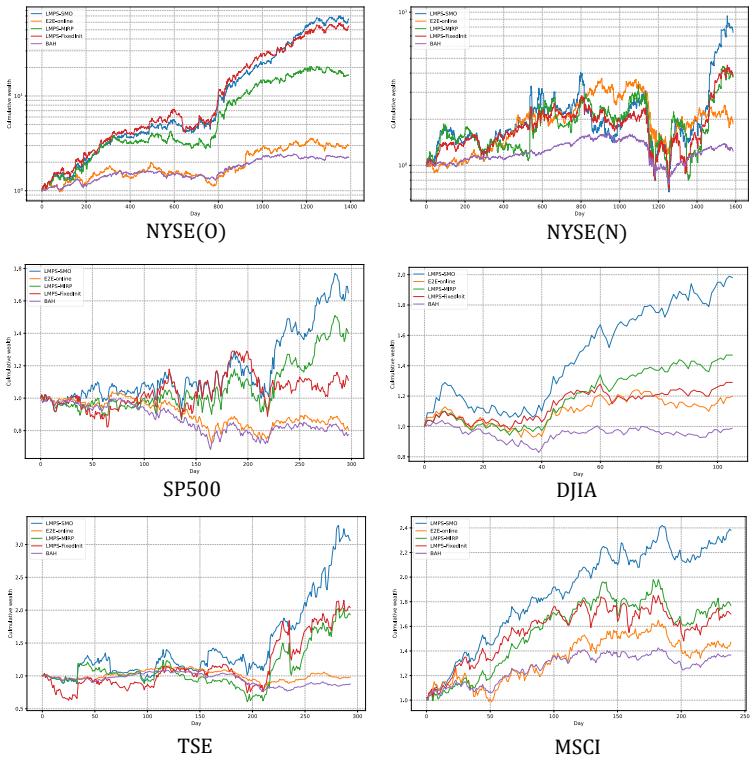
The central claim is that the 'optimal' mixture weights over candidate strategies can be learned by supervised meta-learning. For each period, the paper defines a hindsight label \hat{\omega}^j_t = (r^j_t - \min_j r^j_t)/(\sum_j r^j_t - M\min_j r^j_t), the normalized excess return of policy j in period t, and trains the network to predict \omega_t from the past w return vectors. The final portfolio is the weighted average of the candidate portfolios, b_t = \sum_j \omega^j_t b^j_t, so the learning problem is independent of the number of assets and can transfer across stock pools. The paper reports that this pipeline, with candidate policies chosen by clustering the policy pool by return similarity, beats all individual candidates and baselines on six datasets, with cross-market transfer results on TSE (cumulative wealth 149.57) and MSCI (6.73) against best single candidate PAMR (95.07 and 5.91).
Load-bearing premise
The whole pipeline rests on the assumption that the hindsight-normalized return vector \hat{\omega}_t is both predictable from the past w returns and a faithful stand-in for the allocation that maximizes future wealth.
Editorial extensions
If this is right
- If the central claim holds, an investor can maintain a library of classic strategies and use a single small network to allocate among them, rather than committing to one strategy's market assumptions.
- Because the network's input is policy returns and output is mixture weights, the same trained initialization transfers to markets with different numbers of assets; the paper's cross-market experiment is direct evidence.
- The ten-day support set means deployment adaptation is cheap: after meta-training, a new market needs roughly two weeks of local data before the adapted network produces allocations.
- Ablations show both meta-training and test-time adaptation are needed: random initialization (LMPS-MIRP) and no adaptation (LMPS-FixedInit) underperform the full method, so the MAML initialization is doing real work.
Reading between the lines
- A natural next test is to replace the hindsight-normalized label with a wealth-maximizing target, such as the weights that maximize log-wealth over the coming period; if the network still beats baselines, the success is robust to the label choice, and if not, the label is the bottleneck.
- Because the prediction target is constructed from contemporaneous returns, the supervised task may be partially self-fulfilling in trending markets: a policy that happened to win yesterday will have a high label again tomorrow. Separating label-prediction accuracy from raw portfolio performance would clarify the mechanism.
- The method opens a concrete high-frequency use case: policy return sequences can be computed at the same frequency as the price data, and a single gradient step on ten observations is quick; the paper's reported low training time is consistent with that direction.
Signed reviews
Editorial analysis
A structured set of objections, weighed in public.
Referee Report
Summary. The manuscript proposes Meta-LMPS-Online, a meta-learning framework for online portfolio selection. The method maintains a pool of M classic OLPS algorithms chosen by clustering historical return sequences, and trains an LSTM-with-attention network under MAML to output mixture weights over those candidate policies. Long investment horizons are split into short tasks; meta-training learns an initialization and meta-testing adapts the parameters on a K-sample support set before predicting each period's mixture weights. Two variants are presented: LMPS-SMO for single-market training/testing and LMPS-CMO for cross-market training. Experiments on six public OLPS datasets compare against 14 baselines and include ablations (E2E-online, LMPS-MIRP, LMPS-FixedInit). The main claim is that the meta-learned mixture policies achieve higher cumulative wealth and Sharpe ratios than the candidate policies and traditional strategies, including in cross-market transfer, while requiring less training data and time.
Significance. The framework is well motivated: learning mixture weights rather than asset weights makes the model independent of the stock-pool size and facilitates transfer across markets, which is a genuine advantage over end-to-end deep portfolio models. The paper provides explicit algorithms and ablations that separately isolate the contributions of meta-training, meta-testing, and the mixture-policy framework, and it uses public OLPS datasets. If the empirical claims were fully supported, the method would be a useful addition to the online portfolio selection literature. However, as detailed below, the optimality framing, the empirical dominance claim, and the reproducibility of the reported numbers require substantial additional support before the results can be taken at face value.
major comments (5)
- [Section 3.1, Eq. (3) and 'Data and labels'] The supervised label \hat{\omega}_t is defined as a one-period hindsight normalization of realized candidate returns: \hat{\omega}^j_t = (r^j_t - \min_j r^j_t)/(\sum_j r^j_t - M \min_j r^j_t). This quantity is not the maximizer of cumulative wealth, log-wealth, or the loss in Eq. (3), and the paper provides no evidence that it is learnable from the past w returns or that regression onto it yields wealth-maximizing allocations. Because the title and the central narrative use the word "optimal," this gap is load-bearing. The authors should either establish a connection between this label and the wealth objective, or reframe the method as learning a heuristic supervised target and add an ablation comparing alternative label constructions.
- [Section 4.2, Table 5] The claimed superiority over traditional OLPS strategies in cross-market tests is contradicted by the authors' own table. On MSCI, LMPS-CMO has cumulative wealth 6.73 and Sharpe 13.30, while RMR has 8.09 and 13.51 and OLMAR has 7.76 and 13.10. The paper's contribution statement that numerical results "valid the superiority of the proposed algorithm over traditional OLPS strategies" is therefore not supported as written. The claims should be restricted to what the tables actually show, and the cross-market results should be discussed dataset by dataset.
- [Section 4.1 and Eq. (3)] The loss function in Eq. (3) contains hyperparameters \eta and \lambda whose values are never reported, and the experiments report a single run with no random seeds, error bars, or statistical tests. Several comparisons in Tables 4 and 5 are close (for example, the MSCI Sharpe values 13.30, 13.10, 13.51), so the ranking could plausibly change across seeds or initialization. The authors should report all hyperparameters, run multiple seeds, and report the mean and spread of the performance metrics.
- [Algorithms 2 and 3, lines 16 and 20] The support-set construction is written as T^sup_l = {[r_{l+t-w},..., r_{l+t-1}]; \hat{\omega}_{l+t}}^{-1}_{i=-K}, which on its face places the label \hat{\omega}_{l+t} at a future period l+t. If this is implemented literally, the online adaptation step would use future information and the out-of-sample results would have look-ahead bias. The indexing must be rewritten unambiguously (for example with an explicit backward index t = -K,...,-1) and the text should state clearly that only data strictly before period l are used for adaptation and prediction at period l.
- [Section 4.2, Tables 6 and 7] The reported "Sharpe ratio" appears to be computed as annualized return divided by annualized volatility rather than the standard excess-return-to-volatility Sharpe ratio. For the DJIA row, 400.82/1.90 = 210.96, which is close to the reported 208.71. In addition, the DJIA row reports annualized return 400.82% with cumulative wealth 2.00 over a test period that is only one quarter of the dataset, which is inconsistent with the usual annualization of simple returns. The authors should state the exact formulas used for annualized return, annualized volatility, and Sharpe ratio, and recompute the tables if the metrics are nonstandard.
minor comments (7)
- [Tables 5, 6, 7] The word "Culmulative" should be corrected to "Cumulative."
- [Table 7] The second block of the table is labeled "TSE" but contains the MSCI rows; the dataset label should be "MSCI."
- [Section 3.2] The phrase "refWe refer to this investment portfolio management algorithm" should read "We refer..."
- [Figures 4 and 5] Figures 4 and 5 appear as garbled placeholders in the submitted manuscript, and their captions are incomplete. They should be replaced with readable diagrams.
- [Table 1] The notation entry for S_t is incomplete; it should define cumulative wealth at the start or end of period t and should also define the initial wealth S_0.
- [Table 3] The "Time Interval" column contains only lengths (5651, 6431, ...) rather than actual date intervals; the actual calendar periods should be listed.
- [Section 4.1] The phrase "The epoch of each task is 20" is ambiguous; the authors should specify the number of meta-training epochs and the number of inner-loop gradient steps separately.
Circularity Check
No circularity: the meta-learned mixture weights are trained on a hindsight-normalized return label, but the reported wealth and Sharpe results are evaluated out-of-sample and are not implied by that label construction.
full rationale
The paper's derivation chain is not circular. In Section 3.1, the supervised target is defined as \hat\omega_t^j = (r_t^j - \min_j r_t^j)/(\sum_j r_t^j - M \min_j r_t^j), i.e., a contemporaneous normalization of the candidate policies' realized returns. The network is trained to predict this label from past returns, and the paper never proves that this label maximizes any stated wealth or log-wealth objective. That is a weakness in the optimality justification, but it is not circularity: the reported cumulative wealth and Sharpe ratios are computed on held-out periods (the last quarter for LMPS-SMO, and TSE/MSCI for LMPS-CMO) from predicted mixture weights that use only past data. The wealth outcome is not equal by construction to the training label, and the meta-testing procedure does not leak the current-period label into the prediction. There are no load-bearing self-citations, no imported uniqueness theorem, and no fitted parameter that is renamed as a prediction; MAML and the classical OLPS policies are external published methods. The paper's prose overstates Table 5, since on MSCI both RMR and OLMAR achieve higher cumulative wealth than LMPS-CMO, but this is an internal-consistency or correctness issue rather than a circularity of the derivation chain.
Assumptions & free parameters
free parameters (10)
- M (number of candidate policies) =
4
- w (historical window) =
5
- K (support set size) =
10
- Q (query set size) =
1
- alpha (inner learning rate) =
0.001
- beta (meta learning rate) =
0.0005
- eta (diversification penalty weight in Eq. 3) =
not reported
- lambda (transaction cost penalty weight in Eq. 3) =
not reported
- Number of training epochs =
20
- Number of attention heads =
2
assumptions (4)
- domain assumption Financial time series are locally stationary within short windows of length K+w around a task.
- domain assumption The label \hat{\omega}_t, computed from the same-period realized returns of the candidate policies, is a learnable and appropriate training target for portfolio selection.
- domain assumption k-means clustering on policy return sequences identifies a set of high-performing, diverse policies whose mixture can approximate the optimal online portfolio.
- standard math Gradient-based optimization of the MAML objective converges to a useful initialization.
Cite this review
Pith. "Pith review of Meta-Learning the Optimal Mixture of Strategies for Online Portfolio Selection." pith.science (2026). https://pith.science/paper/WL6OAHSQ
@misc{pith2026250503659,
  author       = {Pith},
  title        = {Pith review of: Meta-Learning the Optimal Mixture of Strategies for Online Portfolio Selection},
  year         = {2026},
  howpublished = {\url{https://pith.science/paper/WL6OAHSQ}},
  note         = {Machine review of arXiv:2505.03659}
}
read the original abstract
This paper presents an innovative online portfolio selection model, situated within a meta-learning framework, that leverages a mixture policies strategy. The core idea is to simulate a fund that employs multiple fund managers, each skilled in handling different market environments, and dynamically allocate our funding to these fund managers for investment. To address the non-stationary nature of financial markets, we divide the long-term process into multiple short-term processes to adapt to changing environments. We use a clustering method to identify a set of historically high-performing policies, characterized by low similarity, as candidate policies. Additionally, we employ a meta-learning method to search for initial parameters that can quickly adapt to upcoming target investment tasks, effectively providing a set of well-suited initial strategies. Subsequently, we update the initial parameters using the target tasks and determine the optimal mixture weights for these candidate policies. Empirical tests show that our algorithm excels in terms of training time and data requirements, making it particularly suitable for high-frequency algorithmic trading. To validate the effectiveness of our method, we conduct numerical tests on cross-training datasets, demonstrating its excellent transferability and robustness.
Figures


Figures from the paper (6 more)



Reference graph
Works this paper leans on
- [1]
-
[2]
Fast universal- ization of investment strategies
Karhan Akcoglu, Petros Drineas, and Ming-Yang Kao. Fast universal- ization of investment strategies. SIAM Journal on Computing , 2004
work page 2004
-
[3]
Deep learning in stock portfolio selection and predic- tions
Chaher Alzaman. Deep learning in stock portfolio selection and predic- tions. Expert Systems with Applications , 2024
work page 2024
-
[4]
Can we learn to beat the best stock
Allan Borodin, Ran El-Yaniv, and Vincent Gogan. Can we learn to beat the best stock. In Advances in Neural Information Processing Systems , 2003
work page 2003
-
[5]
A portfolio construction framework using lstm-based stock markets forecasting
Zeynep Cipiloglu Yildiz and Selim Baha Yildiz. A portfolio construction framework using lstm-based stock markets forecasting. International Journal of Finance & Economics , 2022
work page 2022
-
[6]
Portfolio selection with trans- action costs
Mark HA Davis and Andrew R Norman. Portfolio selection with trans- action costs. Mathematics of Operations Research, 1990
work page 1990
-
[7]
Model-agnostic meta- learning for fast adaptation of deep networks
Chelsea Finn, Pieter Abbeel, and Sergey Levine. Model-agnostic meta- learning for fast adaptation of deep networks. In International Confer- ence on Machine Learning , 2017
work page 2017
-
[8]
Weighted moving average passive aggressive algorithm for online portfolio selection
Li Gao and Weiguo Zhang. Weighted moving average passive aggressive algorithm for online portfolio selection. In 2013 5th International Con- ference on Intelligent Human-Machine Systems and Cybernetics , 2013
work page 2013
Show all 41 references
-
[9]
Seeger, and C´ edric Archambeau
Riccardo Grazzi, Valentin Flunkert, David Salinas, Tim Januschowski, Matthias W. Seeger, and C´ edric Archambeau. Meta-forecasting by com- bining global deep representations with local adaptation. CoRR, 2021. 26
2021
-
[10]
Application of fea- tures and neural network to enhance the performance of deep reinforce- ment learning in portfolio management
Fengchen Gu, Zhengyong Jiang, and Jionglong Su. Application of fea- tures and neural network to enhance the performance of deep reinforce- ment learning in portfolio management. In 2021 IEEE 6th International Conference on Big Data Analytics (ICBDA) , 2021
2021
-
[11]
Fok, and Wai-Ki Ching
Sini Guo, Jiawen Gu, Christopher H. Fok, and Wai-Ki Ching. Online portfolio selection with state-dependent price estimators and transaction costs. European Journal of Operational Research, 2023
2023
-
[12]
Nonparametric kernel- based sequential investment strategies
L´ aszl´ o Gy¨ orfi, G´ abor Lugosi, and Frederic Udina. Nonparametric kernel- based sequential investment strategies. Mathematical Finance: An International Journal of Mathematics, Statistics and Financial Eco- nomics, 2006
2006
-
[13]
Evolutionary meta reinforcement learning for portfolio opti- mization
Myoung Hoon Ha, Seung-geun Chi, Sangyeop Lee, Yujin Cha, and Moon Byung-Ro. Evolutionary meta reinforcement learning for portfolio opti- mization. In Proceedings of the Genetic and Evolutionary Computation Conference, 2021
2021
-
[14]
Seshadhri
Elad Hazan and C. Seshadhri. Efficient learning algorithms for changing environments. In Proceedings of the 26th Annual International Confer- ence on Machine Learning , 2009
2009
-
[15]
Helmbold, Robert E
David P. Helmbold, Robert E. Schapire, Yoram Singer, and Manfred K. Warmuth. On-line portfolio selection using multiplicative updates. Mathematical Finance, 1998
1998
-
[16]
Meta-learning in neural networks: A survey
Timothy Hospedales, Antreas Antoniou, Paul Micaelli, and Amos Storkey. Meta-learning in neural networks: A survey. IEEE Trans- actions on Pattern Analysis and Machine Intelligence , 2021
2021
-
[17]
Dingjiang Huang, Junlong Zhou, Bin Li, Steven C. H. Hoi, and Shuigeng Zhou. Robust median reversion strategy for online portfolio selection. IEEE Transactions on Knowledge and Data Engineering , 2016
2016
-
[18]
J. L. Kelly. A new interpretation of information rate. The Bell System Technical Journal, 1956
1956
-
[19]
Threshold-based portfolio: The role of the threshold and its applications
Sang Il Lee and Seong Joon Yoo. Threshold-based portfolio: The role of the threshold and its applications. The Journal of Supercomputing , 2017. 27
2017
-
[20]
Bin Li and Steven C. H. Hoi. On-line portfolio selection with moving average reversion, 2012
2012
-
[21]
Bin Li and Steven C. H. Hoi. Online portfolio selection: A survey. ACM Computing Surveys, 2014
2014
-
[22]
Bin Li, Steven C. H. Hoi, and Vivekanand Gopalkrishnan. Corn: Correlation-driven nonparametric learning approach for portfolio selec- tion. ACM Transactions on Intelligent Systems and Technology , 2011
2011
-
[23]
Bin Li, Steven C. H. Hoi, Peilin Zhao, and Vivekanand Gopalkrishnan. Confidence weighted mean reversion strategy for on-line portfolio se- lection. In Proceedings of the Fourteenth International Conference on Artificial Intelligence and Statistics , 2011
2011
-
[24]
Bin Li, Peilin Zhao, Steven C. H. Hoi, and Vivekanand Gopalkrishnan. Pamr: Passive aggressive mean reversion strategy for portfolio selection. Machine Learning, 2012
2012
-
[25]
Transaction cost optimization for online portfolio selection
Bin Li, Jialei Wang, Dingjiang Huang, and Steven CH Hoi. Transaction cost optimization for online portfolio selection. Quantitative Finance, 2018
2018
-
[26]
Meta learning for task- driven video summarization
Xuelong Li, Hongli Li, and Yongsheng Dong. Meta learning for task- driven video summarization. IEEE Transactions on Industrial Electron- ics, 67(7):5778–5786, 2019
2019
-
[27]
Online portfolio selection of integrating expert strategies based on mean reversion and trading volume
Hong Lin, Yong Zhang, and Xingyu Yang. Online portfolio selection of integrating expert strategies based on mean reversion and trading volume. Expert Systems with Applications , 238:121472, 2024
2024
-
[28]
Large-scale time series forecasting with meta-learning
Shaohui Ma and Robert Fildes. Large-scale time series forecasting with meta-learning. 2023
2023
-
[29]
Portfolio optimization with return prediction using deep learning and machine learning
Yilin Ma, Ruizhu Han, and Weizhong Wang. Portfolio optimization with return prediction using deep learning and machine learning. Expert Systems with Applications , 2021
2021
-
[30]
Portfolio selection with transactions costs
Michael JP Magill and George M Constantinides. Portfolio selection with transactions costs. Journal of Economic Theory , 1976. 28
1976
-
[31]
Portfolio optimization with prediction-based return using long short- term memory neural networks: Testing on upward and downward euro- pean markets
Xavier Mart´ ınez-Berbero, Roberto Cervell´ o-Royo, and Javier Ribal. Portfolio optimization with prediction-based return using long short- term memory neural networks: Testing on upward and downward euro- pean markets. Computational Economics, 2024
2024
-
[32]
Metatrader: An reinforcement learn- ing approach integrating diverse policies for portfolio optimization
Hui Niu, Siyuan Li, and Jian Li. Metatrader: An reinforcement learn- ing approach integrating diverse policies for portfolio optimization. In Proceedings of the 31st ACM International Conference on Information & Knowledge Management , 2022
2022
-
[33]
Lstm-based deep learning model for stock prediction and predictive optimization model
Akhter Mohiuddin Rather. Lstm-based deep learning model for stock prediction and predictive optimization model. EURO Journal on Deci- sion Processes, 2021
2021
-
[34]
Meta-weight-net: Learning an explicit mapping for sample weighting
Jun Shu, Qi Xie, Lixuan Yi, Qian Zhao, Sanping Zhou, Zongben Xu, and Deyu Meng. Meta-weight-net: Learning an explicit mapping for sample weighting. Advances in neural information processing systems , 32, 2019
2019
-
[35]
Meta-learning of evolutionary strategy for stock trading
Erik Sorensen, Ryan Ozzello, Rachael Rogan, Ethan Baker, Nate Parks, and Wei Hu. Meta-learning of evolutionary strategy for stock trading. Journal of Data Analysis and Information Processing , 2020
2020
-
[36]
Thomas, A
M. Thomas, A. Cover, and C. B. Universal portfolios. Mathematical Finance, 1991
1991
-
[37]
Ayse Sinem Uysal, Xiaoyue Li, and John M. Mulvey. End-to-end risk budgeting portfolio optimization with neural networks. Papers, 2021
2021
-
[38]
A perspective view and survey of meta-learning
Ricardo Vilalta and Youssef Drissi. A perspective view and survey of meta-learning. Artificial Intelligence Review, 2002
2002
-
[39]
Deeptime: Deep time-index meta-learning for non-stationary time- series forecasting
Gerald Woo, Chenghao Liu, Doyen Sahoo, Akshat Kumar, and Steven Hoi. Deeptime: Deep time-index meta-learning for non-stationary time- series forecasting. arXiv preprint arXiv:2207.06046 , 2022
2022 arXiv
-
[40]
Ag- gregating closing position experts for online portfolio selection
Xingyu Yang, Xiaoteng Zheng, Jiahao Li, and Qingmei Huang. Ag- gregating closing position experts for online portfolio selection. Applied Economics Letters, pages 1–12, 2024. 29
2024
-
[41]
A uni- versal end-to-end approach to portfolio optimization via deep learning, 2021
Chao Zhang, Zihao Zhang, Mihai Cucuringu, and Stefan Zohren. A uni- versal end-to-end approach to portfolio optimization via deep learning, 2021. Appendix A. Background of Meta-Learning Meta-learning is a newly flourished research direction in the machine learning field. The g...
2021
Reviewed August 15, 2026 · model on record in the stance chip above.
Discussion (0). Continue with ORCID to comment.