REVIEW 4 major objections 6 minor 1 cited by
Distribution-Conditional Generation: From Class Distribution to Creative Generation
T0 review · 4 major / 6 minor · reviewed 2026-08-15 · deepseek-v4-flash
Pith's one-line read The paper claims that creativity for text-to-image models can be formulated as conditioning on a class distribution: one learned token encodes the whole distribution, and a diffusion model renders it as a single coherent hybrid in about…
desk verdict A genuinely new conditioning paradigm for creative T2I with a real circularity in its evaluation; worth refereeing but not accepting as-is. read the letter →
The pith
A machine-rendered reading of the paper's core claim, the machinery that carries it, and where it could break.
The reading
What carries the argument
The load-bearing object is DisTok's encoder-decoder pair: a Distribution Encoder $E_{\text{dis}}$ that maps a class distribution $p_c \in \Delta^K$ into a 20-dimensional latent $z = E_{\text{dis}}(p_c)$, and a Creative Decoder $D_{\text{tok}}$ that decodes $z$ into a token $t_{\text{crt}}$ which is dropped into a prompt like "a photo of a $\langle t_{\text{crt}}\rangle$" for the Kandinsky 2.1 diffusion model. Around this pair, the machinery is a growing Concept Pool $\mathcal{P}$ and two complementary objectives: a mixing loss $L_{\text{mix}}$ that fuses sampled concept pairs while a threshold caps any single concept's dominance, and a consistency loss $L_{\text{cst}}$ that renders images from Gaussian-sampled latents, asks a vision-language model "What animal is in the photo?", and aligns the predicted class distribution with the input distribution. A latent regularizer $L_{\text{reg}}$ pins samples to zero mean and unit variance so that any such distribution can drive exploration, and a novelty gate admits a sampled token into the pool only when its max predicted class probability stays below $\tau = 0.85$.
What would settle it
Take images DisTok generates for a known input distribution (say 55% pig, 45% sheep), then have independent human annotators—or a second vision-language model with a different class vocabulary—identify which classes are visible and how strongly. If the independent judge cannot recover the stated proportions, or systematically disagrees with the BLIP predictions used for training and for the KL metric in Table 4, then the claimed distributional fidelity is inherited from the supervisor, not a property of the images.
Extended reading notes
Core claim
DisTok treats creative generation as the inverse of classification: just as a classifier answers an ambiguous input with a soft distribution over familiar classes, DisTok starts from that distribution and produces an image. The Distribution Encoder collapses the distribution into a low-dimensional latent, the Creative Decoder turns the latent into a token the diffusion model can render, and the Concept Pool grows as newly sampled tokens pass the novelty threshold, so later rounds can fuse richer mixtures. Two supervision channels train the pair: continuous concept combination, which fuses pairs of existing tokens under adaptive and restrictive prompts, and distribution consistency, where the vision-language model's prediction about a rendered image supervises the alignment between the input distribution and the visual outcome. The paper's central claim is that this single architecture covers the whole spectrum of creative generation—fine-grained multi-class composition with controlled proportions, two-concept fusion as its uniform-distribution special case, unconditional sampling from any zero-mean unit-variance latent, and style transfer via the same reusable token—and does so in about three seconds per concept without per-concept optimization.
Load-bearing premise
Everything hinges on accepting the vision-language model's softmax distribution over the fixed 60 CangJie classes as a faithful and complete description of what a novel hybrid image actually depicts; if that predictor mislabels or under-specifies out-of-distribution hybrids, both the training signal from Section 3.3 and the consistency metric in Table 4 are measuring the model's bias rather than the true visual composition.
Editorial extensions
If this is right
- A single token can encode three or more classes at once with controlled proportions, so multi-concept composition needs no new machinery beyond the one trained encoder-decoder.
- Two-concept fusion (the TP2O task) falls out as the special case of a uniform distribution over two classes, letting one model serve both the new task and the existing benchmark.
- Because latents can be drawn from any zero-mean, unit-variance distribution, the model generates novel concepts unconditionally, without reference images, prompts, or iterative optimization.
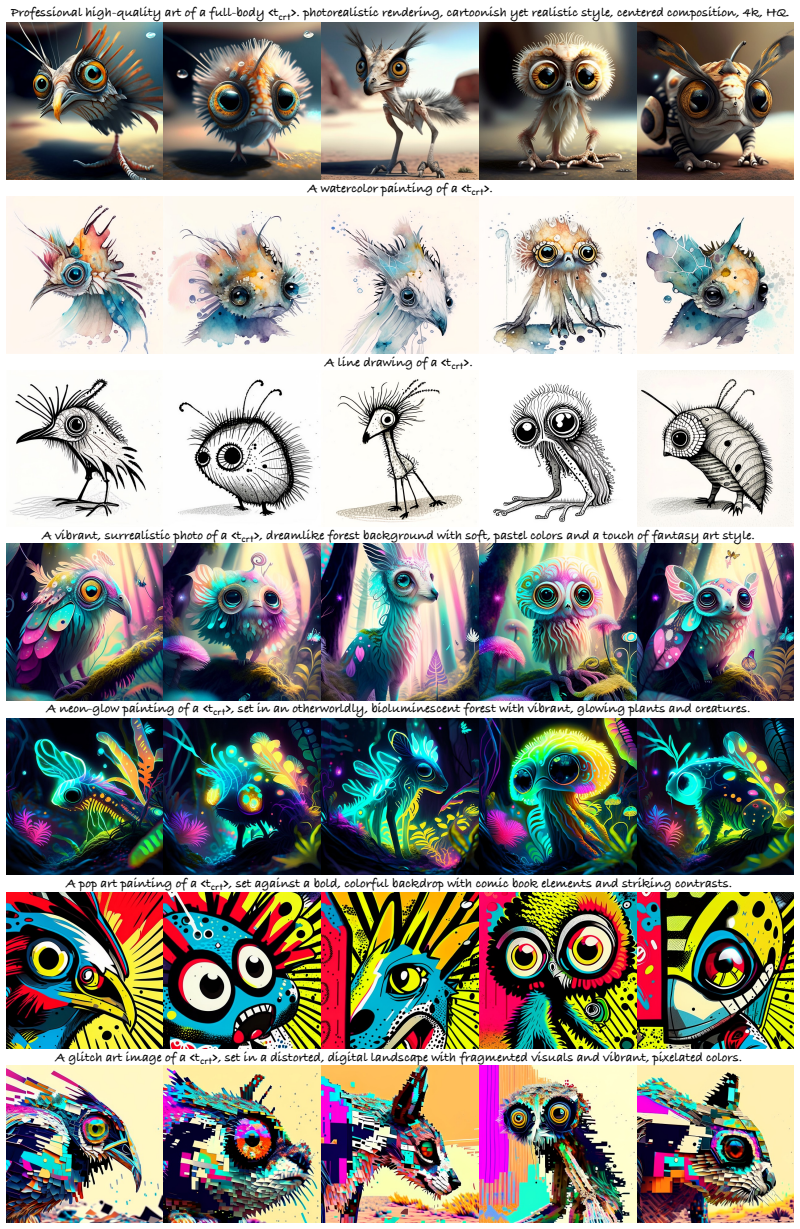
- The same token stays recognizable under style prompts such as watercolor, line drawing, or pop art, separating the conceptual content from its rendering style.
- Inference cost is roughly three seconds per concept, against about forty seconds for BASS and about one hundred twenty seconds for ConceptLab, which is what makes the token-level approach practically deployable.
Reading between the lines
- Beyond the paper: the method's "novelty" is measured only against the fixed 60-class vocabulary, so an image that shares nothing with those classes would be rejected by the novelty gate rather than celebrated; extending the same recipe to an open or expanding class set is the natural next step.
- Beyond the paper: the distributional-consistency loop is self-referential, since the same vision-language model supplies the supervision that shapes the tokens and then the metric (KL divergence) that certifies their fidelity; an independent judge would settle how much of the reported proportion fidelity is real.
- Beyond the paper: a cheap stress test would freeze the trained encoder-decoder and rerun the pipeline with a different vision-language supervisor; large changes in the resulting tokens would reveal how much of DisTok's compositional behavior is inherited from the supervisor's biases.
Signed reviews
Editorial analysis
A structured set of objections, weighed in public.
Referee Report
Summary. The paper introduces Distribution-Conditional Generation (DCG), a formulation in which image synthesis is conditioned on soft class distributions rather than discrete labels or concept pairs, and proposes DisTok, an encoder-decoder architecture that maps such distributions to learned text tokens. Training alternates between recursive concept-pair fusion and a VLM-supervised consistency objective, with a dynamically growing concept pool. The authors report qualitative and quantitative results on DCG, text-pair-to-object generation, unconditional creation, style adaptation, and human/GPT-4o evaluations, claiming state-of-the-art performance and large speedups over prior creative-generation methods.
Significance. The DCG formulation is a meaningful step beyond pairwise concept fusion: it offers a continuous, controllable interface for creative synthesis and, if validated, would let a single token encode a multi-class distribution and be reused across styles without per-concept optimization. Strengths of the paper include a self-contained training loop, no per-concept test-time optimization, a clear 3s inference advantage, and extensive qualitative demonstrations. The paper also ships a user study and multiple automated metrics. However, the empirical support for the central SOTA claim is currently incomplete: Table 1 lacks quantitative DCG baselines, Table 4's KL evaluation is both circular and statistically thin, and the GPT-4o protocol appears to supply the target composition to the evaluator. These gaps must be addressed before the main claims can be accepted.
major comments (4)
- [Section 5.1, Table 1] The central claim that DisTok 'consistently outperforms' diffusion baselines on the DCG task is not backed by the main quantitative table: Table 1 reports VQAScore/PickScore/ImageReward for DisTok (DCG) but omits the corresponding rows for SD3, SD3.5, Kandinsky, and FLUX on the same distribution-conditioned inputs, so no baseline comparison is possible on that task. Please add those baseline rows or clearly state why they are unavailable; the current comparison rests only on qualitative Fig. 3 and on the GPT-4o scores in Table 2.
- [Sections 3.3, 3.4, Table 4] The training loop uses BLIP-predicted class distributions as supervision: the novelty gate (max_c p_vlm < tau), the stored p_vlm labels for novel concepts, and the consistency objective all depend on BLIP's softmax over the CangJie classes. Table 4 then evaluates distributional consistency by computing KL divergence between the input distribution and the same BLIP model's predictions on generated images. This is a closed evaluation loop: the reported improvement (0.0732 vs. 0.0602) may measure how well DisTok matches BLIP's biases rather than true visual composition. The paper should evaluate consistency with independent annotations (e.g., human proportion judgments or a different VLM) and should include non-DisTok baselines; otherwise the 'distributional consistency' claim is under-determined.
- [Table 4 and Section 5.6] The only quantitative evidence for the proposed distribution-consistency objective is a single pair of KL values with no variance, no statistical test, and no baseline comparison for standard T2I models. The claim that removing this objective 'significantly increases divergence' requires error bars over repeated evaluations and at least one independent baseline, especially since the effect size (0.013) is small relative to likely run-to-run variation.
- [Appendix B.1, Table 2] The GPT-4o evaluation prompt begins by asserting that 'the subject of this evaluation is an image that represents a mixture of' specific classes and percentages, and then asks GPT-4o to rate alignment and integration. This phrasing supplies the ground-truth composition to the evaluator, which can bias the scores toward any image that superficially matches the description and likely explains the near-ceiling scores with near-zero standard deviations (e.g., 9.8±0.1 for Originality). The protocol should ask GPT-4o to infer the mixture from the image alone, or should be redesigned so the target composition is not embedded in the subject line.
minor comments (6)
- [Equation (3), Section 3.3] The notation for L_reg is ill-defined: it is unclear whether the expectation is over sampled latent vectors and how mu(z) and sigma(z) are computed (element-wise mean/std of z, or statistics of the sample distribution). Please clarify, since the claim that latent vectors can be sampled from any zero-mean, unit-variance distribution rests on this regularizer.
- [Table 2] The abbreviation 'Kandin' should be 'Kandinsky' for consistency with the rest of the text.
- [References] References [19] and [20] are the same paper (Zhiqiu Lin et al., ECCV 2024) and should be consolidated into one entry.
- [Section 5.2] The claim that CreTok produces 'near-identical outputs' for (Lion, Snake) and (Lion, Shrimp) is only supported qualitatively; please provide a diversity metric or embedding similarity to substantiate the 'greater expressiveness' claim.
- [Section 3.5] The text says 'Each training iteration consists of n sampling steps' and later mentions 'gradient accumulation over n = 8 steps'; please clarify the relationship between iterations, sampling steps, and gradient accumulation.
- [Section 5.5, Table 3] The user study reports aggregate vote counts only (e.g., 312:188) without per-participant proportions, inter-rater agreement, or significance testing; please provide these details to assess the reliability of the preference results.
Circularity Check
BLIP teacher/examiner loop makes Table 4's distributional-consistency KL partially circular; other SOTA metrics are external.
-
fitted input called prediction
[Sec. 3.3 (training supervision) and Sec. 5.6 / Table 4 (evaluation via BLIP KL)]
"The predicted class distribution, obtained by applying softmax to p_vlm(c|x_crt), serves as structured supervision for enforcing distributional consistency during training ... We evaluate its impact via an ablation study by removing this supervision and computing the KL divergence between the input token distribution and the visual distribution predicted by BLIP."
BLIP's softmax supplies the 'ground truth' labels for novelty: in Sec. 3.3 novel tokens enter the Concept Pool with distributions p_vlm(c|x_crt) predicted by BLIP, and L_cst trains Edis/Dtok to make decoded token embeddings close to those BLIP-labeled tokens. Table 4 then scores consistency as KL(input distribution, BLIP's prediction on the rendered image). Teacher and examiner are the same model over the same CangJie class set, so DisTok's lower KL relative to w/o-Cons means, at least in part, that the model has learned to reproduce BLIP's label distribution, not that the image independently realizes the specified class proportions.
full rationale
DisTok's headline SOTA claims are not wholly circular: Table 1 uses VQAScore, PickScore, and ImageReward as external judges, and GPT-4o and a 100-participant user study provide independent preference/originality evidence. The self-citations to CreTok [9] for the CangJie dataset, the adaptive/restrictive prompt loss (Eqs. 1-2), and the GPT-4o evaluation rubric are load-bearing but are adopted prior components, not the target result, so they do not constitute circularity. The one substantive circularity is the distributional-consistency loop: BLIP both generates the structured supervision for novel concepts and serves as the oracle for the KL metric in Table 4. Since the class-proportion fidelity of the generated hybrids is never checked against independent human or external annotation, the reported KL improvement is partly a self-consistency fit. This is partial, not total, circularity; hence score 6.
Assumptions & free parameters
free parameters (4)
- θ1, θ2 =
Not reported
- τ =
0.85
- α, β, γ =
α=1, β=1, γ=0.001
- Latent dimension δ =
20
assumptions (4)
- domain assumption The 60 CangJie base concepts define the complete semantic vocabulary for creative generation.
- domain assumption BLIP's soft class distribution over the 60 known classes is a faithful measurement of an image's visual content.
- domain assumption Cosine similarity in CLIP-L/14 text-embedding space is a valid semantic distance for fusing concept tokens.
- domain assumption Kandinsky 2.1 can render an arbitrary creative token, including tokens never seen during its training, into an image that faithfully reflects the token's text-embedding semantics.
Cite this review
Pith. "Pith review of Distribution-Conditional Generation: From Class Distribution to Creative Generation." pith.science (2026). https://pith.science/paper/TF4R4TQ7
@misc{pith2026250503667,
  author       = {Pith},
  title        = {Pith review of: Distribution-Conditional Generation: From Class Distribution to Creative Generation},
  year         = {2026},
  howpublished = {\url{https://pith.science/paper/TF4R4TQ7}},
  note         = {Machine review of arXiv:2505.03667}
}
read the original abstract
Text-to-image (T2I) diffusion models are effective at producing semantically aligned images, but their reliance on training data distributions limits their ability to synthesize truly novel, out-of-distribution concepts. Existing methods typically enhance creativity by combining pairs of known concepts, yielding compositions that, while out-of-distribution, remain linguistically describable and bounded within the existing semantic space. Inspired by the soft probabilistic outputs of classifiers on ambiguous inputs, we propose Distribution-Conditional Generation, a novel formulation that models creativity as image synthesis conditioned on class distributions, enabling semantically unconstrained creative generation. Building on this, we propose DisTok, an encoder-decoder framework that maps class distributions into a latent space and decodes them into tokens of creative concept. DisTok maintains a dynamic concept pool and iteratively sampling and fusing concept pairs, enabling the generation of tokens aligned with increasingly complex class distributions. To enforce distributional consistency, latent vectors sampled from a Gaussian prior are decoded into tokens and rendered into images, whose class distributions-predicted by a vision-language model-supervise the alignment between input distributions and the visual semantics of generated tokens. The resulting tokens are added to the concept pool for subsequent composition. Extensive experiments demonstrate that DisTok, by unifying distribution-conditioned fusion and sampling-based synthesis, enables efficient and flexible token-level generation, achieving state-of-the-art performance with superior text-image alignment and human preference scores.
Figures


Figures from the paper (9 more)


Forward citations
Cited by 1 Pith paper
-
Muses: Designing, Composing, Generating Nonexistent Fantasy 3D Creatures without Training
Muses creates new fantasy 3D animals by designing a combined skeleton, fusing voxel parts from separate 3D models along that skeleton, then restyling textures via image editing — with no training.
Reference graph
Works this paper leans on
-
[1]
Josh Achiam, Steven Adler, Sandhini Agarwal, Lama Ahmad, Ilge Akkaya, Florencia Leoni Aleman, Diogo Almeida, Janko Altenschmidt, Sam Altman, Shyamal Anadkat, et al. Gpt-4 technical report. arXiv preprint arXiv:2303.08774, 2023
arXiv 2023
-
[2]
Prompting for discovery: Flexible sense-making for ai art-making with dreamsheets
Shm Garanganao Almeda, JD Zamfirescu-Pereira, Kyu Won Kim, Pradeep Mani Rathnam, and Bjoern Hartmann. Prompting for discovery: Flexible sense-making for ai art-making with dreamsheets. In Proceedings of the 2024 CHI Conference on Human Factors in Computing Systems, pages 1–17, 2024
work page 2024
-
[3]
Flux: Diffusion models for layered image generation
Black-Forest. Flux: Diffusion models for layered image generation. https://huggingface. co/black-forest-labs/FLUX.1-schnell , 2024. Accessed: 2025-05-01
work page 2024
-
[4]
Artadapter: Text-to-image style transfer using multi-level style encoder and explicit adaptation
Dar-Yen Chen, Hamish Tennent, and Ching-Wen Hsu. Artadapter: Text-to-image style transfer using multi-level style encoder and explicit adaptation. In Proceedings of the IEEE/CVF Conference on Computer Vision and Pattern Recognition (CVPR’24), pages 8619–8628, 2024
work page 2024
-
[5]
Tailored visions: Enhancing text-to-image generation with personalized prompt rewriting
Zijie Chen, Lichao Zhang, Fangsheng Weng, Lili Pan, and Zhenzhong Lan. Tailored visions: Enhancing text-to-image generation with personalized prompt rewriting. In Proceedings of the IEEE/CVF Conference on Computer Vision and Pattern Recognition (CVPR’24) , pages 7727–7736, 2024
work page 2024
-
[6]
IP-Composer: Semantic Composition of Visual Concepts
Sara Dorfman, Dana Cohen-Bar, Rinon Gal, and Daniel Cohen-Or. Ip-composer: Semantic composition of visual concepts. arXiv preprint arXiv:2502.13951, 2025
work page Pith review arXiv 2025
-
[7]
Scaling rectified flow trans- formers for high-resolution image synthesis
Patrick Esser, Sumith Kulal, Andreas Blattmann, Rahim Entezari, Jonas Müller, Harry Saini, Yam Levi, Dominik Lorenz, Axel Sauer, Frederic Boesel, et al. Scaling rectified flow trans- formers for high-resolution image synthesis. In Proceedings of International Conference on Machine Learning (ICML’24), pages 1–13, 2024
work page 2024
-
[8]
Fu Feng, Jing Wang, Xu Yang, and Xin Geng. Genes in intelligent agents. arXiv preprint arXiv:2306.10225, 2023
arXiv 2023
Show all 48 references
-
[9]
Redefining <creative> in dictionary: Towards an enhanced semantic understanding of creative generation
Fu Feng, Yucheng Xie, Xu Yang, Jing Wang, and Xin Geng. Redefining <creative> in dictionary: Towards an enhanced semantic understanding of creative generation. In Proceedings of the IEEE/CVF Conference on Computer Vision and Pattern Recognition (CVPR’25), 2025
2025
-
[10]
An image is worth one word: Personalizing text-to-image generation using textual inversion
Rinon Gal, Yuval Alaluf, Yuval Atzmon, Or Patashnik, Amit Haim Bermano, Gal Chechik, and Daniel Cohen-or. An image is worth one word: Personalizing text-to-image generation using textual inversion. In Proceedings of the International Conference on Learning Representations (ICL...
2023
-
[11]
Enhancing creative generation on stable diffusion-based models
Jiyeon Han, Dahee Kwon, Gayoung Lee, Junho Kim, and Jaesik Choi. Enhancing creative generation on stable diffusion-based models. In Proceedings of the IEEE/CVF Conference on Computer Vision and Pattern Recognition (CVPR’25), 2025
2025
-
[12]
Svdiff: Compact parameter space for diffusion fine-tuning
Ligong Han, Yinxiao Li, Han Zhang, Peyman Milanfar, Dimitris Metaxas, and Feng Yang. Svdiff: Compact parameter space for diffusion fine-tuning. In Proceedings of the IEEE/CVF International Conference on Computer Vision (ICCV’23), pages 7323–7334, 2023
2023
-
[13]
One more step: A versatile plug-and-play module for rectifying diffusion schedule flaws and enhancing low-frequency controls
Minghui Hu, Jianbin Zheng, Chuanxia Zheng, Chaoyue Wang, Dacheng Tao, and Tat-Jen Cham. One more step: A versatile plug-and-play module for rectifying diffusion schedule flaws and enhancing low-frequency controls. In Proceedings of the IEEE/CVF Conference on Computer Vision an...
2024
-
[14]
Pick-a-pic: An open dataset of user preferences for text-to-image generation
Yuval Kirstain, Adam Polyak, Uriel Singer, Shahbuland Matiana, Joe Penna, and Omer Levy. Pick-a-pic: An open dataset of user preferences for text-to-image generation. In Proceedings of the Annual Conference on Neural Information Processing Systems (NeurIPS’23) , pages 36652–36...
2023
-
[15]
Multi- concept customization of text-to-image diffusion
Nupur Kumari, Bingliang Zhang, Richard Zhang, Eli Shechtman, and Jun-Yan Zhu. Multi- concept customization of text-to-image diffusion. In Proceedings of the IEEE/CVF Conference on Computer Vision and Pattern Recognition (CVPR’23), pages 1931–1941, 2023
1931
-
[16]
A path towards autonomous machine intelligence
Yann LeCun. A path towards autonomous machine intelligence. Open Review, 62(1):1–62, 2022
2022
-
[17]
Tp2o: Creative text pair-to-object generation using balance swap-sampling
Jun Li, Zedong Zhang, and Jian Yang. Tp2o: Creative text pair-to-object generation using balance swap-sampling. In Proceedings of the European Conference on Computer Vision (ECCV’24), pages 1–19, 2024
2024
-
[18]
Magicmix: Semantic mixing with diffusion models
Jun Hao Liew, Hanshu Yan, Daquan Zhou, and Jiashi Feng. Magicmix: Semantic mixing with diffusion models. arXiv preprint arXiv:2210.16056, 2022
2022 arXiv
-
[20]
Evaluating text-to-visual generation with image-to-text generation
Zhiqiu Lin, Deepak Pathak, Baiqi Li, Jiayao Li, Xide Xia, Graham Neubig, Pengchuan Zhang, and Deva Ramanan. Evaluating text-to-visual generation with image-to-text generation. In Proceedings of the European Conference on Computer Vision (ECCV’24) , pages 366–384, 2024
2024
-
[21]
Procreate, don’t reproduce! propulsive energy diffusion for creative generation
Jack Lu, Ryan Teehan, and Mengye Ren. Procreate, don’t reproduce! propulsive energy diffusion for creative generation. In Proceedings of the European Conference on Computer Vision (ECCV’24), pages 397–414, 2024
2024
-
[22]
Towards machine learning as an enabler of computational creativity
Deborah Mateja and Armin Heinzl. Towards machine learning as an enabler of computational creativity. IEEE Transactions on Artificial Intelligence, 2(6):460–475, 2021
2021
-
[23]
Art, creativity, and the potential of artificial intelligence
Marian Mazzone and Ahmed Elgammal. Art, creativity, and the potential of artificial intelligence. Arts, 8(1):26, 2019
2019
-
[24]
Midjourney.com
Midjourney. Midjourney.com. https://www.midjourney.com, 2022. Accessed: 2024-11- 14
2022
-
[25]
T2i-adapter: Learning adapters to dig out more controllable ability for text-to-image diffusion models
Chong Mou, Xintao Wang, Liangbin Xie, Yanze Wu, Jian Zhang, Zhongang Qi, and Ying Shan. T2i-adapter: Learning adapters to dig out more controllable ability for text-to-image diffusion models. In Proceedings of the AAAI Conference on Artificial Intelligence (AAAI’24), pages 429...
2024
-
[26]
Chirpy3d: Continuous part latents for creative 3d bird generation
Kam Woh Ng, Jing Yang, Jia Wei Sii, Jiankang Deng, Chee Seng Chan, Yi-Zhe Song, Tao Xiang, and Xiatian Zhu. Chirpy3d: Continuous part latents for creative 3d bird generation. arXiv preprint arXiv:2501.04144, 2025
2025 arXiv
-
[27]
Partcraft: Crafting creative objects by parts
Kam Woh Ng, Xiatian Zhu, Yi-Zhe Song, and Tao Xiang. Partcraft: Crafting creative objects by parts. In Proceedings of the European Conference on Computer Vision (ECCV’24), pages 420–437, 2024
2024
-
[28]
Gpt-4: Openai language model
OpenAI. Gpt-4: Openai language model. https://openai.com/research/gpt-4, 2023. Accessed: 2025-05-01
2023
-
[29]
Prompting ai art: An investiga- tion into the creative skill of prompt engineering
Jonas Oppenlaender, Rhema Linder, and Johanna Silvennoinen. Prompting ai art: An investiga- tion into the creative skill of prompt engineering. International Journal of Human–Computer Interaction, pages 1–23, 2024. 11
2024
-
[30]
Portraitbooth: A versatile portrait model for fast identity-preserved personalization
Xu Peng, Junwei Zhu, Boyuan Jiang, Ying Tai, Donghao Luo, Jiangning Zhang, Wei Lin, Taisong Jin, Chengjie Wang, and Rongrong Ji. Portraitbooth: A versatile portrait model for fast identity-preserved personalization. In Proceedings of the IEEE/CVF Conference on Computer Vision ...
2024
-
[31]
Learning transferable visual models from natural language supervision
Alec Radford, Jong Wook Kim, Chris Hallacy, Aditya Ramesh, Gabriel Goh, Sandhini Agarwal, Girish Sastry, Amanda Askell, Pamela Mishkin, Jack Clark, et al. Learning transferable visual models from natural language supervision. In Proceedings of International Conference on Machi...
2021
-
[32]
Hierarchical text-conditional image generation with clip latents
Aditya Ramesh, Prafulla Dhariwal, Alex Nichol, Casey Chu, and Mark Chen. Hierarchical text-conditional image generation with clip latents. arXiv preprint arXiv:2204.06125, 1(2):3, 2022
2022 arXiv
-
[33]
Kandinsky: An improved text-to-image synthesis with image prior and latent diffusion
Anton Razzhigaev, Arseniy Shakhmatov, Anastasia Maltseva, Vladimir Arkhipkin, Igor Pavlov, Ilya Ryabov, Angelina Kuts, Alexander Panchenko, Andrey Kuznetsov, and Denis Dimitrov. Kandinsky: An improved text-to-image synthesis with image prior and latent diffusion. In Proceeding...
2023
-
[34]
Conceptlab: Creative concept generation using vlm-guided diffusion prior constraints.ACM Transactions on Graphics, 43(3):1–14, 2024
Elad Richardson, Kfir Goldberg, Yuval Alaluf, and Daniel Cohen-Or. Conceptlab: Creative concept generation using vlm-guided diffusion prior constraints.ACM Transactions on Graphics, 43(3):1–14, 2024
2024
-
[35]
Dreambooth: Fine tuning text-to-image diffusion models for subject-driven generation
Nataniel Ruiz, Yuanzhen Li, Varun Jampani, Yael Pritch, Michael Rubinstein, and Kfir Aber- man. Dreambooth: Fine tuning text-to-image diffusion models for subject-driven generation. In Proceedings of the IEEE/CVF Conference on Computer Vision and Pattern Recognition (CVPR’23),...
2023
-
[36]
Hyperdreambooth: Hypernetworks for fast personaliza- tion of text-to-image models
Nataniel Ruiz, Yuanzhen Li, Varun Jampani, Wei Wei, Tingbo Hou, Yael Pritch, Neal Wadhwa, Michael Rubinstein, and Kfir Aberman. Hyperdreambooth: Hypernetworks for fast personaliza- tion of text-to-image models. In Proceedings of the IEEE/CVF Conference on Computer Vision and P...
2024
-
[37]
Stable diffusion 3.5
Stability AI. Stable diffusion 3.5. https://github.com/Stability-AI/sd3.5, 2024. Accessed: 2025-05-01
2024
-
[38]
Multimodal large language models make text-to-image generative models align better
Xun Wu, Shaohan Huang, Guolong Wang, Jing Xiong, and Furu Wei. Multimodal large language models make text-to-image generative models align better. In Proceedings of the Annual Conference on Neural Information Processing Systems (NeurIPS’24), pages 81287– 81323, 2024
2024
-
[39]
Novel object synthesis via adaptive text-image harmony
Zeren Xiong, Zedong Zhang, Zikun Chen, Shuo Chen, Xiang Li, Gan Sun, Jian Yang, and Jun Li. Novel object synthesis via adaptive text-image harmony. arXiv preprint arXiv:2410.20823, 2024
2024 arXiv
-
[40]
Imagereward: Learning and evaluating human preferences for text-to-image generation
Jiazheng Xu, Xiao Liu, Yuchen Wu, Yuxuan Tong, Qinkai Li, Ming Ding, Jie Tang, and Yuxiao Dong. Imagereward: Learning and evaluating human preferences for text-to-image generation. In Proceedings of the Annual Conference on Neural Information Processing Systems (NeurIPS’23), p...
2023
-
[41]
Ip-adapter: Text compatible image prompt adapter for text-to-image diffusion models
Hu Ye, Jun Zhang, Sibo Liu, Xiao Han, and Wei Yang. Ip-adapter: Text compatible image prompt adapter for text-to-image diffusion models. arXiv preprint arXiv:2308.06721, 2023
2023 arXiv
-
[42]
Few-shot learner parameterization by diffusion time-steps
Zhongqi Yue, Pan Zhou, Richang Hong, Hanwang Zhang, and Qianru Sun. Few-shot learner parameterization by diffusion time-steps. In Proceedings of the IEEE/CVF Conference on Computer Vision and Pattern Recognition (CVPR’24), pages 23263–23272, 2024
2024
-
[43]
Diffmorpher: Unleashing the capability of diffusion models for image morphing
Kaiwen Zhang, Yifan Zhou, Xudong Xu, Bo Dai, and Xingang Pan. Diffmorpher: Unleashing the capability of diffusion models for image morphing. In Proceedings of the IEEE/CVF Conference on Computer Vision and Pattern Recognition (CVPR’24), pages 7912–7921, 2024. 12
2024
-
[44]
Spectrum-aware parameter efficient fine-tuning for diffusion models
Xinxi Zhang, Song Wen, Ligong Han, Felix Juefei-Xu, Akash Srivastava, Junzhou Huang, Hao Wang, Molei Tao, and Dimitris N Metaxas. Spectrum-aware parameter efficient fine-tuning for diffusion models. arXiv preprint arXiv:2405.21050, 2024
2024 arXiv
-
[45]
Multi-lora composition for image generation
Ming Zhong, Yelong Shen, Shuohang Wang, Yadong Lu, Yizhu Jiao, Siru Ouyang, Donghan Yu, Jiawei Han, and Weizhu Chen. Multi-lora composition for image generation. arXiv preprint arXiv:2402.16843, 2024. 13 A Additional Results A.1 Additional Results for Distribution-Conditional ...
2024 arXiv
-
[46]
A high score signifies that the elements are intricately merged, creating a new, unified entity
Conceptual Integration (1-10): This criterion gauges the degree to which the image manifests a coherent and integrated concept, as opposed to merely placing two independent elements side by side. A high score signifies that the elements are intricately merged, creating a new, ...
-
[47]
The image should refrain from including irrelevant elements that detract from the primary concepts
Alignment with Prompt (1-10): This evaluates the extent to which the image conforms to and encapsulates the specific combination of concepts described in the prompt. The image should refrain from including irrelevant elements that detract from the primary concepts. A high scor...
-
[48]
The depicted concept should not mimic existing animals, plants, or widely recognized mythical creatures unless specifically mentioned in the prompt
Originality (1-10): This assesses the innovativeness of the concept portrayed in the image. The depicted concept should not mimic existing animals, plants, or widely recognized mythical creatures unless specifically mentioned in the prompt. Images that present a distinctive an...
-
[49]
A high score is awarded when the image is not only conceptually robust but also visually engaging
Aesthetic Quality (1-10): This criterion scrutinizes the visual appeal of the image, focusing on color harmony, the balance and arrangement of elements, and the overall visual impact. A high score is awarded when the image is not only conceptually robust but also visually enga...
Reviewed August 15, 2026 · model on record in the stance chip above.
Discussion (0). Continue with ORCID to comment.