REVIEW 3 major objections 6 minor 55 references
Scratch Copilot: Supporting Youth Creative Coding with AI
T0 review · 3 major / 6 minor · reviewed 2026-08-15 · deepseek-v4-flash
Pith's one-line read This paper argues that an AI copilot embedded in a block-based coding environment can scaffold children's creative coding—ideation, debugging, asset creation, and platform navigation—without eroding their creative ownership.
desk verdict A useful exploratory study of an AI copilot for kids' block-based coding, but the headline claim overreaches: the researcher was part of the intervention, so the paper demonstrates an AI-plus-researcher system, not the copilot alone. read the letter →
The pith
A machine-rendered reading of the paper's core claim, the machinery that carries it, and where it could break.
The reading
What carries the argument
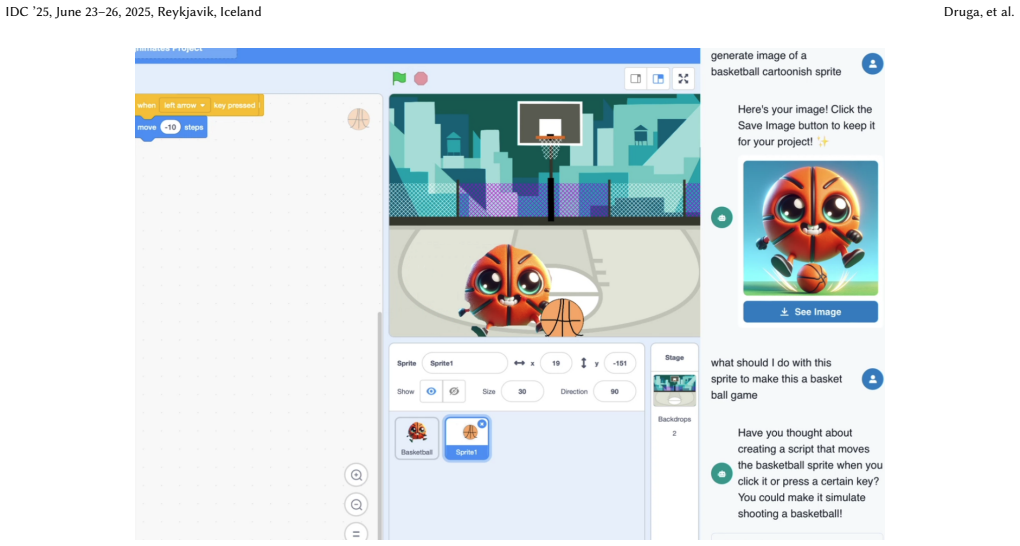
The carrying mechanism is the copilot's question-driven dialogue protocol embedded in the system prompt. The assistant is told to keep responses to a short child-friendly phrase, ask a guiding question before answering, and only give the answer if the same question comes more than twice; for code questions it gives one specific tip or one guiding question, and for image requests it calls a separate image-generation model. This protocol is what lets the tool scaffold without taking over: it forces the child to be the one who tries, evaluates, and decides, which the paper links to the observed agency behaviors. A second mechanism is the side-by-side interface—chat window and block canvas visible together—so prompts and generated images can feed directly into the project.
What would settle it
Run the same 40–50 minute creative coding protocol with no researcher present and no fallback help after failed AI responses, then compare ideation success, code completion, agency behaviors such as rejections and adaptations, and self-reported creative self-efficacy against the current sessions. If the observed scaffolding and agency behaviors disappear or drop sharply without the researcher, the claim that the copilot alone carries the effect is falsified.
Extended reading notes
Core claim
The central claim is that a question-first AI copilot, not a one-shot answer machine, can support the full arc of a child's creative coding project. Designed as a chat pane beside a Scratch-like block canvas, the copilot uses a system prompt that instructs it to respond with a single short tip or a guiding question, to withhold the answer until the child has asked the same thing more than twice, and to offer ideation, code explanation, and image generation. In sessions with 18 children, the authors observed it supporting brainstorming (13 of 18 children asked for ideas), code and debugging help (46 coded instances), visual asset creation (33 instances), and platform navigation (12 instances), with children using it 3–12 times per session. Agency was not lost: 9 of 18 children explicitly rejected at least one suggestion, often describing themselves as the captain of the project, and approximately 30 percent of queries were unsuccessful—yet those failures became moments of prompt refinement and conceptual insight rather than dead ends. The paper concludes that such a tool can effectively scaffold creative coding while children maintain creative control.
Load-bearing premise
The study assumes the effects it reports came from the copilot, even though the researcher who built the tool was present in every session, encouraged children to use it, and directly helped after two failed AI responses.
Editorial extensions
If this is right
- Children in the 7–12 age range can treat an AI assistant as a resource to query, negotiate with, and override, rather than an authority to obey, which is a precondition for using copilots in creative learning settings.
- Question-first system prompts are a transferable design choice: they can be adopted by other block-based coding tools to give help while preserving problem-solving practice.
- Integrated image generation lowers the barrier to visual asset creation in children's coding projects, so designers should treat asset creation as a core copilot function rather than an add-on.
- AI failures, when framed as part of the interaction, can produce teachable moments such as prompt refinement and debugging insight, so copilot designs should make errors visible and recoverable rather than hidden.
- The proposed design guidelines—prioritize agency, balance support and challenge, allow customization and multimodal input—offer a concrete checklist for future youth AI coding tools.
Reading between the lines
- The strongest untested extension is whether the same agency and learning outcomes survive without the researcher in the room: the sessions included the tool's builder, who suggested AI use and stepped in after two failed responses, so the measured effect is plausibly an AI-plus-human team rather than the copilot alone.
- A natural next design is a context-aware copilot that can see the sprite, blocks, and screen state; children themselves requested this, and it would likely cut the observed approximately 30 percent failure rate from ambiguous queries.
- Age differences hinted at in the data—younger children conversing socially, older children wanting more control and advanced features—could be tested with age-stratified studies and might lead to copilot personas that adapt their scaffolding style by developmental stage.
- The same question-first architecture could be tested beyond Scratch-like blocks, such as in text-based introductory programming or creative tools outside coding, where the need to scaffold without eroding agency is similar.
Signed reviews
Editorial analysis
A structured set of objections, weighed in public.
Referee Report
Summary. This paper presents Cognimates Scratch Copilot, an AI assistant embedded in a block-based Scratch-like environment, and reports an exploratory qualitative study with 18 children (ages 7–12) from 11 countries. Each session had a pre-AI coding phase, an AI-enhanced coding phase in which the researcher encouraged AI use and offered direct help after two failed AI attempts, and a semi-structured reflection interview. Thematic analysis of video transcripts produced three themes: AI-enhanced ideation and asset creation, contextual debugging and system navigation, and preservation of child agency. The paper proposes design guidelines and concludes that the tool can effectively scaffold youth creative coding by aiding ideation, debugging, asset creation, and platform navigation while preserving child agency.
Significance. The contribution is potentially valuable for the IDC/HCI community: it is one of the first empirical accounts of an LLM-based copilot embedded in a visual programming environment for children, and it provides concrete observational evidence of youth agency, over-reliance concerns, and failure-driven learning. Strengths include the explicit exploratory framing, a defined codebook with occurrence counts, illustrative quotes, an international sample, and attention to culturally responsive design. However, the paper's headline claim currently exceeds what the method can support, because the study conflates the AI tool with substantial researcher scaffolding and does not measure creative self-efficacy directly.
major comments (3)
- [Sections 3.2, 4.2] The attribution of the observed scaffolding to the AI tool alone is not established. Section 3.2 states that researcher scaffolding occurred in approximately 10 instances, while Section 4.2 reports 20 AI failure instances with the first author intervening 'two to three times per session on average'—a numerical inconsistency (for 18–20 sessions, 20 failures is roughly one per session, not two to three). The first author also conducted, transcribed, translated, and mostly coded all sessions (Section 3.5) and actively suggested AI use and clarified AI responses (Sections 3.2 and 4.2). The evidence therefore describes an AI-plus-researcher intervention, not the copilot alone. To support the conclusion's claim that the tool 'can effectively scaffold' the creative coding process, the authors must either separate AI-only from researcher-assisted interactions in the analysis or explicitly reframe the conclusion to describe the combined system.
- [Section 4.2] The estimate that 'the AI successfully answered about 70% of queries' is undefined and unverifiable. The paper does not define what counts as a query, what counts as success, or how the estimate was calculated across sessions. As this figure is used as a quantitative anchor for the AI's effectiveness, the authors should either provide a clear definition and calculation basis, or remove the estimate and restrict claims to the qualitative patterns.
- [Sections 1, 5.2, 6] The paper repeatedly invokes creative self-efficacy, but no measure of creative self-efficacy appears in the method or codebook; the reported evidence consists of observed behaviors, interview statements, and parent emails. The abstract appropriately uses 'potential to enhance,' but the conclusion states the tool has 'the potential to empower youth, enhance their creative self-efficacy' and the introduction claims the study builds on prior work 'while promoting creative self-efficacy' without measuring it. These claims should be explicitly labeled as hypotheses or directions for future work unless a validated self-efficacy instrument is included.
minor comments (6)
- [Section 3.5] The text refers to 'the second and third author,' but the paper lists only two authors; this should be corrected to match the author list or to identify the specific coders by name.
- [Section 4.1] Participant J. is described as age 14 (New Zealand), outside the stated 7–12 age range; please verify and correct the age or the stated range.
- [References] Reference [27] appears truncated and malformed; the citation should be completed.
- [Section 4.3] The text reads 'In 9 of 18 cases, children explicitly declined an AI's suggestion,' which is ambiguous; if the intended meaning is '9 of 18 participants,' it should say so to match the later phrasing.
- [Section 2.2] Typo: 'a participatory design study the involved children' should be 'that involved children.'
- [Section 3.4] Possessive apostrophes should be consistent: 'childrens'' should be 'children's.'
Circularity Check
No circular derivation: the empirical findings are grounded in new session data, not in the cited prior work.
full rationale
This paper makes no formal derivation, contains no equations, and fits no parameters, so circularity patterns involving fitted inputs, uniqueness theorems, or equations reducing to each other do not apply. The central claim—that Cognimates Scratch Copilot can scaffold children's creative coding—is supported by newly collected session data: 20 video-recorded sessions, 178,105 words of transcripts, and coded frequencies in Table 1 (e.g., Code Support 46, Design Support 33, AI Failure 20, Child Agency 9). These observations are not equivalent by construction to the system's design. The system prompt was indeed built from the authors' earlier co-design study [15], and that self-citation is used as design rationale; however, the empirical outcome—whether children actually found the question-driven help useful, adapted or rejected suggestions, and encountered failures—comes from the new sessions and was not read off the prompt. The trustworthiness concerns raised by the researcher's heavy scaffolding and the inconsistent intervention counts (Section 3.2 says approximately 10 instances; Section 4.2 says 20 AI-failure interventions at two to three per session) are threats to attribution and internal validity, not circularity of the derivation. Under the stated rules, no step reduces to its own input, so the correct finding is no significant circularity.
Assumptions & free parameters
assumptions (3)
- domain assumption Researcher scaffolding after two failed AI responses does not confound attribution of observed help to the AI copilot.
- domain assumption Thematic saturation reached with 18 participants supports transferable design guidelines.
- domain assumption Observed interactions and interview self-reports indicate creative self-efficacy and engagement rather than demand characteristics or scaffolding effects.
Cite this review
Pith. "Pith review of Scratch Copilot: Supporting Youth Creative Coding with AI." pith.science (2026). https://pith.science/paper/HDI527JB
@misc{pith2026250503867,
  author       = {Pith},
  title        = {Pith review of: Scratch Copilot: Supporting Youth Creative Coding with AI},
  year         = {2026},
  howpublished = {\url{https://pith.science/paper/HDI527JB}},
  note         = {Machine review of arXiv:2505.03867}
}
read the original abstract
Creative coding platforms like Scratch have democratized programming for children, yet translating imaginative ideas into functional code remains a significant hurdle for many young learners. While AI copilots assist adult programmers, few tools target children in block-based environments. Building on prior research \cite{druga_how_2021,druga2023ai, druga2023scratch}, we present Cognimates Scratch Copilot: an AI-powered assistant integrated into a Scratch-like environment, providing real-time support for ideation, code generation, debugging, and asset creation. This paper details the system architecture and findings from an exploratory qualitative evaluation with 18 international children (ages 7--12). Our analysis reveals how the AI Copilot supported key creative coding processes, particularly aiding ideation and debugging. Crucially, it also highlights how children actively negotiated the use of AI, demonstrating strong agency by adapting or rejecting suggestions to maintain creative control. Interactions surfaced design tensions between providing helpful scaffolding and fostering independent problem-solving, as well as learning opportunities arising from navigating AI limitations and errors. Findings indicate Cognimates Scratch Copilot's potential to enhance creative self-efficacy and engagement. Based on these insights, we propose initial design guidelines for AI coding assistants that prioritize youth agency and critical interaction alongside supportive scaffolding.
Figures


Figures from the paper (2 more)

Reference graph
Works this paper leans on
-
[1]
RAISE AI Playground - MIT Media Lab
2020. RAISE AI Playground - MIT Media Lab. mit.edu (2020). https://mit.edu/ raiselab/ai-playground/
work page 2020
-
[2]
Can AI Help Kids Feel Creative? - Joan Ganz Cooney Center
2024. Can AI Help Kids Feel Creative? - Joan Ganz Cooney Center. joanganz- cooneycenter.org (2024). https://joanganzcooneycenter.org/2024/09/24/can-ai- help-kids-feel-creative/
work page 2024
-
[3]
Codeium: Free Ai Copilot Alternatives
2024. Codeium: Free Ai Copilot Alternatives. restack.io (2024). https://restack. io/alternatives/comparisons/github-copilot-vs-codeium
work page 2024
-
[4]
Cursor AI: AI-first code editor
2024. Cursor AI: AI-first code editor. cursor.sh (2024). https://cursor.sh/
work page 2024
-
[5]
eCraft2Learn Library for Snap! github.io (2024)
2024. eCraft2Learn Library for Snap! github.io (2024). https://github.com/ ecraft2learn/eCraft2Learn-Snap
work page 2024
-
[6]
2024. PictoBlox: Block Coding & AI. play.google.com (2024). https://play.google. com/store/apps/details?id=com.thestempedia.pictoblox&hl=en_US
work page 2024
-
[7]
2024. Teachable Machine. teachablemachine.withgoogle.com (2024). https: //teachablemachine.withgoogle.com/
work page 2024
-
[8]
Virginia Braun and Victoria Clarke. 2006. Using thematic analysis in psychology. Qualitative research in psychology 3, 2 (2006), 77–101
2006
Show all 55 references
-
[9]
Karen Brennan and Mitchel Resnick. 2015. Balancing Structure and Agency in Computational Tools and Activities for Novices. (2015)
2015
-
[10]
Elizabeth Charters. 2003. The use of think-aloud methods in qualitative research an introduction to think-aloud methods.Brock Education: A Journal of Educational Research and Practice 12, 2 (2003)
2003
-
[11]
Po-Nien Chen, Colin Zhang, Nazneen Rajani, Xi Zhang, Yi Tang, Jure Leskovec, and Christopher D Manning. 2023. Teaching large language models to self-debug. arXiv preprint arXiv:2304.05178 (2023)
2023 arXiv
-
[12]
Stefania Druga, Fee Lia Christoph, and Amy J. Ko. 2022. Family as a Third Space for AI Literacies: How do children and parents learn about AI together?. In CHI Conference on Human Factors in Computing Systems . 1–17
2022
-
[13]
Stefania Druga and Amy J Ko. 2021. How do children’s perceptions of machine intelligence change when training and coding smart programs?. InInteraction De- sign and Children. ACM, Athens Greece, 49–61. https://doi.org/10.1145/3459990. 3460712
2021 doi
-
[15]
Stefania Druga and Amy J. Ko. 2023. AI Friends: A Design Framework for AI- Powered Creative Programming for Youth. arXiv:2305.10412 [cs.HC] https: //arxiv.org/abs/2305.10412
2023 arXiv
-
[17]
Stefania Druga and Nancy Otero. 2023. Scratch Copilot Evaluation: Assessing AI-Assisted Creative Coding for Families. arXiv preprint arXiv:2305.10417 (2023)
2023 arXiv
-
[18]
Stefania Druga, Sarah T Vu, Eesh Likhith, and Tammy Qiu. 2019. Inclusive AI literacy for kids around the world. In Proceedings of FabLearn 2019 . ACM, 104–111
2019
-
[19]
T. K. F. Chiu et al. 2023. Systematic Review of AI in Education. Computers & Education: AI 4 (2023), 100118
2023
-
[20]
Alfonso Freire-Sánchez and Jesús López-González. 2023. Intergenerational Dif- ferences on the Cultural Imagery of AI. In Proc. of Semanticscholar . https: //api.semanticscholar.org/CorpusID:271290607
2023
-
[21]
Jonas Frich, Lindsay MacDonald Vermeulen, Christian Remy, Michael Mose Biskjaer, and Peter Dalsgaard. 2019. Mapping the Landscape of Creativity Support Tools in HCI. In Proceedings of the 2019 CHI Conference on Human Factors in Computing Systems (Glasgow, Scotland Uk) (CHI ’19...
2019
-
[22]
ARIEL HAN, ZHENYAO CAI, SEUNGMIN JEONG, and SUN MYUNG CHOI. 2023. AIStory: design implication of using generative arts AI for visual storytelling
2023
-
[23]
Yerika Jimenez, Amanpreet Kapoor, and Christina Gardner-McCune. 2018. Us- ability challenges that novice programmers experience when using scratch for the first time. In 2018 IEEE Symposium on Visual Languages and Human-Centric Computing (VL/HCC). IEEE, 327–328
2018
-
[24]
Mohsen Kazemitabaar, Theodoros Sapounidis, Robert Weidmann, and Michail Giannakos. 2023. Studying the Effects of Code Generation Tools on Middle Schoolers’ Programming Performance and Learning. (Apr 2023), 1–14. https: //doi.org/10.1145/3583131.3590429
2023
-
[25]
Joy Kim, Maneesh Agrawala, and Michael S Bernstein. 2017. Mosaic: Designing Online Creative Communities for Sharing Works-in-Progress. In Proceedings of the 2017 ACM Conference on Computer Supported Cooperative Work and Social Computing (Portland, Oregon, USA) (CSCW ’17). Asso...
2017
-
[26]
Kim and S
J. Kim and S. Lee. 2023. Socio-Cultural Factors in Middle-Schoolers’ Attitudes Toward AI. Springer Journal of Educational Technology (2023). https://doi.org/10. 1007/s10639-023-12172-y
2023
-
[27]
A Ko, B Myers, and H Aung. 2004. As programming skills increase in demand and utility, the learnability of end-user programming systems is of utmost importance. However, research on learning barriers in programming systems has primarily focused on languages, overlooking potent...
2004
-
[28]
Juho Leinonen, Sébastien Sarsa, Nazneen Rajani, and Hannu Toivonen. 2023. Using gpt-3 to generate explanations of code: a comparative study with human- generated explanations. (2023), 1–14
2023
-
[29]
Dastyni Loksa, Lauren Margulieux, Brett A Becker, Michelle Craig, Paul Denny, Raymond Pettit, and James Prather. 2022. Metacognition and self-regulation in programming education: Theories and exemplars of use. ACM Transactions on Computing Education (TOCE) 22, 4 (2022), 1–31
2022
-
[30]
Duri Long, Anthony Teachey, and Brian Magerko. 2022. Family Learning Talk in AI Literacy Learning Activities. In Proceedings of the 2022 CHI Conference on Human Factors in Computing Systems . 1–20
2022
-
[31]
Aman Madaan, Uri Alon, Kevin Lu, Daniel Luan, Alexander L Gaunt, Graham Neubig, and Noam Zamir. 2023. Learning to improve code performance. arXiv preprint arXiv:2304.03731 (2023)
2023 arXiv
-
[32]
John Maloney, Mitchel Resnick, Natalie Rusk, Brian Silverman, and Evelyn East- mond. 2010. The scratch programming language and environment. ACM Trans- actions on Computing Education (TOCE) 10, 4 (2010), 1–15
2010
-
[33]
RE Mayer. 2005. Cognitive theory of multimedia learning . The Cambridge Hand- book of Visuospatial Thinking/Cambridge University Press
2005
-
[34]
Andrew Mclean and Geraint A Wiggins. 2012. Computer as material: Bricolage and metaphors for construction. Digital Creativity 23, 1 (2012), 23–39
2012
-
[35]
Matthew B Miles and A Michael Huberman. 1984. Drawing valid meaning from qualitative data: Toward a shared craft.Educational researcher 13, 5 (1984), 20–30
1984
-
[36]
José Morales-Chicas and Jane Leonard. 2019. Computing for cultural relevance: Recommendations for creating culturally responsive computing curriculum. In Proceedings of the 50th ACM Technical Symposium on Computer Science Education . 740–746
2019
-
[37]
Luis Morales-Navarro and Yasmin B. Kafai. 2024. Investigating Youths’ Every- day Understanding of Machine Learning Applications: a Knowledge-in-Pieces Perspective. arXiv:2404.00728 [cs.CY] https://arxiv.org/abs/2404.00728
2024 arXiv
-
[38]
Luis Morales-Navarro and Yasmin B Kafai. 2024. Unpacking Approaches to Learning and Teaching Machine Learning in K-12 Education: Transparency, Ethics, and Design Activities. Proceedings of the 19th WiPSCE Conference on Primary and Secondary Computing Education Research , Artic...
2024
-
[39]
Mathilde Neugnot-Cerioli and Olga Muss Laurenty. 2024. The Future of Child Development in the AI Era. ArXiv abs/2405.19275 (2024). https://arxiv.org/abs/ 2405.19275
2024 arXiv
-
[40]
I want it to talk like Darth Vader
Michele Newman, Kaiwen Sun, Ilena B Dalla Gasperina, Grace Y Shin, Matthew Kyle Pedraja, Ritesh Kanchi, Maia B Song, Rannie Li, Jin Ha Lee, and Jason Yip. 2024. " I want it to talk like Darth Vader": Helping Children Construct Creative Self-Efficacy with Generative AI. In Proc...
2024
-
[41]
Seymour Papert. 1980. Mindstorms: Children, computers, and powerful ideas. Basic Books, Inc
1980
-
[42]
Michael Quinn Patton. 1990. Qualitative evaluation and research methods . SAGE Publications, inc
1990
-
[43]
Mitchel Resnick. 2007. All I really need to know (about creative thinking) I learned (by studying how children learn) in kindergarten. In Proceedings of the 6th ACM SIGCHI conference on Creativity & cognition . 1–6
2007
-
[44]
Mitchel Resnick and Eric Rosenbaum. 2013. Designing for tinkerability. Design, make, play: Growing the next generation of STEM innovators (2013), 163–181
2013
-
[45]
Sébastien Sarsa, Juho Leinonen, Anders Petersen, Shang Wang, Samia Khademi, Henri Vartiainen, Ville Valtonen, Hannu Toivonen, Nazneen Rajani, et al. 2022. Automatic generation of programming exercises with large language models. arXiv preprint arXiv:2208.07833 (2022)
2022 arXiv
-
[46]
Sayeda Sapna Shah and Muhammad Mujtaba Asad. 2024. Impact of Critical Think- ing Approach on Learners’ Dependence on Innovative Transformation Through Artificial Intelligence. In The Evolution of Artificial Intelligence in Higher Educa- tion: Challenges, Risks, and Ethical Con...
2024
-
[47]
GovTech Singapore. 2024. Gen-AI in Public Sector Software Development. ArXiv abs/2409.17434 (2024). https://arxiv.org/abs/2409.17434
2024 arXiv
-
[48]
Jenni Solyst, Michelle Wilkerson, Bryan Melton, Gautam Biswas, and Sean Brophy
-
[49]
Leonard Tetzlaff, Florian Schmiedek, and Garvin Brod. 2021. Developing per- sonalized education: A dynamic framework. Educational Psychology Review 33 (2021), 863–882
2021
-
[50]
Pamela Tierney and Steven M Farmer. 2002. Creative self-efficacy: Developing and testing a measurement. Personnel Psychology 55, 1 (2002), 113–134
2002
-
[51]
Sherry Turkle and Seymour Papert. 1990. Epistemological pluralism: Styles of minority cultures within American computing . American Association for the Advancement of Science
1990
-
[52]
Shen Wang, Tianlong Xu, Hang Li, Chaoli Zhang, Joleen Liang, Jiliang Tang, Philip S Yu, and Qingsong Wen. 2024. Large language models for education: A survey and outlook. arXiv preprint arXiv:2403.18105 (2024)
2024 arXiv
-
[53]
Jeannette M Wing. 2006. Computational thinking. Commun. ACM 49, 3 (2006), 33–35. IDC ’25, June 23–26, 2025, Reykjavik, Iceland Druga, et al
2006
-
[54]
Hyunju Woo, Jody Clarke-Midura, Tamar Orkin, and Marina Bers. 2022. Problem- solving strategies in creative coding: Novice animators’ code construction and debugging processes in scratch. Journal of Science Education and Technology 31, 2 (2022), 249–268
2022
-
[55]
Chunpeng Zhai, Santoso Wibowo, and Lily D Li. 2024. The effects of over-reliance on AI dialogue systems on students’ cognitive abilities: a systematic review.Smart Learning Environments 11, 1 (2024), 28
2024
-
[56]
LeChen Zhang and Jalal Nouri. 2019. A systematic review of learning compu- tational thinking through Scratch in K-9. Computers & Education 141 (2019), 103607
2019
-
[2022]
Insights from culturally responsive computing: What are we learning and where do we go from here? Journal of the Learning Sciences 31, 1 (2022), 155–198
2022
Reviewed August 15, 2026 · model on record in the stance chip above.
Discussion (0). Continue with ORCID to comment.