REVIEW 3 major objections 4 minor 21 references
Neural Representational Consistency Emerges from Probabilistic Neural-Behavioral Representation Alignment
T0 review · 3 major / 4 minor · reviewed 2026-08-15 · deepseek-v4-flash
Pith's one-line read A probabilistic alignment of neural activity to behavior reveals preserved neural representations across animals, cortices, and species, without per-subject calibration.
desk verdict Solid neural-behavioral alignment method whose headline 'preserved representations' claim is largely an artifact of the training objective; worth engaging for the engineering, not for the neuroscience conclusion. read the letter →
The pith
A machine-rendered reading of the paper's core claim, the machinery that carries it, and where it could break.
The reading
What carries the argument
The machine is PNBA's probabilistic dual-encoder alignment. A neural encoder $f_\theta$ maps a spike matrix into a Gaussian in a shared latent space $\mathcal{Z}$, and a behavioral encoder $g_\phi$ maps kinematics or visual stimuli into a Gaussian there too; a sigmoid probabilistic matching loss with learnable temperature and bias pulls matched neural-behavioral pairs together and pushes mismatched pairs apart, while the distributional distance includes both mean and variance terms. Generative ELBO constraints—reconstruction of spikes with a Poisson likelihood and of behavior with a Gaussian/MSE likelihood—prevent the trivial constant-code solution, and a shared network with adaptive pooling standardizes the neuron dimension so the same parameters serve all subjects. The preservation claim is measured by Pearson correlation between latent codes across trials, sessions, and subjects, with matched behavioral conditions defined by kinematic correlation above 0.9 in motor cortex and by identical visual stimuli in V1.
What would settle it
Train PNBA on a dataset where the pairing between neural activity and behavior is permuted, replacing each trial's behavior with a randomly chosen behavior from another trial of the same subject, then measure cross-subject latent correlation under zero-shot testing; if the correlation stays near the intact-data values (e.g., $R \approx 0.9$ in M1 or V1), the reported preservation is imposed by the objective rather than discovered in the brain.
Extended reading notes
Core claim
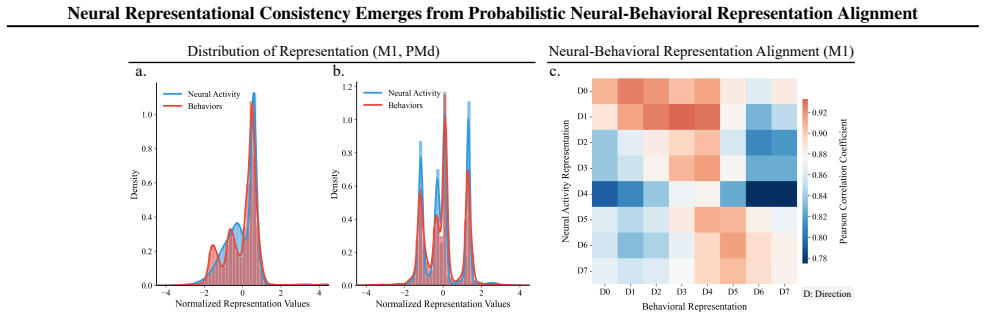
On the paper's own terms, the discovery is that preserved neural representations are not confined to motor cortex or to post-hoc manual alignment. PNBA maps neural activity and behavior into probability distributions in a shared latent space and aligns them with a probabilistic matching loss, while variational-autoencoder-style generative constraints—Poisson reconstruction of spikes and Gaussian reconstruction of behavior—prevent the encoders from collapsing to a constant code. A single network shared across subjects, with adaptive pooling to absorb varying neuron counts, produces latent codes that align to behavior on completely held-out subjects; the reported zero-shot cross-subject correlations are $R = 0.939 \pm 0.033$ in monkey M1, $R = 0.856 \pm 0.072$ in PMd, and $R = 0.892 \pm 0.014$ in mouse V1. The authors interpret the V1 result, obtained with calcium imaging and passive viewing, as evidence that such preservation is a general property of cortical coding across species.
Load-bearing premise
The load-bearing premise is that high cross-subject similarity of the learned codes for matched behavior is evidence of biological preservation; the training objective itself pulls those codes together because both subjects' neural codes are aligned to the same behavioral code, so a null control is needed to show the similarity exceeds what the loss enforces.
Editorial extensions
If this is right
- Calibration-free decoding: because held-out subjects can be mapped into the shared latent space without retraining, PNBA predicts that behavioral decoders trained on one set of subjects will work on new subjects, as shown for V1-guided running-speed decoding with a GRU decoder ($R^2 = 0.888$).
- Hierarchical stability: preservation is graded by scale, with trial-level correlations highest ($R = 0.960$), session-level next ($R = 0.946$), and cross-subject still high ($R = 0.939$), so the paper predicts a nested structure of representational stability in cortex.
- Generality across sensory and motor systems: the V1 result under passive viewing suggests preserved representations exist outside movement-related areas, so the same framework should transfer to other sensory cortices and species.
- Implicit alignment replaces manual alignment: prior demonstrations of cross-subject preservation required post-hoc alignment, while PNBA makes the alignment intrinsic, so no per-subject optimization is needed for comparison or decoding.
- A bridge to covert processes: using temporally delayed behavioral readouts, as in PMd, the authors propose that preparatory or cognitive states with no immediate behavioral correlate can still be anchored to behavior and tested for preservation.
Reading between the lines
- Editorial inference: the near-0.9 cross-subject correlations may be partly manufactured by the objective, because for identical behavior $y$, both subject encoders are trained to approach the same behavioral code $g_\phi(y)$; a permutation null that shuffles which neural trials are paired with which behavioral trials would quantify how much of the similarity is enforced rather than discovered.
- Testable extension: the same framework could be run with the behavioral encoder frozen to a random code or with behavior replaced by a nonsense variable; if cross-subject correlations remain high, preservation is driven by shared stimulus or behavior, and if they drop, the neural code itself contributes.
- Neighbouring problem: PNBA's latent correlation can be used as a metric for representational preservation across developmental stages, learning, or perturbations, since it yields a distance between codes under fixed behavior without retraining.
- Cross-species prediction: if the preservation is truly a general neural property, PNBA should report high cross-subject correlations even when the two subjects are different species performing the same behavioral task; that prediction is testable with existing primate-rodent behavioral datasets.
Signed reviews
Editorial analysis
A structured set of objections, weighed in public.
Referee Report
Summary. The paper proposes PNBA, a probabilistic neural-behavioral representation alignment framework that uses shared encoders and generative constraints to align neural activity with behavioral variables in a common latent space. The authors evaluate PNBA on monkey primary motor cortex (M1) and dorsal premotor cortex (PMd) during reaching, and on mouse primary visual cortex (V1) during visual stimulation. They report high within-session, cross-session, and zero-shot cross-subject representational correlations (e.g., M1 R=0.939, V1 R=0.892), which they interpret as evidence of preserved neural representations across cortices and species. The paper also demonstrates zero-shot V1-guided movement decoding as a practical application.
Significance. If the central claim were established, this would be a significant advance for systems neuroscience and for calibration-free brain-computer interfaces: it would suggest that population codes are shared across individuals without subject-specific calibration. The paper has concrete strengths: a detailed architecture description, public code, evaluation on three datasets, and comparisons to several baselines. However, the central inference is not independently tested. As I detail below, the cross-subject similarity is largely a consequence of the training objective rather than a discovery about the brain, and one of the zero-shot test sets is contaminated. The reported correlations therefore do not support the paper's main scientific claim.
major comments (3)
- [Section 3.2.3, Eq. (5)] The central claim of preserved neural representations is circular because cross-subject similarity is an optimization target by construction. Section 3.2.3 states that a single shared network processes all subjects, and Eq. (5) includes L_ProbMatch (Eq. 1), which minimizes d(f_theta(x), g_phi(y)) between neural and behavioral latent distributions for matched pairs. For identical behavior y presented to two subjects, both f_theta(x_A) and f_theta(x_B) are pulled toward the same g_phi(y), so high cross-subject correlation (Fig. 5c: R=0.939; Fig. 6c: R=0.892) is expected once alignment converges. The matched-vs-mismatched t-tests (Fig. 3b, Supplementary D.3) only demonstrate that the trained latent is behavior-discriminative; they do not show that cross-subject similarity exceeds the level enforced by the loss. A null control is needed, such as shuffling behavior labels across subjects or training without L_ProbMatch, to establish that the observed cross-subject correlation is not a direct consequence of the training objective.
- [Table 3] The PMd zero-shot test set is contaminated because it includes sessions from Monkey M, a subject present in the training set. Table 3 lists test sessions M-CO-20150623 and M-CO-20150625 from Monkey M, while training sessions from Monkey M include M-CO-20140203 through M-CO-20150615. Thus the PMd zero-shot result (Fig. 10c: R=0.856) is at best a held-out-session test within a known subject, not a cross-subject generalization. This undermines the abstract's claim of zero-shot validation in PMd and the broader 'across cortices and species' conclusion.
- [Supplement B, Theorem B.1 (Theorem 3.1)] The proofs of the theoretical guarantees are not rigorous and contain unjustified steps. In part (i), the argument that p(x|z_const) must approach zero for all x under a normalization constraint is not valid for continuous densities: a density can be finite pointwise while still integrating to one, so the claimed limit L_total -> +inf is not established. In part (ii), the existence of constants delta_1 < delta_2 is assumed without derivation, so the claimed eta > 0 is not proven. In part (iii), the lower-bound argument asserts that if two distinct inputs map to arbitrarily close latent codes, then log p(x_i|z) + log p(x_j|z) -> -inf, which depends on the specific likelihood parameterization and is not generally true. Since Theorem 3.1 is used to justify the framework's non-degeneracy and representation stability, these proofs need to be corrected or the claims softened.
minor comments (4)
- [Section 3.2.3 heading] The heading 'CROSS-SUBJECT NETWORK FOR VAIRABLE NEURAL ACTIVTIY' contains typos; it should be 'VARIABLE' and 'ACTIVITY'.
- [Supplementary D.3] The reported p-values of exactly 0.0 are not meaningful; the authors should report actual small values or bounds (e.g., p < 1e-300) instead of p=0.
- [Contributions list] The phrase 'Codes are availiable' should read 'Codes are available'.
- [Equation (9)] The definition of the joint approximate posterior q(z|x,y) is unclear as written: the notation 'for x' and 'for y' suggests different distributions depending on the modality being reconstructed, but the derivations in Eqs. (43)-(46) use q(z|x,y) in both directions. Please clarify the exact form used in practice.
Circularity Check
Cross-subject similarity is an optimization target, not a discovery: PNBA's matching loss and shared encoder force f(x_A) and f(x_B) toward the same g(y), and the PMd 'zero-shot' test is not actually cross-subject.
-
fitted input called prediction
[Sec. 3.1 Eqs. (1)-(2); Sec. 3.2.3; Results Sec. 4.3 Fig. 5c and Sec. 4.4 Fig. 6c]
"LProbMatch = −m·sigmoid(−a·d(·,·)+b) − (1−m)·sigmoid(a·d(·,·)−b) (1) ... d(fθ(x),gφ(y)) = ∥μfθ(x)−μgφ(y)∥2^2 + ∥σ2 fθ(x)+σ2 gφ(y)∥1 (2) ... our approach employs a single shared network across all subjects ... achieving true cross-subject sharing of all network parameters, facilitating direct comparison of neural representations across subjects."
For an identical behavioral variable y presented to two subjects, Eq. (1) minimizes d(fθ(x_A),gφ(y)) and d(fθ(x_B),gφ(y)) with the same shared fθ, pulling both latent codes toward the same gφ(y). Once alignment converges, fθ(x_A) ≈ gφ(y) ≈ fθ(x_B), so high cross-subject Pearson correlation (M1 R=0.939, V1 R=0.892) is the direct output of the training objective, not an independent measurement of raw neural codes. The zero-shot protocol only shows that the learned subject-invariant mapping generalizes to new animals; no control removes or inverts the alignment loss. Reporting these R values as 'preserved neural representations' therefore renames the fit as a discovery.
-
other
[Supplementary Table 3 caption (PMd dataset organization)]
"To align with the M1 experimental setup (which uses 4 monkeys), we treat two sessions from Monkey M in the training set as if they were from a separate monkey for zero-shot evaluation purposes. Sessions are split into training (20 sessions), validation (4 sessions), and test sets (4 sessions), maintaining consistency with the M1 experimental paradigm while accommodating the available PMd recordings."
The PMd test 'held-out subjects' include Monkey M, whose other sessions are in the training set; the caption explicitly says two Monkey M sessions are treated as if they came from a separate monkey. The zero-shot cross-subject result for PMd (R=0.856, Fig. 10c) is therefore not a cross-subject prediction at all: the same animal's neural population appears on both sides of the split. The 'new subject' label is a relabeling of within-subject data, so the PMd claim of zero-shot preservation is invalidated by the paper's own table.
1 more flagged steps
-
self definitional
[Supplementary Sec. E (amLDS comparison) and Remark B.4]
"PNBA does not presuppose neural encoding similarity across subjects—instead, our approach empirically tests whether such similarities exist by introducing behavioral constraints as the bridging element. ... Property (iii) reveals the intrinsic characteristics of preserved neural representations: while maintaining maximal similarity (≤ β), these representations retain inherent distinctiveness (≥ α)."
The claim of neutrality is contradicted by the method itself: with a shared encoder and Eq. (1), identical behavior y anchors every subject's fθ(x) to the same gφ(y), so cross-subject similarity is imposed by the loss, not merely tested. Remark B.4 then takes Theorem 3.1(iii), a bound on same-y pairs that follows from compactness/continuity plus reconstruction, and labels it the 'intrinsic characteristics of preserved neural representations.' The empirical quantity is thus defined by the optimization objective, making the 'test' circular: preservation is built into the loss and read back out of the latent codes.
full rationale
PNBA's engineering contribution—a subject-invariant neural-behavioral encoder that generalizes zero-shot to new animals—is real and benchmarkable; the baselines in Table 1 and the ablations are independent of the circularity concern. However, the paper's headline neuroscience claim ('preserved neural representations across cortices and species') is not supported independently of the training objective. Equations (1)-(2) and the shared-network design make f(x_A) and f(x_B) converge to the same g(y) for matched behavior, so cross-subject correlation is a fitted property. The zero-shot protocol adds generalization evidence about the model but not about raw neural representations, and no null control separates learned similarity from biological preservation. The PMd 'zero-shot' result is further compromised by the explicit relabeling of Monkey M sessions as a new subject. Hence the central claim partially reduces by construction, and the PMd evidence is not zero-shot by the paper's own table.
Assumptions & free parameters
free parameters (4)
- Latent dimensionality =
32 (V1), 4 (M1/PMd)
- Generative constraint weights lambda_1, lambda_2, lambda_3 =
not reported
- Probabilistic matching parameters a, b (Eq. 1) =
learned, final values not reported
- Kinematic similarity threshold for matched trials =
R > 0.9
assumptions (4)
- domain assumption Neural-behavioral correlations primarily reside in a shared low-dimensional latent space, with a bidirectional Markov chain x <-> z <-> y and conditional independence of x and y given z.
- standard math Variational posteriors q(z|x) and q(z|y) are conditionally independent Gaussians, and the joint q(z|x,y) is proportional to their product.
- ad hoc to paper The latent distributions p(z|x) and p(z|y) converge during training, so the conditional ELBO derivations in Supplement B.2 may substitute one for the other.
- ad hoc to paper For PMd zero-shot evaluation, held-out sessions from Monkey M (a subject present in training) can stand in for a new subject.
Cite this review
Pith. "Pith review of Neural Representational Consistency Emerges from Probabilistic Neural-Behavioral Representation Alignment." pith.science (2026). https://pith.science/paper/A4YPFWHY
@misc{pith2026250504331,
  author       = {Pith},
  title        = {Pith review of: Neural Representational Consistency Emerges from Probabilistic Neural-Behavioral Representation Alignment},
  year         = {2026},
  howpublished = {\url{https://pith.science/paper/A4YPFWHY}},
  note         = {Machine review of arXiv:2505.04331}
}
read the original abstract
Individual brains exhibit striking structural and physiological heterogeneity, yet neural circuits can generate remarkably consistent functional properties across individuals, an apparent paradox in neuroscience. While recent studies have observed preserved neural representations in motor cortex through manual alignment across subjects, the zero-shot validation of such preservation and its generalization to more cortices remain unexplored. Here we present PNBA (Probabilistic Neural-Behavioral Representation Alignment), a new framework that leverages probabilistic modeling to address hierarchical variability across trials, sessions, and subjects, with generative constraints preventing representation degeneration. By establishing reliable cross-modal representational alignment, PNBA reveals robust preserved neural representations in monkey primary motor cortex (M1) and dorsal premotor cortex (PMd) through zero-shot validation. We further establish similar representational preservation in mouse primary visual cortex (V1), reflecting a general neural basis. These findings resolve the paradox of neural heterogeneity by establishing zero-shot preserved neural representations across cortices and species, enriching neural coding insights and enabling zero-shot behavior decoding.
Figures


Figures from the paper (7 more)




Reference graph
Works this paper leans on
-
[1]
and no statistical difference between matched and mismatched pairs (t=0.02, p=0.981> 0.05). When incorporating information bottleneck regularization (λ = 10−4), the PCA projection in e demonstrates maintained distributional structure but altered geometric relationships, while the corresponding similarity matrix in f exhibits systematic negative correlatio...
work page 2023
-
[3]
Monkey PMd Dataset Organization and Recording Sessions. The dataset comprises recordings from 3 monkeys (C, M, and T) performing a center-out (CO) reaching task. To align with the M1 experimental setup (which uses 4 monkeys), we treat two sessions from Monkey M in the training set as if they were from a separate monkey for zero-shot evaluation purposes. S...
work page 2023
-
[6]
This design significantly reduces computational complexity while preserving the temporal dimension throughout all processing stages, enabling robust capture of temporal dependencies and population dynamics for neural data analysis. C.5. Implementation Details for Verifying Preserved Neural Representations Verification of preserved neural representations n...
work page 1982
-
[7]
G., Courville, A., and Ballas, N
Lavoie, S., Kirichenko, P., Ibrahim, M., Assran, M., Wilson, A. G., Courville, A., and Ballas, N. Modeling caption diversity in contrastive vision-language pretraining.arXiv preprint arXiv:2405.00740,
-
[8]
Umap: Uniform manifold approximation and projection for dimension reduction
McInnes, L., Healy, J., and Melville, J. Umap: Uniform manifold approximation and projection for dimension reduction. arXiv preprint arXiv:1802.03426,
-
[9]
reveals robust preservation of neural representational structure, with strong within-condition correlations (diagonal blocks, self-correlation R = 1.0, t=136.715, p=0.) and weak between-condition correlations). Independent samples t-tests between matched and mismatched trial pairs showed highly significant differences (p< 0.001), demonstrating PNBA’s abil...
work page 2021
-
[10]
Walker, E. Y ., Sinz, F. H., Cobos, E., Muhammad, T., Froudarakis, E., Fahey, P. G., Ecker, A. S., Reimer, J., Pitkow, X., and Tolias, A. S. Inception loops discover what excites neurons most using deep predictive models. Nature neuroscience, 22(12):2060–2065,
-
[12]
Ye, J. and Pandarinath, C. Representation learning for neural population activity with neural data transformers. arXiv preprint arXiv:2108.01210,
Show all 21 references
-
[15]
and probabilistic matching (Chun, 2023; Chun et al., 2024)), evaluating their capabilities in handling the inherent variability structure in neural data. A.1. Hierarchical Variability in Neural Responses Neural population recordings exhibit systematic variability at multiple s...
2023
-
[17]
attempts to address this by modeling distribution-level alignment: LProbMatch =− 1 B BX i=1 log 1 1 + exp(−τ·d(f(xi),g (yi)) +b) + X j∈[B]\{i} log 1 1 + exp(τ·d(f(xi),g (yj))−b) (20) whered(f(x),g (y)) =∥µf (x)− µg(y)∥2 2 +∥σ2 f (x) + σ2 g(y)∥1 However, this formulation...
2016
-
[21]
SwapV AE operates only within the neural activity domain, employing augmentation, i.e., swap operation, based on trial similarity assumption without any behavioral constraints
proposed SwapV AE, a self-supervised approach for generating neural activity through data augmentation. SwapV AE operates only within the neural activity domain, employing augmentation, i.e., swap operation, based on trial similarity assumption without any behavioral constrain...
2021
-
[1982]
B., Schaffer, E., Aoi, M
Gondur, R., Sikandar, U. B., Schaffer, E., Aoi, M. C., and Keeley, S. L. Multi-modal gaussian process variational au- toencoders for neural and behavioral data. arXiv preprint arXiv:2310.03111,
-
[2010]
Oord, A. v. d., Li, Y ., and Vinyals, O. Representation learn- ing with contrastive predictive coding. arXiv preprint arXiv:1807.03748,
-
[2014]
B., Benson, B., Benson, J., Birman, D., Bonacchi, N., Carandini, M., Catarino, J
Laboratory, I. B., Benson, B., Benson, J., Birman, D., Bonacchi, N., Carandini, M., Catarino, J. A., Chapuis, G. A., Churchland, A. K., Dan, Y ., et al. A brain-wide map of neural activity during complex behaviour.Biorxiv, pp. 2023–07,
2023
-
[2016]
H., Rainforth, T., Schmon, S
Joy, T., Shi, Y ., Torr, P. H., Rainforth, T., Schmon, S. M., and Siddharth, N. Learning multimodal vaes through mutual supervision. arXiv preprint arXiv:2106.12570,
-
[2017]
A., Fischer, I., Dillon, J
Alemi, A. A., Fischer, I., Dillon, J. V ., and Murphy, K. Deep variational information bottleneck. arXiv preprint arXiv:1612.00410,
-
[2019]
Exploring behavior- relevant and disentangled neural dynamics with genera- tive diffusion models
Wang, Y ., Li, C., Li, W., and Wu, A. Exploring behavior- relevant and disentangled neural dynamics with genera- tive diffusion models. arXiv preprint arXiv:2410.09614,
-
[2021]
and MARBLE(Gosztolai et al., 2025). A. Analysis of Cross-modal Representation Alignment Methods for Neural-Behavioral Alignment In this section, we analyze cross-modal alignment methods from artificial intelligence that are adapted to neural-behavioral representation alignment...
2025
-
[2022]
Analysis of Cross-modal Representation Alignment Methods
13 Neural Representational Consistency Emerges from Probabilistic Neural-Behavioral Representation Alignment Supplementary Materials In the following sections, we provide a comprehensive analysis of cross-modal representation learning approaches for neural-behavioral data inte...
2021
-
[2023]
Proba- bilistic language-image pre-training
Chun, S., Kim, W., Park, S., and Yun, S. Proba- bilistic language-image pre-training. arXiv preprint arXiv:2410.18857,
-
[2024]
Improved probabilistic image-text representations
Chun, S. Improved probabilistic image-text representations. arXiv preprint arXiv:2305.18171,
Reviewed August 15, 2026 · model on record in the stance chip above.
Discussion (0). Continue with ORCID to comment.