REVIEW 4 major objections 4 minor 1 cited by
Star formation and accretion rates within 500 pc as traced by Gaia DR3 XP spectra
T0 review · 4 major / 4 minor · reviewed 2026-08-15 · deepseek-v4-flash
Pith's one-line read The paper argues that Gaia DR3 XP spectra can yield reliable accretion rates for 145,975 young stellar objects within 500 pc, revealing a dispersed low-accreting population.
desk verdict A genuinely useful all-sky YSO accretion catalogue from Gaia XP spectra, with an abstract that oversells the low-accreting population by leaning on the unfiltered table. read the letter →
The pith
A machine-rendered reading of the paper's core claim, the machinery that carries it, and where it could break.
The reading
What carries the argument
The load-bearing object is the $\mathrm{H}\alpha$ pseudo-equivalent width (pEW) from the Gaia DR3 ESP-ELS module, together with line measurements from the linefinder tool on the XP spectra. The pEW is calibrated against medium-resolution equivalent widths, converted to a line flux using a continuum flux derived from the Gaia $RP$ magnitude, corrected for extinction in three ways (none, GSP-Phot, and med-GSP-Phot), and finally turned into $L_\mathrm{acc}$ and $\dot{M}_\mathrm{acc}$ through the empirical relation $\log(L_\mathrm{acc}/L_\odot) = 1.13 + 1.74\,\log(L_{\mathrm{H}\alpha}/L_\odot)$ and the standard magnetospheric-accretion formula $\dot{M}_\mathrm{acc} \approx 1.25\,L_\mathrm{acc} R_\star/(G M_\star)$. Linefinder line-width and line-depth cuts ($\mathrm{width} < 25$ nm, $\mathrm{depth} > 10^{-17}$ W/nm/m$^2$) remove M-dwarf TiO contamination, while three quality flags (IR excess, pEW strength, and their combination) define purified subsamples. This machinery is what lets a low-resolution, all-sky survey stand in for targeted high-resolution spectroscopy.
What would settle it
Take a random subset of the 145,975 candidates that fall below the chromospheric emission locus (55% of the table) and observe them with medium-resolution spectroscopy (resolving power ~10,000) measuring both UV excess and $\mathrm{H}\alpha$. If nearly all show chromospheric $\mathrm{H}\alpha$ with no UV continuum excess and no veiling, the claimed large dispersed low-accreting population is mostly a selection artifact; if a substantial fraction show genuine UV excess, the population is real.
Extended reading notes
Core claim
The central claim is that $\mathrm{H}\alpha$ emission measured in Gaia XP spectra can be converted into reliable accretion luminosities and mass accretion rates for essentially all YSOs within 500 pc, not just those with infrared-bright discs. After calibrating the Gaia pseudo-equivalent width to literature equivalent widths, deriving $\mathrm{H}\alpha$ line fluxes from a continuum flux–$RP$ relation and three extinction treatments, and converting through the empirical $L_\mathrm{acc}$–$L_{\mathrm{H}\alpha}$ relation, the authors produce a table of 145,975 objects with accretion properties and stellar parameters. From the cleanest subsample (1,945 objects passing both IR-excess and strong-$\mathrm{H}\alpha$ cuts) they obtain $L_\mathrm{acc} \propto L_\star^{1.41\pm0.02}$ and $\dot{M}_\mathrm{acc} \propto M_\star^{2.4\pm0.1}$, and from the Sco-Cen clusters an exponential accretion timescale of $2.7\pm0.4$ Myr with a power-law decay giving 70% accretors at 2 Myr and 2.8% at 10 Myr. They further claim that the newly found population of low-accreting candidates is mostly spatially dispersed, often unconnected to known star-forming regions, and may contain numerous 'Peter Pan' discs.
Load-bearing premise
The load-bearing premise is that $\mathrm{H}\alpha$ pseudo-equivalent width traces magnetospheric accretion through the literature $L_\mathrm{acc}$–$L_{\mathrm{H}\alpha}$ relation for every source in the table, even though the paper finds 55% of sources fall below the chromospheric emission level.
Editorial extensions
If this is right
- Accretion rates can now be assigned to any $\mathrm{H}\alpha$-emitting source within 500 pc with public XP spectra, so future studies can build statistically complete YSO samples without new spectroscopic campaigns.
- The $L_\mathrm{acc}$–$L_\star$ and $\dot{M}_\mathrm{acc}$–$M_\star$ relations are recovered on a homogeneous all-sky sample, with slopes consistent with most literature values, which supports using these relations to interpret larger and fainter samples.
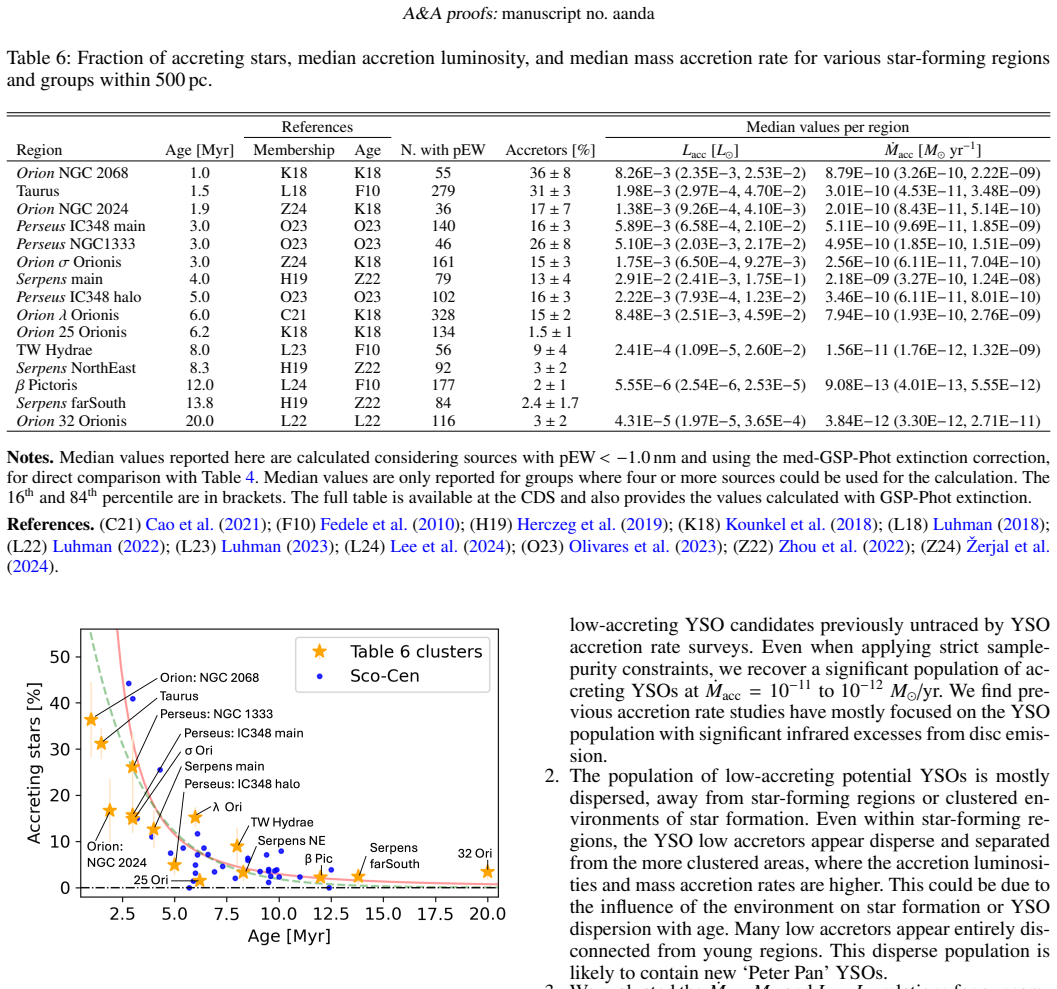
- The fraction of accretors in Sco-Cen declines on a timescale of $2.7\pm0.4$ Myr (exponential) or as a power law with 70% at 2 Myr and 2.8% at 10 Myr, giving a comparative benchmark for disc dispersal models.
- A large population of low-accreting, spatially dispersed YSO candidates, many with no clear young association, is now available for follow-up, including candidate 'Peter Pan' discs.
- Quality-flag subsamples (4,208 by IR excess, 6,170 by strong $\mathrm{H}\alpha$, 1,945 by both) let users balance completeness against contamination for different science cases.
Reading between the lines
- The 55% of sources below the chromospheric emission level are probably not all real accretors; medium-resolution spectroscopy of a random subset of those sources would likely shrink the dispersed low-accreting population, though the purified flag_combined sample suggests a real core remains.
- If the 'Peter Pan' interpretation is right, the dispersed low accretors should show old ages, thin-disc signatures, and kinematics unconnected to any association; checking their lithium abundances or space motions would test this.
- The same XP-based pipeline could be applied to the epoch-level spectra expected in future data releases, turning accretion variability and burst statistics into a general diagnostic rather than a single-epoch census.
- The method's extinction limitations (med-GSP-Phot underestimates accretion luminosities) imply that individual-source accretion rates in the table should be treated as lower limits when only the filled-in extinction is available.
Signed reviews
Editorial analysis
A structured set of objections, weighed in public.
Referee Report
Summary. The paper presents the first all-sky, homogeneous derivation of H-alpha-based accretion properties for young stellar objects within 500 pc using Gaia DR3 XP spectra. The authors construct a catalogue of 145,975 H-alpha emitter candidates (Table 2), derive equivalent widths from ESP-ELS pseudo-equivalent widths, continuum fluxes from an RP-magnitude relation, extinction corrections via two methods (GSP-Phot and median GSP-Phot), and convert H-alpha luminosities to accretion luminosities and mass accretion rates using the Alcala et al. (2017) calibration. They define three purer sub-samples: flag_IR (4,208 sources), flag_pEW (6,170 sources), and flag_combined (1,945 sources), and use these to derive Lacc-Lstar and Macc-Mstar relations, a Sco-Cen accretion timescale of 2.7±0.4 Myr, and the claim of a large, spatially dispersed population of low-accreting YSO candidates. The catalogue and methodology are the main deliverables.
Significance. If the catalogue is accepted as reliable, it represents a substantial advance: a homogeneous all-sky local census of YSO accretion, with transparent, reproducible methodology and explicit quality flags. The comparison against 341 X-Shooter YSOs is a genuine strength, as are the machine-readable catalogue and the explicit documentation of selection thresholds. However, the central physical claim—the existence of a large, previously unseen low-accreting population—rests on the unfiltered catalogue, for which the paper itself shows that 55% of sources fall below the chromospheric emission locus. The purified samples are more credible but are not the basis for the headline discovery claim. The small formal errors on the derived power-law slopes also need to be reconciled with the known systematic scatter in the calibration chain.
major comments (4)
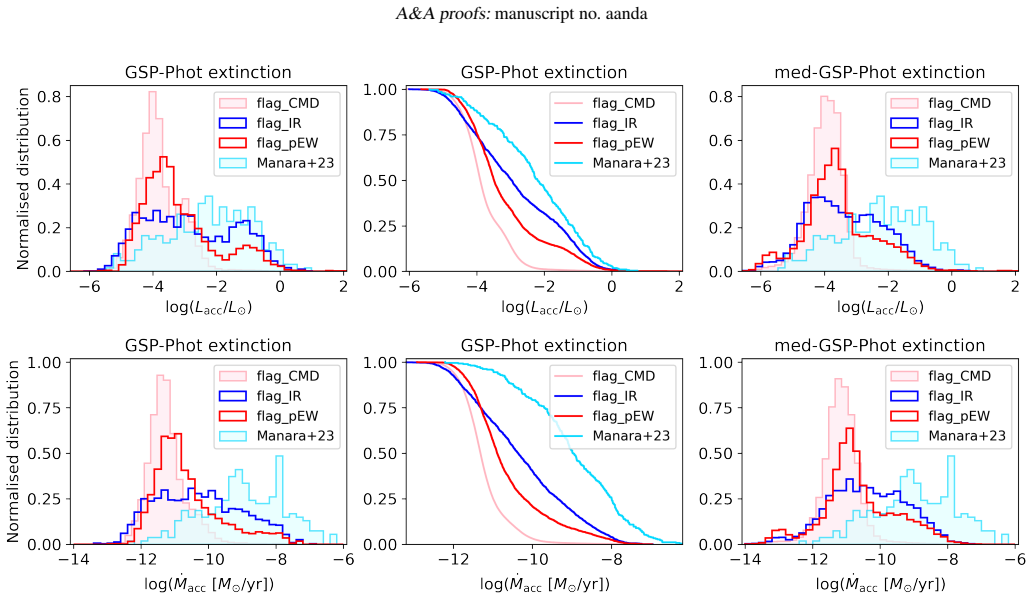
- [Sect. 2.7 and Abstract] The abstract's claim of a 'large population of low-accreting YSO candidates untraced by previous surveys' is drawn from the full Table 2, yet Sect. 2.7 reports that 55% of sources in that table lie below the chromospheric emission locus of Manara et al. (2017a). For those sources, the derived Lacc and Macc values could be dominated by chromospheric emission, making the population claim unsubstantiated as presented. The authors should re-derive the low-accretor statistics after applying flag_above_chromospheric_level, or explicitly quantify how many low-accreting sources in Table 2 remain above the chromospheric locus and show that the spatial-dispersion result survives that cut.
- [Sect. 2.8, Fig. 9] The validation against 341 X-Shooter YSOs tests relatively strong, known accretors and shows agreement only to within an order of magnitude. The low-accretion regime (log Lacc below about -4) is not probed by this comparison, yet it is exactly the regime where the new dispersed population is claimed to reside. The paper should either validate the pipeline on known chromospherically active non-accreting stars (to demonstrate that the method does not overproduce low-Lacc sources) or state explicitly that the low-accretion rates in the catalogue are unvalidated and should be treated with caution until spectroscopic follow-up is available.
- [Sect. 3.2, Table 3] The quoted uncertainties on the power-law slopes (0.02 for the Lacc-Lstar slope and 0.1 for the Macc-Mstar slope) reflect only formal propagation of random errors. Table 3 shows that switching from GSP-Phot to med-GSP-Phot extinction changes the combined-sample slope from 1.41±0.02 to 1.50±0.02, and switching samples changes it further; the intrinsic scatter in Eq. (1) and Eq. (5) and the choice of extinction treatment are not included in the reported errors. The paper should report a systematic error budget or a combined uncertainty that accounts for these choices, since the claim '1.41±0.02' is likely an underestimate of the true uncertainty.
- [Sect. 2.1, Appendix E] The full Table 2 includes 20,274 sources without public XP spectra, which receive no linefinder-based M-dwarf filtering (width_lf cut) and are retained on the basis of pEW alone. The pEW<−0.5 nm threshold was chosen with an F_beta score (beta=2) that prioritizes completeness over purity. The paper should state explicitly how many sources in Table 2 lack XP spectra and quantify the impact of their inclusion on the low-accretor statistics, especially for the spatially dispersed population claimed in the abstract.
minor comments (4)
- [Throughout] The text contains several spacing errors ('di fferent', 'e ffects') and a grammatical error in Sect. 2.8 ('the lower limit to the mass accretion rate that we are sensitive too' should be 'sensitive to'). A careful proofread would improve readability.
- [Sect. 2.2] The fit of Eq. (1) discards 18 points with pEW > -0.1 nm or EWHalpha > -0.1 nm; the paper should justify more explicitly that these are non-emitting or peculiar sources and confirm that the retained 120 sources span the parameter space of the final catalogue, including the low-pEW regime.
- [Sect. 4.1, Table 4] Several Sco-Cen clusters have only upper limits or no median accretion values (e.g., clusters 11, 12, 24, 25, 27, 30), and the table is not self-explanatory about why. A short note in the caption clarifying that medians require at least four accretors would help.
- [Appendix B] The F_beta-score definition and the choice of beta=2 are described, but the paper does not state the numerical values of the accuracy, completeness, and F_beta for the chosen thresholds (pEW<−0.5 and <−1.0 nm). Reporting those numbers would allow readers to judge the purity/completeness tradeoff quantitatively.
Circularity Check
No significant circularity: the accretion-rate chain is anchored to external X-Shooter calibrations and validated against independent literature values; the low-accretor claim is explicitly caveated by the paper's own chromospheric flag.
full rationale
The paper derives EWHalpha from pEW via Eq. 1, fitted to 120 literature YSOs with X-Shooter spectra; derives Fcont from RP via Eq. 3, fitted to 114 known YSOs; and converts LHalpha to Lacc with Eq. 5 using Alcala et al. (2017), an externally calibrated relation. The final Lacc and Macc values are compared to 341 common objects from Manara et al. (2023), an independent benchmark, and agree to within an order of magnitude. The pEW selection thresholds are internal cross-calibrations between ESP-ELS pEW and linefinder on the same XP spectra; this is an instrument-calibration choice, not a prediction of the paper's physical results. The paper explicitly reports that 55% of the unfiltered Table 2 lies below the chromospheric locus (Sect. 2.7), whereas samples A, B, and C are 8.44%, 0.15%, and ~0% below it, so the headlined dispersed low-accretor population is not presented as validated for the unfiltered sample. The scaling relations and tau_acc are empirical fits, not derived from their own assumptions by construction. The only minor self-referential element is the use of Vioque et al. (2018, 2022) catalogues in calibrating linefinder thresholds, but this is not load-bearing because the same thresholds are corroborated by the Manara et al. (2023) sample and the external X-Shooter comparison.
Assumptions & free parameters
free parameters (7)
- pEW-to-EW calibration coefficients (m, c, σ) =
m=1.13±0.04, c=0.41±0.02, σ=0.18
- Fcont-RP relation coefficients (a, b, σ) =
a=-0.48±0.01, b=-10.2±0.1, σ=0.05-0.06
- Lacc-LHα calibration (A, B) from Alcalá et al. 2017 =
A=1.13±0.05, B=1.74±0.19
- Inner disk radius ratio Rin/R* =
5
- facc exponential/power-law fit parameters (τ, C, k, α) =
τ=2.7±0.4 Myr, C=79±28%; k=281±149, α=-2.0±0.3
- Criterion B accretion floor for no-XP sources =
log(Lacc/L⊙)>-3.5
- Minimum CMD error floor =
0.1 mag in color and absolute magnitude
assumptions (5)
- domain assumption Hα emission traces magnetospheric accretion for all sample members (Eq. 5, A=1.13, B=1.74 from Alcalá et al. 2017).
- domain assumption Baraffe et al. (2015) tracks describe the CMD positions of these YSOs.
- domain assumption GSP-Phot and med-GSP-Phot extinctions bracket the true line-of-sight plus circumstellar extinction.
- domain assumption The 34 Sco-Cen clusters are comparable snapshots of one star formation process.
- ad hoc to paper pEW<−0.5 nm and widthlf<25 nm separate real Hα emission from M-dwarf TiO bands.
Cite this review
Pith. "Pith review of Star formation and accretion rates within 500 pc as traced by Gaia DR3 XP spectra." pith.science (2026). https://pith.science/paper/RZ6TZAB7
@misc{pith2026250504699,
  author       = {Pith},
  title        = {Pith review of: Star formation and accretion rates within 500 pc as traced by Gaia DR3 XP spectra},
  year         = {2026},
  howpublished = {\url{https://pith.science/paper/RZ6TZAB7}},
  note         = {Machine review of arXiv:2505.04699}
}
abstract
Accretion rates from protoplanetary disks onto forming stars are a key ingredient in star formation and protoplanetary disk evolution. Extensive efforts surveying individual star forming regions with spectroscopy and narrow-band photometry have been performed to derive accretion rates on large populations of young stellar objects (YSOs). We use Gaia DR3 XP spectra to perform the first all-sky homogeneous analysis of YSO accretion within 500 pc. We characterise the H$\alpha$ line emission of YSOs by using the H$\alpha$ pseudo-equivalent widths and XP spectra from Gaia DR3. We derive accretion luminosities, mass accretion rates and stellar parameters for 145 975 candidate YSO H$\alpha$ emitters all-sky. We describe filtering strategies to select specific sub-samples of YSOs from this catalogue. We identify a large population of low-accreting YSO candidates untraced by previous surveys. The population of low accreting YSOs is mostly spatially dispersed, away from star forming regions or more clustered environments of star formation. Many YSOs appear disconnected from young populations, reminiscent of 'Peter Pan' YSOs. We find $L_{acc}\propto L_\star^{1.41\pm0.02}$ and $\dot M_{acc}\propto M_\star^{2.4\pm0.1}$ for the purest all-sky sample of YSO candidates. By fitting an exponential to the fraction of accreting stars in clusters of different ages in the Sco-Cen complex, we obtain an accretion timescale of 2.7$\pm$0.4 Myr. The percentage of accretors found by fitting a power-law is 70% at 2 Myr and 2.8% at 10 Myr. With this new catalogue of H$\alpha$ emitters we significantly increase the number of YSO candidates with accretion rate estimations in the local neighbourhood. This allows us to study accretion timescales and the spatial and physical properties of YSO accretion from a large, all-sky, and homogeneous sample for the first time. [abridged]
Figures


Figures from the paper (12 more)




Forward citations
Cited by 1 Pith paper
-
exoALMA. XVIII. Interpreting large scale kinematic structures as moderate warping
Moderate disk warps of about 0.5 to 2 degrees can reproduce the single-armed velocity patterns seen in many exoALMA disks, and may also explain spiral structures in scattered light and CO temperature.
Reference graph
Works this paper leans on
-
[1]
, " * write output.state after.block = add.period write newline
ENTRY address archiveprefix author booktitle chapter edition editor howpublished institution eprint journal key month note number organization pages publisher school series title type volume year label extra.label sort.label short.list INTEGERS output.state before.all mid.sentence after.sentence after.block FUNCTION init.state.consts #0 'before.all := #1 ...
-
[2]
write newline
" write newline "" before.all 'output.state := FUNCTION n.dashify 't := "" t empty not t #1 #1 substring "-" = t #1 #2 substring "--" = not "--" * t #2 global.max substring 't := t #1 #1 substring "-" = "-" * t #2 global.max substring 't := while if t #1 #1 substring * t #2 global.max substring 't := if while FUNCTION word.in bbl.in " " * FUNCTION format....
-
[3]
M., Manara , C
Alcal \'a , J. M., Manara , C. F., Natta , A., et al. 2017, , 600, A20
2017
-
[4]
M., Natta , A., Manara , C
Alcal \'a , J. M., Natta , A., Manara , C. F., et al. 2014, , 561, A2
2014
-
[5]
F., Testi , L., et al
Almendros-Abad , V., Manara , C. F., Testi , L., et al. 2024, , 685, A118
2024
-
[6]
Anania , R., Rosotti , G. P., G \'a rate , M., et al. 2025, arXiv e-prints, arXiv:2506.10743
arXiv 2025
-
[7]
2023, , 674, A27
Andrae , R., Fouesneau , M., Sordo , R., et al. 2023, , 674, A27
2023
-
[8]
P., Manara , C
Ansdell , M., Williams , J. P., Manara , C. F., et al. 2017, , 153, 240
2017
Show all 98 references
-
[9]
Avedisova , V. S. 2002, Astronomy Reports, 46, 193
2002
-
[10]
Bailer-Jones , C. A. L., Rybizki , J., Fouesneau , M., Demleitner , M., & Andrae , R. 2021, , 161, 147
2021
-
[11]
2015, , 577, A42
Baraffe , I., Homeier , D., Allard , F., & Chabrier , G. 2015, , 577, A42
2015
-
[12]
2012, , 427, 127
Bressan , A., Marigo , P., Girardi , L., et al. 2012, , 427, 127
2012
-
[13]
2023, , 669, A55
Cantat-Gaudin , T., Fouesneau , M., Rix , H.-W., et al. 2023, , 669, A55
2023
-
[14]
2021, in The 20.5th Cambridge Workshop on Cool Stars, Stellar Systems, and the Sun (CS20.5), Cambridge Workshop on Cool Stars, Stellar Systems, and the Sun, 269
Cao , L., Pinsonneault , M., Hillenbrand , L., & Kuhn , M. 2021, in The 20.5th Cambridge Workshop on Cool Stars, Stellar Systems, and the Sun (CS20.5), Cambridge Workshop on Cool Stars, Stellar Systems, and the Sun, 269
2021
-
[15]
M., Esplin , T
Carpenter , J. M., Esplin , T. L., Luhman , K. L., Mamajek , E. E., & Andrews , S. M. 2024, arXiv e-prints, arXiv:2410.21598
2024 arXiv
-
[16]
M., Weiler , M., Jordi , C., et al
Carrasco , J. M., Weiler , M., Jordi , C., et al. 2021, , 652, A86
2021
-
[17]
Castro-Ginard , A., Brown , A. G. A., Kostrzewa-Rutkowska , Z., et al. 2023, , 677, A37
2023
-
[18]
Claes , R. A. B., Manara , C. F., Garcia-Lopez , R., et al. 2022, , 664, L7
2022
-
[19]
Cody , A. M. & Hillenbrand , L. A. 2018, , 156, 71
2018
-
[20]
Coleman , G. A. L. & Haworth , T. J. 2020, , 496, L111
2020
-
[21]
P., & Wilhelm , M
Cournoyer-Cloutier , C., Karam , J., Sills , A., Zwart , S. P., & Wilhelm , M. J. C. 2024, , 975, 207
2024
-
[22]
L., Sordo , R., Pailler , F., et al
Creevey , O. L., Sordo , R., Pailler , F., et al. 2023, , 674, A26
2023
-
[23]
M., Wright , E
Cutri , R. M., Wright , E. L., Conrow , T., et al. 2021, VizieR Online Data Catalog: AllWISE Data Release (Cutri+ 2013) , VizieR On-line Data Catalog: II/328. Originally published in: IPAC/Caltech (2013)
2013
-
[24]
2023, , 674, A2
De Angeli , F., Weiler , M., Montegriffo , P., et al. 2023, , 674, A2
2023
-
[25]
2010, , 715, 1
De Marchi , G., Panagia , N., & Romaniello , M. 2010, , 715, 1
2010
-
[26]
R., Oudmaijer , R
Fairlamb , J. R., Oudmaijer , R. D., Mendigut \' a , I., Ilee , J. D., & van den Ancker , M. E. 2015, , 453, 976
2015
-
[27]
R., Oudmaijer , R
Fairlamb , J. R., Oudmaijer , R. D., Mendigutia , I., Ilee , J. D., & van den Ancker , M. E. 2017, , 464, 4721
2017
-
[28]
2023, , 945, 112
Fang , M., Pascucci , I., Edwards , S., et al. 2023, , 945, 112
2023
-
[29]
E., Henning , T., Jayawardhana , R., & Oliveira , J
Fedele , D., van den Ancker , M. E., Henning , T., Jayawardhana , R., & Oliveira , J. M. 2010, , 510, A72
2010
-
[30]
2023, , 944, 135
Fiorellino , E., Tychoniec , ., Cruz-S \'a enz de Miera , F., et al. 2023, , 944, 135
2023
-
[31]
J., Hillenbrand , L
Fischer , W. J., Hillenbrand , L. A., Herczeg , G. J., et al. 2023, in Astronomical Society of the Pacific Conference Series, Vol. 534, Protostars and Planets VII, ed. S. Inutsuka , Y. Aikawa , T. Muto , K. Tomida , & M. Tamura , 355
2023
-
[32]
S., Reipurth , B., Boogert , A., & Doppmann , G
Flores , C., Connelley , M. S., Reipurth , B., Boogert , A., & Doppmann , G. 2024, , 972, 149
2024
-
[33]
2023, , 674, A28
Fouesneau , M., Fr \'e mat , Y., andrae , R., et al. 2023, , 674, A28
2023
-
[34]
Gaia Collaboration , Brown , A. G. A., Vallenari , A., et al. 2021, , 649, A1
2021
-
[35]
Gaia Collaboration , Prusti , T., de Bruijne , J. H. J., et al. 2016, , 595, A1
2016
-
[36]
Gaia Collaboration , Vallenari , A., Brown , A. G. A., et al. 2023, , 674, A1
2023
-
[37]
L., Stapper , L
Grant , S. L., Stapper , L. M., Hogerheijde , M. R., et al. 2023, , 166, 147
2023
-
[38]
P., et al
Gupta , A., Miotello , A., Williams , J. P., et al. 2024, , 683, A133
2024
-
[39]
2016, , 54, 135
Hartmann , L., Herczeg , G., & Calvet , N. 2016, , 54, 135
2016
-
[40]
J., Kuhn , M
Herczeg , G. J., Kuhn , M. A., Zhou , X., et al. 2019, , 878, 111
2019
-
[41]
Kelly , B. C. 2007, , 665, 1489
2007
-
[42]
D., Henry , T
Kirkpatrick , J. D., Henry , T. J., & McCarthy , Donald W., J. 1991, , 77, 417
1991
-
[43]
A., et al
K \'o sp \'a l , \'A ., Cruz-S \'a enz de Miera , F., White , J. A., et al. 2021, , 256, 30
2021
-
[44]
2018, The Astronomical Journal, 156, 84
Kounkel, M., Covey, K., Suárez, G., et al. 2018, The Astronomical Journal, 156, 84
2018
-
[45]
S., & Haugb lle , T
Kuffmeier , M., Jensen , S. S., & Haugb lle , T. 2023, European Physical Journal Plus, 138, 272
2023
-
[46]
2024, Monthly Notices of the Royal Astronomical Society, 528
Lee, R., Gaidos, E., Saders, J., Feiden, G., & Gagné, J. 2024, Monthly Notices of the Royal Astronomical Society, 528
2024
-
[47]
2024, arXiv e-prints, arXiv:2412.05535
Long , F., Pascucci , I., Houge , A., et al. 2024, arXiv e-prints, arXiv:2412.05535
2024 arXiv
-
[48]
Luhman, K. L. 2018, The Astronomical Journal, 156
2018
-
[49]
Luhman , K. L. 2022, , 164, 151
2022
-
[50]
Luhman, K. L. 2023, The Astronomical Journal, 165, 269
2023
-
[51]
F., Ansdell , M., Rosotti , G
Manara , C. F., Ansdell , M., Rosotti , G. P., et al. 2023, in Astronomical Society of the Pacific Conference Series, Vol. 534, Protostars and Planets VII, ed. S. Inutsuka , Y. Aikawa , T. Muto , K. Tomida , & M. Tamura , 539
2023
-
[52]
F., Fedele , D., Herczeg , G
Manara , C. F., Fedele , D., Herczeg , G. J., & Teixeira , P. S. 2016 a , , 585, A136
2016
-
[53]
F., Frasca , A., Alcal \'a , J
Manara , C. F., Frasca , A., Alcal \'a , J. M., et al. 2017 a , , 605, A86
2017
-
[54]
F., Natta , A., Rosotti , G
Manara , C. F., Natta , A., Rosotti , G. P., et al. 2020, , 639, A58
2020
-
[55]
F., Rosotti , G., Testi , L., et al
Manara , C. F., Rosotti , G., Testi , L., et al. 2016 b , , 591, L3
2016
-
[56]
F., Testi , L., Herczeg , G
Manara , C. F., Testi , L., Herczeg , G. J., et al. 2017 b , , 604, A127
2017
-
[57]
2023, , 674, A21
Marton , G., \'A brah \'a m , P., Rimoldini , L., et al. 2023, , 674, A21
2023
-
[58]
2019, , 487, 2522
Marton , G., \'A brah \'a m , P., Szegedi-Elek , E., et al. 2019, , 487, 2522
2019
-
[59]
2022, , 660, A131
Mej \' as , A., Minniti , D., Alonso-Garc \' a , J., et al. 2022, , 660, A131
2022
-
[60]
2020, Galaxies, 8, 39
Mendigut \' a , I. 2020, Galaxies, 8, 39
2020
-
[61]
D., Rigliaco , E., et al
Mendigut \' a , I., Oudmaijer , R. D., Rigliaco , E., et al. 2015, , 452, 2837
2015
-
[62]
2024, Nature Astronomy, 8, 216
Miret-Roig , N., Alves , J., Barrado , D., et al. 2024, Nature Astronomy, 8, 216
2024
-
[63]
2023, , 674, A3
Montegriffo , P., De Angeli , F., andrae , R., et al. 2023, , 674, A3
2023
-
[64]
M., et al
Nisini , B., Antoniucci , S., Alcal \'a , J. M., et al. 2018, , 609, A87
2018
-
[65]
2023, , 671, A1
Olivares , J., Bouy , H., Miret-Roig , N., et al. 2023, , 671, A1
2023
-
[66]
J., et al
Pascucci , I., Testi , L., Herczeg , G. J., et al. 2016, , 831, 125
2016
-
[67]
2020, , 641, A3
Planck Collaboration , Aghanim , N., Akrami , Y., et al. 2020, , 641, A3
2020
-
[68]
A., Ratzenb \"o ck , S., Gro schedl , J
Polnitzky , F. A., Ratzenb \"o ck , S., Gro schedl , J. E., & Alves , J. 2025, , submitted
2025
-
[69]
E., Alves , J., et al
Ratzenb \"o ck , S., Gro schedl , J. E., Alves , J., et al. 2023 a , , 678, A71
2023
-
[70]
o ck , S., Gro schedl , J. E., M \
Ratzenb \"o ck , S., Gro schedl , J. E., M \"o ller , T., et al. 2023 b , , 677, A59
2023
-
[71]
2015, , 576, A52
Ribas , \'A ., Bouy , H., & Mer \' n , B. 2015, , 576, A52
2015
-
[72]
C., Roche , P
Riddick , F. C., Roche , P. F., & Lucas , P. W. 2007, , 381, 1067
2007
-
[73]
W., et al
Riello , M., De Angeli , F., Evans , D. W., et al. 2021, , 649, A3
2021
-
[74]
2024, , 684, L8
Rogers , C., de Marchi , G., & Brandl , B. 2024, , 684, L8
2024
-
[75]
& Meingast , S
Rottensteiner , A. & Meingast , S. 2024, , 690, A16
2024
-
[76]
2023, GaiaXPy v2.1.0, doi=10.5281/zenodo.8239995, https://gaia-dpci.github.io/GaiaXPy-website/
Ruz-Mieres, D. 2023, GaiaXPy v2.1.0, doi=10.5281/zenodo.8239995, https://gaia-dpci.github.io/GaiaXPy-website/
2023 doi
-
[77]
M., Wisniewski , J
Silverberg , S. M., Wisniewski , J. P., Kuchner , M. J., et al. 2020, , 890, 106
2020
-
[78]
Soderblom , D. R. 2010, , 48, 581
2010
-
[79]
2022, , 514, 5927
Somigliana , A., Toci , C., Rosotti , G., et al. 2022, , 514, 5927
2022
-
[80]
P., Lodato , G., et al
Tabone , B., Rosotti , G. P., Lodato , G., et al. 2022, , 512, L74
2022
-
[81]
Taylor , M. B. 2005, in Astronomical Society of the Pacific Conference Series, Vol. 347, Astronomical Data Analysis Software and Systems XIV, ed. P. Shopbell , M. Britton , & R. Ebert , 29
2005
-
[82]
F., et al
Testi , L., Natta , A., Manara , C. F., et al. 2022, , 663, A98
2022
-
[83]
J., Pringle , J
Tilling , I., Clarke , C. J., Pringle , J. E., & Tout , C. A. 2008, , 385, 1530
2008
-
[84]
2023, , 166, 183
Vioque , M., Cavieres , M., Pantaleoni Gonz \'a lez , M., et al. 2023, , 166, 183
2023
-
[85]
T., Trapman , L., et al
Vioque , M., Kurtovic , N. T., Trapman , L., et al. 2025, arXiv e-prints, arXiv:2506.10746
2025 arXiv
-
[86]
D., Baines , D., Mendigut \' a , I., & P \'e rez-Mart \' nez , R
Vioque , M., Oudmaijer , R. D., Baines , D., Mendigut \' a , I., & P \'e rez-Mart \' nez , R. 2018, , 620, A128
2018
-
[87]
D., Schreiner , M., et al
Vioque , M., Oudmaijer , R. D., Schreiner , M., et al. 2020, , 638, A21
2020
-
[88]
D., Wichittanakom , C., et al
Vioque , M., Oudmaijer , R. D., Wichittanakom , C., et al. 2022, , 930, 39
2022
-
[89]
L., & P \'e rez-Garrido , A
Z erjal , M., Mart \' n , E. L., & P \'e rez-Garrido , A. 2024, , 686, A161
2024
-
[90]
M., Fabricius , C., & Jordi , C
Weiler , M., Carrasco , J. M., Fabricius , C., & Jordi , C. 2023, , 671, A52
2023
-
[91]
C., Lopez , S., et al
Wendeborn , J., Espaillat , C. C., Lopez , S., et al. 2024, , 970, 118
2024
-
[92]
D., Fairlamb , J
Wichittanakom , C., Oudmaijer , R. D., Fairlamb , J. R., et al. 2020, , 493, 234
2020
-
[93]
J., Benisty , M., Manara , C
Winter , A. J., Benisty , M., Manara , C. F., & Gupta , A. 2024 a , , 691, A169
2024
-
[94]
J., Benisty , M., Shuai , L., et al
Winter , A. J., Benisty , M., Shuai , L., et al. 2024 b , , 691, A43
2024
-
[95]
Winter , A. J. & Haworth , T. J. 2022, European Physical Journal Plus, 137, 1132
2022
-
[96]
J., Rosotti , G
Zagaria , F., Clarke , C. J., Rosotti , G. P., & Manara , C. F. 2022, , 512, 3538
2022
-
[97]
2024, , 692, A93
Zallio , L., Rosotti , G., Tabone , B., et al. 2024, , 692, A93
2024
-
[98]
J., Liu , Y., Fang , M., & Kuhn , M
Zhou , X., Herczeg , G. J., Liu , Y., Fang , M., & Kuhn , M. 2022, , 933, 77
2022
Reviewed August 15, 2026 · model on record in the stance chip above.
Discussion (0). Continue with ORCID to comment.