REVIEW 4 major objections 4 minor 34 references
GlyphMastero: A Glyph Encoder for High-Fidelity Scene Text Editing
T0 review · 4 major / 4 minor · reviewed 2026-08-15 · deepseek-v4-flash
Pith's one-line read A trainable glyph encoder gives diffusion-based scene text editors stroke-level control, raising sentence accuracy by 18% over the previous best system and cutting text-region style distance by 53%.
desk verdict Solid, incremental glyph encoder for scene text editing; strong experiments, but the headline 18-point accuracy gain needs an OCR disclosure and cross-OCR check before I'd trust it fully. read the letter →
The pith
A machine-rendered reading of the paper's core claim, the machinery that carries it, and where it could break.
The reading
What carries the argument
The load-bearing object is the glyph encoder itself — a trainable conditioning module that maps a text string to an embedding the latent diffusion UNet consumes through cross-attention. It has three parts acting on a frozen PaddleOCR-v4 recognizer: a dual-stream extraction that renders the string both as N single-character images (local stream) and as one text-line image (global stream); a feature pyramid network that merges five backbone layers of the global stream so shallow high-resolution stroke detail survives alongside deep semantics; and two glyph attention modules, one on backbone features and one on neck features, that run multi-head cross-attention with rotary position embeddings using each character token as query and the repeated global line feature as key and value. A final aggregator concatenates and projects the two attention outputs into the conditioning embedding, and the whole module is trained jointly with the diffusion model so the guidance is optimized for generation rather than fixed at encoding time.
What would settle it
Evaluate GlyphMastero on a script family PaddleOCR-v4 was not trained for — for instance Arabic or Devanagari — or on a highly stylized display font, and compare sentence accuracy against AnyText on the same splits; if the accuracy advantage disappears on that script while English results stay high, the gain comes from the OCR backbone's feature statistics rather than from cross-level glyph modeling. A cleaner internal check is to remove both glyph attention modules and condition on plain concatenated local and global OCR features: if sentence accuracy stays close to the reported 0.8170 English and 0.7301 Chinese, cross-attention is not the load-bearing component the paper claims.
Extended reading notes
Core claim
The central claim is that the missing ingredient in diffusion-based scene text editing is an explicit model of text's hierarchy: strokes compose into characters, and characters sit inside text lines. GlyphMastero extracts a local stream of per-character glyph features and a global stream of line-level features from a frozen OCR recognizer, fuses five backbone scales of the global stream with a feature pyramid network, and lets every character token attend to the whole text line through two glyph attention modules before the aggregated embedding conditions the denoising UNet by cross-attention. Trained end-to-end on the AnyWord-3M corpus under the inpainting objective, the system reports 81.7% English and 73.0% Chinese sentence accuracy, with text-region FID down to 4.61 and 11.89 respectively. The authors are trying to establish that encoding glyphs hierarchically, rather than pouring raw OCR features into a diffusion model, is what closes the legibility gap on complex scripts while preserving style.
Load-bearing premise
The entire pipeline rests on the frozen PaddleOCR-v4 recognizer already containing glyph features informative enough for every script, font, and image style the model will encounter; the paper never tests a different backbone, so if that recognizer is weak for some character set the attention modules and feature pyramid have no lost information to recover.
Editorial extensions
If this is right
- Complex logographic scripts become editable at near-parity with Latin: Chinese sentence accuracy of 73.0% versus 58.0% for the strongest prior multilingual model.
- Style preservation improves sharply on both scripts — text-region FID drops from 10.43 to 4.61 in English and from 24.90 to 11.89 in Chinese — without sacrificing content accuracy.
- Every architectural choice in the encoder is load-bearing: removing the feature pyramid cuts average sentence accuracy by 22.4%, and removing the backbone-level glyph attention cuts it by 13.7%.
- Classifier-free guidance becomes a readability-versus-style dial: a higher guidance scale yields clearer, thicker text, while a lower scale keeps the original lettering style.
- Long text remains a stated weakness: accuracy on long strings, though better than before, still trails short-text accuracy because the 512×512 training resolution and the base diffusion model cap it.
Reading between the lines
- The ablation in which removing both the feature pyramid and the backbone attention module hurts less than removing the pyramid alone suggests the two components act as a coupled pair; a lighter encoder that feeds raw multi-scale backbone features directly into cross-attention is a testable variant the paper does not run.
- Because the OCR backbone is frozen and never swapped, the reported gains are established only inside PaddleOCR-v4's feature space; replacing that recognizer would reveal whether the hierarchical encoder generalizes or merely amplifies one backbone's biases.
- The CFG trade-off the paper documents could be exposed as a user-facing control — a single legibility-versus-style slider — since both endpoints are reachable by changing only the guidance scale.
- If the mechanism is genuinely hierarchical stroke modeling, the same encoder should transfer to text-to-image generation, where rendered signage and captions are a known failure mode; the paper evaluates only the editing setting.
Signed reviews
Editorial analysis
A structured set of objections, weighed in public.
Referee Report
Summary. The paper proposes GlyphMastero, a trainable glyph encoder for diffusion-based scene text editing. The encoder extracts local character-level and global text-line features from a frozen PaddleOCR-v4 recognizer, fuses multi-scale backbone features with an FPN, and uses two glyph attention modules (T_b and T_n) to produce cross-attention conditioning for a Stable Diffusion 2.1 inpainting UNet. Training uses AnyWord-3M, and evaluation is on AnyText-Eval plus an English-only ScenePair test set. The authors report state-of-the-art results against DiffUTE and AnyText, including an 18.02% gain in sentence accuracy and a 53.28% reduction in text-region FID, together with ablations of the FPN and the two glyph attention modules.
Significance. If the reported results are reproducible, the improvements over AnyText are substantial: English sentence accuracy increases from 0.6067 to 0.8170, Chinese from 0.5801 to 0.7301, and text-region FID decreases from 10.43 to 4.61 in English. The hierarchical local-global glyph attention design is a clear and sensible contribution, and the ablation study covers the main components. The paper also makes an honest attempt to acknowledge reconstruction bias and failure cases in the supplementary material. However, the central accuracy claim rests on an undisclosed OCR evaluation, the quantitative benchmark is reconstruction-based, and no code or checkpoints are released. These issues are significant but addressable, so the contribution is promising rather than established.
major comments (4)
- [§3.3 / §4.4] The OCR engine used to compute Sen.Acc and CER is never disclosed. Section 3.3 builds the conditioning signal from PaddleOCR-v4 features, and the public AnyText-Eval harness commonly used for this benchmark scores accuracy with PaddleOCR. If the same recognizer family is used for both conditioning and evaluation, the model is explicitly trained to be legible to that recognizer, which can inflate the headline accuracy numbers. Please disclose the evaluation OCR, report accuracy with at least one independent recognizer (e.g., TrOCR), and ideally include human reading of generated text regions. Without this, the sentence-accuracy claims in Table 1 and the abstract cannot be taken at face value.
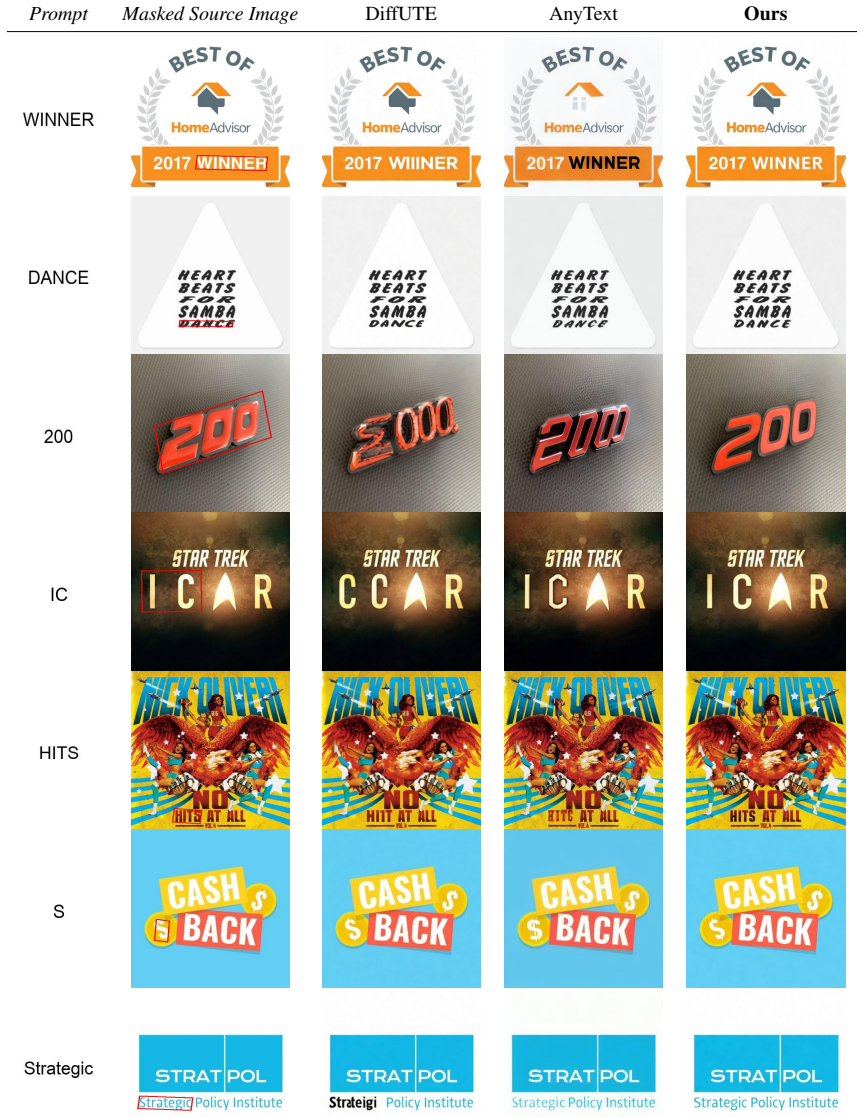
- [§4.1 / §4.4] The quantitative benchmark is reconstruction-based: as the paper itself states in §4.1, 'its target texts match the original, not fully reflecting real-world editing tasks.' Scene text editing is meant to insert new content, and the curated 80-image / 120-pair set with new text is used only for qualitative comparison (Figure 8 and Supplementary Figure 8). Reporting sentence accuracy and CER on genuinely new-content edits, even on a modest set, is needed before claiming high-fidelity scene text editing.
- [Abstract / §4.4] The claimed '18.02% improvement' is an absolute percentage-point increase in average sentence accuracy (0.7736 vs. 0.5934 for AnyText), not an 18.02% relative improvement (which would be about 30.4%). The same issue affects the '48.14%' figure reported against DiffUTE. The text should say 'percentage points' or report relative changes; the current phrasing materially overstates the gain.
- [§4.6, Table 3] The statement that the 'w/gn' variant is 'equivalent to AnyText's OCR feature utilization' is inaccurate. The variant truncates the global neck feature to a length-1 vector and omits AnyText's other conditioning inputs, including its text embeddings and auxiliary objectives. The ablation therefore does not isolate AnyText's way of using OCR features, and the direct AnyText row in Table 1 remains the only valid comparison. Please revise this wording so that the component analysis is not over-interpreted.
minor comments (4)
- [Table 1 caption] The caption contains a typo: 'multi-lingual (English and Chines) methods' should be '(English and Chinese) methods'.
- [§4.3] FID and LPIPS are measured between cropped ground-truth and generated text regions; please report the crop statistics, the number of samples, and the exact FID implementation, since FID computed on small or variable-sized crops is sensitive to these choices.
- [§4.6] The non-monotonic result that removing both FPN and T_b improves over removing FPN alone is surprising; the post hoc explanation is plausible, but the paper should explicitly acknowledge that this weakens the clean attribution of each component's contribution.
- [§3.4, Eq. (6)] The notation 'RoPE(l_p, g_p)' is not standard; please clarify how rotary positional embeddings are applied to the projected local and global features, for instance whether the two sequences are concatenated before RoPE or embedded separately.
Circularity Check
No circularity found: the central claims are empirical benchmark results on held-out data, not derivations from the conditioning inputs.
full rationale
The paper makes no theoretical derivation that could reduce to its own inputs; the central claims are measured sentence accuracy, CER, FID, and LPIPS on AnyText-Eval and ScenePair. The method conditions on PaddleOCR-v4 features extracted from rendered glyph images, while the reported Sen.Acc and CER are computed by an OCR engine that the paper never identifies. There is no quoted statement that the evaluation OCR is PaddleOCR-v4 or otherwise identical to the conditioning recognizer, so the paper's own text does not establish a self-definitional metric. FID and LPIPS are measured between cropped ground-truth and generated text regions and are independent of any recognition engine, providing an external check on the headline style claim. Training and evaluation use separate data, and no parameter is fitted to the test metrics. The ablation study is an internal component analysis on a held-out subset of AnyWord-3M; the 'w/gn' row may be a weak comparison, but that is an experimental-design concern, not circularity. All cited prior work (DiffUTE, AnyText, TextCtrl, PaddleOCR) is external, with no load-bearing self-citations. Accordingly, the derivation chain is self-contained and the appropriate finding is no significant circularity.
Assumptions & free parameters
free parameters (5)
- Classifier-free guidance scale =
3 for GlyphMastero and DiffUTE; 9 for AnyText
- Glyph attention model dimensions =
tilde_d = 512, d_o = 1024, 4 heads
- Number of FPN levels =
M = 5
- Null condition probability =
0.1
- DDIM inference steps =
20
assumptions (5)
- domain assumption Pretrained PaddleOCR-v4 features are a sufficient control signal for glyph generation
- domain assumption Stable Diffusion 2.1 inpainting backbone is a suitable base model
- domain assumption AnyWord-3M is representative of scene text editing data
- domain assumption OCR-based Sen.Acc and CER reflect human-readable text quality
- standard math Latent diffusion and cross-attention background
invented entities (1)
-
GlyphMastero glyph encoder
Cite this review
Pith. "Pith review of GlyphMastero: A Glyph Encoder for High-Fidelity Scene Text Editing." pith.science (2026). https://pith.science/paper/RLR2VZKI
@misc{pith2026250504915,
  author       = {Pith},
  title        = {Pith review of: GlyphMastero: A Glyph Encoder for High-Fidelity Scene Text Editing},
  year         = {2026},
  howpublished = {\url{https://pith.science/paper/RLR2VZKI}},
  note         = {Machine review of arXiv:2505.04915}
}
read the original abstract
Scene text editing, a subfield of image editing, requires modifying texts in images while preserving style consistency and visual coherence with the surrounding environment. While diffusion-based methods have shown promise in text generation, they still struggle to produce high-quality results. These methods often generate distorted or unrecognizable characters, particularly when dealing with complex characters like Chinese. In such systems, characters are composed of intricate stroke patterns and spatial relationships that must be precisely maintained. We present GlyphMastero, a specialized glyph encoder designed to guide the latent diffusion model for generating texts with stroke-level precision. Our key insight is that existing methods, despite using pretrained OCR models for feature extraction, fail to capture the hierarchical nature of text structures - from individual strokes to stroke-level interactions to overall character-level structure. To address this, our glyph encoder explicitly models and captures the cross-level interactions between local-level individual characters and global-level text lines through our novel glyph attention module. Meanwhile, our model implements a feature pyramid network to fuse the multi-scale OCR backbone features at the global-level. Through these cross-level and multi-scale fusions, we obtain more detailed glyph-aware guidance, enabling precise control over the scene text generation process. Our method achieves an 18.02\% improvement in sentence accuracy over the state-of-the-art multi-lingual scene text editing baseline, while simultaneously reducing the text-region Fr\'echet inception distance by 53.28\%.
Figures


Figures from the paper (8 more)




Reference graph
Works this paper leans on
-
[1]
Diffute: Universal text editing diffusion model
Haoxing Chen, Zhuoer Xu, Zhangxuan Gu, Jun Lan, Xing Zheng, Yaohui Li, Changhua Meng, Huijia Zhu, and Weiqiang Wang. Diffute: Universal text editing diffusion model. InAdvances in Neural Information Processing Sys- tems 36: Annual Conference on Neural Information Process- ing Systems 2023, NeurIPS 2023, New Orleans, LA, USA, December 10 - 16, 2023, 2023. 2, 5
work page 2023
-
[2]
Textdiffuser: Diffusion models as text painters
Jingye Chen, Yupan Huang, Tengchao Lv, Lei Cui, Qifeng Chen, and Furu Wei. Textdiffuser: Diffusion models as text painters. InAdvances in Neural Information Processing Sys- tems 36: Annual Conference on Neural Information Process- ing Systems 2023, NeurIPS 2023, New Orleans, LA, USA, December 10 - 16, 2023, 2023. 2, 3, 4, 5
work page 2023
-
[3]
Goodfellow, Jean Pouget-Abadie, Mehdi Mirza, Bing Xu, David Warde-Farley, Sherjil Ozair, Aaron C
Ian J. Goodfellow, Jean Pouget-Abadie, Mehdi Mirza, Bing Xu, David Warde-Farley, Sherjil Ozair, Aaron C. Courville, and Yoshua Bengio. Generative adversarial nets. InAd- vances in Neural Information Processing Systems 27: An- nual Conference on Neural Information Processing Systems 2014, December 8-13 2014, Montreal, Quebec, Canada, pages 2672–2680, 2014. 2
work page 2014
-
[4]
Denoising dif- fusion probabilistic models
Jonathan Ho, Ajay Jain, and Pieter Abbeel. Denoising dif- fusion probabilistic models. InAdvances in Neural Informa- tion Processing Systems 33: Annual Conference on Neural Information Processing Systems 2020, NeurIPS 2020, De- cember 6-12, 2020, virtual, 2020. 2, 3
work page 2020
-
[5]
GenText: Unsupervised Artistic Text Generation via Decoupled Font and Texture Manipulation
Qirui Huang, Bin Fu, Aozhong Zhang, and Yu Qiao. Gen- text: Unsupervised artistic text generation via decoupled font and texture manipulation.CoRR, abs/2207.09649, 2022. 2
work page Pith review arXiv 2022
-
[6]
Improving diffusion models for scene text editing with dual encoders
Jiabao Ji, Guanhua Zhang, Zhaowen Wang, Bairu Hou, Zhifei Zhang, Brian Price, and Shiyu Chang. Improving diffusion models for scene text editing with dual encoders. CoRR, abs/2304.05568, 2023. 2, 4, 5
arXiv 2023
-
[7]
Kingma and Max Welling
Diederik P. Kingma and Max Welling. Auto-encoding vari- ational bayes. In2nd International Conference on Learning Representations, ICLR 2014, Banff, AB, Canada, April 14- 16, 2014, Conference Track Proceedings, 2014. 3
2014
-
[8]
RewriteNet: Reliable Scene Text Editing with Implicit Decomposition of Text Contents and Styles
Junyeop Lee, Yoonsik Kim, Seonghyeon Kim, Moon- bin Yim, Seung Shin, Gayoung Lee, and Sungrae Park. Rewritenet: Realistic scene text image generation via edit- ing text in real-world image.CoRR, abs/2107.11041, 2021. 2
work page Pith review arXiv 2021
Show all 34 references
-
[9]
Minghao Li, Tengchao Lv, Jingye Chen, Lei Cui, Yijuan Lu, Dinei A. F. Flor ˆencio, Cha Zhang, Zhoujun Li, and Furu Wei. Trocr: Transformer-based optical character recogni- tion with pre-trained models. InThirty-Seventh AAAI Con- ference on Artificial Intelligence, AAAI 2023, T...
2023
-
[10]
Girshick, Kaiming He, Bharath Hariharan, and Serge J
Tsung-Yi Lin, Piotr Doll ´ar, Ross B. Girshick, Kaiming He, Bharath Hariharan, and Serge J. Belongie. Feature pyramid networks for object detection. In2017 IEEE Conference on Computer Vision and Pattern Recognition, CVPR 2017, Honolulu, HI, USA, July 21-26, 2017, pages 936–944...
2017
-
[11]
Glyphdraw: Learning to draw chinese characters in image synthesis models coher- ently.CoRR, abs/2303.17870, 2023
Jian Ma, Mingjun Zhao, Chen Chen, Ruichen Wang, Di Niu, Haonan Lu, and Xiaodong Lin. Glyphdraw: Learning to draw chinese characters in image synthesis models coher- ently.CoRR, abs/2303.17870, 2023. 3
2023 arXiv
-
[12]
PP-OCRv4.https://github.com/ PaddlePaddle/PaddleOCR/blob/release/2.7/ doc/doc_ch/PP-OCRv4_introduction.md, 2023
PaddlePaddle. PP-OCRv4.https://github.com/ PaddlePaddle/PaddleOCR/blob/release/2.7/ doc/doc_ch/PP-OCRv4_introduction.md, 2023. Accessed: 2024-07-31. 4, 7
2023
-
[13]
Exploring stroke-level modifi- cations for scene text editing
Yadong Qu, Qingfeng Tan, Hongtao Xie, Jianjun Xu, YuXin Wang, and Yongdong Zhang. Exploring stroke-level modifi- cations for scene text editing. InThirty-Seventh AAAI Con- ference on Artificial Intelligence, AAAI 2023, Thirty-Fifth Conference on Innovative Applications of Arti...
2023
-
[14]
Learning transferable visual models from natural language supervision
Alec Radford, Jong Wook Kim, Chris Hallacy, Aditya Ramesh, Gabriel Goh, Sandhini Agarwal, Girish Sastry, Amanda Askell, Pamela Mishkin, Jack Clark, Gretchen Krueger, and Ilya Sutskever. Learning transferable visual models from natural language supervision. InProceedings of the...
2021
-
[15]
Colin Raffel, Noam Shazeer, Adam Roberts, Katherine Lee, Sharan Narang, Michael Matena, Yanqi Zhou, Wei Li, and Peter J. Liu. Exploring the limits of transfer learning with a unified text-to-text transformer.J. Mach. Learn. Res., 21: 140:1–140:67, 2020. 3
2020
-
[16]
High-resolution image syn- thesis with latent diffusion models
Robin Rombach, Andreas Blattmann, Dominik Lorenz, Patrick Esser, and Bj¨orn Ommer. High-resolution image syn- thesis with latent diffusion models. InIEEE/CVF Conference on Computer Vision and Pattern Recognition, CVPR 2022, New Orleans, LA, USA, June 18-24, 2022, pages 10674– ...
2022
-
[17]
U-net: Convolutional networks for biomedical image segmentation
Olaf Ronneberger, Philipp Fischer, and Thomas Brox. U-net: Convolutional networks for biomedical image segmentation. InMedical Image Computing and Computer-Assisted Inter- vention - MICCAI 2015 - 18th International Conference Mu- nich, Germany, October 5 - 9, 2015, Proceedings...
2015
-
[18]
STEFANN: scene text editor using font adap- tive neural network
Prasun Roy, Saumik Bhattacharya, Subhankar Ghosh, and Umapada Pal. STEFANN: scene text editor using font adap- tive neural network. In2020 IEEE/CVF Conference on Com- puter Vision and Pattern Recognition, CVPR 2020, Seattle, WA, USA, June 13-19, 2020, pages 13225–13234. Comput...
2020
-
[19]
pytorch-fid: FID Score for PyTorch
Maximilian Seitzer. pytorch-fid: FID Score for PyTorch. https://github.com/mseitzer/pytorch-fid,
-
[20]
Sirignano and Konstantinos Spiliopoulos
Justin A. Sirignano and Konstantinos Spiliopoulos. Scaling limit of neural networks with the xavier initialization and convergence to a global minimum.CoRR, abs/1907.04108,
1907 arXiv
-
[21]
Denois- ing diffusion implicit models
Jiaming Song, Chenlin Meng, and Stefano Ermon. Denois- ing diffusion implicit models. In9th International Con- ference on Learning Representations, ICLR 2021, Virtual Event, Austria, May 3-7, 2021. OpenReview.net, 2021. 7
2021
-
[22]
Roformer: Enhanced transformer with rotary position embedding.CoRR, abs/2104.09864, 2021
Jianlin Su, Yu Lu, Shengfeng Pan, Bo Wen, and Yunfeng Liu. Roformer: Enhanced transformer with rotary position embedding.CoRR, abs/2104.09864, 2021. 5
2021 arXiv
-
[23]
Resolution-robust large mask inpainting with fourier convolutions
Roman Suvorov, Elizaveta Logacheva, Anton Mashikhin, Anastasia Remizova, Arsenii Ashukha, Aleksei Silvestrov, Naejin Kong, Harshith Goka, Kiwoong Park, and Victor Lempitsky. Resolution-robust large mask inpainting with fourier convolutions. InIEEE/CVF Winter Conference on Appl...
2022
-
[24]
Anytext: Multilingual visual text gen- eration and editing.CoRR, abs/2311.03054, 2023
Yuxiang Tuo, Wangmeng Xiang, Jun-Yan He, Yifeng Geng, and Xuansong Xie. Anytext: Multilingual visual text gen- eration and editing.CoRR, abs/2311.03054, 2023. 2, 3, 4, 5
2023 arXiv
-
[25]
Anytext: Multilingual visual text genera- tion and editing
Yuxiang Tuo, Wangmeng Xiang, Jun-Yan He, Yifeng Geng, and Xuansong Xie. Anytext: Multilingual visual text genera- tion and editing. InThe Twelfth International Conference on Learning Representations, ICLR 2024, Vienna, Austria, May 7-11, 2024. OpenReview.net, 2024. 2, 4, 5
2024
-
[26]
Editing text in the wild
Liang Wu, Chengquan Zhang, Jiaming Liu, Junyu Han, Jing- tuo Liu, Errui Ding, and Xiang Bai. Editing text in the wild. InProceedings of the 27th ACM International Conference on Multimedia, MM 2019, Nice, France, October 21-25, 2019, pages 1500–1508. ACM, 2019. 2, 5
2019
-
[27]
Swaptext: Image based texts transfer in scenes
Qiangpeng Yang, Jun Huang, and Wei Lin. Swaptext: Image based texts transfer in scenes. In2020 IEEE/CVF Confer- ence on Computer Vision and Pattern Recognition, CVPR 2020, Seattle, WA, USA, June 13-19, 2020, pages 14688– 14697. Computer Vision Foundation / IEEE, 2020. 2
2020
-
[28]
Glyphcontrol: Glyph conditional control for visual text generation
Yukang Yang, Dongnan Gui, Yuhui Yuan, Weicong Liang, Haisong Ding, Han Hu, and Kai Chen. Glyphcontrol: Glyph conditional control for visual text generation. InAdvances in Neural Information Processing Systems 36: Annual Con- ference on Neural Information Processing Systems 202...
2023
-
[29]
Textctrl: Diffusion-based scene text editing with prior guidance control
Weichao Zeng, Yan Shu, Zhenhang Li, Dongbao Yang, and Yu Zhou. Textctrl: Diffusion-based scene text editing with prior guidance control. InAdvances in Neural Information Processing Systems 38: Annual Conference on Neural Infor- mation Processing Systems 2024, NeurIPS 2024, Van...
2024
-
[30]
Adding conditional control to text-to-image diffusion models
Lvmin Zhang, Anyi Rao, and Maneesh Agrawala. Adding conditional control to text-to-image diffusion models. In IEEE/CVF International Conference on Computer Vision, ICCV 2023, Paris, France, October 1-6, 2023, pages 3813–
2023
-
[31]
The unreasonable effectiveness of deep features as a perceptual metric
Richard Zhang, Phillip Isola, Alexei A Efros, Eli Shechtman, and Oliver Wang. The unreasonable effectiveness of deep features as a perceptual metric. InCVPR, 2018. 7 10 GlyphMastero: A Glyph Encoder for High-Fidelity Scene Text Editing Supplementary Material
2018
-
[32]
Effects of Classifier-Free Guidance Classifier-free guidance (CFG) has demonstrated effective- ness in controlling the strength of prompt-following behav- ior in text-to-image diffusion models. Recognizing its po- tential utility in scene text editing, we incorporate CFG by tr...
-
[33]
In such scenarios, the model struggles to maintain coherent text generation, resulting in irregu- larly sized characters and occasional repetition patterns in the output
Example Failure Cases As shown in Figure 7, our method encounters limitations when the selected editing region substantially exceeds the target text length. In such scenarios, the model struggles to maintain coherent text generation, resulting in irregu- larly sized characters...
-
[34]
Learning
Additional Results 9.1. Quantitative Comparison To cross-validate the effectiveness of our method, we also evaluated our method on TextCtrl’s ScenePair dataset (1,285 test cases), re-evaluating all other methods using TextCtrl’s GitHub-published results and scripts. Table 4 sh...
Reviewed August 15, 2026 · model on record in the stance chip above.
Discussion (0). Continue with ORCID to comment.