REVIEW 4 major objections 8 minor 29 references
FF-PNet: A Pyramid Network Based on Feature and Field for Brain Image Registration
T0 review · 4 major / 8 minor · reviewed 2026-08-15 · deepseek-v4-flash
Pith's one-line read FF-PNet shows a purely convolutional pyramid network with two residual fusion modules can outperform transformer-based registration methods on brain MRI benchmarks.
desk verdict Pure-CNN pyramid registration architecture with strong ablations, but SOTA Dice claim undercut by cross-paper baselines and a 54/56 ROI mismatch. read the letter →
The pith
A machine-rendered reading of the paper's core claim, the machinery that carries it, and where it could break.
The reading
What carries the argument
Two residual fusion modules operating in parallel in the decoder. RFFM (Residual Feature Fusion Module) warps the moving feature using a coarse deformation field, combines it with the fixed feature, then warps the coarse fused feature again to form a residual feature, and cross-fuses the three streams through the Cross-Fusion Module (CFM). RDFFM (Residual Deformation Field Fusion Module) warps the deformation field itself, predicts an intermediate field, and adds it after another warp, making the field sensitive to local deformation details. The parallel operation lets one stream refine semantic correspondence while the other sharpens geometric detail.
What would settle it
Run VoxelMorph, TransMorph, and DualPRNet++ through FF-PNet's own training code, data splits, and hyperparameters on LPBA40 and OASIS, then compare Dice. If the re-run baselines match or exceed FF-PNet's 0.726 and 0.884 within one standard deviation, the claim of consistent improvement is not supported.
Extended reading notes
Core claim
The central discovery is that parallel dual-stream fusion in the decoder is sufficient to close the accuracy gap with transformer-based registration. RFFM extracts residual and warped features from intermediate representations and cross-fuses them with the fixed image's features, while RDFFM treats the deformation field itself as a refined flow, warping it and adding an intermediate field. Over three pyramid scales, the network achieves the best reported Dice on both datasets among the listed methods, and ablations show each module adds roughly 1.3 to 1.8 points of Dice, with the largest gain from RFFM. The three-layer configuration with fusion outperforms a four-layer version at about one quarter of the parameters, and channel studies indicate that 48 initial channels maximize the accuracy-complexity trade-off.
Load-bearing premise
The reported accuracy gains come from comparing FF-PNet's own runs with numbers copied from the original papers, assuming the same preprocessing, training setup, and label definitions; if those differ, the improvement could shrink or disappear.
Editorial extensions
If this is right
- Transformer or attention blocks are not required for high-accuracy brain registration; a CNN encoder plus the two fusion modules is enough to set the best reported Dice among the compared methods on LPBA and OASIS.
- The modules are described as portable additions to the decoder, so any pyramid or U-Net registration framework adopting RFFM and RDFFM could expect a similar accuracy boost without adding attention machinery.
- The layer ablation implies a three-level pyramid with fusion captures mid-level spatial correspondences better than a deeper four-level design, so adding depth is not the obvious path to further gains when these modules are active.
- The full model is reported at roughly 8.9 million parameters, about a quarter of the four-layer variant with nearly identical Dice, which makes the design more practical for deployment.
Reading between the lines
- A natural next test is to transplant RFFM and RDFFM into VoxelMorph's plain U-Net decoder and measure whether the Dice gain transfers; if it does, the fusion modules are the active ingredient rather than the specific pyramid configuration.
- A fairer comparison would re-run all baselines inside FF-PNet's own preprocessing and training pipeline; the reported margins, such as 2.3 points over DualPRNet++, may shrink or shift if the original papers used different label definitions or data splits.
- The paper's claim that convolutional encoders suffice suggests the transformer advantage in registration may be concentrated in the decoder. An exchange experiment with a transformer encoder and a CNN decoder, and vice versa, would isolate where the capacity actually matters.
Signed reviews
Editorial analysis
A structured set of objections, weighed in public.
Referee Report
Summary. FF-PNet is an unsupervised deformable image registration network with a three-level pyramidal CNN encoder and a dual-stream decoder composed of a Residual Feature Fusion Module (RFFM) and a Residual Deformation Field Fusion Module (RDFFM). The encoder is purely convolutional, with no attention or MLP modules. The decoder predicts deformation fields at multiple scales, combining feature-level and field-level residual flows. The network is trained with an NCC similarity loss plus a diffusion regularizer. On the LPBA40 and OASIS datasets, the authors report mean Dice scores of 0.726 and 0.884, which are higher than the previously published numbers for VoxelMorph, TransMorph, DualPRNet++, Im2Grid, PIVIT, RDN, and H-ViT listed in their tables. Ablations are provided for the two fusion modules, the number of layers, and the initial channel count.
Significance. The proposed architecture is attractive because it achieves competitive accuracy with a simple convolutional design, and the ablations demonstrate that both RFFM and RDFFM contribute to the reported Dice gain (Table III). The layer and channel ablations (Tables IV and V) provide useful information about the complexity-accuracy trade-off within the proposed model. If the improvements over the baselines are confirmed in a controlled comparison, the dual-stream fusion decoder would be a valuable contribution to the registration toolbox, especially for settings where transformer-based models are too heavy. However, the central empirical claim currently depends on numerical results quoted from other papers without a demonstrated common evaluation protocol, and the margins are small; the paper's own tables show that FF-PNet does not win on every metric. Consequently, the significance is real but conditional on the evaluation being made rigorous.
major comments (4)
- [§IV-C, Tables I and II] The comparison against prior work is not demonstrated to be apples-to-apples. The tables mix FF-PNet results obtained in-house with numbers taken from the original publications, and the manuscript does not state that preprocessing, affine initialization, training/test splits, or ROI label definitions are identical. Section IV-A states that LPBA contains '54 manually labeled regions', while Table I is headed 'LPBA (56 ROIs)'; this inconsistency raises the possibility that the label set used for FF-PNet differs from that used by some baselines. Because the reported advantage over the best baseline is only 0.6 DSC points on LPBA (0.726 vs 0.720) and 0.5 points on OASIS (0.884 vs 0.879), a label or protocol mismatch could erase the improvement. The paper should re-run the baselines under a unified protocol, or provide a clear justification (e.g., a reference to identical preprocessing and label definitions) showing that the quoted numbers are directly comparable.
- [§IV-C, Tables I and II; abstract] No statistical significance tests are reported. The differences between FF-PNet and the strongest baselines are small relative to the reported standard deviations (e.g., on LPBA, RDN 0.720±0.011 vs FF-PNet 0.726±0.010; on OASIS, DualPRNet++ 0.879±0.015 vs FF-PNet 0.884±0.015). Since the test sets contain only 90 pairs (LPBA) and 38 pairs (OASIS), a paired significance test (e.g., Wilcoxon signed-rank) or at least a report of the per-subject performance distribution is needed to support the claim that the network 'consistently outperforms' popular methods. Without this, the reported improvements could be sampling noise.
- [Abstract; §IV-C] The abstract's claim that the method 'consistently outperforms popular methods in metrics like the Dice Similarity Coefficient' is not supported by the paper's own tables. On LPBA, RDN achieves a lower HD95 (3.756 mm vs 3.767 mm), and on both datasets PIVIT achieves a lower SDlogJ (0.246 vs 0.297 on LPBA; 0.414 vs 0.466 on OASIS). The text should be qualified to state that FF-PNet attains the highest Dice on these two datasets, with some other metrics still favoring earlier methods.
- [§III-C, Eq. (4)] The multi-scale deformation field composition is not fully specified. Eq. (4) computes F^{2'}_w = Warp(F^{2'}_m, ϕ3) and ϕ2 = Warp(ϕ3, ϕ') + ϕ', where ϕ3 is at the coarsest scale while F^{2'}_m and ϕ' are at a finer scale. The text does not describe how ϕ3 is resampled or upsampled to the finer grid before the warping and addition operations, nor how the 'superposition' of the fields mentioned in §III-A is computed. This omission makes the core contribution of RDFFM irreproducible from the description; please define the resampling method and the exact operation used to combine the fields.
minor comments (8)
- [§IV-A vs Table I] The number of ROIs in LPBA is inconsistently reported as 54 in the text and 56 in Table I; please unify and justify this number.
- [§IV-A] For OASIS, the table header says '35 ROIs' but the text does not mention the ROI count; please state it explicitly and cite the label atlas used.
- [§II-B, related work] The Recursive Decomposition Network (RDN) is cited as [24] in the text but as [27] in Table I; reference [24] in the bibliography is a different paper (Lv et al.). Please correct the citation.
- [Eq. (3)] There is a missing closing parenthesis in the third line of Eq. (3): 'Warp(ψ3, fθ(ψ')' should be 'Warp(ψ3, fθ(ψ'))'.
- [§III-A] The sentence 'Experimental results show that when the network adopts a four-layer architecture, the image distorted by the deformation field of the penultimate layer has the highest similarity...' refers to an experiment not described elsewhere in the paper; it would be helpful to cite the corresponding table or explain the observation.
- [§III-B and Figure 3] The abbreviation 'CnC' is used before it is defined; please define it (presumably concatenation followed by convolution) at its first occurrence.
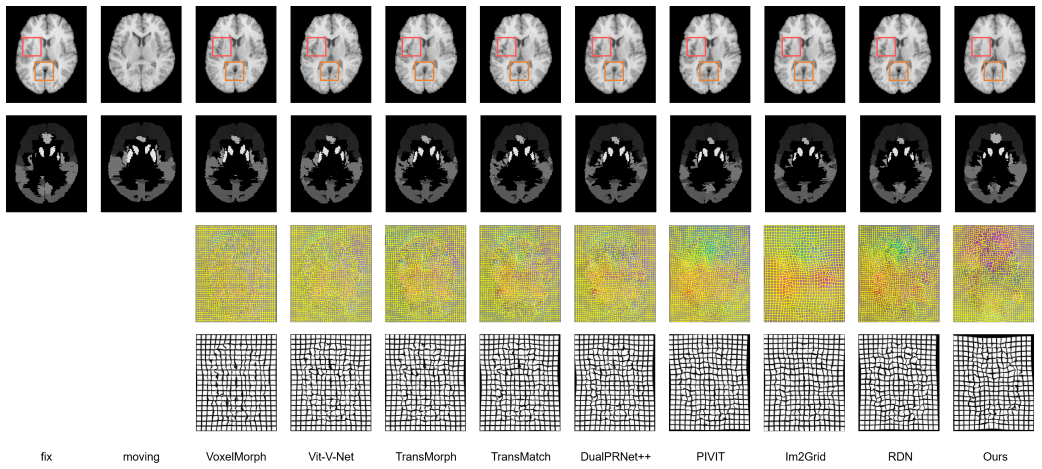
- [Figures 6 and 7] The box plots in Figures 6 and 7 are not referenced in the running text; add a sentence or two explaining the regions shown and the observations to be drawn from them.
- [§IV-D, Table III] In the text after Table III, the claim that the full model 'achieves superior performance across all evaluation metrics' is stronger than the table shows, since Table III reports only DSC and HD95, not SDlogJ.
Circularity Check
No circularity: FF-PNet is an empirical architecture paper whose reported metrics come from held-out test data and external baselines, not from quantities defined by its own outputs.
full rationale
FF-PNet's contribution is a network design (RFFM and RDFFM) specified by Eqs. (1)-(4), trained with the standard unsupervised loss in Eqs. (5)-(7). No scientific constant is derived from the model and then renamed as a prediction; hyperparameters such as the layer count, channel count, and lambda are selected by ablations, but those choices are not used to define the reported DSC or HD95 values. The reported scores are measured on held-out test volumes after training, so the central empirical claim is not forced by construction. Baseline numbers are quoted from external papers, which raises legitimate comparability concerns (for example, the text states LPBA has 54 ROIs while Table I is headed "LPBA (56 ROIs)"), but cross-paper comparison is a correctness and protocol issue, not circularity: the quoted baselines do not enter the definition of FF-PNet's outputs or metrics. The few self-citations (references [10] and [11]) appear only as contextual examples of U-Net variants and are not load-bearing for any claim in the paper. Therefore no circular step is present, and the appropriate circularity score is 0.
Assumptions & free parameters
free parameters (5)
- lambda (regularization weight in Eq. 7) =
1
- Initial channel width =
48
- Number of pyramid layers =
3
- NCC local window size n =
9
- Learning rate / batch size / iterations =
1e-4 / 1 / 500
assumptions (4)
- domain assumption Normalized cross-correlation with a 9^3 local window is a suitable similarity measure for brain MRI registration.
- domain assumption The diffusion regularizer (Eq. 6) is sufficient to keep predicted deformation fields smooth and biologically plausible.
- domain assumption Quoted baseline scores from prior papers are directly comparable to the authors' own runs.
- standard math Warping layers are differentiable and trained end-to-end with the rest of the network.
Cite this review
Pith. "Pith review of FF-PNet: A Pyramid Network Based on Feature and Field for Brain Image Registration." pith.science (2026). https://pith.science/paper/ZC4M2XHE
@misc{pith2026250504938,
  author       = {Pith},
  title        = {Pith review of: FF-PNet: A Pyramid Network Based on Feature and Field for Brain Image Registration},
  year         = {2026},
  howpublished = {\url{https://pith.science/paper/ZC4M2XHE}},
  note         = {Machine review of arXiv:2505.04938}
}
read the original abstract
In recent years, deformable medical image registration techniques have made significant progress. However, existing models still lack efficiency in parallel extraction of coarse and fine-grained features. To address this, we construct a new pyramid registration network based on feature and deformation field (FF-PNet). For coarse-grained feature extraction, we design a Residual Feature Fusion Module (RFFM), for fine-grained image deformation, we propose a Residual Deformation Field Fusion Module (RDFFM). Through the parallel operation of these two modules, the model can effectively handle complex image deformations. It is worth emphasizing that the encoding stage of FF-PNet only employs traditional convolutional neural networks without any attention mechanisms or multilayer perceptrons, yet it still achieves remarkable improvements in registration accuracy, fully demonstrating the superior feature decoding capabilities of RFFM and RDFFM. We conducted extensive experiments on the LPBA and OASIS datasets. The results show our network consistently outperforms popular methods in metrics like the Dice Similarity Coefficient.
Figures


Figures from the paper (4 more)



Reference graph
Works this paper leans on
-
[1]
Sonification as a reliable alternative to conventional visual surgical navigation,
S. Matinfar, M. Salehi, D. Suter, M. Seibold, S. Dehghani, N. Navab, F. Wanivenhaus, P. F¨urnstahl, M. Farshad, and N. Navab, “Sonification as a reliable alternative to conventional visual surgical navigation,” Scientific Reports, vol. 13, no. 1, p. 5930, 2023
work page 2023
-
[2]
Deformable medical image registration: A survey,
A. Sotiras, C. Davatzikos, and N. Paragios, “Deformable medical image registration: A survey,” IEEE transactions on medical imaging , vol. 32, no. 7, pp. 1153–1190, 2013
2013
-
[3]
M. M. Siddiqui, S. Rais-Bahrami, B. Turkbey, A. K. George, J. Rothwax, N. Shakir, C. Okoro, D. Raskolnikov, H. L. Parnes, W. M. Linehanet al., “Comparison of mr/ultrasound fusion–guided biopsy with ultrasound- guided biopsy for the diagnosis of prostate cancer,” Jama, vol. 313, no. 4, pp. 390–397, 2015
work page 2015
-
[4]
Evaluation of 14 nonlinear deformation algorithms applied to human brain mri registration,
A. Klein, J. Andersson, B. A. Ardekani, J. Ashburner, B. Avants, M.- C. Chiang, G. E. Christensen, D. L. Collins, J. Gee, P. Hellier et al. , “Evaluation of 14 nonlinear deformation algorithms applied to human brain mri registration,” Neuroimage, vol. 46, no. 3, pp. 786–802, 2009
work page 2009
-
[5]
Diffeomorphic registration using b-splines,
D. Rueckert, P. Aljabar, R. A. Heckemann, J. V . Hajnal, and A. Ham- mers, “Diffeomorphic registration using b-splines,” in Medical Image Computing and Computer-Assisted Intervention–MICCAI 2006: 9th International Conference, Copenhagen, Denmark, October 1-6, 2006. Proceedings, Part II 9 . Springer, 2006, pp. 702–709
work page 2006
-
[6]
Deep learning in medical image registration: a review,
Y . Fu, Y . Lei, T. Wang, W. J. Curran, T. Liu, and X. Yang, “Deep learning in medical image registration: a review,” Physics in Medicine & Biology, vol. 65, no. 20, p. 20TR01, 2020
work page 2020
-
[7]
An unsupervised learning model for deformable medical image registration,
G. Balakrishnan, A. Zhao, M. R. Sabuncu, J. Guttag, and A. V . Dalca, “An unsupervised learning model for deformable medical image registration,” in Proceedings of the IEEE conference on computer vision and pattern recognition , 2018, pp. 9252–9260
2018
-
[8]
U-net: Convolutional networks for biomedical image segmentation,
O. Ronneberger, P. Fischer, and T. Brox, “U-net: Convolutional networks for biomedical image segmentation,” in Medical image computing and computer-assisted intervention–MICCAI 2015: 18th international con- ference, Munich, Germany, October 5-9, 2015, proceedings, part III 18 . Springer, 2015, pp. 234–241
2015
Show all 29 references
-
[9]
Hy- permorph: Amortized hyperparameter learning for image registration,
A. Hoopes, M. Hoffmann, B. Fischl, J. Guttag, and A. V . Dalca, “Hy- permorph: Amortized hyperparameter learning for image registration,” in Information Processing in Medical Imaging: 27th International Con- ference, IPMI 2021, Virtual Event, June 28–June 30, 2021, Proceedings
2021
-
[10]
Dual decoder unet with contrastive learning for brain image registration,
Y . Zhang, S. Guo, D. Shi, and J. Xiang, “Dual decoder unet with contrastive learning for brain image registration,” in 2024 IEEE Interna- tional Conference on Bioinformatics and Biomedicine (BIBM) . IEEE, 2024, pp. 2922–2927
2024
-
[11]
Ccac: Contrastive learning with channel attention and contour loss for brain image regis- tration,
Y . Zhang, D. Shi, J. Wang, J. Xiang, and W. Zhang, “Ccac: Contrastive learning with channel attention and contour loss for brain image regis- tration,” in 2023 IEEE International Conference on Bioinformatics and Biomedicine (BIBM). IEEE, 2023, pp. 1704–1709
2023
-
[12]
V oxelmorph: a learning framework for deformable medical image registration,
G. Balakrishnan, A. Zhao, M. R. Sabuncu, J. Guttag, and A. V . Dalca, “V oxelmorph: a learning framework for deformable medical image registration,” IEEE transactions on medical imaging , vol. 38, no. 8, pp. 1788–1800, 2019
2019
-
[13]
An image is worth 16x16 words: Transformers for image recognition at scale,
A. Dosovitskiy, L. Beyer, A. Kolesnikov, D. Weissenborn, X. Zhai, T. Unterthiner, M. Dehghani, M. Minderer, G. Heigold, S. Gelly et al., “An image is worth 16x16 words: Transformers for image recognition at scale,” arXiv preprint arXiv:2010.11929 , 2020
2010 arXiv
-
[14]
Transmorph: Transformer for unsupervised medical image registration,
J. Chen, E. C. Frey, Y . He, W. P. Segars, Y . Li, and Y . Du, “Transmorph: Transformer for unsupervised medical image registration,” Medical image analysis, vol. 82, p. 102615, 2022
2022
-
[15]
Attention is all you need,
A. Vaswani, N. Shazeer, N. Parmar, J. Uszkoreit, L. Jones, A. N. Gomez, Ł. Kaiser, and I. Polosukhin, “Attention is all you need,” Advances in neural information processing systems , vol. 30, 2017
2017
-
[16]
Dual- stream pyramid registration network,
M. Kang, X. Hu, W. Huang, M. R. Scott, and M. Reyes, “Dual- stream pyramid registration network,” Medical image analysis , vol. 78, p. 102379, 2022
2022
-
[17]
Coor- dinate translator for learning deformable medical image registration,
Y . Liu, L. Zuo, S. Han, Y . Xue, J. L. Prince, and A. Carass, “Coor- dinate translator for learning deformable medical image registration,” in International workshop on multiscale multimodal medical imaging . Springer, 2022, pp. 98–109
2022
-
[18]
Modet: learning deformable image registration via motion decomposition transformer,
H. Wang, D. Ni, and Y . Wang, “Modet: learning deformable image registration via motion decomposition transformer,” in International Conference on Medical Image Computing and Computer-Assisted In- tervention. Springer, 2023, pp. 740–749
2023
-
[19]
Pivit: Large deformation image registration with pyramid-iterative vision transformer,
T. Ma, X. Dai, S. Zhang, and Y . Wen, “Pivit: Large deformation image registration with pyramid-iterative vision transformer,” in International Conference on Medical Image Computing and Computer-Assisted Inter- vention. Springer, 2023, pp. 602–612
2023
-
[20]
andm. r. sabuncu,“unsupervised learning for fast probabilistic diffeomorphic registration,
A. Dalca, G. Balakrishnan, and J. Guttag, “andm. r. sabuncu,“unsupervised learning for fast probabilistic diffeomorphic registration,”,” in Proc. Int. Conf. Med. Image Comput. Comput.-Assist. Intervention, 2018, pp. 729–738
2018
-
[21]
Swin transformer: Hierarchical vision transformer using shifted windows,
Z. Liu, Y . Lin, Y . Cao, H. Hu, Y . Wei, Z. Zhang, S. Lin, and B. Guo, “Swin transformer: Hierarchical vision transformer using shifted windows,” in Proceedings of the IEEE/CVF international conference on computer vision, 2021, pp. 10 012–10 022
2021
-
[22]
Swin-voxelmorph: A symmetric unsupervised learning model for deformable medical image registration using swin transformer,
Y . Zhu and S. Lu, “Swin-voxelmorph: A symmetric unsupervised learning model for deformable medical image registration using swin transformer,” in International Conference on Medical Image Computing and Computer-Assisted Intervention . Springer, 2022, pp. 78–87
2022
-
[23]
Recursive cascaded networks for unsupervised medical image registration,
S. Zhao, Y . Dong, E. I. Chang, Y . Xu et al. , “Recursive cascaded networks for unsupervised medical image registration,” in Proceedings of the IEEE/CVF international conference on computer vision , 2019, pp. 10 600–10 610
2019
-
[24]
Joint progressive and coarse-to-fine registration of brain mri via deformation field integration and non-rigid feature fusion,
J. Lv, Z. Wang, H. Shi, H. Zhang, S. Wang, Y . Wang, and Q. Li, “Joint progressive and coarse-to-fine registration of brain mri via deformation field integration and non-rigid feature fusion,” IEEE Transactions on Medical Imaging, vol. 41, no. 10, pp. 2788–2802, 2022
2022
-
[25]
Vit-v-net: Vision transformer for unsupervised volumetric medical image registration,
J. Chen, Y . He, E. C. Frey, Y . Li, and Y . Du, “Vit-v-net: Vision transformer for unsupervised volumetric medical image registration,” arXiv preprint arXiv:2104.06468 , 2021
2021 arXiv
-
[26]
Transmatch: a transformer-based multilevel dual-stream feature matching network for unsupervised de- formable image registration,
Z. Chen, Y . Zheng, and J. C. Gee, “Transmatch: a transformer-based multilevel dual-stream feature matching network for unsupervised de- formable image registration,” IEEE transactions on medical imaging , vol. 43, no. 1, pp. 15–27, 2023
2023
-
[27]
Springer, 2021, pp. 3–17
2021
-
[28]
Recursive decomposition network for deformable image registration,
B. Hu, S. Zhou, Z. Xiong, and F. Wu, “Recursive decomposition network for deformable image registration,” IEEE Journal of Biomedical and Health Informatics, vol. 26, no. 10, pp. 5130–5141, 2022
2022
-
[29]
H-vit: A hierarchical vision transformer for deformable image registration,
M. Ghahremani, M. Khateri, B. Jian, B. Wiestler, E. Adeli, and C. Wachinger, “H-vit: A hierarchical vision transformer for deformable image registration,” in Proceedings of the IEEE/CVF Conference on Computer Vision and Pattern Recognition , 2024, pp. 11 513–11 523
2024
Reviewed August 15, 2026 · model on record in the stance chip above.
Discussion (0). Continue with ORCID to comment.