REVIEW 4 minor 71 references
The polarimetric response of the Nan\c{c}ay Radio Telescope and its impact on precision pulsar timing
T0 review · 0 major / 4 minor · reviewed 2026-08-15 · deepseek-v4-flash
Pith's one-line read The Nançay Radio Telescope's response is direction-independent, and a template-based calibration recovers accurate polarimetry for pre-2019 pulsar data, cutting timing noise.
desk verdict A careful, transparent calibration paper that convincingly recovers the pre-2019 Nançay archive for precision timing, with the main caveats being an unquantified reference-pulsar stability test and an indirect null result on direction dependence. read the letter →
The pith
A machine-rendered reading of the paper's core claim, the machinery that carries it, and where it could break.
The reading
What carries the argument
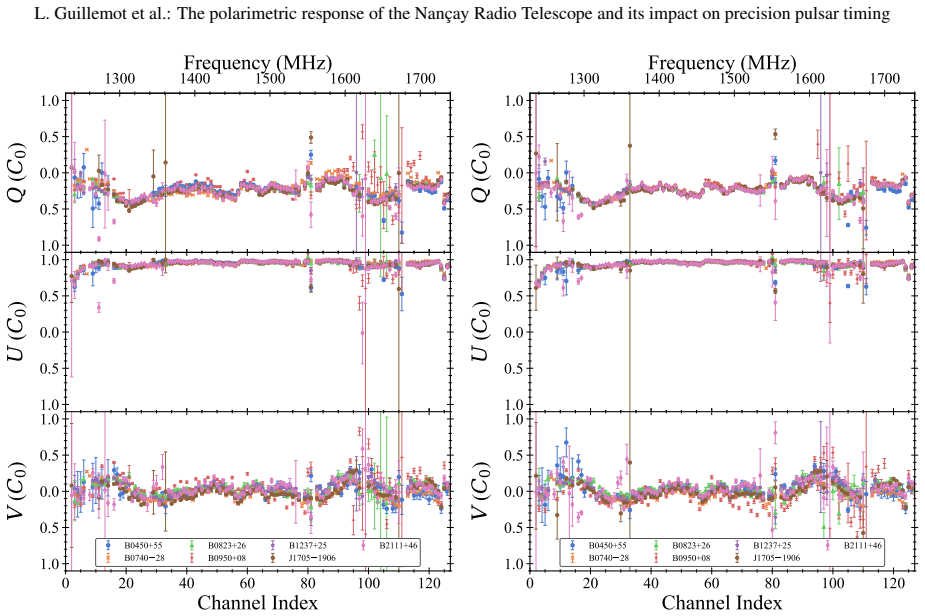
The central object is the calibration archetype, used inside the METM (measurement equation template matching) procedure that derives instrumental calibration by comparing observations of a reference pulsar with a well-calibrated polarized template. Within each manually identified time segment in which the NRT's response was stable, the frequency variation of every calibration parameter is represented by a single archetype function, and each individual observation's parameter values are assumed to be a scaled and possibly offset copy of that function (Eqs. 7 to 9). The time evolution of the scale and offset factors is then modeled with Gaussian processes, yielding predicted calibration solutions at arbitrary epochs. The direction-dependence test uses a modified measurement-equation model in which differential gain and phase are two-dimensional polynomials of declination and hour angle, fit jointly to several pulsars' rotating-horn observations; the winning model is the one with constant parameters.
What would settle it
Re-derive the pre-2019 calibration without the archetype constraint, fitting each epoch's calibration parameters freely, and compare the resulting millisecond-pulsar timing residuals with the archetype-based ones; materially lower white or red noise in the free fits would show the archetype assumption is biasing the solutions. Independently, compare METM-predicted Stokes $Q$ and $U$ for J0953+0755 at an early epoch against a well-calibrated observation of a different bright pulsar from the same epoch; systematic growth of the residuals would falsify the assumed decade-long profile stability.
Extended reading notes
Core claim
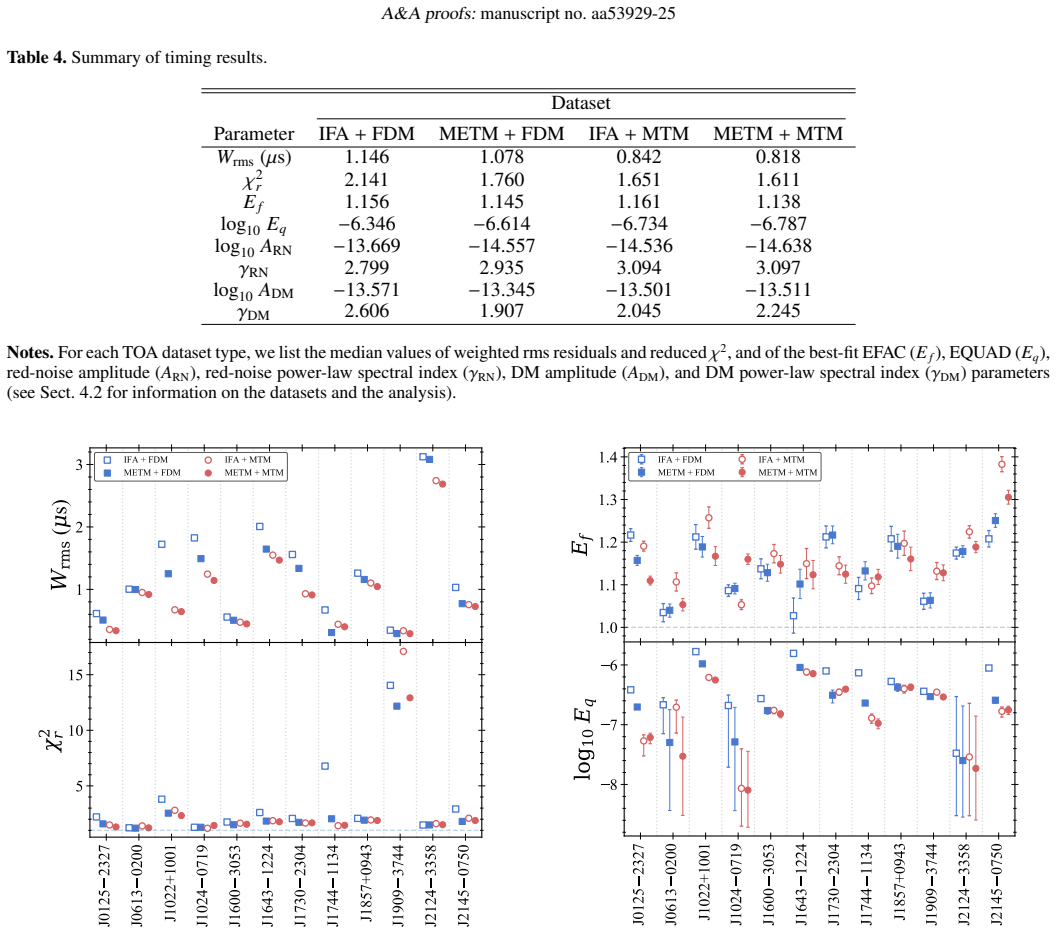
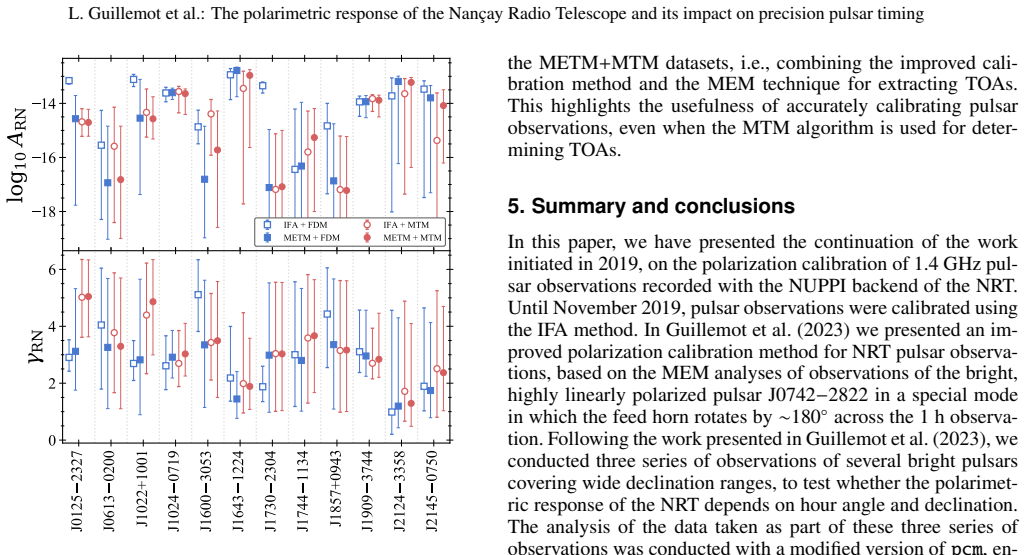
On the paper's own terms, the central discovery is twofold. First, the NRT's polarimetric response does not appear to vary measurably with hour angle or declination: a joint analysis of rotating-feed-horn observations of seven pulsars spanning declinations from roughly $-28^\circ$ to $+56^\circ$, with differential gain and phase modeled as polynomials in hour angle and declination, selects the constant $0/0$ model, and applying higher-order solutions to normal-mode MSP observations degrades signal-to-noise ratios. Second, a calibration procedure built on measurement equation template matching recovers accurate polarization calibration for pre-November 2019 data, where no rotating-horn observations exist. Using the bright pulsar J0953+0755 as a reference, the authors define time segments of stable instrumental response, construct archetype functions for the frequency dependence of each calibration parameter, and model the time evolution of scale and offset factors with Gaussian processes. On twelve millisecond pulsars this raises median signal-to-noise ratios (for example $1.035$ for J1730$-$2304 and $1.130$ for J1744$-$1134), lowers time-of-arrival uncertainties, and reduces both white noise and red noise in timing residuals. Combined with matrix template matching for TOA extraction, the calibration gives the lowest median weighted-rms residuals among the four dataset types tested, with the median dropping from $1.146$ to $1.078~\mu\mathrm{s}$ for standard FDM extraction and from $0.842$ to $0.818~\mu\mathrm{s}$ for MTM extraction.
Load-bearing premise
The procedure assumes that inside each manually chosen time segment the frequency shape of every calibration parameter stayed constant up to a per-epoch scaling and offset, and that the polarization profile of the reference pulsar J0953+0755 was intrinsically stable over the whole decade.
Editorial extensions
If this is right
- The 2011-2019 NUPPI archive can be calibrated to the same standard as post-2019 data, so pulsar timing array analyses no longer need to treat the earlier epoch as a separate, noisier regime.
- Combining the new calibration with matrix template matching for TOA extraction gives the lowest median weighted-rms residuals and the lowest additional white noise among the four dataset combinations tested, so future NRT-based timing analyses should adopt both together.
- Because the polarimetric response is independent of hour angle and declination, a single calibration solution per stable epoch is sufficient for normal-mode observations; no pointing-dependent correction is needed beyond the known variation of absolute gain with declination.
- More homogeneous and higher-signal-to-noise polarimetric profiles should improve rotation-measure determinations and wide-band template matching on NRT data.
Reading between the lines
- The same archetype-plus-Gaussian-process recipe should transfer to the older BON backend data, which the paper flags as noisy and possibly poorly calibrated; success there would extend high-quality NRT timing back toward 2004.
- The contrast between an earlier result where the simplest feed model won and the results here and at another telescope where model-based calibration won suggests the best calibration method is set by each telescope's reference-source and feed stability rather than by a universal rule; a portable comparison protocol could test this across observatories.
- Because the procedure only requires a bright, frequently observed, polarization-stable pulsar and regular noise-diode measurements, other transit telescopes with narrow parallactic-angle coverage could adopt it directly.
- Correcting the parallactic-angle sign changes the interpretation of the earlier apparent hour-angle dependence and may require revisiting published NRT position angles from analyses that used the uncorrected convention.
Signed reviews
Editorial analysis
A structured set of objections, weighed in public.
Referee Report
Summary. This paper presents two main results. First, using three sessions of special rotating-feed observations of bright pulsars at different declinations, the authors test whether the polarimetric response of the Nançay Radio Telescope (NRT) depends on hour angle or declination. From a model-comparison analysis with a modified pcm tool and validation on normal-mode millisecond pulsar (MSP) observations, they conclude that the response does not appear to vary with these parameters. Second, to calibrate pre-November 2019 NUPPI data, they develop a new calibration scheme based on the Measurement Equation Template Matching (METM) technique, using PSR J0953+0755 as the reference pulsar. Within manually determined time segments, the frequency dependence of each calibration parameter is represented by an archetype function, and the time variation of per-observation scale and offset parameters is modeled with Gaussian processes. Applying this calibration to 12 MSPs, they find more homogeneous polarimetric profiles, higher signal-to-noise ratios in most cases, and improved timing quality as quantified by reduced weighted RMS residuals and lower white- and red-noise parameters (median Wrms drops from 1.146 to 1.078 microseconds for FDM and from 0.842 to 0.818 microseconds for MTM).
Significance. If the calibration improvement is real, it will enable consistent use of the NRT's 2011-2019 NUPPI data in pulsar timing array analyses and polarimetric studies, extending the improvements previously demonstrated for post-November 2019 data. The paper's main strengths are the validation of the calibration on MSPs that were not used to derive the calibration solutions, the multi-metric assessment (profile homogeneity, S/N, TOA uncertainties, and noise parameters), and the careful null test of direction dependence. The work also provides a reproducible analysis path through public PSRCHIVE extensions. The conclusions are consistent with those of Rogers et al. (2024) and appropriately nuanced in their wording, e.g., that the response 'does not appear to vary' with direction. The manuscript is well written and the figures are informative.
minor comments (4)
- [Sect. 3, choice of METM reference pulsar] The choice of PSR J0953+0755 as the METM reference is justified by the smoothness of the derived parameters compared with J1136+1551, but a quantitative stability test would strengthen the paper. For example, deriving independent calibration solutions from disjoint subsets of J0953+0755 observations (e.g., early versus late epochs) and comparing them would directly address the reference-profile-stability failure mode discussed for Dey et al. (2024).
- [Sect. 4.1 and Table 3] For three MSPs (J0613-0200, J1022+1001, J2124-3358) the median S/N ratio R1 is below 1, so the statement that S/N increases in 'almost all' tested MSPs is correct but could be more explicit. It would be helpful to state which pulsars show degradation and whether the effect is statistically significant relative to the scatter in the ratios.
- [Sect. 4.2 and Table 4] The reported improvements in Wrms are modest (a few percent) and per-pulsar changes in Table C.1 are often comparable to the quoted uncertainties. A paired statistical test across the 12 pulsars (e.g., a Wilcoxon signed-rank test on the Wrms ratios or on the EQUAD values) would better quantify the significance of the global improvement and would address the concern that some changes may be within noise.
- [Sect. 2, qAIC metric] The quasi-AIC metric is introduced with appropriate caveats about the asymmetric sampling of declination versus hour angle, and the conclusion of no direction dependence ultimately rests on the S/N comparison in Fig. 5. It would be informative to report the effective number of observations that probe extreme hour angles for each declination, or to show a direct comparison of calibration solutions (e.g., differential gain) evaluated at the extreme hour angles, to make the null result more transparent.
Circularity Check
No construction-level circularity: METM calibration is validated on MSP data not used in the fit; only a minor internal self-consistency check is overstated.
-
other
[Section 3, paragraph following Eqs. (7)-(9) and discussion of Fig. 8]
"The scaled and offset calibration parameters match the corresponding archetypes well, validating the construction of the archetypes and the measurement of the a and b parameters for each observation."
The archetypes were refined by forming weighted averages of the calibration parameters within each time segment after correcting for the same a and b scale/offset factors, and then a and b were re-fit against those same archetypes. The agreement displayed in Fig. 8 is therefore a measure of the internal consistency of the fit, not an independent test: the archetype is, by construction, the average of the scaled/offset data to which it is compared. This 'validation' is not load-bearing for the paper's central claim; the independent evidence is the Sect. 4 application to MSPs whose data were not used to build the archetypes or the Gaussian processes.
full rationale
The central claim, that the METM/archetype/GP calibration procedure significantly improves pre-November 2019 NUPPI data, is not circular at the construction level. The calibration model (time-segmented archetypes, scale/offset parameters, and Gaussian-process fits) is derived exclusively from J0953+0755 observations, with J1136+1551 used only to locate time-segment boundaries; the 12 MSPs used to demonstrate profile homogeneity, higher S/N, lower TOA uncertainties, and reduced red/white noise are not inputs to those fits. The improvement is therefore evaluated out-of-sample on data that were not used to derive the calibration solutions. The only genuinely circular sentence is the Fig. 8 statement that scaled/offset parameters 'match' the archetypes; this is a self-consistency check because the archetypes are weighted averages of those same data. It is a minor overstatement and is not the basis of the headline result. The paper's main vulnerability is the unverified stability of the J0953+0755 reference polarized profile: if that profile drifted, the smooth METM solutions would imprint a common, stable-but-wrong transformation on all pulsars, making profiles mutually homogeneous without being accurate. The paper cites Dey et al. (2024) for exactly this failure mode and states that future work will add more reference pulsars, but it provides no quantitative stability test for J0953+0755. This is a correctness and robustness concern, not a circular reduction: no equation reduces the claimed improvement to the fitted inputs by construction, and the MSP-based validation is independent of the calibration fit. Score 2 reflects the single minor self-consistent-validation overstatement plus the paper's reliance on the authors' prior calibration framework.
Assumptions & free parameters
free parameters (3)
- Per-observation scale/offset parameters (a, b) =
Values determined per observation per calibration parameter (not tabulated)
- Gaussian process hyperparameters (amplitude, lengthscale) =
Best-fit values not tabulated
- Time segment boundaries =
Chosen by visual inspection (dashed lines in Fig. 6)
assumptions (5)
- domain assumption The NRT feeds have equal ellipticities (epsilon0 = epsilon1) and the first feed's orientation is zero.
- domain assumption The reference noise diode is coupled after the frontend, so pcm's -Q option applies.
- domain assumption The intrinsic polarized profile of PSR J0953+0755 is stable over the NUPPI dataset, so METM variations reflect the instrument.
- ad hoc to paper Within a time segment, each calibration parameter's frequency dependence is a scaled/offset version of a common archetype function.
- domain assumption The measurement equation model (MEM) accurately represents the NRT polarimetric response.
Cite this review
Pith. "Pith review of The polarimetric response of the Nan\c{c}ay Radio Telescope and its impact on precision pulsar timing." pith.science (2026). https://pith.science/paper/UCFAECZA
@misc{pith2026250504990,
  author       = {Pith},
  title        = {Pith review of: The polarimetric response of the Nan\ccay Radio Telescope and its impact on precision pulsar timing},
  year         = {2026},
  howpublished = {\url{https://pith.science/paper/UCFAECZA}},
  note         = {Machine review of arXiv:2505.04990}
}
abstract
In \citet{Guillemot2023} we presented a new method for calibrating pulsar observations conducted with the Nan\c{c}ay decimetric Radio Telescope (NRT), which significantly improved NRT polarimetric measurements and pulsar timing quality for data taken after this method was developed, in November 2019. Results hinted at a dependence of the polarimetric response of the NRT on the observed direction. We investigated this potential dependence, since unaccounted variations of the instrumental response could degrade polarimetric measurements. Additionally, we aimed to develop a method for properly calibrating NRT pulsar observations conducted before November 2019. We conducted three series of observations of bright pulsars over wide declination ranges, in a special observation mode in which the feed horn rotates by $\sim$ 180$^\circ$ degrees across the observation, enabling us to determine the full polarimetric response of the NRT while modeling potential variations of calibration parameters with hour angle and declination. In addition, we used the METM technique to improve the calibration of pre-November 2019 data. From the analysis of the series of observations of bright pulsars with horn rotation, we found that the polarimetric response of the NRT does not appear to vary with hour angle or declination. On the other hand, the new METM-based calibration method appears to significantly improve the calibration of pre-November 2019 data. By analyzing NRT data on a selection of millisecond pulsars we found that the new polarimetric profiles are more homogeneous, they generally have larger signal-to-noise ratios, and found that the TOA data for these MSPs are more accurate and contain lower levels of noise, especially when combining the new calibration method with the \textit{Matrix Template Matching} (MTM) method for extracting TOAs from pulsar observations.
Figures


Figures from the paper (11 more)



Reference graph
Works this paper leans on
-
[1]
M., et al
Agazie , G., Anumarlapudi , A., Archibald , A. M., et al. 2023, , 951, L8
2023
-
[2]
1973, Information Theory and an Extension of the Maximum Likelihood Principle (New York, NY: Springer New York), 199--213
Akaike, H. 1973, Information Theory and an Extension of the Maximum Likelihood Principle (New York, NY: Springer New York), 199--213
1973
-
[3]
M., Lim , P
Astropy Collaboration , Price-Whelan , A. M., Lim , P. L., et al. 2022, , 935, 167
2022
-
[4]
Bailes , M., Harrison , P. A., Lorimer , D. R., et al. 1994, , 425, L41
work page 1994
- [5]
-
[6]
Bonsignori-Facondi , S. R., Salter , C. J., & Sutton , J. M. 1973, , 27, 67
work page 1973
-
[7]
Britton , M. C. 2000, , 532, 1240
work page 2000
-
[8]
Camilo , F., Nice , D. J., Shrauner , J. A., & Taylor , J. H. 1996, , 469, 819
work page 1996
Show all 71 references
-
[9]
2022, , 509, 5538
Chalumeau , A., Babak , S., Petiteau , A., et al. 2022, , 509, 5538
2022
-
[10]
2013, in SF2A-2013: Proceedings of the Annual meeting of the French Society of Astronomy and Astrophysics, ed
Cognard , I., Theureau , G., Guillemot , L., et al. 2013, in SF2A-2013: Proceedings of the Annual meeting of the French Society of Astronomy and Astrophysics, ed. L. Cambresy , F. Martins , E. Nuss , & A. Palacios , 327--330
2013
-
[11]
D., Lovelace , R
Craft , H. D., Lovelace , R. V. E., & Sutton , J. M. 1968, , 2100, 1
1968
-
[12]
H., & Hulse , R
Damashek , M., Taylor , J. H., & Hulse , R. A. 1978, , 225, L31
1978
-
[13]
Davies , J. G. & Large , M. I. 1970, , 149, 301
1970
-
[14]
C., Cognard , I., Lespagnol , P., & Theureau , G
Desvignes , G., Barott , W. C., Cognard , I., Lespagnol , P., & Theureau , G. 2011, in American Institute of Physics Conference Series, Vol. 1357, Radio Pulsars: An Astrophysical Key to Unlock the Secrets of the Universe, ed. M. Burgay , N. D'Amico , P. Esposito , A. Pellizzon...
2011
-
[15]
A., Wahl , H
Dey , L., McLaughlin , M. A., Wahl , H. M., et al. 2024, arXiv e-prints, arXiv:2406.13463
2024 arXiv
-
[16]
& van Haasteren, R
Ellis, J. & van Haasteren, R. 2017, jellis18/PTMCMCSampler: Official Release
2017
-
[17]
A., Vallisneri , M., Taylor , S
Ellis , J. A., Vallisneri , M., Taylor , S. R., & Baker , P. T. 2020, ENTERPRISE: Enhanced Numerical Toolbox Enabling a Robust PulsaR Inference SuitE
2020
-
[18]
2023 a , , 678, A48
EPTA Collaboration , Antoniadis , J., Babak , S., et al. 2023 a , , 678, A48
2023
-
[19]
2023 b , , 678, A50
EPTA Collaboration , InPTA Collaboration , Antoniadis , J., et al. 2023 b , , 678, A50
2023
-
[20]
B., et al
FERMI-LAT Collaboration , Ajello , M., Atwood , W. B., et al. 2022, Science, 376, 521
2022
-
[21]
2015, , 453, 1489
Foster , G., Karastergiou , A., Paulin , R., et al. 2015, , 453, 1489
2015
-
[22]
S., Wolszczan , A., & Camilo , F
Foster , R. S., Wolszczan , A., & Camilo , F. 1993, , 410, L91
1993
-
[23]
2023, , 678, A79
Guillemot , L., Cognard , I., van Straten , W., Theureau , G., & G \'e rard , E. 2023, , 678, A79
2023
-
[24]
R., Millman, K
Harris, C. R., Millman, K. J., van der Walt, S. J., et al. 2020, Nature, 585, 357
2020
-
[25]
B., Edwards , R
Hobbs , G. B., Edwards , R. T., & Manchester , R. N. 2006, , 369, 655
2006
-
[26]
W., van Straten , W., & Manchester , R
Hotan , A. W., van Straten , W., & Manchester , R. N. 2004, , 21, 302
2004
-
[27]
Hunter, J. D. 2007, Computing in Science & Engineering, 9, 90
2007
-
[28]
A., Bailes , M., Ord , S
Jacoby , B. A., Bailes , M., Ord , S. M., Knight , H. S., & Hotan , A. W. 2007, , 656, 408
2007
-
[29]
A., Bailes , M., van Kerkwijk , M
Jacoby , B. A., Bailes , M., van Kerkwijk , M. H., et al. 2003, , 599, L99
2003
-
[30]
F., et al
Jankowski , F., van Straten , W., Keane , E. F., et al. 2018, , 473, 4436
2018
-
[31]
J., Cordes , J
Jennings , R. J., Cordes , J. M., Chatterjee , S., et al. 2022, arXiv e-prints, arXiv:2210.12266
2022 arXiv
-
[32]
2002, , 19, 277
Johnston , S. 2002, , 19, 277
2002
-
[33]
1998, International Journal of Computer Vision, 26, 171
Kanatani, K. 1998, International Journal of Computer Vision, 26, 171
1998
-
[34]
H., Manchester , R
Kramer , M., Stairs , I. H., Manchester , R. N., et al. 2021, Physical Review X, 11, 041050
2021
-
[35]
Kraus , J. D. 1960, , 65, 54
1960
-
[36]
Kraus , J. D. 1966, Radio astronomy
1966
-
[37]
Lang , K. R. 1969, , 158, L175
1969
-
[38]
2016, , 458, 868
Lazarus , P., Karuppusamy , R., Graikou , E., et al. 2016, , 458, 868
2016
-
[39]
M., Coles , W
Lentati , L., Shannon , R. M., Coles , W. A., et al. 2016, , 458, 2161
2016
-
[40]
Lorimer , D. R. & Kramer , M. 2004, Handbook of Pulsar Astronomy , Vol. 4
2004
-
[41]
R., Nicastro , L., Lyne , A
Lorimer , D. R., Nicastro , L., Lyne , A. G., et al. 1995, , 439, 933
1995
-
[42]
N., Hobbs , G., Bailes , M., et al
Manchester , R. N., Hobbs , G., Bailes , M., et al. 2013, , 30, e017
2013
-
[43]
N., Hobbs , G
Manchester , R. N., Hobbs , G. B., Teoh , A., & Hobbs , M. 2005, , 129, 1993
2005
-
[44]
N., Lyne , A
Manchester , R. N., Lyne , A. G., Taylor , J. H., et al. 1978, , 185, 409
1978
-
[45]
N., Taylor , J
Manchester , R. N., Taylor , J. H., & Huguenin , G. R. 1972, Nature Physical Science, 240, 74
1972
-
[46]
Matthews, A. G. d. G., van der Wilk , M., Nickson, T., et al. 2017, Journal of Machine Learning Research, 18, 1
2017
-
[47]
2018, RMextract: Ionospheric Faraday Rotation calculator , Astrophysics Source Code Library, record ascl:1806.024
Mevius , M. 2018, RMextract: Ionospheric Faraday Rotation calculator , Astrophysics Source Code Library, record ascl:1806.024
2018
-
[48]
D., Cooper , S., et al
Morello , V., Barr , E. D., Cooper , S., et al. 2019, , 483, 3673
2019
-
[49]
C., Keith , M
Ni t u , I. C., Keith , M. J., Champion , D. J., et al. 2024, , 534, 1753
2024
-
[50]
& Freire , P
\"O zel , F. & Freire , P. 2016, , 54, 401
2016
-
[51]
V., Barr , E
Padmanabh , P. V., Barr , E. D., Champion , D. J., et al. 2021, , 500, 1178
2021
-
[52]
S., Folkner , W
Park , R. S., Folkner , W. M., Williams , J. G., & Boggs , D. H. 2021, , 161, 105
2021
-
[53]
T., Demorest , P
Pennucci , T. T., Demorest , P. B., & Ransom , S. M. 2014, , 790, 93
2014
-
[54]
Perera , B. B. P., DeCesar , M. E., Demorest , P. B., et al. 2019, , 490, 4666
2019
-
[55]
Pilkington , J. D. H., Hewish , A., Bell , S. J., & Cole , T. W. 1968, , 218, 126
1968
-
[56]
J., Zic , A., Shannon , R
Reardon , D. J., Zic , A., Shannon , R. M., et al. 2023, , 951, L6
2023
-
[57]
1989, Stochastic Complexity in Statistical Inquiry, Computer Science Series (World Scientific Publishing Company Pte Limited)
Rissanen, J. 1989, Stochastic Complexity in Statistical Inquiry, Computer Science Series (World Scientific Publishing Company Pte Limited)
1989
-
[58]
F., van Straten , W., Gulyaev , S., et al
Rogers , A. F., van Straten , W., Gulyaev , S., et al. 2024, , 973, 94
2024
-
[59]
1978, The Annals of Statistics, 6, 461
Schwarz, G. 1978, The Annals of Statistics, 6, 461
1978
-
[60]
J., Rawley , L
Segelstein , D. J., Rawley , L. A., Stinebring , D. R., Fruchter , A. S., & Taylor , J. H. 1986, , 322, 714
1986
-
[61]
P., Joshi , B
Singha , J., Surnis , M. P., Joshi , B. C., et al. 2021, , 507, L57
2021
-
[62]
R., Cordes , J
Stinebring , D. R., Cordes , J. M., Rankin , J. M., Weisberg , J. M., & Boriakoff , V. 1984, , 55, 247
1984
-
[63]
2005, , 430, 373
Theureau , G., Coudreau , N., Hallet , N., et al. 2005, , 430, 373
2005
-
[64]
2004, , 152, 129
van Straten , W. 2004, , 152, 129
2004
-
[65]
2006, , 642, 1004
van Straten , W. 2006, , 642, 1004
2006
-
[66]
2013, , 204, 13
van Straten , W. 2013, , 204, 13
2013
-
[67]
E., et al
Virtanen, P., Gommers, R., Oliphant, T. E., et al. 2020, Nature Methods, 17, 261
2020
-
[68]
2025, , 693, A143
Voisin , G., Cognard , I., Saillenfest , M., et al. 2025, , 693, A143
2025
-
[69]
X., Burgay , M., et al
Xu , H., Huang , Y. X., Burgay , M., et al. 2021, The Astronomer's Telegram, 14642, 1
2021
-
[70]
, " * write output.state after.block = add.period write newline
ENTRY address archiveprefix author booktitle chapter edition editor howpublished institution eprint journal key month note number organization pages publisher school series title type volume year label extra.label sort.label short.list INTEGERS output.state before.all mid.sent...
-
[71]
write newline
" write newline "" before.all 'output.state := FUNCTION n.dashify 't := "" t empty not t #1 #1 substring "-" = t #1 #2 substring "--" = not "--" * t #2 global.max substring 't := t #1 #1 substring "-" = "-" * t #2 global.max substring 't := while if t #1 #1 substring * t #2 gl...
Reviewed August 15, 2026 · model on record in the stance chip above.
Discussion (0). Continue with ORCID to comment.