REVIEW 3 major objections 7 minor 47 references
The Pitfalls of Growing Group Complexity: LLMs and Social Choice-Based Aggregation for Group Recommendations
T0 review · 3 major / 7 minor · reviewed 2026-08-15 · deepseek-v4-flash
Pith's one-line read LLM-based group recommenders break down once the prompt contains more than about 100 ratings, and in-context learning largely repairs the breakdown.
desk verdict A useful, honestly-reported empirical result on how group complexity degrades LLM aggregation accuracy, but the headline ICL gain needs protection from an output-length confound. read the letter →
The pith
A machine-rendered reading of the paper's core claim, the machinery that carries it, and where it could break.
The reading
What carries the argument
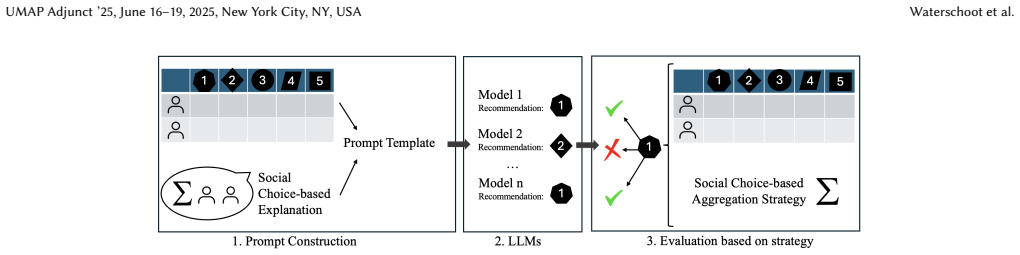
The load-bearing objects are the four social-choice aggregation strategies—Additive Utilitarian (highest sum), Approval Voting (most ratings above a threshold), Least Misery (highest of the lowest per-item ratings), and Most Pleasure (highest individual rating)—each inserted into the prompt as a social-choice explanation instructing the model how to combine the group's rating matrix. Group complexity is defined as the product of group size and item count, i.e. the number of ratings in the prompt. The evaluation machinery is an overlap-based accuracy score: an LLM output is correct if it shares at least one item with the strategy's gold-label tie list, a soft criterion the paper acknowledges. In-context learning is the intervention that carries the positive result: three full worked group scenarios with correct outputs are prepended to the prompt, raising high-complexity accuracy by 28 percentage points for the best model.
What would settle it
Re-run the 1,000-scenario evaluation with strict set equality (the model must return exactly the gold-label list, or at least exactly the winning set) and with a random-overlap chance baseline conditioned on tie-list length; if accuracy no longer declines past 100 ratings, or if the model ranking changes, the complexity-deterioration claim is an artifact of the soft metric.
Extended reading notes
Core claim
The central discovery is a scaling breakdown: LLMs can apply four standard social-choice aggregation strategies (Additive Utilitarian, Approval Voting, Least Misery, Most Pleasure) almost perfectly up to a group complexity of about 80–100 total ratings, but accuracy falls once the prompt contains more than roughly 100 ratings. The deterioration is not identical across models—Phi4 held near-perfect accuracy to 80 and stayed best overall, Mistral peaked at complexity 100–200, and Llama and Gemma declined steadily. The paper further claims that in-context learning with three worked examples is the intervention that works: at complexities of 100, 200, and 400 ratings, Phi4's accuracy rose from 0.57 to 0.85, while requesting explanations or adding real-world domain cues did not significantly improve accuracy. Data formatting changes the outcome too: per-item JSON (0.74/0.53/0.40 across 100/200/400 ratings) outperformed per-user JSON (0.59/0.24/0.16) and a dataframe (0.58/0.45/0.40). The authors conclude that group complexity and prompt format belong in the evaluation pipeline of LLM-based group recommenders, and that small locally run models suffice under favorable conditions.
Load-bearing premise
The load-bearing premise is that overlap with the strategy's gold-label tie list is a fair measure of correctness; because Least Misery and Most Pleasure produce long tie lists at high complexity, a model can be counted correct by luck or by over-recommending, and no chance baseline is reported.
Editorial extensions
If this is right
- Any evaluation of LLM-based group recommenders that only tests small rating matrices will overstate real-world capability; the paper argues that group complexity should be manipulated in future evaluation pipelines.
- Prompt engineering matters at high complexity: adding in-context examples is an effective fix, while explanation prompting and domain cues are not.
- Data format is a confound: per-item JSON consistently outperforms per-user JSON and dataframe rendering, so format choices need to be reported and tuned.
- Smaller local models (7–14B parameters) can apply aggregation strategies accurately under good conditions, supporting privacy-preserving and cost-effective deployment.
- Ranking ability also degrades with complexity: NDCG@10 for Phi4 falls from 0.97 at 100 ratings to 0.74 at 400 ratings, so the effect is not limited to picking a single winner.
Reading between the lines
- If the overlap-accuracy criterion is replaced by strict exact match, the reported accuracy numbers would drop substantially—especially for Least Misery and Most Pleasure, which generate long tie lists—so the magnitude of the complexity effect should be re-estimated before using the 100-rating threshold as a design rule.
- An implicit testable implication is that a random-chance baseline, conditioned on gold tie-list length, should be reported alongside accuracy; without it, part of the apparent decline at high complexity could be a property of tie proliferation rather than of the model.
- The in-context learning result suggests a broader recipe: rather than merely instructing with the strategy definition, injecting worked executions of the aggregation rule may be an inexpensive way to push the complexity ceiling of LLM-based group recommenders further, potentially beyond 400 ratings with more or tailored examples.
- The format effect hints that token-level readability, not just information content, shapes aggregation accuracy; one could test this directly by comparing JSON variants with identical content but different key orderings or spacing.
Signed reviews
Editorial analysis
A structured set of objections, weighed in public.
Referee Report
Summary. The paper investigates how well locally run LLMs can apply social choice-based aggregation strategies (ADD, APP, LMS, MPL) for group recommendations as the number of ratings in the prompt grows, and whether prompt modifications (explanations, in-context learning, domain cues) or data formatting improve accuracy. Using 1,000 synthetic groups, four quantized LLMs, and an overlap-based accuracy metric, the authors report that accuracy declines beyond roughly 100 ratings, that in-context learning (ICL) improves accuracy at high complexity, that explanations and domain cues do not, and that the data format matters. The authors provide a companion GitHub repository with code for group generation, strategy implementations, and prompts.
Significance. If the findings hold, the paper makes a useful contribution by identifying group complexity as a factor that should be controlled in LLM-based group recommender evaluation, and by providing early evidence on prompt robustness and the viability of small, locally run models. The systematic variation of complexity and the use of quantized open-weight models are practical strengths, and the public code supports reproducibility. The main claims are interesting and timely, but the evaluation metric and statistical reporting currently leave the quantitative conclusions under-supported, so the significance of the work will depend on the authors' ability to address these concerns.
major comments (3)
- [§3.3, §4.3.2, §5.3] The overlap-based correctness definition in Section 3.3 makes the headline results vulnerable to a tie-list/output-length confound. Because LMS and MPL produce long tie lists at high complexity, and the LLM output is scored as correct if it overlaps the gold list, models can earn credit by chance or by emitting longer lists. Section 5.3 reports output-list lengths only for the baseline condition (Table 7), not for the ICL, explanation, domain-cue, or formatting conditions. Since the ICL examples (Section 3.4.2) are constructed from gold outputs, which can themselves be long tie lists, the reported ICL improvement (0.57 to 0.85 in Section 4.3.2) may partially reflect longer outputs rather than better strategy application. The authors should provide a chance baseline (e.g., expected overlap under random item selection conditioned on list length) and report output-list-length statistics for all conditions, ideally alongside a stricter exact-match metric.
- [§4, §4.3.2, Table 5] The paper uses the word 'significantly' in the abstract and in Section 4.3.2 ('significantly improved the model's ability') to describe the ICL result, but no statistical test, confidence interval, or standard error is reported anywhere. Similarly, the RQ1 accuracy decline (Figure 2), the RQ2 condition comparisons, and the RQ3 formatting differences (Table 5) are presented without uncertainty quantification. The authors should add appropriate inferential statistics, such as McNemar's test for paired scenarios or bootstrap confidence intervals, to support the existence and magnitude of these differences.
- [§3.4, §4.3] The RQ2 prompt-condition analysis is performed with a single model (Phi4) on a subset of 245 scenarios, yet the abstract and conclusions make general claims: 'we showed that In-Context Learning (ICL) can significantly increase the performance at higher degrees of group complexity' and that other prompt modifications 'did not impact accuracy.' These claims are not established across models; they are at best properties of Phi4 under the tested conditions. The authors should either restrict the claims to Phi4 or validate the main prompt-condition effects on at least one additional model.
minor comments (7)
- [§3.1] The text says ratings are generated 'between 0 and 10' while Table 2 states 'Ratings are on a scale of 1 to 10'; please align the description with the code and example.
- [§3.2.2] The model list contains a typo: 'Mistal' should be 'Mistral'; the same typo appears near Table 7.
- [§4.2] The sentence 'Gemma, Llama and Mistral underperfomed at lower group complexity compared toPhi' contains a typo ('underperfomed') and a missing space; also, the claim about lower-complexity underperformance could be more specific.
- [§4.3] The baseline accuracy of 0.57 for Phi4 at higher complexity appears to be the average across the 100/200/400 complexity levels; please state this explicitly, since Table 5 reports per-level values of 0.74, 0.53, and 0.40 for the same baseline format.
- [§5.5] The limitations section does not mention that the RQ2 and RQ3 comparisons are based on a single model (Phi4); adding this to the limitations would help calibrate the scope of the prompt-condition findings.
- [References] References [9] and [10] cite the same paper; please deduplicate and renumber.
- [§4.5] The sentence 'This results illustrated once more the extent that group complexity affects...' is grammatically incorrect; consider revising to 'This result illustrates once more the extent to which group complexity affects...'.
Circularity Check
No significant circularity: gold labels are independent direct implementations and no fitted parameter is renamed as a prediction.
full rationale
The paper's central claims are evaluated against gold labels computed by direct implementations of the social choice-based aggregation strategies (Section 3.3: 'the correct response was generated using a direct implementation of the strategy (gold_label)'). The LLM outputs are measured against these externally defined labels, so there is no fitted parameter that is later renamed as a prediction, and no derivation that reduces to its own inputs by construction. The in-context learning condition (Section 3.4.2) provides examples with correct outputs derived from the same strategy implementations, but that is precisely the definition of few-shot prompting, not a circular validation: the model must still generalize to new scenarios not present in the examples. The prompt templates are drawn in part from prior work by the authors ([16, 26, 2, 34]), but those citations supply the wording of social choice-based explanations, not the empirical result; the accuracy measurements would stand or fall independently of who authored the templates. There is no imported uniqueness theorem, no ansatz smuggled in via citation, and no renaming of a known empirical pattern as a new result. The overlap-based accuracy metric and the absence of a chance baseline are important validity concerns, but they are evaluation weaknesses, not circularity: the metric does not define the outcome as correct by construction, and the lack of a chance baseline does not make the measured accuracies equivalent to the inputs. Accordingly, no circular step is identified and the circularity score is 0.
Assumptions & free parameters
assumptions (4)
- domain assumption Ratings are drawn uniformly at random per user and item from 0 to 10.
- domain assumption Overlap between the gold_label tie list and the LLM output is a valid measure of successful strategy application.
- domain assumption The social choice-based explanations in the prompt correctly encode the aggregation strategies.
- domain assumption Quantized Ollama models faithfully represent the named base LLMs.
Cite this review
Pith. "Pith review of The Pitfalls of Growing Group Complexity: LLMs and Social Choice-Based Aggregation for Group Recommendations." pith.science (2026). https://pith.science/paper/6I74OJSD
@misc{pith2026250505016,
  author       = {Pith},
  title        = {Pith review of: The Pitfalls of Growing Group Complexity: LLMs and Social Choice-Based Aggregation for Group Recommendations},
  year         = {2026},
  howpublished = {\url{https://pith.science/paper/6I74OJSD}},
  note         = {Machine review of arXiv:2505.05016}
}
read the original abstract
Large Language Models (LLMs) are increasingly applied in recommender systems aimed at both individuals and groups. Previously, Group Recommender Systems (GRS) often used social choice-based aggregation strategies to derive a single recommendation based on the preferences of multiple people. In this paper, we investigate under which conditions language models can perform these strategies correctly based on zero-shot learning and analyse whether the formatting of the group scenario in the prompt affects accuracy. We specifically focused on the impact of group complexity (number of users and items), different LLMs, different prompting conditions, including In-Context learning or generating explanations, and the formatting of group preferences. Our results show that performance starts to deteriorate when considering more than 100 ratings. However, not all language models were equally sensitive to growing group complexity. Additionally, we showed that In-Context Learning (ICL) can significantly increase the performance at higher degrees of group complexity, while adding other prompt modifications, specifying domain cues or prompting for explanations, did not impact accuracy. We conclude that future research should include group complexity as a factor in GRS evaluation due to its effect on LLM performance. Furthermore, we showed that formatting the group scenarios differently, such as rating lists per user or per item, affected accuracy. All in all, our study implies that smaller LLMs are capable of generating group recommendations under the right conditions, making the case for using smaller models that require less computing power and costs.
Figures


Figures from the paper (1 more)

Reference graph
Works this paper leans on
-
[1]
Linas Baltrunas, Tadas Makcinskas, and Francesco Ricci. 2010. Group recommen- dations with rank aggregation and collaborative filtering. In Proceedings of the fourth ACM conference on Recommender systems . 119–126
work page 2010
-
[2]
Francesco Barile, Tim Draws, Oana Inel, Alisa Rieger, Shabnam Najafian, Amir Ebrahimi Fard, Rishav Hada, and Nava Tintarev. 2023. Evaluating explainable social choice-based aggregation strategies for group recommendation. User Modeling and User-Adapted Interaction (2023), 1–58
2023
-
[3]
Francesco Barile, Shabnam Najafian, Tim Draws, Oana Inel, Alisa Rieger, Rishav Hada, and Nava Tintarev. 2021. Toward Benchmarking Group Explanations: Evaluating the Effect of Aggregation Strategies versus Explanation. (2021)
2021
-
[4]
Lei Chen, Jie Cao, Huanhuan Chen, Weichao Liang, Haicheng Tao, and Guixiang Zhu. 2021. Attentive multi-task learning for group itinerary recommendation. Knowl. Inf. Syst. 63, 7 (2021), 1687–1716. doi:10.1007/s10115-021-01567-3
-
[5]
Amra Delic, Judith Masthoff, Julia Neidhardt, and Hannes Werthner. 2018. How to use social relationships in group recommenders: empirical evidence. In Pro- ceedings of the 26th Conference on User Modeling, Adaptation and Personalization . 121–129. LLMs and Social Choice Aggregation for Group Recommendations UMAP Adjunct ’25, June 16–19, 2025, New York Cit...
work page 2018
-
[6]
Amra Delic, Judith Masthoff, and Hannes Werthner. 2020. The effects of group diversity in group decision-making process in the travel and tourism domain. In Information and Communication Technologies in Tourism 2020. Springer, 117–129
work page 2020
-
[7]
Qingxiu Dong, Lei Li, Damai Dai, Ce Zheng, Jingyuan Ma, Rui Li, Heming Xia, Jingjing Xu, Zhiyong Wu, Baobao Chang, Xu Sun, Lei Li, and Zhifang Sui. 2024. A Survey on In-context Learning. In Proceedings of the 2024 Conference on Empirical Methods in Natural Language Processing , Yaser Al-Onaizan, Mohit Bansal, and Yun-Nung Chen (Eds.). Association for Comp...
-
[8]
Alexander Felfernig, Ludovico Boratto, Martin Stettinger, and Marko Tkalčič
Show all 47 references
-
[10]
Shanshan Feng, Zeping Lang, Jing He, Huaxiang Zhang, Wenjuan Chen, and Jian Cao. 2025. A group recommendation method based on automatically integrating members’ preferences via taking advantages of LLM. Information Sciences 709 (2025), 122067. doi:10.1016/j.ins.2025.122067
2025
-
[11]
Yunfan Gao, Tao Sheng, Youlin Xiang, Yun Xiong, Haofen Wang, and Jiawei Zhang. 2023. Chat-REC: Towards interactive and explainable LLMs-augmented recommender system. (2023). arXiv:2303.14524 [cs.IR]
2023 arXiv
-
[12]
F Maxwell Harper and Joseph A Konstan. 2016. The MovieLens datasets. ACM Trans. Interact. Intell. Syst. 5, 4 (jan 2016), 1–19
2016
-
[13]
Yihao Hou, Christoph Bert, Ahmed Gomaa, Godehard Lahmer, Daniel Höfler, Thomas Weissmann, Raphaela Voigt, Philipp Schubert, Charlotte Schmitter, Alina Depardon, Sabine Semrau, Andreas Maier, Rainer Fietkau, Yixing Huang, and Florian Putz. 2024. Fine-tuning a local LLaMA-3 larg...
2024
-
[14]
Yupeng Hou, Junjie Zhang, Zihan Lin, Hongyu Lu, Ruobing Xie, Julian McAuley, and Wayne Xin Zhao. 2024. Large language models are zero-shot rankers for recommender systems. In Lecture Notes in Computer Science . Springer Nature Switzerland, Cham, 364–381
2024
-
[15]
Arjan J. P. Jeckmans, Michael Beye, Zekeriya Erkin, Pieter Hartel, Reginald L. Lagendijk, and Qiang Tang. 2013. Privacy in Recommender Systems . Springer London, London, 263–281. doi:10.1007/978-1-4471-4555-4_12
2013 doi
-
[16]
Öykü Kapcak, Simone Spagnoli, Vincent Robbemond, Soumitri Vadali, Shabnam Najafian, and Nava Tintarev. 2018. Tourexplain: A crowdsourcing pipeline for generating explanations for groups of tourists. In Workshop on Recommenders in Tourismco-located with the 12th ACM Conference ...
2018
-
[17]
J.S. Kelly. 2013. Social Choice Theory: An Introduction. Springer Berlin Heidelberg
2013
-
[18]
Hareem Kibriya, Wazir Zada Khan, Ayesha Siddiqa, and Muhammad Khurram Khan. 2024. Privacy issues in Large Language Models: A survey. Computers and Electrical Engineering 120, 109698 (Dec. 2024), 109698
2024
-
[19]
Sein Kim, Hongseok Kang, Seungyoon Choi, Donghyun Kim, Minchul Yang, and Chanyoung Park. 2024. Large language models meet collaborative filtering: An efficient all-round LLM-based recommender system. In Proceedings of the 30th ACM SIGKDD Conference on Knowledge Discovery and D...
2024
-
[20]
Sebastian Lubos, Thi Ngoc Trang Tran, Alexander Felfernig, Seda Polat Erdeniz, and Viet-Man Le. 2024. LLM-generated explanations for recommender systems. In Adjunct Proceedings of the 32nd ACM Conference on User Modeling, Adaptation and Personalization (Cagliari Italy). ACM, N...
2024
-
[21]
Judith Masthoff. 2004. Group modeling: Selecting a sequence of television items to suit a group of viewers. In Personalized digital television. Springer, 93–141
2004
-
[22]
Judith Masthoff. 2015. Group recommender systems: aggregation, satisfaction and group attributes. In recommender systems handbook. Springer, 743–776
2015
-
[23]
Judith Masthoff and Amra Delić. 2022. Group Recommender Systems: Beyond Preference Aggregation. Springer US, New York, NY, 381–420. doi:10.1007/978-1- 0716-2197-4_10
2022 doi
-
[24]
Shabnam Najafian, Amra Delic, Marko Tkalcic, and Nava Tintarev. 2021. Fac- tors Influencing Privacy Concern for Explanations of Group Recommendation. In Proceedings of the 29th ACM Conference on User Modeling, Adaptation and Personalization. 14–23
2021
-
[25]
Shabnam Najafian, Tim Draws, Francesco Barile, Marko Tkalcic, Jie Yang, and Nava Tintarev. 2021. Exploring User Concerns about Disclosing Location and Emotion Information in Group Recommendations. In Proceedings of the 32st ACM Conference on Hypertext and Social Media . 155–164
2021
-
[26]
Shabnam Najafian and Nava Tintarev. 2018. Generating Consensus Explanations for Group Recommendations: an exploratory study. In Adjunct Publication of the 26th Conference on User Modeling, Adaptation and Personalization (Singapore, Singapore) (UMAP ’18). Association for Comput...
2018
-
[27]
Thuy Ngoc Nguyen, Francesco Ricci, Amra Delic, and Derek Bridge. 2019. Conflict resolution in group decision making: insights from a simulation study. User Modeling and User-Adapted Interaction 29, 5 (2019), 895–941
2019
-
[28]
Alessandro Petruzzelli, Cataldo Musto, Lucrezia Laraspata, Ivan Rinaldi, Marco de Gemmis, Pasquale Lops, and Giovanni Semeraro. 2024. Instructing and prompting large language models for explainable cross-domain recommendations. In 18th ACM Conference on Recommender Systems (Ba...
2024
-
[29]
Alan Said. 2025. On explaining recommendations with Large Language Models: a review. Frontiers in Big Data 7 (2025). doi:10.3389/fdata.2024.1505284
2025
-
[30]
Scott Sanner, Krisztian Balog, Filip Radlinski, Ben Wedin, and Lucas Dixon
-
[31]
Christophe Senot, Dimitre Kostadinov, Makram Bouzid, Jérôme Picault, Armen Aghasaryan, and Cédric Bernier. 2010. Analysis of strategies for building group profiles. In International Conference on User Modeling, Adaptation, and Personal- ization. Springer, 40–51
2010
-
[32]
Yisheng Song, Ting Wang, Puyu Cai, Subrota K Mondal, and Jyoti Prakash Sahoo
-
[33]
Antonela Tommasel. 2024. Fairness Matters: A look at LLM-generated group recommendations. In 18th ACM Conference on Recommender Systems (Bari Italy). ACM, New York, NY, USA, 993–998
2024
-
[34]
Thi Ngoc Trang Tran, Müslüm Atas, Alexander Felfernig, Viet Man Le, Ralph Samer, and Martin Stettinger. 2019. Towards social choice-based explanations in group recommender systems. In Proceedings of the 27th ACM Conference on User Modeling, Adaptation and Personalization . 13–21
2019
-
[35]
ACM Comput
A comprehensive survey of few-shot learning: Evolution, applications, challenges, and opportunities. ACM Comput. Surv. 55, 13s (2023), 1–40
2023
-
[36]
Yaqing Wang, Quanming Yao, James T Kwok, and Lionel M Ni. 2021. Generalizing from a few examples. ACM Comput. Surv. 53, 3 (2021), 1–34
2021
-
[37]
Cedric Waterschoot, Raciel Yera Toledo, Nava Tintarev, and Francesco Barile
-
[38]
Yining Wang, Liwei Wang, Yuanzhi Li, Di He, and Tie-Yan Liu. 2013. A Theoretical Analysis of NDCG Type Ranking Measures. In Proceedings of the 26th Annual Conference on Learning Theory (Proceedings of Machine Learning Research, Vol. 30), Shai Shalev-Shwartz and Ingo Steinwart ...
2013
-
[39]
Xuansheng Wu, Huachi Zhou, Yucheng Shi, Wenlin Yao, Xiao Huang, and Ning- hao Liu. 2024. Could small language models serve as recommenders? Towards data-centric cold-start recommendation. In Proceedings of the ACM Web Confer- ence 2024 (Singapore Singapore), Vol. 55. ACM, New ...
2024
-
[40]
Ziqing Wu. 2023. Enhanced privacy preservation for recommender systems. In Proceedings of the 17th ACM Conference on Recommender Systems (Singapore Singapore), Vol. 11. ACM, New York, NY, USA, 1364–1368
2023
-
[41]
Dayu Yang, Fumian Chen, and Hui Fang. 2024. Behavior alignment: A new perspective of evaluating LLM-based conversational recommendation systems. In Proceedings of the 47th International ACM SIGIR Conference on Research and Development in Information Retrieval (Washington DC US...
2024
-
[42]
Isabella Catharina Wiest, Dyke Ferber, Jiefu Zhu, Marko van Treeck, Sonja K Meyer, Radhika Juglan, Zunamys I Carrero, Daniel Paech, Jens Kleesiek, Matthias P Ebert, Daniel Truhn, and Jakob Nikolas Kather. 2024. Privacy- preserving large language models for structured medical i...
2024
-
[43]
Zihuai Zhao, Wenqi Fan, Jiatong Li, Yunqing Liu, Xiaowei Mei, Yiqi Wang, Zhen Wen, Fei Wang, Xiangyu Zhao, Jiliang Tang, and Qing Li. 2024. Recommender systems in the era of large language models (LLMs). IEEE Trans. Knowl. Data Eng. 36, 11 (Nov. 2024), 6889–6907
2024
-
[46]
Zamfirescu-Pereira, Richmond Y
J.D. Zamfirescu-Pereira, Richmond Y. Wong, Bjoern Hartmann, and Qian Yang
-
[47]
In Proceedings of the 2023 CHI Conference on Human Factors in Computing Systems (Hamburg, Germany) (CHI ’23)
Why Johnny Can’t Prompt: How Non-AI Experts Try (and Fail) to Design LLM Prompts. In Proceedings of the 2023 CHI Conference on Human Factors in Computing Systems (Hamburg, Germany) (CHI ’23). Association for Computing Machinery, New York, NY, USA, Article 437, 21 pages. doi:10...
2023 doi
-
[2018]
In Group Recommender Systems
Explanations for Groups. In Group Recommender Systems. Springer, 105– 126
-
[2023]
In Proceedings of the 17th ACM Conference on Recommender Systems (Singapore Singapore), Vol
Large language models are competitive near cold-start recommenders for language- and item-based preferences. In Proceedings of the 17th ACM Conference on Recommender Systems (Singapore Singapore), Vol. 1. ACM, New York, NY, USA, 890–896
-
[2025]
In Proceedings of the 33rd ACM Conference on User Modeling, Adaptation and Personalization (UMAP ’25)
With Friends Like These, Who Needs Explanations? Evaluating User Under- standing of Group Recommendations. In Proceedings of the 33rd ACM Conference on User Modeling, Adaptation and Personalization (UMAP ’25) . Association for Computing Machinery, New York, NY, USA. doi:10.114...
Reviewed August 15, 2026 · model on record in the stance chip above.
Discussion (0). Continue with ORCID to comment.