REVIEW 3 major objections 6 minor 1 cited by
OpenworldAUC: Towards Unified Evaluation and Optimization for Open-world Prompt Tuning
T0 review · 3 major / 6 minor · reviewed 2026-08-15 · deepseek-v4-flash
Pith's one-line read OpenworldAUC unifies base-to-new detection and classification into one distribution-insensitive metric for open-world prompt tuning.
desk verdict Solid metric and experiments for open-world prompt tuning, but the key equivalence in Prop. 5.1 is wrong and Thm. 5.2 needs repair. read the letter →
The pith
A machine-rendered reading of the paper's core claim, the machinery that carries it, and where it could break.
The reading
What carries the argument
The central object is the OpenworldAUC pairwise metric together with its equivalent surrogate objective. The metric counts a pair $(x_b,x_n)$ only if the base sample is correctly classified, the new sample is correctly classified, and the detector ranks $x_b$ above $x_n$. Its replacement loss is $\mathbf{1}[y_b\neq g(x_b)]+\mathbf{1}[y_n\neq h(x_n)]+\mathbf{1}[y_b=g(x_b)]\mathbf{1}[r(x_b)\le r(x_n)]\mathbf{1}[y_n=h(x_n)]$, approximated by a squared ranking loss weighted by sigmoid gates derived from classifier confidence. The pseudo base-to-new partition, averaged over $K$ random splits of the known classes, simulates the unseen domain during training and produces the detector ensembles whose maximum score is used as $r$.
What would settle it
Run any competitor on an open-world split where the true new classes lie in a different distributional family from a random half of the training classes (e.g., base classes are photos and new classes are sketches or satellite images) and compare OpenworldAUC: if GMoP's OpenworldAUC collapses relative to a baseline whose detector was trained on genuine OOD signals, the pseudo-partition proxy is the bottleneck.
Extended reading notes
Core claim
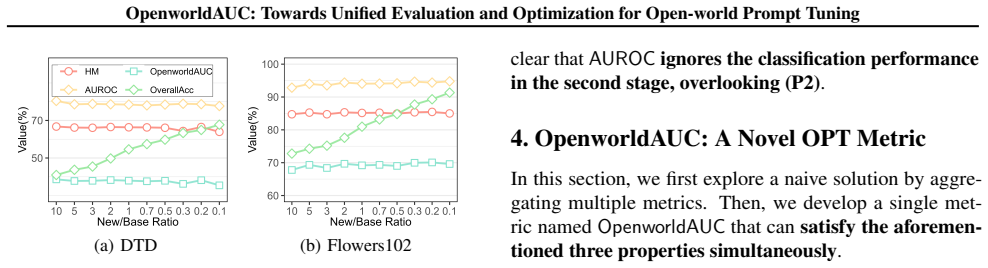
OpenworldAUC, defined as $\mathbb{E}_{(x_b,y_b)\sim D_b,(x_n,y_n)\sim D_n}[\mathbf{1}[y_b=g(x_b)]\cdot \mathbf{1}[r(x_b)>r(x_n)]\cdot \mathbf{1}[y_n=h(x_n)]]$, is a unified metric for open-world prompt tuning that jointly evaluates base-to-new detection (P1), base classification (P2), and new classification (P2), while remaining insensitive to the base/new sample ratio because it uses pairwise ranking rather than class-marginal accuracy. The paper establishes that HM ignores detection, OverallAcc is dominated by the more numerous domain, and AUROC ignores classification, so none alone evaluates an open-world model faithfully. GMoP optimizes this metric by assigning a dedicated prompt to each of the detector, base classifier, and (zero-shot) new classifier, and the gating mechanism weights the pairwise ranking loss toward correctly classified samples. Theorem 5.2 bounds the generalization gap through the empirical loss, the zero-shot error of the new classifier, and three stochastic error terms involving the number of pseudo partitions, the base sample size, and the discrepancy between the pseudo and true base/new partitions. Across fifteen benchmarks, the method reports higher OpenworldAUC and better stage-wise trade-offs than ten competitors while using fewer trainable parameters than some of them.
Load-bearing premise
The whole argument assumes the pseudo base/new split of the training classes behaves like the true base/new split of the data; if that proxy is badly unrepresentative of the real new domain, the guarantee includes an unmeasured shift term and the method's new-class promise rests on the zero-shot classifier alone.
Editorial extensions
If this is right
- Open-world model selection becomes a single-number decision guided by OpenworldAUC, replacing separate stage-wise metrics where a model strong in one stage can appear better than one that balances both.
- Prompt tuning methods can be re-ranked by a metric that is stable under changed base/new test ratios, so deployment decisions no longer depend on assumptions about the unobserved domain distribution.
- The gated division of labor among prompts provides a recipe for optimizing ranking-based objectives when the full label space is unavailable: pseudo partitions plus confidence gates.
- The reported results suggest that a modest set of prompt parameters, around 26.6k, suffices to improve over methods with larger prompt budgets, which matters for low-resource adaptation of vision-language models.
- The generalization bound implies that more pseudo partitions and more base shots monotonically reduce the excess risk, a prediction testable on any downstream benchmark.
Reading between the lines
- A direct corollary: any existing prompt-tuning method could be converted into an OpenworldAUC learner solely by reweighting its training objective with the gated pairwise term, without changing the prompt architecture, so the metric itself, not GMoP, is the primary contribution.
- The metric could be imported into other staged recognition pipelines, such as open-set recognition or test-time-agnostic long-tail learning, wherever a detector fronts a classifier and ground truth for a target split is unavailable.
- A testable extension: swap the fixed zero-shot new classifier for a lightweight adversarially trained new-domain classifier and measure whether the irreducible zero-shot error term in Theorem 5.2 shrinks enough to improve OpenworldAUC, especially on fine-grained new classes.
- If pseudo partitions are class-level while the true new domain is distribution-level, the bound's partition-shift term predicts a measurable degradation; comparing OpenworldAUC under class-split versus dataset-split new domains would quantify that gap and tell practitioners where the metric can be trusted.
Signed reviews
Editorial analysis
A structured set of objections, weighed in public.
Referee Report
Summary. The paper proposes OpenworldAUC, a metric for open-world prompt tuning that jointly evaluates base-to-new detection and classification in both domains through a pairwise ranking formulation, and argues it is insensitive to the base/new sample ratio. To optimize the metric, it introduces GMoP, a gated mixture-of-prompts approach with a base classifier prompt, multiple detector prompts trained on pseudo base/new partitions, and a fixed zero-shot new-domain classifier. A generalization bound is stated for the empirical risk. Experiments on recognition, domain generalization, and cross-dataset benchmarks compare against ten methods and report improvements when evaluating with OpenworldAUC, with code released.
Significance. If the optimization-theory issues were repaired, the work would be a solid contribution: the metric definition (Prop. 4.2) is sound and addresses a real evaluation gap in open-world prompt tuning; the empirical study is broad (many datasets and competitors, released code); and the pseudo-partition idea for detector training is practically promising. However, the formal link between the objective actually optimized by GMoP and the OpenworldAUC metric is currently broken by an incorrect equivalence claim in Prop. 5.1, and the proof of the generalization bound contains an unsupported step that treats discrete partition distributions as continuous simplex densities. These issues are load-bearing for the central optimization and theoretical claims; once repaired, the metric and empirical method would constitute a valuable contribution. The released code supports reproducibility of the empirical results.
major comments (3)
- [Section 5.1, Prop. 5.1, App. A.5 and Tab. 5] The equivalence in Prop. 5.1 is incorrect. With indicators I_g=1[y_b=g(x_b)], I_r=1[r(x_b)>r(x_n)], I_h=1[y_n=h(x_n)], the arithmetic objective in Prop. 5.1 has expectation E[(1-I_g)+(1-I_h)+I_g(1-I_r)I_h] = 1 - OpenworldAUC + E[(1-I_g)(1-I_h)]. The extra term E[(1-I_g)(1-I_h)] does not vanish in general, so minimizing the stated objective is not equivalent to maximizing OpenworldAUC. The truth table in Tab. 5 is valid only if '+' is interpreted as logical OR, not arithmetic addition; the empirical risks in (OP0) and (OPfin) are arithmetic sums. Since this equivalence is the only formal link between GMoP and OpenworldAUC, the paper should either prove a surrogate-gap bound (e.g., control E[(1-I_g)(1-I_h)] under training conditions) or explicitly present the objective as a heuristic surrogate for OpenworldAUC rather than an equivalent reformulation.
- [Section 5.2, Thm. 5.2, App. B.4, term (a)] Term (a) of the proof of Thm. 5.2 bounds |E_Y[R_D] - E_hatY[R_hatD]| by an integral over the simplex S^{C-1} of |E(P)-E'(P)| dP, and then uses Lemma B.9 (simplex volume 1/C!) to obtain the factor ||E(P)-E'(P)||_infinity/C!. However, E and E' are, by definition, distributions over discrete class partitions, not probability densities on the continuous simplex; the integral representation and the resulting C! factor are not justified. Moreover, the term ||E(P)-E'(P)||_infinity/(C_b+C_n)! depends on the unknown true partition distribution and is never estimated or controlled by the algorithm, so the stated guarantee is conditional on a quantity the method does not handle. Please repair the derivation or restate the theorem explicitly as a conditional bound dependent on an unestimated partition-shift term.
- [Section 4.2, Prop. 4.3, App. A.4] The claimed lower bound on HitRaten is not proportional to OpenworldAUC u. From the derived inequality, HitRaten >= 1 - (1-u)/a where a = MissRateb; this is an affine function of u, and for a < 1-u the bound is negative and vacuous. Consequently, the subsequent claim that optimizing OpenworldAUC 'can guarantee the model performance on the new domain under arbitrary base/new ratio' (Sec. 4, discussion after Prop. 4.3) is not supported as stated. Please qualify the statement with the condition u > 1 - a and describe the bound as affine rather than proportional, or remove the overclaim.
minor comments (6)
- [Section 6.1] The sentence 'based on the open-source library open-source library XCurve' contains a duplicated phrase; please remove one instance.
- [Figure 1 caption] The caption labels the third and fourth panels both with 'c)'; the fourth panel should be labeled 'd)'.
- [Appendix table of contents] The word 'dasdsa' appears before the table of contents in the appendix; this appears to be an accidental insertion and should be deleted.
- [Section 5.2 / App. B.4] The notation for the partition-shift term is inconsistent: the theorem statement in the main text uses ||E-E'||_infinity/(C_b+C_n)!, while the proof in App. B.4 uses ||E(P)-E'(P)||_infinity/C!. Please unify the notation.
- [Abstract / Section 6.1] The abstract states '15 benchmarks', while the experimental section reports 11 recognition datasets, 4 ImageNet variants, 7 cross-dataset targets, and 10 imbalance variants; please clarify the exact counting of benchmarks to avoid apparent inconsistency.
- [Section 4.2, Prop. 4.2] The phrase 'joint possibility' should be 'joint probability' in the statement of Prop. 4.2.
Circularity Check
No significant circularity: OpenworldAUC is a definition, GMoP is benchmarked against external methods, and the generalization bound is self-contained; the Prop. 5.1 algebra flaw is a correctness risk rather than a circular step.
full rationale
The paper's central claim is that OpenworldAUC, defined as E[1[y_b=g(x_b)]·1[r(x_b)>r(x_n)]·1[y_n=h(x_n)]], unifies detection and classification. This is a definition, not a derivation from a hidden input, and the paper's own proof of Prop. 4.2 computes the integral form to this joint probability without importing the conclusion. GMoP is an optimization heuristic whose objective is connected to OpenworldAUC through Prop. 5.1; the proof of that proposition treats the arithmetic '+' as Boolean OR, so the stated equivalence E[¬I_g + I_g·¬I_r·I_h + ¬I_h] = 1 - I_g I_r I_h is false as written, and the surrogate objectives (OP0)/(OPfin) are therefore not provably equivalent to maximizing OpenworldAUC. This is a genuine correctness defect, but it is not circularity: the method's effectiveness is established empirically on 15 held-out benchmarks against ten external competitors, and no parameter is fitted to the reported OpenworldAUC values. The pseudo base-to-new partition taken from DeCoOp is an acknowledged approximation: Theorem 5.2 explicitly includes the unestimated term ||E(P)-E'(P)||_inf/C! and the irreducible zero-shot error E_Dn[ell_ce(s_n,y_n)], and App. B.4 states 'Without prior knowledge of the new domain, we cannot bound the expected error.' The generalization proof uses standard McDiarmid and covering-number arguments, not the target result. Self-citations to the authors' AUC work (surrogate losses, CE regularization, OpenAUC) are auxiliary and are accompanied by external citations such as Gao & Zhou and Yuan et al., so they are not load-bearing. Appendix C.5's reformulation of OpenworldAUC as AUROC on masked scores is an equivalent computation of the same definition, not a renamed known result or a fitted prediction. Overall, the derivation chain contains no step that reduces to its own inputs by construction.
Assumptions & free parameters
free parameters (3)
- K (number of pseudo base-to-new partitions) =
3
- lambda (cross-entropy regularization weight) =
0.5 to 1.0
- Detector prompt length =
16
assumptions (4)
- domain assumption The open-world task is two-stage: first detect base vs new, then classify within the detected domain.
- domain assumption Pseudo base-to-new partitions of the training classes approximate the real base/new distribution (small ||E(P)-E'(P)||infinity/C! term).
- standard math The loss functions and prompts are Lipschitz continuous and bounded, and the covering number of the hypothesis class satisfies log N(epsilon;H,rho) <= d log(3r/epsilon).
- ad hoc to paper In term (a) of the Thm.5.2 proof, the distributions E(P) and E'(P) over partitions are treated as densities on the probability simplex so the integral is bounded by the simplex volume 1/C!.
Cite this review
Pith. "Pith review of OpenworldAUC: Towards Unified Evaluation and Optimization for Open-world Prompt Tuning." pith.science (2026). https://pith.science/paper/PRCPQU6K
@misc{pith2026250505180,
  author       = {Pith},
  title        = {Pith review of: OpenworldAUC: Towards Unified Evaluation and Optimization for Open-world Prompt Tuning},
  year         = {2026},
  howpublished = {\url{https://pith.science/paper/PRCPQU6K}},
  note         = {Machine review of arXiv:2505.05180}
}
read the original abstract
Prompt tuning adapts Vision-Language Models like CLIP to open-world tasks with minimal training costs. In this direction, one typical paradigm evaluates model performance separately on known classes (i.e., base domain) and unseen classes (i.e., new domain). However, real-world scenarios require models to handle inputs without prior domain knowledge. This practical challenge has spurred the development of open-world prompt tuning, which demands a unified evaluation of two stages: 1) detecting whether an input belongs to the base or new domain (P1), and 2) classifying the sample into its correct class (P2). What's more, as domain distributions are generally unknown, a proper metric should be insensitive to varying base/new sample ratios (P3). However, we find that current metrics, including HM, overall accuracy, and AUROC, fail to satisfy these three properties simultaneously. To bridge this gap, we propose OpenworldAUC, a unified metric that jointly assesses detection and classification through pairwise instance comparisons. To optimize OpenworldAUC effectively, we introduce Gated Mixture-of-Prompts (GMoP), which employs domain-specific prompts and a gating mechanism to dynamically balance detection and classification. Theoretical guarantees ensure generalization of GMoP under practical conditions. Experiments on 15 benchmarks in open-world scenarios show GMoP achieves SOTA performance on OpenworldAUC and other metrics. We release the code at https://github.com/huacong/OpenworldAUC
Figures


Figures from the paper (9 more)


Forward citations
Cited by 1 Pith paper
-
UniTraffic-Agent: Unified Traffic Video Reasoning for AI City Challenge 2026 Track 3 with Two Out-of-Domain Evaluations
UniTraffic-Agent, a single GPT-5.5-based pipeline, ranks 2nd on FETV and 4th on PSI-VQA on the AI City Challenge 2026 public leaderboard.
Reference graph
Works this paper leans on
-
[1]
write newline
" write newline "" before.all 'output.state := FUNCTION n.dashify 't := "" t empty not t #1 #1 substring "-" = t #1 #2 substring "--" = not "--" * t #2 global.max substring 't := t #1 #1 substring "-" = "-" * t #2 global.max substring 't := while if t #1 #1 substring * t #2 global.max substring 't := if while FUNCTION format.date year duplicate empty "emp...
-
[2]
Bossard, L., Guillaumin, M., and Gool, L. V. Food-101 - mining discriminative components with random forests. In European Conference on Computer Vision, pp.\ 446--461, 2014
work page 2014
-
[3]
Bulat, A. and Tzimiropoulos, G. LASP: Text-to-Text Optimization for Language-Aware Soft Prompting of Vision Language Models . In IEEE/CVF Conference on Computer Vision and Pattern Recognition , pp.\ 23232--23241, 2023
work page 2023
-
[4]
Describing textures in the wild
Cimpoi, M., Maji, S., Kokkinos, I., Mohamed, S., and Vedaldi, A. Describing textures in the wild. In IEEE/CVF Conference on Computer Vision and Pattern Recognition , pp.\ 3606--3613, 2014
work page 2014
-
[5]
Imagenet: A large-scale hierarchical image database
Deng, J., Dong, W., Socher, R., Li, L.-J., Li, K., and Fei-Fei, L. Imagenet: A large-scale hierarchical image database. In IEEE/CVF Conference on Computer Vision and Pattern Recognition , pp.\ 248--255, 2009
work page 2009
-
[6]
An introduction to ROC analysis
Fawcett, T. An introduction to ROC analysis. Pattern Recognit. Lett., 27 0 (8): 0 861--874, 2006
work page 2006
-
[7]
Fei - Fei, L., Fergus, R., and Perona, P. Learning generative visual models from few training examples: An incremental bayesian approach tested on 101 object categories. In IEEE/CVF Conference on Computer Vision and Pattern Recognition Workshops , pp.\ 178--178, 2004
work page 2004
-
[8]
Shrec'22 track: Open-set 3d object retrieval
Feng, Y., Gao, Y., Zhao, X., Guo, Y., Bagewadi, N., Bui, N.-T., Dao, H., Gangisetty, S., Guan, R., Han, X., Hua, C., Hunakunti, C., Jiang, Y., Jiao, S., Ke, Y., Kuang, L., Liu, A., Nguyen, D.-H., Nguyen, H.-D., Nie, W., Pham, B.-D., Raikar, K., Tang, Q., Tran, M.-T., Wan, J., Yan, C., You, H., and Zhu, D. Shrec'22 track: Open-set 3d object retrieval. Comp...
work page 2022
Show all 60 references
-
[9]
and Zhou, Z
Gao, W. and Zhou, Z. On the consistency of auc pairwise optimization. In International Joint Conference on Artificial Intelligence, pp.\ 939--945, 2015
2015
-
[10]
Aucseg: Auc-oriented pixel-level long-tail semantic segmentation
Han, B., Xu, Q., Yang, Z., Bao, S., Wen, P., Jiang, Y., and Huang, Q. Aucseg: Auc-oriented pixel-level long-tail semantic segmentation. In Annual Conference on Neural Information Processing Systems, pp.\ 126863--126907, 2024
2024
-
[11]
Eurosat: A novel dataset and deep learning benchmark for land use and land cover classification
Helber, P., Bischke, B., Dengel, A., and Borth, D. Eurosat: A novel dataset and deep learning benchmark for land use and land cover classification. IEEE J. Sel. Top. Appl. Earth Obs. Remote. Sens. , 12 0 (7): 0 2217--2226, 2019
2019
-
[12]
and Gimpel, K
Hendrycks, D. and Gimpel, K. A baseline for detecting misclassified and out-of-distribution examples in neural networks. In International Conference on Learning Representations, pp.\ 1--12, 2017
2017
-
[13]
The many faces of robustness: A critical analysis of out-of-distribution generalization
Hendrycks, D., Basart, S., Mu, N., Kadavath, S., Wang, F., Dorundo, E., Desai, R., Zhu, T., Parajuli, S., Guo, M., Song, D., Steinhardt, J., and Gilmer, J. The many faces of robustness: A critical analysis of out-of-distribution generalization. In IEEE/CVF International Confer...
2021
-
[14]
Natural adversarial examples
Hendrycks, D., Zhao, K., Basart, S., Steinhardt, J., and Song, D. Natural adversarial examples. In IEEE/CVF Conference on Computer Vision and Pattern Recognition , pp.\ 15262--15271, 2021 b
2021
-
[15]
Reconboost: Boosting can achieve modality reconcilement
Hua, C., Xu, Q., Bao, S., Yang, Z., and Huang, Q. Reconboost: Boosting can achieve modality reconcilement. In International Conference on Machine Learning, pp.\ 19573--19597, 2024
2024
-
[16]
U., Rasheed, H
Khattak, M. U., Rasheed, H. A., Maaz, M., Khan, S. H., and Khan, F. S. Maple: Multi-modal prompt learning. In IEEE/CVF Conference on Computer Vision and Pattern Recognition , pp.\ 19113--19122, 2023 a
2023
-
[17]
U., Wasim, S
Khattak, M. U., Wasim, S. T., Naseer, M., Khan, S., Yang, M.-H., and Khan, F. S. Self-regulating prompts: Foundational model adaptation without forgetting. In IEEE/CVF International Conference on Computer Vision , pp.\ 15190--15200, 2023 b
2023
-
[18]
U., Naeem, M
Khattak, M. U., Naeem, M. F., Naseer, M., Gool, L. V., and Tombari, F. Learning to prompt with text only supervision for vision-language models. CoRR, abs/2401.02418, 2024
2024 arXiv
-
[19]
and Ramanan, D
Kong, S. and Ramanan, D. Opengan: Open-set recognition via open data generation. IEEE Trans. Pattern Anal. Mach. Intell. , 47 0 (5): 0 3233--3243, 2025
2025
-
[20]
3d object representations for fine-grained categorization
Krause, J., Stark, M., Deng, J., and Fei-Fei, L. 3d object representations for fine-grained categorization. In IEEE/CVF International Conference on Computer Vision Workshop , pp.\ 554--561, 2013
2013
-
[21]
Gallop: Learning global and local prompts for vision-language models
Lafon, M., Ramzi, E., Rambour, C., Audebert, N., and Thome, N. Gallop: Learning global and local prompts for vision-language models. In European Conference on Computer Vision, pp.\ 264--282, 2024
2024
-
[22]
The power of scale for parameter-efficient prompt tuning
Lester, B., Al - Rfou, R., and Constant, N. The power of scale for parameter-efficient prompt tuning. In Conference on Empirical Methods in Natural Language Processing, pp.\ 3045--3059, 2021
2021
-
[23]
Promptkd: Unsupervised prompt distillation for vision-language models
Li, Z., Li, X., Fu, X., Zhang, X., Wang, W., Chen, S., and Yang, J. Promptkd: Unsupervised prompt distillation for vision-language models. In IEEE/CVF Conference on Computer Vision and Pattern Recognition , pp.\ 26617--26626, 2024
2024
-
[24]
Stochastic auc maximization with deep neural networks
Liu, M., Yuan, Z., Ying, Y., and Yang, T. Stochastic auc maximization with deep neural networks. In International Conference on Learning Representations, pp.\ 1--24, 2020
2020
-
[25]
B., and Vedaldi, A
Maji, S., Rahtu, E., Kannala, J., Blaschko, M. B., and Vedaldi, A. Fine-grained visual classification of aircraft. CoRR, abs/1306.5151, 2013
2013 arXiv
-
[26]
Mistretta, M., Baldrati, A., Bertini, M., and Bagdanov, A. D. Improving zero-shot generalization of learned prompts via unsupervised knowledge distillation. In European Conference on Computer Vision, pp.\ 459--477, 2024
2024
-
[27]
Locoop: Few-shot out-of-distribution detection via prompt learning
Miyai, A., Yu, Q., Irie, G., and Aizawa, K. Locoop: Few-shot out-of-distribution detection via prompt learning. In Annual Conference on Neural Information Processing Systems, pp.\ 76298--76310, 2023
2023
-
[28]
Out-of-distribution detection with negative prompts
Nie, J., Zhang, Y., Fang, Z., Liu, T., Han, B., and Tian, X. Out-of-distribution detection with negative prompts. In International Conference on Learning Representations, pp.\ 1--20, 2024
2024
-
[29]
and Zisserman, A
Nilsback, M.-E. and Zisserman, A. Automated flower classification over a large number of classes. In Indian Conference on Computer Vision, Graphics and Image Processing, pp.\ 722--729, 2008
2008
-
[30]
M., Vedaldi, A., Zisserman, A., and Jawahar, C
Parkhi, O. M., Vedaldi, A., Zisserman, A., and Jawahar, C. V. Cats and dogs. In IEEE/CVF Conference on Computer Vision and Pattern Recognition , pp.\ 3498--3505, 2012
2012
-
[31]
Automatic differentiation in pytorch
Paszke, A., Gross, S., Chintala, S., Chanan, G., Yang, E., DeVito, Z., Lin, Z., Desmaison, A., Antiga, L., and Lerer, A. Automatic differentiation in pytorch. 2017
2017
-
[32]
W., Hallacy, C., Ramesh, A., Goh, G., Agarwal, S., Sastry, G., Askell, A., Mishkin, P., Clark, J., Krueger, G., and Sutskever, I
Radford, A., Kim, J. W., Hallacy, C., Ramesh, A., Goh, G., Agarwal, S., Sastry, G., Askell, A., Mishkin, P., Clark, J., Krueger, G., and Sutskever, I. Learning transferable visual models from natural language supervision. In International Conference on Machine Learning, pp.\ 8...
2021
-
[33]
Do I mage N et classifiers generalize to I mage N et? In International Conference on Machine Learning, pp.\ 5389--5400, 2019
Recht, B., Roelofs, R., Schmidt, L., and Shankar, V. Do I mage N et classifiers generalize to I mage N et? In International Conference on Machine Learning, pp.\ 5389--5400, 2019
2019
-
[34]
and Etemad, A
Roy, S. and Etemad, A. Consistency-guided prompt learning for vision-language models. In International Conference on Learning Representations, pp.\ 1--14, 2024
2024
-
[35]
Scherreik, M. D. and Rigling, B. D. Open set recognition for automatic target classification with rejection. IEEE Trans. Aerosp. Electron. Syst. , 52 0 (2): 0 632--642, 2016
2016
-
[36]
R., and Shah, M
Soomro, K., Zamir, A. R., and Shah, M. UCF101: A dataset of 101 human actions classes from videos in the wild. CoRR, abs/1212.0402, 2012
2012 arXiv
-
[37]
Kill two birds with one stone: Rethinking data augmentation for deep long-tailed learning
Wang, B., Wang, P., Xu, W., Wang, X., Zhang, Y., Wang, K., and Wang, Y. Kill two birds with one stone: Rethinking data augmentation for deep long-tailed learning. In International Conference on Learning Representations, pp.\ 1--24, 2024 a
2024
-
[38]
C., and Xing, E
Wang, H., Ge, S., Lipton, Z. C., and Xing, E. P. Learning robust global representations by penalizing local predictive power. In Annual Conference on Neural Information Processing Systems, pp.\ 10506--10518, 2019
2019
-
[39]
Llm-autoda: Large language model-driven automatic data augmentation for long-tailed problems
Wang, P., Zhao, Z., Wen, H., Wang, F., Wang, B., Zhang, Q., and Wang, Y. Llm-autoda: Large language model-driven automatic data augmentation for long-tailed problems. In Annual Conference on Neural Information Processing Systems, pp.\ 64915--64941, 2024 b
2024
-
[40]
Openauc: Towards auc-oriented open-set recognition
Wang, Z., Xu, Q., Yang, Z., He, Y., Cao, X., and Huang, Q. Openauc: Towards auc-oriented open-set recognition. In Annual Conference on Neural Information Processing Systems, pp.\ 25033--25045, 2022
2022
-
[41]
Cascade prompt learning for vision-language model adaptation
Wu, G., Zhang, X., Li, Z., Chen, Z., Liang, J., Yang, J., and Li, X. Cascade prompt learning for vision-language model adaptation. In European Conference on Computer Vision, pp.\ 304--321, 2024
2024
-
[42]
Zero-shot learning — the good, the bad and the ugly
Xian, Y., Schiele, B., and Akata, Z. Zero-shot learning — the good, the bad and the ugly. In IEEE/CVF Conference on Computer Vision and Pattern Recognition , pp.\ 3077--3086, 2017
2017
-
[43]
A., Oliva, A., and Torralba, A
Xiao, J., Hays, J., Ehinger, K. A., Oliva, A., and Torralba, A. Sun database: Large-scale scene recognition from abbey to zoo. In IEEE/CVF Conference on Computer Vision and Pattern Recognition , pp.\ 3485--3492, 2010
2010
-
[44]
and Ying, Y
Yang, T. and Ying, Y. AUC maximization in the era of big data and AI: A survey. ACM Comput. Surv. , 55 0 (8): 0 172:1--172:37, 2023
2023
-
[45]
Learning with multiclass AUC: theory and algorithms, 2022
Yang, Z., Xu, Q., Bao, S., Cao, X., and Huang, Q. Learning with multiclass AUC: theory and algorithms, 2022
2022
-
[46]
Optimizing two-way partial AUC with an end-to-end framework
Yang, Z., Xu, Q., Bao, S., He, Y., Cao, X., and Huang, Q. Optimizing two-way partial AUC with an end-to-end framework. IEEE Trans. Pattern Anal. Mach. Intell. , 45 0 (8): 0 10228--10246, 2023
2023
-
[47]
Harnessing hierarchical label distribution variations in test agnostic long-tail recognition
Yang, Z., Xu, Q., Wang, Z., Li, S., Han, B., Bao, S., Cao, X., and Huang, Q. Harnessing hierarchical label distribution variations in test agnostic long-tail recognition. In International Conference on Machine Learning, pp.\ 56624--56664, 2024
2024
-
[48]
Visual-language prompt tuning with knowledge-guided context optimization
Yao, H., Zhang, R., and Xu, C. Visual-language prompt tuning with knowledge-guided context optimization. In IEEE/CVF Conference on Computer Vision and Pattern Recognition , pp.\ 6757--6767, 2023
2023
-
[49]
Tcp: Textual-based class-aware prompt tuning for visual-language model
Yao, H., Zhang, R., and Xu, C. Tcp: Textual-based class-aware prompt tuning for visual-language model. In IEEE/CVF Conference on Computer Vision and Pattern Recognition , pp.\ 23438--23448, 2024
2024
-
[50]
Compositional training for end-to-end deep AUC maximization
Yuan, Z., Guo, Z., Chawla, N., and Yang, T. Compositional training for end-to-end deep AUC maximization. In International Conference on Learning Representations, pp.\ 1--26, 2022
2022
-
[51]
Counterfactual zero-shot and open-set visual recognition
Yue, Z., Wang, T., Zhang, H., Sun, Q., and Hua, X.-S. Counterfactual zero-shot and open-set visual recognition. In IEEE/CVF Conference on Computer Vision and Pattern Recognition , pp.\ 15404--15414, 2021
2021
-
[52]
Enhancing outlier knowledge for few-shot out-of-distribution detection with extensible local prompts
Zeng, F., Cheng, Z., Zhu, F., and Zhang, X. Enhancing outlier knowledge for few-shot out-of-distribution detection with extensible local prompts. CoRR, abs/2409.04796, 2024
2024 arXiv
-
[53]
T., and Song, J
Zhang, J., Wu, S., Gao, L., Shen, H. T., and Song, J. Dept: Decoupled prompt tuning. In IEEE/CVF Conference on Computer Vision and Pattern Recognition , pp.\ 12924--12933, 2024
2024
-
[54]
Prompt, generate, then cache: Cascade of foundation models makes strong few-shot learners
Zhang, R., Hu, X., Li, B., Huang, S., Deng, H., Qiao, Y., Gao, P., and Li, H. Prompt, generate, then cache: Cascade of foundation models makes strong few-shot learners. pp.\ 15211--15222, 2023
2023
-
[55]
Two fists, one heart: Multi-objective optimization based strategy fusion for long-tailed learning
Zhao, Z., Wang, P., Wen, H., Xu, W., Song, L., Zhang, Q., and Wang, Y. Two fists, one heart: Multi-objective optimization based strategy fusion for long-tailed learning. In International Conference on Machine Learning, pp.\ 61040--61071, 2024 a
2024
-
[56]
Breaking long-tailed learning bottlenecks: A controllable paradigm with hypernetwork-generated diverse experts
Zhao, Z., Wen, H., Wang, Z., Wang, P., Wang, F., Lai, S., Zhang, Q., and Wang, Y. Breaking long-tailed learning bottlenecks: A controllable paradigm with hypernetwork-generated diverse experts. In Annual Conference on Neural Information Processing Systems, pp.\ 7493--7520, 2024 b
2024
-
[57]
C., and Liu, Z
Zhou, K., Yang, J., Loy, C. C., and Liu, Z. Conditional prompt learning for vision-language models. In IEEE/CVF Conference on Computer Vision and Pattern Recognition , pp.\ 16795--16804, 2022 a
2022
-
[58]
C., and Liu, Z
Zhou, K., Yang, J., Loy, C. C., and Liu, Z. Learning to prompt for vision-language models. Int. J. Comput. Vis., 130 0 (9): 0 2337--2348, 2022 b
2022
-
[59]
Decoop: Robust prompt tuning with out-of-distribution detection
Zhou, Z., Yang, M., Shi, J.-X., Guo, L.-Z., and Li, Y.-F. Decoop: Robust prompt tuning with out-of-distribution detection. In International Conference on Machine Learning, pp.\ 62161--62177, 2024
2024
-
[60]
Prompt-aligned gradient for prompt tuning
Zhu, B., Niu, Y., Han, Y., Wu, Y., and Zhang, H. Prompt-aligned gradient for prompt tuning. In IEEE/CVF International Conference on Computer Vision , pp.\ 15613--15623, 2023
2023
Reviewed August 15, 2026 · model on record in the stance chip above.
Discussion (0). Continue with ORCID to comment.