REVIEW 4 major objections 3 minor 75 references
Information-theoretic characterization of turbulence intermittency
T0 review · 4 major / 3 minor · reviewed 2026-08-15 · deepseek-v4-flash
Pith's one-line read Using KL divergence from a Gaussian random field, the paper finds turbulence-induced intermittency grows logarithmically with Reynolds number and is equal for dissipation and enstrophy.
desk verdict A genuinely useful kinematic/dynamic decomposition of intermittency, but the headline scalings and symmetry claim need error bars and statistical tests before I'd trust them. read the letter →
The pith
A machine-rendered reading of the paper's core claim, the machinery that carries it, and where it could break.
The reading
What carries the argument
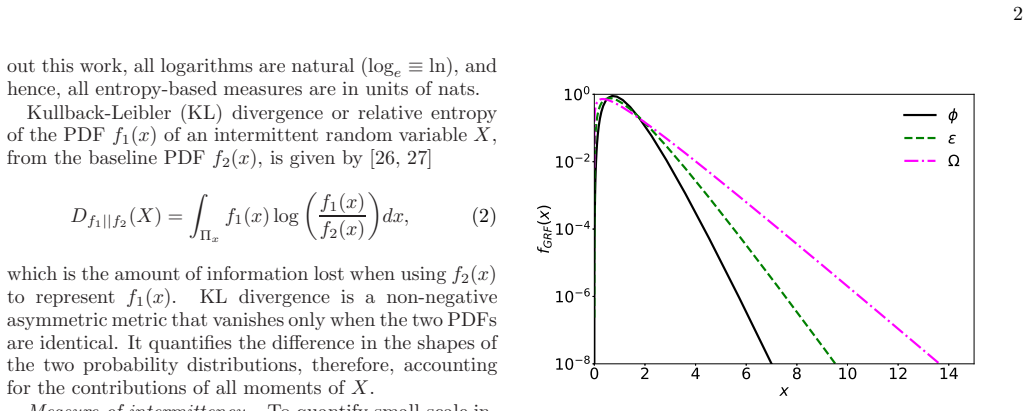
The load-bearing object is the Gamma-distribution baseline PDF for a Gaussian random velocity field from Eq. (3): $f_{\mathrm{GRF}}(x) = \frac{(n/2)^{n/2}}{\Gamma(n/2)} x^{n/2-1} e^{-nx/2}$, with $n=8$ for pseudodissipation, $n=5$ for dissipation, and $n=3$ for enstrophy. Because mean-normalized quadratic forms of Gaussian gradients follow Gamma distributions, this baseline encodes the kinematic intermittency inherent in the definitions of $\phi$, $\epsilon$, and $\Omega$; any deviation from it is attributed to turbulence dynamics. KL divergence (Eq. 2) measures that deviation, and the lognormal model for $\phi$ (Eq. 5) provides an analytic approximation whose KL divergence scales as $2\sigma_\theta^2 - \tfrac{1}{2}\log\sigma_\theta^2$, explaining the logarithmic growth.
What would settle it
A direct check is to evaluate the KL divergence of dissipation PDFs from the Gamma baseline in a flow whose velocity gradients are Gaussian but with no turbulent dynamics, and to extend DNS of $D_{f\|f_{\mathrm{GRF}}}$ beyond $Re_\lambda=1000$; the central claim fails if the divergence is nonzero without dynamics or if the growth becomes power-law rather than logarithmic.
Extended reading notes
Core claim
The central discovery is that KL divergence from a Gamma-distributed Gaussian random field baseline gives a clean separation between kinematic and dynamic intermittency, and that the dynamic part obeys simple log laws. For pseudodissipation, $D_{f\|f_{\mathrm{GRF}}}(\phi) \approx -0.925 + 0.376 \log Re_\lambda$ for $10 < Re_\lambda < 600$, while dissipation and enstrophy both follow $D_{f\|f_{\mathrm{GRF}}}(X) \approx -0.459 + 0.173 \log Re_\lambda$. The Shannon entropy of pseudodissipation increases below $Re_\lambda\approx100$ and decreases above it, producing a maximum near $Re_\lambda \approx 100$. The authors interpret two critical Reynolds numbers: $Re_\lambda \approx 10$, where turbulence-induced intermittency begins, and $Re_\lambda \approx 100$, where small-scale statistics become fully developed and the uncertainty of the field starts to decline. These results contradict the usual power-law scaling of moments and the common inference that enstrophy is more intermittent than dissipation.
Load-bearing premise
The Gamma distributions of Eq. (3) are assumed to be the exact and Reynolds-number-independent representation of the non-intermittent state, so if the kinematic baseline changes with $Re_\lambda$, the measured KL divergences would not isolate turbulence dynamics alone.
Editorial extensions
If this is right
- At higher Reynolds numbers, intermittency grows more slowly than individual moment scaling suggests, and if the log trend continues, the KL divergence may approach a finite asymptotic value.
- The near-equal intermittency of dissipation and enstrophy implies that small-scale models should treat strain and rotation dynamics as equally intermittent rather than encoding a built-in asymmetry.
- The entropy maximum at $Re_\lambda\approx100$ provides a quantitative marker for the onset of fully developed small-scale turbulence, coinciding with the dissipative anomaly and velocity-gradient partitioning.
- The Reynolds-number-independent Gamma baseline offers a single reference PDF, so intermittency can be compared across different flows and Reynolds numbers without re-fitting the null.
- The lognormal-derived approximation reproduces the log growth, tying the scaling to the established logarithmic growth of the log-gradient variance $\sigma_\theta^2$.
Reading between the lines
- A direct extension would test whether the logarithmic growth saturates by pushing DNS to $Re_\lambda \gtrsim 10^4$; if the divergence plateaus, the hypothesis of finite maximum intermittency would be supported.
- The $\epsilon$-$\Omega$ symmetry may also appear in the joint statistics of strain-rate and rotation-rate invariants, which could be checked in existing high-$Re$ DNS databases.
- If the two critical Reynolds numbers are universal, the same entropy and KL analysis applied to shear flows, boundary layers, or convective turbulence would show the same $Re_\lambda\approx10$ and $Re_\lambda\approx100$ markers.
Signed reviews
Editorial analysis
A structured set of objections, weighed in public.
Referee Report
Summary. The paper proposes an information-theoretic characterization of small-scale turbulence intermittency by measuring the Kullback-Leibler divergence of pseudodissipation, dissipation, and enstrophy from analytically derived Gamma-distribution baselines of a Gaussian random velocity field. Using DNS data of forced homogeneous isotropic turbulence over Re_λ ≈ 1–588, the authors report that turbulence-induced intermittency grows logarithmically with Reynolds number (Eqs. 6–7), that dissipation and enstrophy exhibit nearly equal turbulence-induced intermittency, and that the Shannon entropy of pseudodissipation is non-monotonic, with two critical Reynolds numbers near 10 and 100. The paper argues that this logarithmic growth contrasts with the commonly invoked power-law scaling of moments and that the strain/vorticity asymmetry is largely kinematic, not dynamic.
Significance. If the central claims hold, the paper offers a genuinely useful new diagnostic: KL divergence relative to a Gaussian random field separates kinematic intermittency from dynamics-induced intermittency in a single scalar measure, and the analytic Gamma baseline is a clean, parameter-free construction. The reported logarithmic growth and the ε–Ω symmetry would be notable contributions to the intermittency literature. However, the quantitative support for these claims is currently limited: the scaling laws and the symmetry rest on fits to ensemble DNS data without uncertainty estimates, statistical model comparison, or tests for dataset heterogeneity. The strength of the contribution is therefore conditional on the completion of that statistical work.
major comments (4)
- [Intermittency, Eqs. (6) and (7), Figs. 4 and 5] The central quantitative claims—logarithmic growth of D_f||f_GRF with Re_λ and the equality of the ε and Ω trends—are based on least-squares fits over Re_λ ∈ (10, 600) with no reported confidence intervals, residuals, or goodness-of-fit statistics. Because the DNS points come from at least three different solvers and forcing schemes (in-house, JHTDB, and Texas A&M), systematic inter-dataset differences could easily corrupt the apparent slopes or the apparent overlap. The authors should provide bootstrap or subsampling estimates of the KL values and their uncertainties, and preferably fit both log and power-law models to the same data points to support the log-law preference.
- [Intermittency, Eq. (7) and Fig. 5] The claim that dissipation and enstrophy have 'nearly identical' turbulence-induced intermittency is inferred from visual overlap of the two data series. No statistical test is reported for the difference D(ε) − D(Ω) across Re_λ. Since the baseline Gamma distributions have different shape parameters (n = 5 vs n = 3), the near-identity of the KL values is not automatically expected and is a headline result; it therefore requires a quantitative comparison, such as a paired bootstrap on the per-Re_λ differences or a confidence interval for the fitted slope difference.
- [Uncertainty, Fig. 3 and Eq. (1)] The two critical Reynolds numbers, Re_λ^(1) ≈ 10 and Re_λ^(2) ≈ 100, are read from the entropy curve without a stated quantitative criterion (e.g., a change-point test or a threshold on dH/d log Re_λ). Moreover, the absolute entropy H(φ) depends on the histogram bin width through the −log(Δx) term in Eq. (1). The text states that Δx = 0.05 was selected from a range where KL divergence remains approximately constant, but no convergence data or sensitivity analysis for the entropy itself is shown; the location of the maximum could be affected by binning and by finite-sample tail resolution.
- [Baseline Distribution, Eq. (3)] The interpretation of D_f||f_GRF as purely 'turbulence-induced' intermittency depends on the assumption that a zero-mean, divergence-free, spatially uncorrelated Gaussian random field is the correct Reynolds-number-independent null for all Re_λ, including the low-Re_λ range 1–10 where the flow is not developed turbulence. This is a reasonable first choice, but it is an assumption about the null, not a proven separation of kinematic and dynamic effects. The authors should at least discuss whether a GRF with the same one-point energy spectrum or a finite-Re_λ Gaussian ensemble would change the conclusion, and should verify that the low-Re_λ 'D ≈ 0' plateau is not an artifact of the baseline being mismatched to the actual low-Re_λ state.
minor comments (3)
- [Uncertainty, Fig. 3] The sentence 'despite continuously growing variability, entropy decays above a certain Reynolds number' is potentially confusing: the 'variability' referred to is presumably the variance of the PDF, while entropy is a different measure. The distinction between variance growth and entropy decay should be stated explicitly in the figure caption or text.
- [PDF estimation, Fig. 2] The figure caption does not report the sample size or the number of independent snapshots used for each PDF estimate. Since KL divergence is sensitive to poorly sampled tails, a brief statement of sample sizes and the range of Δx over which the estimate is stable would improve reproducibility.
- [Introduction, refs. [26, 31–33]] The claim that KL divergence is 'more robust to sampling errors' than moment-based estimators is cited to references on change detection and soil mapping; a turbulence-specific convergence study or a direct argument would be more appropriate here.
Circularity Check
No significant circularity: the Gamma baseline is derived analytically, the scaling laws are fits to DNS data, and the lognormal support uses an independent prior variance scaling.
full rationale
The paper's central quantities are the KL divergences D_f||f_GRF(X) for X = phi, epsilon, Omega. The baseline distributions in Eq. (3) are derived analytically from a zero-mean divergence-free Gaussian random velocity field, with parameter counts n = 8, 5, 3 fixed by kinematics; they contain no DNS data and no fitted intermittency parameters. The main claims in Eqs. (6) and (7) are presented as log-law fits to DNS-derived KL values, not as outputs of the baseline construction. The lognormal model used as supporting evidence for the logarithmic growth depends on sigma_theta^2 scaling taken from prior work by Yeung & Pope and Das & Girimaji; this is an external, pre-existing empirical result, not a parameter fitted to the KL data in this paper. Self-citations to Das & Girimaji appear for velocity-gradient structure, forcing effects, and lognormal variance context, but they are not load-bearing in the sense that the DNS comparison and the analytical baseline would stand independently. The dissipation/enstrophy symmetry claim is an empirical comparison of KL divergences computed from two distinct Gamma baselines (n = 5 vs n = 3), so equality is not enforced by construction. No reduction of a prediction to its own input, no fitted parameter renamed as a prediction, and no uniqueness theorem imported from the authors' prior work were found.
Assumptions & free parameters
free parameters (4)
- Lognormal variance coefficients for σ_θ^2 =
-0.354 + 0.289 log(Reλ)
- φ KL log-law coefficients (Eq. 6) =
a = -0.925, b = 0.376
- ε/Ω KL log-law coefficients (Eq. 7) =
a = -0.459, b = 0.173
- Histogram bin width Δx =
0.05
assumptions (4)
- domain assumption Velocity gradient tensor in the GRF baseline is zero-mean Gaussian and isotropic, yielding Gamma-distributed mean-normalized φ, ε, Ω with shape parameters n/2 for n = 8, 5, 3.
- domain assumption The GRF Gamma baseline represents the non-intermittent state at all Reλ; kinematic intermittency does not depend on Reλ.
- domain assumption External DNS datasets from multiple groups and forcings are mutually consistent and adequately resolved at kmaxη ≥ 1.32.
- ad hoc to paper Histogram estimates with Δx = 0.05 converge to the continuous PDFs across all Reλ.
Cite this review
Pith. "Pith review of Information-theoretic characterization of turbulence intermittency." pith.science (2026). https://pith.science/paper/7QUQ6WHG
@misc{pith2026250505304,
  author       = {Pith},
  title        = {Pith review of: Information-theoretic characterization of turbulence intermittency},
  year         = {2026},
  howpublished = {\url{https://pith.science/paper/7QUQ6WHG}},
  note         = {Machine review of arXiv:2505.05304}
}
abstract
Small-scale intermittency is studied as the deviation of the probability distributions of pseudodissipation, dissipation and enstrophy in turbulence from those of a Gaussian random velocity field. This deviation is quantified using Kullback-Leibler (KL) divergence between the two distributions, directly measuring turbulence-induced intermittency separated from purely kinematic effects. Using direct numerical simulation data of forced isotropic turbulence over a wide range of Taylor Reynolds numbers ($Re_{\lambda}$), we characterize the $Re_{\lambda}$ dependence of small-scale intermittency via KL divergence and uncertainty via Shannon entropy, identifying distinct behavioral regimes. Small-scale uncertainty exhibits a non-monotonic dependence on $Re_{\lambda}$: despite continuously growing variability, entropy decays above a certain Reynolds number, suggesting a fundamental change in the statistical nature of the small scales. Turbulence-induced intermittency grows logarithmically with Reynolds number in contrast to the commonly reported power-law scaling, implying that turbulence shows a diminishing growth rate of intermittency at higher Reynolds numbers. Finally, we uncover an emergent symmetry: turbulence dynamics is shown to generate nearly equal intermittency in dissipation rate and enstrophy, challenging the prevailing assumption of asymmetry between strain-rate and vorticity dynamics.
Figures


Figures from the paper (2 more)


Reference graph
Works this paper leans on
-
[1]
K. R. Sreenivasan and R. A. Antonia, The phenomenol- ogy of small-scale turbulence, Annual Review of Fluid Mechanics 29, 435 (1997)
work page 1997
-
[2]
J. M. Lawson and J. R. Dawson, On velocity gradient dynamics and turbulent structure, Journal of Fluid Me- chanics 780, 60 (2015)
work page 2015
-
[3]
M. Wilczek and C. Meneveau, Pressure hessian and vis- cous contributions to velocity gradient statistics based o n gaussian random fields, Journal of Fluid Mechanics 756, 191 (2014)
work page 2014
-
[4]
A. Tsinober, An Informal Conceptual Introduction to Turbulence: Second Edition of An Informal Introduc- tion to Turbulence , Fluid Mechanics and Its Applications (Springer Netherlands, 2009)
work page 2009
-
[5]
N. Cao, S. Chen, and G. D. Doolen, Statistics and struc- tures of pressure in isotropic turbulence, Physics of Fluid s 11, 2235 (1999)
work page 1999
-
[6]
C. Rosales and C. Meneveau, Anomalous scaling and intermittency in three-dimensional synthetic turbulence , Physical Review E—Statistical, Nonlinear, and Soft Mat- ter Physics 78, 016313 (2008)
work page 2008
-
[7]
T. Gotoh and J. Yang, Transition of fluctuations from gaussian state to turbulent state, Philosophical Transac- tions of the Royal Society A: Mathematical, Physical and Engineering Sciences 380, 20210097 (2022)
work page 2022
-
[8]
S. B. Pope, Turbulent flows, Measurement Science and Technology 12, 2020 (2001)
work page 2001
Show all 75 references
-
[9]
P. A. Durbin, Some recent developments in turbulence closure modeling, Annual Review of Fluid Mechanics 50, 77 (2018)
2018
-
[10]
Schumacher, J
J. Schumacher, J. D. Scheel, D. Krasnov, D. A. Donzis, V. Yakhot, and K. R. Sreenivasan, Small-scale univer- sality in fluid turbulence, Proceedings of the National Academy of Sciences 111, 10961 (2014)
2014
-
[11]
K. R. Sreenivasan and V. Yakhot, Dynamics of three- dimensional turbulence from navier-stokes equations, 6 Physical Review Fluids 6, 104604 (2021)
2021
-
[12]
Yakhot and D
V. Yakhot and D. Donzis, Emergence of multiscaling in a random-force stirred fluid, Phys. Rev. Lett. 119, 044501 (2017)
2017
-
[13]
Yakhot and D
V. Yakhot and D. A. Donzis, Anomalous exponents in strong turbulence, Physica D: Nonlinear Phenomena 384-385, 12 (2018)
2018
-
[14]
showed that intermittency measured this way begins to grow only beyond a critical Taylor Reynolds number, Reλ ∼ 10, where Reλ ≡ urmsλ/ν, with λ as the Taylor micro-scale, urms the root mean square of velocity fluc- tuations, and ν the kinematic viscosity. The moments scale as p...
2025 arXiv
-
[15]
Yakhot and D
V. Yakhot and D. A. Donzis, Multiscaling in strong turbulence driven by a random force, arXiv preprint arXiv:1705.02555 (2017)
2017 arXiv
-
[16]
Schumacher, K
J. Schumacher, K. R. Sreenivasan, and V. Yakhot, Asymptotic exponents from low-reynolds-number flows, New Journal of Physics 9, 89 (2007)
2007
-
[17]
P. K. Yeung, X. M. Zhai, and K. R. Sreenivasan, Ex- treme events in computational turbulence, Proceedings of the National Academy of Sciences 112, 12633 (2015), https://www.pnas.org/doi/pdf/10.1073/pnas.1517368112
2015 doi
-
[18]
G. E. Elsinga, T. Ishihara, and J. C. R. Hunt, Extreme dissipation and intermittency in turbulence at very high reynolds numbers, Proceedings of the Royal Society A: Mathematical, Physical and Engineering Sciences 476, 20200591 (2020)
2020
-
[19]
Bermejo-Moreno, D
I. Bermejo-Moreno, D. Pullin, and K. Horiuti, Geometry of enstrophy and dissipation, grid resolution effects and proximity issues in turbulence, Journal of fluid mechanics 620, 121 (2009)
2009
-
[20]
D. A. Donzis, P. K. Yeung, and K. R. Sreenivasan, Dis- sipation and enstrophy in isotropic turbulence: Resolu- tion effects and scaling in direct numerical simulations, Physics of Fluids 20, 045108 (2008)
2008
-
[21]
S. Chen, K. R. Sreenivasan, and M. Nelkin, Inertial range scalings of dissipation and enstrophy in isotropic turbu- lence, Physical review letters 79, 1253 (1997)
1997
-
[22]
B. W. Zeff, D. D. Lanterman, R. McAllister, R. Roy, E. J. Kostelich, and D. P. Lathrop, Measuring intense rotation and dissipation in turbulent flows, Nature 421, 146 (2003)
2003
-
[23]
R. M. Kerr, Higher-order derivative correlations and the alignment of small-scale structures in isotropic numerica l turbulence, Journal of Fluid Mechanics 153, 31 (1985)
1985
-
[24]
E. D. Siggia, Numerical study of small-scale intermit- tency in three-dimensional turbulence, Journal of Fluid Mechanics 107, 375 (1981)
1981
-
[25]
Elsinga, T
G. Elsinga, T. Ishihara, and J. Hunt, Intermittency across reynolds numbers – the influence of large-scale shear layers on the scaling of the enstrophy and dissi- pation in homogenous isotropic turbulence, Journal of Fluid Mechanics 974, A17 (2023)
2023
-
[26]
Buaria and A
D. Buaria and A. Pumir, Vorticity-strain rate dynamics and the smallest scales of turbulence, Physical Review Letters 128, 094501 (2022)
2022
-
[27]
Kullback, Information Theory and Statistics , Dover Books on Mathematics (Dover Publications, 2012)
S. Kullback, Information Theory and Statistics , Dover Books on Mathematics (Dover Publications, 2012)
2012
-
[28]
Granero-Belinch´ on, S
C. Granero-Belinch´ on, S. G. Roux, and N. B. Garnier, Kullback-Leibler divergence measure of intermittency: Application to turbulence, Phys. Rev. E 97, 013107 (2018)
2018
-
[29]
Jabari, M
S. Jabari, M. Rezaee, F. Fathollahi, and Y. Zhang, Mul- tispectral change detection using multivariate Kullback- Leibler distance, ISPRS Journal of Photogrammetry and Remote Sensing 147, 163 (2019)
2019
-
[30]
Bovolo and L
F. Bovolo and L. Bruzzone, An adaptive technique based on similarity measures for change detection in very high resolution sar images, in IGARSS 2008-2008 IEEE In- ternational Geoscience and Remote Sensing Symposium , Vol. 3 (IEEE, 2008) pp. III–158
2008
-
[31]
R. Raj, A. Thiruthummal, and A. Potherat, Detecting turbulent patterns in particulate pipe flow by streak angle visualization, arXiv preprint arXiv:2501.01753 (2025)
2025 arXiv
-
[32]
D. D. Saurette, R. J. Heck, A. W. Gillespie, A. A. Berg, and A. Biswas, Divergence metrics for determining op- timal training sample size in digital soil mapping, Geo- derma 436, 116553 (2023)
2023
-
[33]
Tsuji and I
Y. Tsuji and I. Nakamura, Probability density function in the log-law region of low reynolds number turbulent boundary layer, Physics of Fluids 11, 647 (1999)
1999
-
[34]
Zhou and J
A. Zhou and J. Klewicki, Properties of the streamwise velocity fluctuations in the inertial layer of turbulent boundary layers and their connection to self-similar mean dynamics, International Journal of Heat and Fluid Flow 51, 372 (2015)
2015
-
[35]
Shtilman, M
L. Shtilman, M. Spector, and A. Tsinober, On some kine- matic versus dynamic properties of homogeneous turbu- lence, Journal of Fluid Mechanics 247, 65 (1993)
1993
-
[36]
Tsinober, J
A. Tsinober, J. Tsinober, and Jacobs, Essence of turbu- lence as a physical phenomenon (Springer, 2019)
2019
-
[37]
A. Y. Khinchin, Mathematical foundations of information theory (Courier Corporation, 2013)
2013
-
[38]
C. E. Shannon, A mathematical theory of communica- tion, The Bell System Technical Journal 27, 379 (1948)
1948
-
[39]
Black dotted lines mark the two critical Reynolds numbers: Re(1) λ , Re(2) λ
and black solid line: entropy based on lognormal fit, Hf it (φ) = log ( √ 2πe/∆x) + log (σ2 θ )/2 − σ2 θ /2. Black dotted lines mark the two critical Reynolds numbers: Re(1) λ , Re(2) λ . [53, 54]. This lognormal PDF model will be used to sup- port the findings from DNS data. Un...
-
[40]
A. Lesne, Shannon entropy: a rigorous notion at the crossroads between probability, information theory, dy- namical systems and statistical physics, Mathematical Structures in Computer Science 24, e240311 (2014)
2014
-
[41]
Cover and J
T. Cover and J. Thomas, Elements of Information The- ory (Wiley, 2012)
2012
-
[42]
Buaria and K
D. Buaria and K. R. Sreenivasan, Scaling of acceleration statistics in high reynolds number turbulence, Physical Review Letters 128, 234502 (2022)
2022
-
[43]
P. K. Yeung, D. A. Donzis, and K. R. Sreenivasan, Dis- sipation, enstrophy and pressure statistics in turbulence simulations at high reynolds numbers, Journal of Fluid Mechanics 700, 5–15 (2012)
2012
-
[44]
Gotoh, T
T. Gotoh, T. Watanabe, and I. Saito, Kinematic effects on probability density functions of energy dissipation rate and enstrophy in turbulence, Phys. Rev. Lett. 130, 254001 (2023)
2023
-
[45]
Solak, R
E. Solak, R. Murray-Smith, W. Leithead, D. Leith, and C. Rasmussen, Derivative observations in gaussian pro- cess models of dynamic systems, Advances in neural in- formation processing systems 15 (2002)
2002
-
[46]
Meneveau, Lagrangian dynamics and models of the velocity gradient tensor in turbulent flows, Annual Re- view of Fluid Mechanics 43, 219 (2011)
C. Meneveau, Lagrangian dynamics and models of the velocity gradient tensor in turbulent flows, Annual Re- view of Fluid Mechanics 43, 219 (2011)
2011
-
[47]
Rogallo, Numerical Experiments in Homogeneous Tur- bulence, NASA technical memorandum, Vol
R. Rogallo, Numerical Experiments in Homogeneous Tur- bulence, NASA technical memorandum, Vol. 81315 (Na- tional Aeronautics and Space Administration, 1981)
1981
-
[48]
Canuto, M
C. Canuto, M. Hussaini, A. Quarteroni, and J. Thomas A., Spectral Methods in Fluid Dynam- ics, Scientific Computation (Springer Berlin Heidelberg, 2012)
2012
-
[49]
Pekurovsky, P3dfft: A framework for parallel compu- tations of fourier transforms in three dimensions, SIAM Journal on Scientific Computing 34, C192 (2012)
D. Pekurovsky, P3dfft: A framework for parallel compu- tations of fourier transforms in three dimensions, SIAM Journal on Scientific Computing 34, C192 (2012)
2012
-
[50]
S. A. Orszag and G. S. Patterson, Numerical simulation of three-dimensional homogeneous isotropic turbulence, Phys. Rev. Lett. 28, 76 (1972). 7
1972
-
[51]
Y. Li, E. Perlman, M. Wan, Y. Yang, C. Meneveau, R. Burns, S. Chen, A. Szalay, and G. Eyink, A public turbulence database cluster and applications to study la- grangian evolution of velocity increments in turbulence, Journal of Turbulence 9, N31 (2008)
2008
-
[52]
Das and S
R. Das and S. S. Girimaji, On the reynolds number de- pendence of velocity-gradient structure and dynamics, Journal of Fluid Mechanics 861, 163–179 (2019)
2019
-
[53]
Das and S
R. Das and S. S. Girimaji, Revisiting turbulence small- scale behavior using velocity gradient triple decomposi- tion, New Journal of Physics 22, 063015 (2020)
2020
-
[54]
Lin and H
Y. Lin and H. Xu, Experimental investigation of pres- sure statistics in laboratory homogeneous isotropic tur- bulence, Physics of Fluids 35 (2023)
2023
-
[55]
Das and S
R. Das and S. S. Girimaji, Data-driven model for la- grangian evolution of velocity gradients in incompressibl e turbulent flows, Journal of Fluid Mechanics 984, A39 (2024)
2024
-
[56]
P. K. Yeung and S. B. Pope, Lagrangian statistics from direct numerical simulations of isotropic turbulence , Journal of Fluid Mechanics 207, 531–586 (1989)
1989
-
[57]
K. R. Sreenivasan, An update on the energy dissipation rate in isotropic turbulence, Physics of Fluids 10, 528 (1998)
1998
-
[58]
Donzis, K
D. Donzis, K. Sreenivasan, and P. K. Yeung, Scalar dis- sipation rate and dissipative anomaly in isotropic turbu- lence, Journal of Fluid Mechanics 532, 199 (2005)
2005
-
[59]
Arun and T
R. Arun and T. Colonius, Velocity gradient partitioning in turbulent flows, Journal of Fluid Mechanics 1000, R5 (2024)
2024
-
[60]
Das and S
R. Das and S. S. Girimaji, The effect of large-scale forc- ing on small-scale dynamics of incompressible turbulence, Journal of Fluid Mechanics 941, A34 (2022)
2022
-
[61]
Zhou and R
T. Zhou and R. Antonia, Reynolds number dependence of the small-scale structure of grid turbulence, Journal of Fluid Mechanics 406, 81 (2000)
2000
-
[62]
Vela-Mart ´ ın, The energy cascade as the origin of in- tense events in small-scale turbulence, Journal of Fluid Mechanics 937, A13 (2022)
A. Vela-Mart ´ ın, The energy cascade as the origin of in- tense events in small-scale turbulence, Journal of Fluid Mechanics 937, A13 (2022)
2022
-
[63]
Khurshid, D
S. Khurshid, D. A. Donzis, and K. R. Sreenivasan, Emer- gence of universal scaling in isotropic turbulence, Physi- cal Review E 107, 045102 (2023)
2023
-
[64]
Buaria, A
D. Buaria, A. Pumir, E. Bodenschatz, and P.-K. Yeung, Extreme velocity gradients in turbulent flows, New Jour- nal of Physics 21, 043004 (2019)
2019
-
[65]
S. Chen, G. D. Doolen, R. H. Kraichnan, and L.-P. Wang, Is the kolmogorov refined similarity relation dynamic or kinematic?, Physical review letters 74, 1755 (1995)
1995
-
[66]
Chen and S
H. Chen and S. Chen, Kinematic effects on local energy dissipation rate and local enstrophy in fluid turbulence, Physics of Fluids 10, 312 (1998)
1998
-
[67]
Yeung, K
P. Yeung, K. Sreenivasan, and S. Pope, Effects of finite spatial and temporal resolution in direct numerical sim- ulations of incompressible isotropic turbulence, Physica l Review Fluids 3, 064603 (2018)
2018
-
[68]
Qian, A closure theory of intermittency of turbulence, The Physics of fluids 29, 2165 (1986)
J. Qian, A closure theory of intermittency of turbulence, The Physics of fluids 29, 2165 (1986)
1986
-
[69]
S. Tang, R. Antonia, L. Djenidi, L. Danaila, and Y. Zhou, Reappraisal of the velocity derivative flatness factor in various turbulent flows, Journal of Fluid Mechanics 847, 244 (2018)
2018
-
[70]
Frisch and A
U. Frisch and A. N. Kolmogorov, Turbulence: the legacy of AN Kolmogorov (Cambridge university press, 1995)
1995
-
[71]
Bormashenko, I
E. Bormashenko, I. Legchenkova, and M. Frenkel, Sym- metry and shannon measure of ordering: Paradoxes of voronoi tessellation, Entropy 21, 452 (2019)
2019
-
[72]
Bormashenko, Entropy, information, and symmetry: Ordered is symmetrical, Entropy 22, 11 (2019)
E. Bormashenko, Entropy, information, and symmetry: Ordered is symmetrical, Entropy 22, 11 (2019)
2019
-
[73]
Bormashenko, Entropy, information, and symmetry; ordered is symmetrical, ii: system of spins in the mag- netic field, Entropy 22, 235 (2020)
E. Bormashenko, Entropy, information, and symmetry; ordered is symmetrical, ii: system of spins in the mag- netic field, Entropy 22, 235 (2020)
2020
-
[74]
Warhaft, Turbulence in nature and in the laboratory, Proceedings of the National Academy of Sciences 99, 2481 (2002)
Z. Warhaft, Turbulence in nature and in the laboratory, Proceedings of the National Academy of Sciences 99, 2481 (2002)
2002
-
[75]
Antonov, N
N. Antonov, N. Gulitskiy, M. Kostenko, and A. Maly- shev, Statistical symmetry restoration in fully developed turbulence: Renormalization group analysis of two mod- els, Physical Review E 97, 033101 (2018)
2018
Reviewed August 15, 2026 · model on record in the stance chip above.
Discussion (0). Continue with ORCID to comment.