REVIEW 4 major objections 5 minor 38 references
Quantum-Aware Network Planning and Integration
T0 review · 4 major / 5 minor · reviewed 2026-08-15 · deepseek-v4-flash
Pith's one-line read Quantum-aware wavelength assignment allows CV-QKD to coexist with classical WDM traffic on deployed fiber with minimal impact on either capacity, provided a few-percent QKD capacity margin is reserved.
desk verdict Honest invited overview of prior CV-QKD planning simulations; the value is the planning insight, not new results, and the authors openly flag the SpRS model dependence that limits the main claim. read the letter →
The pith
A machine-rendered reading of the paper's core claim, the machinery that carries it, and where it could break.
The reading
What carries the argument
The central object is the SpRS noise floor: spontaneous Raman scattering spreads photons from each classical channel over a broad spectrum of roughly 15 THz in silica fiber, so it cannot be removed by filtering and becomes the dominant crosstalk term at high power. The QAWA heuristic treats this spectrum as a cost landscape, choosing a QKD wavelength where the summed SpRS from neighboring classical channels is minimal, then packing classical channels around it. The second mechanism is the QKD capacity margin: by leaving a few percent of each link's QKD capacity unallocated, the noise budget is not fully consumed, so a link can accept classical power without pushing QKD beyond its noise limit. Together these convert a hard coexistence limit into a soft planning tradeoff.
What would settle it
Rerun the same seven-node simulation replacing the Raman-spectrum model used here with the competing published model that favors the high-frequency side of the C band. If the quantum-aware wavelength assignment no longer brings classical blocking back to the no-QKD baseline, the claimed benefit is an artifact of the chosen spectrum rather than a general property of the heuristic. A direct measurement of the Raman gain spectrum on deployed standard single-mode fiber across the C band would settle which placement is correct.
Extended reading notes
Core claim
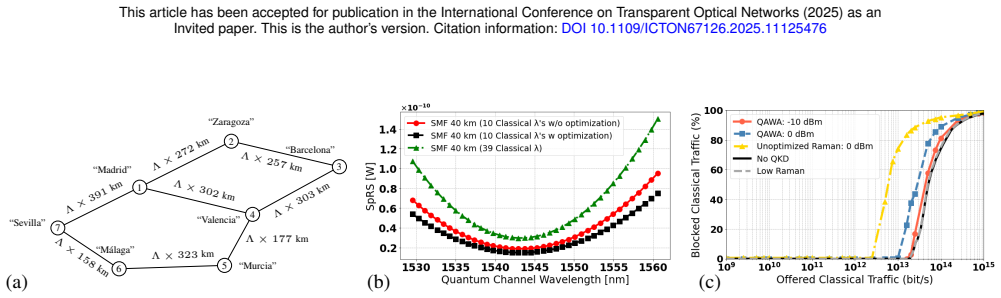
On its own terms, the paper's central claim is that spontaneous Raman scattering (SpRS) is the dominant obstacle to quantum-classical coexistence in the C band, and that this obstacle can be planned around. Using a model of secure key rate versus attenuation and SpRS, the authors simulate a scaled seven-node mesh network in which CV-QKD traffic is allocated first and classical lightpaths afterward. They find that a naive QKD-first allocation can saturate a link's noise budget and thereby block all classical traffic on that link, isolating parts of a low-connectivity network. A quantum-aware wavelength assignment (QAWA), which places classical channels around the QKD channel to minimize SpRS, combined with reserving a few percent of QKD capacity as margin, makes the classical blocking probability nearly identical to the no-QKD baseline. The paper is explicit that this result depends on the SpRS spectral model; a competing published model would place the QKD channel on the opposite side of the C band.
Load-bearing premise
The whole benefit of the heuristic depends on the exact shape of the Raman noise spectrum across the C band; the paper itself notes that a different published model would place the optimal quantum channel at the opposite end of the band.
Editorial extensions
If this is right
- Network operators can host CV-QKD on deployed fiber without dedicating dark fibers, as long as planning tools include the quantum channel in the wavelength assignment problem.
- QKD-first allocation without margins is risky in low-connectivity topologies: exhausting one link's noise budget can isolate nodes and cut classical capacity disproportionately.
- Reserving a few percent of QKD capacity as margin is a nearly free insurance policy: it costs little QKD throughput and removes most of the classical blocking penalty.
- The accuracy of the SpRS model becomes a first-order planning input; the same heuristic can give opposite channel placements depending on which model is trusted.
- The joint-optimization approach is expected to extend to entanglement distribution networks, though the authors note that more complex topologies and variable connectivity need further study.
Reading between the lines
- A testable engineering rule follows that the authors do not state explicitly: operators should provision QKD demand forecasts with deliberate headroom of a few percent, treating the margin as a noise-budget buffer rather than unused capacity.
- Because SpRS is broadband, the size of the QAWA benefit will depend on how finely classical channels can be spaced around the QKD channel; repeating the simulation on a coarse fixed ITU grid would quantify how much of the gain survives in practice.
- The same methodology could be turned into a field-deployment test: measure the Raman spectrum of a specific fiber span, run the heuristic with that measured spectrum, and compare classical blocking against the mid-band rule, decoupling the heuristic's value from the disputed model.
- The clogging result suggests a broader principle: when a fragile service has a hard noise budget in a shared medium, reserving headroom on the fragile service is cheaper than reserving capacity on the robust one.
Signed reviews
Editorial analysis
A structured set of objections, weighed in public.
Referee Report
Summary. The manuscript, an invited ICTON paper, argues that integrating CV-QKD into deployed optical networks requires network-level planning tools that jointly manage quantum and classical traffic. After reviewing physical limits (attenuation, decoherence, linear and nonlinear crosstalk) and management issues, it describes simulation studies on a 7-node Spanish-based topology in which CV-QKD and classical WDM channels share the C-band. QKD traffic is allocated first, with a capacity margin; classical lightpaths are then allocated around the chosen CV-QKD channel. The findings are: (i) in the authors' SpRS model, the middle of the C-band appears to be the best CV-QKD channel placement, while the alternative model in [18] favors the high-frequency side; (ii) prioritizing QKD without a margin can 'clog' links to classical traffic; and (iii) combining QKD margin reservation with a quantum-aware wavelength assignment (QAWA) heuristic gives classical blocking nearly identical to a classical-only baseline. The conclusion calls for further work on more complex topologies and more accurate SpRS models.
Significance. If the reported results hold, they offer a practical planning rule: network operators can host CV-QKD on existing C-band WDM fiber and reserve a small amount of QKD capacity to protect classical traffic almost entirely. The paper is commendably explicit about its limitations: it acknowledges the SpRS-model dependence (Section IV-B1), the low-connectivity topology, and the need for further studies. The qualitative clogging mechanism is physically plausible, and the QAWA heuristic is a concrete contribution beyond point-to-point coexistence demonstrations. However, the paper's significance is currently conditional: the key quantitative claim is supported by simulations whose details are not in this manuscript, and the leading physical input model (SpRS from [30]) is explicitly contradicted by another model cited by the authors themselves.
major comments (4)
- [IV-B1, Fig. 1(b)] The placement recommendation is load-bearing: the QAWA heuristic places the CV-QKD channel where the SpRS model from [30] predicts minimal noise, and the near-zero classical blocking in Fig. 1(c) depends on that placement being optimal or near-optimal. Yet the same paragraph states that the SpRS model in [18] suggests the opposite placement (high-frequency side of the C band). This is not a small parameter shift: the two models disagree to the extent that the heuristic could select the best location under one model and the worst under the other. The manuscript should quantify the spectral difference between [18] and [30], rerun the network simulation with both models, and state the regime in which QAWA helps versus hurts. As written, the central 'minimal impact' claim is robust only if [30] is accurate, and the paper itself supplies a reason to doubt that.
- [IV-A, Fig. 1(c)] The simulation details needed to reproduce or evaluate the key figure are missing. The text gives the topology, the distance scaling factor Lambda between 10^-2 and 10^-1, 280 Mbit/s network-wide CV-QKD traffic with 12% margins, and per-channel classical launch powers of 0 or -10 dBm, but it does not specify the exact SKR model from [22], the SpRS gain model from [30], the WDM channel grid, the classical demand arrival model, the lightpath routing and wavelength assignment algorithm, the noise acceptance criterion, or how blocking probability is computed. Fig. 1(c) is attributed to [19], so the present paper alone does not allow the reader to verify the result. The authors should add a full parameter table, clarify whether the plotted curve is a single instance or an average, and provide error bars or a range across demand patterns.
- [IV-B2] The 'clogging' model is an all-or-nothing threshold: once a CV-QKD link's capacity is fully allocated, the text states that adding any optical power for classical channels would push SpRS noise above acceptable limits, so the link becomes unavailable to classical traffic. This is a strong modeling assumption; in reality, CV-QKD secure key rate degrades continuously as SpRS noise grows, and a small classical power increment may cause only a small key-rate reduction. The margin strategy's benefit appears to rely on this binary clogging behavior, so the simulation may overstate both the danger and the cure. The authors should either justify the threshold (e.g., a minimal SKR below which no keys can be extracted) or implement a continuous noise-to-key-rate relationship and re-evaluate the margin and QAWA results under that model.
- [Abstract, Section V] The statement that 'a quantum-aware wavelength assignment heuristic allows coexistence with minimal impact on both capacities' is broader than what the simulations demonstrate. The reported result is for one 7-node low-connectivity topology, a particular CV-QKD load (280 Mbit/s with 12% margins), and a particular SpRS model. The paper itself says the effect occurred 'in certain situations,' and Section V acknowledges the need for studies on more complex topologies. I recommend that the abstract and conclusion explicitly state the conditions under which minimal impact was observed, and avoid implying a general guarantee.
minor comments (5)
- [Abstract] The word 'contraints' should be 'constraints'; also check that the LaTeX escape 'na\"ive' renders correctly as 'naïve' in the published version.
- [IV-B1] The heuristic is written as 'QAW A' in the text of Section IV-B1; use 'QAWA' consistently throughout.
- [Fig. 1(b)] The y-axis of Fig. 1(b) is not described in the caption or text; please add a clear label with units (e.g., SpRS noise power in dBm) and state whether higher or lower is better.
- [Reference [19]] Because Fig. 1(c) is explicitly 'Previously published in [19],' the paper should clarify which results, if any, are new to this manuscript and which are reproduced from the earlier ECOC paper.
- [II-B] The subsection on decoherence and latency is only loosely connected to the network planning results; either integrate it with the simulation discussion or shorten it.
Circularity Check
No significant circularity: the simulation uses external physical models and no fitted parameter is renamed as a prediction.
full rationale
The paper's derivation chain is a simulation study: CV-QKD SKR is modeled from Laudenbach et al. [22] and SpRS from Bromage [30], both external references; the network topology comes from Net2Plan [33]; and no constant or parameter is fitted to the headline blocking result. The QAWA heuristic is an optimization rule defined to choose channel placement and classical-channel allocation that minimizes SpRS under that model, so evaluating it with the same propagation model is an algorithm-in-the-loop test, not a circular prediction; the network-level blocking outcome still depends on topology and routing, so it is not a tautology. The key figure is previously published in the authors' own [19], but the current paper reports the result as its own ongoing study rather than deriving it from a self-citation, and the underlying physical models are independent. The paper explicitly flags the main robustness caveat: another SpRS model [18] suggests the opposite optimal placement, which is a model-uncertainty and correctness concern, not circularity. No equation-level reduction or fitted-input-renamed-as-prediction can be exhibited, so the score is 0.
Assumptions & free parameters
free parameters (3)
- QKD link capacity margin =
12%
- Distance scaling factor Lambda =
10^-2 to 10^-1 (exact values omitted)
- Network-wide CV-QKD traffic =
280 Mbit/s
assumptions (3)
- domain assumption SKR depends on attenuation and SpRS exactly as in the models of [22] and [30].
- ad hoc to paper A link whose CV-QKD capacity is fully allocated is completely clogged to any added classical power.
- domain assumption All network nodes are trusted relays for QKD and transparent for classical traffic.
Cite this review
Pith. "Pith review of Quantum-Aware Network Planning and Integration." pith.science (2026). https://pith.science/paper/UGF2MUT6
@misc{pith2026250505351,
  author       = {Pith},
  title        = {Pith review of: Quantum-Aware Network Planning and Integration},
  year         = {2026},
  howpublished = {\url{https://pith.science/paper/UGF2MUT6}},
  note         = {Machine review of arXiv:2505.05351}
}
read the original abstract
In order to broaden the adoption of highly-demanded quantum functionalities such as QKD, there is a need for having quantum signals coexist with classical traffic over the same physical medium, typically optical fibers in already-deployed networks. Beyond the experimental point-to-point demonstrations of the past few years, efforts are now underway to integrate QKD at the network level: developing interfaces with the software-defined-network ecosystem; but also network planning tools that satisfy physical-layer contraints jointly on the classical and quantum signals. We have found that in certain situations, na\"ive network planning prioritizing quantum traffic drastically degrades classical capacity, whereas a quantum-aware wavelength assignment heuristic allows coexistence with minimal impact on both capacities. More such techniques will be required to enable widespread deployment of QKD and other future quantum functionalities.
Figures
Reference graph
Works this paper leans on
-
[15]
Potential impact of CV-QKD integration on classical WDM network capacity,
C. Ware, R. Aymeric, C. Zidi, and M. Lourdiane, “Potential impact of CV-QKD integration on classical WDM network capacity,” IEEE Photon. Technol. Lett. 34 no. 18, (2022) 957–960
work page 2022
-
[19]
V . V . Garbhapu, C. Ware, and M. Lourdiane, “Minimal impact network-wide heuristics for the coexistence of classical and CV-QKD signals in the C-band,” in ECOC 2024; 50th European Conference on Optical Communication, no. W4A.1, pp. 1412–1415, VDE. Sept., 2024
work page 2024
-
[30]
Raman amplification for fiber communications systems,
J. Bromage, “Raman amplification for fiber communications systems,” J. Lightw. Technol. 22 no. 1, (Jan., 2004) 79. https://opg.optica.org/jlt/abstract.cfm?URI=jlt-22-1-79
work page 2004
-
[18]
M. Iqbal, M. S. Moreolo, R. Mu ˜noz, L. Nadal, A. Villegas, J. M. Rivas-Moscoso, S. Sarmiento, A. Melgar, P. Adillon, J. Tabares, and S. Etcheverry, “SDN-enabled CV-QKD and classical channels coexistence: key insights for dense wavelength division multiplexing,” IEEE J. Opt. Commun. Netw. 17 no. 6, (June, 2025) B28–B37. https://opg.optica.org/jocn/abstrac...
work page 2025
-
[22]
F. Laudenbach, C. Pacher, C.-H. F. Fung, A. Poppe, M. Peev, B. Schrenk, M. Hentschel, P. Walther, and H. H ¨ubel, “Continuous-variable quantum key distribution with gaussian modulation—the theory of practical implementations,” Advanced Quantum Technologies (2018) 1800011, arXiv:1703.09278 [quant-ph]
work page Pith review arXiv 2018
-
[1]
Quantum technology: The second quantum revolution,
J. P. Dowling and G. J. Milburn, “Quantum technology: The second quantum revolution,” Philosophical Transactions: Mathematical, Physical and Engineering Sciences 361 no. 1809, (2003) 1655–1674. http://www.jstor.org/stable/3559215
-
[2]
Quantum internet: A vision for the road ahead,
S. Wehner, D. Elkouss, and R. Hanson, “Quantum internet: A vision for the road ahead,” Science 362 no. 6412, (2018) eaam9288. https://www.science.org/doi/abs/10.1126/science.aam9288
-
[3]
The SECOQC quantum key distribution network in vienna,
M. Peev, C. Pacher, R. All ´eaume, C. Barreiro, J. Bouda, W. Boxleitner, T. Debuisschert, E. Diamanti, M. Dianati, J. F. Dynes, et al., “The SECOQC quantum key distribution network in vienna,” New Journal of Physics 11 no. 7, (July, 2009) 075001. https://dx.doi.org/10.1088/1367-2630/11/7/075001. This article has been accepted for publication in the Intern...
arXiv 2025
Show all 38 references
-
[4]
Field test of quantum key distribution in the tokyo QKD network,
M. Sasaki, M. Fujiwara, H. Ishizuka, W. Klaus, K. Wakui, M. Takeoka, S. Miki, T. Yamashita, Z. Wang, A. Tanaka, et al., “Field test of quantum key distribution in the tokyo QKD network,” Opt. Express 19 no. 11, (May, 2011) 10387–10409. https://opg.optica.org/oe/abstract.cfm?UR...
2011
-
[5]
Implementation of a 46-node quantum metropolitan area network,
T.-Y . Chen, X. Jiang, S.-B. Tang, L. Zhou, X. Yuan, H. Zhou, J. Wang, Y . Liu, L.-K. Chen, W.-Y . Liu,et al., “Implementation of a 46-node quantum metropolitan area network,” npj Quantum Information 7 no. 1, (Sept., 2021) 134
2021
-
[6]
MadQCI: a heterogeneous and scalable SDN-QKD network deployed in production facilities,
V . Martin, J. P. Brito, L. Ort ´ız, R. Mendez, J. Buruaga, R. Vicente, A. Sebastian-Lombrana, D. Rincon, F. Perez, C. Sanchez, et al., “MadQCI: a heterogeneous and scalable SDN-QKD network deployed in production facilities,” npj Quantum Information 10 no. 1, (2024) 80
2024
-
[7]
Development of a boston-area 50-km fiber quantum network testbed,
E. Bersin, M. Grein, M. Sutula, R. Murphy, Y . Q. Huan, M. Stevens, A. Suleymanzade, C. Lee, R. Riedinger, D. J. Starling, et al., “Development of a boston-area 50-km fiber quantum network testbed,” Phys. Rev. Appl. 21 (Jan., 2024) 014024. https://link.aps.org/doi/10.1103/Phys...
2024 doi
-
[8]
Integrating quantum key distribution with classical communications in backbone fiber network,
Y . Mao, B.-X. Wang, C. Zhao, G. Wang, R. Wang, H. Wang, F. Zhou, J. Nie, Q. Chen, Y . Zhao, et al., “Integrating quantum key distribution with classical communications in backbone fiber network,” Opt. Express 26 no. 5, (Mar., 2018) 6010–6020. https://opg.optica.org/oe/abstrac...
2018
-
[9]
Review on quantum communication and quantum computation,
J. Chen, “Review on quantum communication and quantum computation,” Journal of Physics: Conference Series 1865 no. 2, (Apr.,
-
[10]
Longer-baseline telescopes using quantum repeaters,
D. Gottesman, T. Jennewein, and S. Croke, “Longer-baseline telescopes using quantum repeaters,” Phys. Rev. Lett. 109 (Aug., 2012) 070503. https://link.aps.org/doi/10.1103/PhysRevLett.109.070503
2012 doi
-
[11]
Quantum sensing,
C. L. Degen, F. Reinhard, and P. Cappellaro, “Quantum sensing,” Rev. Mod. Phys. 89 (July, 2017) 035002. https://link.aps.org/doi/10.1103/RevModPhys.89.035002
2017 doi
-
[12]
Coexistence of continuous variable QKD with intense DWDM classical channels,
R. Kumar, H. Qin, and R. All ´eaume, “Coexistence of continuous variable QKD with intense DWDM classical channels,” New Journal of Physics 17 no. 4, (2015) 043027, arXiv:1412.1403 [quant-ph]
2015 arXiv
-
[13]
Quantum teleportation coexisting with classical communications in optical fiber,
J. M. Thomas, F. I. Yeh, J. H. Chen, J. J. Mambretti, S. J. Kohlert, G. S. Kanter, and P. Kumar, “Quantum teleportation coexisting with classical communications in optical fiber,” Optica 11 no. 12, (Dec.,
-
[14]
Symbiotic joint operation of quantum and classical coherent communications,
R. Aymeric, Y . Jaou ¨en, C. Ware, and R. All ´eaume, “Symbiotic joint operation of quantum and classical coherent communications,” in Optical Fiber Communication Conference , no. W2A.37. Mar., 2022. arXiv:2202.06942 [quant-ph] . Poster
2022 arXiv
-
[16]
Quantum repeaters: From quantum networks to the quantum internet,
K. Azuma, S. E. Economou, D. Elkouss, P. Hilaire, L. Jiang, H.-K. Lo, and I. Tzitrin, “Quantum repeaters: From quantum networks to the quantum internet,” Rev. Mod. Phys. 95 (Dec., 2023) 045006. https://link.aps.org/doi/10.1103/RevModPhys.95.045006
2023 doi
-
[17]
A blueprint for large-scale quantum-network deployments,
A. Sebasti ´an-Lombra˜na, H. H. Brunner, J. P. Brito, R. B. M ´endez, R. J. Vicente, J. S. Buruaga, L. Ortiz, C.-H. F. Fung, M. Peev, J. M. Rivas-Moscoso, et al., “A blueprint for large-scale quantum-network deployments,” arXiv:2409.01069 [quant-ph]
-
[20]
Quantum network planning for utility maximization,
S. Pouryousef, H. Shapourian, A. Shabani, and D. Towsley, “Quantum network planning for utility maximization,” in Proceedings of the 1st Workshop on Quantum Networks and Distributed Quantum Computing , QuNet ’23, p. 13–18. Association for Computing Machinery, New York, NY , US...
2023
-
[21]
Towards real-world quantum networks: a review,
S.-H. Wei, B. Jing, X.-Y . Zhang, J.-Y . Liao, C.-Z. Yuan, B.-Y . Fan, C. Lyu, D.-L. Zhou, Y . Wang, G.-W. Deng, et al., “Towards real-world quantum networks: a review,” Laser & Photonics Reviews 16 no. 3, (2022) 2100219
2022
-
[23]
1002 km twin-field quantum key distribution with finite-key analysis,
Y . Liu, W.-J. Zhang, C. Jiang, J.-P. Chen, D. Ma, C. Zhang, W.-X. Pan, H. Dong, J.-M. Xiong, C.-J. Zhang, et al., “1002 km twin-field quantum key distribution with finite-key analysis,” Quantum Frontiers 2 no. 1, (2023) 16. https://doi.org/10.1007/s44214-023-00039-9
2023 doi
-
[24]
Long-distance continuous-variable quantum key distribution over 100-km fiber with local local oscillator,
A. A. E. Hajomer, I. Derkach, N. Jain, H.-M. Chin, U. L. Andersen, and T. Gehring, “Long-distance continuous-variable quantum key distribution over 100-km fiber with local local oscillator,” Science Advances 10 no. 1, (2024) eadi9474. https://www.science.org/doi/abs/10.1126/sc...
2024 doi
-
[25]
0.174 dB/km hollow core double nested antiresonant nodeless fiber (DNANF),
G. T. Jasion, H. Sakr, J. R. Hayes, S. R. Sandoghchi, L. Hooper, E. N. Fokoua, A. Saljoghei, H. C. Mulvad, M. Alonso, A. Taranta, et al., “0.174 dB/km hollow core double nested antiresonant nodeless fiber (DNANF),” in Optical Fiber Communication Conference (OFC) 2022 , no. Th4...
2022
-
[26]
First broadband optical fibre with an attenuation lower than 0.1 decibel per kilometre,
M. Petrovich, E. N. Fokoua, Y . Chen, H. Sakr, A. I. Adamu, R. Hassan, D. Wu, R. F. Ando, A. Papadimopoulos, S. R. Sandoghchi, G. Jasion, and F. Poletti, “First broadband optical fibre with an attenuation lower than 0.1 decibel per kilometre,” arXiv:2503.21467 [physics.optics]
-
[27]
Telecommunication compatibility evaluation for co-existing quantum key distribution in homogenous multicore fiber,
R. Lin, A. Udalcovs, O. Ozolins, X. Pang, L. Gan, M. Tang, S. Fu, S. Popov, T. F. D. Silva, G. B. Xavier, and J. Chen, “Telecommunication compatibility evaluation for co-existing quantum key distribution in homogenous multicore fiber,” IEEE Access 8 (2020) 78836–78846
2020
-
[28]
Coexistence of discrete-variable QKD with WDM classical signals in the C-band for fiber access environments,
D. Zavitsanos, G. Giannoulis, A. Raptakis, C. Papapanos, F. Setaki, E. Theodoropoulou, G. Lyberopoulos, C. Kouloumentas, and H. Avramopoulos, “Coexistence of discrete-variable QKD with WDM classical signals in the C-band for fiber access environments,” in 2019 21st Internation...
2019
-
[29]
Multiple-vibrational-mode model for fiber-optic raman gain spectrum and response function,
D. Hollenbeck and C. D. Cantrell, “Multiple-vibrational-mode model for fiber-optic raman gain spectrum and response function,” Journal of the Optical Society of America B 19 no. 12, (2002) 2886–2892
2002
-
[31]
First demonstration of 25 λ × 10 gb/s C+L band classical / DV-QKD co-existence over single bidirectional fiber link,
F. Honz, F. Prawits, O. Alia, H. Sakr, T. Bradley, C. Zhang, R. Slav ´ık, F. Poletti, G. Kanellos, R. Nejabati, P. Walther, D. Simeonidou, H. H ¨ubel, and B. Schrenk, “First demonstration of 25 λ × 10 gb/s C+L band classical / DV-QKD co-existence over single bidirectional fibe...
2023
-
[32]
QSNP - quantum secure networks partnership
“QSNP - quantum secure networks partnership.” https://qsnp.eu/. European Quantum Flagship Project
-
[33]
Net2plan: an open source network planning tool for bridging the gap between academia and industry,
P. Pavon-Marino and J.-L. Izquierdo-Zaragoza, “Net2plan: an open source network planning tool for bridging the gap between academia and industry,” IEEE Netw. 29 no. 5, (2015) 90–96
2015
-
[34]
Entanglement routing design over quantum networks,
Y . Zeng, J. Zhang, J. Liu, Z. Liu, and Y . Yang, “Entanglement routing design over quantum networks,” IEEE/ACM Trans. Netw. 32 no. 1, (2024) 352–367
2024
-
[35]
End-to-end capacities of a quantum communication network,
S. Pirandola, “End-to-end capacities of a quantum communication network,” Communications Physics 2 no. 1, (2019) 51
2019
-
[36]
Quantum network utility maximization,
G. Vardoyan and S. Wehner, “Quantum network utility maximization,” in 2023 IEEE International Conference on Quantum Computing and Engineering (QCE), vol. 01, pp. 1238–1248. 2023. https://dx.doi.org/10.1109/QCE57702.2023.00140
2023
-
[2021]
https://dx.doi.org/10.1088/1742-6596/1865/2/022008
022008. https://dx.doi.org/10.1088/1742-6596/1865/2/022008
-
[2024]
https://opg.optica.org/optica/abstract.cfm?URI=optica-11-12-1700
1700–1707. https://opg.optica.org/optica/abstract.cfm?URI=optica-11-12-1700
Reviewed August 15, 2026 · model on record in the stance chip above.
Discussion (0). Continue with ORCID to comment.