REVIEW 4 major objections 6 minor 13 references
GenAI in Entrepreneurship: a systematic review of generative artificial intelligence in entrepreneurship research: current issues and future directions
T0 review · 4 major / 6 minor · reviewed 2026-08-15 · deepseek-v4-flash
Pith's one-line read This paper claims to be the first systematic literature review of generative AI and large language models in entrepreneurship research, and it organizes 83 peer-reviewed papers into five thematic clusters.
desk verdict Useful orientation map of GenAI-entrepreneurship research, but the clustering pipeline is not reproducible as reported and the 'first systematic review' claim overreaches. read the letter →
The pith
A machine-rendered reading of the paper's core claim, the machinery that carries it, and where it could break.
The reading
What carries the argument
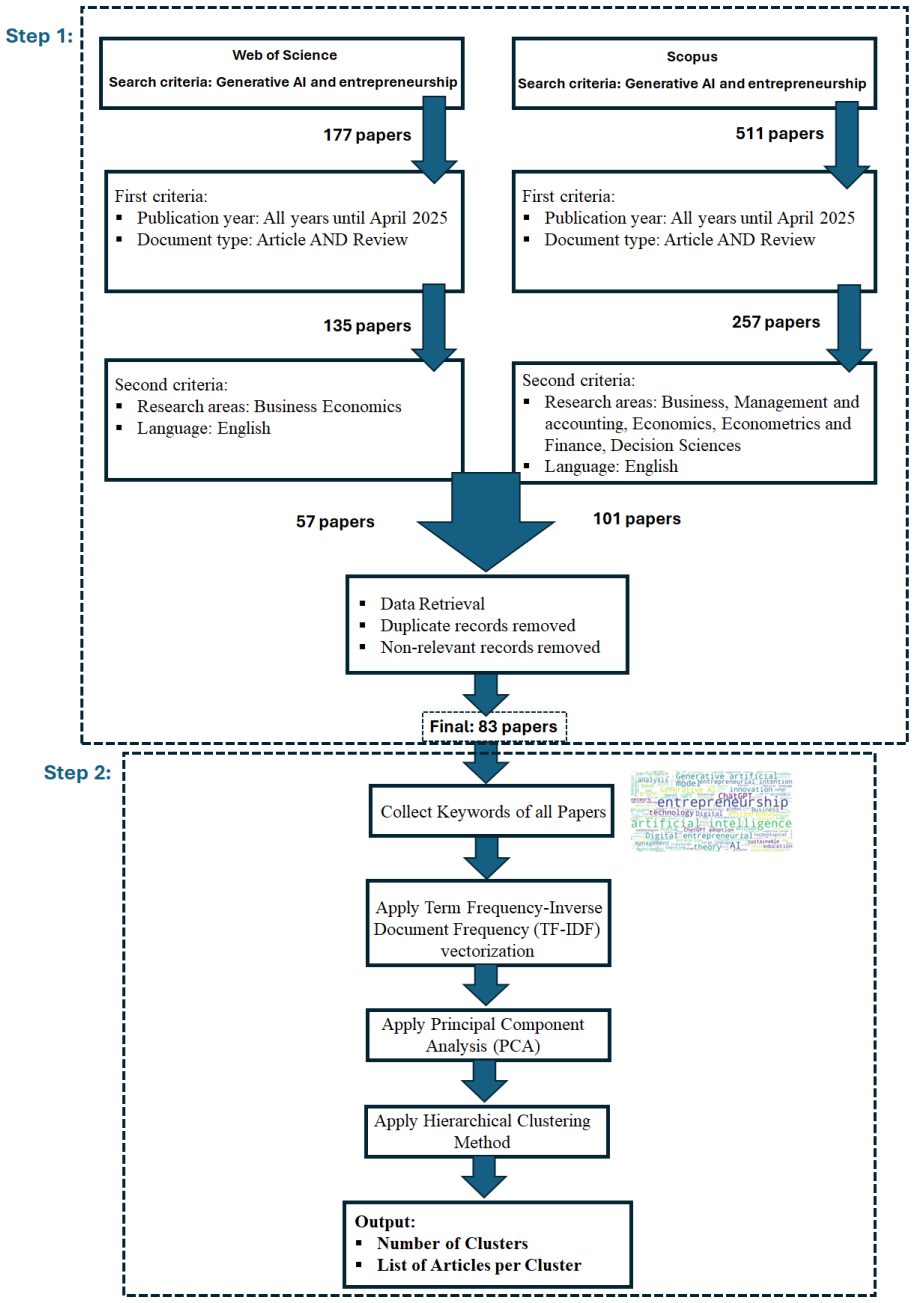
The mechanism that carries the argument is an unsupervised text-analysis pipeline: TF-IDF vectorization turns the textual content of each paper into a numerical vector; Principal Component Analysis reduces the dimensionality of those vectors; hierarchical clustering then merges similar papers into a tree, and the tree is cut to produce five groups. The paper also uses the notion of external enablers from entrepreneurship theory as the interpretive lens for why GenAI and LLMs matter for entrepreneurship. The pipeline is what generates the five cluster labels; the external-enabler lens is what turns the clusters into a research agenda.
What would settle it
Re-run the same TF-IDF, PCA, and hierarchical clustering recipe on the same 83 papers with different text inputs or similarity settings, have independent entrepreneurship scholars label the resulting groups, and compare; if the five themes do not reappear or the labels cannot be reproduced, the five-cluster map is an artifact of the method.
Extended reading notes
Core claim
The paper's central claim is that this is the first systematic literature review devoted specifically to GenAI and LLMs in entrepreneurship research, and that the field's current intellectual landscape consists of five thematic clusters. The largest cluster, Business Models & Market Trends, contains 21 of the 83 papers; Sustainable Innovation & Strategic AI Impact contains 20; Data-Driven Technological Trends contains 18; GenAI-Enhanced Education & Learning Systems contains 13; and Digital Transformation & Behavioural Models contains 11. The authors argue that GenAI and LLMs act as external enablers that change the preconditions for entrepreneurship in two ways: by helping entrepreneurs do current work more effectively and by enabling new ventures, products, and business models. They conclude that existing research has concentrated on micro-level and firm-level effects, and they call for more macro-level research on scope, mechanisms, and roles of GenAI as an external enabler, and on regulatory frameworks that balance ethics and risk with experimentation and innovation.
Load-bearing premise
The five themes are genuine divisions in the literature rather than artifacts of the clustering setup, because the number of clusters was chosen from a dendrogram and no stability check or independent expert validation is reported.
Editorial extensions
If this is right
- If the five-cluster map is correct, future literature reviews in this area can use it as a starting point rather than starting from scratch.
- The cluster sizes imply that business-model and sustainability questions currently dominate, while digital-transformation and behavioural research is comparatively thinner.
- The paper's gap analysis says the field needs longitudinal and experimental designs, more diverse samples beyond students in emerging economies, and more attention to macro-level external-enabler and regulatory questions.
- The steep growth in publications from about three per year in 2020-2022 to 47 in 2024 suggests the review captures a field in rapid expansion, so the baseline may date quickly.
Reading between the lines
- If the clustering is robust, a natural next test would be to compare these keyword-derived themes with a citation-network or co-authorship map of the same 83 papers; topic clusters and community structures do not always coincide.
- The paper's own observation that publication counts surged only after 2023 suggests the five clusters may be a snapshot of a pre-paradigmatic field, and later reviews will likely find new clusters or splits.
- The external-enabler framing could be made operational by extracting, paper by paper, which specific enabling mechanism the authors credit to GenAI, such as cost reduction, speed, or new opportunity recognition, and testing whether those mechanisms differ across the five clusters.
- One testable extension is to apply the same TF-IDF, PCA, and hierarchical clustering recipe to a larger corpus that includes preprints and conference papers; if the five themes persist, the map generalizes beyond peer-reviewed journals.
Signed reviews
Editorial analysis
A structured set of objections, weighed in public.
Referee Report
Summary. The paper presents a systematic literature review of research on generative artificial intelligence (GenAI) and large language models (LLMs) in entrepreneurship. The authors searched Web of Science and Scopus, retained 83 peer-reviewed articles after screening, and applied TF-IDF vectorization, PCA, and hierarchical clustering to identify five thematic clusters. The paper reports descriptive statistics by cluster and year, summarizes the literature within each cluster, discusses ethical concerns, and proposes future research directions organized around the five clusters. The central claims are that these five thematic clusters accurately organize the field and that this is the first systematic literature review of GenAI and LLMs in entrepreneurship research.
Significance. If the clustering analysis is reliable and the novelty claim is accurate, the paper would provide a useful map of a rapidly growing research area and a structured research agenda. The study has several strengths: it follows a documented systematic-review protocol, reports the search and screening flow, gives a worked-out future research directions table, and explicitly addresses ethical dimensions. The unsupervised clustering approach is a reasonable and potentially valuable complement to purely narrative reviews. However, the load-bearing methodological step is not currently reproducible: Section 3.2 omits key parameters, contains an internal inconsistency about whether clustering was performed on TF-IDF vectors or keyword lists, and reports no validation of cluster stability or label validity. Several cited studies are also not clearly about GenAI, which raises questions about corpus composition. These issues must be resolved before the five-cluster taxonomy can be accepted as the paper's main contribution.
major comments (4)
- [Section 3.2] The clustering pipeline is not reproducible as described. The authors do not report the number of PCA components retained, the linkage criterion (e.g., Ward, complete, average), the distance metric, or the dendrogram height at which the five-cluster cut is made. Because the number of clusters is selected by inspecting the dendrogram, the five themes in Figure 2 and the cluster distribution in Figure 3 could change under alternative, equally plausible parameter choices. The text also shifts between two different inputs: it first says TF-IDF vectorization transforms textual content, then says hierarchical clustering groups articles 'based on their keyword lists.' If the clustering was actually performed on keyword lists rather than on TF-IDF representations of titles/abstracts/full texts, the method and results would differ substantially. I request that the authors specify the exact input representation, all preprocessing steps, all hyperparameters, the cluster-cut rule, and a stability or validation analysis (e.g., silhouette scores, bootstrap resampling, or independent expert labeling of cluster membership).
- [Section 6 (and Abstract)] The claim that this is 'the first systematic literature review of GenAI and LLMs in research on entrepreneurship' is contradicted by the paper's own references. Section 4.3 cites Dwivedi (2025) as 'A systematic review' and Section 4.4 cites López-Solís et al. (2025) as 'a systematic literature review.' Both are described as covering GenAI in entrepreneurship-adjacent domains. The authors should either demonstrate how their scope, corpus, or analytical approach differs from these existing reviews, or qualify the novelty claim accordingly.
- [Section 3.1 (Figure 1) and Sections 4.3–4.6] The search strategy appears over-inclusive relative to the stated focus on GenAI. The keyword list includes models and methods such as BERT, RoBERTa, GANs, and diffusion models, which are not necessarily generative AI in the sense used in the paper, and several included papers do not appear to be about GenAI at all, e.g., Karim et al. (2022) on ICT use, Knieps (2021; 2024) on 5G networks, Sajter (2024) on Croatian economic science, and Basilico and Graf (2023) on regional knowledge spaces. The screening stage is described only as an abstract screening with 27 exclusions; the authors should report inclusion/exclusion criteria in sufficient detail to allow replication and should consider a sensitivity analysis that shows whether the five clusters remain stable when questionable papers are removed.
- [Figure 3 and Section 4.1.1] The cluster-level results cannot be verified because the paper does not provide a full list of which papers are assigned to which cluster. Figure 2 is a low-resolution dendrogram and Figure 3 gives only cluster sizes. I recommend that the authors include, as a supplementary table or appendix, the cluster membership for all 83 papers, together with the keywords or representative terms used to label each cluster. Without this, the qualitative summaries in Sections 4.2–4.6 cannot be checked against the actual clustering output.
minor comments (6)
- [Abstract] The sentence 'not least because of its impact on the preconditions for entrepreneurship' contains a singular/plural mismatch; 'its' should agree with 'GenAI and LLMs.'
- [Section 3.1] The phrase 'international mall and medium-sized enterprises' is a typo; it should read 'small and medium-sized enterprises.'
- [Section 4.2 and References] In-text citations and reference entries are inconsistent: 'Abaddi, 2023' in the text corresponds to 'Abaddi, S. (2024)' in the references, and 'Thottoli et al. (2023)' in the text corresponds to a 2025 reference entry. These mismatches should be corrected throughout.
- [References] The reference list contains duplicate entries, including two entries for Maarouf et al. (2025) and two entries for Duong, C. D. (2024a/2024b) that are not consistently cited. A full bibliography cleanup is needed.
- [Section 3.2 and Figure 5] Figure 5 is referenced but not explained in the main text; the authors should describe how the common keywords were computed and what the figure is intended to show.
- [Section 4.4] The paper says 'López-Solís et al. (2025) underscores the continued importance of human oversight' and 'a study by López-Solís et al. (2025)' but the reference list identifies it as a systematic literature review; the text should make clear that this is a review rather than a primary empirical study.
Circularity Check
No significant circularity: the clustering is descriptive, no fitted value is recycled as evidence, and there is no load-bearing self-citation chain.
full rationale
The paper's central claim is that TF-IDF vectorization, PCA, and hierarchical clustering produce five thematic clusters from 83 articles. This is an unsupervised, descriptive analysis over a fixed corpus; the cluster labels are assigned after inspecting the dendrogram, which is interpretation rather than a prediction derived from fitted inputs. No parameter is fit to a subset and then used to predict a closely related quantity, and no equation or result reduces to an input by construction. The method section is under-specified and contains an internal inconsistency (it says clustering groups articles 'based on their keyword lists' after describing TF-IDF vectorization of textual content), and the 'first systematic review' claim is weakened by the paper's own citations of Dwivedi (2025) and Lopez-Solis et al. (2025) as systematic reviews. However, these are reproducibility and accuracy concerns, not circularity: the clustering does not assume the clusters it reports, the authors do not rely on their own prior work as load-bearing evidence, and no uniqueness theorem or ansatz is smuggled in via self-citation. The derivation chain is therefore self-contained in the relevant sense, and the appropriate circularity score is 0.
Assumptions & free parameters
free parameters (2)
- Number of clusters =
5
- PCA and clustering hyperparameters
assumptions (3)
- domain assumption The 83 articles retrieved from Scopus and WoS collectively represent the relevant literature on GenAI and entrepreneurship.
- domain assumption TF-IDF vectors, PCA reduction, and hierarchical clustering produce thematic groups that correspond to meaningful research topics.
- domain assumption The papers in the five clusters concern generative AI rather than adjacent technologies.
Cite this review
Pith. "Pith review of GenAI in Entrepreneurship: a systematic review of generative artificial intelligence in entrepreneurship research: current issues and future directions." pith.science (2026). https://pith.science/paper/T2LDAU34
@misc{pith2026250505523,
  author       = {Pith},
  title        = {Pith review of: GenAI in Entrepreneurship: a systematic review of generative artificial intelligence in entrepreneurship research: current issues and future directions},
  year         = {2026},
  howpublished = {\url{https://pith.science/paper/T2LDAU34}},
  note         = {Machine review of arXiv:2505.05523}
}
read the original abstract
Generative Artificial Intelligence (GenAI) and Large Language Models (LLMs) are recognized to have significant effects on industry and business dynamics, not least because of their impact on the preconditions for entrepreneurship. There is still a lack of knowledge of GenAI as a theme in entrepreneurship research. This paper presents a systematic literature review aimed at identifying and analyzing the evolving landscape of research on the effects of GenAI on entrepreneurship. We analyze 83 peer-reviewed articles obtained from leading academic databases: Web of Science and Scopus. Using natural language processing and unsupervised machine learning techniques with TF-IDF vectorization, Principal Component Analysis (PCA), and hierarchical clustering, five major thematic clusters are identified: (1) Digital Transformation and Behavioral Models, (2) GenAI-Enhanced Education and Learning Systems, (3) Sustainable Innovation and Strategic AI Impact, (4) Business Models and Market Trends, and (5) Data-Driven Technological Trends in Entrepreneurship. Based on the review, we discuss future research directions, gaps in the current literature, as well as ethical concerns raised in the literature. We highlight the need for more macro-level research on GenAI and LLMs as external enablers for entrepreneurship and for research on effective regulatory frameworks that facilitate business experimentation, innovation, and further technology development.
Figures


Figures from the paper (1 more)

Reference graph
Works this paper leans on
-
[1]
Abaddi, S. (2024). GPT revolution and digital entrepreneurial intentions. Journal of Entrepreneurship in Emerging Economies, 16(6), 1903–1930. Al Halbusi, H., Ruiz -Palomino, P., & Williams, K. (2023). Ethical leadership, subordinates' moral identity and self-control: Two- and three-way interaction effect on subordinates' ethical behavior. Journal of Busi...
work page 2024
-
[12]
Munoko, I., Brown-Liburd, H. L., & Vasarhelyi, M. (2020). The ethical implications of using artificial intelligence in auditing. Journal of Business Ethics, 167 Norbäck, P.-J., & Persson, L. (2024). Why generative AI can make creative destruction more creative but less destructive. Small Business Economics, 63, 349–377. Nuanmeesri, S. (2021). The efficien...
work page 2020
-
[16]
31 Chang, Y ., Wang, X., Wang, J., Wu, Y ., Yang, L., Zhu, K., Chen, H., Yi, X., Wang, C., & Wang, Y . (2024). A survey on evaluation of large language models. ACM Transactions on Intelligent Systems and Technology, 15(3), Article 39, 1–45. Chen, Y ., Zhang, H., & Liu, X. (2023). The impact of intellectual property protection on business performance of hi...
work page 2024
-
[45]
Corvello, V. (2025). Generative AI and the fu ture of innovation management: A human centered perspective and an agenda for future research . Journal of Open Innovation: Technology, Market, and Complexity, 11(1), 100456. Csaszar, F. A., Ketkar, H., & Kim, H. (2024). Artificial intelligence and strategic decision- making: Evidence from entrepreneurs and in...
work page 2025
-
[66]
36 Maarouf, A., Feuerriegel, S., & Pröllochs, N. (2025). A fused large language model for predicting startup success. European Journal of Operational Research, 322(1), 198–214. Maarouf, A., Feuerriege l, S., & Pröllochs, N. (2025). A fused large language model for predicting startup success. European Journal of Operational Research, 322(1), 198–214. Maine...
work page 2025
-
[82]
Ester, M., Kriegel, H.-P., Sander, J., & Xu, X. (1996). A density-based algorithm for discovering clusters in large spatial databases with noise. In Proceedings of the 2nd International Conference on Knowledge Discovery and Data Mining (pp. 226–231). Etemad, H. (2023). The need for strategic redirection and business model change: The impact of evolving in...
work page 1996
-
[103]
Gupta, V ., & Yang, H. (2024). Study protocol for factors influencing the adoption of ChatGPT technology by startups: Perceptions and attitudes of entrepreneurs . PLOS ONE, 19 (2), e0298427. Han, Q., Li, C., & Jin, Y . (2025). The impact of intellectual property protection on the development of artificial intelligence in enterprises. International Review ...
work page 2024
-
[172]
Davidsson, P., & Sufyan, M. (2023). What does AI think of AI as an external enabler (EE) of entrepreneurship? An assessment through and of the EE framework. Journal of Business Venturing Insights, 20, e00413. De Haan, U., Shwartz, S.C. & Gómez -Baquero, F (2020). A startup postdoc program as a channel for university technology transfer: the case of the Ru...
work page 2023
Show all 13 references
-
[220]
https://doi.org/10.3390/admsci14090220 Schade, P., & Schuhmacher, M. C. (2023) . Predicting entrepreneurial activity using machine learning. Journal of Business Venturing Insights, 19, e00357. Sharma, M. J. (2025). GenAI for hiring: Solution or challenge? Emerging Markets Case...
2023 arXiv
-
[744]
Unsupervised K-Means Clustering Algorithm,
34 Jayashankar, P., Roy, T., Chattopadhyay, S., Arshad, M. A., & Sarkar, S. (2025). The impact of market orientation and brand storytelling on Shark Tank evaluations – a B2B and large language modeling perspective. Journal of Business & Industrial Marketing, 39(1), 265–280. Je...
2025
-
[2020]
Kampmann, D. (2024). Venture capital, the fetish of artificial intelligence, and the contradictions of making intangible assets. Economy and Society, 53(1), 39–66. Karim, M. S., Nahar, S., & Demirbag, M. (2022). Resource-based perspective on ICT use and firm performance: A met...
2024
-
[2412]
Y ., & Liang, C
Liu, H.-C., Ip, C. Y ., & Liang, C. (2020). A new runway for journalists: On the intentions of journalists to start social enterprises . Journal of Entrepreneurship, Management and Innovation, 14(2), 83–100. Liu, Y ., Yang, Z., Yu, Z., Liu, Z., Liu, D., Lin, H., et al. (2023)....
2020
-
[5390]
B., Gaurav, A., Panigrahi, P
Gupta, B. B., Gaurav, A., Panigrahi, P. K., & Arya, V . (2023). Analysis of artificial intelligence- based technologies and approaches on sustainable entrepreneurship. Technological Forecasting and Social Change, 186(Part B), 122152. Gupta, V . (2024). An empirical evaluation ...
2023
Reviewed August 15, 2026 · model on record in the stance chip above.
Discussion (0). Continue with ORCID to comment.