REVIEW 3 major objections 5 minor 28 references
STORI2024: Tests of Amorphous Carbon-coated Storage Cells for a Polarized Gas Target at LHCb and Further Results
T0 review · 3 major / 5 minor · reviewed 2026-08-15 · deepseek-v4-flash
Pith's one-line read Amorphous carbon storage cells recombine 93–100% of atomic hydrogen into H2 molecules while preserving over 74% of nuclear polarization, making them viable for the LHCspin polarized gas target at LHCb.
desk verdict A useful, honest feasibility study with new data on amorphous carbon, H3+, and HD critical fields—but the headline preservation number rests on unmeasured assumptions and needs an error budget. read the letter →
The pith
A machine-rendered reading of the paper's core claim, the machinery that carries it, and where it could break.
The reading
What carries the argument
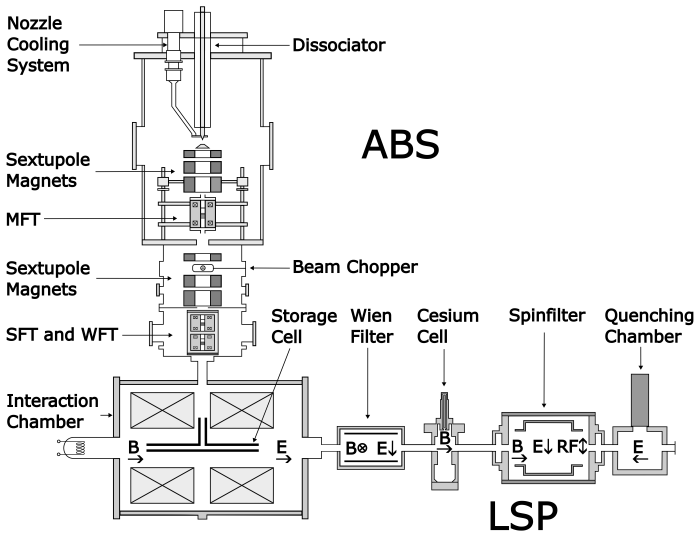
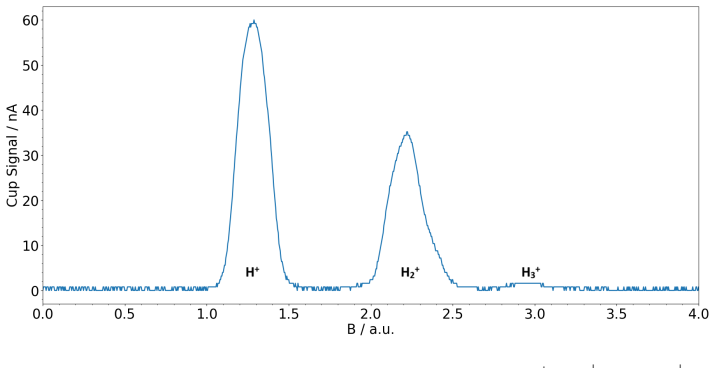
The argument is carried by the Lamb-shift polarimeter, the device that converts $\mathrm{H}^+$, $\mathrm{H}_2^+$, or $\mathrm{H}_3^+$ ions into metastable hydrogen atoms via cesium charge exchange and reads out their hyperfine populations as two Lyman-$\alpha$ resonance peaks whose height ratio gives the nuclear polarization. The interpretive model is the wall-collision depolarization law $P_m(B,n) = P_{m0}e^{-n(B_{c,m}/B)^2}$, where $B_{c,m}$ is the critical magnetic field coupling molecular rotation to nuclear spin (5.4 mT for $\mathrm{H}_2$ with $J = 1$); averaging over an exponential distribution of collision counts yields the mean molecular polarization $\bar{P}_m(B)$, which enters the composite proton-polarization formula $P_p(B) = aP_a + b\bar{P}_m(B)$. Fitting that formula to polarization measured as a function of the storage-cell field yields the atomic fraction $a$, the molecular fraction $b$, and the mean collision number $\tilde{n}$, from which the recombination rate $c = 2b/(2b + ka)$ follows with the ionization cross-section ratio $k = \sigma_{\mathrm{H}_2\to p}/\sigma_{\mathrm{H}\to p} \approx 0.2$. A final piece is the Wien-filter tuning condition $\omega_L\tau = \pi$: the proton magnetic moment must precess through $180^\circ$ while crossing the filter, otherwise the measured polarization is systematically reduced.
What would settle it
A decisive check is to measure, in the same run, the polarization and molecular fraction of the beam entering the storage cell rather than adopting $P \approx 0.8$ and $3.5\%$ from prior source characterization: the inferred preservation is $0.59/(P_{\rm in}(1-f))$, and it falls below $74\%$ if the true incoming polarization exceeds about $0.83$ or if the unpolarized-molecule fraction $f$ is below about $0.3\%$. A second check is to verify in the $\mathrm{H}_2^+$ channel that the Wien-filter polarization follows the cosine law of Eq. 8 with the Larmor angle scaled for the heavier ion, which would rule out a systematic spin-rotation offset in the measured $-0.59$.
Extended reading notes
Core claim
The central discovery is that amorphous carbon, a material chosen for its compatibility with the LHCb vacuum and beam policy, behaves as a strongly recombining yet polarization-preserving surface for atomic hydrogen. In the test stand, atoms with incoming polarization near $0.8$ recombined on the 400 mm by 11 mm cell wall at 100 K at a rate of about $96\%$, and the $\mathrm{H}_2$ molecules produced carried a nuclear polarization of $-0.59 \pm 0.02$, measured after Wien filtering and cesium charge exchange in the Lamb-shift polarimeter. Correcting for the roughly $3.5\%$ unpolarized molecules that enter with the atomic beam, the authors infer that more than $74\%$ of the polarization is retained in the recombination step itself, so the carbon cell stands as a working prototype for the LHCspin polarized $\mathrm{H}_2$ target. The same runs also produced the first measurement of polarized $\mathrm{H}_3^+$ ions (polarization $-0.41 \pm 0.02$) and a measurement of the critical magnetic fields in HD molecules that confirms the rotation axis shifts toward the deuteron (proton field ratio $2.3 \pm 0.3$ versus the predicted $64/27 \approx 2.37$).
Load-bearing premise
The over-74% preservation figure assumes the atomic beam entering the cell was polarized near $0.8$ and contained only about $3.5\%$ unpolarized molecules, values taken from earlier source characterization rather than measured in this run, and that the Lamb-shift polarimeter readout is not distorted by systematic Wien-filter effects.
Editorial extensions
If this is right
- An amorphous carbon-coated storage cell can serve as the dense polarized hydrogen target for the LHCspin project, replacing water, Teflon, and aluminum, which the LHC vacuum and beam-policy rules exclude.
- With near-complete recombination and more than $74\%$ polarization preservation, the cell yields $\mathrm{H}_2$ molecules at polarization about $0.59$ and a target thickness two orders of magnitude above a jet target, sufficient for double-polarized fixed-target spin measurements at center-of-mass energies up to 115 GeV.
- The carbon surface accumulated no significant water over several weeks at 100 K, so its performance should be stable over the operational timescales LHCspin requires.
- The same test stand produces and measures polarized $\mathrm{H}_3^+$ ions, adding a new diagnostic channel for ion-formation processes in storage cells.
Reading between the lines
- A consequence the paper leaves implicit: because the measured preservation is dominated by the recombination step once the up-to-1 T field suppresses wall-collision depolarization, the same carbon coating should deliver essentially the same molecular polarization under LHCspin's operating field, making the measured $0.59$ a direct input to LHCspin luminosity and asymmetry projections.
- A temperature scan on the same cell, not reported here, would separate the recombination mechanisms the paper lists (Langmuir-Hinshelwood versus hot-atom), which have different temperature scalings, and would let the next experiment choose the operating point that maximizes polarization rather than recombination.
- The authors report hydrogen only; their own HD data show that deuteron critical fields differ from proton ones, so a deuterium run on the carbon coating would be needed before proposing it for a polarized deuteron target — a natural next test the paper leaves open.
Signed reviews
Editorial analysis
A structured set of objections, weighed in public.
Referee Report
Summary. The paper reports storage-cell tests of an amorphous carbon coating for the proposed LHCspin polarized gas target at LHCb. Using an atomic beam source, a storage cell at 100 K, and a Lamb-shift polarimeter, the authors measure a molecular H2 polarization of -0.59 +/- 0.02 and, from a fit to Eq. (3), infer a recombination rate of c = (96.5 +/- 3.5)% (abstract: 93%-100%) and a polarization preservation during recombination exceeding 74%. Additional results include polarized H3+ ions (P = -0.41 +/- 0.02, reported as the first observation) and measurements of the critical magnetic field ratio in HD compared with H2 and D2.
Significance. If the central quantitative claims are supported, amorphous carbon would be an attractive coating for the LHCspin storage cell: it combines high recombination (desired for target density) with polarization preservation above 74% and vacuum compatibility over several weeks. The direct LSP measurement of H2 molecular polarization and the HD critical-field test (measured 2.3 +/- 0.3 versus expected 2.37) are solid and useful. However, the two headline numbers are model-inferred and currently lack propagated systematic uncertainties, so the paper's practical conclusion is not yet established to the precision claimed.
major comments (3)
- [Sec. 4] The statement that 'over 74% of the polarization is retained during recombination' is not a direct measurement. It is inferred from P_m = -0.59 +/- 0.02, an assumed incoming atomic polarization P_a ~ 0.8, and an assumed 3.5% fraction of unpolarized molecules entering the cell. Neither P_a nor the 3.5% fraction is measured in this run or assigned an uncertainty. The algebra is knife-edged: using R = P_m / [(1 - f) P_a], P_a = 0.83 or f = 0 each lower R to about 0.74, below the headline threshold. The authors should either measure or independently constrain P_a and f in this setup and propagate their uncertainties, or soften the abstract and conclusion claims to a value with a full error budget.
- [Sec. 4, Eq. (4)] The reported c = (96.5 +/- 3.5)% is not consistent with the stated fit parameters. With a = 0.16, b = 0.84, and k = 0.2, Eq. (4) gives c = 2*0.84 / (2*0.84 + 0.2*0.16) = 0.981, not 0.965. Propagating a +/- 0.18 gives a range of about 0.95-1.00, not 0.93-1.00. The abstract's '93% to 100%' range therefore does not follow from the quoted numbers. In addition, k = sigma(H2->p)/sigma(H->p) ~ 0.2 is taken without uncertainty, and the fit parameters a and n = 400 +/- 300 are themselves highly uncertain, with the text noting a lack of low-field data. The recombination rate should be recomputed with a full covariance and systematic budget, or explicitly labeled as a model-dependent estimate.
- [Sec. 3.1, Eqs. (1)-(3); Sec. 4] Because a and b are determined by fitting the same Eq. (3) that is then used to compute c in Eq. (4), the recombination rate is not measured independently but is circularly tied to the model. This would be acceptable if the fit were tightly constrained, but with a = 0.16 +/- 0.18 and n = 400 +/- 300, the constraint is weak. The authors should provide an independent check of the recombination rate, for example from the calibrated ion mass spectra in Fig. 5, or report the covariance between c and the fit parameters.
minor comments (5)
- [Sec. 3.1] The distribution W(n) = alpha * exp(-alpha n) has mean 1/alpha, not ln(2)/alpha; ln(2)/alpha is the median. Eq. (2) appears to use the correct combination, but the text should be corrected and the reported n should be defined unambiguously.
- [Sec. 4] The sentence 'Once again, Eq. 3 was utilized to fit the data' lacks details of the fit, such as the number of data points, the chi-square value, and the fitting procedure. A figure showing the fit with residuals would help the reader assess the reliability of the extracted a and n.
- [Sec. 3.2] The discrepancy between the measured deuteron ratio (2.7 +/- 0.2) and the expected value (3.375) is explained qualitatively by the different J-level populations; a quantitative estimate of the expected shift or a reference to a calculation would strengthen the argument.
- [Abstract] The abstract states 'preservation of polarization during recombination surpassing 74%' without the qualifier 'inferred under assumptions' that appears in Sec. 4; the abstract should match the body's uncertainty and model dependence.
- [References] Reference [7] contains a typo ('ANKJE' instead of 'ANKE'), and the formatting of some DOIs should be checked for consistency.
Circularity Check
No significant circularity: the main results are fit-derived or assumption-dependent but not equivalent to their inputs by construction.
full rationale
I find no circular step that reduces a claimed derivation to its own inputs. The amorphous-carbon recombination rate is obtained by fitting Eq. 3 to polarization-vs-field data and then applying the defining relation Eq. 4; this is model-dependent parameter extraction, but the paper explicitly states the fit and the derivation, and it does not recycle the fitted quantity as an independent prediction. The polarization-preservation figure (>74%) is computed from the measured molecular polarization (-0.59) together with assumed values for the incoming atomic polarization (about 0.8) and an unpolarized molecular fraction (roughly 3.5%); this is assumption-sensitive and should be read with caution, but it is not a definitional or fitted-input circularity. The HD critical-field ratio is an independent theoretical prediction compared with measured values, and the H3+ polarization is a direct measurement. The self-citations [27,28] anchor the molecular polarization value, but that same value is also measured in the present work, so the citations are redundant rather than load-bearing. The central claims therefore retain independent experimental content, and any concerns belong to systematic-uncertainty assessment rather than circularity.
Assumptions & free parameters
free parameters (4)
- a (atomic proton fraction) =
0.16 ± 0.18
- n_tilde (mean wall collisions) =
400 ± 300
- k (ionization cross-section ratio) =
~0.2
- Wien filter cosine parameters (amplitude, frequency, phase) =
0.44, 0.46, 3.57
assumptions (5)
- domain assumption Wise depolarization model: Pm(B,n) = Pm0 exp(-n (Bc,m/B)^2) describes molecular polarization loss per wall collision.
- domain assumption Wall collision count follows an exponential distribution W(n) = alpha e^{-alpha n}.
- domain assumption Critical magnetic field scales as Bc ~ r^{-3} for H2, D2, and HD.
- domain assumption At 100 K only J=0 and J=1 rotational states are occupied in H2.
- domain assumption Ionization by 150 eV electron impact and cesium charge exchange preserve nuclear polarization.
Cite this review
Pith. "Pith review of STORI2024: Tests of Amorphous Carbon-coated Storage Cells for a Polarized Gas Target at LHCb and Further Results." pith.science (2026). https://pith.science/paper/GISYA2UU
@misc{pith2026250505585,
  author       = {Pith},
  title        = {Pith review of: STORI2024: Tests of Amorphous Carbon-coated Storage Cells for a Polarized Gas Target at LHCb and Further Results},
  year         = {2026},
  howpublished = {\url{https://pith.science/paper/GISYA2UU}},
  note         = {Machine review of arXiv:2505.05585}
}
abstract
As the LHC beams cannot be polarized, introducing a dense polarized gas target at the LHCb experiment at CERN, to be operated concurrently with beam-beam collisions, will facilitate fixed-target interactions to explore a new energy regime of spin physics measurements. Unfortunately, typical surface coatings, such as water, Teflon, or aluminum, commonly used to avoid polarization losses, are prohibited due to restrictions imposed by vacuum and beam policies. Using the former atomic beam source for the polarized target at ANKE/COSY (Forschungszentrum J\"ulich), an accompanying Lamb-shift polarimeter and a storage cell chamber inside a superconducting magnet, provide a perfect test stand to investigate the properties of a storage cell coated with amorphous carbon. A significant recombination rate, ranging from $93\%$ to $100\%$, as well as preservation of polarization during recombination surpassing $74\%$, were observed. We successfully produced H$_2$ molecules with a nuclear polarization of P$\sim 0.59$. In addition, we could produce polarized H$_3^+$ ions for the first time and observed the shift of the axis of rotation within HD molecules.
Figures


Figures from the paper (4 more)



Reference graph
Works this paper leans on
-
[1]
C. Wilkin; Eur. Phys. J. A 53, 114 (2017). DOI: 10.1140/epja/i2017-12295-4
-
[2]
A. Lehrach; Int. J. Mod. Phys. Conf. 40, 1660092 (2016). DOI: 10.1142/S2010194516600922
-
[3]
R. Gebel, O. Felden, R. Maier; AIP Conf. Proc. 980, 231 (2008). DOI: 10.1063/1.2888091
-
[4]
D. Prasuhn, J. Dietrich, R. Maier, et al.; Nucl. Instrum. Meth. A 441, 167 (2000). DOI: 10.1016/S0168-9002(99)01128-6
-
[5]
M. Mikirtychyants, R. Engels, K. Grigoryev, et al.; Nucl. Instrum. Meth. A 721, 83 (2013). DOI: 10.1016/j.nima.2013.03.043
-
[6]
S. Barsov, U. Bechstedt, G. Borchert, et al.; Nucl. Phys. A 663, 1107c (2000). DOI: 10.1016/S0375-9474(99)00788-5
-
[7]
B. Gou; Initial investigations of (np)–scattering with a polarized deu- terium target at ANKJE–COSY[D] , PhD thesis, Institut f¨ ur Kern- physik, Forschungszentrum J¨ ulich, 2014
work page 2014
-
[8]
R. Engels, R. Emmerich, J. Ley, et al.; Rev. Sci. Instrum. 74 (11), 4607 (2003). DOI: 10.1063/1.1619550
Show all 28 references
-
[9]
Engels, D
R. Engels, D. Chiladze, S. Dymov, et al.; Proc. 11th Int. Work. on Pol. Sources and Targets (PSTP2011), Tokyo, Japan, 14-17 November 2005. World Scientific, 2007: 28. DOI: 10.1142/9789812770653 0005
2005 doi
-
[10]
Engels; Proc
R. Engels; Proc. 16th Int. Work. on Pol. Sources and Targets (PSTP2015), Bochum, Germany, PoS 243, POS(PSTP2015)008 (2016). DOI: 10.22323/1.243.0008
2016 doi
-
[11]
Erhan; Nucl
S. Erhan; Nucl. Instrum. Meth. A 368, 133 (1995). DOI: 10.1016/0168-9002(95)01272-9 14
1995 doi
-
[12]
Passalacqua, P
B. Passalacqua, P. Di Nezza, P. Lenisa, L.L. Pappalardo; Il Nuovo Cimento C 45, 121 (2022). DOI: 10.1393/ncc/i2022-22121-9
2022 doi
-
[13]
Paetz gen
H. Paetz gen. Schieck; Nucl. Instrum. Meth. A 587, 213 (2008). DOI: 10.1016/j.nima.2008.01.063
2008 doi
-
[14]
Engels, H.M
R. Engels, H.M. Awwad, S. Clausen, et al.; Proc. of 23rd Int. Spin Phys. Symp. (SPIN2018), PoS 346, PoS(SPIN2018)099 (2019). DOI: 10.22323/1.346.0099
2019 doi
-
[15]
Engels, R
R. Engels, R. Gorski, K. Grigoryev, et al.; Rev. Sci. Instrum. 85, 103505 (2014). DOI: 10.1063/1.4897479
2014 doi
-
[16]
Pradel, F
P. Pradel, F. Roussel, A. S. Schlachter, G. Spiess, and A. Valance; Phys. Rev. A 10, 797 (1974). DOI: 10.1103/PhysRevA.10.797
1974 doi
-
[17]
McKibben, G.P
J.L. McKibben, G.P. Lawrence, and G.G. Ohlsen; Phys. Rev. Lett. 20, 1180 (1968). DOI: 10.1103/PhysRevLett.20.1180
1968 doi
-
[18]
Lemieux, T.B
S.K. Lemieux, T.B. Clegg, H.J. Karwowski, et al.; Nucl. Instrum. Meth. A 333, 434 (1993). DOI: 10.1016/0168-9002(93)91188-S
1993 doi
-
[19]
T. Wise, W. Haeberli, B. Lorentz, et al.; Phys. Rev. Lett. 87, 042701 (2001). DOI: 10.1103/PhysRevLett.87.042701
2001 doi
-
[20]
Bouman; ”Semiclassical Simulation of Nuclear Spin Relaxation of Low-density H2 in a Storage Cell” , Bachelor Thesis, Supervisor G.C
M. Bouman; ”Semiclassical Simulation of Nuclear Spin Relaxation of Low-density H2 in a Storage Cell” , Bachelor Thesis, Supervisor G.C. Groenenboom, Radboud University Nijmegen (2018)
2018
-
[21]
Engels, M
R. Engels, M. Gaisser, R. Gorski, et al.; Phys. Rev. Lett. 115, 113007 (2015). DOI: 10.1103/PhysRevLett.115.113007
2015 doi
-
[22]
Le Bourlot, F
J. Le Bourlot, F. Le Petit, C. Pinto, et al.; A&A 541, A76 (2012). DOI: 10.1051/0004-6361/201118126
2012 doi
-
[23]
Engels, K
R. Engels, K. Grigoryev, C. Kannis, et al.; Phys. Rev. Lett. 124, 113003 (2020). DOI: 10.1103/PhysRevLett.124.113003
2020 doi
-
[24]
Engels, K
R. Engels, K. Grigoryev, Y. Valdau, et al.; Proc. 24th Int. Spin Symp. (SPIN2021), JPS Conf. Proc. 37, 021202 (2022). DOI: 10.7566/JPSCP.37.021202 15
2022 doi
-
[25]
Boente Garcia et al., Phys
O. Boente Garcia et al., Phys. Rev. Accelerators and Beams 27, 111001 (2024). DOI: 10.1103/PhysRevAccelBeams.27.11100
2024 doi
-
[26]
Engels, O
R. Engels, O. Bilen, K. Grigoryev; 19th Work. Pol. Sources, Targets and Polarimetry (PSTP2022), PoS 433, POS(PSTP2022)0036 (2023). DOI: 10.22323/1.433.0036
2023 doi
-
[27]
El-Kordy; Storage cell tests for the polarized target at LHCb/CERN , Master Thesis at FH Aachen University of Applied Sciences (2023)
T. El-Kordy; Storage cell tests for the polarized target at LHCb/CERN , Master Thesis at FH Aachen University of Applied Sciences (2023)
2023
-
[28]
El-Kordy et al.; Nucl
T. El-Kordy et al.; Nucl. Instrum. Meth. A 1068, 169707 (2024). DOI: 10.1016/j.nima.2024.169707 16
2024
Reviewed August 15, 2026 · model on record in the stance chip above.
Discussion (0). Continue with ORCID to comment.