REVIEW 3 major objections 5 minor 116 references
OTI on FIRE: Testing the Efficacy of Orbital Torus Imaging to Recover the Galactic Potential
T0 review · 3 major / 5 minor · reviewed 2026-08-15 · deepseek-v4-flash
Pith's one-line read Run on a realistic, out-of-equilibrium simulated galaxy, Orbital Torus Imaging recovers the true vertical acceleration within $3\sigma$ for 15 of 16 solar-analog volumes and within $1\sigma$ for 12 of 16.
desk verdict Useful FIRE-2 benchmark for OTI, but the 94%/75% recovery fractions lean on precision-only error bars the authors themselves flag as incomplete. read the letter →
The pith
A machine-rendered reading of the paper's core claim, the machinery that carries it, and where it could break.
The reading
What carries the argument
The engine of the method is the vertical metallicity gradient: stars near the midplane carry higher $\langle\mathrm{[Fe/H]}\rangle$ than stars at large $|z|$, so contours of constant mean abundance in the $(z, v_z)$ plane outline the shapes of stellar orbits. OTI parameterizes those contours as ellipses distorted by $m = 2$ and $m = 4$ Fourier terms whose coefficients are splines of a proxy vertical action $r_z$, fits the 26-parameter model to binned abundance data by gradient descent through automatic differentiation, and then reads the vertical acceleration $a_z$ off the best-fit orbital shapes through the one-dimensional vertical collisionless Boltzmann equation with the radial term dropped. The proxy-action splines carry the argument: they let the model represent the transition from elliptical orbits near the midplane to pinched, diamond-like orbits at large heights without ever committing to a parameterized mass model, which is why the technique is insensitive to the selection function.
What would settle it
Re-run the analysis on the four volumes that missed the $1\sigma$ threshold (V2, V13, V14, V16) using only stars with $|z| < 1.5$ kpc. The paper's own explanation predicts these volumes should then agree within $3\sigma$; if they still disagree, the proposed failure mechanism, breakdown of vertical-radial separability, is wrong.
Extended reading notes
Core claim
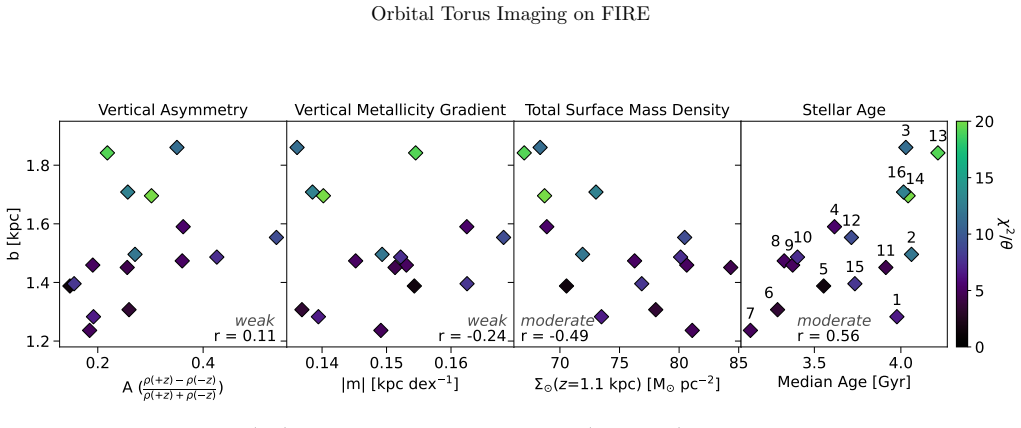
The paper's central claim is that OTI, despite assuming axisymmetry and steady state, recovers the true vertical acceleration profile of a realistic Milky-Way-mass galaxy that is out of equilibrium. Across 16 solar-analog volumes at $R = 8$ kpc, the inferred $a_z$ matches the simulation's stored acceleration within $3\sigma$ in 15 volumes and within $1\sigma$ in 12, and the total surface mass density at $z = 1.1$ kpc agrees within $3\sigma$ in the same 15 volumes. The method's failures concentrate in the volumes with the largest scale heights (above roughly 1.5 kpc) and oldest stars, exactly where the assumed separability of vertical and radial motion breaks down; notably, vertical asymmetry of the density distribution does not hurt accuracy. A previously published OTI estimate of the Milky Way's surface mass density at $z = 1.1$ kpc falls squarely within the range of true simulated values, which the authors take as evidence that the method can be trusted on real survey data.
Load-bearing premise
The method assumes a star's up-down motion is independent of its in-plane motion, which holds only for stars on nearly circular, dynamically cold orbits and fails at heights above roughly 1.5 kpc.
Editorial extensions
If this is right
- OTI can be applied to Milky Way-like disks that are mildly out of equilibrium, with a quantified error budget: 94% of volumes within $3\sigma$ and 75% within $1\sigma$ for the vertical acceleration, and the same 94% for the surface mass density at $z = 1.1$ kpc.
- The Milky Way's OTI-inferred surface mass density from earlier work lands inside the range of true FIRE-2 values, so existing OTI-based Galactic constraints gain an independent plausibility check.
- With uncertainties from MCMC sampling and bootstrapping, OTI's vertical acceleration estimates are about 85% more precise than Jeans modeling, making it the sharper tool for mapping the disk's vertical mass profile.
- OTI is most trustworthy in thin, dense, young volumes; regions with scale heights above about 1.5 kpc or old stellar populations should be flagged before interpreting their inferred potentials.
- The error bars derived from the simulation establish a touchstone for interpreting results from current and forthcoming surveys such as SDSS-V, Gaia, WEAVE, and 4MOST.
Reading between the lines
- The four volumes that miss the $1\sigma$ bar (V2, V13, V14, V16) are precisely those with large scale heights and old median ages, so a cheap pre-analysis cut on those two observables could flag survey volumes where OTI results are likely biased before any potential fitting is done.
- The residual pattern the paper reports, overpredicting $a_z$ above the midplane and underpredicting it below by about 15%, is a coherent fingerprint of the dropped radial term; if the same antisymmetric signature appears in real Milky Way data, it would identify the separability approximation, not measurement noise, as the limiting error.
- Because the paper finds that vertical asymmetry barely affects accuracy, OTI may be resilient to the warps and breathing modes the Milky Way is currently experiencing; this resilience is testable directly by running the same protocol on mock Gaia-like catalogs drawn from other FIRE-2 snapshots.
- The natural stress test is to repeat the 16-volume protocol on FIRE-2 galaxies that have undergone recent mergers; recovery fractions falling well below 94% would map out how much disequilibrium OTI can tolerate and where it should not be trusted.
Signed reviews
Editorial analysis
A structured set of objections, weighed in public.
Referee Report
Summary. This paper benchmarks the Orbital Torus Imaging (OTI) method on the FIRE-2 cosmological zoom-in simulation m12i. The authors select 16 solar-analog volumes at R = 8 kpc, fit OTI models to the binned mean [Fe/H] distribution in (z, vz) vertical phase space, and compare the inferred vertical acceleration profiles and total surface mass densities at z = 1.1 kpc against the accelerations and densities stored in the simulation. They report that the OTI-inferred az profiles match the known FIRE-2 profiles within 3σ for 15/16 volumes and within 1σ for 12/16 volumes, and that Σ☉(z = 1.1 kpc) agrees within 3σ for 15/16 volumes. The paper also compares OTI precision with Jeans modeling, identifies volume properties (scale height, median stellar age, surface density) that correlate with fit quality, and discusses implications of OTI for distinguishing dark matter models.
Significance. If the headline recovery fractions were supported by a complete error budget, this would be a valuable validation of OTI in a realistic, live, out-of-equilibrium simulated disk. The comparison is genuinely external: the FIRE-2 stored accelerations played no role in the OTI fit, so the benchmark is not circular. The use of 16 spatially separated volumes within one cosmological simulation is a meaningful step beyond the earlier single-volume N-body test, and the authors are commendably transparent about their assumptions and residual trends. However, the central quantitative claim currently rests on an error budget that the authors themselves state excludes model inaccuracies, and the paper's own Figure 7 shows a systematic residual pattern. The significance of the result is therefore conditional on re-framing or supplementing the uncertainty assessment.
major comments (3)
- [§5.1, Figure 6, and abstract] The central claim that OTI recovers the true vertical acceleration 'within 3σ/1σ for 94%/75% of volumes' is not supported by the quoted uncertainties. The errors shown in Figure 6 combine MCMC sampling and bootstrap resampling only. The text in §5.1 explicitly states that this combined uncertainty 'reflects the precision of our measurement but not model inaccuracies' and that OTI's symmetry assumptions are violated in m12i. Since the true FIRE-2 profiles are known, the appropriate accuracy statement would use a total error budget that includes model misspecification, or report residuals directly. Figure 7 shows a systematic trend: OTI overpredicts above the midplane and underpredicts below it, with median percent differences of 15% and 14%. With a precision-only σ, the 15/16 and 12/16 counts measure whether the precision error bars happen to cover the true profile, not whether the method is accurately recovering it. The abstract and conclusions should be revised to either quote residual-based accuracy metrics or to explicitly qualify the σ as precision-only, ideally with an added systematic component.
- [§7, first bullet] The argument that '12/16 within 1σ is almost what we observe' (expected 11/16 under pure statistical errors) is circular. The expected count of 11/16 is derived from the same incomplete σ that defines the observed count, so the near-agreement between expectation and observation carries no information about whether systematic errors dominate. A meaningful test would compare the observed residuals to a σ that includes model error, or would compare the magnitude of the systematic residual to the statistical precision independently. As written, this bullet over-interprets the agreement between an observation and an expectation that were constructed from the same input.
- [§3, §4.1, and Figure 6, volumes V13/V14] The paper's own model assumptions are acknowledged to break down in precisely the regimes where the failures occur: R–z separability and neglect of the radial term of the collisionless Boltzmann equation 'may not be valid for regions far (|z| ≥ 1.5 kpc) from the midplane' (footnote in §3), and §4.1 restricts the analysis accordingly. Volumes V13 and V14, which have the largest scale heights and oldest, kinematically heated populations, are the ones with the worst recovery, consistent with this misspecification. Because the model error from separability is not quantified, the reader cannot tell how much of the recovery success in the other volumes is due to the method working versus the volumes being close enough to the thin-disk regime that the misspecification is small. The authors should add a sensitivity test or comparable systematic-error estimate that varies the model assumptions (e.g., including the radial term or fitting a non-separable model) and report how the recovery fractions change.
minor comments (5)
- [§3, first paragraph] There is a typo: 'We employ the the 1D vertical collisionless Boltzmann equation' should read 'We employ the 1D vertical collisionless Boltzmann equation'.
- [§5.1, paragraph after Figure 6] The statement that OTI provides a more precise az estimate 'by ~85% across the disk' is not defined precisely: it is unclear whether this is the median ratio of Jeans to OTI error bars, averaged over z, or computed in some other way. A brief definition of the metric would improve reproducibility.
- [§4.2 and Appendix D] The 26 free parameters are listed, but the bounds and priors used in the MCMC sampling are not given. For a paper whose headline is about uncertainty quantification, specifying the priors and the chain convergence checks (e.g., R-hat, effective sample size) would be important for reproducibility.
- [§6, Figure 9] The Pearson correlation coefficients are reported to two decimals, but no significance or confidence intervals are given. Given only 16 volumes, reporting p-values or bootstrap confidence intervals on r would help the reader judge whether the claimed weak/moderate correlations are meaningful.
- [§1 and §2] The phrase 'recently quiescent' is used for m12i, but the quantitative definition is deferred to a citation. Stating the last major merger time and the current snapshot time explicitly would make the 'dynamically-evolving' context easier to interpret.
Circularity Check
No significant circularity: the OTI-inferred vertical acceleration is benchmarked against FIRE-2 stored accelerations that play no role in the fit.
full rationale
The OTI model is fit exclusively to binned mean-metallicity data in each of 16 solar-analog volumes, as described in Sections 4.1 and 4.2; no FIRE-2 acceleration value enters the likelihood, the optimization, or the MCMC and bootstrap error estimation. The ground-truth vertical acceleration used for validation is FIRE-2's stored particle acceleration, which the paper explicitly identifies as an independent quantity: 'The particle accelerations used for comparison with the OTI inferences are a stored quantity for Latte galaxies' (Section 2). Figure 6 is therefore an external benchmark rather than a fitted-input prediction. The method's assumptions (axisymmetry, steady-state, R-z separability, neglect of the radial collisionless Boltzmann term) are imported from Price-Whelan et al. (2025) through self-citations, but this import is not circular in the present paper because the new content is precisely a test of those assumptions against an independent simulation. The paper also explicitly concedes that the quoted uncertainty 'reflects the precision of our measurement but not model inaccuracies' and that OTI 'assumes a symmetric distribution, an assumption which is violated in a realistic simulated galaxy, m12i' (Section 5.1). This is an honest limitation and a statistical-correctness caveat, not a circular derivation: the 94%/75% recovery fractions may overstate accuracy because model error is excluded, but they do not reduce to the inputs of the fit. No equation is shown to be equivalent to its own input by construction, and no fitted parameter is renamed as a prediction. The only circularity-adjacent feature is that the method papers and the torusimaging package originate from coauthors, but the load-bearing comparison is to an external, independently stored simulation quantity, so this self-citation is not load-bearing.
Assumptions & free parameters
free parameters (7)
- OTI label spline knots (8 per volume, 16 volumes) =
not tabulated
- e2 Fourier distortion spline knots (10 per volume, 16 volumes) =
not tabulated
- e4 Fourier distortion spline knots (5 per volume, 16 volumes) =
not tabulated
- Centroid (z0, vz0) per volume =
not tabulated
- Midplane orbital frequency Omega0 per volume =
not tabulated
- OTI hyperparameters (nknots, L2 regularization, smoothing, spacing power) =
nknots=8/10/5; L2=1.0; smoothing=0.5/0.1/0.1; spacing power=0.75
- zmax and vzmax bin extents per volume =
zmax 3.0-3.7 kpc; vzmax 139-154 km/s
assumptions (6)
- domain assumption The stellar distribution function is in steady state and phase-mixed
- domain assumption The gravitational potential is axisymmetric
- domain assumption Vertical and radial motions decouple; R-z separability and the radial term in the collisionless Boltzmann equation are neglected
- domain assumption The mean [Fe/H] is a function only of orbital invariants and carries no explicit orbital-phase dependence
- domain assumption FIRE-2 m12i is a representative testbed for Milky Way-like disequilibrium conditions
- domain assumption The MCMC plus bootstrap variance is treated as the total uncertainty for the sigma-agreement claims
Cite this review
Pith. "Pith review of OTI on FIRE: Testing the Efficacy of Orbital Torus Imaging to Recover the Galactic Potential." pith.science (2026). https://pith.science/paper/ZTZ4LGPS
@misc{pith2026250505590,
  author       = {Pith},
  title        = {Pith review of: OTI on FIRE: Testing the Efficacy of Orbital Torus Imaging to Recover the Galactic Potential},
  year         = {2026},
  howpublished = {\url{https://pith.science/paper/ZTZ4LGPS}},
  note         = {Machine review of arXiv:2505.05590}
}
read the original abstract
Orbital Torus Imaging (OTI) is a dynamical inference method for determining the Milky Way's gravitational potential using stellar survey data. OTI uses gradients in stellar astrophysical quantities, such as element abundances, as functions of dynamical quantities, like orbital actions or energy, to estimate the Galactic mass distribution, assuming axisymmetry and steady-state of the system. While preliminary applications have shown promising outcomes, its sensitivity to disequilibrium effects is unknown. Here, we apply OTI to a benchmark Feedback in Realistic Environments (FIRE-2) cosmological hydrodynamic simulation, m12i, which enables a comparative analysis between known FIRE-2 vertical acceleration profiles and total surface mass densities to the analogous OTI-inferred results. We quantify OTI's accuracy within solar-analog volumes embedded in the simulated galactic disk. Despite a dynamically-evolving system, we find that OTI recovers the known vertical acceleration profiles within 3 sigma/1 sigma errors for 94%/75% of the volumes considered. We discuss the method's sensitivity to the local, instantaneous structure of the disk, reporting a loss in accuracy for volumes that have large (>1.5 kpc) scale heights and low total density at z=1.1 kpc. We present realistic OTI error bars from both MCMC sampling and bootstrapping the FIRE-2 simulated data, which provides a touchstone for interpreting results obtained from current and forthcoming surveys such as SDSS-V, Gaia, WEAVE, and 4MOST.
Figures


Figures from the paper (5 more)


Reference graph
Works this paper leans on
-
[1]
, " * write output.state after.block = add.period write newline
ENTRY address archivePrefix author booktitle chapter doi edition editor eprint howpublished institution journal key month number organization pages publisher school series title misctitle type volume year version url label extra.label sort.label short.list INTEGERS output.state before.all mid.sentence after.sentence after.block FUNCTION init.state.consts ...
-
[2]
write newline
" write newline "" before.all 'output.state := FUNCTION format.url url empty "" new.block "" url * "" * if FUNCTION format.eprint eprint empty "" archivePrefix empty "" archivePrefix "arXiv" = new.block " " eprint * " " * new.block " " eprint * " " * if if if FUNCTION format.doi doi empty "" " " doi * " " * if FUNCTION format.pid doi empty eprint empty ur...
-
[3]
w po [Am۶ 5*& qRC&kdaVIIIƍ - r°, |殺pbt o 3f.c2 lbdc*'YU- ) Ι3' G^
thebibliography [1] 20pt to REFERENCES 6pt =0pt -12pt 10pt plus 3pt =0pt =0pt =1pt plus 1pt =0pt =0pt -12pt =13pt plus 1pt =20pt =13pt plus 1pt \@M =10000 =-1.0em =0pt =0pt 0pt =0pt =1.0em @enumiv\@empty 10000 10000 `\.\@m \@noitemerr \@latex@warning Empty `thebibliography' environment \@ifnextchar \@reference \@latexerr Missing key on reference command E...
arXiv 2021
-
[4]
Abadi , M. G., Navarro , J. F., Steinmetz , M., & Eke , V. R. 2003, , 597, 21, 10.1086/378316
doi:10.1086/378316 2003
-
[5]
Ansar , S., Pearson , S., Sanderson , R. E., et al. 2025, , 978, 37, 10.3847/1538-4357/ad8b45
-
[6]
2018, , 561, 360, 10.1038/s41586-018-0510-7
Antoja , T., Helmi , A., Romero-G \'o mez , M., et al. 2018, , 561, 360, 10.1038/s41586-018-0510-7
-
[7]
E., Panithanpaisal , N., et al
Arora , A., Sanderson , R. E., Panithanpaisal , N., et al. 2022, , 939, 2, 10.3847/1538-4357/ac93fb
-
[8]
2024 a , , 977, 23, 10.3847/1538-4357/ad88f0
Arora , A., Sanderson , R., Regan , C., et al. 2024 a , , 977, 23, 10.3847/1538-4357/ad88f0
Show all 116 references
-
[9]
E., Chakrabarti , S., et al
Arora , A., Sanderson , R. E., Chakrabarti , S., et al. 2024 b , , 974, 223, 10.3847/1538-4357/ad71c4
2024 doi
-
[10]
E., et al
Arora, A., Garavito-Camargo, N., Sanderson, R. E., et al. 2025, arXiv e-prints. arXiv:2504.20133
2025 arXiv
-
[11]
J., & Scott , P
Asplund , M., Grevesse , N., Sauval , A. J., & Scott , P. 2009, , 47, 481, 10.1146/annurev.astro.46.060407.145222
2009
-
[12]
M., Sip o cz , B
Astropy Collaboration , Price-Whelan , A. M., Sip o cz , B. M., et al. 2018, , 156, 123, 10.3847/1538-3881/aabc4f
2018 doi
-
[13]
Bahcall , J. N. 1984, , 287, 926, 10.1086/162750
1984 doi
- [14]
-
[15]
2022, Symmetry, 14, 1331, 10.3390/sym14071331
Banik , I., & Zhao , H. 2022, Symmetry, 14, 1331, 10.3390/sym14071331
2022 doi
-
[16]
C., Flynn , K., & Gebhardt , K
Beers , T. C., Flynn , K., & Gebhardt , K. 1990, , 100, 32, 10.1086/115487
1990 doi
-
[17]
A., Wetzel , A., Loebman , S
Bellardini , M. A., Wetzel , A., Loebman , S. R., & Bailin , J. 2022, , 10.1093/mnras/stac1637
2022 doi
-
[18]
A., Wetzel , A., Loebman , S
Bellardini , M. A., Wetzel , A., Loebman , S. R., et al. 2021, , 505, 4586, 10.1093/mnras/stab1606
2021 doi
-
[19]
B., Evans , N
Belokurov , V., Zucker , D. B., Evans , N. W., et al. 2006, , 642, L137, 10.1086/504797
2006 doi
-
[20]
Bennett , M., Bovy , J., & Hunt , J. A. S. 2022, , 927, 131, 10.3847/1538-4357/ac5021
2022 doi
-
[21]
R., Ness , M
Bhattarai , B., Loebman , S. R., Ness , M. K., et al. 2024, , 977, 70, 10.3847/1538-4357/ad8bac
2024 doi
-
[22]
C., Salomon , J
Bienaym \'e , O., Robin , A. C., Salomon , J. B., & Reyl \'e , C. 2024, , 689, A280, 10.1051/0004-6361/202450327
2024 doi
-
[23]
2014, , 571, A92, 10.1051/0004-6361/201424478
Bienaym \'e , O., Famaey , B., Siebert , A., et al. 2014, , 571, A92, 10.1051/0004-6361/201424478
2014 doi
-
[24]
2008, Galactic Dynamics: Second Edition (Princeton University Press)
Binney , J., & Tremaine , S. 2008, Galactic Dynamics: Second Edition (Princeton University Press). http://adsabs.harvard.edu/abs/2008gady.book.....B
2008
-
[25]
C., Loebman , S
Bird , J. C., Loebman , S. R., Weinberg , D. H., et al. 2021, , 503, 1815, 10.1093/mnras/stab289
2021 doi
-
[26]
F., & Kere s , D
Bonaca , A., Conroy , C., Wetzel , A., Hopkins , P. F., & Kere s , D. 2017, , 845, 101, 10.3847/1538-4357/aa7d0c
2017 doi
- [27]
-
[28]
2015, , 216, 29, 10.1088/0067-0049/216/2/29
Bovy , J. 2015, , 216, 29, 10.1088/0067-0049/216/2/29
2015 doi
-
[29]
2018, JAX: Composable Transformations of Python+NumPy Programs, 0.3.13
Bradbury, J., Frostig, R., Hawkins, P., et al. 2018, JAX: Composable Transformations of Python+NumPy Programs, 0.3.13. http://github.com/google/jax
2018
- [30]
-
[31]
R., & Schutz, K
Buschmann, M., Safdi, B. R., & Schutz, K. 2021, Phys. Rev. Lett., 127, 241104, 10.1103/PhysRevLett.127.241104
2021 doi
-
[32]
H., Lu , P., Nocedal , J., & Zhu , C
Byrd , R. H., Lu , P., Nocedal , J., & Zhu , C. 1995, SIAM Journal on Scientific Computing, 16, 1190, 10.1137/0916069
1995 doi
-
[33]
2024, BlackJAX: Composable B ayesian inference in JAX
Cabezas, A., Corenflos, A., Lao, J., & Louf, R. 2024, BlackJAX: Composable B ayesian inference in JAX . 2402.10797
2024 arXiv
- [34]
-
[35]
2012, , 144, 185, 10.1088/0004-6256/144/6/185
Carrell , K., Chen , Y., & Zhao , G. 2012, , 144, 185, 10.1088/0004-6256/144/6/185
2012 doi
-
[36]
K., Hawkins , K., et al
Carrillo , A., Ness , M. K., Hawkins , K., et al. 2023, , 942, 35, 10.3847/1538-4357/aca1c7
2023 doi
-
[37]
T., Vigeland , S
Chakrabarti , S., Chang , P., Lam , M. T., Vigeland , S. J., & Quillen , A. C. 2021, , 907, L26, 10.3847/2041-8213/abd635
2021 doi
-
[38]
2020, The Astrophysical Journal, 902, L28, 10.3847/2041-8213/abb9b5
Chakrabarti, S., Wright, J., Chang, P., et al. 2020, The Astrophysical Journal, 902, L28, 10.3847/2041-8213/abb9b5
2020 doi
-
[39]
Chiba , R., Friske , J. K. S., & Sch \"o nrich , R. 2021, , 500, 4710, 10.1093/mnras/staa3585
2021 doi
-
[40]
A., Schaye , J., Bower , R
Crain , R. A., Schaye , J., Bower , R. G., et al. 2015, , 450, 1937, 10.1093/mnras/stv725
2015 doi
-
[41]
J., Belokurov , V., Evans , N
Deason , A. J., Belokurov , V., Evans , N. W., & Johnston , K. V. 2013, , 763, 113, 10.1088/0004-637X/763/2/113
2013 doi
-
[42]
1998, , 294, 429, 10.1046/j.1365-8711.1998.01282.x10.1111/j.1365-8711.1998.01282.x
Dehnen , W., & Binney , J. 1998, , 294, 429, 10.1046/j.1365-8711.1998.01282.x10.1111/j.1365-8711.1998.01282.x
1998
-
[43]
M., et al
Donlon , T., Chakrabarti , S., Widrow , L. M., et al. 2024, , 110, 023026, 10.1103/PhysRevD.110.023026
2024 doi
-
[44]
D'Souza , R., & Bell , E. F. 2022, , 512, 739, 10.1093/mnras/stac404
2022 doi
-
[45]
W., Rix , H.-W., & Ness , M
Eilers , A.-C., Hogg , D. W., Rix , H.-W., & Ness , M. K. 2019, , 871, 120, 10.3847/1538-4357/aaf648
2019 doi
-
[46]
Faucher-Gigu \`e re , C.-A., Quataert , E., & Hopkins , P. F. 2013, , 433, 1970, 10.1093/mnras/stt866
2013 doi
-
[47]
Gaia Collaboration , Prusti , T., de Bruijne , J. H. J., et al. 2016, , 595, A1, 10.1051/0004-6361/201629272
2016 doi
-
[48]
Garavito-Camargo , N., Besla , G., Laporte , C. F. P., et al. 2019, , 884, 51, 10.3847/1538-4357/ab32eb
2019 doi
-
[49]
M., Samuel , J., et al
Garavito-Camargo , N., Price-Whelan , A. M., Samuel , J., et al. 2024, , 975, 100, 10.3847/1538-4357/ad6e7e
2024 doi
-
[50]
I., & Lake , G
Garbari , S., Liu , C., Read , J. I., & Lake , G. 2012, , 425, 1445, 10.1111/j.1365-2966.2012.21608.x
2012
-
[51]
A., White , S
G \'o mez , F. A., White , S. D. M., Marinacci , F., et al. 2016, , 456, 2779, 10.1093/mnras/stv2786
2016 doi
-
[52]
L., Wetzel , A., Bellardini , M
Graf , R. L., Wetzel , A., Bellardini , M. A., & Bailin , J. 2025, , 981, 47, 10.3847/1538-4357/adacd7
2025 doi
-
[53]
Grand , R. J. J., G \'o mez , F. A., Marinacci , F., et al. 2017, , 467, 179, 10.1093/mnras/stx071
2017 doi
-
[54]
2020, , 495, 4828, 10.1093/mnras/staa1483
Guo , R., Liu , C., Mao , S., et al. 2020, , 495, 4828, 10.1093/mnras/staa1483
2020 doi
-
[55]
B., Faucher-Gigu \`e re , C.-A., Richings , A
Gurvich , A. B., Faucher-Gigu \`e re , C.-A., Richings , A. J., et al. 2020, , 498, 3664, 10.1093/mnras/staa2578
2020 doi
-
[56]
R., Millman , K
Harris , C. R., Millman , K. J., van der Walt , S. J., et al. 2020, , 585, 357, 10.1038/s41586-020-2649-2
2020 doi
-
[57]
R., Holtzman , J
Hayden , M. R., Holtzman , J. A., Bovy , J., et al. 2014, , 147, 116, 10.1088/0004-6256/147/5/116
2014 doi
-
[58]
H., et al
Helmi, A., Babusiaux, C., Koppelman, H. H., et al. 2018, Nature, 563, 85, 10.1038/s41586-018-0625-x
2018 doi
-
[59]
Hopkins , P. F. 2015, , 450, 53, 10.1093/mnras/stv195
2015 doi
-
[60]
F., Wetzel , A., Kere s , D., et al
Hopkins , P. F., Wetzel , A., Kere s , D., et al. 2018, , 480, 800, 10.1093/mnras/sty1690
2018 doi
-
[61]
M., Hogg , D
Horta , D., Price-Whelan , A. M., Hogg , D. W., et al. 2024, , 962, 165, 10.3847/1538-4357/ad16e8
2024 doi
-
[62]
W., Yuan , H
Huang , Y., Liu , X. W., Yuan , H. B., et al. 2016, , 463, 2623, 10.1093/mnras/stw2096
2016 doi
-
[63]
Hunt , J. A. S., Stelea , I. A., Johnston , K. V., et al. 2021, , 508, 1459, 10.1093/mnras/stab2580
2021 doi
-
[64]
Hunter, J. D. 2007, Computing in Science & Engineering, 9, 90, 10.1109/MCSE.2007.55
2007 doi
-
[65]
A., et al
Imig , J., Price , C., Holtzman , J. A., et al. 2023, , 954, 124, 10.3847/1538-4357/ace9b8
2023 doi
-
[66]
2008, , 684, 287, 10.1086/589678
Ivezi \'c , Z ., Sesar , B., Juri \'c , M., et al. 2008, , 684, 287, 10.1086/589678
2008 doi
-
[67]
Jeans , J. H. 1915, , 76, 70, 10.1093/mnras/76.2.70
1915 doi
- [68]
-
[69]
Kapteyn , J. C. 1922, , 55, 302, 10.1086/142670
1922 doi
-
[70]
2014, , 210, 14, 10.1088/0067-0049/210/1/14
Kim , J.-h., Abel , T., Agertz , O., et al. 2014, , 210, 14, 10.1088/0067-0049/210/1/14
2014 doi
-
[71]
M., & Laporte , C
Koop , O., Antoja , T., Helmi , A., Callingham , T. M., & Laporte , C. F. P. 2024, , 692, A50, 10.1051/0004-6361/202450911
2024 doi
-
[72]
2001, , 322, 231, 10.1046/j.1365-8711.2001.04022.x
Kroupa , P. 2001, , 322, 231, 10.1046/j.1365-8711.2001.04022.x
2001
-
[74]
1989 b , , 239, 571, 10.1093/mnras/239.2.571
---. 1989 b , , 239, 571, 10.1093/mnras/239.2.571
1989 doi
- [75]
-
[76]
Lacey , C. G. 1984, , 208, 687, 10.1093/mnras/208.4.687
1984 doi
-
[77]
Laporte , C. F. P., Johnston , K. V., G \'o mez , F. A., Garavito-Camargo , N., & Besla , G. 2018, , 481, 286, 10.1093/mnras/sty1574
2018 doi
-
[78]
D., et al
Leitherer , C., Schaerer , D., Goldader , J. D., et al. 1999, , 123, 3, 10.1086/313233
1999 doi
-
[79]
R., Ivezi \'c , Z ., Quinn , T
Loebman , S. R., Ivezi \'c , Z ., Quinn , T. R., et al. 2012, , 758, L23, 10.1088/2041-8205/758/1/L23
2012 doi
-
[80]
2014, , 794, 151, 10.1088/0004-637X/794/2/151
---. 2014, , 794, 151, 10.1088/0004-637X/794/2/151
2014 doi
-
[81]
2006, , 370, 773, 10.1111/j.1365-2966.2006.10501.x
Mannucci , F., Della Valle , M., & Panagia , N. 2006, , 370, 773, 10.1111/j.1365-2966.2006.10501.x
2006
-
[82]
R., et al
McCluskey , F., Wetzel , A., Loebman , S. R., et al. 2024, , 527, 6926, 10.1093/mnras/stad3547
2024 doi
-
[83]
F., Parravano , A., & Hollenbach , D
McKee , C. F., Parravano , A., & Hollenbach , D. J. 2015, , 814, 13, 10.1088/0004-637X/814/1/13
2015 doi
-
[84]
2019, , 883, 27, 10.3847/1538-4357/ab3afc
Necib , L., Lisanti , M., Garrison-Kimmel , S., et al. 2019, , 883, 27, 10.3847/1538-4357/ab3afc
2019 doi
-
[85]
Oort , J. H. 1932, , 6, 249
1932
-
[86]
E., Fielding , D
Orr , M. E., Fielding , D. B., Hayward , C. C., & Burkhart , B. 2022, , 932, 88, 10.3847/1538-4357/ac6c26
2022 doi
-
[87]
E., Burkhart , B., Wetzel , A., et al
Orr , M. E., Burkhart , B., Wetzel , A., et al. 2023, , 521, 3708, 10.1093/mnras/stad676
2023 doi
-
[88]
2024, , 528, 693, 10.1093/mnras/stae034
Ou , X., Eilers , A.-C., Necib , L., & Frebel , A. 2024, , 528, 693, 10.1093/mnras/stae034
2024 doi
-
[89]
2025, arXiv e-prints, arXiv:2503.05877
Ou , X., Necib , L., Wetzel , A., et al. 2025, arXiv e-prints, arXiv:2503.05877. 2503.05877
2025 arXiv
-
[90]
E., Wetzel , A., et al
Panithanpaisal , N., Sanderson , R. E., Wetzel , A., et al. 2021, , 920, 10, 10.3847/1538-4357/ac1109
2021 doi
-
[91]
R., et al
Parul , H., Bailin , J., Loebman , S. R., et al. 2025, , 537, 1571, 10.1093/mnras/staf137
2025 doi
-
[92]
Perez, F., & Granger, B. E. 2007, Computing in Science & Engineering, 9, 21, 10.1109/MCSE.2007.53
2007 doi
-
[93]
2024, adrn/TorusImaging: v0.1, v0.1, Zenodo, 10.5281/zenodo.10498412
Price-Whelan, A. 2024, adrn/TorusImaging: v0.1, v0.1, Zenodo, 10.5281/zenodo.10498412
2024 doi
-
[94]
M., Hunt , J
Price-Whelan , A. M., Hunt , J. A. S., Horta , D., et al. 2025, , 979, 115, 10.3847/1538-4357/ad969a
2025 doi
-
[95]
M., Hogg , D
Price-Whelan , A. M., Hogg , D. W., Johnston , K. V., et al. 2021, , 910, 17, 10.3847/1538-4357/abe1b7
2021 doi
-
[96]
W., Bullock , J
Purcell , C. W., Bullock , J. S., Tollerud , E. J., Rocha , M., & Chakrabarti , S. 2011, , 477, 301, 10.1038/nature10417
2011 doi
-
[97]
Read , J. I. 2014, Journal of Physics G Nuclear Physics, 41, 063101, 10.1088/0954-3899/41/6/063101
2014 doi
-
[98]
2024, , 972, 70, 10.3847/1538-4357/ad58d7
Roche , C., Necib , L., Lin , T., Ou , X., & Nguyen , T. 2024, , 972, 70, 10.3847/1538-4357/ad58d7
2024 doi
-
[99]
C., Torrey , P., Villaescusa-Navarro , F., et al
Rose , J. C., Torrey , P., Villaescusa-Navarro , F., et al. 2025, , 982, 68, 10.3847/1538-4357/adb8e5
2025 doi
- [100]
-
[101]
E., Wetzel , A., Loebman , S., et al
Sanderson , R. E., Wetzel , A., Loebman , S., et al. 2020, , 246, 6, 10.3847/1538-4365/ab5b9d
2020 doi
-
[102]
A., Bower , R
Schaye , J., Crain , R. A., Bower , R. G., et al. 2015, , 446, 521, 10.1093/mnras/stu2058
2015 doi
- [103]
-
[104]
1951, , 114, 385, 10.1086/145478
Spitzer , Jr., L., & Schwarzschild , M. 1951, , 114, 385, 10.1086/145478
1951 doi
-
[105]
van der Marel , R. P. 1991, , 248, 515, 10.1093/mnras/248.3.515
1991 doi
-
[106]
2020, , 497, 4162, 10.1093/mnras/staa2114
Vasiliev , E., & Belokurov , V. 2020, , 497, 4162, 10.1093/mnras/staa2114
2020 doi
-
[107]
2021, , 501, 2279, 10.1093/mnras/staa3673
Vasiliev , E., Belokurov , V., & Erkal , D. 2021, , 501, 2279, 10.1093/mnras/staa3673
2021 doi
-
[108]
E., et al
Virtanen, P., Gommers, R., Oliphant, T. E., et al. 2020, Nature Methods, 17, 261, 10.1038/s41592-019-0686-2
2020 doi
-
[109]
2014, , 444, 1518, 10.1093/mnras/stu1536
Vogelsberger , M., Genel , S., Springel , V., et al. 2014, , 444, 1518, 10.1093/mnras/stu1536
2014 doi
-
[110]
L., Evans, N
Watkins, L. L., Evans, N. W., & An, J. H. 2010, Mon. Not. R. Astron. Soc, 406, 264, 10.1111/j.1365-2966.2010.16708.x
2010
-
[111]
2020 a , HaloAnalysis: Read and analyze halo catalogs and merger trees
Wetzel , A., & Garrison-Kimmel , S. 2020 a , HaloAnalysis: Read and analyze halo catalogs and merger trees . 2002.014
2020
-
[112]
2020 b , GizmoAnalysis: Read and analyze Gizmo simulations
---. 2020 b , GizmoAnalysis: Read and analyze Gizmo simulations . 2002.015
2020
-
[113]
C., Sanderson , R
Wetzel , A., Hayward , C. C., Sanderson , R. E., et al. 2023, , 265, 44, 10.3847/1538-4365/acb99a
2023 doi
-
[114]
R., Hopkins , P
Wetzel , A. R., Hopkins , P. F., Kim , J.-h., et al. 2016, , 827, L23, 10.3847/2041-8205/827/2/L23
2016 doi
-
[115]
M., Barber , J., Chequers , M
Widrow , L. M., Barber , J., Chequers , M. H., & Cheng , E. 2014, , 440, 1971, 10.1093/mnras/stu396
2014 doi
-
[116]
2022, , 2022, 031, 10.1088/1475-7516/2022/07/031
Zentner , A., Dandavate , S., Slone , O., & Lisanti , M. 2022, , 2022, 031, 10.1088/1475-7516/2022/07/031
2022 doi
-
[117]
2013, , 772, 108, 10.1088/0004-637X/772/2/108
Zhang , L., Rix , H.-W., van de Ven , G., et al. 2013, , 772, 108, 10.1088/0004-637X/772/2/108
2013 doi
Reviewed August 15, 2026 · model on record in the stance chip above.
Discussion (0). Continue with ORCID to comment.