REVIEW 3 major objections 5 minor 106 references
Correlation-Driven $d$-Wave Superconducting Dome from Pseudogap Spectral Reconstruction
T0 review · 3 major / 5 minor · reviewed 2026-08-15 · deepseek-v4-flash
Pith's one-line read A solvable correlated model produces a d-wave superconducting dome peaked at the pseudogap quantum critical point, with d-wave pairing robust against phase fluctuations.
desk verdict A credible and clearly written phase-fluctuating d-wave calculation on a solvable pseudogap model; the dome is largely inherited from the input flat band, and the effective dispersion assumption needs stronger checking before the d-wave robustness claim is taken as established. read the letter →
The pith
A machine-rendered reading of the paper's core claim, the machinery that carries it, and where it could break.
The reading
The authors add a superconducting pairing interaction and also include fluctuations of the superconducting phase, both thermal and quantum. They find that the superconducting transition temperature forms a dome as a function of doping, with the highest temperature at the doping where the pseudogap closes and the flat band sits at the Fermi level. The phase fluctuations are especially destructive for d_xy and s-wave pairing, but barely hurt d_{x^2-y^2} pairing, because near the flat band the electronic velocity is nearly zero, so the pair-breaking Doppler shift is small.
The model produces a qualitative match to cuprate experiments, including the dome shape and the dominance of d-wave pairing. The authors are careful to state limitations: superconductivity persists too far into the overdoped region, and the antiferromagnetic insulator at zero doping is not captured. The main assumption is an effective single-particle dispersion extracted from the exact spectral function, which they test against the exact model and find to be accurate at the ten-percent level.
Extended reading notes
Core claim
The abstract states: 'the interplay between superconducting order and pseudogap correlations naturally generates a superconducting dome in the temperature-doping phase diagram, with optimal doping located near the quantum critical point separating the pseudogap and metallic phases.' The main text specifies that d_{x^2-y^2}-wave superconductivity is robust against phase fluctuations and dominates over d_xy- and s-wave across a wide doping range. If true, the model reproduces the cuprate dome and the observed d-wave symmetry from a solvable correlated model.
Load-bearing premise
The effective normal-state dispersion ξ_k = (1 - n_{k+Q}) ε_k + n_{k+Q}(ε_k + U), Eq. (4), is treated as the exact single-particle spectrum at all temperatures, and all superconducting calculations use this ξ_k as the input band. The paper calls this 'a key assumption in the present work.' If the finite-temperature spectral weight redistribution makes this effective dispersion inaccurate, the dome shape and the d-wave robustness could change. The authors provide supportive DOS and mean-field Tc comparisons, but the approximation is load-bearing, not a derived identity.
Signed reviews
Editorial analysis
A structured set of objections, weighed in public.
Referee Report
Summary. The manuscript studies an exactly solvable Hubbard-like model with a pseudogap phase and a partially flat band, and uses it to compute self-consistent d-wave superconductivity with both thermal and zero-point superconducting phase fluctuations in the presence of long-range Coulomb interactions. The central results are a dome-shaped d_{x^2-y^2}-wave superconducting region with optimal doping near the quantum critical point between the pseudogap and metallic phases, a strong suppression of d_{xy}- and s-wave pairing by phase fluctuations, and a discontinuity on the underdoped side of the dome. The authors derive the effective normal-state dispersion ξ_k = (1−n_{k+Q})ε_k + n_{k+Q}(ε_k+U) in Eq. (4), use it for all superconducting calculations, and justify it in the End Matter by comparing the density of states and the zero-phase-fluctuation mean-field T_c against the exact solution.
Significance. If the central claim holds, the paper offers a controlled, analytically solvable route to a cuprate-like phase diagram, including a superconducting dome and robust d-wave symmetry, while explicitly including long-range phase fluctuations and Coulomb interactions, which are usually difficult to treat. The manuscript is commendable for using an exactly solvable correlated model, for providing a detailed path-integral derivation of the phase-fluctuating gap equation in the supplemental material, and for testing the effective dispersion against the exact density of states and the exact mean-field T_c. The main caveat is that the headline results rely on an approximate finite-temperature dispersion whose validation does not directly cover the phase-fluctuation regime where the reported d-wave robustness and the underdoped discontinuity live.
major comments (3)
- [Eq. (4) and End Matter, 'Justification of the effective electronic energy dispersion'] The finite-temperature effective dispersion is load-bearing for the phase-fluctuation calculation, but the validation provided does not test the quantity that controls the d-wave robustness claim. At finite temperature the exact spectral function A(k,ω) = (1−n_{k+Q})δ(ω−ε_k) + n_{k+Q}δ(ω−ε_k−U) has weight in both branches, and the centroid dispersion ξ_k = ε_k + n_{k+Q}U has gradient ∇_k ξ_k = ∇_k ε_k + U∇_k n_{k+Q}; the second term is not controlled by the DOS comparisons in Fig. 3(a) or by the mean-field T_c comparisons in Fig. 3(b), both of which are insensitive to the group velocities that enter the Doppler-shift term p_a·v_k. Since the unpairing criterion |p_a·v_k| < sqrt(ξ_k^2+|Δ_k|^2) near (π,0) is the stated physical reason for d-wave robustness, the authors should either repeat the phase-fluctuation calculation using both spectral branches explicitly or provide a direct check of the group velocities and phase-fluctuation amplitude ⟨p_a^2⟩ in the doping and temperature window where the dome and the discontinuity are obtained.
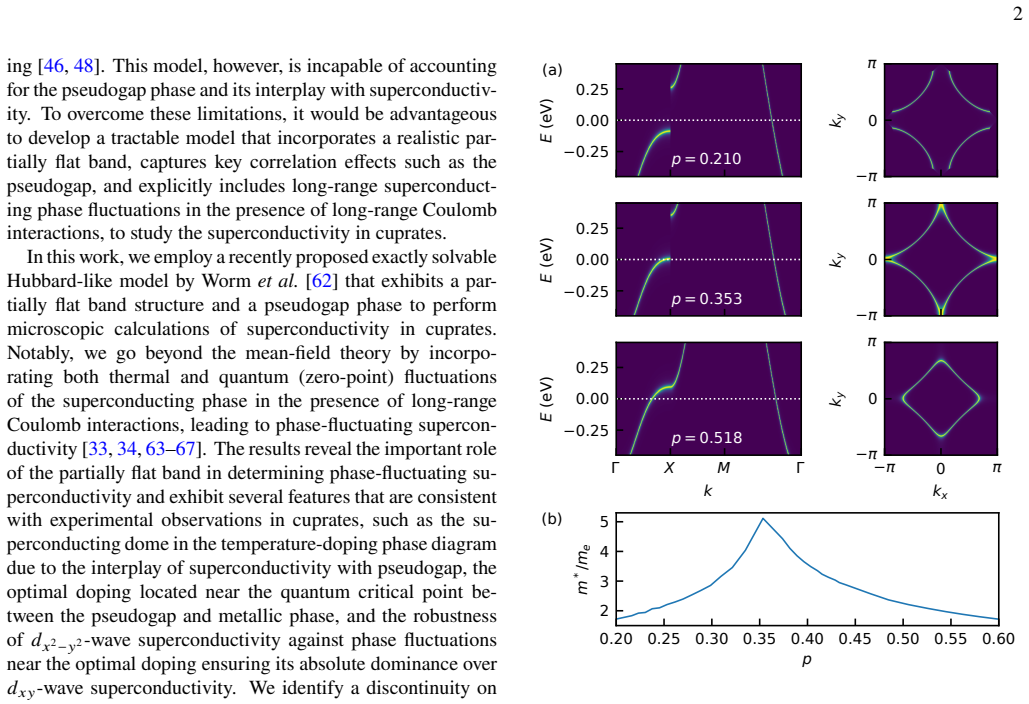
- [Abstract and Fig. 2(b)] The advertised claim that the superconducting dome is 'naturally generated' by the interplay between superconducting order and pseudogap correlations is overstated, because the dome already exists at the BCS level and is explicitly attributed by the authors to the doping-dependent density of states peaked at p = 0.353, a peak inherited from the model's flat band at the quantum critical point. Phase fluctuations modify the dome (including the underdoped discontinuity) but do not create the dome shape. To support the mechanism claimed in the abstract, the authors should either reframe the central claim as 'the pseudogap-induced partially flat band produces a DOS peak that controls the dome location' or provide a control calculation, such as a band structure without the flat band, showing that the QCP location rather than the input DOS determines the optimal doping.
- [Fig. 2(a) and text near the underdoped discontinuity] The first-order-like transition from a strong-phase-fluctuating state to a weak-phase-fluctuating state on the underdoped side of the dome is a central new feature, but its numerical robustness is not documented. The discontinuity appears in a narrow doping window between p = 0.31 and p = 0.32, and its location and sharpness depend on the phase-fluctuation integral, including the momentum cutoff q_c = 1/ξ0 introduced in the End Matter. The authors should report a convergence check in the k-grid, the q-integration cutoff, and the iterative solution procedure, and should state whether the discontinuity is a true solution-branch change or a numerical jump in the self-consistent iteration.
minor comments (5)
- [Title and abstract] The full-text title, 'An Exactly Solvable Model of Phase-Fluctuating Superconductivity in Cuprates: The Role of Partially Flat Bands', differs from the title under which the paper is submitted; the two should be harmonized.
- [Eq. (7) and End Matter, phase-fluctuation cutoff] The upper cutoff q_c = 1/ξ0 for the bosonic phase-fluctuation integral is introduced without any sensitivity analysis; a brief statement of how the dome, the T_c values, and the discontinuity depend on this cutoff would make the calculation more reproducible.
- [Supplemental Material, Section I] The pseudogap onset temperature T* is defined through a Lorentzian broadening Γ = 0.01t and a 10% spectral-weight threshold; the sensitivity of the reported T* line, and hence of its intersection with the superconducting dome, to these numerical choices should be stated.
- [Discussion and Ref. [71]] The statement that U = 1.15t in the exactly solvable model corresponds to U = 8t in the conventional Hubbard model is not derived; a brief explanation of the mapping would help readers assess the physical regime.
- [Throughout] The notation for the pairing symmetries is not fully consistent (d_{x^2-y^2}-wave appears as 'dx2−y2-wave' and 'd_{x^2-y^2}-wave' in different places); please unify the notation.
Circularity Check
No significant circularity: the dome and d-wave robustness are computed consequences of the model's input flat-band spectrum, with the key approximation explicitly validated against the exact spectral function.
full rationale
The paper's derivation chain is self-contained. The input is an exactly solvable Hubbard-like model whose spectral function A(k,ω) = (1−n_{k+Q})δ(ω−ε_k) + n_{k+Q}δ(ω−ε_k−U) produces a partially flat band and a pseudogap. The effective dispersion ξ_k = (1−n_{k+Q})ε_k + n_{k+Q}(ε_k+U) is introduced as an explicit assumption, not an undisclosed fit, and is checked in Fig. 3 against the exact DOS and against an exact-diagonalization mean-field Tc computed from the full Hamiltonian. The superconducting dome is openly attributed to the doping-dependent density of states: the text states that 'this dome behavior arises from the doping-dependent normal-state density of states that is peaked at p = 0.353,' which is a computed property of the input model rather than a parameter fitted to the dome. The d-wave robustness against phase fluctuations follows from the momentum-space structure of the d-wave gap relative to the flat band, a nontrivial emergent result. Self-citations to the authors' earlier phase-fluctuation formalism are supported by a full derivation in the Supplemental Material rather than being imported unexamined. The paper also explicitly discloses limitations (long-tail superconductivity at high doping, absence of the antiferromagnetic phase, and lack of quantitative comparison), further indicating that the central claims are derived consequences rather than circular restatements. No step reduces by construction to its own input, and no fitted quantity is renamed as a prediction.
Assumptions & free parameters
free parameters (5)
- Interaction strength U/t =
1.15
- Pairing potential D/t =
0.235
- Hopping parameters t, t', t'' =
t ~ 0.3 eV, t' = -0.2t, t'' = 0.1t
- Pseudogap onset criterion =
spectral weight below 10% of Lorentzian peak height
- Phase fluctuation momentum cutoff q_c =
1/ξ_0 = |Δ(0)|/(ℏ v_F)
assumptions (6)
- domain assumption The effective dispersion ξ_k approximates the exact spectral function at finite temperature.
- domain assumption The exactly solvable γ = 0 model captures essential cuprate pseudogap physics.
- domain assumption Phase fluctuations are dominated by the long-wavelength gapless Nambu-Goldstone mode.
- domain assumption The pair potential has a separable angular form D cos(2θ) cos(2θ').
- domain assumption Statistical average over phase fluctuation directions with zero mean and finite variance.
- standard math The 2D Coulomb interaction gives a gapless phase mode with ω_NG ∝ sqrt(q).
Cite this review
Pith. "Pith review of Correlation-Driven $d$-Wave Superconducting Dome from Pseudogap Spectral Reconstruction." pith.science (2026). https://pith.science/paper/IXYO75O7
@misc{pith2026250505761,
  author       = {Pith},
  title        = {Pith review of: Correlation-Driven $d$-Wave Superconducting Dome from Pseudogap Spectral Reconstruction},
  year         = {2026},
  howpublished = {\url{https://pith.science/paper/IXYO75O7}},
  note         = {Machine review of arXiv:2505.05761}
}
abstract
Previous theoretical studies [Nat. Phys. {\bf 16}, 1175 (2020)] based on the Hatsugai-Kohmoto model have examined the stability of $s$-wave superconductivity in strongly correlated systems, demonstrating that correlations alone can substantially modify superconducting behavior. Motivated by this perspective, but going beyond these studies, we perform self-consistent microscopic calculations of $d$-wave superconductivity in strongly correlated systems by employing an exactly solvable correlated model that hosts a pseudogap phase and a partially flat band [Phys. Rev. Lett. {\bf 133}, 166501 (2024)]. We show that pseudogap correlations and superconducting order affect the low-energy spectrum in qualitatively different ways: the former leads to a momentum-localized suppression of spectral weight, whereas the latter induces a coherent reorganization of quasiparticle excitations. Moreover, we demonstrate that the interplay between superconducting order and pseudogap correlations naturally generates a superconducting dome in the temperature-doping phase diagram, with optimal doping located near the quantum critical point separating the pseudogap and metallic phases. Furthermore, $d_{x^2-y^2}$-wave superconductivity is found to be remarkably robust, remaining energetically dominant over both $d_{xy}$-wave and $s$-wave pairing channels across a wide doping range. Our results offer a potential route for a direct and controlled connection between pseudogap correlations and the emergence of the superconducting dome in cuprates.
Figures


Reference graph
Works this paper leans on
-
[1]
(3) 3 Here /u1D6FD = 1/( /u1D458/u1D435 /u1D447), with /u1D458/u1D435 being the Boltzmann constant and /u1D447being the temperature
with /u1D6FE = 0 is [62, 70] /u1D434(k, /u1D714 ) = (1 − /u1D45Bk+Q)/u1D6FF (/u1D714 − /u1D716 k) + /u1D45Bk+Q/u1D6FF (/u1D714 − /u1D716 k − /u1D448), (2) where the electron occupation is given by /u1D45Bk+Q = /u1D452−/u1D6FD /u1D716k+Q + /u1D452−/u1D6FD ( /u1D716k+/u1D716k+Q+/u1D448 ) 1 + /u1D452−/u1D6FD /u1D716k + /u1D452−/u1D6FD /u1D716k+Q + /u1D452−/u...
-
[2]
M.-K. Wu, J. R. Ashburn, C. Torng, P .-H. Hor, R. L. Meng, L. Gao, Z. J. Huang, Y . Wang, and A. Chu, Superconductivity at 93 K in a new mixed-phase Y -Ba-Cu-O compound system at ambient pressure, Phys. Rev. Lett. 58, 908 (1987)
1987
-
[3]
Keimer, S
B. Keimer, S. A. Kivelson, M. R. Norman, S. Uchida, and J. Zaanen, From quantum matter to high-temperature supercon- ductivity in copper oxides, Nature 518, 179 (2015)
2015
-
[4]
represents the exact single-particle excitation spectrum [Fig. 1(a)], while at finite temperatures it assumes a smooth connection between the otherwise separated branches /u1D716 k and /u1D716 k + /u1D448 through the momenta satisfying /u1D45Bk+Q ∼ 1/2 (see the justification of the effective dispersion in End Mat- ter). Compared to Hamiltonian ( 1), this agr...
-
[5]
J. G. Bednorz and K. A. M¨ uller, Possible high /u1D447/u1D450 superconduc- tivity in the Ba-La-Cu-O system, Zeit. Phys. B 64, 189 (1986)
1986
-
[6]
The temperature-doping phase diagram of phase-fluctuating /u1D451/u1D4652 −/u1D4662-, /u1D451/u1D465 /u1D466-, and /u1D460-wave super- conducting states is shown in Fig
and ( 7)], we numerically calculate the su- perconductivity in cuprates. The temperature-doping phase diagram of phase-fluctuating /u1D451/u1D4652 −/u1D4662-, /u1D451/u1D465 /u1D466-, and /u1D460-wave super- conducting states is shown in Fig. 2(a), while the correspond- ing phase diagram obtained from the BCS-type theory (without phase fluctuations) is pres...
-
[7]
Dagotto, Correlated electrons in high-temperature supercon- ductors, Rev
E. Dagotto, Correlated electrons in high-temperature supercon- ductors, Rev. Mod. Phys. 66, 763 (1994)
1994
-
[8]
Timusk and B
T. Timusk and B. Statt, The pseudogap in high-temperature superconductors: an experimental survey, Rep. Prog. Phys. 62, 61 (1999)
1999
Show all 106 references
-
[9]
N. P . Armitage, P . Fournier, and R. L. Greene, Progress and perspectives on electron-doped cuprates, Rev. Mod. Phys. 82, 2421 (2010)
2010
-
[10]
J. C. S. Davis and D.-H. Lee, Concepts relating magnetic inter- actions, intertwined electronic orders, and strongly correlated superconductivity, Proc. Natl. Acad. Sci. 110, 17623 (2013)
2013
-
[11]
Damascelli, Z
A. Damascelli, Z. Hussain, and Z.-X. Shen, Angle-resolved pho- toemission studies of the cuprate superconductors, Rev. Mod. Phys. 75, 473 (2003)
2003
-
[12]
Martin, A
S. Martin, A. T. Fiory, R. Fleming, L. Schneemeyer, and J. V . Waszczak, Normal-state transport properties of Bi2+/u1D465 Sr2−/u1D466CuO6+ /u1D6FF crystals, Phys. Rev. B 41, 846 (1990)
1990
-
[13]
H. Ding, T. Y okoya, J. C. Campuzano, T. Takahashi, M. Rande- ria, M. Norman, T. Mochiku, K. Kadowaki, and J. Giapintzakis, Spectroscopic evidence for a pseudogap in the normal state of underdoped high-/u1D447/u1D450 superconductors, Nature 382, 51 (1996)
1996
-
[14]
Loeser, Z.-X
A. Loeser, Z.-X. Shen, D. Dessau, D. Marshall, C. Park, P . Fournier, and A. Kapitulnik, Excitation gap in the normal state of underdoped Bi 2Sr2CaCu2O8+ /u1D6FF , Science 273, 325 (1996)
1996
-
[15]
M. R. Norman, H. Ding, M. Randeria, J. C. Campuzano, T. Y okoya, T. Takeuchi, T. Takahashi, T. Mochiku, K. Kad- owaki, P . Guptasarma,et al., Destruction of the Fermi surface in underdoped high-/u1D447/u1D450 superconductors, Nature 392, 157 (1998)
1998
-
[16]
Valla, A
T. Valla, A. Fedorov, J. Lee, J. Davis, and G. Gu, The ground state of the pseudogap in cuprate superconductors, Science 314, 1914 (2006)
2006
-
[17]
K. K. Gomes, A. N. Pasupathy, A. Pushp, S. Ono, Y . Ando, and A. Y azdani, Visualizing pair formation on the atomic scale in the high-/u1D447/u1D450 superconductor Bi2Sr2CaCu2O8+ /u1D6FF , Nature 447, 569 (2007)
2007
-
[18]
A. N. Pasupathy, A. Pushp, K. K. Gomes, C. V . Parker, J. Wen, Z. Xu, G. Gu, S. Ono, Y . Ando, and A. Y azdani, Electronic origin of the inhomogeneous pairing interaction in the high- /u1D447/u1D450 superconductor Bi2Sr2CaCu2O8+ /u1D6FF , Science 320, 196 (2008)
2008
-
[19]
Alldredge, J
J. Alldredge, J. Lee, K. McElroy, M. Wang, K. Fujita, Y . Kohsaka, C. Taylor, H. Eisaki, S. Uchida, P . Hirschfeld,et al., Evolution of the electronic excitation spectrum with strongly di- minishing hole density in superconducting Bi 2Sr2CaCu2O8+ /u1D6FF , Nat. Phys. 4, 319 (2008)
2008
-
[22]
P . B. Littlewood and C. M. Varma, Gauge-invariant theory of the dynamical interaction of charge density waves and super- conductivity, Phys. Rev. Lett. 47, 811 (1981)
1981
-
[23]
Emery and S
V . Emery and S. Kivelson, Importance of phase fluctuations in superconductors with small superfluid density, Nature 374, 434 6 (1995)
1995
-
[24]
Randeria, N
M. Randeria, N. Trivedi, A. Moreo, and R. T. Scalettar, Pair- ing and spin gap in the normal state of short coherence length superconductors, Phys. Rev. Lett. 69, 2001 (1992)
1992
-
[25]
Y ang, J
H.-B. Y ang, J. Rameau, P . Johnson, T. Valla, A. Tsvelik, and G. Gu, Emergence of preformed Cooper pairs from the doped Mott insulating state in Bi 2Sr2CaCu2O8+ /u1D6FF , Nature 456, 77 (2008)
2008
-
[26]
Y . Seo, W. Choi, S.-i. Kimura, and Y . S. Kwon, Evidence for a preformed Cooper pair model in the pseudogap spectra of a Ca10(Pt4As8)(Fe2As2)5 single crystal with a nodal supercon- ducting gap, Sci. Rep. 9, 3987 (2019)
2019
-
[27]
Benfatto, S
L. Benfatto, S. Caprara, C. Castellani, A. Paramekanti, and M. Randeria, Phase fluctuations, dissipation, and superfluid stiffness in /u1D451-wave superconductors, Phys. Rev. B 63, 174513 (2001)
2001
-
[28]
O. Yuli, I. Asulin, O. Millo, D. Orgad, L. Iomin, and G. Koren, Enhancement of the superconducting transition temperature of La2− /u1D465 Sr/u1D465 CuO4 bilayers: Role of pairing and phase stiffness, Phys. Rev. Lett. 101, 057005 (2008)
2008
-
[29]
P . A. Lee, N. Nagaosa, and X.-G. Wen, Doping a Mott insulator: Physics of high-temperature superconductivity,Rev. Mod. Phys. 78, 17 (2006)
2006
-
[30]
Y . Wang, L. Li, M. Naughton, G. Gu, S. Uchida, and N. Ong, Field-enhanced diamagnetism in the pseudogap state of the cuprate Bi 2Sr2CaCu2O8+ /u1D6FF superconductor in an intense mag- netic field, Phys. Rev. Lett. 95, 247002 (2005)
2005
-
[31]
Kondo, Y
T. Kondo, Y . Hamaya, A. D. Palczewski, T. Takeuchi, J. Wen, Z. Xu, G. Gu, J. Schmalian, and A. Kaminski, Disentangling cooper-pair formation above the transition temperature from the pseudogap state in the cuprates, Nat. Phys. 7, 21 (2011)
2011
-
[32]
Corson, R
J. Corson, R. Mallozzi, J. Orenstein, J. N. Eckstein, and I. Bozovic, Vanishing of phase coherence in underdoped Bi2Sr2CaCu2O8+ /u1D6FF , Nature 398, 221 (1999)
1999
-
[33]
Bilbro, R
L. Bilbro, R. V . Aguilar, G. Logvenov, O. Pelleg, I. Bozovi ´c, and N. Armitage, Temporal correlations of superconductivity above the transition temperature in La 2− /u1D465 Sr/u1D465 CuO4 probed by terahertz spectroscopy, Nat. Phys. 7, 298 (2011)
2011
-
[34]
J. Wade, J. Loram, K. Mirza, J. Cooper, and J. Tallon, Electronic specific heat of Tl 2Ba2CuO6+ /u1D6FF from 2 K to 300 K for 0 f /u1D6FF f
-
[35]
Supercond
1, J. Supercond. 7, 261 (1994)
1994
-
[36]
Mahmood, X
F. Mahmood, X. He, I. Boˇ zovi´c, and N. Armitage, Locating the missing superconducting electrons in the overdoped cuprates La2−/u1D465 Sr/u1D465 CuO4, Phys. Rev. Lett. 122, 027003 (2019)
2019
-
[37]
He, S.-D
Y . He, S.-D. Chen, Z.-X. Li, D. Zhao, D. Song, Y . Y oshida, H. Eisaki, T. Wu, X.-H. Chen, D.-H. Lu, C. Meingast, T. P . Devereaux, R. J. Birgeneau, M. Hashimoto, D.-H. Lee, and Z.-X. Shen, Superconducting Fluctuations in Overdoped Bi2Sr2CaCu2O8+ /u1D6FF , Phys. Rev. X 11, 03...
2021
-
[38]
Z.-X. Li, S. A. Kivelson, and D.-H. Lee, Superconductor-to- metal transition in overdoped cuprates, npj Quantum Materials 6, 36 (2021)
2021
-
[39]
E. W. Huang, M.-S. Vaezi, Z. Nussinov, and A. Vaezi, Enhanced correlations and superconductivity in weakly interacting par- tially flat-band systems: A determinantal quantum monte carlo study, Phys. Rev. B 99, 235128 (2019)
2019
-
[40]
Sayyad, E
S. Sayyad, E. W. Huang, M. Kitatani, M.-S. Vaezi, Z. Nussinov, A. Vaezi, and H. Aoki, Pairing and non-fermi liquid behavior in partially flat-band systems: Beyond nesting physics, Phys. Rev. B 101, 014501 (2020)
2020
-
[41]
M. Qin, T. Sch ¨afer, S. Andergassen, P . Corboz, and E. Gull, The Hubbard Model: A Computational Perspective, Annu. Rev. Condens. Matter Phys. 13, 275 (2022)
2022
-
[42]
Sakai, Y
S. Sakai, Y . Motome, and M. Imada, Evolution of Electronic Structure of Doped Mott Insulators: Reconstruction of Poles and Zeros of Green’s Function, Phys. Rev. Lett. 102, 056404 (2009)
2009
-
[43]
Sch ¨afer, N
T. Sch ¨afer, N. Wentzell, F.ˇSimkovic, Y .- Y . He, C. Hille, M. Klett, C. J. Eckhardt, B. Arzhang, V . Harkov, F. m. c.-M. Le R ´egent, A. Kirsch, Y . Wang, A. J. Kim, E. Kozik, E. A. Stepanov, A. Kauch, S. Andergassen, P . Hansmann, D. Rohe, Y . M. Vilk, J. P . F. LeBlanc, ...
2021
-
[44]
E. G. C. P . van Loon, H. Hafermann, and M. I. Katsnelson, Precursors of the insulating state in the square-lattice Hubbard model, Phys. Rev. B 97, 085125 (2018)
2018
-
[45]
W. Wu, M. S. Scheurer, S. Chatterjee, S. Sachdev, A. Georges, and M. Ferrero, Pseudogap and fermi-surface topology in the two-dimensional Hubbard model, Phys. Rev. X 8, 021048 (2018)
2018
-
[46]
Georges, G
A. Georges, G. Kotliar, W. Krauth, and M. J. Rozenberg, Dy- namical mean-field theory of strongly correlated fermion sys- tems and the limit of infinite dimensions, Rev. Mod. Phys. 68, 13 (1996)
1996
-
[47]
Vollhardt, K
D. Vollhardt, K. Byczuk, and M. Kollar, Dynamical mean-field theory, in Strongly Correlated Systems: Theoretical Methods (Springer, 2011) pp. 203–236
2011
-
[48]
Avella and F
A. Avella and F. Mancini, Strongly correlated systems: numer- ical methods , Vol. 176 (Springer Science & Business Media, 2013)
2013
-
[49]
P . W. Phillips, C. Setty, and S. Zhang, Absence of a charge diffusion pole at finite energies in an exactly solvable interact- ing flat-band model in /u1D451 dimensions, Phys. Rev. B 97, 195102 (2018)
2018
-
[50]
P . W. Phillips, L. Y eo, and E. W. Huang, Exact theory for su- perconductivity in a doped mott insulator, Nat. Phys. 16, 1175 (2020)
2020
-
[51]
Y eo and P
L. Y eo and P . W. Phillips, Local entropies across the Mott tran- sition in an exactly solvable model, Phys. Rev. D 99, 094030 (2019)
2019
-
[52]
J. Zhao, L. Y eo, E. W. Huang, and P . W. Phillips, Thermody- namics of an exactly solvable model for superconductivity in a doped Mott insulator, Phys. Rev. B 105, 184509 (2022)
2022
-
[53]
J. Zhao, P . Mai, B. Bradlyn, and P . Phillips, Failure of Topolog- ical Invariants in Strongly Correlated Matter, Phys. Rev. Lett. 131, 106601 (2023)
2023
-
[54]
Zhong, Solvable periodic anderson model with infinite- range Hatsugai-Kohmoto interaction: Ground-states and be- yond, Phys
Y . Zhong, Solvable periodic anderson model with infinite- range Hatsugai-Kohmoto interaction: Ground-states and be- yond, Phys. Rev. B 106, 155119 (2022)
2022
-
[55]
H.-S. Zhu, Z. Li, Q. Han, and Z. D. Wang, Topological /u1D460-wave superconductors driven by electron correlation, Phys. Rev. B 103, 024514 (2021)
2021
-
[56]
Tenkila, J
G. Tenkila, J. Zhao, and P . W. Phillips, Dynamical spectral weight transfer in the orbital Hatsugai-Kohmoto model, Phys. Rev. B 111, 045126 (2025)
2025
-
[57]
P . Mai, J. Zhao, B. E. Feldman, and P . W. Phillips, 1/4 is the new 1/2 when topology is intertwined with Mottness, Nat. Commun. 14, 5999 (2023)
2023
-
[58]
P . Mai, B. E. Feldman, and P . W. Phillips, Topological Mott insulator at quarter filling in the interacting Haldane model, Phys. Rev. Res. 5, 013162 (2023)
2023
-
[59]
Setty, F
C. Setty, F. Xie, S. Sur, L. Chen, M. G. Vergniory, and Q. Si, Electronic properties, correlated topology, and Green’s function zeros, Phys. Rev. Res. 6, 033235 (2024)
2024
-
[60]
Setty, S
C. Setty, S. Sur, L. Chen, F. Xie, H. Hu, S. Paschen, J. Cano, and Q. Si, Symmetry constraints and spectral crossing in a Mott in- 7 sulator with Green’s function zeros, Phys. Rev. Res.6, L032018 (2024)
2024
-
[61]
Y ang, H.-G
W.-W. Y ang, H.-G. Luo, and Y . Zhong, Bose metal in an exactly solvable model with infinite-range Hatsugai-Kohmoto interac- tion, Phys. Rev. B 108, 235149 (2023)
2023
-
[62]
Y . Li, V . Mishra, Y . Zhou, and F.-C. Zhang, T wo-stage super- conductivity in the Hatsugai–Kohomoto-BCS model, New J. of Phys. 24, 103019 (2022)
2022
-
[63]
M. M. Wysoki ´nski and W. Brzezicki, Quantum anomalous Hall insulator in ionic Rashba lattice of correlated electrons, Phys. Rev. B 108, 035121 (2023)
2023
-
[64]
Hatsugai and M
Y . Hatsugai and M. Kohmoto, Exactly solvable model of corre- lated lattice electrons in any dimensions, J. Phys. Soc. Jpn. 61, 2056 (1992)
1992
-
[65]
Baskaran, An exactly solvable fermion model: Spinons, holons and a non-fermi liquid phase, Mod
G. Baskaran, An exactly solvable fermion model: Spinons, holons and a non-fermi liquid phase, Mod. Phys. Lett. B 05, 643 (1991)
1991
-
[66]
P . Worm, M. Reitner, K. Held, and A. Toschi, Fermi and Lut- tinger Arcs: T wo Concepts, Realized on One Surface,Phys. Rev. Lett. 133, 166501 (2024)
2024
-
[69]
Y . Dubi, Y . Meir, and Y . Avishai, Nature of the superconductor– insulator transition in disordered superconductors, Nature 449, 876 (2007)
2007
-
[70]
He, S.-D
Y . He, S.-D. Chen, Z.-X. Li, D. Zhao, D. Song, Y . Y oshida, H. Eisaki, T. Wu, X.-H. Chen, D.-H. Lu, C. Meingast, T. P . Devereaux, R. J. Birgeneau, M. Hashimoto, D.-H. Lee, and Z.-X. Shen, Superconducting fluctuations in overdoped bi2sr2cacu2o8+ /u1D6FF , Phys. Rev. X 11, 031...
2021
-
[71]
Mondal, A
M. Mondal, A. Kamlapure, M. Chand, G. Saraswat, S. Kumar, J. Jesudasan, L. Benfatto, V . Tripathi, and P . Raychaudhuri, Phase fluctuations in a strongly disordered /u1D460-wave nbn super- conductor close to the metal-insulator transition, Phys. Rev. Lett. 106, 047001 (2011)
2011
-
[72]
Nicoletti, O
D. Nicoletti, O. Limaj, P . Calvani, G. Rohringer, A. Toschi, G. Sangiovanni, M. Capone, K. Held, S. Ono, Y . Ando, and S. Lupi, High-temperature optical spectral weight and fermi- liquid renormalization in Bi-based cuprate superconductors, Phys. Rev. Lett. 105, 077002 (2010)
2010
-
[73]
Worm, Numerical analysis of many-body effects in cuprate and nickelate superconductors , Ph.D
P . Worm, Numerical analysis of many-body effects in cuprate and nickelate superconductors , Ph.D. thesis, Technische Uni- versit¨at Wien (2023)
2023
-
[74]
See Supplemental Material for a detailed derivation of the normal-state single-particle excitation spectrum and phase- fluctuating superconductivity theory
-
[75]
A comparison between the exactly solvable model at /u1D6FE = 0 and the conventional Hubbard model was presented in Ref. [ 62]. It has been demonstrated that this exactly solvable model pro- posed by Worm et al. qualitatively reproduces the results of numerically demanding many...
-
[76]
Dzyaloshinskii, Some consequences of the luttinger theorem: The luttinger surfaces in non-fermi liquids and mott insulators, Phys
I. Dzyaloshinskii, Some consequences of the luttinger theorem: The luttinger surfaces in non-fermi liquids and mott insulators, Phys. Rev. B 68, 085113 (2003)
2003
-
[77]
I. M. Vishik, Photoemission perspective on pseudogap, super- conducting fluctuations, and charge order in cuprates: a review of recent progress, Rep. Prog. Phys. 81, 062501 (2018)
2018
-
[78]
W.-S. Lee, I. Vishik, K. Tanaka, D. Lu, T. Sasagawa, N. Na- gaosa, T. Devereaux, Z. Hussain, and Z.-X. Shen, Abrupt onset of a second energy gap at the superconducting transition of underdoped Bi2212, Nature 450, 81 (2007)
2007
-
[79]
Hashimoto, I
M. Hashimoto, I. M. Vishik, R.-H. He, T. P . Devereaux, and Z.-X. Shen, Energy gaps in high-transition-temperature cuprate superconductors, Nat. Phys. 10, 483 (2014)
2014
-
[80]
Vishik, M
I. Vishik, M. Hashimoto, R.-H. He, W.-S. Lee, F. Schmitt, D. Lu, R. Moore, C. Zhang, W. Meevasana, T. Sasagawa, et al. , Phase competition in trisected superconducting dome, Proc. Natl. Acad. Sci. 109, 18332 (2012)
2012
-
[81]
R.-H. He, M. Hashimoto, H. Karapetyan, J. Koralek, J. Hinton, J. Testaud, V . Nathan, Y . Y oshida, H. Y ao, K. Tanaka, et al. , From a single-band metal to a high-temperature superconductor via two thermal phase transitions, Science 331, 1579 (2011)
2011
-
[82]
Michon, A
B. Michon, A. B. Kuzmenko, M. K. Tran, B. McElfresh, S. Komiya, S. Ono, S. Uchida, and D. van der Marel, Spec- tral weight of hole-doped cuprates across the pseudogap critical point, Phys. Rev. Res. 3, 043125 (2021)
2021
-
[83]
Legros, K
A. Legros, K. W. Post, P . Chauhan, D. G. Rickel, X. He, X. Xu, X. Shi, I. Boˇ zovi´c, S. A. Crooker, and N. P . Armitage, Evolution of the cyclotron mass with doping in la 2− /u1D465 sr/u1D465 cuo4, Phys. Rev. B 106, 195110 (2022)
2022
-
[84]
S. E. Sebastian and C. Proust, Quantum oscillations in hole- doped cuprates, Annu. Rev. Condens. Matter Phys. 6, 411 (2015)
2015
-
[86]
Goldstone, Field theories with superconductor solutions, Il Nuovo Cimento 19, 154 (1961)
J. Goldstone, Field theories with superconductor solutions, Il Nuovo Cimento 19, 154 (1961)
1961
-
[87]
Goldstone, A
J. Goldstone, A. Salam, and S. Weinberg, Broken symmetries, Phys. Rev. 127, 965 (1962)
1962
-
[88]
Nambu, Nobel lecture: Spontaneous symmetry breaking in particle physics: A case of cross fertilization, Rev
Y . Nambu, Nobel lecture: Spontaneous symmetry breaking in particle physics: A case of cross fertilization, Rev. Mod. Phys. 81, 1015 (2009)
2009
-
[91]
Fulde and R
P . Fulde and R. A. Ferrell, Superconductivity in a strong spin- exchange field, Phys. Rev. 135, A550 (1964)
1964
-
[92]
Larkin and Y
A. Larkin and Y . N. Ovchinnikov, Nonuniform state of super- conductors, JETP 20, 762 (1965)
1965
-
[93]
Y ang and M
F. Y ang and M. W. Wu, Fulde–Ferrell state in spin–orbit-coupled superconductor: Application to Dresselhaus SOC, J. Low Temp. Phys. 192, 241 (2018) . End Matter Further details.— In our developed self-consistent phase- transition theory of the phase-fluctuating superconductivit...
2018
-
[94]
and (7)] as well as the density- density correlation and the superconducting phase stiffness [Eqs. (
-
[95]
and ( 9)] using a numerical iteration method. More- over, in our simulation, the summation of k is performed in the entire Brillouin zone, but for the integral related to the Bosonic excitation, following the conventional treatment [ 64], we set an upper cutoff /u1D45Ecutoff = 1...
-
[96]
as /u1D43D= 0. 164 eV. +/u1D448( ˆ/u1D45Bk/u1D70E ˆ/u1D45Bk+Q ¯/u1D70E + ˆ/u1D45B−k ¯/u1D70E ˆ/u1D45B−k−Q/u1D70E ) + [ /u1D436(k) ˆ/u1D450 k/u1D70E ˆ/u1D450 −k ¯/u1D70E + /u1D436(k + Q) ˆ/u1D450 −k−Q/u1D70E ˆ/u1D450 k+Q ¯/u1D70E + H. c. ] /u1D70E ||, (13) which involves four ...
2025
-
[97]
Even at zero temperature, the latter leads to a finite value of the phase fluctuations, reflecting the inherent quantum fluctuations of the superconducting phase
consists of two distinct contributions: thermal excitations and quantum zero-point oscillations. Even at zero temperature, the latter leads to a finite value of the phase fluctuations, reflecting the inherent quantum fluctuations of the superconducting phase. To properly account f...
-
[98]
G. D. Mahan, Many-particle physics (Springer Science & Business Media, 2013). 6
2013
-
[99]
Y ang and L
F. Y ang and L. Q. Chen, Thermodynamic theory of disordered 2d superconductors (2024), arXiv:2410.05216
2024 arXiv
-
[100]
Y ang and M
F. Y ang and M. W. Wu, Theory of coupled dual dynamics of macroscopic phase coherence and microscopic electronic fluids: Effect of dephasing on cuprate superconductivity, Phys. Rev. B 104, 214510 (2021)
2021
-
[101]
Y ang and M
F. Y ang and M. W. Wu, Gauge-invariant microscopic kinetic theory of superconductivity: Application to the optical response of nambu- goldstone and higgs modes, Phys. Rev. B 100, 104513 (2019)
2019
-
[102]
Schrieffer, Theory of Superconductivity (W.A
J. Schrieffer, Theory of Superconductivity (W.A. Benjamin, 1964)
1964
-
[103]
Y ang and M
F. Y ang and M. W. Wu, Theory of higgs modes in /u1D451-wave superconductors, Phys. Rev. B 102, 014511 (2020)
2020
-
[104]
Z. Sun, M. M. Fogler, D. N. Basov, and A. J. Millis, Collective modes and terahertz near-field response of superconductors, Phys. Rev. Res. 2, 023413 (2020)
2020
-
[105]
A. A. Abrikosov, L. P . Gorkov, and I. E. Dzyaloshinski,Methods of quantum field theory in statistical physics (Courier Corporation, 2012)
2012
-
[106]
Fulde and R
P . Fulde and R. A. Ferrell, Superconductivity in a strong spin-exchange field, Phys. Rev. 135, A550 (1964)
1964
-
[107]
Y ang and M
F. Y ang and M. W. Wu, Fulde–Ferrell state in spin–orbit-coupled superconductor: Application to Dresselhaus SOC, J. Low Temp. Phys. 192, 241 (2018)
2018
-
[108]
P . W. Anderson, Plasmons, gauge invariance, and mass, Phys. Rev. 130, 439 (1963)
1963
-
[109]
Ambegaokar and L
V . Ambegaokar and L. P . Kadanoff, Electromagnetic properties of superconductors, Il Nuovo Cimento 22, 914 (1961)
1961
-
[110]
P . B. Littlewood and C. M. Varma, Gauge-invariant theory of the dynamical interaction of charge density waves and superconductivity, Phys. Rev. Lett. 47, 811 (1981)
1981
-
[111]
Nambu, Quasi-particles and gauge invariance in the theory of superconductivity, Phys
Y . Nambu, Quasi-particles and gauge invariance in the theory of superconductivity, Phys. Rev. 117, 648 (1960)
1960
-
[112]
L. D. Landau, E. M. Lifshitz, and L. P . Pitaevskii, Statistical Physics, Part 1 (Pergamon, New Y ork, 1980)
1980
-
[113]
M. E. Peskin, An introduction to quantum field theory (CRC press, 2018)
2018
Reviewed August 15, 2026 · model on record in the stance chip above.
Discussion (0). Continue with ORCID to comment.