REVIEW 4 major objections 5 minor 101 references
What Is Next for LLMs? Next-Generation AI Computing Hardware Using Photonic Chips
T0 review · 4 major / 5 minor · reviewed 2026-08-15 · deepseek-v4-flash
Pith's one-line read Photonic chips could outrun GPUs for LLMs — if memory catches up
desk verdict Broad, uneven survey of photonic LLM hardware; the honest challenges section is the best part, but the abstract and conclusion overclaim relative to what the paper actually demonstrates. read the letter →
The pith
A machine-rendered reading of the paper's core claim, the machinery that carries it, and where it could break.
The reading
What carries the argument
The load-bearing object is the Mach-Zehnder interferometer (MZI) mesh, a cascaded array of optical splitters and phase shifters that applies programmable $2\times 2$ unitary rotations and, in aggregate, acts as an optical matrix multiplier, alongside microring-resonator (MRR) weight banks that use wavelength-division multiplexing to run many multiply-accumulate operations in parallel. These devices perform the linear algebra at the heart of transformer self-attention and feed-forward layers. To supply the missing memory and nonlinearity, the paper brings in phase-change and spintronic synapses for non-volatile weight storage, 2D materials such as graphene and TMDCs for high-speed modulators and detectors, and delay-line reservoir schemes for temporal context. The mechanism that carries the argument is the mapping of transformer dynamic weight matrices onto reconfigurable optical meshes, with electronic or optical nonlinear elements completing each layer.
What would settle it
Build a complete photonic LLM inference accelerator, including ADC/DAC conversion, weight programming, and off-chip memory traffic, and compare its energy per token and latency against a current electronic GPU for a 7B-parameter model at a 100K-token context. If the photonic system does not beat the electronic baseline at system level, or if the measured on-chip weight storage and precision force frequent external memory access, the central claim fails. A simpler check is to measure the fraction of time the optical core is idle waiting for data; if that fraction is not near zero in a realistic workload, the memory bottleneck dominates.
Extended reading notes
Core claim
The central claim is that transformer LLM workloads, dominated by dense matrix multiplications in attention and feed-forward layers, can be mapped onto photonic hardware that performs those multiplications at the speed of light, giving order-of-magnitude gains over electronic GPUs in throughput and energy efficiency. The paper documents component-level demonstrations of optical matrix-vector multiplication with Mach-Zehnder interferometer meshes, wavelength-multiplexed microring-resonator weight banks, all-optical spiking neurons, and 2D-material-integrated modulators, and argues these can be integrated into full accelerators. It is equally explicit that the claim is conditional: without large on-chip memory for long context windows and multi-terabyte datasets, photonic systems stream data in and out and reintroduce the von Neumann bottleneck; without native nonlinearities they depend on electronic conversions; and ADC/DAC circuitry can consume more than half of chip area and power. Projecting past these obstacles, the conclusion states that photonic integrated circuits will eventually replace electronic integrated circuits as the backbone of computing.
Load-bearing premise
The load-bearing premise is that the demonstrated photonic building blocks, including interferometer meshes, microring weight banks, and spintronic or phase-change synapses, can be assembled into a full LLM accelerator with reconfigurable weights, sufficient precision, and enough on-chip memory that data movement does not reintroduce the von Neumann bottleneck; the paper itself flags this as unresolved.
Editorial extensions
If this is right
- Transformer matrix multiplications, including query-key-value projections and attention-weighted sums, can in principle be executed optically in parallel, shifting LLM compute from electronic multiply-accumulate units to light-speed interference.
- Long-context inference will remain memory-bound until on-chip non-volatile storage reaches multi-terabyte capacity and bandwidth comparable to the optical core.
- ADC/DAC conversion and electronic nonlinearities are likely to remain part of any near-term photonic LLM chip, making hybrid optical-electronic designs the practical stepping stone.
- If the roadmap is realized, training and inference energy could drop by orders of magnitude, easing the gigawatt-scale power projections for next-generation models.
- The paper projects that photonic integrated circuits will eventually replace electronic integrated circuits as the backbone of computing systems.
Reading between the lines
- A near-term testable milestone follows implicitly: a photonic transformer accelerator must beat a GPU on system-level energy-delay product for a standard open model; the paper does not predict when or at what scale this will happen.
- Because attention weights are input-dependent, the fastest path to practical photonic LLMs may be to keep dynamic weights in electronic memory and send only the large static weight matrices, such as feed-forward layers and value projections, to the optical core, an allocation the paper suggests but does not prescribe.
- The memory bottleneck implies photonic hardware may first find a niche in inference with static, pre-trained weights rather than in training, where frequent weight updates and high precision are unavoidable; this is an editorial inference, not a paper claim.
- If optical saturable absorbers or other native nonlinearities mature, an all-optical transformer block with delay-line memory could remove electronic conversion overhead; a direct experiment would measure per-layer latency and energy against a hybrid design.
Signed reviews
Editorial analysis
A structured set of objections, weighed in public.
Referee Report
Summary. This review-style manuscript surveys photonic and neuromorphic hardware candidates for future LLM computing. It reviews microring resonators, Mach-Zehnder interferometer meshes, metasurfaces, 2D-material-integrated photonics, spintronic devices, transformer and spiking-neural-network principles, and current challenges. The abstract claims that photonic systems could potentially surpass electronic processors by orders of magnitude in throughput and energy efficiency but require breakthroughs in memory and storage; the conclusion asserts that photonic integrated circuits will eventually replace electronic integrated circuits as the backbone of computing.
Significance. A broad, readable synthesis of a large and fragmented literature is potentially useful to the AI-hardware community, and the paper deserves credit for explicitly naming the main system-level obstacles: memory streaming, ADC/DAC conversion overhead, and missing native optical nonlinearities. The survey also collects a wide range of component-level demonstrations in one place. However, the central quantitative claim is an extrapolation rather than a synthesis: the manuscript contains no end-to-end energy or latency model of a photonic LLM system, and several load-bearing references and benchmarks are untraceable or garbled. The paper is therefore valuable as a roadmap but does not currently provide evidence for its headline orders-of-magnitude claim.
major comments (4)
- [Abstract; §8; §7.1; §7.3] The abstract's 'orders of magnitude' claim and the conclusion's 'PICs will eventually replace ICs' are not supported by a system-level accounting. Section 7.1 states that without extensive on-chip SRAM or NVM, photonic systems must stream data in and out, reintroducing the von Neumann bottleneck, and Section 7.3 reports a photonic transformer accelerator in which ADC/DAC circuitry occupied over 50% of the chip and became a performance bottleneck. Component-level demonstrations cannot establish system-level gains unless these dominant cost terms are quantified, so the headline claim should be reworded as a research hypothesis or supported by an end-to-end energy/latency model.
- [§5.9] The DeepSeek description confuses the two architectural innovations: it says DeepSeek introduces 'Multi-Head Attention (MoE) for parameter sparsity and Multi-Layer Perceptron (MLA)', whereas the correct terms are Mixture-of-Experts (MoE) and Multi-head Latent Attention (MLA). This is a factual error in the LLM survey portion and should be corrected; it also makes the surrounding efficiency discussion unreliable.
- [§4; Table 2; Table 1] Many quantitative claims are not traceable. Section 4 cites author-year keys such as Grollier2020, Chen2021, Camsari2019, Locatelli2014, and Sengupta2017 that do not appear in the numbered reference list; Table 2 reports benchmark numbers (e.g., Photonic STDP latency 0.1 ps, energy 0.3 aJ) with no source or methodology; and Table 1 contains garbled entries, including 'MoS2 37.515.28' and 'Graphene 2.085.6910.692.78'. Without clean values and traceable sources, these quantitative claims cannot be verified.
- [§3.3; §6.1; References] The reference apparatus is incomplete. The text cites '[graphenea]' in Section 3.3 and '[Li2023NatPhoton]' and '[Zhang2024Optica]' in Section 6.1, none of which appear in the reference list, and Figures 13 and 14 carry '<empty citation>' placeholders. The survey cannot be properly assessed until every in-text citation resolves to a full bibliographic entry.
minor comments (5)
- [§5.1; §3.2; §3.5] There are numerous typographical errors: 'Transformer achitecture' in the Section 5.1 heading, 'aquired', 'shocasing', and 'softy' in Section 3.2, and 'continuining' in Section 3.5. These should be corrected throughout.
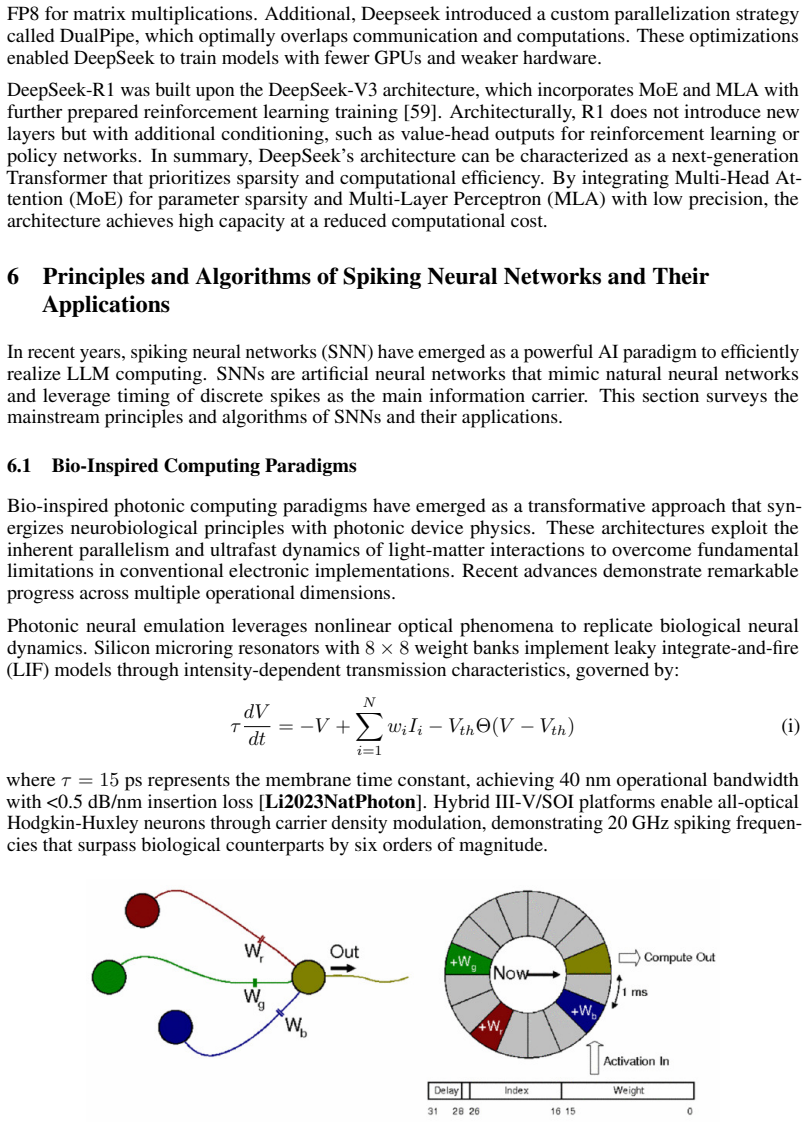
- [§6.1] The displayed equations (i)-(iii) lack a source and do not define all symbols; please provide citations or brief derivations for the leaky integrate-and-fire model, the STDP update rule, and the nonlinear Schrödinger equation as used here.
- [§8] The conclusion introduces terms such as PCSELs and topological insulators that are not discussed in the body of the paper; aligning the conclusion with the material actually reviewed would improve coherence.
- [Author contributions] The author contributions list names Y.G., H.H., and Y.Z. that do not appear in the author list, suggesting stale boilerplate; this should be corrected.
- [§5.9] In addition to the MoE/MLA error, the sentence 'By integrating Multi-Head Attention (MoE) for parameter sparsity and Multi-Layer Perceptron (MLA) with low precision, the architecture achieves high capacity at a reduced computational cost' is garbled and should be rewritten for clarity.
Circularity Check
No circular derivation: the central claim is a conditional survey-level extrapolation resting on external component literature, with only a non-load-bearing self-citation.
full rationale
By its own structure this is a survey, not a derivation: no target quantity is computed from an input, no parameter is fitted to a subset of data and then re-predicted, and no uniqueness theorem is invoked. The abstract's "orders of magnitude" sentence is explicitly conditional ("could potentially ... but require breakthroughs"), and its support is the component-level literature surveyed in Sections 2-4, including MZI meshes, MRR weight banks, 2D-material modulators, and spintronic synapses. The conclusion "PICs will eventually replace ICs" is presented as an expectation ("we expect"), not as a consequence of an equation. The one self-citation, reference [1] (the authors' own Advanced Materials survey), appears in the introduction to support the widely known existence of memory-processor bottlenecks; that premise is independently established, and removing [1] would not change any later claim. The paper even concedes in Sections 7.1, 7.3, and 7.4 that memory I/O reintroduces the von Neumann bottleneck, that ADC/DAC circuitry can occupy over 50% of a photonic transformer chip, and that native nonlinear functions are missing. These concessions weaken the extrapolation but do not make it circular. I therefore find no circular step; the score of 2 reflects only the presence of a non-load-bearing self-citation.
Assumptions & free parameters
assumptions (4)
- domain assumption Photonic components demonstrated in isolation can be scaled to LLM-scale integrated systems.
- domain assumption The performance numbers cited from prior component work (e.g., Table 2) are accurate and transferable to end-to-end LLM workloads.
- domain assumption Nonlinear activation functions (softmax, GeLU) can be implemented optically or hybridized without dominating cost.
- domain assumption Memory and storage bottlenecks can be overcome by future integration (on-chip nonvolatile memory, co-packaged optics, novel weight storage).
Cite this review
Pith. "Pith review of What Is Next for LLMs? Next-Generation AI Computing Hardware Using Photonic Chips." pith.science (2026). https://pith.science/paper/2RGAXY4A
@misc{pith2026250505794,
  author       = {Pith},
  title        = {Pith review of: What Is Next for LLMs? Next-Generation AI Computing Hardware Using Photonic Chips},
  year         = {2026},
  howpublished = {\url{https://pith.science/paper/2RGAXY4A}},
  note         = {Machine review of arXiv:2505.05794}
}
read the original abstract
Large language models (LLMs) are rapidly pushing the limits of contemporary computing hardware. For example, training GPT-3 has been estimated to consume around 1300 MWh of electricity, and projections suggest future models may require city-scale (gigawatt) power budgets. These demands motivate exploration of computing paradigms beyond conventional von Neumann architectures. This review surveys emerging photonic hardware optimized for next-generation generative AI computing. We discuss integrated photonic neural network architectures (e.g., Mach-Zehnder interferometer meshes, lasers, wavelength-multiplexed microring resonators) that perform ultrafast matrix operations. We also examine promising alternative neuromorphic devices, including spiking neural network circuits and hybrid spintronic-photonic synapses, which combine memory and processing. The integration of two-dimensional materials (graphene, TMDCs) into silicon photonic platforms is reviewed for tunable modulators and on-chip synaptic elements. Transformer-based LLM architectures (self-attention and feed-forward layers) are analyzed in this context, identifying strategies and challenges for mapping dynamic matrix multiplications onto these novel hardware substrates. We then dissect the mechanisms of mainstream LLMs, such as ChatGPT, DeepSeek, and LLaMA, highlighting their architectural similarities and differences. We synthesize state-of-the-art components, algorithms, and integration methods, highlighting key advances and open issues in scaling such systems to mega-sized LLM models. We find that photonic computing systems could potentially surpass electronic processors by orders of magnitude in throughput and energy efficiency, but require breakthroughs in memory, especially for long-context windows and long token sequences, and in storage of ultra-large datasets.
Figures


Figures from the paper (19 more)




Reference graph
Works this paper leans on
-
[1]
R. Li, Y . Gong, H. Huang, Y . Zhou, S. Mao, Z. Wei, and Z. Zhang. In:Advanced Materials 37.2 (2025), p. 2312825
2025
-
[2]
X. Xu, M. Tan, B. Corcoran, J. Wu, A. Boes, T. G. Nguyen, S. T. Chu, B. E. Little, D. G. Hicks, R. Morandotti, et al. In: Nature 589.7840 (2021), pp. 44–51
2021
-
[3]
Feldmann, N
J. Feldmann, N. Youngblood, M. Karpov, H. Gehring, X. Li, M. Stappers, M. Le Gallo, X. Fu, A. Lukashchuk, A. S. Raja, et al. In: Nature 589.7840 (2021), pp. 52–58
2021
-
[4]
Cheng, Y
J. Cheng, Y . Xie, Y . Liu, J. Song, X. Liu, Z. He, W. Zhang, X. Han, H. Zhou, K. Zhou, et al. In: Nanophotonics 12.20 (2023), pp. 3883–3894
2023
-
[5]
Y . Shen, N. C. Harris, S. Skirlo, M. Prabhu, T. Baehr-Jones, M. Hochberg, X. Sun, S. Zhao, H. Larochelle, D. Englund, et al. In: Nature photonics 11.7 (2017), pp. 441–446
2017
-
[6]
T. W. Hughes, M. Minkov, Y . Shi, and S. Fan. In: Optica 5.7 (2018), pp. 864–871
2018
-
[7]
H. Zhu, J. Zou, H. Zhang, Y . Shi, S. Luo, N. Wang, H. Cai, L. Wan, B. Wang, X. Jiang, et al. In:Nature communications 13.1 (2022), p. 1044
2022
-
[8]
S. Pai, Z. Sun, T. W. Hughes, T. Park, B. Bartlett, I. A. Williamson, M. Minkov, M. Milanizadeh, N. Abebe, F. Morichetti, et al. In: Science 380.6643 (2023), pp. 398–404
2023
Show all 101 references
-
[9]
X. Lin, Y . Rivenson, N. T. Yardimci, M. Veli, Y . Luo, M. Jarrahi, and A. Ozcan. In:Science 361.6406 (2018), pp. 1004–1008
2018
-
[10]
Z. Wang, T. Li, A. Soman, D. Mao, T. Kananen, and T. Gu. In:Nature communications 10.1 (2019), p. 3547
2019
-
[11]
C. Qian, X. Lin, X. Lin, J. Xu, Y . Sun, E. Li, B. Zhang, and H. Chen. In:Light: Science & Applications 9.1 (2020), p. 59
2020
-
[12]
Zarei, M.-r
S. Zarei, M.-r. Marzban, and A. Khavasi. In: Optics Express 28.24 (2020), pp. 36668–36684
2020
-
[13]
E. Goi, X. Chen, Q. Zhang, B. P. Cumming, S. Schoenhardt, H. Luan, and M. Gu. In: Light: Science & Applications 10.1 (2021), p. 40
2021
-
[14]
T. Zhou, X. Lin, J. Wu, Y . Chen, H. Xie, Y . Li, J. Fan, H. Wu, L. Fang, and Q. Dai. In:Nature Photonics 15.5 (2021), pp. 367–373
2021
-
[15]
X. Luo, Y . Hu, X. Ou, X. Li, J. Lai, N. Liu, X. Cheng, A. Pan, and H. Duan. In: Light: Science & Applications 11.1 (2022), p. 158
2022
-
[16]
C. Liu, Q. Ma, Z. J. Luo, Q. R. Hong, Q. Xiao, H. C. Zhang, L. Miao, W. M. Yu, Q. Cheng, L. Li, et al. In: Nature Electronics 5.2 (2022), pp. 113–122
2022
-
[17]
T. Fu, Y . Zang, Y . Huang, Z. Du, H. Huang, C. Hu, M. Chen, S. Yang, and H. Chen. In: Nature Communications 14.1 (2023), p. 70
2023
-
[18]
T. Yan, J. Wu, T. Zhou, H. Xie, F. Xu, J. Fan, L. Fang, X. Lin, and Q. Dai. In:Physical review letters 123.2 (2019), p. 023901
2019
-
[19]
Chang, V
J. Chang, V . Sitzmann, X. Dun, W. Heidrich, and G. Wetzstein. In:Scientific reports 8.1 (2018), pp. 1– 10
2018
-
[20]
Xiang, Z
S. Xiang, Z. Ren, Z. Song, Y . Zhang, X. Guo, G. Han, and Y . Hao. In:IEEE transactions on neural networks and learning systems 32.6 (2020), pp. 2494–2505
2020
-
[21]
Z. Chen, A. Sludds, R. Davis III, I. Christen, L. Bernstein, L. Ateshian, T. Heuser, N. Heermeier, J. A. Lott, S. Reitzenstein, et al. In: Nature Photonics 17.8 (2023), pp. 723–730
2023
-
[22]
Y . Shi, S. Xiang, X. Guo, Y . Zhang, H. Wang, D. Zheng, Y . Zhang, Y . Han, Y . Zhao, X. Zhu, et al. In: Photonics Research 11.8 (2023), pp. 1382–1389
2023
-
[23]
Xiang, Y
S. Xiang, Y . Shi, X. Guo, Y . Zhang, H. Wang, D. Zheng, Z. Song, Y . Han, S. Gao, S. Zhao, et al. In: Optica 10.2 (2023), pp. 162–171
2023
-
[24]
A. N. Tait, T. F. De Lima, E. Zhou, A. X. Wu, M. A. Nahmias, B. J. Shastri, and P. R. Prucnal. In: Scientific reports 7.1 (2017), p. 7430
2017
-
[25]
Feldmann, N
J. Feldmann, N. Youngblood, C. D. Wright, H. Bhaskaran, and W. H. Pernice. In: Nature 569.7755 (2019), pp. 208–214
2019
-
[26]
J. You, Y . Luo, J. Yang, J. Zhang, K. Yin, K. Wei, X. Zheng, and T. Jiang. In: Laser & Photonics Reviews 14.12 (2020)
2020
-
[27]
F. Xia, T. Mueller, Y .-m. Lin, A. Valdes-Garcia, and P. Avouris. In:Nature nanotechnology 4.12 (2009), pp. 839–843
2009
-
[28]
W. Li, B. Chen, C. Meng, W. Fang, Y . Xiao, X. Li, Z. Hu, Y . Xu, L. Tong, H. Wang, et al. In:Nano letters 14.2 (2014), pp. 955–959. 33
2014
-
[29]
Cheng, R
Z. Cheng, R. Cao, K. Wei, Y . Yao, X. Liu, J. Kang, J. Dong, Z. Shi, H. Zhang, and X. Zhang. In: Advanced Science 8.11 (2021)
2021
-
[30]
J. Wu, H. Ma, P. Yin, Y . Ge, Y . Zhang, L. Li, H. Zhang, and L. Hongtao. In: Small Science 1.4 (2020)
2020
-
[31]
Busschaert, R
S. Busschaert, R. Reimann, M. Cavigelli, R. Khelifa, A. Jain, and L. Novotny. In: ACS Photonics 7.9 (2020), pp. 2482–2488
2020
-
[32]
X. Cao, C. Jiang, D. Tan, Q. Li, S. Bi, and J. Song. In: Journal of Science: Advanced Materials and Devices 6.2 (2021), pp. 135–152
2021
-
[33]
B. A. Marquez, H. Morison, Z. Guo, M. Filipovich, P. R. Prucnal, and B. J. Shastri. In: MRS Advances 5.37-38 (2020), pp. 1909–1917
2020
-
[34]
Pelgrin, H
V . Pelgrin, H. H. Yoon, E. Cassan, and Z. Sun. In: Light: Advanced Manufacturing 4.14 (2023)
2023
-
[35]
Bandyopadhyay, A
S. Bandyopadhyay, A. Sludds, S. Krastanov, R. Hamerly, N. Harris, D. Bunandar, M. Streshinsky, M. Hochberg, and D. Englund. In: Nature Photonics 18.12 (2024), pp. 1335–1343
2024
-
[36]
Rizzo, A
A. Rizzo, A. Novick, V . Gopal, B. Y . Kim, X. Ji, S. Daudlin, Y . Okawachi, Q. Cheng, M. Lipson, A. L. Gaeta, et al. In: Nature Photonics 17.9 (2023), pp. 781–790
2023
-
[37]
https : / / www
Roni Peleg. https : / / www . graphene - info . com / black - semiconductor - opens - new - headquarters-fabone-production-energy-efficient . Accessed: 2025-04-07
2025
-
[38]
Vranic, R
S. Vranic, R. Kurapati, K. Kostarelos, and A. Bianco. In:JNatural Reviews Chemistry9 (2025), pp. 173– 184
2025
-
[39]
Vaswani, N
A. Vaswani, N. Shazeer, N. Parmar, J. Uszkoreit, L. Jones, A. N. Gomez,´L. Kaiser, and I. Polosukhin. In: Advances in Neural Information Processing Systems. 2017, pp. 5998–6008
2017
-
[40]
Radford, J
A. Radford, J. Wu, R. Child, D. Luan, D. Amodei, and I. Sutskever. https://openai.com/blog/ better-language-models/ . OpenAI, 2019. 2019
2019
- [41]
- [43]
-
[44]
E. G. Matthew Renze. In: arXiv preprint arXiv:2405.06682 (2023)
2023 arXiv
-
[45]
Y . Qu, T. Zhang, N. Garg, and A. Kumar. In:Advances in Neural Information Processing Systems 37 (2024), pp. 55249–55285
2024
- [46]
- [47]
- [49]
- [50]
-
[51]
Z. Su, H. Liu, et al. In: arXiv preprint arXiv:2104.09864 (2021)
2021 arXiv
- [52]
-
[53]
J. Bai, S. Bai, Y . Chu, Z. Cui, K. Dang, X. Deng, Y . Fan, W. Ge, Y . Han, F. Huang, et al. In:arXiv preprint arXiv:2309.16609 (2023)
2023 arXiv
-
[54]
In: arXiv preprint arXiv:2303.08774 (2024)
OpenAI. In: arXiv preprint arXiv:2303.08774 (2024)
2024 arXiv
- [55]
-
[56]
Chowdhery, S
A. Chowdhery, S. Narang, J. Devlin, M. Bosma, G. Mishra, A. Roberts, P. Barham, H. W. Chung, C. Sutton, S. Gehrmann, et al. In: Journal of Machine Learning Research 24.240 (2023), pp. 1–113
2023
- [57]
-
[58]
X. Bi, D. Chen, G. Chen, S. Chen, D. Dai, C. Deng, H. Ding, K. Dong, Q. Du, Z. Fu, et al. In: arXiv preprint arXiv:2401.02954 (2024)
2024 arXiv
-
[59]
D. Guo, D. Yang, H. Zhang, J. Song, R. Zhang, R. Xu, Q. Zhu, S. Ma, P. Wang, X. Bi, et al. In:arXiv preprint arXiv:2501.12948 (2025)
2025 arXiv
-
[60]
Zhang and B
L. Zhang and B. Zhang. In: IEEE transactions on neural networks 10.4 (1999), pp. 925–929
1999
-
[61]
M. Xu, D. Ma, H. Tang, Q. Zheng, and G. Pan. In: Advances in Neural Information Processing Systems 37 (2024), pp. 91930–91950
2024
-
[62]
Theunissen and J
F. Theunissen and J. P. Miller. In: Journal of computational neuroscience 2 (1995), pp. 149–162
1995
-
[63]
Nomura, Y
O. Nomura, Y . Sakemi, T. Hosomi, and T. Morie. In:IEEE Transactions on Circuits and Systems II: Express Briefs 69.9 (2022), pp. 3640–3644
2022
-
[64]
Panzeri and S
S. Panzeri and S. R. Schultz. In: Neural Computation 13.6 (2001), pp. 1311–1349
2001
-
[65]
N. Lin, S. Wang, Y . Li, B. Wang, S. Shi, Y . He, W. Zhang, Y . Yu, Y . Zhang, X. Zhang, et al. In:Nature Computational Science (2025), pp. 1–11
2025
-
[66]
M. Yao, X. Qiu, T. Hu, J. Hu, Y . Chou, K. Tian, J. Liao, L. Leng, B. Xu, and G. Li. In:IEEE Transactions on Pattern Analysis and Machine Intelligence (2025). 34
2025
-
[67]
J. J. Hopfield. In: Nature 376.6535 (1995), pp. 33–36
1995
-
[68]
Gallego, T
G. Gallego, T. Delbrück, G. Orchard, C. Bartolozzi, B. Taba, A. Censi, S. Leutenegger, A. J. Davison, J. Conradt, K. Daniilidis, et al. In: IEEE transactions on pattern analysis and machine intelligence 44.1 (2020), pp. 154–180
2020
-
[69]
Huang, Y
T. Huang, Y . Zheng, Z. Yu, R. Chen, Y . Li, R. Xiong, L. Ma, J. Zhao, S. Dong, L. Zhu, et al. In: Engineering 25 (2023), pp. 110–119
2023
-
[70]
Z. Pan, Y . Chua, J. Wu, M. Zhang, H. Li, and E. Ambikairajah. In:Frontiers in neuroscience13 (2020), p. 1420
2020
-
[71]
X. Chen, Q. Yang, J. Wu, H. Li, and K. C. Tan. In:IEEE transactions on pattern analysis and machine intelligence 46.5 (2023), pp. 3064–3078
2023
-
[72]
Borthakur and T
A. Borthakur and T. A. Cleland. In: Frontiers in neuroscience13 (2019), p. 656
2019
-
[73]
J.-K. Han, M. Kang, J. Jeong, I. Cho, J. -M. Yu, K.-J. Yoon, I. Park, and Y .-K. Choi. In: Advanced Science 9.18 (2022), p. 2106017
2022
-
[74]
Bartolozzi
C. Bartolozzi. In: Science 360.6392 (2018), pp. 966–967
2018
-
[75]
N. Bai, Y . Xue, S. Chen, L. Shi, J. Shi, Y . Zhang, X. Hou, Y . Cheng, K. Huang, W. Wang, et al. In: Nature Communications 14.1 (2023), p. 7121
2023
-
[76]
Y . Hu, H. Tang, and G. Pan. In:IEEE Transactions on Neural Networks and Learning Systems 34.8 (2021), pp. 5200–5205
2021
-
[77]
K. He, X. Zhang, S. Ren, and J. Sun. In: Proceedings of the IEEE conference on computer vision and pattern recognition. 2016, pp. 770–778
2016
-
[78]
M. Yao, H. Gao, G. Zhao, D. Wang, Y . Lin, Z. Yang, and G. Li. In: Proceedings of the IEEE/CVF international conference on computer vision. 2021, pp. 10221–10230
2021
-
[79]
Z. Zhou, Y . Zhu, C. He, Y . Wang, Y . Shuicheng, Y . Tian, and L. Yuan. In:The Eleventh International Conference on Learning Representations
-
[80]
W. Pan, F. Zhao, Z. Zhao, and Y . Zeng. In: IEEE Transactions on Artificial Intelligence (2024)
2024
-
[81]
C. Xiao, Z. Zhang, C. Song, D. Jiang, F. Yao, X. Han, X. Wang, S. Wang, Y . Huang, G. Lin, et al. In: arXiv preprint arXiv:2409.02877 (2024)
2024 arXiv
-
[82]
Bi and M.-m
G.-q. Bi and M.-m. Poo. In: Nature 401.6755 (1999), pp. 792–796
1999
-
[83]
Guyonneau, R
R. Guyonneau, R. VanRullen, and S. J. Thorpe. In: Neural Computation 17.4 (2005), pp. 859–879
2005
-
[84]
Masquelier and S
T. Masquelier and S. J. Thorpe. In: PLoS computational biology 3.2 (2007), e31
2007
-
[85]
Zhang, Y
T. Zhang, Y . Zeng, D. Zhao, and M. Shi. In:Proceedings of the AAAI conference on artificial intelligence. V ol. 32. 1. 2018
2018
-
[86]
M. Shi, T. Zhang, and Y . Zeng. In: Frontiers in Computational Neuroscience14 (2020), p. 7
2020
-
[87]
Zhang, S
T. Zhang, S. Jia, X. Cheng, and B. Xu. In:IEEE Transactions on Neural Networks and Learning Systems 33.12 (2021), pp. 7621–7631
2021
-
[88]
Zhang, T
D. Zhang, T. Zhang, S. Jia, and B. Xu. In: Proceedings of the AAAI conference on artificial intelligence. V ol. 36. 1. 2022, pp. 59–67
2022
-
[89]
Z. Hao, J. Ding, T. Bu, T. Huang, and Z. Yu. In:The Eleventh International Conference on Learning Representations
-
[90]
Huang, X
Z. Huang, X. Shi, Z. Hao, T. Bu, J. Ding, Z. Yu, and T. Huang. In: Proceedings of the 32nd ACM International Conference on Multimedia. 2024, pp. 10688–10697
2024
-
[91]
B. Han, G. Srinivasan, and K. Roy. In: Proceedings of the IEEE/CVF conference on computer vision and pattern recognition. 2020, pp. 13558–13567
2020
-
[92]
Y . Wu, L. Deng, G. Li, J. Zhu, and L. Shi. In: Frontiers in neuroscience12 (2018), p. 331
2018
-
[93]
Q. Meng, M. Xiao, S. Yan, Y . Wang, Z. Lin, and Z. -Q. Luo. In: Proceedings of the IEEE/CVF International Conference on Computer Vision. 2023, pp. 6166–6176
2023
-
[94]
W. Fang, Z. Yu, Z. Zhou, D. Chen, Y . Chen, Z. Ma, T. Masquelier, and Y . Tian. In:Advances in Neural Information Processing Systems 36 (2023), pp. 53674–53687
2023
-
[95]
Zhang, M
J. Zhang, M. Zhang, Y . Wang, Q. Liu, B. Yin, H. Li, and X. Yang. In:IEEE Transactions on Image Processing (2025)
2025
-
[96]
Z. Pan, M. Zhang, J. Wu, J. Wang, and H. Li. In: IEEE/ACM Transactions on Audio, Speech, and Language Processing 29 (2021), pp. 2656–2670
2021
-
[97]
X. Qiu, M. Zhang, J. Zhang, W. Wei, H. Cao, J. Guo, R.-J. Zhu, Y . Shan, Y . Yang, and H. Li. In:arXiv preprint arXiv:2501.13492 (2025)
2025 arXiv
-
[98]
X. Ju, B. Fang, R. Yan, X. Xu, and H. Tang. In: Neural computation 32.1 (2020), pp. 182–204
2020
-
[99]
S.-Q. Wang, L. Wang, Y . Deng, Z.-J. Yang, S.-S. Guo, Z.-Y . Kang, Y .-F. Guo, and W.-X. Xu. In: Journal of Computer Science and Technology 35 (2020), pp. 475–489
2020
-
[100]
Q. Chen, C. Gao, X. Fang, and H. Luan. In:IEEE Transactions on Computer-Aided Design of Integrated Circuits and Systems 41.12 (2022), pp. 5732–5736. 35
2022
-
[101]
M. T. L. Aung, C. Qu, L. Yang, T. Luo, R. S. M. Goh, and W.-F. Wong. In: 2021 31st International Conference on Field-Programmable Logic and Applications (FPL). IEEE. 2021, pp. 28–32
2021
-
[102]
J. Li, G. Shen, D. Zhao, Q. Zhang, and Y . Zeng. In:IEEE Transactions on Very Large Scale Integration (VLSI) Systems 31.8 (2023), pp. 1178–1191
2023
-
[103]
J. Li, G. Shen, D. Zhao, Q. Zhang, and Y . Zeng. In:IEEE Transactions on Computer-Aided Design of Integrated Circuits and Systems (2024). 36
2024
Reviewed August 15, 2026 · model on record in the stance chip above.
Discussion (0). Continue with ORCID to comment.