REVIEW 2 major objections 4 minor 36 references
Best of Both Worlds Guarantees for Equitable Allocations
T0 review · 2 major / 4 minor · reviewed 2026-08-15 · deepseek-v4-flash
Pith's one-line read Fair lotteries always exist for two agents; at three they can fail, and deciding is NP-complete.
desk verdict Settles the BoBW question for equitability with a clean characterization and matching complexity bounds; deserves a serious referee, but check the external EQX citation. read the letter →
The pith
A machine-rendered reading of the paper's core claim, the machinery that carries it, and where it could break.
The reading
What carries the argument
The central object is the value-vector set of EQ1 allocations, $\{\vec{v}(A) : A \text{ is EQ1}\}$, together with the diagonal in $\mathbb{R}^n$. A BoBW lottery exists exactly when the convex hull of these value vectors meets the diagonal; equivalently, no zero-sum linear functional separates the two. For two agents this condition reduces to the existence of $i$-biased EQ1 allocations for both agents, and the algorithm constructs one by starting from a linear-time EQX allocation and transferring 'compressing' goods one at a time. For binary valuations, the machinery is a rounding theorem for linear programs with bihierarchical constraint structures, a generalization of Birkhoff–von Neumann decomposition, which turns the optimal fractional EQ solution into a convex combination of integral EQ1 allocations.
What would settle it
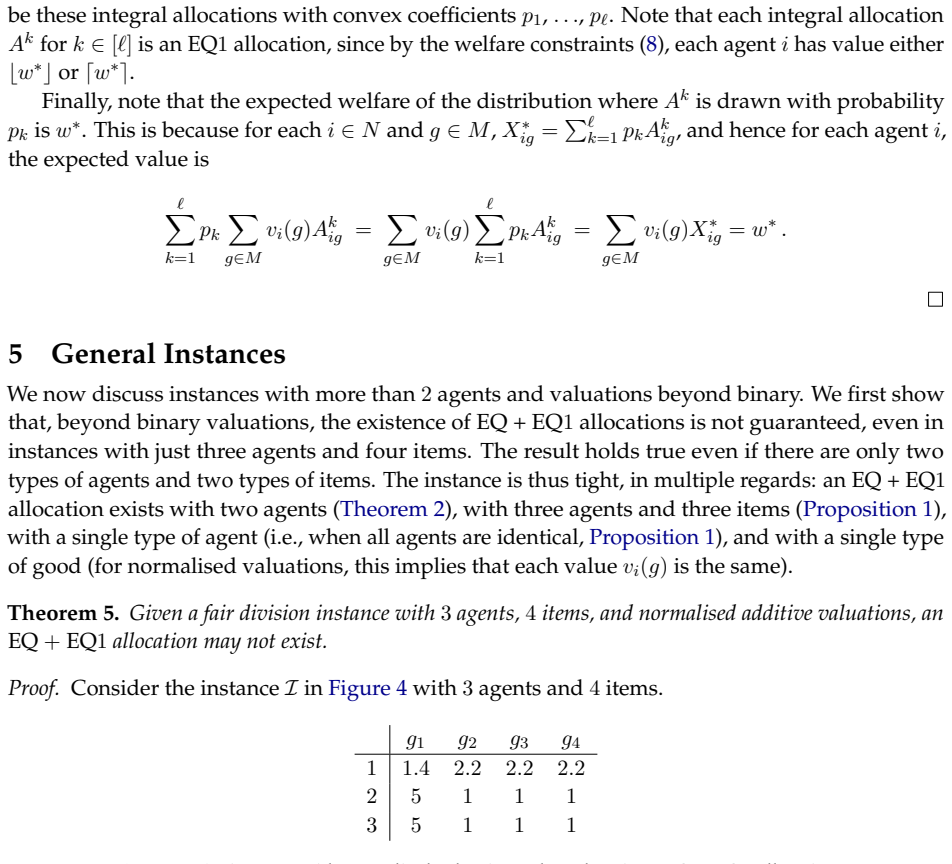
Enumerate all integral allocations of the paper's three-agent, four-item example (Figure 4) and check whether every EQ1 allocation gives agent 1 less than the average of agents 2 and 3, confirming the claimed non-existence; or brute-force search small two-agent normalized instances for any counterexample to the claimed universal existence, which would refute Theorem 2.
Extended reading notes
Core claim
The paper establishes the full existence and complexity landscape for ex ante EQ / ex post EQ1 randomized allocations. Its central positive results are that such allocations always exist and are linearly computable for two agents, and that for binary valuations they exist for any number of agents while attaining the same social welfare as the best fractional EQ allocation. Its central negative results are that with three agents and four items such allocations can fail to exist, that deciding existence is weakly NP-complete for three agents and strongly NP-complete in general, and that a pseudo-polynomial algorithm handles any constant number of agents. The load-bearing characterization is geometric: an instance admits the allocation iff for every $\lambda$ with $\sum_i \lambda_i = 0$ there is some EQ1 allocation $A$ with $\sum_i \lambda_i v_i(A_i) \ge 0$, an equivalence proven by LP duality.
Load-bearing premise
The paper relies on two cited theorems it does not reprove: that an EQX allocation can be computed in linear time for two agents, and that fractional solutions to linear programs with bihierarchical constraints decompose into whole solutions; if either theorem fails in the relevant setting, the matching existence proof collapses.
Editorial extensions
If this is right
- Any two-agent fair division system can simultaneously promise ex ante equal utility and ex post EQ1, with an $O(m)$ algorithm suitable for large item sets.
- For binary valuations, randomization costs nothing: the fair lottery can match the social welfare of the best fractional equitable allocation.
- For three or more agents, efficient general algorithms are impossible unless P = NP, so practical systems must either restrict valuations or settle for approximate equitability.
- The three-agent, four-item counterexample pinpoints the exact boundary of guaranteed existence: two agents always work, three agents with four items can fail.
- The $i$-biased EQ1 notion gives a new lever: for two agents, checking both biased allocations certifies BoBW existence, while for three agents the check becomes NP-hard.
Reading between the lines
- Inference: the two-agent compression argument may extend to approximate ex ante equitability ($\alpha$-EQ with $\alpha < 1$), which the paper raises as an open question; the transfer-and-swap structure suggests small slack can restore existence for small groups.
- Inference: the bihierarchical rounding used for binary valuations is a candidate template for matroid-rank valuations, as the paper suggests; a direct check is whether the welfare LP's constraint matrix stays bihierarchical under matroid constraints.
- Inference: the zero-sum separation condition is a general recipe: for any ex post fairness notion with a value-vector set, BoBW existence is equivalent to the convex hull touching the diagonal, which could classify other fairness notions.
- Inference: the non-existence example may be useful as a stress test for heuristic or approximate BoBW algorithms, since it is minimal in agents, items, and valuation types.
Signed reviews
Editorial analysis
A structured set of objections, weighed in public.
Referee Report
Summary. The paper studies randomized allocations that are equitable in expectation (ex ante EQ) and equitable up to one item in every realized outcome (ex post EQ1), with an analogous variant for EQX. It gives a geometric characterization (Theorem 1) of instances admitting such allocations via a linear-programming duality argument, and then derives a detailed landscape: for two agents with normalized additive valuations, an EQ+EQ1 allocation always exists and is claimed to be computable in O(m) time (Theorem 2); for binary valuations, an EQ+EQ1 allocation with optimal welfare over all fractional EQ allocations exists and is efficiently computable (Theorem 3); for three or more agents, such allocations may fail to exist (Theorem 5), and deciding existence is weakly NP-complete for three agents (Theorem 6) and strongly NP-complete in general (Theorem 7). The paper also gives a pseudopolynomial-time algorithm for a constant number of agents (Theorem 8) and studies i-biased EQ1 allocations, including their NP-hardness (Theorem 9).
Significance. The paper contributes a clean and useful characterization of best-of-both-worlds equitability, and the contrast with the always-positive results for envy-freeness is conceptually interesting. The characterization theorem is proved directly via LP duality and is likely to be reusable. The binary-valuation result is a strong positive result: it shows that, in that domain, the ex post EQ1 constraint causes no loss in social welfare relative to all fractional EQ allocations, and the proof via bihierarchical decomposition is well matched to the problem. The complexity results, if correct after repairs, provide a fairly complete picture. The paper is also careful about normalization and about stating the dependence on external results, though, as detailed below, one of those external dependencies needs verification and one reduction has a gap that currently leaves Theorem 9 unproved as stated.
major comments (2)
- [Section 3, Theorem 2 and Algorithm 1] The proof begins by invoking [GMT14] for an EQX allocation computable in O(m) time, and this is load-bearing: the EQX property is used to infer that v2(g) >= delta for every g in A2, which forces C subset of A1 and supports the transfer/swap argument in Cases 1 and 2. As used elsewhere in the paper, [GMT14] is cited for EQ1/EF1 allocations, not for EQX. The manuscript neither states the exact theorem from [GMT14] nor proves that an EQX allocation for two agents exists and is computable in O(m). If [GMT14] only guarantees EQ1, the proof of Theorem 2 is unsupported and the claimed O(m) time may be incorrect. The authors should either supply a correct citation, e.g., the two-agent EQX result of [FSVX19] if that is intended, or prove the needed EQX guarantee and re-derive the running time accordingly.
- [Section 5, Theorem 9 proof] The reverse direction of the NP-hardness reduction states that d cannot be assigned to agent 2 or agent 3 in any 1-biased EQ1 allocation. This is false without an additional assumption on m. For example, take m=2, b1=3, b2=1, T=2. The allocation A1={g1}, A2={d}, A3={g2} gives values (2,2,1) and is 1-biased and EQ1, but the 2-PARTITION instance has no solution. Thus, as written, the reduction does not prove NP-hardness. The argument can likely be repaired by assuming m>=5, with a padding argument, or by a modified case analysis, but this is a load-bearing gap in a claimed hardness result.
minor comments (4)
- [Section 8, Claim 3 proof] In the inductive step for g_t in A1, the second occurrence of 'condition (C1b)' should be 'condition (C1a)', and the variable 'v_i(g_t)' should be 'v_1(g_t)'. As written, the proof text is internally inconsistent.
- [Section 5, Theorem 7 proof] In the reverse direction, the text says that two goods are 'of utility 2/3T each' but the table gives (2m/3)T per partition item; later 'the integers in S_i' should be 'the integers in S'. These are typos but they make the proof hard to follow.
- [Section 5, Theorem 5 example] The values 1.4 and 2.2 in Figure 4 are not integers, while the formal model in Section 2 states v_i: M -> Z+. The example can be scaled by 5 to fit the model, and this should be stated.
- [Section 4, proof of Theorem 3] When applying Theorem 4 to the polytope P2, the nonnegativity constraints (10) should be written with an explicit upper bound of 1 for each variable, which is implied by the assignment constraints, so that the lower and upper bound vectors in the theorem are integral. The current wording leaves this implicit.
Circularity Check
No significant circularity: Theorem 1 is proved by LP duality, and the load-bearing external citations to [GMT14] and [BCKM13] are not self-citations.
full rationale
The paper's central characterization (Theorem 1) is proved directly by LP duality: condition (2) is the dual separation condition for the primal asking for a convex combination of EQ1 allocations with equal utilities, so it is not a restatement of the target definition and neither direction assumes the conclusion. Corollary 1 follows by specializing lambda to (lambda, -lambda), and the two-agent proof of Theorem 2 is a constructive transfer/swap argument that starts from an EQX allocation; the only external input is the existence and O(m) computability of an EQX allocation from [GMT14], whose authors are distinct from the present paper's authors. That is independent published support, not a self-citation chain, and any doubt about the exact statement or complexity of [GMT14] is a correctness risk rather than circularity. The binary-valuation result (Theorem 3) optimizes welfare over fractional EQ allocations via LP L1, then uses the bihierarchical decomposition theorem of Budish, Che, Kojima, and Milgrom [BCKM13] to decompose the optimal fractional point into integral allocations whose per-agent values are floor(w*) or ceil(w*), hence EQ1; the welfare target w* is the LP optimum being studied, not an assumed output, and the decomposition theorem is external and parameter-free. The hardness reductions and the pseudo-polynomial dynamic program are self-contained relative to standard NP-complete problems and direct DP arguments. I find no fitted parameter renamed as a prediction, no ansatz smuggled in by citation, no uniqueness theorem imported from the authors' own prior work, and no result defined in terms of its own conclusion. The only caveat worth flagging is the paper's reliance on the external [GMT14] guarantee in Algorithm 1 and on [BCKM13] in Theorem 3; both are load-bearing but neither is circular, so the circularity score is 0.
Assumptions & free parameters
assumptions (4)
- domain assumption Valuations are normalized: v_i(M) = t for all agents i, with integer values.
- standard math Every fractional allocation can be decomposed into a distribution over at most mn+1 integral allocations (Carathéodory's theorem).
- domain assumption EQX allocations exist for two agents and can be computed in linear time.
- domain assumption Bihierarchical constraint matrices give integral polytopes.
Cite this review
Pith. "Pith review of Best of Both Worlds Guarantees for Equitable Allocations." pith.science (2026). https://pith.science/paper/V3RUA6ZD
@misc{pith2026250505809,
  author       = {Pith},
  title        = {Pith review of: Best of Both Worlds Guarantees for Equitable Allocations},
  year         = {2026},
  howpublished = {\url{https://pith.science/paper/V3RUA6ZD}},
  note         = {Machine review of arXiv:2505.05809}
}
read the original abstract
Equitability is a well-studied fairness notion in fair division, where an allocation is equitable if all agents receive equal utility from their allocation. For indivisible items, an exactly equitable allocation may not exist, and a natural relaxation is EQ1, which stipulates that any inequitability should be resolved by the removal of a single item. In this paper, we study equitability in the context of randomized allocations. Specifically, we aim to achieve equitability in expectation (ex ante EQ) and require that each deterministic outcome in the support satisfies ex post EQ1. Such an allocation is commonly known as a `Best of Both Worlds' allocation, and has been studied, e.g., for envy-freeness and MMS. We characterize the existence of such allocations using a geometric condition on linear combinations of EQ1 allocations, and use this to give comprehensive results on both existence and computation. For two agents, we show that ex ante EQ and ex post EQ1 allocations always exist and can be computed in polynomial time. For three or more agents, however, such allocations may not exist. We prove that deciding existence of such allocations is strongly NP-complete in general, and weakly NP-complete even for three agents. We also present a pseudo-polynomial time algorithm for a constant number of agents. We show that when agents have binary valuations, best of both worlds allocations that additionally satisfy welfare guarantees exist and are efficiently computable.
Figures


Figures from the paper (6 more)


Reference graph
Works this paper leans on
-
[1]
Best of both worlds: Ex ante and ex post fairness in resource allocation
Haris Aziz, Rupert Freeman, Nisarg Shah, and Rohit Vaish. Best of both worlds: Ex ante and ex post fairness in resource allocation. Oper. Res. , 72:1674--1688, 2023
work page 2023
-
[2]
Achieving envy-freeness and equitability with monetary transfers
Haris Aziz. Achieving envy-freeness and equitability with monetary transfers. In Thirty-Fifth AAAI Conference on Artificial Intelligence, AAAI 2021 , pages 5102--5109. AAAI Press, 2021
work page 2021
-
[3]
Nearly equitable allocations beyond additivity and monotonicity
Siddharth Barman, Umang Bhaskar, Yeshwant Pandit, and Soumyajit Pyne. Nearly equitable allocations beyond additivity and monotonicity. In Proceedings of the AAAI Conference on Artificial Intelligence , volume 38, pages 9494--9501, 2024
work page 2024
- [4]
-
[5]
Designing random allocation mechanisms: Theory and applications
Eric Budish, Yeon-Koo Che, Fuhito Kojima, and Paul Milgrom. Designing random allocation mechanisms: Theory and applications. American Economic Review , 103(2):585–623, April 2013
work page 2013
-
[6]
Eric Budish, G\' e rard P. Cachon, Judd B. Kessler, and Abraham Othman. Course match: A large-scale implementation of approximate competitive equilibrium from equal incomes for combinatorial allocation. Oper. Res. , 65(2):314–336, April 2017
work page 2017
-
[7]
On best-of-both-worlds fair-share allocations
Moshe Babaioff, Tomer Ezra, and Uriel Feige. On best-of-both-worlds fair-share allocations. In Web and Internet Economics: 18th International Conference, WINE 2022, Troy, NY, USA, December 12–15, 2022, Proceedings , page 237–255, Berlin, Heidelberg, 2022. Springer-Verlag
work page 2022
- [8]
Show all 36 references
-
[9]
A new solution to the random assignment problem
Anna Bogomolnaia and Hervé Moulin. A new solution to the random assignment problem. Journal of Economic Theory , 100(2):295--328, 2001
2001
-
[10]
The price of equity with binary valuations and few agent types
Umang Bhaskar, Neeldhara Misra, Aditi Sethia, and Rohit Vaish. The price of equity with binary valuations and few agent types. In Algorithmic Game Theory: 16th International Symposium, SAGT 2023, Egham, UK, September 4–7, 2023, Proceedings , page 271–289, Berlin, Heidelberg, 2...
2023
-
[11]
Fair Division: From cake-cutting to dispute resolution
Steven J Brams and Alan D Taylor. Fair Division: From cake-cutting to dispute resolution . Cambridge University Press, 1996
1996
-
[12]
The Combinatorial Assignment Problem: Approximate Competitive Equilibrium from Equal Incomes
Eric Budish. The Combinatorial Assignment Problem: Approximate Competitive Equilibrium from Equal Incomes . Journal of Political Economy , 119(6):1061--1103, 2011
2011
-
[13]
How to Cut a Cake Fairly
Lester E Dubins and Edwin H Spanier. How to Cut a Cake Fairly . The American Mathematical Monthly , 68(1P1):1--17, 1961
1961
-
[14]
Narayan, and Tomasz Ponitka
Michal Feldman, Simon Mauras, Vishnu V. Narayan, and Tomasz Ponitka. Breaking the envy cycle: Best-of-both-worlds guarantees for subadditive valuations. In Proceedings of the 25th ACM Conference on Economics and Computation , EC '24, New York, USA, 2024
2024
-
[15]
Resource Allocation and the Public Sector
Duncan Foley. Resource Allocation and the Public Sector . Yale Economic Essays , pages 45--98, 1967
1967
-
[16]
Equitable Allocations of Indivisible Goods
Rupert Freeman, Sujoy Sikdar, Rohit Vaish, and Lirong Xia. Equitable Allocations of Indivisible Goods . In Proceedings of the 28th International Joint Conference on Artificial Intelligence , pages 280--286, 2019
2019
-
[17]
Equitable allocations of indivisible chores
Rupert Freeman, Sujoy Sikdar, Rohit Vaish, and Lirong Xia. Equitable allocations of indivisible chores. In Proceedings of the 19th International Conference on Autonomous Agents and MultiAgent Systems , AAMAS '20, page 384–392, Richland, SC, 2020
2020
-
[18]
Garey and David S
Michael R. Garey and David S. Johnson. Computers and Intractability: A Guide to the Theory of NP-completeness . A Series of Books in the Mathematical Sciences. W. H. Freeman & Co., New York, 2009
2009
-
[19]
Procaccia, and Yair Zick
Ya’akov (Kobi) Gal, Moshe Mash, Ariel D. Procaccia, and Yair Zick. Which is the fairest (rent division) of them all? J. ACM , 64(6), November 2017
2017
-
[20]
Near Fairness in Matroids
Laurent Gourv \`e s, J \'e r \^o me Monnot, and Lydia Tlilane. Near Fairness in Matroids . In Proceedings of the 21st European Conference on Artificial Intelligence , pages 393--398, 2014
2014
-
[21]
Procaccia
Jonathan Goldman and Ariel D. Procaccia. Spliddit: unleashing fair division algorithms. SIGecom Exch. , 13(2):41–46, January 2015
2015
-
[22]
Herreiner and Clemens D
Dorothea K. Herreiner and Clemens D. Puppe. Envy freeness in experimental fair division problems. Theory and Decision , 67(1):65--100, Jul 2009
2009
-
[23]
Herreiner and Clemens Puppe
Dorothea K. Herreiner and Clemens Puppe. Inequality aversion and efficiency with ordinal and cardinal social preferences—an experimental study. Journal of Economic Behavior and Organization , 76(2):238--253, 2010
2010
-
[24]
Equitable allocations of mixtures of goods and chores, 2025
Hadi Hosseini and Aditi Sethia. Equitable allocations of mixtures of goods and chores, 2025. https://arxiv.org/abs/2501.06799 arXiv:2501.06799
2025 arXiv
-
[25]
Best of both worlds: Agents with entitlements
Martin Hoefer, Marco Schmalhofer, and Giovanna Varricchio. Best of both worlds: Agents with entitlements. In Proceedings of the 2023 International Conference on Autonomous Agents and Multiagent Systems , AAMAS '23, page 564–572, Richland, SC, 2023. International Foundation for...
2023
-
[26]
On the complexity of fair house allocation
Naoyuki Kamiyama, Pasin Manurangsi, and Warut Suksompong. On the complexity of fair house allocation. Oper. Res. Lett. , 49:572--577, 2021
2021
-
[27]
On Approximately Fair Allocations of Indivisible Goods
Richard J Lipton, Evangelos Markakis, Elchanan Mossel, and Amin Saberi. On Approximately Fair Allocations of Indivisible Goods . In Proceedings of the 5th ACM Conference on Electronic Commerce , pages 125--131, 2004
2004
-
[28]
The conference paper assignment problem: Using order weighted averages to assign indivisible goods
Jing Wu Lian, Nicholas Mattei, Renee Noble, and Toby Walsh. The conference paper assignment problem: Using order weighted averages to assign indivisible goods. Proceedings of the AAAI Conference on Artificial Intelligence , 32(1), Apr. 2018
2018
-
[29]
The complexity of minimizing envy in house allocation
Jayakrishnan Madathil, Neeldhara Misra, and Aditi Sethia. The complexity of minimizing envy in house allocation. In Proceedings of the 2023 International Conference on Autonomous Agents and Multiagent Systems , AAMAS '23, page 2673–2675, Richland, SC, 2023
2023
-
[30]
Fair Division and Collective Welfare
Herv \'e Moulin. Fair Division and Collective Welfare . MIT press, 2004
2004
-
[31]
Randomized strategyproof mechanisms with best of both worlds fairness and efficiency
Ankang Sun and Bo Chen. Randomized strategyproof mechanisms with best of both worlds fairness and efficiency. European Journal of Operational Research , 2025
2025
-
[32]
Equitability and Welfare Maximization for Allocating Indivisible Items
Ankang Sun, Bo Chen, and Xuan Vinh Doan. Equitability and Welfare Maximization for Allocating Indivisible Items . Autonomous Agents and Multi-Agent Systems , 37(8), 2023
2023
-
[33]
The Problem of Fair Division
Hugo Steinhaus. The Problem of Fair Division . Econometrica , 16(1):101--104, 1948
1948
-
[34]
Rental harmony: Sperner's lemma in fair division
Francis Edward Su. Rental harmony: Sperner's lemma in fair division. American Mathematical Monthly , 106:930--942, 1999
1999
-
[35]
Equity, envy, and efficiency
Hal R Varian. Equity, envy, and efficiency. Journal of Economic Theory , 9(1):63--91, 1974
1974
-
[36]
A Certain Zero-sum Two-person Game Equivalent to the Optimal Assignment Problem , pages 5--12
John von Neumann. A Certain Zero-sum Two-person Game Equivalent to the Optimal Assignment Problem , pages 5--12. Princeton University Press, Princeton, 1953
1953
Reviewed August 15, 2026 · model on record in the stance chip above.
Discussion (0). Continue with ORCID to comment.