REVIEW 3 major objections 5 minor 86 references
Symbol-based entity marker highlighting for enhanced text mining in materials science with generative AI
T0 review · 3 major / 5 minor · reviewed 2026-08-15 · deepseek-v4-flash
Pith's one-line read Symbol-based entity tags in a two-stage pipeline lift text-mining F1 by up to 83%.
desk verdict A genuinely useful NER marker idea and a sensible hybrid pipeline, but the central superiority claim is currently confounded by unequal training budgets (2,000 vs 7,500 steps), so the paper needs revision, not rejection. read the letter →
The pith
A machine-rendered reading of the paper's core claim, the machinery that carries it, and where it could break.
The reading
What carries the argument
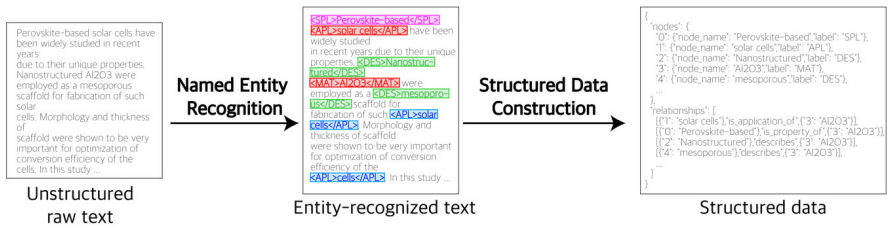
The central object is the entity marker, a symbolic tag inserted before and after each entity span, with the entity type encoded in the tag name. It carries the argument by combining two mechanisms: in-context learning of entity descriptions supplied in the prompt, and multi-type extraction in a single prompt, which makes fine-tuning sentences densely highlighted and prevents the model from becoming overly conservative. The downstream part of the pipeline uses the same highlighted text as an intermediate representation that simplifies the final conversion to structured data.
What would settle it
Retrain the special-marker and entity-marker generative models with identical training step counts, identical numbers of highlighted entities per sentence, and identical prompts except for the tag syntax; if entity-level F1 on MatScholar, SOFC, and SOFC Slot does not remain higher under the entity marker, the marker format is not the causal driver.
Extended reading notes
Core claim
The paper's core claim is that symbolic entity markers, pairs of tags such as <MAT>...</MAT> that encode the entity type, allow a fine-tuned generative language model to detect multiple entity types in a single pass while still learning entity definitions in context. This combination addresses two failure modes of prior NER approaches: encoder-only token classifiers that mislabel out-of-pattern tokens, and generative special-marker methods that miss valid entities because each entity type requires a separate prompt. The paper further claims that producing entity-recognized text before the unstructured-to-structured conversion reduces error propagation, so relation-level F1 improves as a consequence of node-level F1 improving.
Load-bearing premise
The central claim assumes the only meaningful difference between the special-marker and entity-marker NER conditions is the marker format, but the reported fine-tuning used 2000 steps for the special marker and 7500 steps for the entity marker, and the two conditions also differ in how many highlighted entities appear per sentence.
Editorial extensions
If this is right
- Knowledge-graph construction from scientific abstracts becomes more accurate when an entity-highlighting step is interposed before final structuring.
- Multi-type named entity recognition can be run with a single prompt per sentence, cutting inference cost relative to methods that need one prompt per entity type.
- New entity types can be introduced without retraining the NER model, since entity definitions are supplied in the prompt and the marker format is symbolic.
- Relation-level improvements follow from node-level improvements, meaning error propagation through the pipeline is reduced when entities are recognized first.
Reading between the lines
- If the entity-marker benefit extends beyond materials science, the same two-stage highlighting design could help in biomedical or chemical literature, where oppositional entity pairs are also common.
- The reported NER gains may be partly confounded by unequal training steps and supervision density between the marker conditions; an ablation that equalizes these would clarify how much of the effect is due to the marker format itself.
- Because the structured-data evaluation used only 49 manually annotated abstracts, the magnitude of the 58% and 83% improvements may shift on a larger or more diverse corpus.
Signed reviews
Editorial analysis
A structured set of objections, weighed in public.
Referee Report
Summary. The manuscript proposes a hybrid text-mining framework for materials science literature. In the first step, a fine-tuned LLaMA model recognizes and highlights entities in raw sentences using symbol-based 'entity markers' (e.g., <MAT> ... </MAT>); in the second step, a one-shot LLaMA-3.3-70B converts the entity-recognized text into structured knowledge graphs. The authors claim two levels of contribution: (1) the entity-marker NER format outperforms encoder-only models and a 'special marker' (GPT-NER style @@ ##) baseline on MatScholar, SOFC, and SOFC-Slot NER datasets; and (2) the resulting hybrid pipeline improves node-level F1 by up to 58% and relation-level F1 by up to 83% over the direct approach of Dagdelen et al. The paper includes fine-tuning details, evaluation procedures, and performance figures.
Significance. If the empirical claims hold, the entity-marker technique is a simple and practical contribution to NLP-based materials text mining, and the hybrid framework offers a plausible way to reduce error propagation between entity recognition and relation extraction. The NER experiments use standard benchmark datasets and report mean and standard deviation over three repeated runs, which is a solid experimental practice. The idea of using descriptive symbols that simultaneously support multi-type extraction and in-context learning is reasonable and potentially transferable to other scientific domains. However, the central causal claim that the marker format itself drives the improvement is not cleanly established because the two generative-model conditions are trained with different optimization budgets and different supervision densities. The structured-data evaluation also lacks inter-annotator agreement and variance information. These issues are fixable but currently limit the reliability of the headline improvement percentages.
major comments (3)
- [Methods, 'Fine tuning hyperparameters' paragraph; Fig. 6] The comparison between the special-marker and entity-marker conditions is confounded by training budget. The Methods state that the special-marker LLaMA was fine-tuned for 2000 steps while the entity-marker LLaMA was fine-tuned for 7500 steps, a 3.75x difference in the maximum step budget. The actual number of steps at the saved checkpoint is not reported, so the effective optimization length difference is unknown. Since Fig. 6 F1 scores are the basis for the claim that entity markers outperform special markers, and since the structured-data results in Fig. 8 depend on entity-recognized text produced by the entity-marker model, both the component-level and the overall-level claims inherit this uncertainty. The authors should retrain the special-marker condition with the same step budget (or demonstrate comparable convergence through training curves or per-step checkpoints) before attributing the observed gains to the marker design.
- [Results, 'Comparison of NER performance' and Methods, 'Fine tuning language models on NER'] A second uncontrolled variable is the number of highlighted entities per training sentence. In the special-marker condition, each sentence is duplicated per entity type with only that type highlighted, whereas in the entity-marker condition all entity types are highlighted in a single sentence. The paper itself notes in the Results that this leads to 'fewer highlighted entities' in special-marker fine-tuning sentences, making the model 'more conservative.' Because this supervision-density difference is entangled with the marker format, the improved recall and F1 of the entity-marker approach cannot be attributed solely to the symbolic marker design. An ablation that varies supervision density while holding the marker format fixed, or a control that equals the number of highlighted spans per sentence across conditions, would be needed to isolate the causal factor.
- [Results, 'Comparison of structured data construction performance'; Fig. 8] The structured-data evaluation relies on manual annotation, but the paper reports no inter-annotator agreement (e.g., Cohen's kappa) and no variance across repeated runs of the knowledge-graph construction. The abstract's headline '58% improvement in entity-level F1 score and up to 83% improvement in relation-level F1 score' rests entirely on this unquantified single evaluation. The authors should report agreement statistics for the manual annotation and, ideally, run the entire hybrid and direct pipelines multiple times to provide error bars or confidence intervals for the node and relation F1 scores.
minor comments (5)
- [Methods, 'Performance evaluation' paragraph] The sentence 'The predictions are evaluated using exact match criteria: a prediction was counted as a true positive if it exactly matched a ground-truth entity, and as a false positive otherwise.' appears twice verbatim near the end of the NER evaluation description. Please delete the duplicate.
- [Fig. 7 caption] The caption contains a typo: 'the number of prompts increasing proportionally to the number of entit' should read 'the number of entities.'
- [Abstract and Conclusion] The '58%' and '83%' improvement figures are not tied to a specific dataset in the abstract or conclusion; the percentages should be attributed to the dataset (or datasets) where the maximum improvement occurs, and the underlying F1 values for Fig. 8 should be reported in a table or in the text so that readers can verify the computation.
- [Methods, 'Fine tuning language models on NER'] The fine-tuned LLaMA model is trained jointly on MatScholar, SOFC, SOFC-Slot, and CoNLL-2003, but the paper does not state whether the special-marker and entity-marker conditions use identical multi-dataset training schedules and loss weighting. If they differ, that should be stated; if they are identical, a brief clarification would help.
- [General] The paper does not include a code availability statement or links to the fine-tuned model weights, which limits reproducibility. Providing the fine-tuning scripts, evaluation code, and the manually annotated knowledge-graph dataset would strengthen the contribution.
Circularity Check
No circularity: the central NER and structured-data claims are empirical comparisons against external ground-truth benchmarks, with no fitted parameter renamed as a prediction.
full rationale
The paper's two central claims are (1) that symbol-based entity markers improve NER F1 over encoder-only and special-marker baselines, and (2) that the hybrid entity-recognized-text pipeline improves knowledge-graph node and relation F1 over the direct approach. Both claims are evaluated with held-out test sets (MatScholar, SOFC, SOFC Slot) and manually annotated knowledge graphs whose ground-truth nodes and relations are external to the model outputs. NER F1 is computed from exact-match true positives, false positives, and false negatives against dataset labels, and knowledge-graph F1 is computed from manual annotation against predefined nodes and relations, so no metric is defined in terms of the method's own outputs. The entity-marker technique is not defined in terms of the special-marker or encoder-only baselines, and no equation in the paper reduces one reported result to another by construction. The closest concern is methodological rather than circular: the Methods 'Fine tuning hyperparameters' paragraph states that the special-marker LLaMA was trained for 2000 steps while the entity-marker LLaMA was trained for 7500 steps, which is an uncontrolled training-budget difference that may confound the causal attribution of the Fig. 6 gains. However, this is a validity or fairness issue, not a definitional or self-referential reduction: the entity-marker F1 is not a fitted parameter that is then relabeled as a prediction, and the benchmark labels do not encode the proposed method. The cited HuggingFace repositories (refs 58-61) are data hosting by the first author, not a load-bearing uniqueness theorem or ansatz, and the entity descriptions generated by ChatGPT are auxiliary prompt inputs rather than the target results. The reported quantities are therefore self-contained empirical measurements, and the paper's derivation chain is not circular.
Assumptions & free parameters
free parameters (2)
- Fine-tuning steps per marker condition =
special marker: 2000 steps; entity marker: 7500 steps
- Number and wording of entity descriptions =
approximately 10 ChatGPT-generated descriptions per entity type, manually curated
assumptions (6)
- domain assumption Ground-truth entity labels in MatScholar, SOFC, SOFC Slot, and CoNLL-2003 are correct and representative.
- domain assumption The manually built knowledge graphs for the 49 selected abstracts are accurate and unbiased.
- domain assumption Exact-match and manual-annotation evaluation protocols capture meaningful entity and relation quality.
- domain assumption 4-bit quantization and Q4_K_M conversion preserve the base LLaMA models' extraction capability.
- ad hoc to paper The training budget difference between baseline and proposed methods does not drive the reported improvement.
- domain assumption Entity descriptions generated by ChatGPT and manually curated match the intended semantics of the entity types.
Cite this review
Pith. "Pith review of Symbol-based entity marker highlighting for enhanced text mining in materials science with generative AI." pith.science (2026). https://pith.science/paper/5FNFXKPC
@misc{pith2026250505864,
  author       = {Pith},
  title        = {Pith review of: Symbol-based entity marker highlighting for enhanced text mining in materials science with generative AI},
  year         = {2026},
  howpublished = {\url{https://pith.science/paper/5FNFXKPC}},
  note         = {Machine review of arXiv:2505.05864}
}
read the original abstract
The construction of experimental datasets is essential for expanding the scope of data-driven scientific discovery. Recent advances in natural language processing (NLP) have facilitated automatic extraction of structured data from unstructured scientific literature. While existing approaches-multi-step and direct methods-offer valuable capabilities, they also come with limitations when applied independently. Here, we propose a novel hybrid text-mining framework that integrates the advantages of both methods to convert unstructured scientific text into structured data. Our approach first transforms raw text into entity-recognized text, and subsequently into structured form. Furthermore, beyond the overall data structuring framework, we also enhance entity recognition performance by introducing an entity marker-a simple yet effective technique that uses symbolic annotations to highlight target entities. Specifically, our entity marker-based hybrid approach not only consistently outperforms previous entity recognition approaches across three benchmark datasets (MatScholar, SOFC, and SOFC slot NER) but also improve the quality of final structured data-yielding up to a 58% improvement in entity-level F1 score and up to 83% improvement in relation-level F1 score compared to direct approach.
Figures


Figures from the paper (5 more)



Reference graph
Works this paper leans on
-
[1]
Energy Storage Research Department, Korea Institute of Energy Research, Daejeon 34129, Republic of Korea
-
[2]
Department of Energy Engineering, Hanyang University, Seoul, 04763, Republic of Korea
-
[3]
Department of Materials Science and Engineering, Korea Advanced Institute of Science and Technology, Daejeon 34141, Republic of Korea
-
[4]
cathode” and “LiMnPO4
Energy AI & Computational Science Labora tory, Korea Institute of Energy Research, Daejeon 34129, Republic of Korea *Corresponding author. E-mail: cwandtj@kier.re.kr Keywords: Text-mining, Natural language processing, Large language model, Generative AI, Named entity recognition 2 Abstract The construction of experimental datasets is essential for expandi...
-
[5]
The NER phase (as in the multi-step approach): Each entity is recognized and highlighted within the text, producing an en tity-recognized text that enhances entity recognition performance in the following step
-
[6]
5 Beyond the overall data structur ing framework, we also contribute at the component level— specifically, in the NER phase
Unstructured-to-structured phase (as in the direct approach): Generative AI is leveraged to directly conver t the entity-recognized text into structured data, thereby capturing complex relationships. 5 Beyond the overall data structur ing framework, we also contribute at the component level— specifically, in the NER phase. We propose a simple yet effectiv...
-
[7]
It contains 4401, 511, and 546 sentences in training, validation and test sets, respectively
MatScholar NER dataset25: This dataset focuses on material science literature and includes seven entity types: material (MAT), structure of phase (SPL), material descriptions (DSC), application of materi al (APL), property of material (PRO), synthesis method (SMT), and characterization method (CMT). It contains 4401, 511, and 546 sentences in training, va...
-
[8]
It includes four entity types: EXPERIMENT, VALUE, MATERIAL and DEVICE
SOFC NER dataset 55: This dataset is derived from materials text related to solid oxide fuel cells (SOFCs). It includes four entity types: EXPERIMENT, VALUE, MATERIAL and DEVICE. The training, validation and test sets consist of 568, 135, and 173 sentences, respectively
Show all 86 references
-
[9]
SOFC Slot NER dataset 55: This dataset contains same sentences with SOFC NER dataset, but with a more fine-grained entity labeling scheme. It includes 18 entity types: anode material, cathode material, conductivity, current density, degradation rate, device, electrolyte mate r...
-
[10]
CoNLL 2003 dataset 56: This dataset involves genera l-purpose sentences which is composed of four entities: person (PER), organization (ORG), location (LOC) and miscellaneous entity (MISC). To enha nce generative AI model’s ability to comprehend a broader range of entity types...
2003
-
[11]
B-X, which indicates the beginning of an entity of type X
-
[12]
I-X, which denotes a token inside an entity of type X
-
[13]
Nanostructured
O, which is used for tokens that do not belong to any named entity For example, in the tokenized sentence [ Nanostructured, Al2O3, …, such, solar, cells], the corresponding labels are [ B-DSC, B-MAT, …, O, B-APL, I-APL] where “Nanostructured” is labeled as a material descripti...
-
[14]
Zakutayev, A. et al. An open experimental database for exploring inorganic materials. Sci Data 5, 180053 (2018)
2018
-
[15]
Choudhary, K. et al. Recent advances and applications of deep learning methods in materials science. npj Comput Mater 8, 1–26 (2022)
2022
-
[16]
Schmidt, J., Marques, M. R. G., Botti, S. & Marques, M. A. L. Recent advances and applications of machine learning in solid-state materials science. npj Comput Mater 5, 1–36 (2019)
2019
-
[17]
Guo, K., Yang, Z., Yu, C.-H. & J. Buehler, M. Artificial intelligence and machine learning in design of mechanical materials. Materials Horizons 8, 1153–1172 (2021)
2021
-
[18]
& Aspuru-Guzik, A
Sanchez-Lengeling, B. & Aspuru-Guzik, A. Inverse molecular design using machine learning: Generative models for matter engineering. Science 361, 360–365 (2018)
2018
-
[19]
& Wata nabe, I
Zheng, X., Zhang, X., Chen, T.-T. & Wata nabe, I. Deep Learning in Mechanical Metamaterials: From Prediction and Generation to Inverse Design. Advanced Materials 35, 2302530 (2023)
2023
-
[20]
Lee, J. et al. Machine learning-based inverse design methods considering data characteristics and design space size in mate rials design and manufacturing: a review. Materials Horizons 10, 5436–5456 (2023)
2023
-
[21]
Zhong, M. et al. Accelerated discovery of CO2 elect rocatalysts using active machine learning. Nature 581, 178–183 (2020)
2020
-
[22]
Merchant, A. et al. Scaling deep learning for materials discovery. Nature 624, 80–85 (2023)
2023
-
[23]
Zeni, C. et al. A generative model for i norganic materials design. Nature 639, 624– 632 (2025)
2025
-
[24]
Jain, A. et al. Commentary: The Materials Project: A materials genome approach to accelerating materials innovation. APL Materials 1, 011002 (2013)
2013
-
[25]
Kirklin, S. et al. The Open Quantum Materials Database (OQMD): assessing the accuracy of DFT formation energies. npj Comput Mater 1, 1–15 (2015)
2015
-
[26]
Curtarolo, S. et al. AFLOW: An automatic framewor k for high-throughput materials discovery. Computational Materials Science 58, 218–226 (2012)
2012
-
[27]
Choudhary, K. et al. The joint automated repository for various integrated simulations (JARVIS) for data-driven materials design. npj Comput Mater 6, 1–13 (2020)
2020
-
[28]
& Cole, J
Huang, S. & Cole, J. M. BatteryBERT: A Pretrained Language Model for Battery Database Enhancement. J. Chem. Inf. Model. 62, 6365–6377 (2022)
2022
-
[29]
Hargreaves, C. J. et al. A database of experimentally measured lithium solid electrolyte conductivities evaluated with machine learning. npj Comput Mater 9, 1–14 (2023)
2023
-
[30]
& Olivetti, E
Venugopal, V. & Olivetti, E. MatKG: An autonomously generated knowledge graph in Material Science. Sci Data 11, 217 (2024)
2024
-
[31]
Bradford, G. et al. Chemistry-Informed Machine Learning for Polymer Electrolyte Discovery. ACS Cent. Sci. 9, 206–216 (2023)
2023
-
[32]
Kononova, O. et al. Opportunities and challenges of text mining in materials research. iScience 24, (2021)
2021
-
[33]
Olivetti, E. A. et al. Data-driven materials resear ch enabled by natural language processing and information extraction. Applied Physics Reviews 7, 041317 (2020)
2020
-
[34]
& Cole, J
Huang, S. & Cole, J. M. A database of battery materials au to-generated using ChemDataExtractor. Sci Data 7, 260 (2020)
2020
-
[35]
Pan, S. et al. Unifying Large Language Models and Knowledge Graphs: A Roadmap. Preprint at http://arxiv.org/abs/2306.08302 (2024)
2024 arXiv
-
[36]
Ji, S., Pan, S., Cambria, E., Marttinen, P. & Yu, P. S. A Survey on Knowledge Graphs: Representation, Acquisition, and Applications. IEEE Transactions on Neural Networks and Learning Systems 33, 494–514 (2022)
2022
-
[37]
& Navigli, R
Huguet Cabot, P.-L. & Navigli, R. RE BEL: Relation Extraction By End-to-end 27 Language generation. in Findings of the Association for Computational Linguistics: EMNLP 2021 (eds. Moens, M.-F., Huang, X., Specia, L. & Yih, S. W.) 2370–2381 (Association for Computational Linguis...
2021 doi
-
[38]
Yao, Y. et al. DocRED: A Large-Scale Document-Level Relation Extraction Dataset. in Proceedings of the 57th Annual Meeting of the Association for Computational Linguistics (eds. Korhonen, A., Traum, D. & Màrqu ez, L.) 764–777 (Association for Computational Linguistics, Florenc...
2019 doi
-
[39]
Weston, L. et al. Named Entity Recognition and Normalization Applied to Large-Scale Information Extraction from the Materials Science Literature. J. Chem. Inf. Model. 59, 3692– 3702 (2019)
2019
-
[40]
Gupta, T., Zaki, M., Krishnan, N. M. A. & Mausam. MatSciBERT: A materials domain language model for text mining and information extraction. npj Comput Mater 8, 1–11 (2022)
2022
-
[41]
Trewartha, A. et al. Quantifying the advantage of do main-specific pre-training on named entity recognition tasks in materials science. Patterns 3, 100488 (2022)
2022
-
[42]
& Kim, J
Kang, Y. & Kim, J. ChatMOF: an artificial intelligen ce system for predicting and generating metal-organic framewor ks using large language models. Nat Commun 15, 4705 (2024)
2024
-
[43]
Swain, M. C. & Cole, J. M. ChemDataEx tractor: A Toolkit for Automated Extraction of Chemical Information from the Scientific Literature. J. Chem. Inf. Model. 56, 1894–1904 (2016)
2016
-
[44]
Kononova, O. et al. Text-mined dataset of inorganic materials synthesis recipes. Sci Data 6, 203 (2019)
2019
-
[45]
Wang, Z. et al. Dataset of solution-based inorgani c materials synthesis procedures extracted from the scientific literature. Sci Data 9, 231 (2022)
2022
- [46]
- [47]
- [48]
- [49]
- [50]
- [51]
- [52]
- [53]
- [54]
- [55]
-
[56]
Sang, E. F. T. K. & Meulder, F. D. Introduction to the CoNLL-2003 Shared Task: Language-Independent Named Entity Recognition. Preprint at https://doi.org/10.48550/arXiv.cs/0306050 (2003)
2003 doi
-
[57]
A linear learning rate scheduler with 100 warmup steps and a weight decay of 0.01 was used. To account for the random initialization of non-BERT layers, different learning rates were applied to the BERT and non-BERT components: the peak learning rate was set to 5e-4 for the BE...
2000
-
[58]
& Lee, B
Choi, J. & Lee, B. Accelerating materi als language processing with large language 28 models. Commun Mater 5, 1–11 (2024)
2024
-
[59]
Zhang, W. et al. Fine-tuning large language mode ls for chemical text mining. Chem. Sci. 15, 10600–10611 (2024)
2024
-
[60]
Keloth, V. K. et al. Advancing entity recognition in biomedicine via instruction tuning of large language models. Bioinformatics 40, btae163 (2024)
2024
-
[61]
Dagdelen, J. et al. Structured information extraction from scientific text with large language models. Nat Commun 15, 1418 (2024)
2024
-
[62]
Lee, S. et al. Data-driven analysis of text-mined seed-mediated syntheses of gold nanoparticles. Digital Discovery (2025) doi:10.1039/D4DD00158C
2025 doi
- [63]
- [64]
-
[65]
A., Fuh, J
Liu, X., Erkoyuncu, J. A., Fuh, J. Y. H., L u, W. F. & Li, B. Knowledge extraction for additive manufacturing process via named entity recognition with LLMs. Robotics and Computer-Integrated Manufacturing 93, 102900 (2025)
2025
-
[66]
D., McCallum, A
Lafferty, J. D., McCallum, A. & Pereira, F. C. N. Conditional Random Fields: Probabilistic Models for Segmenting and Labeling Sequence Data. in Proceedings of the Eighteenth Interna tional Conference on Machine Learning 282–289 (Morgan Kaufmann Publishers Inc., San Francisco, ...
2001
- [67]
- [68]
-
[69]
https://pytorch- crf.readthedocs.io/en/stable/
pytorch-crf — pytorch-crf 0.7.2 documentation. https://pytorch- crf.readthedocs.io/en/stable/
-
[70]
Friedrich, A. et al. The SOFC-Exp Corpus and Neural Approaches to Information Extraction in the Materials Science Domain. in Proceedings of the 58th Annual Meeting of the Association for Computational Linguistics (eds. Jurafsky, D., Chai, J., Schluter, N. & Tetreault, J.) 1255...
2020 doi
-
[71]
GitHub https://github.com/huggingface
Hugging Face. GitHub https://github.com/huggingface
-
[72]
https://huggingface.co/datasets/Junhyeong86/matscholar_ner
Junhyeong86/matscholar_ner · Da tasets at Hugging Face. https://huggingface.co/datasets/Junhyeong86/matscholar_ner
-
[73]
https://huggingface.co/datasets/Junhyeong86/sofc_ner
Junhyeong86/sofc_ner · Data sets at Hugging Face. https://huggingface.co/datasets/Junhyeong86/sofc_ner
-
[74]
https://huggingface.co/datasets/Junhyeong86/NER-special-tagging
Junhyeong86/NER-special-tagging · Datasets at Hugging Face. https://huggingface.co/datasets/Junhyeong86/NER-special-tagging
-
[75]
https://huggingface.co/datasets/Junhyeong86/NER-html-like-tagging
Junhyeong86/NER-html-like-tagging · Datasets at Hugging Face. https://huggingface.co/datasets/Junhyeong86/NER-html-like-tagging
-
[76]
https://huggingface.co/datasets/eriktks/conll2003 (2024)
eriktks/conll2003 · Datasets at Hugging Face. https://huggingface.co/datasets/eriktks/conll2003 (2024)
2024
-
[77]
https://ollama.com/llama3.3
llama3.3. https://ollama.com/llama3.3
-
[78]
Unsloth AI (2025)
unslothai/unsloth. Unsloth AI (2025). 29
2025
-
[79]
https://huggingface.co/docs/bitsandbytes/index
bitsandbytes. https://huggingface.co/docs/bitsandbytes/index
-
[80]
https://huggingface.co/unsloth/Llama-3.2-3B-Instruct-bnb-4bit (2025)
unsloth/Llama-3.2-3B-Instruct-bnb-4bit · Hugging Face. https://huggingface.co/unsloth/Llama-3.2-3B-Instruct-bnb-4bit (2025)
2025
- [81]
- [82]
- [83]
-
[84]
ggml (2025)
ggml-org/llama.cpp. ggml (2025)
2025
-
[85]
https://gith ub.com/langchain-ai
LangChain. https://gith ub.com/langchain-ai
-
[86]
https://github.com/ollama
Ollama. https://github.com/ollama
Reviewed August 15, 2026 · model on record in the stance chip above.
Discussion (0). Continue with ORCID to comment.