REVIEW 3 major objections 3 minor 37 references
Black holes as gravitational mirrors
T0 review · 3 major / 3 minor · reviewed 2026-08-15 · deepseek-v4-flash
Pith's one-line read A black hole can act as a gravitational mirror for solar-system light, and a nearby stellar-mass black hole could brighten Earth's returning image to magnitude 32.
desk verdict Sound application of a known retrolensing formula undercut by an implausible 0.001 pc assumption and a few sloppy editorial slips; it deserves refereeing but only after major revision. read the letter →
The pith
A machine-rendered reading of the paper's core claim, the machinery that carries it, and where it could break.
The reading
What carries the argument
The central object is the strong-deflection limit of photon bending in a static spherically symmetric spacetime, specialized to Reissner-Nordström: the deflection angle $\alpha(b) = -\bar{a} \log(b/b_c - 1) + \bar{b}$, where $b$ is the impact parameter, $b_c$ is the critical impact parameter, and $\bar{a}$ and $\bar{b}$ are functions of the black hole mass and charge. This is paired with the Ohanian lens equation $\beta = \pi - \alpha(\theta) + \theta + \bar{\theta}$, which converts the deflection angle into image positions, and with the magnification formula $\mu(\beta)$ that turns those positions into apparent magnitudes. The boomerang condition is expressed through the emission angle $\beta$, defined by $\tan \beta = \sqrt{(r^2/(b^2 A(r))) - 1}^{-1}$; choosing $\beta$ above the critical angle $\beta_c$ selects orbits that turn around and return to the emitter. These formulas are what turn the gravitational-mirror idea into concrete, testable image brightnesses.
What would settle it
A targeted astrometric and microlensing search for a roughly 90-solar-mass compact object within 0.001 pc of the Sun would settle the observable claim: if no such object exists, the predicted $m \approx 32$ Earth-retrolensing image cannot occur, while finding one would give a specific place and time to check the predicted light curve.
Extended reading notes
Core claim
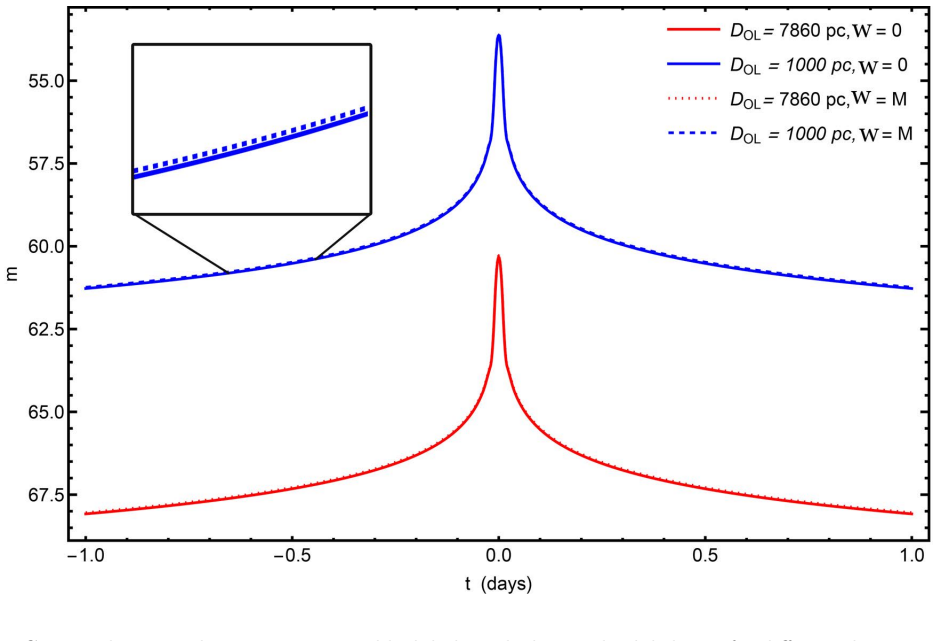
On its own terms, the paper establishes that boomerang photon trajectories exist in Reissner-Nordström spacetime for emitters outside the photon sphere: for emission angles above the critical angle $\beta_c$, the photon reaches a turning point, winds $N$ times around the hole, and returns to the emitter. It then maps these trajectories onto the retrolensing geometry with Earth as the source and derives the total magnification from the strong-deflection deflection angle $\alpha(b) = -\bar{a} \log(b/b_c - 1) + \bar{b}$ and the Ohanian lens equation. The quantitative payoff is a set of predicted retrolensing light curves: the brightest Earth image, apparent magnitude $m \approx 32$, comes from a $90\,M_\odot$ black hole at distance $0.001$ pc with zero charge, while the Sgr A* retrolens gives $m \approx 61$. Electric charge reduces the peak brightness and Weyl tidal charge increases it, but for the observationally allowed tidal charge the change is $\Delta m \approx 0.0001$, far below photometric sensitivity. The paper also notes that a retrolensing detection would test general relativity in the strong-field regime and could constrain modified gravity theories.
Load-bearing premise
The predicted observable event rests on a stellar-mass black hole being as close as 0.001 pc, about 206 AU, to the solar system; no such object is known, and the paper itself concedes the probability is small.
Editorial extensions
If this is right
- If the 0.001 pc stellar-black-hole scenario is real, Earth's retrolensing image at $m \approx 32$ would be within reach of large telescopes, giving a direct observation of light emitted by Earth in the past.
- For Sgr A* at the galactic center, the same formalism predicts $m \approx 61$, too faint for current instruments but a quantitative target for future telescopes.
- The relation between the apex angle of boomerang orbits and black hole mass and distance offers an independent way to measure these parameters when a returning-photon event is observed.
- A detected retrolensing event would test general relativity's strong-field light deflection and could be used to constrain modified gravity theories.
- The inclusion of electric or Weyl tidal charge changes the predicted magnitudes negligibly, so retrolensing light curves are primarily probes of black hole mass and distance rather than charge.
Reading between the lines
- Editorial inference: if a stellar-mass black hole is ever found at about 0.001 pc, the same setup would apply to any solar-system body, not just Earth, turning a nearby black hole into a survey instrument for the solar system's past light.
- Editorial inference: because the charge dependence is so weak, a positive detection would most cleanly measure the lens mass and distance; spin or charge would need a more sensitive observable, such as the resolved shape of the returning image.
- Editorial inference: extending the calculation to a rotating black hole would break the degeneracy between mass and distance through frame dragging, making spin measurable from the position of the returning image; the paper lists rotation as future work.
Signed reviews
Editorial analysis
A structured set of objections, weighed in public.
Referee Report
Summary. The manuscript proposes to treat solar-system bodies, principally the Earth, as sources in black-hole retrolensing. It reviews Reissner-Nordström photon geodesics, exhibits numerically boomerang photon orbits that return to the emission point, and then applies the strong-deflection retrolensing formalism of Tsukamoto and Gong [27] to compute image magnifications for a satellite observer placed 380,000 km from Earth. Two classes of lenses are considered: the supermassive Sgr A* black hole and hypothetical nearby stellar-mass black holes. The paper's new claim is that returning photons from planets, rather than from stars, can be studied in retrolensing geometry, and it reports a best-case apparent magnitude m≈32 for a 90 M_sun black hole at 0.001 pc (Figure 6) and m≈61 for Sgr A* (Figure 8). The conclusions explicitly concede that the probability of a close stellar-mass black-hole encounter is small.
Significance. If taken at face value, the paper makes a modest but useful extension of retrolensing: it applies an established strong-deflection magnification formula to an extended source (the Earth) rather than to distant stars, and it connects boomerang-photon orbits to a concrete observational geometry. The lensing calculation is not circular: it evaluates externally derived expressions from [27] for new scenario parameters, with no fitting to data and no invented degrees of freedom beyond the chosen charge ratios and distances. The paper is also explicit about the main weakness of its headline case, conceding in the conclusions that the probability of a stellar-mass black hole at 0.001 pc is small. As a theoretical proposal the paper has value; as a claim of current observability it is not supported, because the m≈32 result depends on an unsupported distance choice.
major comments (3)
- [Section V, Figure 6, Eq. (18)] The headline result m≈32 rests entirely on the adopted distance D_OL=0.001 pc, a scenario with no observational support and one that the authors themselves describe as having small probability. The same section quotes a local stellar-black-hole density n≈8×10^-4 pc^-3, which implies an expected nearest distance of several parsecs, and the cited nearest candidate HR6819 is at 340 pc. Because Eq. (18) contains θ_m^2 ∝ D_OL^-2 and 1/D_LS^2 ∝ D_OL^-2, the magnification degrades as a high inverse power of D_OL; moving D_OL from 0.001 pc to 1 pc pushes the predicted magnitude to roughly 55–60, which removes the observability claim. The m≈32 curve should be presented strictly as an illustrative hypothetical with an explicit probability estimate, or the analysis should be re-run for a distance consistent with current constraints so the detection limits are stated honestly.
- [Section III, after Eq. (11)] The Schwarzschild strong-deflection constant is misstated: the text says ar b = log[216(7−4√3)] = π, but the correct uncharged limit obtained from Eq. (11) with Q=0 is ar b = log[216(7−4√3)] − π ≈ −0.40. Because Eq. (13) and Eq. (18) depend on the combination ar b − π, the displayed identity is not merely cosmetic. Please correct the identity and confirm whether the numerical light curves were generated with the correct expression.
- [Appendix B, Eq. (B6)] The displayed formula for tan β is garbled and is not consistent with the values in Table I: for r_i=4M and b≈5.20M, the stated β=1.1664 rad cannot be obtained from the equations as written. The derivation from Eq. (B5) to Eq. (B6) should be rewritten, because the boomerang-photon orbits in Section IV are not reproducible from the manuscript in its present form.
minor comments (3)
- [Section V, between Eq. (17) and Eq. (18)] An editorial dialogue remains embedded in the text: "In this please confirm if correct. Following highlights are same. Authors: Yes, this is correct." This must be removed before publication.
- [Section II, line element (1)] The stated ranges "0≤θ≤2π and 0≤φ≤π" follow a nonstandard labeling of the spherical coordinates; the standard convention is θ∈[0,π] and φ∈[0,2π). Please clarify or correct.
- [Section V, Fig. 6 captions] The caption says "The closest separation considered is β=0," but the figures appear to show light curves as functions of time rather than directly of β; please specify the abscissa and the assumed source motion explicitly.
Circularity Check
No significant circularity: the retrolensing magnification is an evaluation of externally derived strong-deflection formulas on specified input parameters, with no fitting of the target result.
full rationale
The paper's derivation chain is largely self-contained as an application, not as a derivation of its inputs. The strong-deflection deflection angle in Eqs. (9)-(11) and the retrolensing magnification in Eqs. (13)-(18) are explicitly taken from Ref. [27], which is an external, independently published result; the present paper does not fit those formulas to data and then re-predict them. The boomerang-photon trajectories in Section IV are obtained by numerically integrating Eq. (4) with stated initial radii and emission angles, and the later retrolensing magnifications do not use those numerical trajectories as fitted inputs. The headline result m=32 in Section V and Figure 6 depends on the assumed distance D_OL=0.001 pc and mass M=90 M_sun, but these are parameter choices, not outputs of the calculation recycled as inputs; the paper itself acknowledges that 'the probability is small,' so the concern is physical plausibility rather than circularity. The self-citations [35,36] appear only in the conclusions as suggestions for future modified-gravity studies and are not load-bearing for any central claim. The unusual inserted passage 'In this please confirm if correct... Authors: Yes, this is correct' appears to be an editorial artifact and does not introduce a circular step. No instance was found in which a prediction reduces by construction to a fitted parameter, a self-definition, or a self-citation chain. The main scientific weakness is that the observability claim is conditional on an unsupported nearby black hole, but that is a correctness-risk issue, not a circularity issue.
Assumptions & free parameters
free parameters (4)
- electric charge ratio Q/M =
varied by hand (e.g., 0, extremal)
- Weyl tidal charge ratio W/M =
varied; upper bound W^2 ~ 0.0004 M^2 from Ref [32]
- observer-source distance D_OS =
380,000 km (Earth-Moon)
- black hole distance D_OL (nearby case) =
0.001 pc
assumptions (3)
- domain assumption The strong-deflection limit deflection angle expansion (Eqs. 9-11) from Tsukamoto and Gong [27] is valid for Reissner-Nordström black holes.
- standard math The Ohanian lens equation (Eq. 12) and the point-lens retrolensing geometry apply to an observer between the source and the lens.
- domain assumption The finite source can be modeled as a uniform disk with angular radius beta_S = R_S/D_LS.
Cite this review
Pith. "Pith review of Black holes as gravitational mirrors." pith.science (2026). https://pith.science/paper/HLCQ2XAT
@misc{pith2026250506018,
  author       = {Pith},
  title        = {Pith review of: Black holes as gravitational mirrors},
  year         = {2026},
  howpublished = {\url{https://pith.science/paper/HLCQ2XAT}},
  note         = {Machine review of arXiv:2505.06018}
}
read the original abstract
Retrolensing is a gravitational lensing effect in which light emitted by a background source is deflected by a black hole and redirected toward the observer after undergoing nearly complete loops around the black hole. In this context, we explore the possibility of seeing objects of the solar system in past eras through telescope observations by using black holes as a gravitational mirror. We consider the motion of the light around Reissner-Nordstr\"om space-time and discuss the properties of the trajectories of boomerang photons. It was shown that, depending on the angle of emission and the position of the source, the photons could return to the emission point. Afterward, we explore the possibility of considering the returning photons in retrolensing geometry where the observer is between the source and the lens in which two classes of black holes are explored: The supermassive Sgr A* black hole at the galactic center and a nearby stellar black hole. For the first time in the literature, we propose the study of the returning photons of planets instead of stars in retrolensing geometry.
Figures


Figures from the paper (6 more)


Reference graph
Works this paper leans on
- [27]
- [1]
- [2]
- [3]
- [4]
- [5]
- [6]
- [7]
Show all 37 references
-
[8]
Iyer and A
S. Iyer and A. Petters, Gen. Rel. Grav.39, 1563 (2007)
2007
-
[9]
Page, Class
D. Page, Class. Quant. Grav.39, 135015 (2021)
2021
-
[10]
Muller, Phys
T. Muller, Phys. Rev. D77, 124042 (2008)
2008
-
[11]
Cramer, Gen
C. Cramer, Gen. Rel. Grav.29, 445 (1997)
1997
-
[12]
Akiyamaet al.(Event Horizon Telescope), Astrophys
K. Akiyamaet al.(Event Horizon Telescope), Astrophys. J. Lett.875, L6 (2019)
2019
-
[13]
Akiyamaet al.(Event Horizon Telescope), Astrophys
K. Akiyamaet al.(Event Horizon Telescope), Astrophys. J. Lett.875, L1 (2019)
2019
-
[14]
Akiyamaet al.(Event Horizon Telescope), Astrophys
K. Akiyamaet al.(Event Horizon Telescope), Astrophys. J. Lett.875, L5 (2019)
2019
-
[15]
Claudel, K
C.-M. Claudel, K. Virbhadra, and G. Ellis, J. Math. Phys.42, 818 (2001)
2001
-
[16]
Hasse and V
W. Hasse and V. Perlick, Gen. Rel. Grav.34, 415 (2002)
2002
-
[17]
Stuckey, Am
W. Stuckey, Am. J. Phys.61, 448 (1993)
1993
-
[18]
By inspection of Equation (18), it can be seen that the parametersD LS andMhave played an important role in the final value for the magnitude of the images
with masses in the range (10−90)M ⊙ considering the scheme proposed in Figures 4 and 5. By inspection of Equation (18), it can be seen that the parametersD LS andMhave played an important role in the final value for the magnitude of the images. In this first example, we consid...
-
[19]
Holz and J
D. Holz and J. Wheeler, Astrophys. J.578, 330 (2002)
2002
-
[20]
De Paolis, A
F. De Paolis, A. Geralico, G. Ingrosso, and A. Nucita, Astron. Astrophys.409, 809 (2003)
2003
- [21]
-
[22]
Tsukamoto, Phys
N. Tsukamoto, Phys. Rev. D95, 084021 (2017)
2017
-
[23]
Bozza and L
V. Bozza and L. Mancini, Astrophys. J.611, 1045 (2004)
2004
-
[24]
Tsukamoto, Phys
N. Tsukamoto, Phys. Rev. D105, 024009 (2022)
2022
-
[25]
Abdujabbarov, B
A. Abdujabbarov, B. Ahmedov, N. Dadhich, and F. Atamurotov, Phys. Rev. D96, 084017 (2017)
2017
-
[26]
Harada, Phys
T. Harada, Phys. Rev. D95, 024030 (2017)
2017
-
[28]
Tsukamoto and Y
N. Tsukamoto and Y. Gong, Phys. Rev. D95, 064034 (2017)
2017
-
[29]
Abuter, A
R. Abuter, A. Amorim, M. Baub¨ ock, J. Berger, H. Bonnet, W. Brandner, Y. Cl´ enet, V. Du Foresto, P. De Zeeuw, J. Dexter,et al., Astron. Astrophys.625, L10 (2019)
2019
-
[30]
Rivinius, D
T. Rivinius, D. Baade, P. Hadrava, M. Heida, and R. Klement, Astron. Astrophys.637, L3 (2020). 20
2020
-
[31]
Ohanian, Am
H. Ohanian, Am. J. Phys.55, 428 (1987)
1987
-
[32]
Bozza, Phys
V. Bozza, Phys. Rev. D78, 103005 (2008)
2008
-
[33]
Neves, Eur
J. Neves, Eur. Phys. J. C80, 717 (2020)
2020
-
[34]
L´ opez-Morales, Publ
M. L´ opez-Morales, Publ. Astron. Soc. Pac.118, 716 (2006)
2006
-
[35]
De Felice and S
A. De Felice and S. Tsujikawa, Living Rev. Relativ.13, 3 (2010)
2010
-
[36]
C. Mota, L. Santos, G. Grams, F. da Silva, and D. Menezes, Phys. Rev. D100, 024043 (2019)
2019
-
[37]
C. Mota, L. Santos, F. da Silva, G. Grams, I. Lobo, and D. Menezes, Int. J. Mod. Phys. B 31, 2250023 (2022). 21
2022
Reviewed August 15, 2026 · model on record in the stance chip above.
Discussion (0). Continue with ORCID to comment.