REVIEW 5 major objections 5 minor 2 cited by
Turbo-ICL: In-Context Learning-Based Turbo Equalization
T0 review · 5 major / 5 minor · reviewed 2026-08-15 · deepseek-v4-flash
Pith's one-line read In-context learning lets a MIMO receiver run turbo equalization with no channel state information, and its soft outputs can beat model-based receivers that know the channel.
desk verdict A genuinely new soft-output ICL equalizer for turbo loops, with the 16-QAM gains worth taking seriously, but the paper never confirms the extrinsic-LLR subtraction that the 5th-iteration results depend on. read the letter →
The pith
A machine-rendered reading of the paper's core claim, the machinery that carries it, and where it could break.
The reading
What carries the argument
The load-bearing mechanism is prompt augmentation: the decoder's extrinsic soft information is encoded as a per-antenna probability mass function over the M-QAM constellation and appended to the target token in the prompt, alongside an embedding of the received pilot and data vectors. The sequence model, either a Transformer decoder or a selective state-space model (Mamba-style), is trained on interleaved query-answer prompts, with each received symbol paired with a Dirichlet-sampled prior PMF and its true transmitted symbol, using a weighted cross-entropy loss that puts more weight on later predictions so the model learns to exploit accumulating context. At inference, the final token's output is a posterior PMF estimate, converted to bitwise LLRs and passed to the decoder; the decoder's extrinsic LLRs are turned back into a prior PMF and reinserted into the prompt, closing the turbo loop.
What would settle it
Run the pre-trained ICL-T and ICL-S models on a test set with correlated Rayleigh fading or with a measured receiver front end whose clipping and quantization differ from the uniform mid-rise model used in pre-training; the central claim would be weakened if under those conditions the perfect-CSI BLMMSE-PIC baseline matches or beats the ICL equalizers.
Extended reading notes
Core claim
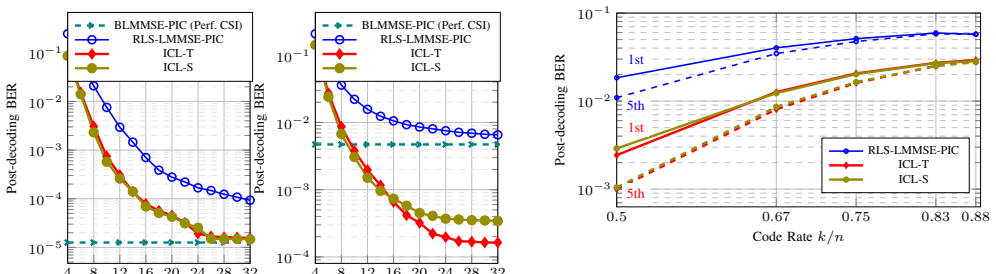
The paper's central discovery is that the turbo equalizer's role can be re-expressed as a supervised in-context mapping from received signals plus prior probabilities to symbol posterior PMFs. The soft equalizer is a causal sequence model that sees a prompt containing received-pilot/transmitted-pilot pairs followed by the target query, which concatenates the received data symbol with a prior PMF obtained from the decoder. Because the decoder's priors are appended to the prompt as part of the target query, the same model refines its estimate across turbo iterations without any architectural change. Under 16-QAM with low-bit quantization, the ICL models outperform the perfect-CSI Bussgang LMMSE-PIC baseline and approach the MAP lower bound, while under 4-QAM they match the perfect-CSI baseline; both consistently beat the practical RLS-LMMSE-PIC receiver. The authors present this as evidence that the model learns, from data, the nonlinear and discrete structure of the channel-plus-quantizer map rather than relying on Gaussian and linearity assumptions.
Load-bearing premise
The gains rest on the assumption that the channel, noise, and quantization conditions seen at deployment are representable by the same family of simulated tasks used in pre-training; the evaluation only generalizes within that simulated distribution.
Editorial extensions
If this is right
- A single pre-trained ICL equalizer can replace the channel-estimation stage in a turbo receiver, working on quantized and nonlinear front ends where linear assumptions break down.
- Decoder feedback genuinely improves the ICL equalizer: feeding extrinsic information back as prompt context lowers post-decoding BER between the first and fifth turbo iterations.
- With 16-QAM and low-bit ADCs, ICL methods can beat a linear equalizer that knows the channel perfectly, approaching the MAP detector's performance.
- The Transformer variant generalizes from fewer training tasks, while the state-space variant delivers comparable BER with about 40 percent of the parameters and lower computational cost.
- Fewer pilots suffice for the ICL receiver: with 16 context pilots it outperforms a perfect-CSI linear baseline that uses 32 pilots for estimation.
Reading between the lines
- The prompt-augmentation recipe may generalize beyond equalization: any iterative receiver that exchanges soft information could expose that information as context tokens, making the approach a template for ICL-based turbo processing.
- The paper only demonstrates generalization within the pre-training distribution; testing on correlated fading, non-uniform ADC, or measured hardware would clarify whether the pilot-based adaptation extends to channels not representable in the simulator.
- The Dirichlet-prior training strategy invites a calibration probe: if the output PMFs are well-calibrated soft likelihoods, they should remain reliable when the decoder's priors become very confident in later turbo iterations.
- A natural extension would be to pre-train over a broader task distribution that includes hardware impairments, then test whether the same prompt-based receiver absorbs them without architectural changes.
Signed reviews
Editorial analysis
A structured set of objections, weighed in public.
Referee Report
Summary. The paper proposes Turbo-ICL, a soft-input soft-output in-context learning (ICL) equalizer for coded MIMO systems with quantized receivers. A causal sequence model (Transformer or Mamba) is prompted with pilot transmit-receive pairs and a target query consisting of the received symbol vector and a prior symbol PMF from the decoder; the model outputs an estimated posterior symbol distribution. In subsequent turbo iterations, decoder-extrinsic LLRs are re-interleaved and converted into symbol priors that augment the prompt, allowing iterative refinement. The models are pre-trained on synthetic tasks sampled from a distribution over channels, noise variances, and quantization settings, and are evaluated against RLS-LMMSE-PIC, BLMMSE-PIC with perfect CSI, and MAP detection with perfect CSI. The paper reports BER versus quantization resolution, SNR, pilot length, code rate, training diversity, and model size, and claims consistent gains over the model-based baselines.
Significance. If the extrinsic-information handling is corrected and confirmed, this would be a useful contribution: it appears to be the first ICL equalizer that produces soft symbol posteriors and closes the turbo loop with decoder feedback, and it demonstrates a CSI-free advantage over linear model-based equalizers under 16-QAM with coarse quantization. The comparison of Transformer and state-space backbones and the efficiency analysis are informative. However, the paper ships no code, data, or error bars, and its headline claim is broader than the reported 4-QAM results; these issues materially limit the evidence for the contribution as currently stated.
major comments (5)
- [Sec. IV-A, Eqs. (22)-(27); Fig. 3(b)] The manuscript never specifies how the ICL equalizer's posterior output is converted to extrinsic LLRs before being fed to the decoder. In Sec. III-A, Eq. (9) defines channel-extrinsic LLRs by subtracting the prior LLR, and the model-based baselines use this operation. In contrast, Sec. IV-A states only that the output \hat p_i = \hat p_\theta(x_i|C,y_i,p_i) 'is finally converted to bitwise LLRs in the same way as (21), which are then passed to the channel decoder,' with no subtraction of the prior p_i or its LLR equivalent. From the second turbo iteration onward, the decoder input may therefore already contain the decoder's own previous extrinsic information, causing double-counting in the equalizer-decoder loop. Because the headline gains in Figs. 8-11 are shown at the fifth turbo iteration, the comparison with BLMMSE-PIC, which does use Eq. (9), is not verifiable from the manuscript as written and may be unfair. Please state explicitly, in an equation or pseudocode, how \hat p_i is made extrinsic before decoding, and rerun or re-justify the fifth-iteration results.
- [Abstract; Sec. I-C; Sec. VI-D] The abstract and contribution list claim that ICL equalizers 'consistently outperform conventional model-based baselines, even when the latter are provided with perfect channel state information,' but the paper's own 4-QAM results do not support this. Sec. VI-D says that under 4-QAM, ICL-T and ICL-S 'approach the performance of BLMMSE-PIC with perfect CSI but do not exceed it,' and Fig. 8(a) shows only close approach across SNR. The defensible version is the 16-QAM statement in Sec. VI-D, where ICL outperforms BLMMSE-PIC with perfect CSI and approaches the MAP detector. Please qualify the abstract and contribution claims to specify the regimes (e.g., higher-order modulation and low-resolution quantization) in which the stated outperformance is demonstrated.
- [Sec. VI-C; Sec. II-B] The pre-training distribution D_\tau is not fully specified. Sec. VI-C defines D_B = U({1,...,32}) as 'the number of active non-zero symbols,' but the system model in Sec. II-B parameterizes the receiver front end by Q = {l_min,l_max,B} with B the quantization resolution, and the experiments vary B over {2,...,10}. There is no 'number of active non-zero symbols' parameter in the model, so the sampling distribution used to generate the simulated tasks is ambiguous. Please correct this description and specify exactly how B (or whichever parameter D_B ranges over) enters the link model and how the values used in training relate to the test values.
- [Sec. VI-A, VI-H, Figs. 8-11] The central performance claims rest on Monte Carlo BER curves without any statistical uncertainty quantification. The paper reports no standard deviations, confidence intervals, number of independent channel/codeword trials, or seeds, and no code or data are released. This matters because several key comparisons are close: for example, ICL-T and BLMMSE-PIC are nearly indistinguishable in Fig. 8(a), and the ICL-T/BLMMSE-PIC crossover near T_P=10 in Fig. 9(b) is within line width. Without trial-level statistics or a reproducibility package, the claimed ordering of methods cannot be assessed. Please add error bars or confidence intervals and a statement of the number of Monte Carlo runs, or explicitly mark the curves as representative single-seed results.
- [Sec. I-C; Sec. VI-H] The claimed generalization 'across channels and receiver architectures' is broader than what is evaluated. Sec. VI-H studies only training diversity N_train within the same task distribution D_\tau: i.i.d. Rayleigh fading, fixed clipping range [-4,4], and a b-bit mid-rise uniform quantizer. No experiments test correlated fading, different clipping ranges, non-uniform ADC, or other hardware impairments, although these are the scenarios in which a learned equalizer's in-context adaptation would matter most. Please either add out-of-distribution evaluations that vary the receiver front end and channel model, or narrow the generalization claim in Sec. I-C and the conclusion.
minor comments (5)
- [Fig. 9 caption] The caption says 'The results are evaluated at the fifth turbo iteration with TP=16,' but the x-axis is the pilot length T_P, which is varied from 4 to 32; this is inconsistent and should be corrected.
- [Sec. V-A] The text says 'We do not claim the optimality of the choice β = 1n,' but the concentration parameter was defined as β = 1_M; the subscript n appears to be a typo.
- [Algorithm 1] The dimension bookkeeping in the multi-head attention output is hard to follow: with Q_h,K_h,V_h ∈ R^{D_H×(2T_P+1)}, the expression Softmax(Q_h^T K_h/√D_H + M) V_h^T yields a (2T_P+1)×D_H matrix, not a D_H×(2T_P+1) matrix as implied by the later concatenation. Please make the transposes explicit.
- [References [16] and [42]] References [16] and [42] appear to be the same paper (da Silva and Yankov, 'Adaptive turbo equalization for nonlinearity compensation in WDM systems'), cited under two different numbers; please consolidate.
- [Sec. VI-C] The statement that N_train = 2^15 = 32,768 'unique combinations' is imprecise because H and σ^2 are drawn from continuous distributions; the pre-training task pool is a set of sampled task instances, not unique combinations of discrete parameters.
Circularity Check
ICL output is a posterior conditioned on decoder feedback, yet it is fed to the decoder without the Eq. (9) extrinsic subtraction, so the 5th-iteration turbo gains are partly self-referential.
-
self definitional
[Sec. III-A Eq. (9); Sec. IV-A Eqs. (25)-(27) and following paragraph]
"Le(c(n) k |Y) = L(c(n) k |Y) − L(c(n) k ). (9) ... ˆpi = ˆpθ(xi|C, yi, pi) ... This output is finally converted to bitwise LLRs in the same way as (21), which are then passed to the channel decoder."
The equalizer's output is defined as the posterior Pr(x_i | C, y_i, p_i), where p_i is the decoder's own previous extrinsic feedback. The only extrinsicization operation defined in the paper is Eq. (9), subtracting the prior LLR from the posterior LLR. For the ICL equalizer the paper applies only the (21) marginalization and never states that the prior log p_i is removed before the LLRs enter the decoder. Consequently the decoder input contains the decoder's own prior by construction; after five turbo iterations the reported gains can reflect circulating decoder output instead of channel-extrinsic information. The BLMMSE-PIC baseline does use Eq. (9), so the 5th-iteration comparisons are not equal-treatment benchmarks.
full rationale
Apart from the missing extrinsic subtraction, the paper's derivation chain is not circular. The ICL posterior is trained with a cross-entropy loss against simulated ground-truth symbols (Eq. (41)) and benchmarked against external model-based receivers (MAP, BLMMSE-PIC, RLS-LMMSE-PIC) with perfect CSI, not against fitted parameters. The self-citations ([11]-[14], [23], [24]) establish background ICL capability but are not load-bearing; no uniqueness theorem or ansatz is imported from them. The first-turbo results (Fig. 7, left panels of Fig. 8, Fig. 10 solid lines) are independent of decoder feedback and therefore unaffected by the missing subtraction. However, the strongest abstract claim ('consistently outperform ... even when the latter are provided with perfect CSI') leans on 5th-iteration curves (Figs. 8-11), where the ICL output is a posterior containing the decoder's own feedback and is not shown to be extrinsicized by Eq. (9). This makes the iterative performance evidence partially circular and not verifiable from the manuscript as written, though it does not invalidate the first-iteration comparison.
Assumptions & free parameters
free parameters (5)
- Loss weighting growth rate lambda =
0.5
- Dirichlet concentration beta =
1_M (all ones)
- Quantizer clipping range [l_min, l_max] =
[-4, 4]
- Training prompt length T_train =
40 query-answer pairs
- Pre-training task ranges (sigma^2, B) =
sigma^2 ~ U[1e-3,1], B ~ U({1,...,32})
assumptions (5)
- standard math Standard turbo principle: exchanging extrinsic LLRs between equalizer and decoder improves coded performance (Sec. III-A).
- domain assumption System model: quasi-static Rayleigh fading, additive Gaussian noise, clipping plus b-bit uniform mid-rise quantization (Sec. II).
- domain assumption In-context learning premise: a sequence model pre-trained over tasks can infer the current channel mapping from a few pilot examples (Sec. IV).
- domain assumption Decoder feedback is representable as a symbol prior PMF and is well approximated by i.i.d. Dirichlet-sampled priors in training (Sec. V-A).
- domain assumption Softmax classifier outputs are calibrated posterior probabilities suitable for LLR conversion (Sec. IV-A, Eq. (35)-(36)).
Cite this review
Pith. "Pith review of Turbo-ICL: In-Context Learning-Based Turbo Equalization." pith.science (2026). https://pith.science/paper/OXLICTGJ
@misc{pith2026250506175,
  author       = {Pith},
  title        = {Pith review of: Turbo-ICL: In-Context Learning-Based Turbo Equalization},
  year         = {2026},
  howpublished = {\url{https://pith.science/paper/OXLICTGJ}},
  note         = {Machine review of arXiv:2505.06175}
}
read the original abstract
This paper introduces a novel in-context learning (ICL) framework, inspired by large language models (LLMs), for soft-input soft-output channel equalization in coded multiple-input multiple-output (MIMO) systems. The proposed approach learns to infer posterior symbol distributions directly from a prompt of pilot signals and decoder feedback. A key innovation is the use of prompt augmentation to incorporate extrinsic information from the decoder output as additional context, enabling the ICL model to refine its symbol estimates iteratively across turbo decoding iterations. Two model variants, based on Transformer and state-space architectures, are developed and evaluated. Extensive simulations demonstrate that, when traditional linear assumptions break down, e.g., in the presence of low-resolution quantization, ICL equalizers consistently outperform conventional model-based baselines, even when the latter are provided with perfect channel state information. Results also highlight the advantage of Transformer-based models under limited training diversity, as well as the efficiency of state-space models in resource-constrained scenarios.
Figures


Figures from the paper (7 more)



Forward citations
Cited by 2 Pith papers
-
CSI-Free Symbol Detection for Atomic MIMO Receivers via In-Context Learning
A transformer trained by in-context learning directly maps pilot-response examples to data symbols for a linearized atomic MIMO measurement model, outperforming two optimization-based baselines in simulation.
-
In-Context Learning for Gradient-Free Receiver Adaptation: Principles, Applications, and Theory
In-context learning lets wireless receivers adapt to new channels in a single forward pass using pilot signals, without gradient-based retraining, and it outperforms prior neural baselines in the authors' simulations.
Reference graph
Works this paper leans on
-
[1]
R. Koetter, A. C. Singer, and M. Tuchler, “Turbo equalization,” IEEE signal processing magazine , vol. 21, no. 1, pp. 67–80, 2004
work page 2004
-
[2]
Iterative correction of intersymbol inter- ference: turbo-equalization,
C. Douillard, M. J ´ez´equel, C. Berrou, D. Electronique, A. Picart, P. Didier, and A. Glavieux, “Iterative correction of intersymbol inter- ference: turbo-equalization,” European transactions on telecommunica- tions, vol. 6, no. 5, pp. 507–511, 1995
work page 1995
-
[3]
Minimum mean squared error equalization using a priori information,
M. Tuchler, A. C. Singer, and R. Koetter, “Minimum mean squared error equalization using a priori information,” IEEE Transactions on Signal processing, vol. 50, no. 3, pp. 673–683, 2002
work page 2002
-
[4]
C. Studer, S. Fateh, and D. Seethaler, “ASIC implementation of soft- input soft-output MIMO detection using MMSE parallel interference cancellation,” IEEE Journal of Solid-State Circuits , vol. 46, no. 7, pp. 1754–1765, 2011
work page 2011
-
[5]
Achieving near-capacity on a multiple-antenna channel,
B. M. Hochwald and S. Ten Brink, “Achieving near-capacity on a multiple-antenna channel,” IEEE transactions on communications , vol. 51, no. 3, pp. 389–399, 2003
work page 2003
-
[6]
Soft-output sphere decoding: Performance and implementation aspects,
C. Studer, M. Wenk, A. Burg, and H. Bolcskei, “Soft-output sphere decoding: Performance and implementation aspects,” in 2006 Fortieth Asilomar Conference on Signals, Systems and Computers . IEEE, 2006, pp. 2071–2076
work page 2006
-
[7]
Turbo equalization: An overview,
M. T ¨uchler and A. C. Singer, “Turbo equalization: An overview,” IEEE Transactions on Information Theory , vol. 57, no. 2, pp. 920–952, 2011
work page 2011
-
[8]
Spectral vs Energy Efficiency in 6G: Impact of the Receiver Front-End
A. Lozano and S. Rangan, “Spectral vs energy efficiency in 6G: Impact of the receiver front-end,” arXiv preprint arXiv:2310.02622 , 2023
work page Pith review arXiv 2023
Show all 45 references
-
[9]
Neural turbo equalization: Deep learning for fiber-optic nonlinearity compensation,
T. Koike-Akino, Y . Wang, D. S. Millar, K. Kojima, and K. Parsons, “Neural turbo equalization: Deep learning for fiber-optic nonlinearity compensation,” Journal of Lightwave Technology , vol. 38, no. 11, pp. 3059–3066, 2020
2020
-
[10]
From learning to meta-learning: Reduced training overhead and complexity for communication systems,
O. Simeone, S. Park, and J. Kang, “From learning to meta-learning: Reduced training overhead and complexity for communication systems,” in 2020 2nd 6G Wireless Summit (6G SUMMIT) . IEEE, 2020, pp. 1–5
2020
-
[11]
In-context learning for MIMO equalization using transformer-based sequence models,
M. Zecchin, K. Yu, and O. Simeone, “In-context learning for MIMO equalization using transformer-based sequence models,” in 2024 IEEE International Conference on Communications Workshops (ICC Work- shops), 2024, pp. 1573–1578
2024
-
[12]
Transformers are ef- ficient in-context estimators for wireless communication,
V . Rajagopalan, V . T. Kunde, C. S. K. Valmeekam, K. Narayanan, S. Shakkottai, D. Kalathil, and J.-F. Chamberland, “Transformers are ef- ficient in-context estimators for wireless communication,” arXiv preprint arXiv:2311.00226, 2023
2023 arXiv
-
[13]
Cell-free multi-user MIMO equalization via in-context learning,
M. Zecchin, K. Yu, and O. Simeone, “Cell-free multi-user MIMO equalization via in-context learning,” in 2024 IEEE 25th International Workshop on Signal Processing Advances in Wireless Communications (SPAWC), 2024, pp. 646–650
2024
-
[14]
Transformer- based adaptive OFDM MIMO equalization in intelligence-native RAN,
Z. Song, Y . Ma, C. You, H. Yuan, J. Peng, and Y . Gao, “Transformer- based adaptive OFDM MIMO equalization in intelligence-native RAN,” in 2024 IEEE/CIC International Conference on Communications in China (ICCC Workshops). IEEE, 2024, pp. 179–184
2024
-
[15]
Decision feedback in-context symbol detection over block-fading channels,
L. Fan, J. Yang, and C. Shen, “Decision feedback in-context symbol detection over block-fading channels,” arXiv preprint arXiv:2411.07600, 2024
2024 arXiv
-
[16]
Adaptive turbo equalization for nonlinearity compensation in wdm systems,
E. P. da Silva and M. P. Yankov, “Adaptive turbo equalization for nonlinearity compensation in wdm systems,” Journal of Lightwave Technology, vol. 39, no. 22, pp. 7124–7134, 2021
2021
-
[17]
Low-resolution ADCs for wireless communication: A comprehensive survey,
J. Liu, Z. Luo, and X. Xiong, “Low-resolution ADCs for wireless communication: A comprehensive survey,” IEEE Access , vol. 7, pp. 91 291–91 324, 2019
2019
-
[18]
Analysis of Rayleigh-fading channels with 1-bit quantized output,
A. Mezghani and J. A. Nossek, “Analysis of Rayleigh-fading channels with 1-bit quantized output,” in 2008 IEEE International Symposium on Information Theory. IEEE, 2008, pp. 260–264
2008
-
[19]
Channel estimation and performance analysis of one-bit massive MIMO systems,
Y . Li, C. Tao, G. Seco-Granados, A. Mezghani, A. L. Swindlehurst, and L. Liu, “Channel estimation and performance analysis of one-bit massive MIMO systems,” IEEE Transactions on Signal Processing , vol. 65, no. 15, pp. 4075–4089, 2017
2017
-
[20]
Modular model- based Bayesian learning for uncertainty-aware and reliable deep MIMO receivers,
T. Raviv, S. Park, O. Simeone, and N. Shlezinger, “Modular model- based Bayesian learning for uncertainty-aware and reliable deep MIMO receivers,” in 2023 IEEE International Conference on Communications Workshops (ICC Workshops), 2023, pp. 1032–1037
2023
-
[21]
Adaptive and flexible model-based AI for deep receivers in dynamic channels,
T. Raviv, S. Park, O. Simeone, Y . C. Eldar, and N. Shlezinger, “Adaptive and flexible model-based AI for deep receivers in dynamic channels,” IEEE Wireless Communications, 2024
2024
-
[22]
Modular hypernetworks for scalable and adaptive deep MIMO receivers,
T. Raviv and N. Shlezinger, “Modular hypernetworks for scalable and adaptive deep MIMO receivers,”arXiv preprint arXiv:2408.11920, 2024
2024 arXiv
-
[23]
Neuromorphic in-context learning for energy-efficient MIMO symbol detection,
Z. Song, O. Simeone, and B. Rajendran, “Neuromorphic in-context learning for energy-efficient MIMO symbol detection,” in 2024 IEEE 25th International Workshop on Signal Processing Advances in Wireless Communications (SPAWC), 2024, pp. 1–5
2024
-
[24]
In-context learned equalization in cell-free massive MIMO via state-space models,
Z. Song, M. Zecchin, B. Rajendran, and O. Simeone, “In-context learned equalization in cell-free massive MIMO via state-space models,” in 2025 IEEE International Conference on Machine Learning for Communica- tion and Networking (ICMLCN) , 2025
2025
-
[25]
R. W. Heath Jr and A. Lozano, Foundations of MIMO communication . Cambridge University Press, 2018
2018
-
[26]
Tse and P
D. Tse and P. Viswanath, Fundamentals of wireless communication . Cambridge university press, 2005
2005
-
[27]
Turbo-BLAST for wireless communica- tions: Theory and experiments,
M. Sellathurai and S. Haykin, “Turbo-BLAST for wireless communica- tions: Theory and experiments,” IEEE Transactions on Signal Process- ing, vol. 50, no. 10, pp. 2538–2546, 2002
2002
-
[28]
Combined channel estima- tion and turbo equalization on wireless channels,
F.-S. Shiao, D. P. Taylor, and P. A. Martin, “Combined channel estima- tion and turbo equalization on wireless channels,” in 2008 IEEE 68th Vehicular Technology Conference. IEEE, 2008, pp. 1–5
2008
-
[29]
Iterative tree search detection for MIMO wireless systems,
Y . L. de Jong and T. J. Willink, “Iterative tree search detection for MIMO wireless systems,” IEEE Transactions on Communications , vol. 53, no. 6, pp. 930–935, 2005
2005
-
[30]
Parallel interference cancellation in multiuser detection,
M. Latva-aho and J. Lilleberg, “Parallel interference cancellation in multiuser detection,” in Proceedings of ISSSTA’95 International Sym- posium on Spread Spectrum Techniques and Applications , vol. 3, 1996, pp. 1151–1155 vol.3
1996
-
[31]
Linear parallel interference cancellation in long-code CDMA multiuser detection,
D. Guo, L. Rasmussen, and T. J. Lim, “Linear parallel interference cancellation in long-code CDMA multiuser detection,” IEEE Journal on Selected Areas in Communications , vol. 17, no. 12, pp. 2074–2081, 1999
1999
-
[32]
Generalized parallel interference cancellation with near-optimal detection performance,
Z. Luo, M. Zhao, S. Liu, and Y . Liu, “Generalized parallel interference cancellation with near-optimal detection performance,” IEEE Transac- tions On Signal Processing , vol. 56, no. 1, pp. 304–312, 2007
2007
-
[33]
Soft-decision-driven sparse chan- nel estimation and turbo equalization for MIMO underwater acoustic communications,
Y . Zhang, Y . V . Zakharov, and J. Li, “Soft-decision-driven sparse chan- nel estimation and turbo equalization for MIMO underwater acoustic communications,” IEEE Access, vol. 6, pp. 4955–4973, 2018
2018
-
[34]
Attention is all you need,
A. Vaswani, N. Shazeer, N. Parmar, J. Uszkoreit, L. Jones, A. N. Gomez, Ł. Kaiser, and I. Polosukhin, “Attention is all you need,” in Advances in neural information processing systems , vol. 30, 2017
2017
-
[35]
Efficiently modeling long sequences with structured state spaces,
A. Gu, K. Goel, and C. R ´e, “Efficiently modeling long sequences with structured state spaces,” arXiv preprint arXiv:2111.00396 , 2021
2021 arXiv
-
[36]
Mamba: Linear-time sequence modeling with selective state spaces,
A. Gu and T. Dao, “Mamba: Linear-time sequence modeling with selective state spaces,” arXiv preprint arXiv:2312.00752 , 2023
2023 arXiv
-
[37]
Can mamba learn how to learn? a comparative study on in-context learning tasks,
J. Park, J. Park, Z. Xiong, N. Lee, J. Cho, S. Oymak, K. Lee, and D. Papailiopoulos, “Can mamba learn how to learn? a comparative study on in-context learning tasks,” arXiv preprint arXiv:2402.04248 , 2024
2024 arXiv
-
[38]
Token weighting for long-range language modeling,
F. Helm, N. Daheim, and I. Gurevych, “Token weighting for long-range language modeling,” arXiv preprint arXiv:2503.09202 , 2025
2025 arXiv
-
[39]
Decoupled weight decay regularization,
I. Loshchilov and F. Hutter, “Decoupled weight decay regularization,” arXiv preprint arXiv:1711.05101 , 2017
2017 arXiv
-
[40]
NR; Multiplexing and channel coding,
3GPP, “NR; Multiplexing and channel coding,” 3rd Generation Partnership Project (3GPP), Technical Specification TS 38.212, Jan. 2024, Release 18. [Online]. Available: https://www.3gpp.org/ DynaReport/38212.htm
2024
-
[41]
An introduction to LDPC codes,
W. E. Ryan et al. , “An introduction to LDPC codes,” CRC Handbook for Coding and Signal Processing for Recording Systems , vol. 5, no. 2, pp. 1–23, 2004
2004
-
[42]
Adaptive turbo equalization for nonlinearity compensation in WDM systems,
E. P. da Silva and M. P. Yankov, “Adaptive turbo equalization for nonlinearity compensation in WDM systems,” Journal of Lightwave Technology, vol. 39, no. 22, pp. 7124–7134, 2021
2021
-
[43]
Crosscorrelation functions of amplitude-distorted gaus- sian signals,
J. J. Bussgang, “Crosscorrelation functions of amplitude-distorted gaus- sian signals,” Research Laboratory of Electronics, Massachusetts Insti- tute of Technology, Cambridge, MA, Tech. Rep. Technical Report 216, 1952
1952
-
[44]
Language models are unsupervised multitask learners,
A. Radford, J. Wu, R. Child, D. Luan, D. Amodei, I. Sutskever et al., “Language models are unsupervised multitask learners,” OpenAI blog , vol. 1, no. 8, p. 9, 2019
2019
-
[45]
Model tells you what to discard: Adaptive KV cache compression for LLMs,
S. Ge, Y . Zhang, L. Liu, M. Zhang, J. Han, and J. Gao, “Model tells you what to discard: Adaptive KV cache compression for LLMs,” arXiv preprint arXiv:2310.01801, 2023
2023 arXiv
Reviewed August 15, 2026 · model on record in the stance chip above.
Discussion (0). Continue with ORCID to comment.