REVIEW 3 major objections 6 minor 57 references
LineFlow: A Framework to Learn Active Control of Production Lines
T0 review · 3 major / 6 minor · reviewed 2026-08-15 · deepseek-v4-flash
Pith's one-line read LineFlow introduces a standardized RL benchmark for production-line control, using provable optima as the yardstick for what learning achieves.
desk verdict A genuinely useful open-source RL benchmark for production-line control, with one overclaimed 'optimal' baseline in the non-stationary WTJ scenario. read the letter →
The pith
A machine-rendered reading of the paper's core claim, the machinery that carries it, and where it could break.
The reading
What carries the argument
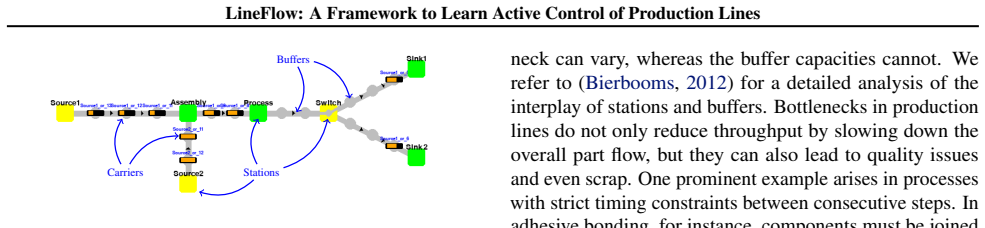
The central object is LineFlow itself: a discrete-event simulator in which stations (sources, processes, assemblies, sinks, switches, worker pools) are connected by finite-capacity FIFO buffers and every processing time has the form $T + \mathrm{Exp}_S$ (a minimum plus an exponential delay). The measuring instrument is the accumulated value $C^\pi(t) = T_C/t\,(c\, n^\pi_{\mathrm{ok}}(t) - \sum_i c_i n^\pi_{\mathrm{nok}}(t,i))$, which converts produced and scrapped parts into reward. The load-bearing machinery is the set of provable optima: the static waiting time $T^*_W = \mathbb{E}[T_A + 2T_g - T_{S_C}]$ for WT, the expected-parts formula $T_{\mathrm{sim}}/(T+S+E)$ behind WTJ's controlled jump factor $f$, the greedy lowest-fill/highest-fill switch policy that matches the optimal distribution $\rho_i$, and the max-min integer program for worker allocation. These optima act as certificates: a learned policy is judged by how close its reward comes to a value that does not depend on the RL implementation.
What would settle it
Take the WT scenario and replace the exponential delay with a lognormal or Gamma distribution having the same mean and variance, then recompute Equation (3) and the simulated optimal reward; if the gap between learned policies and the paper's "optimal waiting time" changes by more than the noise in Table 1, the exponential assumption is decision-relevant. Additionally, on the publicly available production-line dataset used in Appendix D, a tail-sensitive distribution test at each station (rather than pooled 100-part averages) would show whether the exponential fits are artifacts of smoothing.
Extended reading notes
Core claim
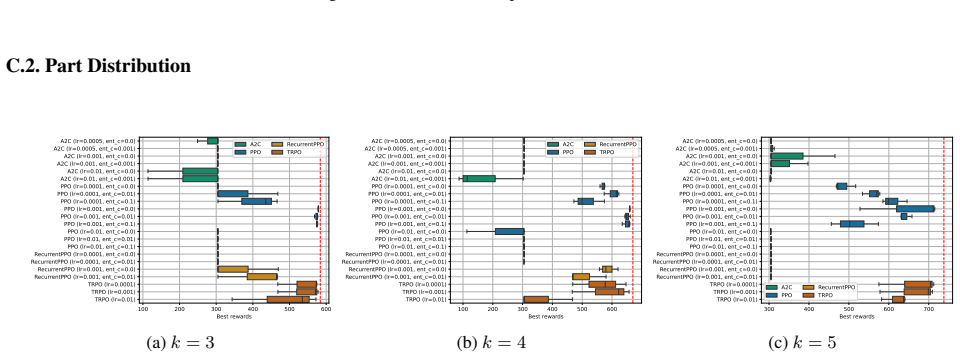
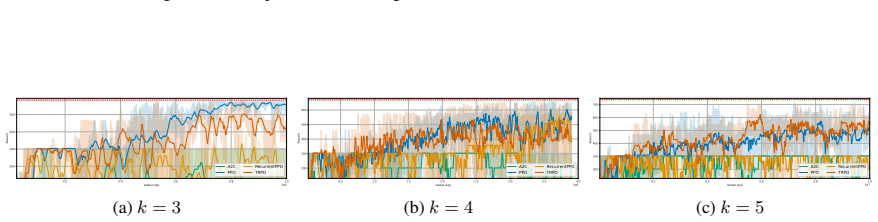
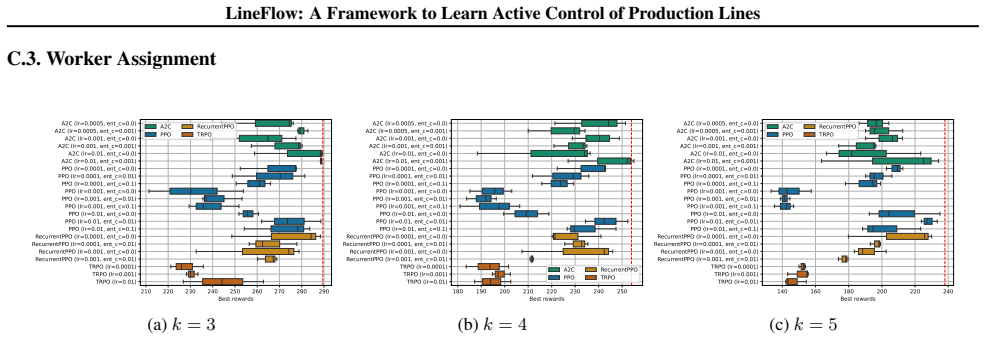
On its own terms, the paper claims that active production-line control can be decomposed into a small set of measurable subproblems, and that with the LineFlow simulator these subproblems become standard RL environments with known optimal answers. It reports that on the static waiting-time (WT), jumping waiting-time (WTJ), worker-assignment (WA k,3k), and part-distribution (PD k) scenarios, the best learned policies approach the computed optima—recurrent PPO comes closest on WTJ, policy-gradient methods succeed at PD, and A2C is competitive on WA—while on the complex line (CL) every from-scratch agent collapses into a deadlock and even curriculum-trained recurrent PPO achieves lower reward than the paper's heuristic.
Load-bearing premise
The whole benchmark assumes each station's process time is a minimum plus an exponentially distributed random delay; if real stations follow other distributions or have setup-dependent times, the claimed optima are no longer the right targets.
Editorial extensions
If this is right
- Standardized benchmarks: future RL work on active line control can say exactly how far from optimal a new algorithm is, because each LineFlow scenario ships with its own computable optimum, not just a heuristic baseline.
- Memory matters: within these experiments, recurrent policies are the only ones that track a jumping bottleneck or manage the complex line, so non-Markovian observations are a first-class requirement for production control.
- Curriculum is not optional on hard layouts: from-scratch agents in CL converge to a deadlock with zero reward, and annealing scrap penalties lets training escape that failure mode.
- The remaining gap is stated openly: in the complex line the best learned agents score below the hand-tuned heuristic, which locates the open problem at reward shaping, hierarchical control, and multi-timescale memory rather than raw sample efficiency.
Reading between the lines
- Editorial inference: if real stations deviate from the exponential-delay model (setup-dependent times, heavy tails, worker-dependent speeds), the closed-form optima in the paper are no longer the right yardsticks; a line operator should re-derive the waiting-time and distribution formulas for their own fitted distributions before trusting the benchmark numbers.
- Editorial inference: the appendix's real-data validation pools 100 consecutive parts into averaged processing times and assumes negligible traversal times and round-robin routing, which weakens the directness of the sim-to-real evidence; a stricter test would compare full inter-completion distributions, not cumulative produced parts alone.
- Editorial inference: a natural next experiment is to treat the heuristic that beats RL on CL as a teacher, using its decisions as demonstrations or as a shaping reward; that would test whether the remaining gap is a search problem or a representation problem.
- Editorial inference: since the complex line combines exactly the subproblems that RL solves separately, another test is whether hierarchical decomposition—separate policies for waiting time, routing, and worker allocation coordinated by a meta-controller—reaches or exceeds the heuristic; the paper leaves this route open.
Signed reviews
Editorial analysis
A structured set of objections, weighed in public.
Referee Report
Summary. LineFlow is an open-source Python discrete-event simulator for production lines, integrated with Gymnasium and Stable-Baselines3. The paper defines four analytically tractable control subproblems—optimal waiting time (WT), waiting time with jumps (WTJ), optimal part distribution (PD_k), and optimal worker assignment (WA_{k,N})—plus a combined complex line (CL). For each subproblem, the authors supply an "Optimal" column derived from modeling assumptions, and benchmark PPO, recurrent PPO, TRPO, and A2C against it. The experiments show that RL policies approach the computed optima on WT, PD, and WA, while only recurrent PPO approaches the WTJ comparator; on CL, RL agents converge to deadlock unless a curriculum is used, and a hand-designed heuristic outperforms them. An appendix reconstructs a Bosch production line from public data and reports a close match between simulated and real output.
Significance. The main value of this work is infrastructural: a standardized, extensible simulation environment for RL research on production-line control, with open-source code and clearly stated stochastic assumptions (T = T + ExpS). The worker-assignment optima are verified by exhaustive enumeration for k=3,4,5, and the PD optimum has a clean closed form; these are genuine strengths. However, the headline claim that learned policies "approach optimal performance in well-understood scenarios" is only as strong as the "Optimal" comparators, and the WTJ comparator is not an optimum. If the baseline issue is fixed by re-labeling or by a true upper bound, the benchmark would still be a useful contribution to the community.
major comments (3)
- [Section B.1, Table 1, Figure 13] The WTJ "Optimal" value 114.8±0.9 is not the outcome of an optimality proof. It is obtained by an agent that estimates E[T_A] from a rolling mean of the last l observed processing times, with l=1 selected by trying values and keeping the one with highest reward (Figure 13). This is an online heuristic tuned on the same benchmark, not an upper bound; a change-point detector or Bayesian online estimator could plausibly exceed 114.8±0.9. Because Table 1 labels this column "Optimal" and the abstract generalizes from it, the claim that RL approaches optimality in WTJ is unsupported. Please replace this baseline with a provable upper bound or relabel it (e.g., "rolling-mean baseline") and revise the abstract and Section 6 accordingly.
- [Section D, Figures 22-23] The real-data validation is weaker than presented: the exponential processing-time parameters are fitted to the Bosch dataset and the simulation is then compared against the very same dataset. This is a consistency check, not an independent validation of the exponential assumption or of the auxiliary assumptions (negligible traversal times, round-robin routing). The close parts-count match could reflect the fitted parameters rather than model validity. Please add a holdout evaluation (e.g., fit on the first portion of the production run and compare on the remainder), a sensitivity analysis, or an explicit caveat that this section is an illustration of reconstruction rather than evidence of sim-to-real transfer.
- [Section B.1, Eqs. (3)-(4)] The WT optimum is also stated rather than proved. The formula T*_W = E[T_A + 2T_g - T_SC] and the expected maximum parts in Eq. (4) are derived from a gap-filling argument under the assumption that A is the bottleneck, but no argument shows that no other (adaptive) policy can do better. The empirical reward curve in Figure 11 is supportive, but the section is titled "Optimality Proofs". Please supply the formal argument or soften the terminology to "analytic baseline".
minor comments (6)
- [Appendix A.2] The code example is missing a comma after the "Switch" dictionary entry; the `return` statement as printed would not parse.
- [Section 2.1] The symbol T is overloaded: it denotes both the processing-time random variable and the minimum processing time in "T = T + ExpS". Please introduce a distinct symbol such as T_min to improve readability of Eqs. (3)-(5).
- [Table 1] The parenthetical "maximal reward" values and the note that RL agents may outperform the expected optimal mean in individual episodes could confuse readers; recommend a separate column and a clearer definition of which statistic is reported and how it was computed over seeds and evaluation episodes.
- [Section 5.3] The sentence beginning "Our heuristics prioritized the buffer with the lowest fill level fills..." is grammatically incomplete and should be rewritten for clarity.
- [Section D] The description of the rolling, non-overlapping window of 100 consecutive parts should state explicitly how the histogram data in Figure 22 were aggregated and how the exponential parameters were estimated from the pooled averages.
- [Section 3.3] The claim that discrete-time interaction can approximate continuous-time control "with high fidelity" is not quantified; please report the Tstep values used in each benchmark (Tstep=1 appears in Table 7) and any evidence about discretization error.
Circularity Check
WTJ's 'Optimal' value is a tuned rolling-mean baseline rather than a proven optimum, so the 'approach optimal' claim for that scenario is partially self-referential; the other scenario optima are independently derived.
-
fitted input called prediction
[Section B.1 (Waiting Time, WTJ paragraph), reported in Table 1, WTJ row]
"To get an optimal policy for WTJ, we estimate E[TA + 2·Tg−TSC] from Equation (3) by regressing on E[TA] with the processing times reported from A. Essentially, we take a rolling mean of the last l processing times observations from A. ... By varying l and testing the agent for WTJ (see Figure 13), we found that l = 1 gives the best reward. This reward is used as optimal value in Section 5."
The WTJ 'Optimal' yardstick in Table 1 (114.8±0.9) is not a derived upper bound but the reward of a rolling-mean heuristic whose look-back l was selected by maximizing reward on the very WTJ benchmark it is then used to judge. Thus the claim that RL 'approaches optimal performance' in WTJ compares learned policies to a self-tuned baseline, not to an independent optimum. A different adaptive estimator could plausibly exceed this value, so the benchmark target is defined by the baseline's best tuned performance rather than by an analytic optimum.
full rationale
The core benchmark is largely non-circular. The WT optimum follows from the explicit balance condition T*_W = E[TA + 2·Tg − TSC] (Eq. 3) and the expected throughput expression (Eq. 4); the PD optimum follows from the throughput formula E[N] = sum_i Tsim/((1+Si)Ti) (Eq. 5); and the WA optimum follows from the min-max integer program (Eq. 7). These analytic optima are verified against enumerated simulations (e.g., Figure 15) and are independent of the RL agents' fitted parameters. The real-data validation in Section D fits exponential distributions to the Bosch dataset and then compares the same dataset's output to simulation; this is in-sample calibration rather than derivation, so it weakens external validity but is not circular in the load-bearing sense. There is no self-citation chain or imported uniqueness theorem. The only substantive circularity is the WTJ baseline: its 'optimal' value is selected by tuning l on the benchmark reward itself, making the WTJ 'approaches optimal' conclusion partially self-referential. Since WTJ is one of four headline scenarios, this raises the score to 4 rather than higher.
Assumptions & free parameters
free parameters (4)
- Performance coefficient c in worker assignment =
0.3
- WTJ online-estimator look-back l =
1
- WTJ reward-fraction R =
Only specified as 0.5<R<1.0
- Rolling pooling window for real-data processing times =
100 parts
assumptions (5)
- domain assumption Processing times at each station are distributed as T + ExpS, with a fixed minimum plus an exponential.
- domain assumption In PD, source and sink processing times are negligible and get/put times are already included in T_i.
- domain assumption In WT/WTJ, assembly A is the bottleneck, so total throughput is governed by A's cycle.
- ad hoc to paper Worker effect follows the exponential law pc(n)=exp(-c n) with c=0.3.
- ad hoc to paper For the Bosch-data layout, traversal times are negligible and switches route round-robin.
Cite this review
Pith. "Pith review of LineFlow: A Framework to Learn Active Control of Production Lines." pith.science (2026). https://pith.science/paper/27UDU4UO
@misc{pith2026250506744,
  author       = {Pith},
  title        = {Pith review of: LineFlow: A Framework to Learn Active Control of Production Lines},
  year         = {2026},
  howpublished = {\url{https://pith.science/paper/27UDU4UO}},
  note         = {Machine review of arXiv:2505.06744}
}
read the original abstract
Many production lines require active control mechanisms, such as adaptive routing, worker reallocation, and rescheduling, to maintain optimal performance. However, designing these control systems is challenging for various reasons, and while reinforcement learning (RL) has shown promise in addressing these challenges, a standardized and general framework is still lacking. In this work, we introduce LineFlow, an extensible, open-source Python framework for simulating production lines of arbitrary complexity and training RL agents to control them. To demonstrate the capabilities and to validate the underlying theoretical assumptions of LineFlow, we formulate core subproblems of active line control in ways that facilitate mathematical analysis. For each problem, we provide optimal solutions for comparison. We benchmark state-of-the-art RL algorithms and show that the learned policies approach optimal performance in well-understood scenarios. However, for more complex, industrial-scale production lines, RL still faces significant challenges, highlighting the need for further research in areas such as reward shaping, curriculum learning, and hierarchical control.
Figures


Figures from the paper (20 more)




Reference graph
Works this paper leans on
-
[1]
write newline
" write newline "" before.all 'output.state := FUNCTION n.dashify 't := "" t empty not t #1 #1 substring "-" = t #1 #2 substring "--" = not "--" * t #2 global.max substring 't := t #1 #1 substring "-" = "-" * t #2 global.max substring 't := while if t #1 #1 substring * t #2 global.max substring 't := if while FUNCTION format.date year duplicate empty "emp...
-
[2]
Ali, A. M. and Tirel, L. Action masked deep reinforcement learning for controlling industrial assembly lines. In 2023 IEEE World AI IoT Congress (AIIoT), pp.\ 0797--0803, 2023. doi:10.1109/AIIoT58121.2023.10174426
arXiv 2023
-
[3]
Beal, L., Hill, D., Martin, R., and Hedengren, J. Gekko optimization suite. Processes, 6 0 (8): 0 106, 2018. doi:10.3390/pr6080106
-
[4]
Performance analysis of production lines: Discrete and continuous flow models
Bierbooms, R. Performance analysis of production lines: Discrete and continuous flow models. PhD Thesis, Technische Universiteit Eindhoven, 2012
work page 2012
-
[5]
Modeling and control of dispensing processes for surface mount technology
Chen, X., Schoenau, G., and Zhang, W. Modeling and control of dispensing processes for surface mount technology. IEEE/ASME Transactions on Mechatronics, 10: 0 326--334, 2005. doi:10.1109/TMECH.2005.848295
-
[6]
Y., Malyutin, S., and Soukhal, A
Dolgui, A., Kovalev, S., Kovalyov, M. Y., Malyutin, S., and Soukhal, A. Optimal workforce assignment to operations of a paced assembly line. European Journal of Operational Research, 264 0 (1): 0 200--211, 2018. doi:10.1016/j.ejor.2017.06.017. URL https://www.sciencedirect.com/science/article/pii/S0377221717305350
-
[7]
Deep reinforcement learning for optimal planning of assembly line maintenance
Geurtsen, M., Adan, I., and Atan, Z. Deep reinforcement learning for optimal planning of assembly line maintenance. Journal of Manufacturing Systems, 69: 0 170--188, 2023. doi:https://doi.org/10.1016/j.jmsy.2023.05.011. URL https://www.sciencedirect.com/science/article/pii/S0278612523000845
-
[8]
Gonçalves, J. N., Cortez, P., Carvalho, M. S., and Frazão, N. M. A multivariate approach for multi-step demand forecasting in assembly industries: Empirical evidence from an automotive supply chain. Decision Support Systems, 142: 0 113452, 2021. doi:10.1016/j.dss.2020.113452. URL https://www.sciencedirect.com/science/article/pii/S0167923620302074
arXiv 2021
Show all 57 references
-
[9]
A reinforcement learning decision model for online process parameters optimization from offline data in injection molding
Guo, F., Zhou, X., Liu, J., Zhang, Y., Li, D., and Zhou, H. A reinforcement learning decision model for online process parameters optimization from offline data in injection molding. Applied Soft Computing, 85: 0 105828, 2019. doi:10.1016/j.asoc.2019.105828. URL https://www.sc...
2019
-
[10]
R., Millman, K
Harris, C. R., Millman, K. J., van der Walt, S. J., Gommers, R., Virtanen, P., Cournapeau, D., Wieser, E., Taylor, J., Berg, S., Smith, N. J., Kern, R., Picus, M., Hoyer, S., van Kerkwijk, M. H., Brett, M., Haldane, A., del R \' i o, J. F., Wiebe, M., Peterson, P., G \' e rard...
2020 doi
-
[11]
J., Lillicrap, T
Heess, N., Hunt, J. J., Lillicrap, T. P., and Silver, D. Memory-based control with recurrent neural networks, 2015. URL https://arxiv.org/abs/1512.04455
2015 arXiv
-
[12]
Y., and Jiang, J
Huang, B., Wang, W., Ren, S., Zhong, R. Y., and Jiang, J. A proactive task dispatching method based on future bottleneck prediction for the smart factory. International Journal of Computer Integrated Manufacturing, 32 0 (3): 0 278--293, 2019
2019
-
[13]
An intelligent weld control strategy based on reinforcement learning approach
Jin, Z., Li, H., and Gao, H. An intelligent weld control strategy based on reinforcement learning approach. The International Journal of Advanced Manufacturing Technology, 100 0 (9): 0 2163--2175, 2019. doi:10.1007/s00170-018-2864-2
2019 doi
-
[14]
M., Evans, R., Pritzel, A., Green, T., Figurnov, M., Ronneberger, O., Tunyasuvunakool, K., Bates, R., Ž \'i dek, A., Potapenko, A., Bridgland, A., Meyer, C., Kohl, S
Jumper, J. M., Evans, R., Pritzel, A., Green, T., Figurnov, M., Ronneberger, O., Tunyasuvunakool, K., Bates, R., Ž \'i dek, A., Potapenko, A., Bridgland, A., Meyer, C., Kohl, S. A. A., Ballard, A., Cowie, A., Romera-Paredes, B., Nikolov, S., Jain, R., Adler, J., Back, T., Pete...
2021
-
[15]
Machine learning applications in production lines: A systematic literature review
Kang, Z., Catal, C., and Tekinerdogan, B. Machine learning applications in production lines: A systematic literature review. Computers & Industrial Engineering, 149: 0 106773, 2020. doi:10.1016/j.cie.2020.106773. URL https://www.sciencedirect.com/science/article/pii/S036083522030485X
2020
-
[16]
Kim, G. H. and Lee, C. S. G. Genetic reinforcement learning approach to the heterogeneous machine scheduling problem. IEEE Transactions on Robotics and Automation, 14 0 (6): 0 879--893, 1998. doi:10.1109/70.736772
1998 doi
-
[17]
Designing an adaptive production control system using reinforcement learning
Kuhnle, A., Kaiser, J.-P., Theiss, F., Stricker, N., and Lanza, G. Designing an adaptive production control system using reinforcement learning. Journal of Intelligent Manufacturing, 32 0 (3): 0 855--876, 2021. doi:10.1007/s10845-020-01612-y
2021 doi
-
[18]
Data-driven dynamic bottleneck detection in complex manufacturing systems
Lai, X., Shui, H., Ding, D., and Ni, J. Data-driven dynamic bottleneck detection in complex manufacturing systems. Journal of Manufacturing Systems, 60: 0 662--675, 2021. doi:10.1016/j.jmsy.2021.07.016. URL https://www.sciencedirect.com/science/article/pii/S0278612521001539
2021 doi
-
[19]
Real time production improvement through bottleneck control
Li, L., Chang, Q., Ni, J., and Biller, S. Real time production improvement through bottleneck control. International Journal of production research, 47 0 (21): 0 6145--6158, 2009
2009
-
[20]
T., Tan, B
Liberopoulos, G., Papadopoulos, C. T., Tan, B. s., Smith, J. M., and Gershwin, S. B. (eds.). Stochastic Modeling of Manufacturing Systems : Advances in Design , Performance Evaluation , and Control Issues . Springer, 2006. ISBN 978-3-540-26579-5 978-3-540-29057-5. doi:10.1007/...
2006 doi
-
[21]
C., Schäfer, L., Matta, A., and Lanza, G
Loffredo, A., May, M. C., Schäfer, L., Matta, A., and Lanza, G. Reinforcement learning for energy-efficient control of parallel and identical machines. CIRP Journal of Manufacturing Science and Technology, 44: 0 91--103, 2023. doi:10.1016/j.cirpj.2023.05.007. URL https://www.s...
2023 doi
-
[22]
C., Matta, A., and Lanza, G
Loffredo, A., May, M. C., Matta, A., and Lanza, G. Reinforcement learning for sustainability enhancement of production lines. Journal of Intelligent Manufacturing, 35 0 (8): 0 3775--3791, dec 2024. doi:10.1007/s10845-023-02258-2
2024 doi
-
[23]
The impact of industry 4.0 on bottleneck analysis in production and manufacturing: Current trends and future perspectives
Mahmoodi, E., Fathi, M., and Ghobakhloo, M. The impact of industry 4.0 on bottleneck analysis in production and manufacturing: Current trends and future perspectives. Computers & Industrial Engineering, 174: 0 108801, 2022. doi:10.1016/j.cie.2022.108801. URL https://www.scienc...
2022
-
[24]
Masinelli, G., Le-Quang, T., Zanoli, S., Wasmer, K., and Shevchik, S. A. Adaptive laser welding control: A reinforcement learning approach. IEEE Access, 8: 0 103803--103814, 2020. doi:10.1109/ACCESS.2020.2998052
2020
-
[25]
P., Mirza, M., Graves, A., Lillicrap, T., Harley, T., Silver, D., and Kavukcuoglu, K
Mnih, V., Badia, A. P., Mirza, M., Graves, A., Lillicrap, T., Harley, T., Silver, D., and Kavukcuoglu, K. Asynchronous methods for deep reinforcement learning. In Balcan, M. F. and Weinberger, K. Q. (eds.), Proceedings of The 33rd International Conference on Machine Learning, ...
1928
-
[26]
Introduction to TPM: Total Productive Maintenance
Nakajima, S. Introduction to TPM: Total Productive Maintenance. Preventative Maintenance Series. Productivity Press, 1988. ISBN 9780915299232. URL https://books.google.de/books?id=XKc28H3JeUUC
1988
-
[27]
E., and Stone, P
Narvekar, S., Peng, B., Leonetti, M., Sinapov, J., Taylor, M. E., and Stone, P. Curriculum learning for reinforcement learning domains: A framework and survey. Journal of Machine Learning Research, 21 0 (181): 0 1--50, 2020. URL http://jmlr.org/papers/v21/20-212.html
2020
-
[28]
A review on reinforcement learning: Introduction and applications in industrial process control
Nian, R., Liu, J., and Huang, B. A review on reinforcement learning: Introduction and applications in industrial process control. Computers & Chemical Engineering, 139: 0 106886, 2020. doi:10.1016/j.compchemeng.2020.106886. URL https://www.sciencedirect.com/science/article/pii...
2020
-
[29]
C., Kuhnle, A., and Lanza, G
Overbeck, L., Hugues, A., May, M. C., Kuhnle, A., and Lanza, G. Reinforcement learning based production control of semi-automated manufacturing systems. Procedia CIRP, 103: 0 170--175, 2021. doi:10.1016/j.procir.2021.10.027. URL https://www.sciencedirect.com/science/article/pi...
2021 doi
-
[30]
Irizarry, M., Resto, P., and Mej \' a, H
Padr \'o n, M., de los A. Irizarry, M., Resto, P., and Mej \' a, H. P. A methodology for cost-oriented assembly line balancing problems. Journal of Manufacturing Technology Management, 20 0 (8): 0 1147--1165, 2009
2009
-
[31]
Generalization, mayhems and limits in recurrent proximal policy optimization, 2022
Pleines, M., Pallasch, M., Zimmer, F., and Preuss, M. Generalization, mayhems and limits in recurrent proximal policy optimization, 2022. URL https://arxiv.org/abs/2205.11104
2022 arXiv
-
[32]
Memory gym: Partially observable challenges to memory-based agents
Pleines, M., Pallasch, M., Zimmer, F., and Preuss, M. Memory gym: Partially observable challenges to memory-based agents. In International Conference on Learning Representations, 2023. URL https://openreview.net/forum?id=jHc8dCx6DDr
2023
-
[33]
M., Ou, W., Yenradee, P., and Huynh, V.-N
Pérez-Wheelock, R. M., Ou, W., Yenradee, P., and Huynh, V.-N. A demand-driven model for reallocating workers in assembly lines. IEEE Access, 10: 0 80300--80320, 2022. doi:10.1109/ACCESS.2022.3194658
2022
-
[34]
Stable-baselines3: Reliable reinforcement learning implementations
Raffin, A., Hill, A., Gleave, A., Kanervisto, A., Ernestus, M., and Dormann, N. Stable-baselines3: Reliable reinforcement learning implementations. Journal of Machine Learning Research, 22 0 (268): 0 1--8, 2021. URL http://jmlr.org/papers/v22/20-1364.html
2021
-
[35]
Bosch production line performance
Risdal, M., Prasanth, RumiGhosh, soundar, W., S., and Cukierski, W. Bosch production line performance. https://kaggle.com/competitions/bosch-production-line-performance, 2016. Kaggle
2016
-
[36]
Shifting bottleneck detection
Roser, C., Nakano, M., and Tanaka, M. Shifting bottleneck detection. In Proceedings of the Winter Simulation Conference. IEEE, 2003
2003
-
[37]
Reliable shop floor bottleneck detection for flow lines through process and inventory observations
Roser, C., Lorentzen, K., and Deuse, J. Reliable shop floor bottleneck detection for flow lines through process and inventory observations. Procedia CIRP, 19: 0 63--68, 2014. doi:10.1016/j.procir.2014.05.020. URL https://www.sciencedirect.com/science/article/pii/S2212827114006...
2014 doi
-
[38]
Bottleneck prediction using the active period method in combination with buffer inventories
Roser, C., Lorentzen, K., Lenze, D., Deuse, J., Klenner, F., Richter, R., Schmitt, J., and Willats, P. Bottleneck prediction using the active period method in combination with buffer inventories. In L \"o dding, H., Riedel, R., Thoben, K.-D., von Cieminski, G., and Kiritsis, D...
2017
-
[39]
and Becker, C
Scholl, A. and Becker, C. State-of-the-art exact and heuristic solution procedures for simple assembly line balancing. European Journal of Operational Research, 168 0 (3): 0 666--693, 2006
2006
-
[40]
Trust region policy optimization
Schulman, J., Levine, S., Abbeel, P., Jordan, M., and Moritz, P. Trust region policy optimization. In Bach, F. and Blei, D. (eds.), Proceedings of the 32nd International Conference on Machine Learning, volume 37 of Proceedings of Machine Learning Research, pp.\ 1889--1897, Lil...
2015
-
[41]
Proximal policy optimization algorithms
Schulman, J., Wolski, F., Dhariwal, P., Radford, A., and Klimov, O. Proximal policy optimization algorithms. arXiv preprint arXiv:1707.06347, 2017
2017 arXiv
-
[42]
skrl: Modular and flexible library for reinforcement learning
Serrano-Muñoz, A., Chrysostomou, D., Bøgh, S., and Arana-Arexolaleiba, N. skrl: Modular and flexible library for reinforcement learning. Journal of Machine Learning Research, 24 0 (254): 0 1--9, 2023. URL http://jmlr.org/papers/v24/23-0112.html
2023
-
[43]
Intelligent scheduling of discrete automated production line via deep reinforcement learning
Shi, D., Fan, W., Xiao, Y., Lin, T., and Xing, C. Intelligent scheduling of discrete automated production line via deep reinforcement learning. International Journal of Production Research, 58 0 (11): 0 3362--3380, 2020. doi:10.1080/00207543.2020.1717008
2020
-
[44]
Real-time scheduling for a smart factory using a reinforcement learning approach
Shiue, Y.-R., Lee, K.-C., and Su, C.-T. Real-time scheduling for a smart factory using a reinforcement learning approach. Computers & Industrial Engineering, 125: 0 604--614, 2018. doi:10.1016/j.cie.2018.03.039. URL https://www.sciencedirect.com/science/article/pii/S036083521830130X
2018 doi
-
[45]
J., Guez, A., Sifre, L., Van Den Driessche, G., Schrittwieser, J., Antonoglou, I., Panneershelvam, V., Lanctot, M., et al
Silver, D., Huang, A., Maddison, C. J., Guez, A., Sifre, L., Van Den Driessche, G., Schrittwieser, J., Antonoglou, I., Panneershelvam, V., Lanctot, M., et al. Mastering the game of go with deep neural networks and tree search. Nature, 529 0 (7587): 0 484--489, 2016
2016
-
[46]
Simpy 4.1 webpage, 2025
SimPy, T. Simpy 4.1 webpage, 2025. URL https://simpy.readthedocs.io/en/latest/
2025
-
[47]
A., Th \"u rer, M., and Chang, Q
Subramaniyan, M., Skoogh, A., Bokrantz, J., Sheikh, M. A., Th \"u rer, M., and Chang, Q. Artificial intelligence for throughput bottleneck analysis--state-of-the-art and future directions. Journal of Manufacturing Systems, 60: 0 734--751, 2021
2021
-
[48]
Sutton, R. S. and Barto, A. Reinforcement Learning: An Introduction. Adaptive Computation and Machine Learning. The MIT Press, second edition edition, 2020. ISBN 978-0-262-03924-6
2020
-
[49]
and Chauhan, S
Szarski, M. and Chauhan, S. Instant flow distribution network optimization in liquid composite molding using deep reinforcement learning. Journal of Intelligent Manufacturing, 34 0 (1): 0 197--218, 2023. doi:10.1007/s10845-022-01990-5
2023 doi
-
[50]
A parallel deep reinforcement learning framework for controlling industrial assembly lines
Tortorelli, A., Imran, M., Delli Priscoli, F., and Liberati, F. A parallel deep reinforcement learning framework for controlling industrial assembly lines. Electronics, 11 0 (4), 2022. doi:10.3390/electronics11040539. URL https://www.mdpi.com/2079-9292/11/4/539
2022 doi
-
[51]
U., Cola, G
Towers, M., Kwiatkowski, A., Terry, J., Balis, J. U., Cola, G. D., Deleu, T., Goulão, M., Kallinteris, A., Krimmel, M., KG, A., Perez-Vicente, R., Pierré, A., Schulhoff, S., Tai, J. J., Tan, H., and Younis, O. G. Gymnasium: A standard interface for reinforcement learning envir...
2024 arXiv
-
[52]
Viharos, Z. J. and Jakab, R. Reinforcement learning for statistical process control in manufacturing. Measurement, 182, 2021. doi:10.1016/j.measurement.2021.109616. URL https://www.sciencedirect.com/science/article/pii/S0263224121005881
2021
-
[53]
M., Mathieu, M., Dudzik, A., Chung, J., Choi, D
Vinyals, O., Babuschkin, I., Czarnecki, W. M., Mathieu, M., Dudzik, A., Chung, J., Choi, D. H., Powell, R., Ewalds, T., Georgiev, P., Oh, J., Horgan, D., Kroiss, M., Danihelka, I., Huang, A., Sifre, L., Cai, T., Agapiou, J. P., Jaderberg, M., Vezhnevets, A. S., Leblond, R., Po...
2019
-
[54]
Multi-agent reinforcement learning based maintenance policy for a resource constrained flow line system
Wang, X., Wang, H., and Qi, C. Multi-agent reinforcement learning based maintenance policy for a resource constrained flow line system. Journal of Intelligent Manufacturing, 27 0 (2): 0 325--333, 2016. doi:10.1007/s10845-013-0864-5
2016 doi
-
[55]
D ata S tructures for S tatistical C omputing in P ython
W es M c K inney. D ata S tructures for S tatistical C omputing in P ython. In S t\'efan van der W alt and J arrod M illman (eds.), P roceedings of the 9th P ython in S cience C onference , pp.\ 56 -- 61, 2010. doi:10.25080/Majora-92bf1922-00a
2010 doi
-
[56]
Daydreamer: World models for physical robot learning
Wu, P., Escontrela, A., Hafner, D., Abbeel, P., and Goldberg, K. Daydreamer: World models for physical robot learning. In Liu, K., Kulic, D., and Ichnowski, J. (eds.), Proceedings of The 6th Conference on Robot Learning, volume 205 of Proceedings of Machine Learning Research, ...
2023
-
[57]
and Lan, R
Zou, Y. and Lan, R. An end-to-end calibration method for welding robot laser vision systems with deep reinforcement learning. IEEE Transactions on Instrumentation and Measurement, 69 0 (7): 0 4270--4280, 2020. doi:10.1109/TIM.2019.2942533
2020
Reviewed August 15, 2026 · model on record in the stance chip above.
Discussion (0). Continue with ORCID to comment.